医疗保健

Search documents
特朗普在豪赌美国国运!我们该如何应对?
格隆汇APP· 2025-04-06 09:43
Core Viewpoint - The article discusses the implications of Trump's recent "reciprocal tariff" executive order, which imposes a 10% minimum tariff on global trade partners and a 34% tariff specifically on China, highlighting the potential economic risks and market reactions associated with this policy [1][2][3]. Group 1: Objectives of the Tariff Policy - The primary goal of the tariff policy is to alleviate the U.S. debt burden by increasing revenue through higher tariffs [5]. - Another objective is to stimulate the return of manufacturing jobs to the U.S. by making domestic production more financially attractive [6]. - The policy aims to reshape the geopolitical landscape and re-establish U.S. dominance in international trade [7]. Group 2: Market Reactions - Following the announcement, U.S. stock markets experienced significant declines, with the Dow Jones dropping 2.72%, S&P 500 down 3.16%, and Nasdaq falling 4.24% within two days [12]. - Global markets also reacted negatively, with Japan's Nikkei 225 index down 2.6% and Vietnam's stock market plummeting 7% [13]. - The volatility in the markets reflects concerns over the uncertainty of the tariff policy and its long-term implications [14]. Group 3: Investment Strategies - In the U.S. market, a cautious approach is recommended, avoiding high-valuation tech stocks and focusing on defensive sectors such as utilities and healthcare [24]. - For Hong Kong stocks, it is advised to reduce exposure to export-oriented companies and increase holdings in domestic consumption and financial sectors [34]. - In the A-share market, investors are encouraged to consider undervalued blue-chip stocks and sectors benefiting from domestic demand and technological advancements [34]. Group 4: China's Response and Market Risks - China is likely to implement reciprocal tariffs on U.S. goods, particularly in agriculture and energy, while also diversifying its export markets [37]. - Long-term strategies may include tax reductions and infrastructure investments to boost domestic demand, alongside enhancing regional trade cooperation [38]. - Potential risks include increased import costs leading to domestic inflation and the impact of reduced U.S. demand on export-oriented companies [38].


2025边缘AI报告:实时自主智能,从范式创新到AI硬件的技术基础
3 6 Ke· 2025-03-28 11:29
Core Insights - The Edge AI Foundation has rebranded from the TinyML Foundation and released the "2025 Edge AI Technology Report," highlighting the maturity and real-world applications of TinyML [1][3]. Group 1: Edge AI Technology Drivers - The report discusses advancements in hardware and software that support Edge AI deployment, focusing on innovations in dedicated processors and ultra-low power devices [3]. - Edge AI is transforming operational models across various industries by enabling real-time analysis and decision-making capabilities [3]. Group 2: Industry Applications of Edge AI - In the automotive sector, Edge AI enhances safety and response times, with examples like Waymo and NIO utilizing real-time data processing for improved performance [7][8]. - Manufacturing benefits from Edge AI through predictive maintenance, quality control, and process optimization, with reported reductions in maintenance costs by 30% and downtime by 45% [9][12]. - In healthcare, localized AI accelerates diagnostics and improves patient outcomes by analyzing medical data directly on devices [14]. - Retail operations are optimized through real-time behavior analysis and AI-driven systems, reducing checkout times by 30% [16]. - Logistics is enhanced by integrating Edge AI with IoT sensors, allowing for immediate analysis of data and optimization of supply chain operations [18]. - Smart agriculture utilizes Edge AI for precision farming, reducing water usage by 25% and pesticide use by 30% [21]. Group 3: Edge AI Ecosystem and Collaboration - The Edge AI ecosystem relies on collaboration among hardware vendors, software developers, cloud providers, and industry stakeholders to avoid fragmentation [24]. - A three-layer architecture is recognized for Edge AI, distributing workloads across edge devices, edge servers, and cloud platforms [24][25]. - Cross-industry partnerships are increasing, with companies like Intel and Qualcomm collaborating to enhance Edge AI deployment [26][27]. Group 4: Emerging Trends in Edge AI - Five emerging trends are reshaping Edge AI, including federated learning, quantum neural networks, and neuromorphic computing [30]. - Federated learning is expected to enhance model adaptability and collaboration across industries, with a projected market value of nearly $300 million by 2030 [31]. - Quantum computing is set to redefine Edge AI capabilities, enabling faster decision-making and real-time processing [34][36]. - AI-driven AR/VR applications are evolving with Edge AI, allowing for real-time responses and improved energy efficiency [39]. - Neuromorphic computing is gaining traction for its energy efficiency and ability to handle complex tasks without cloud connectivity [41].
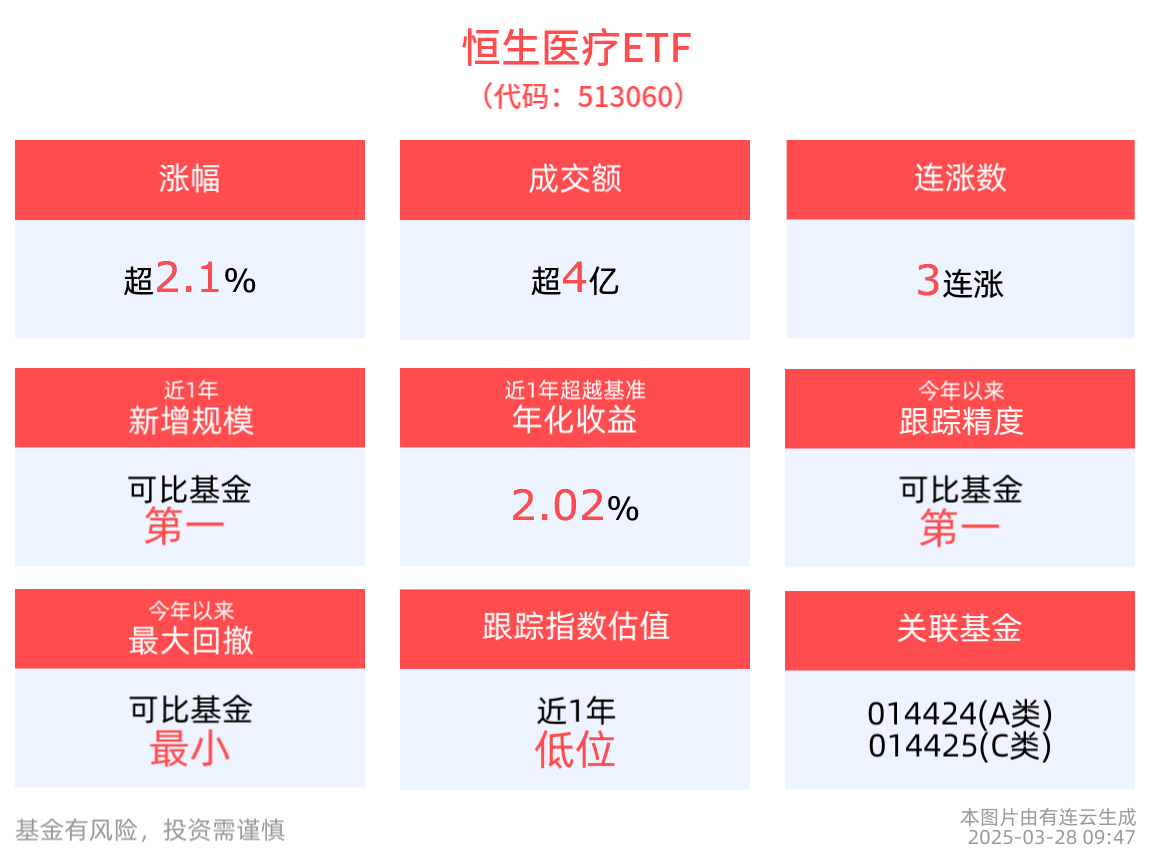
生物医药板块强势上涨,恒生医疗ETF(513060)上涨2.11%,乐普生物-B涨超16%
Sou Hu Cai Jing· 2025-03-28 02:22
Group 1 - The Hang Seng Healthcare Index (HSHCI) has seen a strong increase of 1.80%, with notable gains from companies such as Lepu Biopharma-B (up 16.56%) and Zai Lab (up 10.27%) [1] - The Hang Seng Medical ETF (513060) has risen by 2.11%, marking its third consecutive increase, with a trading volume of 4.69 billion yuan [1][2] - The second Boao Lecheng Stem Cell Conference has opened, marking a new phase of standardized and high-quality development in China's stem cell industry [2] Group 2 - Financial analysts predict that the approval and implementation of more projects in the stem cell sector will lead to advanced treatment methods benefiting the public [2] - The domestic medical innovation industry is expected to experience multiple growth opportunities, particularly for companies with true innovation capabilities in new drug development [2] - The Hang Seng Medical ETF has seen a significant growth in scale, increasing by 34.09 billion yuan over the past year, ranking in the top third among comparable funds [2] Group 3 - Since its inception, the Hang Seng Medical ETF has achieved a maximum monthly return of 28.34% and an average monthly return of 7.00% [3] - The ETF has outperformed its benchmark with an annualized excess return of 2.02% over the past year [3] - The ETF's management fee is 0.50%, and the custody fee is 0.15% [3] Group 4 - The tracking error of the Hang Seng Medical ETF is 0.033%, the highest tracking precision among comparable funds [4] - The latest price-to-earnings ratio (PE-TTM) of the Hang Seng Medical Healthcare Index is 24.97, indicating it is at a historical low compared to the past year [4] - The top ten weighted stocks in the Hang Seng Medical Healthcare Index account for 55.64% of the index, with companies like WuXi Biologics and BeiGene among the leaders [4][6]



全球宏观:PI数据均显示通胀短期内降温
Orient Securities Hongkong· 2025-03-20 12:24
Investment Rating - The report does not explicitly provide an investment rating for the industry or specific companies [1]. Core Insights - The report highlights a general cooling of inflation in the U.S., with February CPI rising 2.8%, lower than the expected 2.9% and previous 3% [6][20]. - The report indicates that the Chinese government has launched a "Consumption Promotion Special Action Plan" to boost domestic demand, reflecting a consensus among decision-makers to enhance consumption [26][23]. - The report notes that the A-share market has shown strong performance, leading among global indices, with policies aimed at stimulating domestic consumption expected to benefit the consumer sector [21][23]. Summary by Sections U.S. Economic Data - February CPI data shows a year-on-year increase of 2.8%, with core CPI rising 3.1%, both lower than expectations [6][20]. - February PPI data indicates a year-on-year increase of 3.2%, also below expectations, suggesting a short-term easing of inflation [5][6]. Japanese Economic Data - Japan's Q4 GDP was revised down to a seasonally adjusted annualized growth of 2.2%, lower than the expected 2.8%, with personal consumption remaining flat [10]. Chinese Financial Data - As of the end of February, M2 money supply was 320.52 trillion yuan, growing 7% year-on-year, while social financing stock was 417.29 trillion yuan, up 8.2% year-on-year [15][16]. - The report indicates a significant increase in government bond issuance to address local debt, with nearly 800 billion yuan in replacement bonds issued [15]. Stock Market Insights - The report notes that the Indian market is underperforming compared to global indices, with a projected GDP growth of only 6.5% for 2025 [21]. - The consumer sector in China is expected to benefit from policy support aimed at boosting domestic consumption, with notable gains in the beauty and food & beverage sectors [21][26]. Bond Market Overview - The U.S. bond market experienced fluctuations due to concerns over tariffs and inflation data, with the 10-year Treasury yield rising to 4.32% [33][36]. - The Chinese bond market remains cautious, with the 10-year government bond yield increasing to 1.89% amid a stable funding environment [34][36].
策略动态跟踪:中国科技资产观察:A股、港股、美股上市资产对比
Ping An Securities· 2025-03-16 14:28
Group 1: Asset Structure - The asset structure of Chinese technology assets shows that A-shares are more focused on manufacturing, while Hong Kong and US stocks lean towards internet software services and new energy vehicle sectors [9][10][11] - In A-shares, technology assets account for nearly 50% of the market, with hardware and electrical equipment dominating [9] - In Hong Kong, technology assets represent 61% of the market, with a balanced distribution between technology services and manufacturing [10] - In the US, technology assets account for approximately 92% of the market, predominantly in software services and internet companies [11] Group 2: Performance Comparison - Since 2024, the revenue and profit growth rates of technology assets in Hong Kong and the US have surpassed those in A-shares, with ROE_TTM also beginning to exceed A-shares [21][22] - As of Q3 2024, the revenue growth rates for A-shares, Hong Kong, and US-listed Chinese technology assets were 3.5%, 7.5%, and 14.1% respectively, while net profit growth rates were -11.3%, 31.2%, and 76.1% [23] - The profitability of technology assets in Hong Kong and the US is significantly higher, particularly in the software services and media sectors, compared to A-shares [32][33] Group 3: Valuation Comparison - The valuation of A-shares is generally lower than that of Hong Kong and US stocks, with A-share technology indices trading at historical averages [6][21] - As of March 11, 2025, the PE ratios for A-shares' ChiNext 50 and Sci-Tech Innovation 50 indices were 32x and 41x, while Hong Kong's Hang Seng Tech index was at 25x [21] - The PS ratios for A-shares' Sci-Tech 50 and Sci-Tech 100 indices were 5x and 6.8x, indicating a potential for upward valuation adjustments [21] Group 4: Investment Outlook - The report suggests that the revaluation of Chinese technology assets is expected to continue, with each market having its unique advantages [5][21] - The ongoing support for technological innovation from government policies, particularly in AI and robotics, is anticipated to drive further interest in these assets [5][21]
全球资产配置资金流向月报(2025年2月):恒生科技涨幅靠前,但资金仍未系统性增配-2025-03-14
Shenwan Hongyuan Securities· 2025-03-14 13:45
Investment Rating - The report indicates a positive sentiment towards the Chinese technology sector, with a notable increase in the Hang Seng Tech Index by 11% in February 2025, outperforming other indices [4][5]. Core Insights - The report highlights a shift in investor sentiment towards Chinese technology assets, driven by Alibaba's better-than-expected Q4 earnings and significant AI investments, leading to an optimistic outlook [4][5]. - Despite the positive performance of the Hang Seng Tech Index, there has been a systemic outflow of funds from the Chinese market, particularly from passive ETFs, which saw a withdrawal of $170.9 billion in February compared to an inflow of $41.4 billion in January [13][21]. - Global fund flows indicate that developed markets, particularly the US, have attracted more capital compared to emerging markets, with a significant outflow from Chinese equities totaling $174.1 billion in February [10][13]. Summary by Sections Global Fund Flows - In February 2025, global equity funds experienced a significant outflow from China, with a total of $174.1 billion, contrasting with an inflow of $34.4 billion in January [13][21]. - The report notes that the US equity and fixed income markets received substantial inflows, while emerging markets, including China, faced outflows [10][29]. Sector Performance - The technology sector in China saw a notable outflow of funds, while financials, healthcare, and consumer staples experienced inflows, indicating a shift in investor preferences [21][26]. - The report emphasizes that the Hang Seng Tech Index's performance was significantly better than other indices, reflecting a temporary recovery in investor sentiment towards technology stocks [4][5]. Market Dynamics - The report discusses the impact of external factors such as the ongoing geopolitical tensions affecting energy prices and the US Federal Reserve's interest rate decisions, which have influenced market dynamics [4][5]. - It also highlights that while the US market remains attractive, the allocation to Chinese equities has decreased, with the proportion of global funds allocated to China dropping to 0.9% [29][30].
大模型私有化部署浪潮下的AB面:警惕“信息孤岛”顽疾在AI时代复现|人工智能瞭望台
证券时报· 2025-03-14 00:04
Core Viewpoint - The article discusses the rapid adoption of the open-source large model DeepSeek across various sectors, highlighting the preference for private and localized deployment due to data security, customization, and stability concerns. However, it also raises concerns about the fragmentation of the market and inefficiencies arising from this deployment strategy [1][6]. Group 1: Private Deployment Advantages - Private deployment of DeepSeek is favored for ensuring data security and privacy, particularly in sensitive sectors like finance and healthcare [4][5]. - Organizations prefer private deployment for its controllability, reducing reliance on external vendors and enhancing system reliability [4][5]. - Customization is a significant advantage, allowing organizations to tailor the model to their specific operational needs [4][5]. Group 2: Private Deployment Disadvantages - The trend towards private deployment may lead to market fragmentation, hindering the establishment of standardized applications and creating inefficiencies [6][8]. - The lack of a robust SaaS ecosystem in China contributes to the challenges faced by companies adopting a "private + project" model, limiting the growth of industry giants [7][10]. - The focus on private deployment can perpetuate "information silos," particularly in government sectors, affecting overall service efficiency [8][9]. Group 3: Solutions to Fragmentation - To address fragmentation, experts suggest promoting data interoperability and encouraging the development of public and industry cloud solutions [12][13]. - Government and industry associations should collaborate to establish standards that facilitate data sharing while ensuring security [13]. - A "public cloud first" strategy is recommended to support the adoption of cloud-based AI products and services, alongside incentives for businesses to utilize public cloud solutions [13][14].

太古股份公司A(00019) - 2024 H2 - 业绩电话会
2025-03-13 16:35
Financial Data and Key Metrics Changes - The recurring underlying profit decreased by 11% to HKD 9.3 billion compared to the prior year, but excluding the impact of the U.S. bottler sale in 2023, there was a small gain in recurring underlying profit in 2024 [5][10] - The company increased its dividend by 5%, reflecting confidence in its financial position despite the profit decline [6][11] - Net debt stands at HKD 70 billion with a healthy gearing ratio of 22.1%, and a weighted average cost of debt remains at 4% [14] Business Line Data and Key Metrics Changes - Property segment faced lower office rental income in Hong Kong, with a 42% drop in underlying profit primarily due to fewer disposals compared to the previous year [7][19] - Beverages segment saw an overall profit decrease, driven by the disposal of the U.S. bottling business, but recurring profit from the Chinese Mainland increased by 11% due to price increases [8][29] - Aviation division reported strong results, with Cathay Pacific achieving a profit of HKD 9.9 billion in 2024, reflecting robust demand for passenger travel and cargo [9][34] Market Data and Key Metrics Changes - Retail sales in both the Chinese Mainland and Hong Kong began to normalize towards the end of 2024 [7] - The Chinese Mainland is becoming a significant growth engine for the company, with retail contributions nearly equal to those from the Hong Kong office portfolio [24] Company Strategy and Development Direction - The company continues to invest confidently in various sectors, including a commitment of HKD 100 billion over the next seven years for aviation and HKD 100 billion for property investments [3][4] - The focus remains on expanding in the Greater Bay Area and Southeast Asia, with significant investments in residential projects and beverage franchises [4][18][26] Management's Comments on Operating Environment and Future Outlook - Management characterized the operating environment as challenging but expressed confidence in future growth due to ongoing investments [3] - The outlook for 2025 includes expectations of continued revenue growth in the Chinese Mainland and normalization of yields in aviation, while challenges in the Hong Kong office market are anticipated to persist [41][42] Other Important Information - The company is committed to sustainability, with Swire Properties recognized as a leader in the Dow Jones Best in Class World Index for real estate management [15][19] - The beverage segment is focusing on price increases and market execution to maintain revenue growth in a deflationary environment [50] Q&A Session Summary Question: Thoughts on renewing the buyback program and pressure from credit rating metrics - Management indicated that the share buyback program is relatively small and part of a broader shareholder return strategy, with a decision to be made in May [44][48] Question: Outlook on EBITDA trend in the Chinese Mainland - Management expects steady EBITDA growth in the Chinese Mainland, driven by revenue management and operational efficiency [52][54] Question: Comfortable gearing level for Swire Pacific - Management stated a comfortable gearing level of 30%, with both Swire Properties and Swire Pacific well under that level [58][60] Question: Opportunities for capital recycling - Management confirmed ongoing capital recycling as part of their portfolio strategy, with a focus on timing and market conditions [66][67]

同类排名倒数第一!金鹰多元策略混合遭吐槽:3年亏超60%怎么做到的?
YOUNG财经 漾财经· 2025-03-12 11:24
资料图。 本文来源:新浪基金 同类排名倒数第一!金鹰多元策略混合遭吐槽:3年 亏超60%怎么做到的? 近期,金鹰多元策略混合被基民吐槽,"这基跟科技基比起来收益偏弱了""这个基金好像没有人 管理了""3年亏70%,这业绩怎么做到的?"。查了一下该基金的业绩,近3年收益率在同类基金 中排名倒数第一。 查阅公开资料显示,金鹰多元策略混合A成立于2016年08月09日,累计单位净值0.7482元,比 较基准:沪深300指数收益率*50%+中证全债指数收益率*50%。基金经理:欧阳娟。近三年业 绩比较基准增长率-64.64%,跑输业绩比较基准。 数据来源:WIND 截止日期:2025-03-10 来源:新浪基金数据库 截止日期:2025年3月10日 数据来源:WIND 截止日期:2025-03-10 数据来源:基金定期报告 最高换手率超10倍!前后历任6任基金经理 金鹰多元策略混合成立8年零7个月,历任6位基金经理,2022年3月14日之前,历任基金经理分 别为黄艳芳、于利强、李海、樊勇,此前任职基金经理业绩回报均为正收益。自2022年3月14日 至2023年12月14日,任期1.75年,回报-52.64%,期间换手 ...

中金:港股还能买吗?
中金点睛· 2025-03-09 23:37
Core Viewpoint - The Hong Kong stock market has rebounded strongly, driven by positive sentiment from government reports and technological advancements, particularly in AI, leading to significant gains in major indices and sectors [1][2][4]. Valuation Analysis - The Hang Seng Index's dynamic PE has recovered from 9.1x to around 10.8x, which is near the historical average, while the Hang Seng Tech Index's dynamic PE has risen from 15.6x to 19.3x, still below historical averages [5][6]. - Compared to global markets, Hong Kong's dynamic PE remains low, with a dividend yield of approximately 3.2%, significantly higher than the 10-year Chinese bond yield of about 1.8% [6][10]. - New economy sectors have seen a PE recovery to 16.7x, while traditional sectors have reached 6.1x, both below their averages since 2015 [10][12]. - The valuation of Hong Kong stocks is lower than that of comparable US stocks, with the dynamic PE of China's "Tech Giants" averaging 21.9x, compared to the US "Tech Seven" at 28.4x [12][30]. Drivers of Valuation Rebound - The valuation rebound is primarily driven by a shift in market sentiment, with the Hang Seng Index and Hang Seng Tech Index experiencing valuation expansions of 18.0% and 24.1%, respectively, largely due to a decrease in risk premium [14][17]. - The risk premium for the Hang Seng Index has decreased to 5.7%, approaching the high point of 5.4% seen in early 2021, indicating improved investor sentiment [15][16]. - The influx of southbound capital has significantly influenced Hong Kong's pricing, with a cumulative purchase of 313.9 billion HKD since the beginning of the year, five times that of the same period last year [17][18]. Future Valuation Expansion Potential - Traditional sectors have a relative valuation expansion potential of about 5% compared to A-shares, while technology sector valuations are closely aligned with return on equity (ROE) expectations [21][23]. - The current valuation of technology stocks appears reasonable, but further expansion will depend on improved profitability, as the dynamic PE of Chinese tech leaders is significantly lower than that of their US counterparts [27][30]. - If the ROE for Chinese tech leaders can exceed 30%, there is potential for valuation to double, but this is contingent on upward revisions of profit expectations [30][31]. Investment Strategy - The current market rebound is based on optimistic sentiment regarding technological trends, and the extent of this sentiment will determine future market potential [31][32]. - The company suggests focusing on sectors with strong fundamentals and structural trends, particularly technology, while also considering dividend-paying stocks for balance [32][33].