
橡胶

Search documents
能源化工期权策略早报:能源化工期权-20251111
Wu Kuang Qi Huo· 2025-11-11 02:03
1. Report Industry Investment Rating - No information provided in the content 2. Core Viewpoints of the Report - The energy - chemical sector is divided into energy, alcohols, polyolefins, rubber, polyesters, alkalis, and others. Strategies are recommended for selected options in each sector [8]. - A seller - based options portfolio strategy and spot hedging or covered strategies are constructed to enhance returns [2]. 3. Summary by Relevant Catalogs 3.1 Market Overview of Underlying Futures - Information on the latest price, price change, percentage change, trading volume, volume change, open interest, and open interest change of various energy - chemical option underlying futures is presented, including crude oil, LPG, methanol, etc [3]. 3.2 Option Factors - Volume and Open Interest PCR - The volume PCR and open interest PCR of various energy - chemical options are provided, which can be used to analyze the strength of the underlying option market and the turning point of the market [4]. 3.3 Option Factors - Pressure and Support Levels - The pressure points, pressure point offsets, support points, support point offsets, maximum call option open interest, and maximum put option open interest of various energy - chemical options are given, which can help analyze the pressure and support levels of the underlying options [5]. 3.4 Option Factors - Implied Volatility - The at - the - money implied volatility, weighted implied volatility, change in weighted implied volatility, annual average implied volatility, call option implied volatility, put option implied volatility, 20 - day historical volatility, and difference between implied and historical volatility of various energy - chemical options are presented [6]. 3.5 Option Strategies and Recommendations 3.5.1 Crude Oil Options - Fundamental analysis shows that US refinery demand has stabilized and recovered, shale oil production has slightly increased, OPEC exports have increased, and European refinery demand is about to enter the peak season [7]. - The option implied volatility has decreased to near the average, the open interest PCR is below 0.80, indicating a weak market. The pressure level is 500 and the support level is 450 [7]. - Directional strategy: None. Volatility strategy: Construct a short - biased call + put option combination strategy. Spot long - hedging strategy: Construct a long collar strategy [7]. 3.5.2 LPG Options - The cost - end crude oil is under pressure from oversupply and geopolitical issues. LPG has shown a market trend of over - sold rebound and slight consolidation [9]. - The option implied volatility has dropped significantly to below the average, the open interest PCR is around 0.80, indicating a weak market. The pressure level is 4550 and the support level is 4200 [9]. - Directional strategy: None. Volatility strategy: Construct a neutral - biased call + put option combination strategy. Spot long - hedging strategy: Construct a long collar strategy [9]. 3.5.3 Methanol Options - Port and enterprise inventories are high and difficult to deplete significantly in the short term. Methanol has shown a weak downward trend [9]. - The option implied volatility fluctuates around the historical average, the open interest PCR is below 0.80, indicating a weak and volatile market. The pressure level is 2200 and the support level is 2050 [9]. - Directional strategy: Construct a bearish spread combination strategy of put options. Volatility strategy: Construct a short - biased call + put option combination strategy. Spot long - hedging strategy: Construct a long collar strategy [9]. 3.5.4 Ethylene Glycol Options - Port and downstream factory inventories are high, and the port inventory is expected to continue the accumulation cycle. Ethylene glycol has shown a weak market trend [10]. - The option implied volatility fluctuates below the average, the open interest PCR is around 0.70, indicating strong short - selling power. The pressure level is 4500 and the support level is 4050 [10]. - Directional strategy: Construct a bearish spread combination strategy of put options. Volatility strategy: Construct a short - volatility strategy. Spot long - hedging strategy: Hold a spot long position + buy a put option + sell an out - of - the - money call option [10]. 3.5.5 Polypropylene Options - PE and PP inventories have different trends. Polypropylene has shown a weak downward trend [10]. - The option implied volatility has decreased to near the average, the open interest PCR is around 0.70, indicating a weak market. The pressure level is 7000 and the support level is 6300 [10]. - Directional strategy: Construct a bearish spread combination strategy of put options. Volatility strategy: None. Spot long - hedging strategy: Hold a spot long position + buy an at - the - money put option + sell an out - of - the - money call option [10]. 3.5.6 Rubber Options - Exchange rubber warehouse receipts are at a ten - year low, and there is an expectation of inventory accumulation. Rubber has shown a weak consolidation trend [11]. - The option implied volatility has decreased to below the average after a sharp rise, the open interest PCR is below 0.60. The pressure level has dropped significantly to 16000 and the support level is 14500 [11]. - Directional strategy: None. Volatility strategy: Construct a short - biased call + put option combination strategy. Spot hedging strategy: None [11]. 3.5.7 PTA Options - PTA social inventory is accumulating, and although the polyester start - up will remain high, inventory accumulation is expected to continue. PTA has shown a rebound trend with pressure [11]. - The option implied volatility fluctuates at a relatively high level, the open interest PCR is around 0.70, indicating a volatile market. The pressure level is 4700 and the support level is 4300 [11]. - Directional strategy: None. Volatility strategy: Construct a neutral - biased call + put option combination strategy. Spot hedging strategy: None [11]. 3.5.8 Caustic Soda Options - The average utilization rate of caustic soda production capacity has increased. Caustic soda has shown a weak short - selling trend [12]. - The option implied volatility fluctuates at a relatively high level, the open interest PCR is below 0.80, indicating a weak and volatile market. The pressure level is 2600 and the support level is 2240 [12]. - Directional strategy: Construct a bearish spread combination strategy. Volatility strategy: None. Spot collar hedging strategy: Hold a spot long position + buy a put option + sell an out - of - the - money call option [12]. 3.5.9 Soda Ash Options - Soda ash factory inventory has increased. Soda ash has shown a low - level weak consolidation trend [1]. - The option implied volatility fluctuates at a relatively high historical level, the open interest PCR is below 0.60, indicating strong short - selling pressure. The pressure level is 1300 and the support level is 1100 [12]. - Directional strategy: Construct a bearish spread combination strategy. Volatility strategy: Construct a short - volatility combination strategy. Spot long - hedging strategy: Construct a long collar strategy [12]. 3.5.10 Urea Options - Enterprise inventory is at a high level, and port inventory has decreased. Urea has shown a low - level shock and rebound trend [13]. - The option implied volatility fluctuates around the historical average, the open interest PCR is below 0.60, indicating strong short - selling pressure. The pressure level is 1800 and the support level is 1600 [13]. - Directional strategy: None. Volatility strategy: Construct a neutral - biased call + put option combination strategy. Spot hedging strategy: Hold a spot long position + buy an at - the - money put option + sell an out - of - the - money call option [13].
能源化工日报-20251111
Wu Kuang Qi Huo· 2025-11-11 01:18
Report Industry Investment Rating No relevant content provided. Core Viewpoints of the Report - For crude oil, although the geopolitical premium has dissipated and OPEC's production increase is minimal with supply not yet surging, it's not advisable to be overly bearish on oil prices in the short - term. A range - trading strategy of buying low and selling high is maintained, but the current prices need to test OPEC's willingness to support prices through exports, so short - term waiting is recommended [3]. - For methanol, domestic production has increased, imports have risen, supply pressure has intensified, while demand has weakened. The high - inventory issue on the 01 contract will increasingly suppress spot prices. With no substantial short - term positive news from overseas supply, there may be further declines. However, the cost - effectiveness of short - selling after the sharp decline is low, and there is no clear driving force for long - positions, so waiting is advised [6]. - For urea, prices are consolidating at a low level with low volatility. The fundamentals lack a driving force. Supply has increased, demand is weak, and the supply - demand situation is relatively loose. Although the upside is limited, the downside is also restricted at these low prices, so waiting is recommended [9]. - For rubber, prices rebounded as expected. It's recommended to set a stop - loss and conduct short - term long - trades on pullbacks. A partial position for the hedging strategy of buying RU2601 and selling RU2609 is recommended [15]. - For PVC, the comprehensive profit of enterprises is at a low level this year, and valuation pressure is low in the short - term. However, supply is high, new devices are about to be commissioned, demand is weak, and exports are expected to decline, so there is a risk of continuous inventory accumulation. It's recommended to pay attention to short - selling opportunities in the medium - term [17]. - For pure benzene and styrene, the BZN spread is at a low level and has room for upward repair. The supply of pure benzene is relatively abundant, and the port inventory of styrene is decreasing significantly. Styrene prices may stop falling in the short - term [20]. - For polyethylene, OPEC+ plans to suspend production growth in Q1 2026, and the price of crude oil may have bottomed out. Although the downward space for PE valuation is limited, high - level warehouse receipts suppress the market. With the arrival of the seasonal peak season, demand may pick up, and prices are expected to fluctuate at a low level [23]. - For polypropylene, although the cost side indicates a potential increase in supply surplus, the downstream start - up rate has rebounded seasonally. With high inventory pressure and high - level warehouse receipts, the market may be supported when the supply - surplus situation on the cost side changes in Q1 next year [26]. - For PX, the current load is high, downstream PTA maintenance is frequent, and PTA processing fees are under pressure. It's expected to see a slight inventory increase in November, but it will be supported by aromatics blending and future supply - demand structure. It mainly follows crude oil fluctuations, and there may be opportunities for valuation increase in the medium - term [29]. - For PTA, supply is expected to increase due to new device commissioning and maintenance, and inventory is expected to accumulate in November. Although polyester demand may remain high, the upside is limited. Pay attention to the opportunity for PTA to strengthen driven by the increase in PXN in the medium - term [32]. - For ethylene glycol, domestic and overseas device loads are high, imports are increasing, and ports are starting to accumulate inventory. It's expected to see continuous inventory accumulation in Q4, and it's recommended to short - sell on rallies [34]. Summary by Related Catalogs Crude Oil - **Market Information**: The main INE crude oil futures closed up 4.90 yuan/barrel, or 1.07%, at 461.80 yuan/barrel. European ARA weekly data showed that gasoline, fuel oil, naphtha, and aviation kerosene inventories increased, while diesel inventory decreased. The total refined oil inventory increased by 1.73 million barrels to 45.27 million barrels, a 3.97% increase [2]. - **Strategy Viewpoint**: Although the geopolitical premium has dissipated and OPEC's production increase is minimal with supply not yet surging, it's not advisable to be overly bearish on oil prices in the short - term. A range - trading strategy of buying low and selling high is maintained, but the current prices need to test OPEC's willingness to support prices through exports, so short - term waiting is recommended [3]. Methanol - **Market Information**: The price in Taicang decreased by 30, in Inner Mongolia increased by 7.5, and in southern Shandong decreased by 10. The 01 contract on the futures market decreased by 11 yuan to 2101 yuan/ton, with a basis of - 41. The 1 - 5 spread was - 6, at - 107 [5]. - **Strategy Viewpoint**: Domestic production has increased, imports have risen, supply pressure has intensified, while demand has weakened. The high - inventory issue on the 01 contract will increasingly suppress spot prices. With no substantial short - term positive news from overseas supply, there may be further declines. However, the cost - effectiveness of short - selling after the sharp decline is low, and there is no clear driving force for long - positions, so waiting is advised [6]. Urea - **Market Information**: Spot prices in Shandong, Henan, and Hubei increased. The 01 contract on the futures market decreased by 7 yuan to 1660 yuan, with a basis of - 40. The 1 - 5 spread was - 5, at - 72 [8]. - **Strategy Viewpoint**: Prices are consolidating at a low level with low volatility. The fundamentals lack a driving force. Supply has increased, demand is weak, and the supply - demand situation is relatively loose. Although the upside is limited, the downside is also restricted at these low prices, so waiting is recommended [9]. Rubber - **Market Information**: The report previously suggested buying opportunities in rubber, and prices rebounded as expected. There are different views on the market. Bulls focus on factors such as limited production in Southeast Asia, seasonal trends, and improved demand expectations in China. Bears are concerned about uncertain macro - expectations, seasonal low demand, and potential under - performance of supply benefits. As of November 6, 2025, the operating rate of all - steel tires in Shandong increased, while that of semi - steel tires decreased. As of November 2, 2025, China's natural rubber social inventory increased. Spot prices of some rubber products increased [12][14]. - **Strategy Viewpoint**: Prices rebounded as expected. It's recommended to set a stop - loss and conduct short - term long - trades on pullbacks. A partial position for the hedging strategy of buying RU2601 and selling RU2609 is recommended [15]. PVC - **Market Information**: The PVC01 contract increased by 3 yuan to 4614 yuan. The spot price of Changzhou SG - 5 was 4520 yuan/ton, with a basis of - 94 yuan/ton. The 1 - 5 spread was - 295 yuan/ton. The overall operating rate of PVC increased, while the downstream operating rate decreased. Factory inventory decreased, and social inventory increased [15]. - **Strategy Viewpoint**: The comprehensive profit of enterprises is at a low level this year, and valuation pressure is low in the short - term. However, supply is high, new devices are about to be commissioned, demand is weak, and exports are expected to decline, so there is a risk of continuous inventory accumulation. It's recommended to pay attention to short - selling opportunities in the medium - term [17]. Pure Benzene and Styrene - **Market Information**: The spot and futures prices of pure benzene remained unchanged, with a stable basis. The spot and futures prices of styrene decreased, and the basis weakened. The upstream operating rate increased, and the port inventory decreased. The weighted operating rate of three S decreased, but the PS operating rate increased, while the EPS and ABS operating rates decreased [19]. - **Strategy Viewpoint**: The BZN spread is at a low level and has room for upward repair. The supply of pure benzene is relatively abundant, and the port inventory of styrene is decreasing significantly. Styrene prices may stop falling in the short - term [20]. Polyethylene - **Market Information**: The main contract closing price of polyethylene was 6802 yuan/ton, and the spot price was 6850 yuan/ton, both unchanged. The upstream operating rate decreased, and inventory increased. The downstream average operating rate decreased. The LL1 - 5 spread widened [22]. - **Strategy Viewpoint**: OPEC+ plans to suspend production growth in Q1 2026, and the price of crude oil may have bottomed out. Although the downward space for PE valuation is limited, high - level warehouse receipts suppress the market. With the arrival of the seasonal peak season, demand may pick up, and prices are expected to fluctuate at a low level [23]. Polypropylene - **Market Information**: The main contract closing price of polypropylene increased by 16 yuan to 6480 yuan, while the spot price remained unchanged. The upstream operating rate decreased, and inventory increased. The downstream average operating rate increased. The LL - PP spread narrowed [25]. - **Strategy Viewpoint**: Although the cost side indicates a potential increase in supply surplus, the downstream start - up rate has rebounded seasonally. With high inventory pressure and high - level warehouse receipts, the market may be supported when the supply - surplus situation on the cost side changes in Q1 next year [26]. PX - **Market Information**: The PX01 contract increased by 72 yuan to 6852 yuan. The PX CFR price increased by 5 dollars to 828 dollars. The basis was - 90 yuan, and the 1 - 3 spread was 24 yuan. The PX operating rate in China and Asia increased. Some domestic and overseas devices restarted. The PTA operating rate decreased. PX imports from South Korea to China increased in October, and inventory increased at the end of September [28]. - **Strategy Viewpoint**: The current load is high, downstream PTA maintenance is frequent, and PTA processing fees are under pressure. It's expected to see a slight inventory increase in November, but it will be supported by aromatics blending and future supply - demand structure. It mainly follows crude oil fluctuations, and there may be opportunities for valuation increase in the medium - term [29]. PTA - **Market Information**: The PTA01 contract increased by 40 yuan to 4704 yuan. The East China spot price increased by 30 yuan/ton to 4605 yuan. The basis was - 78 yuan, and the 1 - 5 spread was - 58 yuan. The PTA operating rate decreased, and the downstream operating rate decreased slightly. Social inventory increased in October [30]. - **Strategy Viewpoint**: Supply is expected to increase due to new device commissioning and maintenance, and inventory is expected to accumulate in November. Although polyester demand may remain high, the upside is limited. Pay attention to the opportunity for PTA to strengthen driven by the increase in PXN in the medium - term [32]. Ethylene Glycol (EG) - **Market Information**: The EG01 contract increased by 11 yuan to 3953 yuan. The East China spot price decreased by 10 yuan to 4003 yuan. The basis was 70 yuan, and the 1 - 5 spread was - 74 yuan. The supply - side operating rate decreased, and the downstream operating rate decreased slightly. Port inventory increased [33]. - **Strategy Viewpoint**: Domestic and overseas device loads are high, imports are increasing, and ports are starting to accumulate inventory. It's expected to see continuous inventory accumulation in Q4, and it's recommended to short - sell on rallies [34].
农业会是高低切换的重点方向之一吗?
2025-11-25 01:19
Summary of Agricultural Sector Conference Call Industry Overview - The agricultural sector is currently undervalued, with a PB percentile ranking low among the 31 sub-industries in the Shenwan index, indicating potential investment opportunities due to low valuations in various sub-sectors [1][3][6] Key Insights and Arguments - **Animal Health Sector**: This sub-sector has seen the highest growth, driven by specific events rather than a broad sector effect, with a 73% increase since September 2024 [4][5] - **Swine Farming**: Expected government interventions to address falling pig prices and production capacity reduction, with a focus on increasing imports of U.S. agricultural products like soybeans and wheat, which could lower feed costs and improve market expectations for swine farming [1][6][8] - **Seed Industry**: Potential investment opportunities driven by policy changes and a rebound in grain prices, particularly during the year-end policy announcement period [1][10] - **Pet Food Industry**: Facing intensified domestic competition and impacts from the U.S.-China tariff war, but leading companies like Guai Bao and Zhong Chong are expected to emerge stronger [1][13] - **Poultry Farming**: The high incidence of avian influenza during the peak season (October to February) may create investment opportunities, particularly in regions like France and the U.S. [2][14] Market Performance - The agricultural sector's performance has been relatively weak, ranking 22nd in terms of price changes since September 2024, but improved to 17th since April 2025 [3] - Specific stocks have shown significant gains, often driven by unique events rather than core business logic, indicating a lack of consistent performance across the sector [5] Future Investment Opportunities - The agricultural sector may benefit from ongoing anti-involution policies and low valuations across sub-sectors, particularly in swine farming, where supply increases, cost reductions, and consumption recovery are anticipated [6][9] - Recommended stocks include leading companies in swine farming like Muyuan and Wens, as well as low-cost or growth-oriented firms [9] Additional Insights - The seed industry may see price recovery due to recent declines in corn prices, which were driven by weather-related issues rather than supply increases [10][11] - The rubber industry is currently stable but faces short-term challenges; however, long-term prospects remain positive [12]




瑞达期货天然橡胶产业日报-20251110
Rui Da Qi Huo· 2025-11-10 09:26
Group 1: Report Industry Investment Rating - No relevant content found Group 2: Core Viewpoints of the Report - The ru2601 contract is expected to fluctuate in the range of 14,700 - 15,220 in the short - term, and the nr2601 contract is expected to fluctuate in the range of 11,800 - 12,200 in the short - term [2] - The overall inventory accumulation rate of Qingdao Port has narrowed compared to the previous period. The bonded warehouse shows a slight destocking, while the general trade warehouse continues to accumulate inventory. In the short term, the natural rubber inventory in Qingdao may still be in an inventory accumulation state [2] Group 3: Summary by Relevant Catalogs Futures Market - The closing price of the main Shanghai rubber contract is 15,110 yuan/ton, up 115 yuan; the closing price of the main 20 - grade rubber contract is 12,165 yuan/ton, up 130 yuan [2] - The 1 - 5 spread of Shanghai rubber is - 75 yuan/ton, unchanged; the 12 - 1 spread of 20 - grade rubber is - 20 yuan/ton, down 15 yuan [2] - The spread between Shanghai rubber and 20 - grade rubber is 2,945 yuan/ton, down 15 yuan [2] - The positions of the main Shanghai rubber contract decreased by 187 hands to 140,848 hands; the positions of the main 20 - grade rubber contract decreased by 1,340 hands to 69,351 hands [2] - The net positions of the top 20 in Shanghai rubber decreased by 885 to - 33,178; the net positions of the top 20 in 20 - grade rubber decreased by 708 to - 10,665 [2] - The exchange warehouse receipts of Shanghai rubber decreased by 650 tons to 118,320 tons; the exchange warehouse receipts of 20 - grade rubber increased by 2,319 tons to 50,905 tons [2] Spot Market - The price of state - owned full - latex in the Shanghai market is not provided in a comparable way; the price of Thai standard STR20 is 1,455 US dollars/ton, unchanged; the price of Shanghai market Vietnamese 3L is not provided clearly; the price of Malaysian standard SMR20 is 1,500 US dollars/ton, unchanged [2] - The price of Thai RMB mixed rubber is 14,550 yuan/ton, down 30 yuan; the price of Malaysian RMB mixed rubber is 14,500 yuan/ton, down 30 yuan [2] - The price of Qilu Petrochemical's styrene - butadiene 1502 is 10,400 yuan/ton, unchanged; the price of Qilu Petrochemical's butadiene BR9000 is 10,200 yuan/ton, unchanged [2] - The basis of Shanghai rubber is - 560 yuan/ton, down 115 yuan; the non - standard product basis of the main Shanghai rubber contract is - 445 yuan/ton, up 20 yuan [2] - The price of 20 - grade rubber in the Qingdao market is 12,928 yuan/ton, down 40 yuan; the basis of the main 20 - grade rubber contract is 763 yuan/ton, down 170 yuan [2] Upstream Situation - The market reference price of Thai raw rubber (smoked sheet) is 58.95 Thai baht/kg, up 0.2 Thai baht; the market reference price of Thai raw rubber (film) is 55.55 Thai baht/kg, up 0.2 Thai baht [2] - The market reference price of Thai raw rubber (glue) is 56.3 Thai baht/kg, unchanged; the market reference price of Thai raw rubber (cup rubber) is 51.9 Thai baht/kg, down 1.4 Thai baht [2] - The theoretical production profit of RSS3 is 130.6 US dollars/ton, down 43.8 US dollars; the theoretical production profit of STR20 is - 23.4 US dollars/ton, down 30 US dollars [2] - The monthly import volume of technically specified natural rubber is 122,600 tons, up 9,500 tons; the monthly import volume of mixed rubber is 317,500 tons, up 49,100 tons [2] - The weekly operating rate of all - steel tires is 65.46%, up 0.12 percentage points; the weekly operating rate of semi - steel tires is 73.67%, up 0.26 percentage points [2] Downstream Situation - The inventory days of all - steel tires in Shandong are 39.2 days, up 0.19 days; the inventory days of semi - steel tires in Shandong are 45.05 days, up 0.23 days [2] - The monthly output of all - steel tires is 13.14 million pieces, up 110,000 pieces; the monthly output of semi - steel tires is 60.25 million pieces, up 2.19 million pieces [2] Option Market - The 20 - day historical volatility of the underlying is 19.36%, down 0.08 percentage points; the 40 - day historical volatility of the underlying is 19.26%, down 0.06 percentage points [2] - The implied volatility of the at - the - money call option is 21.03%, down 0.09 percentage points; the implied volatility of the at - the - money put option is 21.03%, down 0.09 percentage points [2] Industry News - In October 2025, China's heavy - truck market sold about 93,000 vehicles (wholesale basis), a month - on - month decrease of about 12% compared to September and a year - on - year increase of about 40%. From January to October 2025, the cumulative sales of China's heavy - truck market exceeded 900,000 vehicles, reaching 916,000 vehicles, a year - on - year increase of about 22% [2] - As of November 9, 2025, the total inventory of natural rubber in bonded and general trade in Qingdao is 449,500 tons, a month - on - month increase of 1,800 tons, an increase of 0.40%. The bonded area inventory is 67,800 tons, a decrease of 0.74%; the general trade inventory is 381,700 tons, an increase of 0.60% [2] - As of November 6, the capacity utilization rate of China's semi - steel tire sample enterprises is 72.89%, a month - on - month increase of 0.77 percentage points and a year - on - year decrease of 7.03 percentage points; the capacity utilization rate of all - steel tire sample enterprises is 65.37%, a month - on - month increase of 0.03 percentage points and a year - on - year increase of 6.51 percentage points [2]

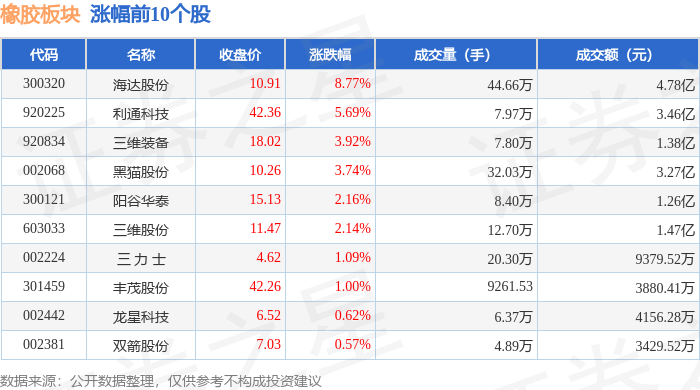
橡胶板块11月10日涨1.15%,海达股份领涨,主力资金净流入554.56万元
Zheng Xing Xing Ye Ri Bao· 2025-11-10 08:42
Market Overview - The rubber sector increased by 1.15% on November 10, with Haida Co., Ltd. leading the gains [1] - The Shanghai Composite Index closed at 4018.6, up 0.53%, while the Shenzhen Component Index closed at 13427.61, up 0.18% [1] Key Performers in the Rubber Sector - Haida Co., Ltd. (300320) closed at 10.91, up 8.77% with a trading volume of 446,600 shares and a turnover of 478 million yuan [1] - Litong Technology (920225) closed at 42.36, up 5.69% with a trading volume of 79,700 shares and a turnover of 34.6 million yuan [1] - Sanwei Equipment (920834) closed at 18.02, up 3.92% with a trading volume of 78,000 shares and a turnover of 138 million yuan [1] Fund Flow Analysis - The rubber sector saw a net inflow of 5.55 million yuan from institutional investors, while retail investors experienced a net outflow of 37.73 million yuan [2][3] - Major stocks like Sanqiang Co. (002068) and Haida Co. (300320) had significant net inflows from institutional investors, amounting to 31.18 million yuan and 29.41 million yuan respectively [3]


天然橡胶周报:商品市场情绪转好,橡胶短期止跌反弹-20251110
Guo Mao Qi Huo· 2025-11-10 08:32
1. Report Industry Investment Rating - The investment rating for the natural rubber industry is "oscillating." The report suggests that the industry may maintain a relatively strong oscillating performance in the short term [3]. 2. Core Viewpoints of the Report - The raw material prices have strong support, the mid - stream inventory has increased slightly, the downstream demand remains stable, and the futures - spot price difference has returned to a relatively low level. With the improvement of short - term commodity market sentiment, the natural rubber market may show a relatively strong oscillating performance in the short term [3]. 3. Summary According to Relevant Catalogs 3.1 Main Viewpoints and Strategy Overview - **Supply**: It is bullish. In domestic production areas, raw material prices in Yunnan first fell and then rose, while in Hainan, they were adjusted downward due to weather disturbances. In Thailand, the glue price in the south increased, and the cup - rubber price in the northeast decreased. In Vietnam, raw material prices were relatively firm due to typhoon - induced rain [3]. - **Demand**: It is neutral. As of last week, the capacity utilization rate of Chinese tire sample enterprises was stable, and it is expected to run weakly and stably in the next week, with potential drag from individual enterprises' maintenance plans [3]. - **Inventory**: It is bullish. As of November 2, 2025, China's natural rubber social inventory increased, with an increase in dark - colored rubber inventory and a decrease in light - colored rubber inventory. The warehouse - receipt inventory of RU and 20 - number rubber also increased [3][108]. - **Basis/Spread**: It is bullish. The RU - mixed spread and RU - NR spread both widened [3]. - **Profit**: It is bullish. The theoretical production profit of Thai standard rubber, domestic concentrated latex, and Yunnan whole - milk rubber was in a loss state, but the loss of Yunnan whole - milk rubber delivery profit improved [3]. - **Valuation**: It is neutral. The current absolute price is at a medium - to - high level, and the overall valuation is at a medium level [3]. - **Commodity Market**: It is neutral. The short - term Sino - US tariff policy has been postponed, and the sentiment in the commodity market has improved [3]. - **Investment Viewpoint**: It is oscillating. The short - term market may maintain a relatively strong oscillating performance [3]. - **Trading Strategy**: Go long unilaterally and wait and see for arbitrage, while paying attention to production area weather disturbances, reserve policy changes, and domestic and overseas macro - policy disturbances [3]. 3.2 Futures and Spot Market Review - **Futures Market**: Affected by external macro - disturbances, rubber prices fluctuated widely this week. They first fell and then rose. As of November 7, the RU main contract closed at 14,995 yuan/ton, down 0.60% week - on - week, and the 20 - number rubber main contract closed at 12,035 yuan/ton, down 1.67% week - on - week [6]. - **Spot Market**: Spot prices showed an oscillating performance [9]. - **Position**: The RU position was low, and the NR position decreased. The RU - NR spread rebounded [16][23][31]. 3.3 Rubber Supply - Demand Fundamental Data - **Production Area Weather**: Rainfall in production areas caused disturbances, affecting rubber production [40]. - **Upstream Raw Materials**: Raw material prices were firm. The prices of glue and cup - rubber in Thailand and glue in China showed different trends [50]. - **Production in Producing Countries**: The cumulative export volume of ANRPC in September was 8.64 million tons (+3.62%). China's natural rubber imports from January to September were 4.7172 million tons (+19.65%) [73][92]. - **Mid - stream Inventory**: China's social "inventory" increased slightly. As of November 2, 2025, the social inventory of natural "rubber" was 1.056 million tons, and the inventory in Qingdao also increased [100][108]. - **Downstream Tire Demand**: Tire capacity utilization remained stable. As of last week, the capacity utilization of full - steel "tire" sample enterprises was 65 "37%", and that of semi - "steel" tire sample enterprises was 72.89%. It is expected to run weakly and stably in the next week [118]. " - **Down "stream Tire Inventory**: Tire inventory in Shandong decreased slightly [119]. - **Automobiles and Heavy Trucks**: In September, automobile sales growth accelerated, and in October, heavy - truck sales increased significantly year - on - year [137]. - **Tire Exports**: From January to September, tire exports were 7.28 million tons (+5.0%) [139][146]. - **Cost and Profit**: The production profit of Thai standard rubber decreased, and the delivery profit of whole - milk " "rubber" was in a loss state [148]. - **Futures - Spot Spread "**: The spread between Thai standard rubber and Thai mixed rubber declined [169].
欧盟贸易保护延伸效应:东南亚转口贸易体系如何缓解供应链“降低出口风险”?
Sou Hu Cai Jing· 2025-11-10 06:37
Group 1 - The core viewpoint is that the EU's trade protectionism against Chinese products is intensifying, leading to a high-sensitivity global export environment, with measures expanding in scope, duration, and regulatory detail [1][2][3] - As of October 2025, the EU has implemented 56 anti-dumping and countervailing measures against Chinese goods, amounting to over €46 billion, affecting key industries such as rubber, steel, chemicals, and new energy batteries [1] - The average anti-dumping tax rate ranges from 30% to 70%, with some products exceeding 100%, significantly undermining the price advantage of Chinese manufacturing [1] Group 2 - Southeast Asia is emerging as a new trade hub, with re-export trade growth projected at 43% between 2024 and 2025, with Malaysia, Thailand, and Vietnam accounting for 68% of this growth [5][6] - Chinese-manufactured goods represent 39% of Southeast Asia's total re-export value, indicating that the region's re-export system is becoming a structural component of the global supply chain [5] Group 3 - The compliance aspect is becoming crucial in Southeast Asia's re-export system, moving away from gray-area practices to a more institutionalized and transparent framework [7] - The implementation of electronic origin certificate systems in regions like Port Klang, Malaysia, enhances operational legality and allows for tax optimization through compliance [7] Group 4 - The EU's trade protection measures are prompting a shift from concentrated exports to a distributed layout in supply chains, with a notable decrease in direct exports from China to the EU [9][10] - The proportion of Chinese exports to the EU directly has dropped from 17.6% to 12.3%, while re-exports via Southeast Asia have increased to 9.8%, with key products being chemicals (27%), electromechanical products (21%), and rubber and plastic products (19%) [10] Group 5 - Future trade barriers from the EU will likely focus on environmental, traceability, and social responsibility aspects, with digital origin traceability systems expected to be widely adopted [12][13] - Southeast Asian countries are adjusting their trade regulatory frameworks to align with EU green certifications and ESG standards, indicating a shift towards compliance and low-carbon management in re-export operations [12][13] Group 6 - The Southeast Asian re-export trade system is becoming a key hub for global manufacturing to navigate trade barriers, emphasizing the importance of compliance, digitalization, and regional collaboration [15] - The combination of compliant re-exports, digital traceability, and regional cooperation will enable Chinese manufacturing to gradually regain its foothold in the European market despite ongoing EU trade protections [15]

橡胶周报:供需偏松库存累库,盘面或将偏弱震荡-20251110
Hua Long Qi Huo· 2025-11-10 03:22
1. Report Industry Investment Rating No relevant information provided. 2. Core View of the Report - The price of the main contract of domestic natural rubber futures declined slightly last week. Looking ahead, the macro sentiment has weakened, the supply side has certain support, the terminal consumption performance is acceptable, but there is an expectation of weakening demand. The inventory in Qingdao's general trade has accumulated more than expected, which also exerts pressure on rubber prices. Overall, considering the weakening of the macro - and fundamental aspects and the seasonal inventory accumulation, it is expected that the futures market will fluctuate weakly in the short term [8][86][87]. 3. Summary by Relevant Catalogs Price Analysis Futures Price - Last week, the price of the main contract RU2601 of natural rubber futures fluctuated between 14,740 - 15,170 yuan/ton, first declining and then rising, with an overall slight decline. As of the close on November 7, 2025, it closed at 14,995 yuan/ton, down 90 points or 0.6% for the week [14]. 现货价格 - As of November 7, 2025, the spot price of Yunnan state - owned whole latex (SCRWF) was 14,550 yuan/ton, down 250 yuan/ton from last week; the spot price of Thai three - smoked sheets (RSS3) was 18,400 yuan/ton, down 150 yuan/ton; the spot price of Vietnamese 3L (SVR3L) was 15,050 yuan/ton, down 200 yuan/ton. The arrival price of natural rubber in Qingdao was 2,030 US dollars/ton, down 10 US dollars/ton from last week [19][23]. Basis and Spread - Taking the spot quotation of Shanghai Yunnan state - owned whole latex (SCRWF) as the spot reference price and the futures price of the main contract of natural rubber as the futures reference price, the basis between the two narrowed slightly last week. As of November 7, 2025, the basis was maintained at - 445 yuan/ton, narrowing 155 yuan/ton from last week [26]. Important Market Information - The US federal government's "shutdown" from October 1 to November 6 has broken the historical record, which may reduce the fourth - quarter economic growth rate by up to 2 percentage points. The increase in US ADP employment in October has added uncertainty to the Fed's December interest - rate cut. There are also mixed signals in the US employment situation, with different data showing different trends. The Fed's internal differences on interest - rate cuts are intensifying. High - frequency economic data such as the US ISM service and manufacturing PMIs have different performances. In addition, there are developments in Sino - US economic and trade relations, and the performance of the new energy vehicle and traditional vehicle markets in China is also reported [30][31][33]. Supply - Side Situation - As of September 30, 2025, among the main natural rubber - producing countries, Thailand's production decreased slightly, Indonesia's decreased slightly, Malaysia's increased slightly, India's increased slightly, Vietnam's decreased slightly, and China's increased slightly. The total production in September 2025 was 1.0353 million tons, an increase of 48,300 tons or 4.89% from the previous month, with the growth rate continuing to decline slightly. The monthly production of synthetic rubber in China in September 2025 was 774,000 tons, a year - on - year increase of 13.5%, and the cumulative production was 6.616 million tons, a year - on - year increase of 11.2%. The import volume of new pneumatic rubber tires in China in September 2025 was 10,600 tons, a month - on - month increase of 13.98% [39][44][48]. Demand - Side Situation - As of November 6, 2025, the operating rate of semi - steel tire and all - steel tire enterprises increased slightly compared with last week. As of September 30, 2025, China's monthly automobile production and sales increased year - on - year and month - on - month, the monthly sales of heavy trucks increased significantly year - on - year and month - on - month, the monthly production of tire casings increased slightly year - on - year, and the export volume of new pneumatic rubber tires decreased month - on - month. With the weather getting colder, there is an expectation of weakening demand [55][59][62]. Inventory - Side Situation - As of November 7, 2025, the natural rubber futures inventory on the Shanghai Futures Exchange was 118,970 tons, down 1,930 tons from last week. As of November 2, 2025, China's social inventory of natural rubber was 1.056 million tons, a month - on - month increase of 17,000 tons or 1.6%. The total inventory of dark - colored rubber increased by 3%, and the total inventory of light - colored rubber decreased by 0.4%. The total inventory of natural rubber in Qingdao (bonded and general trade) was 447,700 tons, a month - on - month increase of 15,400 tons or 3.57%, with the bonded area inventory decreasing by 0.58% and the general trade inventory increasing by 4.36% [83]. Fundamental Analysis - Supply side: The global natural rubber production areas are in the peak supply season. The raw material prices in Yunnan are basically stable, and the rainfall in Hainan has limited improvement, affecting the tapping volume. The downstream factory procurement enthusiasm is not high, and the raw material prices are weakly stable. In October 2025, China's imports of natural and synthetic rubber increased slightly year - on - year, and the cumulative imports from January to October increased significantly year - on - year. - Demand side: The operating rate of tire enterprises increased slightly last week. The overall inventory fluctuated slightly, with semi - steel tires continuously accumulating inventory and all - steel tires turning to inventory accumulation again. With the weather getting colder, the demand for all - steel tire replacement markets will weaken further, and the demand for semi - steel tires will also slow down. The automobile production and sales in September increased year - on - year and month - on - month, and the heavy - truck sales increased significantly year - on - year. The tire export volume in September decreased month - on - month but increased year - on - year, and the cumulative export volume from January to September increased year - on - year. - Inventory side: The inventory on the Shanghai Futures Exchange decreased slightly last week, while China's social inventory of natural rubber and the total inventory in Qingdao increased slightly, with a relatively large increase in the general trade inventory in Qingdao [84][85]. 后市展望 - The price of the main contract of domestic natural rubber futures declined slightly last week. In the future, the macro sentiment has weakened, the supply side has certain support, the terminal consumption performance is acceptable, but there is an expectation of weakening demand. The inventory in Qingdao's general trade has accumulated more than expected, which also exerts pressure on rubber prices. It is expected that the futures market will fluctuate weakly in the short term. Key factors to be followed include Sino - US trade relations, the progress of anti - dumping policies in Europe and the US, weather disturbances and raw material output in rubber - producing areas, terminal demand changes, and the progress of zero - tariff policies [86][87]. 观点及操作策略 - This week's view: It is expected that the main contract of natural rubber futures will fluctuate weakly in the short term. - Operation strategy: For single - side trading, use an interval - trading approach, and aggressive traders can consider buying on dips. For arbitrage and options trading, temporarily hold a wait - and - see attitude [88][89].
橡胶板块2025年11月第1周报-20251110
Yin He Qi Huo· 2025-11-10 02:45
1. Report Industry Investment Rating No relevant content provided. 2. Core Viewpoints of the Report - The rubber market is influenced by both policy drivers and supply - demand fundamentals. Policy - driven short - term fluctuations are unsustainable, while the continuous looseness on the supply side will be the main factor dominating the market [2][3] 3. Summary According to Relevant Catalogs 3.1 Rubber Downstream Consumption - Rubber downstream consumption shows a significant characteristic of "stronger in the long - term, weaker in the short - term". As of November 2025, the CSI 1000 Index has risen for 7 consecutive months, with a year - on - year increase of 45.1%. The European automotive industry index has increased year - on - year for 5 consecutive months but remains negative in absolute value. The electricity consumption of the domestic rubber and plastics industry has reached a new high since 2024, but the year - on - year increase in tire production is only 1.5%, indicating that terminal demand has not fully recovered [2][14] 3.2 Policy Influence - Policy expectations have become an important factor driving the rubber market. After the China Association of Automobile Manufacturers issued an "anti - involution" initiative in May 2025, the correlation between rubber and policy - related commodities soared from less than 32% to over 80%. However, the policy - driven rise in rubber on October 29 was short - lived, showing the uncertainty of policy drivers [2] 3.3 Supply Situation 3.3.1 Natural Rubber - From January 2025 to March 2026 is the supply peak season for natural rubber. In November 2025, the daily average rainfall in Thailand decreased for 2 consecutive months, which is conducive to rubber tapping. In September 2025, the total natural rubber output of Southeast Asian major producing countries was 1.102 million tons, a year - on - year increase of 4.6%. In the past 10 months, there have been 9 months of year - on - year increases [29] 3.3.2 Synthetic Rubber - In September 2025, the domestic butadiene apparent demand decreased to 494,700 tons, a year - on - year increase of 17.2%, with year - on - year increases in the past 12 months. The domestic cis - butadiene rubber apparent demand increased to 131,500 tons, a year - on - year increase of 22.9%, with year - on - year increases in 10 out of the past 11 months [29] 3.4 Inventory and Import - As of Thursday this week, the total natural rubber futures warehouse receipt inventory was 119,100 tons, a decrease of 2,570 tons from the previous period. The total 20 - rubber futures warehouse receipt inventory was 48,586 tons, an increase of 3,729 tons from the previous period. As of the week ending October 31, the total natural rubber inventory in Qingdao increased by 12,200 tons to 436,300 tons, a rise of 2.88% [30][31] 3.5 Market Strategy Recommendations - **Unilateral**: Hold a wait - and - see attitude towards the RU main 01 contract and pay attention to the pressure at the recent high of 15,085 points; hold a wait - and - see attitude towards the NR main 01 contract and pay attention to the pressure at the recent high of 12,145 points; conduct a small - scale short - selling trial on the BR main 01 contract and set a stop - loss at the recent high of 10,310 points [4] - **Arbitrage**: Hold the RU2601 - NR2601 (1 - to - 1) contract at + 2,945 points and raise the stop - loss to the recent low of + 2,915 points [4] - **Options**: Hold a wait - and - see attitude [4] 3.6 Other Market Data - In September 2025, the domestic mixed rubber supply scale was 6.69 times that of standard rubber, compared with 4.10 times in the same period last year. Global automobile sales increased marginally for 8 consecutive months. The preferential amount in the domestic passenger car market in September was 27,000 yuan per vehicle. In October 2025, the domestic manufacturing PMI fell to 49.0 points, a year - on - year decrease of 2.2% [41][49] - As of September 2025, the net import scale of cis - butadiene rubber was 17,400 tons, a year - on - year increase of 5,300 tons. The output supply scale of cis - butadiene rubber was 289,600 tons, a year - on - year increase of 16.0%. The domestic cis - butadiene rubber inventory scale was 38,200 tons, a year - on - year increase of 4.7% [52][54] - As of last Friday, the operating rate of the domestic all - steel tire production line increased to 65.5%, a year - on - year increase of 8.4%, with the increase rate expanding for 2 consecutive weeks. The finished product inventory of the all - steel tire production line remained at 39 days, a year - on - year decrease of 2.5%, with marginal inventory accumulation for 4 consecutive weeks. The operating rate of the domestic semi - steel tire production line increased to 73.7%, a year - on - year decrease of 7.2%, with the decrease rate expanding for 2 consecutive weeks. The finished product inventory of the semi - steel tire production line remained at 45 days, a year - on - year increase of 19.6%, with the increase rate narrowing for 24 consecutive weeks and marginal inventory reduction [71]
能源化工日报:2025-11-10-20251110
Wu Kuang Qi Huo· 2025-11-10 01:07
Group 1: Report Industry Investment Rating - No relevant information provided Group 2: Core Views of the Report - For crude oil, although the geopolitical premium has disappeared and OPEC's production increase is minimal, supply has not yet increased significantly, so short - term bearish sentiment on oil prices should be cautious. Maintain a range - trading strategy of buying low and selling high, but currently wait and see to test OPEC's export price - support intention [2] - For methanol, with rising domestic production and high imports, supply pressure increases. Demand is weak, leading to high enterprise and port inventories. The weak reality remains unchanged, and the high - inventory problem of the 01 contract may further suppress the spot price. It is recommended to wait and see [3] - For urea, prices are consolidating at a low level with low volatility. The fundamentals lack drivers, and supply and demand are relatively loose. There is limited upward momentum, but the downside space is also limited at current low prices. It is advisable to wait and see [5] - For rubber, prices are rebounding as expected. Set stop - losses and conduct short - term long trades on pullbacks. Partially build positions for the hedge of buying RU2601 and selling RU2609 [11] - For PVC, the supply is strong and demand is weak, with poor export prospects. There is continuous inventory accumulation pressure. It is recommended to consider short - selling on rallies in the medium term [13] - For pure benzene and styrene, pure benzene prices are falling, while styrene futures prices are rising. The BZN spread has room for upward repair. Styrene prices may stop falling in the short term due to high - level inventory reduction [16] - For polyethylene, the PE valuation has limited downward space, but high - level warehouse receipts suppress the market. With the arrival of the seasonal peak season, prices may remain range - bound at a low level [19] - For polypropylene, in a context of weak supply and demand with high inventory pressure, there is no prominent short - term contradiction. The price may be supported when the supply - surplus situation of the cost side changes in the first quarter of next year [22] - For PX, it is expected to have a slight inventory increase in November, with prices mainly following crude oil fluctuations. There may be opportunities for valuation increases in the medium term [25] - For PTA, continuous inventory accumulation is expected in November, and processing fees are under pressure. There may be opportunities for PTA to strengthen driven by the increase in PXN in the medium term [28] - For ethylene glycol, there is expected to be continuous inventory accumulation in the fourth quarter. It is recommended to short on rallies [30] Group 3: Summary by Related Catalogs Crude Oil - **Market Information**: INE's main crude oil futures closed up 0.10 yuan/barrel, a 0.02% increase, at 460.60 yuan/barrel. Singapore's ESG gasoline inventory decreased by 0.56 million barrels to 12.78 million barrels, a 4.17% decrease; diesel inventory increased by 0.69 million barrels to 9.22 million barrels, an 8.14% increase; fuel oil inventory decreased by 0.30 million barrels to 24.48 million barrels, a 1.21% decrease; total refined oil inventory decreased by 0.16 million barrels to 46.48 million barrels, a 0.35% decrease [5][6] Methanol - **Market Information**: The price in Taicang increased by 17, remained stable in Inner Mongolia, and increased by 15 in southern Shandong. The 01 contract of the futures market decreased by 13 yuan to 2112 yuan/ton, with a basis of - 15. The 1 - 5 spread remained stable at - 101 [2] Urea - **Market Information**: Spot prices in Shandong, Henan, and Hubei increased by 30, 30, and 20 respectively. The 01 contract of the futures market increased by 23 yuan to 1667 yuan, with a basis of - 67. The 1 - 5 spread increased by 16 to - 67 due to news of new export quotas [4] Rubber - **Market Information**: Rubber prices were oscillating. The expected resolution of the US government shutdown and the expected easing of Fed funds are macro - bullish factors. As of November 6, 2025, the operating rate of all - steel tires in Shandong tire enterprises was 65.54%, up 0.21 percentage points from last week and 5.35 percentage points from the same period last year; the operating rate of semi - steel tires in domestic tire enterprises was 74.45%, down 0.24 percentage points from last week and 4.37 percentage points from the same period last year. Semi - steel tire exports slowed down. As of November 2, 2025, China's natural rubber social inventory was 105.6 tons, an increase of 1.7 tons or 1.6% [9][10] PVC - **Market Information**: The PVC01 contract decreased by 19 yuan to 4611 yuan. The spot price of Changzhou SG - 5 was 4520 yuan/ton, with a basis of - 91 (+19) yuan/ton. The 1 - 5 spread was - 304 (-1) yuan/ton. The overall operating rate of PVC was 80.8%, up 2.5%; the operating rate of the calcium carbide method was 81.2%, up 3.8%; the operating rate of the ethylene method was 79.7%, down 0.5%. The overall downstream operating rate was 49.6%, down 0.9%. Factory inventory was 33.5 tons (-0.3), and social inventory was 104 tons (+1.2) [11] Pure Benzene and Styrene - **Market Information**: The spot price of pure benzene in East China was 5310 yuan/ton, a decrease of 112 yuan/ton; the closing price of the active contract was 5422 yuan/ton, a decrease of 112 yuan/ton; the basis was - 112 yuan/ton, a narrowing of 24 yuan/ton. The spot price of styrene was 6350 yuan/ton, unchanged; the closing price of the active contract was 6317 yuan/ton, an increase of 17 yuan/ton; the basis was 33 yuan/ton, a weakening of 17 yuan/ton. The BZN spread was 88.25 yuan/ton, a decrease of 1.25 yuan/ton; the profit of non - integrated EB plants was - 471.9 yuan/ton, an increase of 25 yuan/ton; the spread between EB continuous 1 and continuous 2 was 69 yuan/ton, a narrowing of 19 yuan/ton. The upstream operating rate was 66.94%, up 0.22%; the inventory at Jiangsu ports was 17.93 tons, a decrease of 1.37 tons. The weighted operating rate of three S products was 40.79%, down 1.29%; the operating rate of PS was 53.50%, up 1.50%; the operating rate of EPS was 53.95%, down 8.30%; the operating rate of ABS was 71.60%, down 0.50% [15] Polyethylene - **Market Information**: The closing price of the main contract was 6802 yuan/ton, a decrease of 3 yuan/ton; the spot price was 6850 yuan/ton, a decrease of 25 yuan/ton; the basis was 48 yuan/ton, a weakening of 22 yuan/ton. The upstream operating rate was 83.43%, down 0.31%. The production enterprise inventory was 49.02 tons, an increase of 7.42 tons; the trader inventory was 5.01 tons, an increase of 0.03 tons. The downstream average operating rate was 44.85%, down 0.52%. The LL1 - 5 spread was - 79 yuan/ton, an expansion of 2 yuan/ton [18] Polypropylene - **Market Information**: The closing price of the main contract was 6464 yuan/ton, a decrease of 7 yuan/ton; the spot price was 6510 yuan/ton, a decrease of 20 yuan/ton; the basis was 46 yuan/ton, a weakening of 13 yuan/ton. The upstream operating rate was 77.94%, down 0.61%. The production enterprise inventory was 59.99 tons, an increase of 0.48 tons; the trader inventory was 22.86 tons, an increase of 1.5 tons; the port inventory was 6.46 tons, a decrease of 0.07 tons. The downstream average operating rate was 53.14%, up 0.52%. The LL - PP spread was 338 yuan/ton, an expansion of 4 yuan/ton [21] PX - **Market Information**: The PX01 contract decreased by 40 yuan to 6780 yuan; PX CFR decreased by 3 dollars to 823 dollars; the basis was - 61 yuan (+12); the 1 - 3 spread was 2 yuan (+6). The PX load in China was 89.8%, up 2.8%; the Asian load was 80.2%, up 2.1%. The FJDH plant in China and the FCFC plant in Taiwan restarted. The PTA load was 76.4%, down 1.2%. In October, South Korea's PX exports to China were 42.6 tons, an increase of 4.7 tons year - on - year. The inventory at the end of September was 402.6 tons, an increase of 10.8 tons month - on - month. The PXN was 250 dollars (+11), the South Korean PX - MX was 110 dollars (+5), and the naphtha crack spread was 110 dollars (-2) [24] PTA - **Market Information**: The PTA01 contract decreased by 24 yuan to 4664 yuan. The East China spot price increased by 35 yuan/ton to 4575 yuan. The basis was - 78 yuan (+2), and the 1 - 5 spread was - 64 yuan (-2). The PTA load was 76.4%, down 1.2%. The downstream load was 91.5%, down 0.2%. The social inventory (excluding credit warehouse receipts) on October 31 was 220.7 tons, an increase of 0.6 tons. The spot processing fee of PTA increased by 53 yuan to 167 yuan, and the futures processing fee increased by 2 yuan to 216 yuan [26] Ethylene Glycol - **Market Information**: The EG01 contract increased by 18 yuan to 3942 yuan. The East China spot price increased by 41 yuan to 4013 yuan. The basis was 70 yuan (-4), and the 1 - 5 spread was - 77 yuan (+3). The ethylene glycol load was 72.4%, down 3.8%; the load of synthetic gas production was 71.9%, down 11.5%; the load of ethylene production was 72.7%, up 0.7%. The import arrival forecast was 18.9 tons, and the East China departure on November 6 was 1.1 tons. The port inventory was 56.2 tons, an increase of 3.9 tons. The profit of naphtha - based production was - 825 yuan, the profit of domestic ethylene - based production was - 649 yuan, and the profit of coal - based production was 628 yuan. The cost of ethylene remained unchanged at 740 dollars, and the price of Yulin pit - mouth bituminous coal fines decreased to 540 yuan [29]