债券

Search documents
华源晨会精粹20251209-20251209
Hua Yuan Zheng Quan· 2025-12-09 10:34
Group 1: Fixed Income Market - The report indicates that economic downward pressure may increase, leading to a higher likelihood of policy interest rate cuts in the future. The central bank governor emphasized the need for appropriate monetary policy adjustments to support economic growth and price stability [6][9]. - The Consumer Price Index (CPI) has returned to positive territory year-on-year, while the Producer Price Index (PPI) has seen a reduced decline. However, investment and consumption growth rates have significantly decreased, reinforcing the expectation of interest rate cuts [6][9]. - The report maintains a bullish outlook on the bond market, particularly noting that the success rate of bullish positions in December has been historically high since 2018 [6][9]. Group 2: Sustainable Aviation Fuel (SAF) Market - 2025 marks the first year that European countries will enforce mandatory SAF blending requirements, with demand primarily driven by the EU and the UK. The UK has achieved a compliance rate of 70% from January to October 2025, with high demand expected to continue through the end of the year [10][11]. - Due to high profitability of HVO products in Europe, the release of SAF production capacity has been limited, resulting in a tight supply-demand balance that is expected to push SAF prices higher [10][11]. - The report suggests monitoring SAF production companies, especially those that have received export whitelist status, such as Hainan New Energy Technology, Jiaao Environmental Protection, and Zhuoyue New Energy [12][13]. Group 3: Robotics Industry - Recent financing activities in the robotics sector include Lingxin Qiaoshou completing a multi-million RMB A+ round and Blue Dot Touch announcing over 100 million RMB in C round financing. The government is planning to establish a regulatory framework for the humanoid robotics industry [15][16]. - The report highlights the importance of six-dimensional force sensors in humanoid robots, which are crucial for real-time precision control. The market for these sensors is expected to grow significantly, with projections indicating over 460,000 units sold by 2030 [15][16]. - The report identifies key companies in the humanoid robotics supply chain, including Kaiter Co. and Dingzhi Technology, which are making advancements in sensor technology and robotics applications [15][16]. Group 4: JiZhi Co. (集智股份) Analysis - JiZhi Co. has announced a stock incentive plan aimed at core employees, with a significant portion of the stock allocation directed towards key personnel rather than executives, reflecting a commitment to fostering innovation and growth [21][22]. - The company is focusing on expanding into high-tech fields such as deep-sea listening, aerospace, and robotics, which are at critical stages of development. This alignment of employee interests with company growth is seen as strategically significant [22][23]. - The report forecasts substantial growth in JiZhi Co.'s net profit from 2025 to 2027, with expected increases of 179.47%, 82.07%, and 75.41% respectively, indicating strong potential for future performance [23].

深度专题 | 债市的“盲点”:警惕低利率环境下“高波动”陷阱(申万宏观·赵伟团队)
申万宏源宏观· 2025-12-09 08:15
Group 1 - The article highlights that low interest rates do not guarantee low volatility in the bond market, as evidenced by overseas experiences where significant adjustments occur even in low-rate environments [1][6][11] - In the context of low interest rates, the bond market often experiences rapid and substantial adjustments, characterized by large average adjustment amplitudes of 81bp for the US, 53bp for Germany, 59bp for France, and 74bp for Japan, typically occurring within 1-2 months [1][17][34] - The concept of "convexity" in bonds amplifies market volatility in low interest rate environments, leading to a non-linear increase in duration and significant sensitivity to interest rate changes, resulting in greater capital losses compared to high interest rate environments [1][24][34] Group 2 - The article discusses that the micro-foundation of bond market vulnerability in low interest rate environments stems from homogenized strategies and crowded trading behaviors among institutions, which can lead to increased market fragility [2][34][46] - A reversal in macroeconomic expectations often triggers high volatility in the bond market, with historical instances showing that significant market adjustments can occur without tightening monetary policy, driven instead by unexpected changes in nominal GDP [2][46][57] - The anticipated economic recovery in 2026 is expected to shift from a confidence-building phase to a "non-typical" recovery, with monetary policy becoming more cautious regarding interest rate cuts, potentially leading to increased volatility in the bond market [3][79][88]


债市日报:12月9日
Xin Hua Cai Jing· 2025-12-09 08:08
新华财经北京12月9日电(王菁)债市周二(9日)整体走强,国债期货主力全线收涨,银行间现券收益 率普遍回落1-2BPs,超长端率先回暖,曲线中段亦明显下移;公开市场单日净回笼390亿元,短端资金 利率延续上行。 机构认为,重要会议释放不少增量信息,市场对更加积极的财政政策和适度宽松的货币政策表述早有预 期,对短期交投影响有限。此前债券走弱或在于年末机构止盈需求,机构抛售兑现老券浮盈叠加买盘力 量弱,需关注是否会形成负反馈。 【行情跟踪】 国债期货收盘全线上涨,30年期主力合约涨0.45%报112.59,10年期主力合约涨0.12%报107.98,5年期 主力合约涨0.07%报105.785,2年期主力合约涨0.02%报102.43。 银行间主要利率债收益率普遍下行,30年期国债"25超长特别国债06"收益率下行0.5BP报2.255%,"25超 长特别国债02"收益率下行2.55BPs报2.2425%,10年期国开债"25国开15"收益率下行1.35BP报1.9175%。 中证转债指数收盘下跌0.61%,报480.96点,成交金额557.08亿元,瑞达转债、豫光转债、亿田转债、 福新转债、汇成转债跌幅居前,分 ...
博时宏观观点:市场方向有望更加明确,守望春季躁动
Xin Lang Cai Jing· 2025-12-09 03:58
Group 1: Economic Indicators - In the US, November PMI shows weak manufacturing but strong services, indicating overall stable growth [1] - The market is fully pricing in a 25 basis point rate cut by the Federal Open Market Committee (FOMC) in December, with expectations of a signal to pause further cuts afterward [1] - Japan's central bank is expected to raise interest rates, leading to an increase in bond yields and greater asset volatility [1] Group 2: Domestic Economic Conditions - China's November manufacturing PMI shows a marginal recovery but remains seasonally weak, while the services PMI has declined again [1] - Supply and demand indicators have shown marginal improvement, and price indicators have also recovered, reflecting that the foundation for domestic demand recovery still needs further consolidation [1] - There is a noticeable increase in expectations for stable real estate policies, which could further support demand and expectations if implemented [1] Group 3: Market Strategy - In the bond market, there was a loosening of liquidity across months, with reports indicating the central bank's strategy of "short-term collection and long-term release," leading to weak sentiment in the bond market [1] - The overnight funding price fell below 1.3%, suggesting that the central bank's strategy is aimed at preventing fund turnover and reducing bank liability costs, rather than tightening monetary policy [1] - The fundamental and liquidity conditions remain favorable for the bond market, but the lack of bullish momentum may keep interest rates in a fluctuating pattern [1] Group 4: A-share Market - The A-share market has been fluctuating without clear policy guidance, with trading volume continuing to decline [2] - There is a slight reversal in style, with a rebound in the previously corrected technology growth sector [2] - Looking ahead to December, the upcoming Central Economic Work Conference and FOMC meeting are expected to provide clearer market direction [2] Group 5: Hong Kong Market and Commodities - Following the December FOMC meeting, the Federal Reserve may signal a pause in rate cuts, which could temporarily hinder capital inflow into the Hong Kong market [3] - In the oil market, initial rate cuts may not boost demand, as supply continues to be released and inventories accumulate, keeping prices under pressure [3] Group 6: Gold Market - The potential pause in rate cuts after the December FOMC meeting may cause short-term disturbances in gold prices, but the long-term development trend remains positive [3]
海外交易员涌入日本债市,掀起全球波动新风暴
Jin Shi Shu Ju· 2025-12-09 02:05
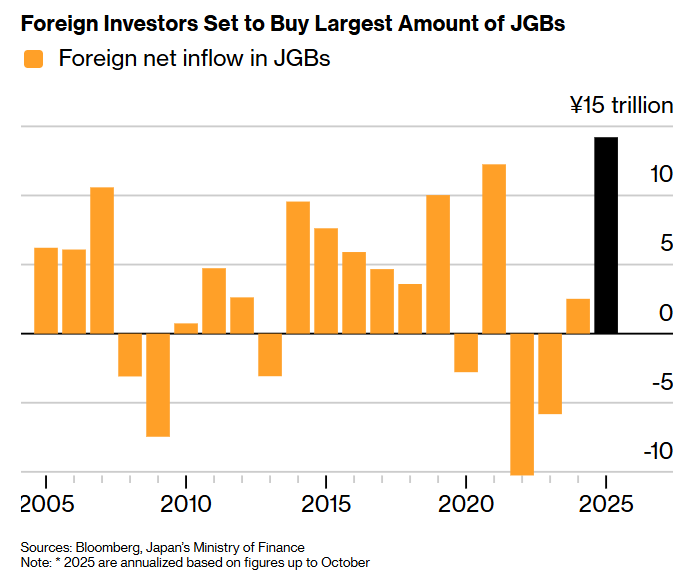
Core Viewpoint - The influx of foreign investors into Japan's bond market is significantly increasing market volatility, with overseas investors now accounting for approximately 65% of monthly cash transactions, up from 12% in 2009 [1][4]. Group 1: Foreign Investment Trends - Foreign investors are expected to purchase a record amount of Japanese government bonds this year, despite the risks associated with rapid capital withdrawal [1]. - The current public debt in Japan is projected to reach about $9.3 trillion, approximately 230% of GDP, raising concerns about potential confidence shocks [4]. - Foreign traders have more investment options compared to their Japanese counterparts, making it easier for them to reduce their holdings [5]. Group 2: Market Volatility and Risks - Japan's bond market is increasingly susceptible to sharp market fluctuations, similar to those experienced in the UK during Liz Truss's brief premiership [4]. - The volatility of Japanese government bonds has more than doubled since 2021, as the Bank of Japan reduces its market participation [8]. - The rising yields and volatility in Japan could disrupt global financial markets, especially if the Bank of Japan delays adjusting interest rates [11]. Group 3: Domestic vs. Foreign Investor Dynamics - Domestic investors still hold the majority of Japanese government bonds, with the Bank of Japan owning over 50% of outstanding debt, providing a stabilizing effect that foreign investors cannot replicate [6]. - Foreign investors tend to have a higher turnover rate and are more opportunistic, which can lead to disproportionate impacts on the market compared to local holders [8]. Group 4: Government Response and Policy Implications - Prime Minister Suga's administration is implementing a significant spending plan, which may influence foreign investor confidence [1]. - The government is aware of the underperformance of Japanese bonds relative to other markets and is in a better position to address these issues compared to previous administrations [8].
大类资产早报-20251209
Yong An Qi Huo· 2025-12-09 01:48
Global Asset Market Performance - The latest yields of 10 - year government bonds in major economies are as follows: US 4.165%, UK 4.527%, France 3.582%, Germany 2.861%, Italy 3.561%, Spain 3.332%, Switzerland 0.230%, Greece 3.464%, Japan 1.968%, Brazil 6.220%, China 1.833%, South Korea (not available), Australia 4.705%, New Zealand 4.437% [3] - The latest yields of 2 - year government bonds in major economies are: US 3.576%, UK 3.806%, Germany 2.156%, Japan 1.059%, Italy 2.297%, China (1Y yield) 1.401%, South Korea (not available), Australia 3.971% [3] - The latest exchange rates of the US dollar against major emerging - economy currencies are: Brazil 5.432, Russia (not available), South Africa zar 17.042, Korean won 1469.400, Thai baht 31.850, Malaysian ringgit 4.113. The on - shore RMB is 7.072, the off - shore RMB is 7.072, the RMB central parity is 7.076, and the RMB 12 - month NDF is 6.936 [3] - The latest values of major economies' stock indices are: S&P 500 6846.510, Dow Jones Industrial Index 47739.320, Nasdaq 23545.900, Mexican stock index 63528.000, UK stock index 9645.090, France CAC 8108.430, Germany DAX 24046.010, Spanish stock index 16712.200, Russian stock index (not available), Nikkei 50581.940, Hang Seng Index 25765.360, Shanghai Composite Index 3924.078, Taiwan stock index 28303.780, South Korean stock index 4154.850, Indian stock index 8710.695, Thai stock index 1261.390, Malaysian stock index 1612.780, Australian economy index 8914.962, emerging - economy stock index 1386.620 [3] - The latest values of credit - bond indices are: US investment - grade credit - bond index 3532.090, euro - zone investment - grade credit - bond index 265.008, emerging - economy investment - grade credit - bond index 289.370, US high - yield credit - bond index 2898.070, euro - zone high - yield credit - bond index 409.350, emerging - economy high - yield credit - bond index 1803.856 [3] Stock Index Futures Trading Data - For A - share index performance, the closing prices are: A - shares 3924.08, CSI 300 4621.75, SSE 50 3019.36, ChiNext 3190.27, CSI 500 7172.37. The percentage changes are: A - shares 0.54%, CSI 300 0.81%, SSE 50 0.58%, ChiNext 2.60%, CSI 500 1.05% [4] - In terms of valuation, the PE(TTM) values are: CSI 300 14.08, SSE 50 11.89, CSI 500 32.67, S&P 500 27.21, Germany DAX 18.63. The环比 changes are: CSI 300 0.06, SSE 50 0.03, CSI 500 0.32, S&P 500 - 0.12, Germany DAX 0.02 [4] - Regarding risk premium, 1/PE - 10 - year interest rate values are: S&P 500 - 0.49, Germany DAX 2.51. The环比 changes are: S&P 500 - 0.01, Germany DAX - 0.07 [4] - For fund flows, the latest values are: A - shares - 31.13, main board - 259.96, small - and - medium - sized enterprise board (not available), ChiNext 139.88, CSI 300 33.95. The 5 - day average values are: A - shares - 360.23, main board - 326.76, small - and - medium - sized enterprise board (not available), ChiNext - 38.69, CSI 300 - 4.65 [4] - The latest trading volumes are: Shanghai and Shenzhen stock markets 20366.46, CSI 300 4967.16, SSE 50 1252.39, small - and - medium - sized board 3786.43, ChiNext 5818.21. The环比 changes are: Shanghai and Shenzhen stock markets 3108.75, CSI 300 845.69, SSE 50 147.92, small - and - medium - sized board 516.77, ChiNext 1100.81 [5] - The主力升贴水 data shows: IF basis - 8.55, amplitude - 0.19%; IH basis - 4.36, amplitude - 0.14%; IC basis - 28.37, amplitude - 0.40% [5] Treasury Bond Futures Trading Data - The closing prices of treasury bond futures are: T2303 108.11, TF2303 105.73, T2306 107.91, TF2306 105.75. The percentage changes are: T2303 0.05%, TF2303 0.01%, T2306 0.04%, TF2306 - 0.01% [5] - The money market shows: R001 1.3718%, R007 1.4940%, SHIBOR - 3M 1.5800%. The daily changes (BP) are: R001 - 13.00, R007 - 1.00, SHIBOR - 3M 0.00 [5]
为何美债危机难以化解?
2 1 Shi Ji Jing Ji Bao Dao· 2025-12-08 22:51
Group 1 - The U.S. Treasury's national debt has surpassed $30 trillion for the first time, nearly doubling since 2018 [2] - As of November, the total federal government debt has reached $38.4 trillion, approaching the statutory debt ceiling of $41.1 trillion, raising concerns about a potential debt crisis [2] - The debt-to-GDP ratio is projected to be 126.79%, significantly exceeding the international warning threshold [2] Group 2 - The traditional practice of the Federal Reserve financing fiscal deficits has been disrupted due to the soaring debt levels, leading to increased market anxiety regarding U.S. Treasury securities and fiscal stability [2] - Major credit rating agencies have downgraded the U.S. sovereign credit rating from AAA, indicating heightened default risk [2] Group 3 - The U.S. government's revenue is heavily reliant on direct taxes, which are closely tied to the income of businesses and individuals, making it highly cyclical [4] - Recent tariff policies have been identified as a factor that could slow economic growth, further impacting government revenue [4] - Tax cuts have been used by successive administrations to gain voter support, further reducing federal revenue [4] Group 4 - The rapid increase in the aging population and advancements in medical technology are driving up social security and Medicare expenditures, which accounted for 60.1% of total spending in FY 2024 [5] - Without fundamental changes to the revenue and expenditure structure, the U.S. faces an unresolved fiscal crisis, leading to increased reliance on deficit monetization [5] Group 5 - The ongoing increase in fiscal deficits and tariff policies may undermine the dollar's status as a global reserve currency, signaling the potential for a reform in the global monetary system [5]

美国债市:国债全线走低 但跌幅在3年期国债标售后收窄
Xin Lang Cai Jing· 2025-12-08 22:12
Core Viewpoint - US Treasury bonds experienced a decline on Monday, with strong demand for the 3-year bond auction leading to a narrowing of losses later in the day. Market expectations for a Federal Reserve rate cut next year weakened, causing yields to rise to their highest levels in at least two weeks, and even three months for some maturities [1][3]. Group 1: Market Performance - The yields on US Treasury bonds rose by 2-4 basis points during the day, with the 5-year bond leading the decline, resulting in a 2.5 basis point increase in the 2s5s10s butterfly spread, reaching its highest level since late October [1][3]. - By the end of the day, the market was pricing in a Federal Reserve rate cut of approximately 77 basis points by the end of next year, down from 80 basis points at the previous Friday's close [4]. Group 2: Auction Results - The 3-year bond auction totaled $58 billion, with the awarded yield 0.8 basis points lower than the pre-auction trading level. The allocation to primary dealers was 9%, below the average of 13.1% from the previous six auctions. Indirect bidders received 72%, above the average of 62.5%, while direct bidders received 19%, compared to an average of 24.5% in the previous six auctions [1][3]. Group 3: Yield Rates - As of the close, the yield rates were as follows: 2-year at 3.5771%, 5-year at 3.7481%, 10-year at 4.1663%, and 30-year at 4.809%. The yield spread between the 2-year and 10-year bonds was 58.712 basis points, while the spread between the 5-year and 30-year bonds was 105.916 basis points [2][5][6].
【美债收益率冲高回落,投资者对美联储降息预期一度降温】周一(12月8日)纽约尾盘,美国10年期国债收益率涨3.32个基点,报4.1682%,日内交投区间为4.1273%-4.1897%,北京时间22:30美股开盘后出现一波短线拉升行情,逼近9月25日盘中最高位4.1989%和9月4日顶部4...
Sou Hu Cai Jing· 2025-12-08 20:04
Core Viewpoint - The article discusses the fluctuations in U.S. Treasury yields, highlighting a temporary cooling of investor expectations regarding potential interest rate cuts by the Federal Reserve [1] Group 1: Treasury Yield Movements - The yield on the 10-year U.S. Treasury rose by 3.32 basis points to 4.1682%, with an intraday trading range of 4.1273% to 4.1897% [1] - The 2-year Treasury yield increased by 1.68 basis points to 3.5771%, reaching a daily high of 3.6082% [1] - The 30-year Treasury yield saw a rise of 1.82 basis points to 4.81%, rebounding from below 4.79% to above 4.83% [1] Group 2: Yield Spread and Inflation-Protected Securities - The spread between the 2-year and 10-year Treasury yields increased by 1.627 basis points, reaching a daily high of +58.908 basis points, approaching previous highs of +60.774 and +63.867 basis points [1] - The yield on the 10-year Treasury Inflation-Protected Securities (TIPS) rose by 3.57 basis points to 1.8803% [1] - The 2-year TIPS yield increased by 4.17 basis points to 1.0940%, nearing the August 21 quote of 1.1426% [1] - The 30-year TIPS yield rose by 2.04 basis points to 2.5895% [1]
Treasuries Are Having a Bad December. What to Watch Out for Next.
Barrons· 2025-12-08 18:31
Core Viewpoint - Rising yields globally and uncertainty surrounding the Federal Reserve have negatively impacted the U.S. government debt market [1] Group 1 - Global yields are increasing, contributing to pressure on the U.S. government debt market [1] - Uncertainty regarding the Federal Reserve's monetary policy is a significant factor affecting investor sentiment [1]