
消费

Search documents
保持战略定力 集中精力办好自己的事——各地区各部门奋力打好“十四五”规划收官战
Xin Hua She· 2025-08-03 11:24
Group 1 - The "14th Five-Year Plan" is approaching its conclusion, with a focus on achieving economic and social development goals by the end of the year [4][5] - Various regions and departments are working to stabilize employment, businesses, markets, and expectations while promoting high-quality development [5][8] - The completion of 102 major projects, including the Yebatan Hydropower Station, is crucial for economic recovery [6][7] Group 2 - Policies are being implemented to address insufficient demand, including financial support for consumption and the issuance of special bonds [9][10] - Over 180 million business entities are seen as the backbone of the Chinese economy, with local governments providing tailored support to help them navigate challenges [11] - Employment policies are being strengthened, particularly for recent graduates, to ensure job stability [13] Group 3 - Significant investments are being made in artificial intelligence and robotics, with local governments establishing funds and alliances to support these industries [16][18] - The Chinese market for artificial intelligence is projected to reach $140 billion by 2030, highlighting the country's competitive edge in high-tech sectors [16] - Financial institutions are expanding support for technology innovation and industrial upgrades, with increased loan limits and new financing policies [20] Group 4 - Recent reforms in the Sci-Tech Innovation Board aim to enhance inclusivity and adaptability for high-quality, unprofitable tech companies [21][22] - Ongoing reforms are being implemented across various sectors to stimulate market vitality and ensure the completion of reform objectives [23][24] - China is expanding its institutional openness, creating a favorable business environment for foreign investors [25][26]


美国非农弱于预期,降息周期有望重启
Tianfeng Securities· 2025-08-03 10:13
Domestic Economic Analysis - The Politburo meeting on July 30 emphasized the need to actively prepare for the "15th Five-Year Plan" and to complete the goals of the "14th Five-Year Plan" [9][10] - The manufacturing PMI for July decreased to 49.3%, indicating a contraction, while the non-manufacturing PMI also fell to 50.1% [12][14] - Industrial profits in June showed a narrowing year-on-year decline of -4.3%, compared to -9.1% previously, with a slight decrease in inventory levels [19][21] - High-frequency indicators in transportation, such as subway passenger volume, showed a rebound, indicating some recovery in activity [26] International Economic Context - The U.S. non-farm payrolls for July were below expectations, with only 73,000 jobs added, significantly lower than the anticipated 110,000 [33] - The unemployment rate in the U.S. rose to 4.2%, reflecting a cooling labor market [33][34] - The Federal Open Market Committee (FOMC) did not lower interest rates in July, with future decisions dependent on economic data [33] Industry Configuration Recommendations - The report suggests focusing on three main investment directions: breakthroughs in AI technology, valuation recovery in consumer stocks, and the rise of undervalued dividends [3] - The report highlights the importance of maintaining a cautious approach in the current market environment, which is showing signs of overheating [3] - Emphasis is placed on the need for structural monetary policy tools to support economic recovery and innovation in key industries [10][11]
决胜“十四五” 打好收官战·新华全媒头条|保持战略定力 集中精力办好自己的事——各地区各部门奋力打好“十四五”规划收官战
Xin Hua She· 2025-08-03 10:00
Group 1 - The "14th Five-Year Plan" is approaching its conclusion, with a focus on stabilizing employment, enterprises, markets, and expectations to ensure high-quality development [2][4] - The completion of major projects, such as the Yebatan Hydropower Station, is crucial for economic recovery, with efforts to enhance construction efficiency and ensure timely production [3][4] - Various regions are implementing targeted measures to stimulate consumption and support enterprises, including financial incentives and local initiatives [5][6] Group 2 - The development of new advantages is emphasized, particularly in the artificial intelligence sector, with significant investments and support for innovation ecosystems [7][8] - Financial institutions are adapting to support technology-driven enterprises, with increased funding for innovation and technology transformation [8] - The ongoing reforms in the Sci-Tech Innovation Board aim to enhance support for high-quality, unprofitable tech companies, reflecting a commitment to fostering innovation [9][10] Group 3 - The commitment to deepening reform and opening up is evident, with new policies to enhance market access and attract foreign investment [12][13] - International perceptions of China's economic prospects are improving, with forecasts for economic growth being revised upward by major financial institutions [13][14] - The emphasis on high-quality development and the ability to meet the goals of the "14th Five-Year Plan" is seen as a foundation for future economic stability [14]
格林大华期货股指月报:回落空间有限,场外资金加速入市-20250801
Ge Lin Qi Huo· 2025-08-01 09:38
1. Report Industry Investment Rating No information provided. 2. Core View of the Report - The market has limited downside space. After sufficient adjustment, the stock index will continue to rise. The Shanghai Composite Index has strong support below 3550 points, and the short - term decline does not hinder the medium - term optimism [11][13]. - The government's fiscal and monetary policies will continue to support the economy. The release of policy effects and the improvement of corporate profitability will drive the upward movement of the stock market [11][13]. - There are investment opportunities in the technology sector, especially in the AI field, covering computing power, data, and downstream applications [34][35]. - The inflow of various funds, including domestic and foreign funds, into the stock market will provide impetus for the rise of the stock market [11][24][33]. 3. Summary by Relevant Catalogs Market Analysis - In July, the Shanghai Composite Index exceeded 3500 points, and the wealth effect spread. The third batch of 69 billion yuan of ultra - long - term special treasury bond funds to support the replacement of old consumer goods has been fully allocated, and the fourth batch of 69 billion yuan will be allocated in October [8][11][13]. - As of July 29, the margin trading balance of the Shanghai Stock Exchange reached 1.0008 trillion yuan, hitting a new high since July 8, 2015, and the total margin trading balance of the two markets was 1.962 trillion yuan [13]. - The decline in the second half of the week was due to some funds believing that the Politburo meeting's policies were lower than expected, but in fact, the economic situation in the first half of the year was better than expected, and policies after April were continuously strengthening [13]. - The decline of commodities at the end of July was a second - wave correction, and after the correction, the overall upward trend of commodities will improve the profitability of listed companies [13]. Economic Policy - On July 31, the Politburo emphasized maintaining policy continuity and stability, enhancing flexibility and predictability, and promoting domestic and international double - circulation. Fiscal policy should be more proactive, and monetary policy should maintain sufficient liquidity and promote the decline of comprehensive social financing costs [15]. - In the second half of the year, anti - involution is the focus, emphasizing the importance of the stock market, promoting the development of new quality productivity through scientific and technological innovation, and optimizing the market competition order [17]. Capital Flow - In June, the year - on - year growth rate of M1 reached 4.6%, indicating accelerated currency activation, which is beneficial to the upward movement of the stock market [21]. - In April and May, the new deposits of non - bank financial institutions exceeded 1 trillion yuan each month, indicating the transfer of funds to the stock market [24]. - The margin trading balance continued to hit new highs in July, and the financing funds accelerated to enter the market. The margin trading balance of the Shanghai Stock Exchange has exceeded 1 trillion yuan, hitting a 10 - year high [27]. - Funds in the bond market continued to flow into the stock market, and bond funds suffered large - scale redemptions [30]. Foreign Investment Views - Sovereign wealth funds and global family offices have a continuous increase in investment interest in China. 59% of sovereign wealth funds surveyed by Invesco listed China as a high - or medium - priority target, up from 44% last year. 19% of global family offices plan to increase their allocation of assets in this region, 3 percentage points higher than in 2024 [33]. - BlackRock is optimistic about the investment in China's technology sector, especially in the AI field, which covers three major directions: computing power, data, and downstream applications [34][35]. Economic Data - In June, China's export value reached 325.1 billion US dollars, a new high in half a year, with a year - on - year growth rate of 5.8% [37]. - In June, the retail sales of social consumer goods reached 3.75 trillion yuan, with a month - on - month increase and a year - on - year growth rate of 5.3% [40]. - In June, the fixed - asset investment in manufacturing reached 3.92 trillion yuan, a record high, with a year - on - year growth rate of 5.1% [43]. - In June, infrastructure investment reached 3.45 trillion yuan, with a year - on - year growth rate of 5.3% [46]. - In June, the new housing start - up area and the commercial housing sales area began to pick up, and the new start - up area reached a new high in a year [49]. - In June, the output of industrial robots reached 74,700 units, a new high, with a year - on - year growth rate of 40.8% [52]. - In June, the output of integrated circuits reached 45 billion pieces, a new high, with a year - on - year growth rate of 24.4%, indicating accelerated domestic substitution of chips [55]. - In June, the export volume of Chinese electric vehicles reached 281,000 units, remaining at a high level [57]. US Economic Data - In June, the US manufacturing PMI and service industry business activity index showed certain trends. The retail and food sales in June were 720.1 billion US dollars, with a month - on - month increase of 0.6%, indicating strong US consumption [60][62]. - In May, the US capital goods import value was 90.9 billion US dollars, with a year - on - year growth rate of 16.3%, indicating the acceleration of the US "re - industrialization" [65]. - In June, the year - on - year growth rate of the US core CPI was 2.9%, with a month - on - month increase of 0.3%. The market expects the Fed to start cutting interest rates in September [68]. - In May, the year - on - year growth rate of US wholesalers' inventory was 1.4%, and that of manufacturers' inventory was 0.9%, indicating an active inventory replenishment state [73]. Strategy Suggestions - As a representative of China's offshore assets, the Hang Seng Technology ETF benefits from the re - allocation of global financial assets [80]. - The Wenhua Commodity Index bottomed out on June 4, rose sharply in July, and entered the second - wave correction after peaking on July 25. It is expected to enter the main upward wave before the Fed cuts interest rates in September [82]. - The decline space of the Shanghai Composite Index is limited, and there is strong support below 3550 points. After technical adjustment, A - shares will continue to rise. Be bullish on the four major stock index futures contracts [85]. - Due to the impact of quantitative funds' hedging, the CSI 1000 and CSI 500 index 2512 contracts still have a relatively deep discount. In the case of limited downside risk, the discount income can be earned [88]. - The decline space is limited. Be bullish on the far - month deep - out - of - the - money call options of stock index options [91].
资本市场月报-20250801
Ping An Securities Hongkong· 2025-08-01 04:25
Stock Market Performance - In July 2025, global stock markets rose, with the KOSPI increasing by over 5%, and the NASDAQ rising nearly 4%[4] - The Hang Seng Index and Hang Seng Tech Index both saw monthly gains of nearly 3%[4] Hong Kong Stock Sector Performance - The healthcare sector surged by 22.8%, while the industrial and energy sectors also performed well with increases of 9.9% and 9.7% respectively[8] - The overall performance of the Hang Seng industry indices showed positive growth across all sectors in July 2025[8] IPO and Financing Overview - In July 2025, the Hong Kong IPO market saw 9 new listings, raising approximately HKD 17.63 billion, with a first-day loss rate of only 22.2%[13] - The major sectors for IPO financing included TMT, finance, consumer, and healthcare[13] - A total of 86 companies announced share placements in July, expected to raise around HKD 40.89 billion, primarily in the healthcare, TMT, and real estate sectors[13] U.S. Economic Indicators - The U.S. labor market remains resilient, with initial jobless claims dropping to 217,000, marking a six-week decline[15] - Despite weak home sales, the median home price increased by 1.97% year-on-year, indicating price stability in the real estate market[15] China Economic Policies - China continues to implement policies to combat "involution," with new regulations in various sectors including agriculture and healthcare[16] - The Yarlung Tsangpo River hydropower project has commenced, with a total investment of approximately CNY 1.2 trillion[16] - The AI industry is receiving new catalysts, with the government advocating for global cooperation in AI governance[16] Market Outlook - The U.S. economy shows resilience, with the Federal Reserve maintaining interest rates between 4.25% and 4.50%[18] - The Hong Kong market is expected to maintain an upward trend, supported by favorable domestic policies and improved U.S.-China relations[18] - Investment focus is recommended on technology assets, consumer sectors, and stable dividend-paying stocks[18]
7月31日A股指数最新估值汇总
Zheng Quan Zhi Xing· 2025-07-31 14:12
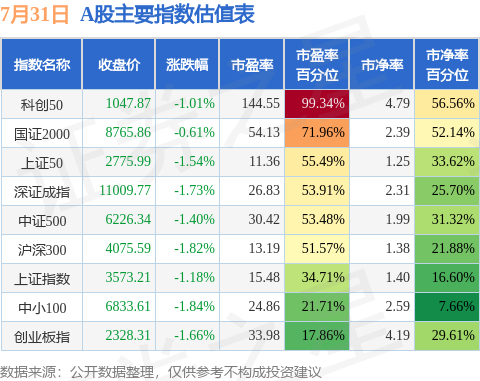
Market Overview - The A-share market experienced a decline on July 31, with the Shanghai Composite Index falling by 1.18% to close at 3573.21 points, the Shenzhen Component Index dropping by 1.73% to 11009.77 points, and the ChiNext Index decreasing by 1.66% to 2328.31 points [1][2]. Index Performance - The major broad-based indices showed varying price-earnings (P/E) ratios, with the Sci-Tech 50 index having a high P/E percentile of 99.34%, while the ChiNext Index had a low P/E percentile of 17.86% [1][2]. - The software index recorded a high P/E percentile of 99.69%, while the 800 Consumer index had a low P/E percentile of 6.42% [4][5]. - The value strategy index (国信价值) had a high P/E percentile of 97.79%, contrasting with the large-cap growth index (大盘成长) which had a low P/E percentile of 46.81% [7][8]. Detailed Index Data - The following are key indices and their respective performance: - Sci-Tech 50: Closed at 1047.87, down 1.01%, P/E 144.55, P/E percentile 99.34% [2]. - Shenzhen Component: Closed at 11009.77, down 1.73%, P/E 26.83, P/E percentile 53.91% [2]. - Software Index: Closed at 15040.97, up 0.46%, P/E 307.69, P/E percentile 99.69% [5]. - 800 Consumer: Closed at 15694.81, down 2.21%, P/E 18.82, P/E percentile 6.42% [5]. - Value Strategy Index: Closed at 3023.64, down 1.90%, P/E 9.54, P/E percentile 97.79% [8].
珠海上半年GDP同比增长3.8%,外贸规模创历史同期新高
2 1 Shi Ji Jing Ji Bao Dao· 2025-07-31 13:35
Economic Overview - Zhuhai's GDP for the first half of the year reached 224.365 billion, with a year-on-year growth of 3.8% [1] - The primary industry added value was 3.004 billion, growing by 3.7%; the secondary industry decreased by 1.3% to 91.755 billion; the tertiary industry increased by 7.4% to 129.606 billion [1] Industrial Performance - The industrial output value above designated size grew by 5.5%, with an increase of 0.7 percentage points compared to the first quarter [1] - The "4+3" industries saw a value increase of 7.2%, with high-end equipment manufacturing, integrated circuits, new energy, and new generation information technology growing by 17.9%, 16.4%, 16.0%, and 15.2% respectively [1] Service Sector Growth - The service sector's added value increased by 7.4%, with information transmission software and IT services growing by 12.1% and leasing and business services by 10.7% [2] - From January to May, the revenue of the service sector above designated size reached 69.681 billion, a year-on-year increase of 10.7% [2] Consumer Market - The total retail sales of social consumer goods reached 46.946 billion, with a growth of 5.0% [2] - Retail sales of daily necessities grew by 9.3%, while the "old-for-new" consumption policy boosted home appliances and communication equipment sales by 40.9% and 131.9% respectively [2] Foreign Trade - Zhuhai's total foreign trade import and export volume reached 168.265 billion, marking an 8.9% year-on-year increase, the highest for the same period historically [2] - Exports totaled 115.417 billion, growing by 4.7%, while imports increased by 19.5% to 52.848 billion [2] Investment Trends - Fixed asset investment decreased by 38.4%, with industrial investment down by 28.0% but showing a 10.3% growth in industrial technological transformation investment [3] - Infrastructure investment fell by 40.6%, and real estate development investment decreased by 42.1% [3] Agricultural Developments - The primary industry saw a 4.9% growth, with fisheries output valued at 5.072 billion, accounting for 76.9% of the total agricultural output [3] - Notable projects include the establishment of the first modern marine ranch in the country and the launch of the world's first deep-sea aquaculture vessel [3]
6月经济数据表现分化
Capital Securities· 2025-07-31 10:42
Group 1: Economic Growth - In Q2, China's actual GDP grew by 5.2% year-on-year, with a target of around 5% for the full year, indicating manageable pressure to meet this goal[3] - The GDP deflator index fell to -1.2% in Q2, marking the ninth consecutive quarter of negative growth, suggesting ongoing price pressures[9] - The contribution of consumption to GDP growth in Q2 was 2.7 percentage points, making it the primary driver of economic expansion[10] Group 2: Industrial Performance - In June, the industrial added value of large-scale enterprises increased by 6.8% year-on-year, exceeding expectations of 5.5%[15] - The export delivery value of large-scale industrial enterprises rose by 4% in June, a 3.4 percentage point increase from the previous value[15] - Key sectors such as automotive manufacturing and electronic equipment manufacturing saw year-on-year growth rates of 11.4% and 11.0%, respectively[15] Group 3: Investment Trends - From January to June, fixed asset investment growth slowed to 2.8%, down 0.9 percentage points, with significant declines in manufacturing and infrastructure investment[21] - Manufacturing investment growth decreased to 7.5%, while infrastructure investment fell to 8.9%, with real estate investment declining by 11.5%[21] - Water management sector investment growth dropped significantly, down 11.2 percentage points to 15.4% year-on-year[25] Group 4: Consumer Spending - In June, the total retail sales of consumer goods grew by 4.8% year-on-year, a decline of 1.6 percentage points from the previous month[29] - Restaurant revenue in June recorded a year-on-year increase of only 0.9%, a drop of 5 percentage points from the previous value[29] - The retail sales of household appliances and communication equipment fell by 20.6% and 19.1%, respectively, indicating weakening consumer demand[29] Group 5: Risk Factors - Potential risks include changes in the external environment and the possibility that the "old-for-new" policy may not meet expectations[34]
ETF榜单来了!7月恒生创新药ETF、港股创新药ETF涨超26%,黄金股ETF调整
Ge Long Hui· 2025-07-31 08:53
Group 1: ETF Performance - In July, the top-performing ETFs included the Hang Seng Innovation Drug ETF and the Hong Kong Innovation Drug ETF, both rising over 26% [1] - The top 10 ETFs in July all recorded gains exceeding 23.9%, with year-to-date increases surpassing 86% [1] - Conversely, gold-related ETFs experienced declines, with several falling over 2% in July [1] Group 2: A-share Market Trends - The A-share market in August is expected to be influenced by policies, external events, and economic fundamentals [5][6] - Historical data shows that the Shanghai Composite Index has had a mixed performance in August, with 7 out of 15 years seeing gains [4] - Positive policies and limited external risks are likely to boost market sentiment in August [6] Group 3: Economic and Profit Recovery - Economic recovery trends are anticipated to continue in August, with improvements in industrial and overall A-share earnings growth [6] - The impact of mid-year earnings reports on A-share performance is diminishing, as seen in previous years [5] Group 4: Market Liquidity - Liquidity conditions are expected to remain accommodative in August, with potential increases in foreign capital inflows due to economic recovery expectations [6] - High market sentiment may lead to increased financing activities and new fund launches [6] Group 5: Investment Strategies - The market style in August is expected to be balanced, with growth and cyclical sectors likely to outperform [7] - The "barbell strategy" (combining technology and dividend stocks) may yield limited excess returns this August due to improving economic and profit expectations [8]
A股点评报告:稳步向好趋势不改
Dongxing Securities· 2025-07-31 03:50
Group 1 - The report indicates a generally optimistic assessment from the Politburo meeting, highlighting that China's economy is showing strong vitality and resilience, with major economic indicators performing well and high-quality development achieving new results [4] - The meeting emphasizes the importance of implementing proactive fiscal policies and moderately loose monetary policies to fully release policy effects, while also recognizing the complex changes in the development environment [4] - The report notes that the capital market's development status is affirmed, with a focus on enhancing the attractiveness and inclusiveness of the domestic capital market, which is crucial for stabilizing market confidence and ensuring financial security [5] Group 2 - The investment strategy suggests that the overall environment is favorable for the stable development of the stock market, with a high likelihood of a slow bull market, recommending a high position with a focus on holding strategies [6] - The report advocates for a stock selection based on economic prosperity, continuing to favor a combination of large technology, high dividends, and consumption, while also paying attention to sectors with good economic prospects such as innovative pharmaceuticals, military industry, and cyclical products [6]