
非银金融

Search documents
“国家队”三季度A股持仓出炉,超4.47万亿!中央汇金、社保基金重仓这些股!
私募排排网· 2025-11-03 10:01
Core Viewpoint - The article discusses the latest holdings of the "National Team" in A-shares as of the end of Q3 2025, highlighting their role in stabilizing the market and the significant increase in their investments in various sectors [2][9]. Group 1: National Team Holdings Overview - As of Q3 2025, the "National Team" is involved in 801 A-share companies, with a total holding value of approximately 44,747 billion yuan, an increase of about 385 billion yuan from Q2 2025 [2][3]. - The largest shareholder among the "National Team" members is Central Huijin, with a holding value of approximately 32,224 billion yuan [3][18]. - The Social Security Fund holds shares in the most companies, totaling 617 A-share companies [3]. Group 2: Sector Allocation - Approximately 84% of the "National Team's" holdings are concentrated in the financial sector, with bank holdings valued at 32,959 billion yuan, accounting for 73.66% of their total holdings [3][9]. - Other sectors with significant holdings include food and beverage, machinery, construction decoration, public utilities, and non-ferrous metals, each exceeding 500 billion yuan in holdings [3]. Group 3: Individual Stock Performance - Among the "National Team's" holdings, 8 stocks have doubled in price this quarter, and 32 stocks have increased by over 70% [6][11]. - Notable performers include Luxshare Precision, which saw its stock price rise over 87% in Q3, with a holding value exceeding 142 billion yuan [6][11]. Group 4: New Investments and Adjustments - In Q3 2025, the "National Team" initiated positions in 22 new companies and increased holdings in 30 companies [11][16]. - The article highlights that 6 of the newly invested companies saw stock price increases exceeding 80% [11]. Group 5: Major Shareholders and Their Strategies - Central Huijin's top three holdings are Agricultural Bank of China, Bank of China, and Industrial and Commercial Bank of China, with a combined holding value exceeding 2.84 trillion yuan [18][19]. - The Social Security Fund's top three holdings also include Agricultural Bank of China and Industrial and Commercial Bank of China, reflecting a strategic focus on major state-owned banks [19][20].






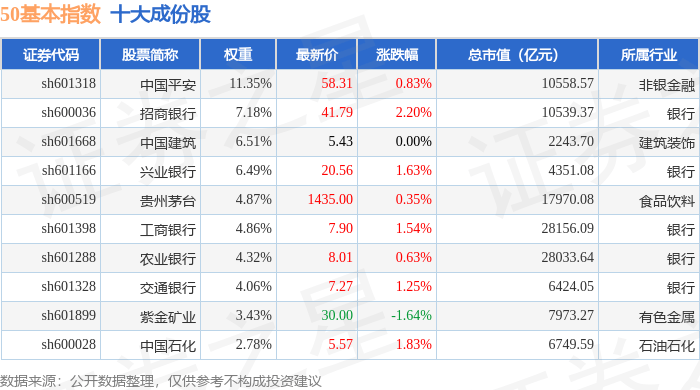
11月3日50基本(000052)指数涨0.78%,成份股中国石油(601857)领涨
Sou Hu Cai Jing· 2025-11-03 09:41
资金流向方面,50基本(000052)指数成份股当日主力资金净流出合计29.79亿元,游资资金净流入合计 11.81亿元,散户资金净流入合计17.98亿元。成份股资金流向详情见下表: 证券之星消息,11月3日,50基本(000052)指数报收于2972.53点,涨0.78%,成交1346.37亿元,换手 率0.32%。当日该指数成份股中,上涨的有30家,中国石油以4.48%的涨幅领涨,下跌的有19家,洛阳钼 业以3.93%的跌幅领跌。 50基本(000052)指数十大成份股详情如下: | 证券代码 | 股票简称 | 权重 | 最新价 | 涨跌幅 | 总市值(亿元) | 所属行业 | | --- | --- | --- | --- | --- | --- | --- | | sh601318 | 中国平安 | 11.35% | 58.31 | 0.83% | 10558.57 | ■ 非银金融 | | sh600036 | 招商银行 | 7.18% | 41.79 | 2.20% | 10539.37 | → 银行 | | sh601668 | 中国建筑 | 6.51% | 5.43 | 0.00% | 224 ...

A股2025年三季报全景分析
GOLDEN SUN SECURITIES· 2025-11-03 09:19
Group 1 - A-share earnings growth shows marginal improvement, with cumulative net profit growth for the entire A-share market and non-financial A-shares in Q3 2025 at 5.54% and 1.89% respectively, reflecting a quarter-on-quarter change of 2.89 and 0.59 percentage points [1][17][20] - Revenue growth in A-shares has accelerated, marking four consecutive quarters of recovery, with cumulative revenue growth for the entire A-share market and non-financial A-shares in Q3 2025 at 1.40% and 0.76% respectively, with quarter-on-quarter changes of 1.22 and 0.94 percentage points [2][28][29] - The technology TMT, midstream manufacturing, and financial sectors have shown superior earnings growth, with cumulative net profit growth in Q3 2025 for these sectors at 21.43%, 12.90%, and 6.48% respectively [3][25][44] Group 2 - The DuPont analysis indicates that profitability, operational efficiency, and financial leverage have all negatively impacted the return on equity (ROE) for non-financial A-shares, with Q3 2025 ROE at 6.38%, reflecting a quarter-on-quarter decline of 2.76% [4][49][52] - The inventory cycle for non-financial A-shares is stabilizing at the bottom, with signs of a shift from passive to active inventory replenishment, although fixed asset turnover continues to decline, indicating an ongoing supply-demand imbalance [5][6][4] - Cumulative net profit growth for industries with high growth and marginal improvement in Q3 2025 includes steel, non-ferrous metals, and non-bank financials, while cumulative revenue growth in these sectors also showed significant improvement [3][44][46]
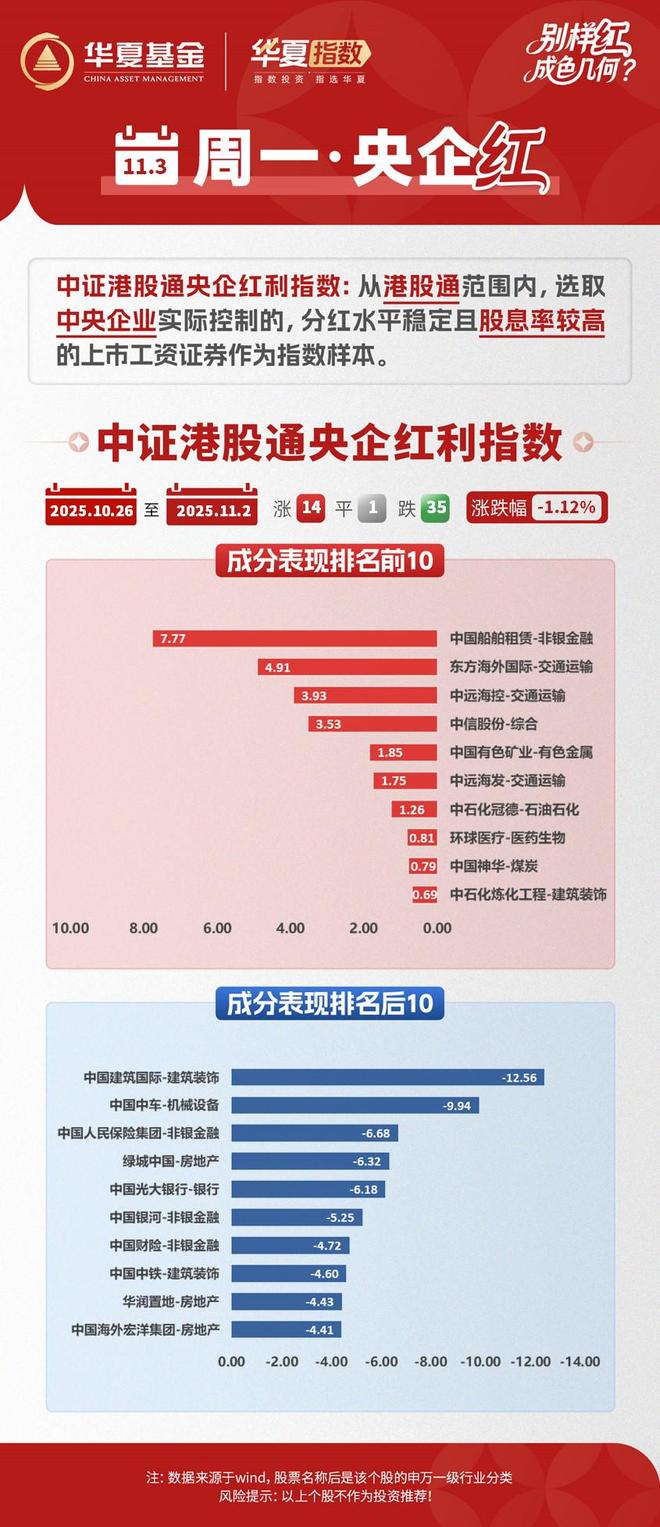
周度表现 | 港股通央企红利指数成分股一周复盘
Xin Lang Cai Jing· 2025-11-03 07:00
中国建筑国际-建筑装饰 -12.56 中国中车-机械设备 -9.94 中国人民保险集团-非银金融 -6.68 绿城中国-房地产 -6,32 中国光大银行-银行 -6.18 中国银河-非银金融 -5.25 中国财险-非银金融 -4.72 中国中铁-建筑装饰 -4.60 华润置地-房地产 -4.43 中国海外宏洋集团-房地产 -4.41 0.00 -2.00 -4.00 -6.00 -8.00 -10.00 -12.00 -14.00 注:数据来源于wind,股票名称后是该个股的申万一级行业分类 风险提示:以上个股不作为投资推荐! #复盘记录 $港股央企红利ETF (513910) 来源:智通财经 ...
“十五五”规划建议发布,未来投资主线怎么把握?来看专家建议
Xin Lang Cai Jing· 2025-11-03 03:01
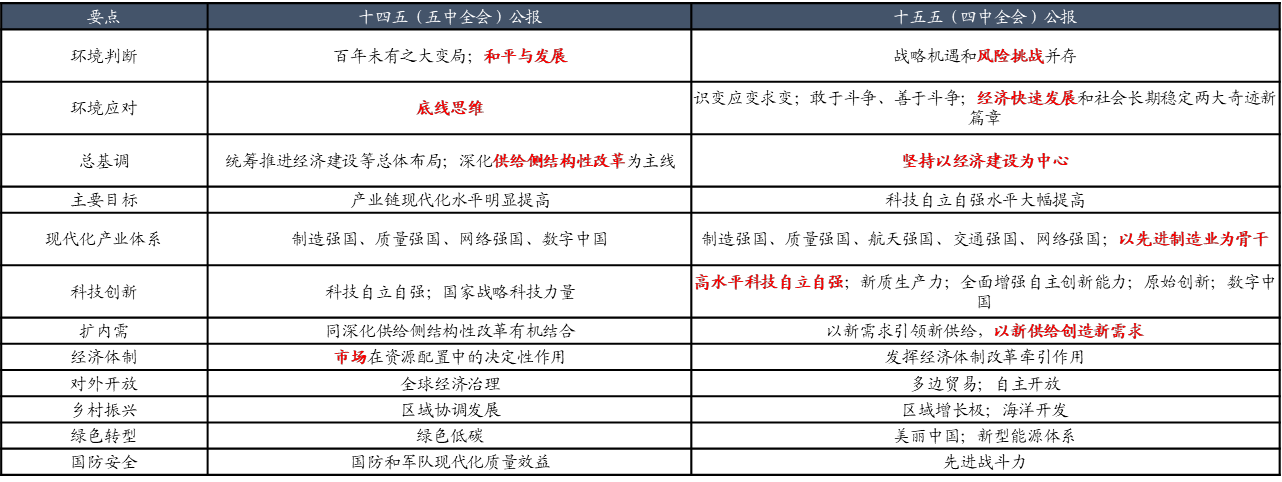
Core Insights - The "15th Five-Year Plan" emphasizes technological self-reliance and innovation as a core strategy, indicating a shift towards original technological innovation and integration with the real economy [1][4] - Key investment areas for the next five years include artificial intelligence, biomedicine, quantum technology, and high-end manufacturing, which are expected to receive policy support [1][4] Policy Direction Comparison - The "14th Five-Year Plan" focused on a comprehensive approach to economic construction, while the "15th Five-Year Plan" emphasizes economic construction as the central theme [1] - The "15th Five-Year Plan" aims for significant improvements in technological self-reliance and a modern industrial system that includes aerospace and transportation [1][3] - The approach to external openness has shifted from global economic governance to multilateral trade and autonomous openness [1][3] Market Structure and Investment Opportunities - Historical analysis shows that A-share market structure changes are closely linked to policy directions, with strategic industries identified in each plan becoming focal points for investment [3] - The current market is expected to focus on new quality productivity, with significant opportunities in AI and manufacturing sectors due to China's competitive advantages [3][4] - The "15th Five-Year Plan" highlights the importance of consumption and proposes policies to boost consumer spending, indicating potential for value reassessment in the consumer sector [5] Sector-Specific Insights - Key sectors expected to thrive include AI, digital economy, and green energy technologies, with specific opportunities in domestic supply chains for advanced chips and energy storage [4][5] - The automotive sector is poised for growth, particularly in intelligent vehicles, as consumer preferences shift towards high-quality products [5] - Investment strategies should focus on core AI-related stocks while being cautious of market volatility, suggesting a balanced approach to capital allocation [6]
2025年三季报深度分析:两非盈利改善,ROE低位反弹
2025-11-03 02:35
Summary of the Conference Call Records Industry Overview - The analysis focuses on the overall performance of the A-share market in Q3 2025, highlighting a significant improvement in net profit growth, particularly in the dual innovation sectors, with the Sci-Tech 50 and ChiNext indices leading in net profit growth rates [1][2]. Key Financial Metrics - The net profit growth rate for the entire A-share market reached 11.55% year-on-year in Q3 2025, a notable increase compared to Q2 [1][2]. - The overall revenue growth for the A-share market was 3.89% year-on-year in Q3, with a cumulative growth of 1.4% for the first three quarters [2]. - The two non-financial sectors (excluding financial and oil & gas industries) showed a revenue growth of 3.5% in Q3, with a cumulative growth of 1.67% [2]. Profitability and Cost Management - The decline in expense ratios significantly contributed to corporate profitability, particularly with financial expenses decreasing by 11% year-on-year [1][6]. - The return on equity (ROE) for the two non-financial sectors slightly rebounded to 6.31% in Q3, although the recovery was weak [1][7]. - The improvement in net profit margins was the main driver for the ROE rebound, while asset turnover remained at a low level [7][10]. Economic Indicators and Their Impact - Macroeconomic indicators showed a rebound in industrial profits due to low base effects in August and September, with improvements in price levels, particularly the Producer Price Index (PPI) [3][11]. - The supply-side reforms are expected to positively influence PPI and related economic indicators, with a potential for PPI to turn positive by mid-2026 [11][12]. Cash Flow Analysis - Overall cash flow in Q3 2025 remained at a low level compared to the past decade, with operating cash flow showing improvement while investment cash flow declined [1][13]. - The operating cash flow for listed companies increased to 7.78% of revenue, up from 6.71% in the previous year, indicating some recovery in profit margins [14]. Sector Performance - The dual innovation sectors (Sci-Tech and ChiNext) showed significant profit improvements, with net profit growth rates of 65.4% and 33.38% respectively [5]. - The TMT (Technology, Media, and Telecommunications) sector maintained high growth, with double-digit net profit growth across various sub-sectors, particularly in semiconductors and optical electronics [23]. - The non-bank financial sector performed well, driven by strong market profitability and significant investment income growth [22]. Consumer Goods Sector - The essential consumer goods sector, particularly the liquor segment, faced challenges with both volume and price declines, impacting even leading companies [19]. - In contrast, the discretionary consumer goods sector saw high growth in segments like sports, automotive services, and cosmetics, benefiting from structural recovery supported by policies [20]. Future Outlook - The economic recovery is expected to accelerate in the latter half of 2025 and into 2026, driven by demand-side policies and improved corporate expectations [18]. - However, there remains uncertainty regarding corporate capital expenditure willingness, as companies have yet to form a strong consensus on future revenue expectations [18]. Conclusion - The overall performance of the A-share market in Q3 2025 indicates a positive trend, with significant improvements in profitability and revenue growth across various sectors. However, challenges remain in consumer goods and the need for sustained economic recovery and corporate investment.
A股市场大势研判:指数震荡整理
Dongguan Securities· 2025-11-02 23:32
Market Overview - The A-share market experienced a volatile adjustment, with major indices collectively declining, particularly the ChiNext index which fell over 2% [2][6] - The Shanghai Composite Index closed at 3954.79, down 0.81%, while the Shenzhen Component Index closed at 13378.21, down 1.14% [2] Sector Performance - The top-performing sectors included pharmaceuticals (up 2.42%), media (up 2.39%), and retail (up 2.08%) [3] - Conversely, the worst-performing sectors were telecommunications (down 4.07%), electronics (down 3.06%), and non-bank financials (down 1.31%) [3] Concept Index Performance - Notable concept indices included recombinant proteins (up 3.72%), cell immunotherapy (up 3.58%), and AI corpus (up 3.42%) [3] - Underperforming concept indices included cultivated diamonds (down 2.96%) and storage chips (down 2.02%) [3] Future Outlook - The report indicates that the market is expected to maintain an upward trend, supported by policies aimed at promoting high-quality development in the capital market during the "14th Five-Year Plan" period [6] - It is suggested to focus on sectors such as banking, oil and petrochemicals, transportation, non-bank financials, and coal for potential investment opportunities [6]
相信“一万小时定律” 追求认知的复利
Zhong Guo Zheng Quan Bao· 2025-11-02 20:16
Core Insights - The article highlights the investment philosophy and strategies of Ma Kewai, founder and chairman of Mingze Investment, emphasizing a systematic approach to investment based on deep industry knowledge and rigorous research [1][4]. Group 1: Investment Philosophy - Ma Kewai's investment style is likened to a "tea connoisseur," focusing on identifying companies with deep roots and unique qualities [1]. - The principle of "extreme truth-seeking and transparency" is central to both Ma's personal and organizational investment strategies [1][4]. - The "10,000-hour rule" serves as a lifelong methodology for Ma, emphasizing systematic learning, deep research, and continuous review to amplify "cognitive compounding" [7][9]. Group 2: Industry Focus and Experience - Ma's background in finance and management within government and large enterprises provides him with a unique perspective on both operational challenges and capital market intricacies [2][3]. - His initial focus on the environmental protection sector allowed Mingze Investment to build a competitive edge through comprehensive market coverage, achieving significant milestones in just 19 months [3][4]. - The transition from environmental investments to sectors like non-bank finance, high-end manufacturing, consumption, and healthcare reflects a strategic expansion based on systematic knowledge transfer [7][9]. Group 3: Systematic Investment Framework - Mingze Investment employs a structured investment strategy characterized by "three objects + six elements + one veto + ESG evaluation" [4][5]. - The "three objects" include trends, deviations from trends, and structural changes, which are fundamental to the investment strategy [5]. - The six elements encompass industry and company dynamics, liquidity and investor sentiment, profit growth and structure, valuation, policy, and economic cycles [6]. Group 4: Future Outlook and Strategic Focus - The company anticipates a "long-term steady progress" trend in China's capital market, with a focus on new productive forces and sustainable investment opportunities [8][9]. - Key areas of interest include technological innovation, AI, and structural opportunities related to safety, consumption, and effective investment [8][9].
A股分析师前瞻:历史上的11月风格更偏向炒小、炒题材?
Xuan Gu Bao· 2025-11-02 13:55
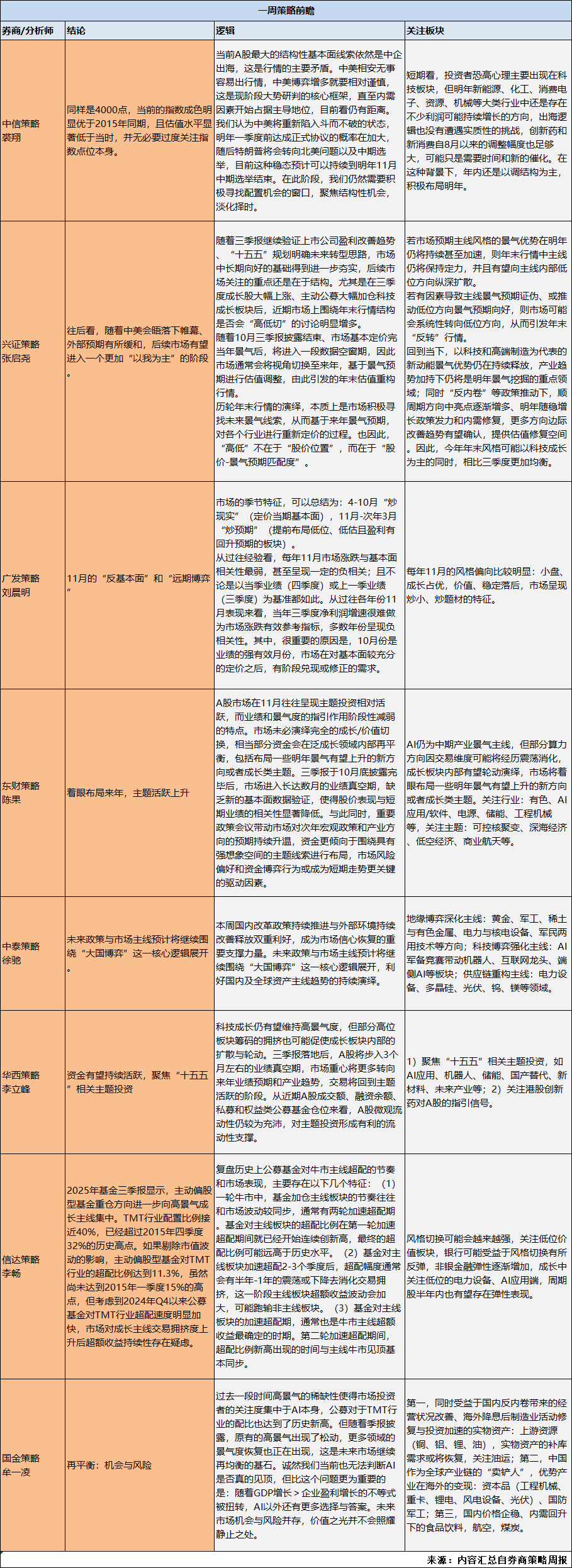
Group 1 - The core viewpoint of the articles discusses the historical market trends in November and year-end, highlighting a shift from "pricing current fundamentals" from April to October to "pricing expectations" from November to March of the following year [1][5] - Historical data indicates that the correlation between market performance in November and fundamentals is weak, often showing a negative correlation, as October is a strong earnings month leading to a need for market correction [1][5] - The market style in November tends to favor small-cap and growth stocks while value and stability lag behind, reflecting a trend of speculative investments in smaller themes [1][5] Group 2 - The year-end market performance is characterized by a search for future economic clues, leading to a revaluation of various industries based on next year's economic expectations [2][3] - The technology and high-end manufacturing sectors are expected to continue their growth momentum, becoming key areas for economic exploration in the coming year [2][3] - The "anti-involution" policies are expected to enhance cyclical sectors, with more areas showing marginal improvement trends, providing room for valuation recovery [2][3] Group 3 - The market is anticipated to enter a more balanced phase with a focus on technology growth, compared to the previous quarter [3] - The scarcity of high-growth sectors has led to increased investor focus on AI, with public funds heavily weighted towards the TMT sector, reaching historical highs [3][6] - As earnings reports conclude, the market is expected to shift focus towards next year's performance expectations and industry trends, leading to a more active thematic investment phase [5][6]
增长正归来——2025年三季报业绩点评
Huachuang Securities· 2025-11-02 13:13
Group 1 - The overall A-share market has entered a continuous upward profit cycle, with Q3 2025 net profit growth of 11.3% YoY for all A-shares and 3.9% for non-financial A-shares, significantly up from Q2 2025 figures of 1.3% and -2.1% respectively [10][14][18] - The forecast for 2025 net profit growth for all A-shares and non-financial A-shares has been revised to a neutral 5.4% and 5.1% respectively, with Q4 2025 expected to show continued recovery in net profit growth [2][15][18] - Q3 2025 return on equity (ROE) for all A-shares was 7.9%, a slight increase from Q2, with net profit margin rising and asset turnover slightly declining [3][25][29] Group 2 - Growth in profit margins is leading over value, with significant contributions from the electronics, non-ferrous metals, steel, and new energy sectors in Q3 2025 [4][30][33] - The cumulative net profit growth for the ChiNext Index in Q3 2025 was 20.1%, compared to 4.9% for the SSE 50, indicating a clear advantage for growth style over value style [30][31] - Most industries reported positive profit growth in Q3 2025, with electronics, non-ferrous metals, steel, and new energy contributing the most, while real estate and agriculture sectors showed significant declines [4][33][39]