
电气机械

Search documents
PPI 分析与预测
Guo Tai Jun An Qi Huo· 2025-11-17 13:19
Report Overview - The report mainly analyzes the basic overview of China's PPI data, the composition of PPI weights, core driving industries, and forecasts the PPI trend in 2026 [1][4] Industry Investment Rating - Not mentioned in the report Core Viewpoints - China's PPI trend is determined by the combined effect of weights and price change amplitudes of various categories, with upstream resource and basic material industries as the core drivers [1] - Two methods are used to predict that the year - on - year decline of PPI in 2026 will narrow and turn positive, with the base effect contributing significantly to the year - on - year recovery [2] Summary by Directory 1. China PPI Data Basic Overview - China's PPI only includes the commodity production field, different from the US PPI which also covers services [7] - China's PPI uses two parallel classification systems: the dichotomy (production and living materials) and the industry - based method, with production materials dominating the PPI trend [11] - The weights of both classification systems are determined by the sales output value method, and they are adjusted every five years, with the current base period being 2020 [13] 2. PPI Weight's Composition and Core Driving Industries - PPI is calculated by weighted average of price indices of surveyed industries, and market generally uses "operating income" to estimate industry weights [16] - Industries like computer, electrical machinery have high weights but limited impact on PPI due to stable prices, while upstream resource industries such as coal, oil have significant influence [20] - In October 2025, the year - on - year decline of PPI production materials was 2.4%, with the mining industry having the largest decline, and among living materials, durable consumer goods had the largest decline [22][24] 3. PPI Trend Calculation - Based on the assumption of key commodity prices remaining stable in 2025 November, 2026 PPI year - on - year will turn positive in Q2, driven by non - ferrous metals, coal, and black/chemical industries successively [28] - Using the method of calculating year - on - year from month - on - month, it is predicted that the average monthly - on - month PPI in 2026 will be 0.02%, the annual PPI will be - 0.44%, and the year - on - year reading will turn positive in Q3 [30]
中国出口的真正“爆单王”,为什么是遥远的非洲?
Ge Long Hui· 2025-11-13 09:23
Core Insights - China's exports to Africa have surged by 25.9% year-on-year, significantly outpacing other regions, with total exports expected to exceed $200 billion in 2023 [1][2] - The increase in exports is driven by strategic policy changes, strong demand, and China's competitive manufacturing advantages [2][3] Group 1: Policy and Trade Dynamics - Strategic policy initiatives, such as the implementation of a 100% zero-tariff policy on goods from 53 African countries, have opened new trade opportunities [2][5] - The restructuring of global trade dynamics, particularly in contrast to U.S. tariffs on African trade partners, has positioned China favorably in the African market [2][6] Group 2: Market Potential and Demand - Africa's significant market potential, characterized by a young population and a growing demand for infrastructure, has made China an essential partner in the continent's industrialization [3][4] - Key import categories from China include machinery, electrical equipment, and vehicles, which account for approximately 55% of imports, driving export growth [3][4] Group 3: Competitive Advantages - China's manufacturing sector benefits from a complete industrial chain, allowing for cost-effective production and competitive pricing in the African market [3][4] - The depreciation of the offshore RMB has further enhanced the price competitiveness of Chinese goods in Africa [4][5] Group 4: Structural Challenges and Risks - Despite the growth potential, Africa's economic and political risks, including varying levels of stability across countries, pose challenges for sustained trade [6][7] - The continent's weak industrial base, with manufacturing contributing only 10%-11% to GDP, indicates a reliance on primary product exports, making it vulnerable to global commodity price fluctuations [7][10] Group 5: Strategic Recommendations - Companies should adopt a long-term strategy focused on deepening cooperation and establishing a strong market presence rather than seeking quick profits [8][9] - Emphasizing core product categories, particularly in infrastructure and renewable energy, will be crucial for capturing growth opportunities in Africa [9][10]
库存周期跟踪报告:上游“主动补”,中下游“主动去”
SINOLINK SECURITIES· 2025-11-10 15:23
Inventory Overview - In September 2025, the inventory of finished products in industrial enterprises increased by 0.5 percentage points to 2.8% year-on-year[7] - The overall industrial inventory cycle has seen a trend of "active restocking" following the spring peak[13] Industry-Specific Trends - The upstream sector (mining, accounting for only 2% of total inventory) is experiencing "active restocking" as of September 2025[15] - The midstream sector (upper and mid-level manufacturing, comprising 54% of total inventory) is undergoing "active destocking" as of September 2025[17] - The downstream sector (downstream manufacturing and utilities, making up 43% of total inventory) is also in a phase of "active destocking" as of September 2025[20] Risk Considerations - There are statistical sampling errors in the data, which may lead to discrepancies with actual conditions[2]
游资抢班夺权,却成就了咱小散!
Sou Hu Cai Jing· 2025-11-10 01:22
Group 1 - The core viewpoint emphasizes the importance of being proactive in the current market environment, as funds are actively moving, and inaction could lead to missed opportunities [1] - The A-share market has shown resilience compared to overseas markets, but concerns about the Federal Reserve's next interest rate decision have created uncertainty in the underlying logic of the current market trend [1][3] - The significance of technology stocks in the U.S. market is highlighted, as they are seen as crucial for maintaining the strength of the dollar amidst declining oil dollar influence [3] Group 2 - Retail investors are currently in a favorable position, as the market has not declined significantly, providing more opportunities for them [6] - Institutional investors are focusing on individual stocks rather than the overall index, indicating a mature investment strategy that prioritizes stock performance over index levels [6][8] - The phenomenon of "first-day speculation" has reached a two-week high, suggesting that investors are still optimistic about market opportunities despite uncertainties [10] Group 3 - The market's performance is relatively stable compared to overseas markets, with A-shares showing strength, which is attributed to the management's commitment to market support [13] - Institutions are actively engaging in "testing the waters" to identify potential new leaders in various sectors, with different sectors leading the market on different days [13] - The presence of "institutional accumulation" before stock price surges indicates that institutional funds are already participating in the market, which is a positive sign for future performance [23]


跟着总书记的考察足迹丨瞰广东
Xin Hua Wang· 2025-11-08 00:20
Core Points - Guangdong is recognized as a pioneer in China's economic reform and development, historically significant for its contributions to modernization and revolution [1] - The Guangdong-Hong Kong-Macao Greater Bay Area is advancing in integrated development, with Guangdong leading in various industries [1] Industry Overview - Guangdong has the largest scale in 15 industries, including electronic information manufacturing, automotive, and electrical machinery, ranking first nationwide [1] - The province is projected to become the first in China to exceed an economic total of 14 trillion yuan by 2024 [1] - Guangdong produces one out of every three industrial robots in China, highlighting its manufacturing strength [1]

同类规模最大的自由现金流ETF(159201)盘中涨超2.2%,成交额率先突破3.3亿元
Mei Ri Jing Ji Xin Wen· 2025-11-06 06:25
Core Viewpoint - The A-share market experienced a rebound on November 6, with the Shanghai Composite Index returning to 4000 points, indicating a positive shift in market sentiment and potential investment opportunities in the near future [1] Group 1: Market Performance - The National Free Cash Flow Index rose over 2.2%, with seven constituent stocks hitting the daily limit up, including Changbao Co., Haili Heavy Industry, Weichai Power, and others [1] - The largest free cash flow ETF (159201) followed the index's upward trend, attracting a total net inflow of 950 million yuan over the past 17 days, with intraday trading volume exceeding 330 million yuan [1] Group 2: Financial Indicators - National Investment Securities reported that the Q3 financial results for A-shares showed improvements in three core indicators: profit, revenue, and ROE compared to H1 [1] - The simultaneous improvement in free cash flow and net profit margin suggests that the earnings bottom for A-shares is becoming clearer, increasing the likelihood of a transition to a fundamental bull market over the next six months [1] Group 3: ETF and Fund Characteristics - The free cash flow ETF (159201) and its linked funds focus on industry leaders with abundant free cash flow, covering sectors such as non-ferrous metals, automotive, petrochemicals, and power equipment, which helps mitigate risks associated with single industry fluctuations [1] - The fund management annual fee is 0.15%, and the custody annual fee is 0.05%, both of which are among the lowest in the market [1]
中元股份易主鼎龙股份实控人 拟定增募资不超5亿巩固行业优势
Chang Jiang Shang Bao· 2025-11-05 01:12
Core Viewpoint - The control of Zhongyuan Co., Ltd. has changed hands again, with the new actual controllers being Zhu Shuangquan, Zhu Shunquan, and Zhu Mengqian, following a rapid process of only four days from announcement to completion of the transfer [1][2]. Group 1: Control Change Details - On October 30, 2023, a voting rights entrustment agreement was signed, allowing the new controllers to exercise the voting rights of 101 million shares, representing 25.63% of the total voting rights [2][3]. - The company plans to issue up to 61.35 million shares to the new controllers, raising a total of up to 500 million yuan, with the share price set at 8.15 yuan per share [3][4]. - After the issuance, the new controllers will collectively hold 26.68% of Zhongyuan's shares, solidifying their control over the company [3][4]. Group 2: Financial Performance - For the first three quarters of 2025, Zhongyuan reported revenue of 415 million yuan, an increase of 18.65% year-on-year, and a net profit attributable to shareholders of 113 million yuan, up 69.27% year-on-year [1][8]. - In the third quarter alone, the company achieved revenue of 178 million yuan, reflecting a year-on-year growth of 20.13%, and a net profit of 54 million yuan, which is a 60.21% increase compared to the same period last year [7][8]. Group 3: Strategic Intentions - The change in control is aimed at bringing in a new actual controller with strong financial capabilities to enhance the company's competitiveness and governance, promoting long-term sustainable development [8]. - The new controllers are expected to support the company's business development, ensuring a stable shareholding structure and reinforcing control over the company [3][4].


聚焦进博会|共享中国大市场的时代机遇
Jing Ji Ri Bao· 2025-11-05 00:40
Group 1 - The China International Import Expo (CIIE) is a significant event showcasing China's commitment to openness and global cooperation, with participation from 155 countries and over 4,100 foreign enterprises [1][2] - China has maintained its position as the world's second-largest import market for 16 consecutive years, with imports of goods and services expected to exceed $15 trillion during the 14th Five-Year Plan period [2] - The CIIE has become a platform for multinational companies to launch new products and technologies, with 461 new products, technologies, and services showcased at this year's event [4] Group 2 - Medtronic has established a digital healthcare innovation base in Beijing, highlighting its commitment to the Chinese market, which is expected to become the largest healthcare market globally [3] - Sanofi has consistently participated in the CIIE for eight years, emphasizing its long-term investment in the Chinese market and its end-to-end value chain from R&D to commercial operations [3] - Schneider Electric has built five R&D centers in China, showcasing its innovations in digital technology and energy solutions at the CIIE, reinforcing its strategy of "developing in China for the world" [5] Group 3 - The CIIE promotes inclusive and sustainable economic globalization, providing opportunities for developing countries and small enterprises to access the Chinese market [6][7] - The event has facilitated the entry of products from the least developed countries into China, supporting local industries and improving livelihoods [6] - Over 1,500 small and medium-sized enterprises participated in the CIIE, demonstrating its role as a platform for global SMEs to share opportunities in the Chinese market [7]
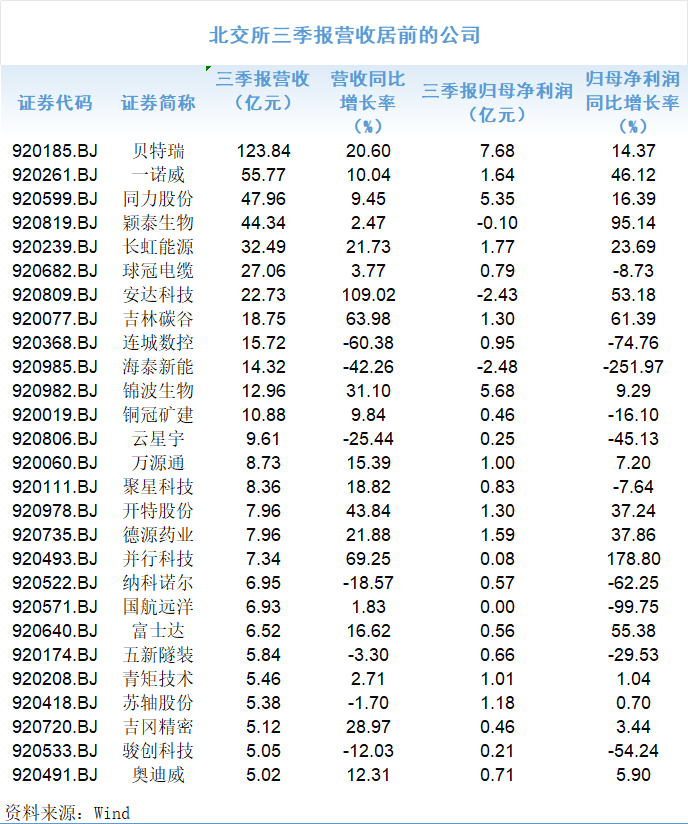
北交所三季报成绩出炉:超八成盈利,多家拟分红
Di Yi Cai Jing· 2025-10-31 06:37
Core Insights - Cash dividends continue to be a highlight during the third quarter report disclosure period for companies on the Beijing Stock Exchange [1][9] - As of October 30, 279 companies have disclosed their third-quarter reports, with an average revenue of 520 million yuan, reflecting a nearly 6% year-on-year growth [1][2] - The North Exchange 50 constituent stocks have significantly contributed to overall performance, accounting for nearly 40% of total revenue [1][2] Financial Performance - The 279 companies reported a total revenue of approximately 145 billion yuan and a net profit of about 9.2 billion yuan, with 82.44% of companies being profitable [2][3] - Bettery leads the revenue rankings with 12.384 billion yuan, a year-on-year increase of 20.6%, and a net profit of 768 million yuan, up 14.37% [2][6] - Other notable companies include Yinuowei and Tongli Co., with revenues of 5.577 billion yuan and 4.796 billion yuan, respectively, both showing year-on-year growth [2][6] Dividend Distribution - Over 10 companies have announced cash dividends, with a total payout exceeding 300 million yuan [1][9] - 13 companies have released dividend proposals, with the highest per-share dividend being 0.6 yuan from Dingjia Precision [9][10] - Guohang Ocean plans to distribute 55.54 million yuan, while several other companies also propose significant payouts [9][10] Growth Dynamics - Five companies reported revenue growth exceeding 100%, with Zhuozhao Point Glue showing a remarkable increase of 164.92% [3] - Two companies, Sunyu Precision and Geli Er, experienced substantial net profit growth, with increases of 2586.85% and 1271.07%, respectively [4][6] Losses and Challenges - Some companies reported losses, including Haitai New Energy, which saw a revenue decline of 42.26% and a net loss of 248 million yuan [6][7] - The decline in revenue and profit for Haitai New Energy is attributed to price drops in the photovoltaic industry, affecting overall profitability [7]
日立股价一度上涨10%
Mei Ri Jing Ji Xin Wen· 2025-10-31 00:29
Group 1 - The Nikkei index has seen an increase, with Hitachi's stock price rising by 10%, marking the largest gain since October 3 [1] - The rise in Hitachi's stock price reflects positive market sentiment and investor confidence [1] - The overall market trend indicates a bullish outlook for Japanese stocks [1]