贵金属

Search documents
[2月1日]美股指数估值数据(黄金白银大跌,原因为何?)
银行螺丝钉· 2026-02-01 13:40
Core Viewpoint - The article discusses the recent trends in global stock markets, highlighting fluctuations in various indices and the impact of liquidity changes on asset valuations. Group 1: Global Market Trends - This week, global stock markets experienced slight increases with minimal volatility [1] - U.S. stocks showed mixed performance with minor fluctuations [2] - Non-U.S. global stock indices also saw slight increases [3] - The Hong Kong stock market was notably strong, with the Hang Seng Index rising by 2.3%, leading global gains [5] - The majority of the global stock market gains occurred from Monday to Thursday, while Friday saw significant volatility [6][7] - On Friday evening, global stock indices fell by 0.87% [8] Group 2: Commodity Market Volatility - The commodity market experienced substantial fluctuations, with gold prices dropping by 9.25% [10] - Silver prices fell by 26%, with an intraday drop of 35%, marking the largest single-day decline in the past two to three decades [11] - The volatility in silver is attributed to two main factors: prior short-term surges leading to high valuations and market concerns over potential changes in Federal Reserve policies following Trump's nomination of a hawkish Fed chair [12][18] Group 3: Small Asset Rally - Over the past two years, there has been a "small asset frenzy" in global markets, with A-shares and small-cap stocks leading the gains [21] - Many small-cap stocks in countries like South Korea, Japan, Brazil, and Spain have also seen significant increases [22] - The primary driver of this trend is the anticipated interest rate cuts by the Federal Reserve starting in September 2024, leading to increased liquidity in the market [24][25] Group 4: Market Valuation Insights - The article references Warren Buffett's perspective on liquidity cycles, indicating that during a rate-cutting phase, high valuations may present profit-taking opportunities, while tightening phases may reveal undervalued assets [30][31] - Historical data shows that after significant rate hikes by the Fed in 2021-2022, A-shares and Hong Kong stocks fell to lower valuation levels [32] - Current market concerns are primarily driven by news, but a rebound in some assets is expected once fear subsides [34] Group 5: Global Stock Index Evaluation - The article presents a star rating system for global stock indices, indicating that the market is currently not very cheap, with a star rating around 2.8 [37] - The star rating system categorizes 4-5 stars as relatively low valuation, while 1-2 stars indicate higher valuations [38] Group 6: Investment Opportunities - The article discusses the availability of global stock index funds in overseas markets, which total over a trillion dollars, but notes the lack of such funds in mainland China [40] - The company has introduced a "Global Index Advisory Portfolio" that diversifies investments across multiple stock markets [41] - There are limitations on investment amounts for mainland investors, with a maximum daily purchase of 50 yuan [43] Group 7: New Publication - The company has released a new book titled "Dividend Index Fund Investment Guide," which quickly became a bestseller on platforms like JD.com [46] - The book aims to address common investor questions regarding dividend products and is designed for easy understanding [47]


新任美联储主席政策引发担忧,金银价格回调
Guolian Minsheng Securities· 2026-02-01 13:35
Investment Rating - The report maintains a "Buy" rating for the industry and specific companies within the non-ferrous metals sector, highlighting a positive outlook for gold and silver prices in the medium to long term [2][4]. Core Views - The new Federal Reserve Chairman's policies have raised concerns, leading to a correction in gold and silver prices. However, the long-term trend remains bullish due to central bank gold purchases and a weakening dollar credit [2][8]. - The report emphasizes the importance of geopolitical factors and macroeconomic policies in influencing metal prices, particularly in the context of expanding domestic demand in China [8][24]. Summary by Sections 1. Industry and Stock Performance - The SW Non-ferrous Index increased by 3.37% during the week, while the Shanghai Composite Index fell by 0.44% [8]. - Key companies recommended for investment include Zijin Mining, China Molybdenum, and Yunnan Aluminum, among others, with a focus on their earnings forecasts and valuations [2][8]. 2. Base Metals - Aluminum prices are influenced by geopolitical tensions and domestic production adjustments, with a notable increase in aluminum inventory [24][28]. - Copper prices are expected to remain stable, supported by a weak dollar and increased import activity, despite a generally subdued demand environment [45][48]. - Zinc prices have shown volatility due to external factors and domestic supply disruptions, with a recent increase in prices observed [49][50]. 3. Precious Metals and Minor Metals - Gold and silver prices are projected to rise in the medium term, driven by central bank purchases and a weakening dollar [2][8]. - The report highlights the potential for price increases in cobalt and nickel due to supply constraints and geopolitical factors [2][24][63]. 4. Rare Earths - The report does not provide specific insights into rare earths, focusing instead on the broader non-ferrous metals market [10].




金属、新材料行业周报:资金博弈加剧,金属板块波动放大-20260201
Shenwan Hongyuan Securities· 2026-02-01 13:10
Investment Rating - The report maintains a "Positive" outlook on the metals and new materials industry [3]. Core Insights - The report highlights increased volatility in the metals sector due to intensified capital competition, with the non-ferrous metals index outperforming the broader market indices [2][5]. - The report suggests that the precious metals sector is poised for recovery, driven by central bank gold purchases and a favorable long-term outlook for gold prices [4][24]. - Industrial metals, particularly copper and aluminum, are expected to see price increases due to stable supply-demand dynamics and significant infrastructure investments [4][48]. Weekly Market Review - The Shanghai Composite Index fell by 0.44%, while the Shenzhen Component Index dropped by 1.62%. In contrast, the non-ferrous metals index rose by 3.37%, outperforming the CSI 300 Index by 3.29 percentage points [5][8]. - Year-to-date, the non-ferrous metals index has increased by 22.59%, surpassing the CSI 300 Index by 20.94 percentage points [9]. Price Changes - The report details price fluctuations for various metals, with copper prices increasing by 0.32% and aluminum prices decreasing by 0.79% week-on-week [16]. - Precious metals saw significant price changes, with gold prices down by 1.52% and silver prices down by 17.44% [16]. Inventory Changes - Copper inventories in domestic markets decreased by 0.7 million tons, while exchange inventories increased by 2.5 million tons [33]. - Aluminum social inventories totaled 102.55 million tons, reflecting a week-on-week increase of 6.05 million tons [49]. Sector-Specific Insights - **Precious Metals**: The report emphasizes the potential for gold prices to rise due to increased central bank purchases and a favorable economic outlook [24]. - **Industrial Metals**: Copper demand is expected to remain strong, supported by infrastructure investments and a stable supply chain [4][33]. - **Aluminum**: The report notes a decrease in the operating rates of downstream processing enterprises, indicating potential supply constraints [48]. Growth Cycle Investment Analysis - The report recommends focusing on stable supply-demand dynamics in the new energy manufacturing sector, highlighting companies such as Huafeng Aluminum and Baowu Magnesium [4].



黄金白银闪崩市民抄底囤金4000克,小米SU7停产iPhone均价引关注
3 6 Ke· 2026-02-01 12:38
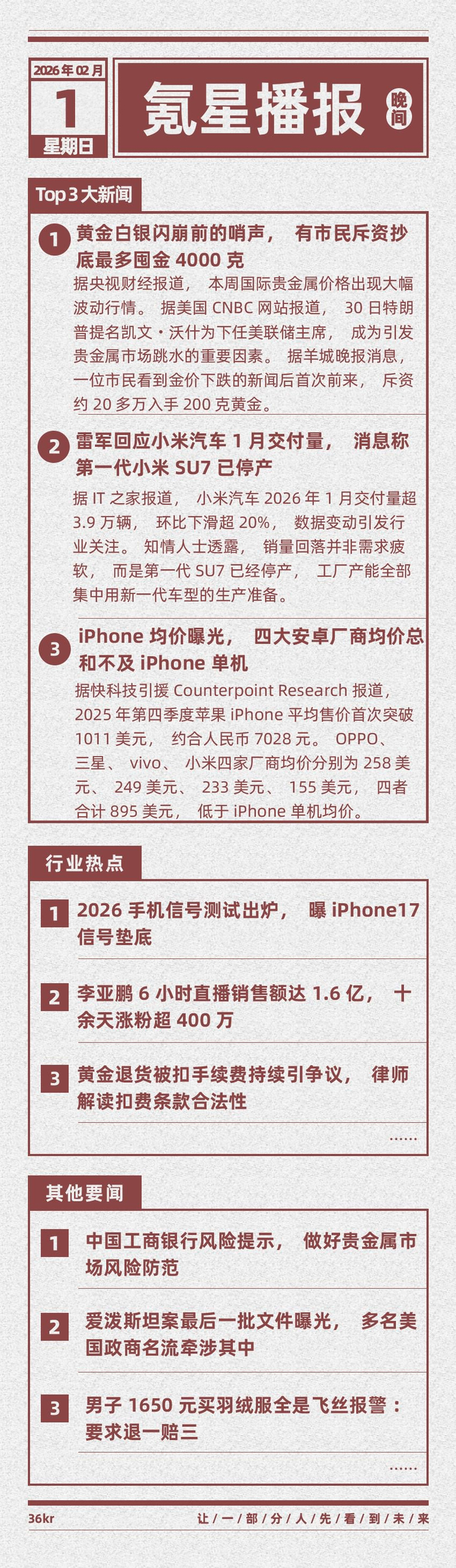
Group 1 - Significant fluctuations in international gold prices were reported, influenced by the nomination of Kevin Walsh as the next Federal Reserve Chairman, which triggered a drop in the precious metals market [6] - A citizen invested approximately 200 grams of gold, spending around 200,000 yuan, following news of declining gold prices [6] Group 2 - Xiaomi's January 2026 delivery volume exceeded 39,000 vehicles, reflecting a more than 20% month-over-month decline, attributed to the discontinuation of the first-generation SU7 model and a shift in production focus to new models [7] - The average selling price of the iPhone surpassed $1,011 in Q4 2025, while the combined average prices of four major Android manufacturers (OPPO, Samsung, vivo, Xiaomi) totaled $895, indicating a significant price gap [8]
白银短期风险或依然处于高位
HTSC· 2026-02-01 12:37
Quantitative Models and Construction Methods 1. Model Name: Commodity Term Structure Model - **Model Construction Idea**: This model captures the contango and backwardation states of commodities by utilizing the roll yield factor. It dynamically goes long on commodities with high roll yields and short on those with low roll yields[23] - **Model Construction Process**: The model is based on the roll yield factor, which is calculated as: $ Roll Yield = \frac{F_{t,T} - S_t}{S_t} $ where $ F_{t,T} $ is the futures price at time $ t $ for maturity $ T $, and $ S_t $ is the spot price at time $ t $[23] The portfolio dynamically adjusts positions to go long on commodities with higher roll yields and short on those with lower roll yields[23] - **Model Evaluation**: The model effectively captures the term structure dynamics of commodities, providing a systematic approach to exploit roll yield opportunities[23] 2. Model Name: Commodity Time-Series Momentum Model - **Model Construction Idea**: This model identifies medium- to long-term trends in domestic commodities using multiple technical indicators. It dynamically goes long on assets with upward trends and short on those with downward trends[23] - **Model Construction Process**: The model uses technical indicators such as moving averages and momentum signals to identify trends. Positions are adjusted dynamically based on the direction of these trends[23] - **Model Evaluation**: The model is effective in capturing momentum effects in commodity markets, particularly in trending environments[23] 3. Model Name: Commodity Cross-Sectional Inventory Model - **Model Construction Idea**: This model captures changes in the fundamentals of domestic commodities using inventory factors. It dynamically goes long on assets with declining inventories and short on those with increasing inventories[23] - **Model Construction Process**: The inventory factor is calculated as: $ Inventory Factor = \frac{\Delta Inventory}{Average Inventory} $ where $ \Delta Inventory $ is the change in inventory levels, and $ Average Inventory $ is the average inventory over a specific period[23] Positions are adjusted dynamically based on the direction of inventory changes[23] - **Model Evaluation**: The model provides a systematic approach to exploit inventory-driven price movements, particularly in supply-constrained markets[23] 4. Model Name: Commodity Fusion Strategy - **Model Construction Idea**: This strategy combines the three sub-strategies (term structure, time-series momentum, and cross-sectional inventory) using an equal-weighted approach to achieve diversification and enhance returns[19][23] - **Model Construction Process**: The net value of the fusion strategy is calculated as: $ Net Value = \frac{1}{3} \times (Term Structure + Time-Series Momentum + Cross-Sectional Inventory) $ Each sub-strategy contributes equally to the overall portfolio[19][23] - **Model Evaluation**: The fusion strategy benefits from diversification, reducing the risk of relying on a single factor while maintaining robust performance across different market conditions[19][23] --- Model Backtesting Results 1. Commodity Term Structure Model - **Two-Week Return**: -0.42%[22] - **Year-to-Date Return**: 0.04%[25] 2. Commodity Time-Series Momentum Model - **Two-Week Return**: 1.79%[22] - **Year-to-Date Return**: 2.17%[30] 3. Commodity Cross-Sectional Inventory Model - **Two-Week Return**: -1.11%[22] - **Year-to-Date Return**: -2.15%[35] 4. Commodity Fusion Strategy - **Two-Week Return**: 0.09%[22] - **Year-to-Date Return**: 0.02%[19] --- Quantitative Factors and Construction Methods 1. Factor Name: Roll Yield Factor - **Factor Construction Idea**: Measures the profitability of rolling futures contracts, capturing the contango or backwardation state of the market[23] - **Factor Construction Process**: $ Roll Yield = \frac{F_{t,T} - S_t}{S_t} $ where $ F_{t,T} $ is the futures price at time $ t $ for maturity $ T $, and $ S_t $ is the spot price at time $ t $[23] 2. Factor Name: Momentum Factor - **Factor Construction Idea**: Identifies trends in commodity prices using technical indicators such as moving averages and momentum signals[23] - **Factor Construction Process**: The factor is derived from the slope of the moving average or the momentum signal over a specific period[23] 3. Factor Name: Inventory Factor - **Factor Construction Idea**: Captures changes in commodity fundamentals by analyzing inventory levels[23] - **Factor Construction Process**: $ Inventory Factor = \frac{\Delta Inventory}{Average Inventory} $ where $ \Delta Inventory $ is the change in inventory levels, and $ Average Inventory $ is the average inventory over a specific period[23] --- Factor Backtesting Results 1. Roll Yield Factor - **Two-Week Return Contribution**: Top contributors include zinc (0.12%), rapeseed oil (0.10%), and soybean oil (0.09%)[27][29] 2. Momentum Factor - **Two-Week Return Contribution**: Top contributors include zinc (0.43%), LPG (0.29%), and palm oil (0.28%)[30][33] 3. Inventory Factor - **Two-Week Return Contribution**: Top contributors include crude oil (0.57%), rubber (0.27%), and rapeseed oil (0.26%)[37][39]
有色金属行业周报:宏观情绪降温,金属价格普调
国盛证券有限责任公司· 2026-02-01 12:24
Investment Rating - The report maintains a "Buy" rating for several companies in the non-ferrous metals sector, including Zijin Mining, Chifeng Jilong Gold Mining, and others [9]. Core Insights - The report highlights a significant drop in precious metals prices, with silver experiencing a historical one-day decline of 36% and gold dropping over 12% [1]. - Macro sentiment has cooled, leading to a collective decline in metal prices, particularly in copper and aluminum, while nickel prices have shown volatility [2][3]. - Supply constraints in copper production are evident, with major companies like Glencore and Southern Copper reducing their output forecasts [2]. - The aluminum market is influenced by international geopolitical tensions and macroeconomic policies, leading to fluctuating prices [3]. - Nickel prices have seen a sharp decline due to macroeconomic sentiment and supply-side cost pressures [4]. - Tin prices are expected to remain supported due to supply chain bottlenecks, despite weak demand [4]. - Lithium prices have retreated from highs due to regulatory disruptions and market liquidity tightening, but there is still fundamental support for prices [5]. - Cobalt prices have stabilized as trading activity slows ahead of the Chinese New Year [8]. Summary by Sections Precious Metals - Significant price drops were noted, with gold and silver experiencing their largest daily declines in decades [1]. - The report suggests monitoring companies like Zijin Mining and Shandong Gold for potential investment opportunities [1]. Industrial Metals - Copper inventories have increased globally, with a notable rise in U.S. stocks, while supply constraints persist due to production cuts from major mining companies [2]. - Aluminum production remains stable, but demand is expected to recover as the market enters a peak season [3]. - Nickel prices have fluctuated significantly, influenced by macroeconomic factors and supply-side constraints [4]. Energy Metals - Lithium prices have decreased due to regulatory impacts and market dynamics, but demand remains strong as companies prepare for future production needs [5]. - Cobalt prices have shown stability, with a slowdown in trading activity as the market approaches the holiday season [8]. Company Announcements - Zijin Mining announced a significant acquisition of a gold mining company, which could enhance its resource base [36]. - Huayou Cobalt signed a cooperation agreement to develop an integrated battery supply chain project in Indonesia [36]. - Tianqi Lithium reported progress on its lithium production expansion project, aiming to meet future demand [36].

金银暴跌只是开始?单日暴跌10%!警惕5000美元下的暗涌:去美元化与AI争矿时代的财富重构危机
Sou Hu Cai Jing· 2026-02-01 12:06
Core Viewpoint - The global precious metals market experienced a historic crash on January 30, 2026, with gold prices plummeting over 10% in a single day, marking the largest daily drop since 1983 [1][3]. Group 1: Market Reaction - Gold prices fell from a high of $5,450 to a low of $4,686 per ounce within half an hour, a drop of $380 [1][3]. - Silver prices saw an even more severe decline, with intraday losses reaching 35%, falling below $80 [1][3]. - The market's panic spread globally, affecting various financial instruments and leading to significant losses in related sectors [1][6]. Group 2: Causes of the Crash - The catalyst for the crash was the appointment of hawkish former Fed governor Kevin Walsh as the new Fed Chair, which was interpreted as a signal for a shift in monetary policy [3][8]. - Prior expectations of three interest rate cuts in the first half of 2026 were quickly abandoned, leading to a surge in the dollar index by 0.93% to 97.03 and a spike in 10-year Treasury yields by 18 basis points [3][8]. - The rapid sell-off was exacerbated by a buildup of speculative positions and a technical correction, as gold had previously surged over 23% in January 2026, reaching a peak of $5,626.80 [3][5]. Group 3: Impact on Trading and Investment - The Chicago Mercantile Exchange raised the margin requirement for gold futures from 5% to 6%, reducing leverage from 23 times to 16.7 times, which forced many high-leverage accounts to liquidate positions [5][6]. - Algorithmic trading triggered stop-loss orders, creating a feedback loop of selling that further drove down prices [5][6]. - The crash led to a significant decline in domestic gold contracts, with the Shanghai gold futures dropping 12% and A-share gold stocks collectively losing over 100 billion yuan in market value [6][8]. Group 4: Broader Economic Context - The crash reflects deeper issues within the U.S. dollar credit system and the competition for AI resources, as the U.S. national debt surpassed $38 trillion and the dollar's share of global reserves fell to a historic low of 56.3% [8]. - Central banks, particularly in emerging markets like China, India, and Russia, have been increasing their gold reserves, indicating a shift towards gold as a non-sovereign asset [8]. - Historical patterns show that shifts in Fed monetary policy are core variables affecting gold price volatility, with high leverage and market bubbles amplifying declines [8].
金银大跌,有底吗?
Hu Xiu· 2026-02-01 11:57
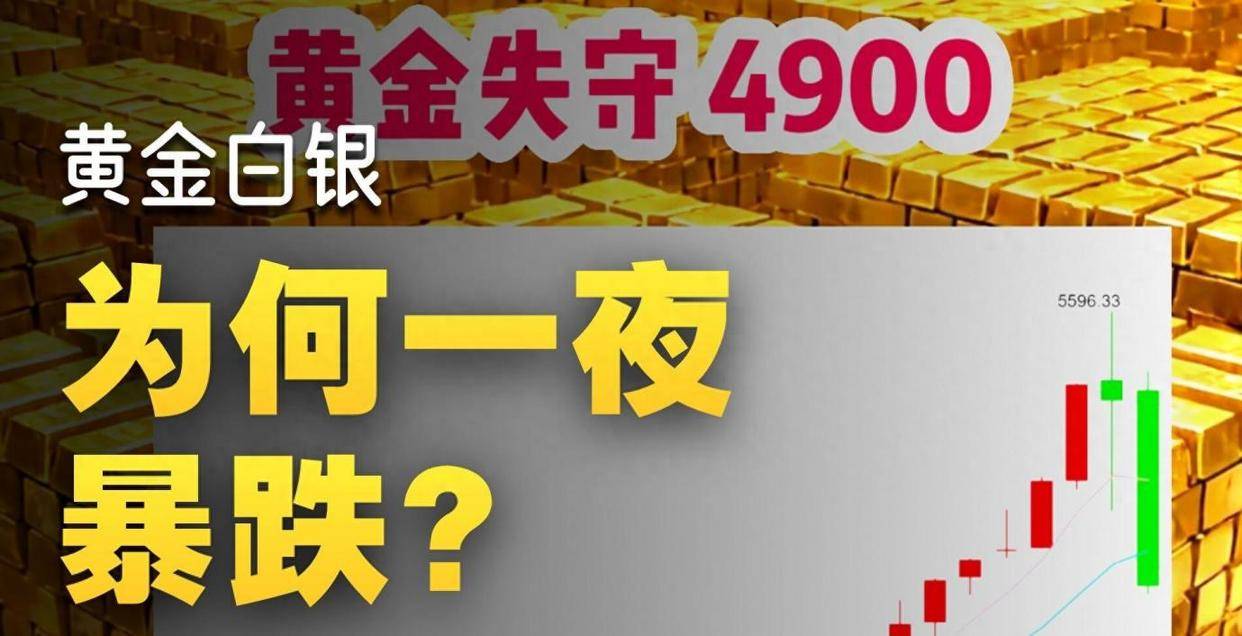
Group 1 - The recent appointment of a new Federal Reserve chairman, who favors "interest rate cuts and balance sheet reduction," has triggered significant market volatility, particularly in precious metals [3] - Gold experienced a dramatic drop of 8% in one day, with intraday losses reaching 12%, while silver fell by 26%, with a maximum intraday decline of 35% [3] - The stock market did not exhibit the typical "risk-off" behavior, as both precious metals and the Nasdaq index declined simultaneously, with the Nasdaq dropping by 1% [3] Group 2 - The new chairman's hawkish stance may lead to a perception of tighter liquidity in the U.S. financial markets, contrary to previous expectations of abundant liquidity [3] - There is concern about the potential spillover effects of this market turmoil on other asset classes and the domestic market in China [3] - The article suggests that the U.S. stock market may face greater pressure moving forward due to these developments [5]
A股行情有点不对劲!节前近几天,行情或将重演2021年
Sou Hu Cai Jing· 2026-02-01 11:56
Group 1 - The A-share market is experiencing a strange atmosphere where individual stock performance diverges significantly from the overall index, particularly since late January [1][10][27] - There is a noticeable decline in the previously hot small and mid-cap stocks, with rapid rotation of market hotspots leading to a lack of sustained interest [3][4][11] - The only sector that has managed to hold up recently is precious metals, but even this sector is showing signs of fatigue and high volatility [5][21][31] Group 2 - The market seems to have lost direction, with no consensus or compelling narrative to drive investor interest [6][24] - Despite maintaining a high overall trading volume of around 3 trillion yuan daily, funds are becoming selective, favoring a few sectors while avoiding most small and mid-cap stocks [10][11][30] - Regulatory measures aimed at curbing speculative trading in small and poorly performing stocks are impacting market dynamics, leading to a significant price resistance for many mid-cap stocks [11][12][30] Group 3 - Historical patterns suggest that the current market environment may mirror the events of early 2021, where a shift occurred from small-cap stocks to large-cap indices before the Spring Festival [15][19][30] - Analysts predict that the market may continue to see a divergence where large-cap indices like the Shanghai Composite and CSI 300 could rise while small-cap stocks face ongoing pressure [19][20][30] - The lack of new compelling narratives in sectors like commercial aerospace and AI applications has contributed to the current market fragmentation [23][24][30]

海外市场持续动荡,A股如何应对?十大券商策略来了
Sou Hu Cai Jing· 2026-02-01 11:56
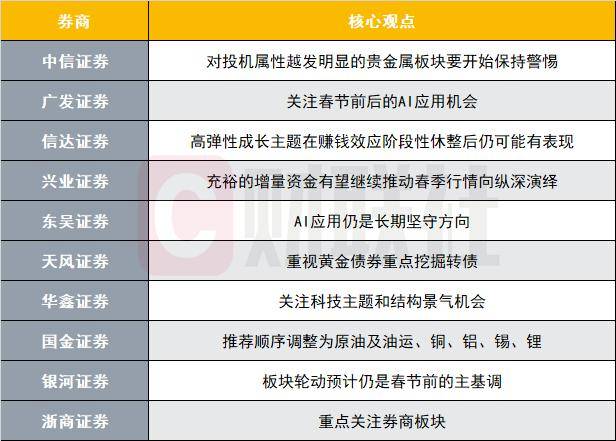
Group 1: Precious Metals and Market Trends - The precious metals sector is showing increasing speculative attributes, warranting caution [2] - The current market is experiencing a style shift from small-cap to large-cap stocks and from themes to quality [2] - The overall trend indicates a potential for profit margin recovery in cyclical sectors, driven by a shift in Chinese policy from expansion to quality improvement [2] Group 2: AI and Technology Opportunities - There is a focus on AI applications and energy storage as key growth areas, with expectations for recovery in lithium battery materials and storage sectors [3] - The AI industry remains a long-term focus, with significant policy support and market optimism surrounding its applications [5] - The technology theme, including AI applications and structural recovery opportunities, is highlighted as a key area for investment [7] Group 3: Spring Market Dynamics - The spring market is expected to continue its upward trend, supported by ample liquidity and positive domestic fundamentals [5] - High elasticity growth themes may still perform well after a phase of profit-taking, with potential for further gains in February [4] - Sector rotation is anticipated to be a dominant theme leading up to the Spring Festival, with a focus on structural opportunities [9] Group 4: Commodity Recommendations - A recommendation has been made to adjust the order of investment focus to include crude oil, copper, aluminum, tin, and lithium, reflecting a shift towards industrial pricing [8] - The emphasis on physical assets is expected to strengthen, with a focus on sectors like chemicals and consumer goods benefiting from domestic recovery [8] Group 5: Market Sentiment and Future Outlook - The market sentiment remains cautious but optimistic, with expectations for continued support from domestic policies and liquidity [5][6] - The potential for structural recovery in manufacturing and resource sectors is noted, with clear paths for profit recovery [9] - The upcoming credit and inflation data in January may provide additional positive signals for the market [4]