Qi Huo Ri Bao

Search documents
超长债双向波动幅度加大
Qi Huo Ri Bao· 2025-12-25 16:21
Group 1 - The bond market has shown significant differentiation since mid-November, with the yield spread between 30-year and 10-year government bonds widening to over 40 basis points due to lower-than-expected central bank bond purchases and strong profit-taking by institutions [1] - After a continuous decline, long-term bonds began to recover in late December, driven by expectations of loose monetary policy and various market influences, including potential reductions in long-term bond issuance [1][3] - The low interest rate environment is expected to persist into 2026, with increasing influence from asset pricing and institutional behavior on the bond market, while traditional allocation strategies face pressure from interest rate risk assessments [3][4] Group 2 - Fiscal policy is anticipated to remain proactive, while monetary policy will focus on coordination, with expectations for a deficit level around 4% and a corresponding scale of 5.9 trillion yuan [3] - The supply of bonds is projected to increase in 2026, but the marginal growth rate is expected to slow down, with a likelihood of one rate cut of 10 basis points and one reserve requirement ratio reduction [3][5] - The yield curve is expected to steepen further, with the 30-year and 10-year bond yield spread likely to remain elevated, and the market is facing uncertainties regarding central bank bond purchases and public fund redemption rates [5]

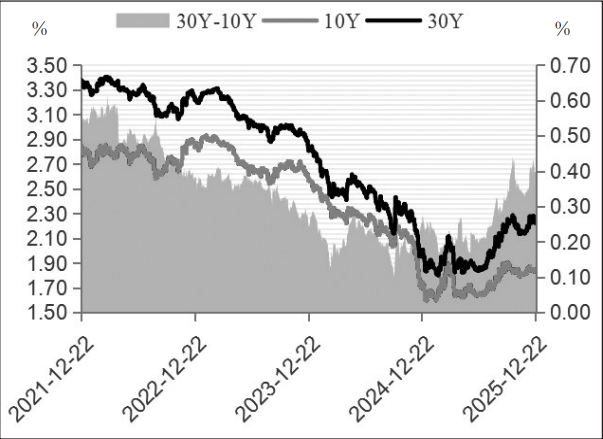
债市 关注期限利差变化
Qi Huo Ri Bao· 2025-12-25 16:21
Group 1 - The bond market experienced fluctuations in December, with weak performance particularly in the ultra-long end, and the year-end allocation market has not yet emerged [1] - As of December 24, the 10-year and 30-year government bond yields were reported at 1.8370% and 2.22%, respectively, reflecting increases of 0.8 and 4 basis points since the end of November [1] - The yield spread between the 30-year and 10-year government bonds has generally trended upward since September 2024, with significant fluctuations observed [1][2] Group 2 - The relationship between yield spreads and economic cycles indicates that a strengthening economic outlook and monetary easing can support the recovery of yield spreads [2] - The demand for ultra-long government bonds has changed, with a weakening trading volume observed, despite the expectation of a rebound in yields in 2025 [2] - Factors supporting the further widening of the yield spread include changes in asset allocation by insurance institutions and reduced demand from banks for ultra-long bonds [2][3] Group 3 - The current global liquidity environment remains loose, and the domestic economic and policy landscape is stabilizing, leading to continued pressure on the bond market in the short term [3] - The short-term volatility of the 30-year government bond is expected to increase, with the possibility of further widening of the yield spread against the 10-year bond [3]
广期所实施多项风控措施,加强市场监管
Qi Huo Ri Bao· 2025-12-25 14:44
Group 1 - The futures market for platinum and palladium has experienced increased volatility and overall trading activity [1] - The Guangxi Futures Exchange announced adjustments to the minimum trading quantities for platinum and palladium futures contracts, effective December 29, 2025, increasing the minimum opening order quantity from 1 lot to 2 lots while maintaining the minimum closing order quantity at 1 lot [1] - The exchange also implemented risk control measures for polysilicon futures, increasing the minimum opening order quantity from 5 lots to 10 lots, raising transaction fees from 0.01% to 0.05%, and reducing the trading limit from 200 lots to 50 lots, effective December 29, 2025 [1] Group 2 - Industry insiders indicate that increasing the minimum opening quantity, raising transaction fees, and lowering trading limits are effective measures to reduce market activity and promote rational trading [2] - The Guangxi Futures Exchange's risk control measures reflect a strong regulatory stance aimed at comprehensive oversight of the polysilicon futures market [2]
冷凉蔬菜迎盛夏 黄土旱塬绿意浓——海证期货多维助力宁夏彭堡镇打造乡村振兴示范样板
Qi Huo Ri Bao· 2025-12-25 11:13
Core Viewpoint - The article highlights the development of a cold-cool vegetable industry in Pengbao Town, Ningxia, supported by Haizheng Futures Co., Ltd. through financial assistance and infrastructure improvements, aiming to enhance both production efficiency and living conditions in the region [1][2] Group 1: Industry Development - The cold-cool vegetable base in Pengbao Town is thriving, with crops like broccoli, Chinese cabbage, and kale being supplied to the Guangdong-Hong Kong-Macao Greater Bay Area [1] - Pengbao Town is recognized as a high-quality cold-cool vegetable production area due to its favorable climate and low pest incidence [1] Group 2: Financial Support and Infrastructure - Haizheng Futures has invested 50,000 yuan in industry support funds specifically for the development of the cold-cool vegetable industry and infrastructure upgrades [1] - The funding is allocated for subsidies to vegetable growers, provision of quality seedlings, technical training, market promotion, and improvements in infrastructure such as roads, lighting, and waste management [1] Group 3: Collaborative Efforts - The initiative represents a dual approach of "industry + infrastructure" to enhance production efficiency while improving the living environment, achieving a win-win situation for economic prosperity and rural beautification [1] - The modernized vegetable base and clean village environment reflect the successful collaboration between different regions, showcasing a new chapter in cooperative efforts [2]
中国人民银行副行长陆磊:全面提升陆海新通道金融服务能级
Qi Huo Ri Bao· 2025-12-25 11:05
Core Viewpoint - The People's Bank of China and eight other departments jointly released the "Opinions on Financial Support for Accelerating the Construction of the Western Land-Sea New Corridor," emphasizing a development approach that integrates logistics, trade, and industry [1][2] Group 1: Key Measures - The "Opinions" propose 21 key measures focusing on six areas: improving organizational collaboration, enhancing financial services, optimizing cross-border fund settlement, supporting digital transformation in financial services, promoting financial openness, and strengthening financial risk prevention [1] - The measures aim to optimize the financial service system for the land-sea new corridor and enhance financial support for the real economy in the corridor's regions [1] Group 2: Implementation Strategy - The People's Bank of China will work with relevant departments to ensure the implementation of the proposed measures, aiming to elevate the financial service capabilities of the land-sea new corridor [1] - There will be a focus on strengthening collaboration between financial and industry sectors, encouraging fiscal-financial cooperation, and supporting financing and financial innovation in key areas and weak links of corridor development [2]
海证期货多维助力宁夏海原县乡村宜居宜业
Qi Huo Ri Bao· 2025-12-25 06:44
Core Viewpoint - The company is actively contributing to rural revitalization in Ningxia Zhongwei City by addressing both infrastructure and community needs, focusing on sustainable development and enhancing the quality of life for local residents [1][2]. Group 1: Infrastructure Development - The company has donated 30,000 yuan to build a temporary parking shed in Fuling Village, resolving the issue of parking difficulties for villagers [1]. - An investment of 40,000 yuan was made for environmental improvements in the Maobao Village resettlement area, enhancing cleanliness and community pride among relocated residents [1]. Group 2: Capacity Building and Economic Support - The company has signed a cooperation agreement with the local government to connect poverty alleviation efforts with rural revitalization, focusing on both hardware and software development [2]. - It is leveraging its expertise and that of its shareholder, Shanghai Securities, to support the development of diversified financing paths for local agriculture [2]. - The company is promoting consumption assistance by organizing employee group purchases of local agricultural products, helping to ensure better prices for these goods [2]. Group 3: Community Empowerment - The company emphasizes the importance of stimulating local self-development through training programs for grassroots leaders and cooperatives, enhancing their market awareness and management skills [2]. - The approach taken by the company is described as a systematic project rather than superficial improvements, aiming for effective and sustainable outcomes [2].
海证期货助力宁夏红寺堡区筑牢产业振兴根基
Qi Huo Ri Bao· 2025-12-25 06:43
此外,公司还与红寺堡区签署《巩固拓展脱贫攻坚成果同乡村振兴有效衔接结对帮扶合作协议》,将在 更广维度提供支持。 如今,在贺兰山东麓的移民新村,温室里藤蔓攀爬,葡萄挂果。海证期货以专业之力,书写着新时 代"山海情"的新篇章。 在宁夏吴忠市红寺堡区——这片由荒漠变绿洲、承载23万移民希望的热土上,一座座日光温室正孕育着 致富的希望。近日,海证期货有限公司投入5万元专项资金,支持红寺堡区开展设施农业提升工程,用 于日光温室及拱棚的新建与维修。 红寺堡作为全国最大的易地生态移民安置区,设施农业是移民群众稳定增收的支柱产业。然而,小农户 面对自然灾害和市场价格波动时往往束手无策,"丰产不丰收""灾年返贫"风险始终存在。 为此,海证期货捐赠资金直接用于改善生产基础设施,提升温室抗灾能力和产出效率。 ...
大棚撑起致富伞 产业铺就振兴路——海证期货援建新疆上皮牙子村蔬菜大棚项目见实效
Qi Huo Ri Bao· 2025-12-25 06:40
Core Viewpoint - The article highlights the successful implementation of a vegetable greenhouse project in Qulihaixiang, Yining County, Xinjiang, supported by Haizheng Futures Co., Ltd., which has significantly improved agricultural productivity and created job opportunities for local residents [1] Group 1: Project Impact - Haizheng Futures invested 40,000 yuan in the greenhouse project, which has effectively enhanced agricultural output and supported 31 impoverished households in increasing their income [1] - The project has created 120 job opportunities for local rural laborers through various stages such as seedling cultivation, planting, harvesting, sorting, transportation, and sales [1] Group 2: Agricultural Development - The region's fertile land faced challenges due to traditional open-air farming being limited by seasonal and climatic factors, leading to income volatility for farmers [1] - The development of facility agriculture is identified as a key solution to overcome these limitations, although high construction costs and technical barriers have deterred many farmers from participating [1] Group 3: Financial Support - Haizheng Futures' targeted funding for greenhouse infrastructure and production materials has alleviated the initial financial burden on the village collective and individual farmers [1] - The initiative demonstrates how financial support can effectively integrate into the daily lives and long-term development of farmers in border areas [1]
常敲廉洁警钟 筑牢合规堤坝——海证期货开展2025年度全员廉洁从业专题培训
Qi Huo Ri Bao· 2025-12-25 06:37
Core Viewpoint - The company is committed to reinforcing a culture of integrity and compliance among all employees through a comprehensive training program aimed at internalizing compliance awareness and ensuring sustainable and high-quality development [1][2] Group 1: Training Objectives and Content - The training program for 2025 aims to cover all employees at the company headquarters and branches, focusing on regular and institutionalized education to provide a solid cultural foundation for stable operations [1] - Core materials for the training include regulations from the China Securities Regulatory Commission and the latest implementation guidelines from the China Futures Industry Association, outlining "positive" and "negative" lists for key operational areas [1] - The training emphasizes strict prohibitions against using one's position for personal gain, accepting gifts or money, engaging in client asset management, and falsifying expenses, ensuring employees understand the boundaries of acceptable behavior [1] Group 2: Case Studies and Cultural Integration - The training incorporates analysis of recent typical violations in the futures industry, highlighting real cases where improper expense reimbursements led to regulatory penalties and how accepting client invitations affected professional integrity [1] - The company leader stressed that integrity in the workplace is reflected in every detail of daily operations, urging all staff to maintain self-discipline and uphold the industry's image of compliance, integrity, and professionalism [2] - The company plans to enhance its long-term integrity mechanisms through regular training, daily advocacy, special inspections, and strict accountability, aiming to embed a culture of integrity into its operations and contribute to the healthy development of the real economy and capital markets [2]
“保险+期货”十周年_期货日报网
Qi Huo Ri Bao· 2025-12-25 05:33
相关报道 十年间,"保险+期货"从单一价格险拓展至收入险,服务延伸至全产业链,覆盖全国31个省份,惠及农户740万户次,为全球农产品风险管理提供了"中国 方案"。 2025-12-1522:50:17 "保险+期货"从"破冰"到"深耕"的进化之路 精准施策筑根基破局提质再出发 从最初的探索试点到如今的规模化推广,"保险+期货"模式在稳定农民收入、服务国家粮食安全方面成绩斐然,但还应看到这一创新模式仍有优化的空 间。站在十年的关键节点,如何破解发展痛点,让"保险+期货"发挥更大的作用,是行业需要共同探索的重要课题。 2025-12-1700:48:57 向全球农产品风险管理递出"中国方案" "保险+期货"多点开花托起"稳稳的幸福" 2015年"保险+期货"试点开展以来,果农、种植户、养殖户等农业主体见证了这一模式的实效。"保险+期货"不仅增强了农户的抗风险能力,而且让越来越 多的新型经营主体主动参与现代农业风险管理,成为乡村振兴不可或缺的金融工具。 2025-12-1022:27:57 当前,"保险+期货"已从星星之火发展为燎原之势,基础框架日益稳固。如今,"保险+期货"模式全面升级,更多元的主体被引入,更立体 ...