
Wen Hua Cai Jing

Search documents
锡:供给端面临恢复性增产,强现实托底价格仍有韧性
Wen Hua Cai Jing· 2025-05-27 12:46
Core Viewpoint - Tin prices have been experiencing narrow fluctuations since May, with a decrease in volatility, as major economies engage in tariff negotiations with the U.S., leading to a more relaxed trade dispute atmosphere [2] Supply Side Recovery Expectations - There is an expectation of supply recovery in tin production by 2025, primarily from Myanmar's Wa State, Indonesia, and the Democratic Republic of the Congo (DRC) [3] - Myanmar's Wa State, which accounted for approximately 11% of global tin production, has resumed operations after a 21-month shutdown, with production expected to scale up by Q3 2024 [3] - Indonesia, the world's largest refined tin exporter, saw a significant recovery in exports, with March and April 2024 exports increasing by 50% and 58% year-on-year, respectively [3] - The DRC's Bijie tin mine, which contributes about 6% to global tin production, has resumed operations after a temporary shutdown due to armed conflict, although future disruptions remain a concern [4] Supply Side Tightness - The supply side remains tight, primarily due to the prolonged shutdown in Wa State, leading to a 48% year-on-year decline in tin ore imports to China from January to April 2024 [5] - Processing fees have dropped to historical lows, indicating a raw material shortage, with the latest processing fee reported at 12,700 yuan per ton [5] - China's tin production in March 2025 was 15,000 tons, a year-on-year decrease of 3.06%, with April production further declining by 8.13% [5] Demand Stability - Demand for tin remains robust, particularly driven by the semiconductor industry and the growth of photovoltaic installations, with a 19% year-on-year increase in solar cell production from January to April 2024 [6] - Traditional tin demand from sectors like tinplate and tin chemicals remains stable, primarily maintaining existing demand levels [6] - The latest social inventory of tin in China stands at 9,959 tons, with a reduction in inventory following a price drop in early April [7] Market Outlook - The tin market shows strong supply-side realities, with ongoing tightness in tin ore supply and a strong willingness among primary smelters to reduce production due to low processing fees [8] - The recovery of supply from Wa State, along with improved exports from Indonesia and the DRC, stabilizes global tin supply [8] - Demand is expected to remain strong, particularly from AI hardware and new energy sectors, although uncertainties exist due to potential global economic slowdowns stemming from trade conflicts [9] - Despite supply recovery pressures, the strong demand and tight supply conditions are likely to support tin prices in the medium term [9]


沪铜进退两难 多空比却有所走强【持仓透视】
Wen Hua Cai Jing· 2025-05-27 09:56
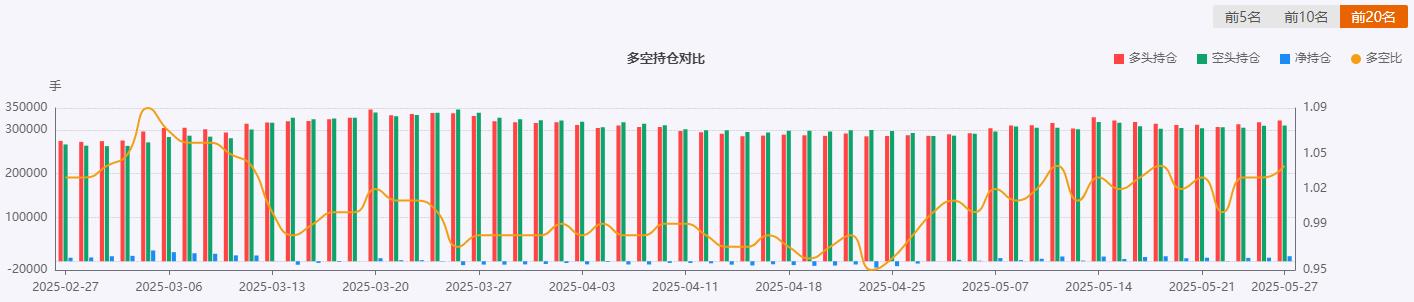
最近沪铜持续徘徊在4月份跳空缺口附近,走势较为纠结,呈现上下两难的状态。究其原因,近期美国与其他国家的贸易谈判仍在进行,但是美国总统态度 反复,且在逆全球化背景下整体关税水平较此前仍将提高,市场担忧可能损及需求,因此上方压制较重。而铜市供需面有存在较强的支撑,主因矿端持续紧 张,这种紧张局势随时可能向冶炼端传导。另外,在全球铜仍在向美国流入之际,其他地区铜供需偏紧,LME和国内库存整体处于偏低位置,也在限制铜 价下方空间。 整体来看,从宏观面和供需面来说,沪铜不论是向上突破还是重心回落都需要更多确定性因素的指引,目前还并未出现。不过从持仓龙虎榜变化来看,最近 多头信心显然进一步提升,空头信心则有所回落,后续仍需观察多空比变化情况。 在铜价持续窄幅震荡之际,通过观察沪铜持仓龙虎榜变动,可以发现多空双方力量确实相对均衡,走势难免纠结。观察近期的多空持仓对比可以发现,尽管 沪铜在4月中旬就快速反弹,收复大部分失地,但是多空比此前一直处于偏弱状态,暗示多头信心不足。直至4月24日,多空比最低触及0.95,随后呈现震荡 回升姿态,最近一直在1附近徘徊,今日升至1.04,暗示相对空头来说,多头势力更显壮大。 再观察今日龙 ...
沪锡窄幅波动 原料供应缺口不断扩大【5月27日SHFE市场收盘评论】
Wen Hua Cai Jing· 2025-05-27 07:15
Group 1 - The core viewpoint indicates that the tin market is experiencing a supply-demand imbalance, with both supply and demand showing weakness, leading to a sideways price movement for tin [1][2] - The main contract for tin closed at 2,646,900 yuan per ton, reflecting a slight increase of 0.09% [1] - The supply situation is tight due to the phased resumption of the Bisie tin mine in the Democratic Republic of Congo, with the first batch of tin concentrate expected to enter the smelting stage only in June [1] Group 2 - The operating rate of tin smelting enterprises in Yunnan and Jiangxi, two key tin-producing provinces, remains low at 56.44% [1] - In Yunnan, the processing fee for 40% grade tin concentrate is at a historically low level, severely squeezing the profit margins of primary ore smelting enterprises [1] - The weekly operating rate of smelting plants in Yunnan has dropped to 65.48%, significantly lower than the previous week due to raw material shortages and cost pressures [1] Group 3 - Demand from traditional sectors such as electronics and home appliances is under pressure due to high tin prices and US-China trade tensions, leading to a "high premium, low transaction" pattern in the spot market [2] - The renewable energy sector, particularly photovoltaic welding strips and new energy vehicles, continues to see high growth, but short-term increases are insufficient to offset the weakness in traditional consumption [2] - The overall supply-demand fundamentals lack strong drivers, suggesting that tin prices may continue to fluctuate in the short term [2]
锌:供增需弱预期强,期价或震荡偏弱
Wen Hua Cai Jing· 2025-05-26 13:47
Core Viewpoint - Zinc prices have been fluctuating within a range following a significant drop due to tariff announcements, with domestic zinc prices hovering between 21,900-22,800 CNY/ton and LME zinc prices around 2,700 USD/ton, influenced by macroeconomic sentiments rather than strong fundamental pressures [2][8]. Macroeconomic Factors - The US-China trade talks made significant progress in mid-May, with both sides agreeing to suspend additional tariffs for 90 days. However, the US has threatened to impose a 50% tariff on the EU starting June 1, causing short-term volatility in financial markets [3]. - The bond market is showing signs of panic, with Japan's 20-year bond auction underperforming and Moody's downgrading the US credit rating, leading to a decline in the US dollar, US bonds, and US stocks simultaneously [3]. - China's social financing and M2 growth rates are stable, but new RMB loan data is disappointing, indicating a potential slowdown in key economic indicators [3]. Supply Side Dynamics - Global zinc mine production reached 1.0184 million tons in March, a month-on-month increase of 10.2% and a year-on-year increase of 2.6%. The cumulative production from January to March was 2.902 million tons, up 3.75% year-on-year [4]. - China's zinc concentrate production in April was 297,700 tons, a month-on-month increase of 4.5% but a year-on-year decrease of 6.6%. Zinc ore imports surged to 494,700 tons in April, a 37.6% month-on-month increase and a 72.6% year-on-year increase [4]. - Domestic smelters are experiencing a rise in processing fees due to ample supply from both imported and domestic sources, with processing fees for domestic zinc concentrate averaging 3,650 CNY/ton in June [4]. Production Stability - Global refined zinc production in March was 1.1219 million tons, a month-on-month increase of 9.7% but a year-on-year decrease of 3.9%. China's refined zinc production in April was 576,000 tons, a slight decrease from March but a year-on-year increase of 0.3% [5]. - The profitability of smelters has improved, with production losses remaining below 500 CNY/ton, leading to expectations of increased production in the near future [5]. Inventory Levels - Domestic refined zinc inventories are gradually declining, with SMM's seven-city zinc ingot inventory at 80,400 tons as of May 22, which is low compared to previous years [6]. - LME zinc inventories have also seen a slight increase but remain at a low level, which may provide some support for zinc prices [6]. Demand Trends - Demand is showing signs of weakening as the peak season ends, with the operating rate of galvanizing enterprises recovering to around 62%, while die-casting zinc alloy enterprises have seen a drop to 56.41% [7]. - The construction sector remains stable, with a narrowing year-on-year decline in new housing starts and steady growth in infrastructure investment [7]. - However, production in the white goods sector has seen limited growth, with significant declines in refrigerator and television production [7]. Summary - Overall, the impact of tariffs is diminishing, and a weaker dollar is providing some support for non-ferrous metals. Despite low inventories providing price support, the expectation of increased supply against weak demand suggests that zinc prices may struggle to rise significantly in the short term, likely remaining in a weak oscillation [8][9].
矿端隐忧如影随形 沪铜能否冲破樊笼?【文华观察】
Wen Hua Cai Jing· 2025-05-26 10:32
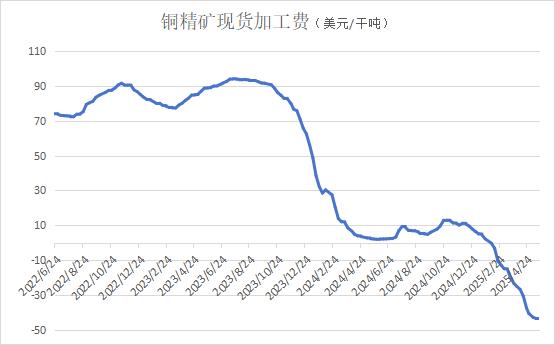
Group 1: Trade and Economic Outlook - The recent easing of trade tensions has led to a recovery in copper prices, but uncertainties remain regarding the tariff buffer period and potential future trade conflicts, particularly with Trump's suggestion to increase EU tariffs [1][2] - Concerns about the U.S. economic growth outlook persist, especially with high debt levels and upcoming significant U.S. Treasury maturities, despite some positive economic indicators such as lower-than-expected inflation and better-than-expected retail sales [2] Group 2: Supply Chain and Processing Fees - The copper market has been facing tight supply conditions, but domestic smelting production has remained stable, with processing fees for copper concentrate dropping to extreme lows, potentially impacting the profitability of smelting operations [3][6] - Recent disruptions in mining operations, such as the temporary halt at the Kamoa-Kakula copper mine due to seismic activity, could negatively affect annual production targets, although the overall impact is still under assessment [5] Group 3: Inventory and Demand Trends - Global copper inventories are showing mixed trends, with COMEX copper stocks increasing while LME stocks are declining, reflecting the flow of copper towards the U.S. amid tariff expectations [7] - Domestic refined copper demand appears to be weakening following the traditional peak season, although certain sectors like electric grid investment continue to support copper prices [7][8] Group 4: Market Dynamics and Future Outlook - The copper market is currently in a state of indecision, with supply concerns and weakening demand creating a challenging environment for price movements, necessitating more definitive changes to break the current stalemate [8]
基本面能否助力沪铜打破僵局?【机构会诊】
Wen Hua Cai Jing· 2025-05-26 07:31
银河期货铜研究员 王伟:艾芬豪2025年一季度报告显示,一季度矿石研磨量是372万吨,而截至 2025 年 4 月 30 日,卡莫阿-卡库拉项目的高品位和中品位矿石地表库存总计约 380 万吨,矿石库存相对充 足,第一、第二序列选矿厂暂时以较低产能运行则会限制产出,这两个序列选矿厂一季度矿石研磨量差 不多是221万吨,短期对产出形成压力,不过值得关注的是kamoa在3月最后两周平均单日产铜量达到 1732吨,相当于产能63万吨,后期恢复或比较迅速,实际影响相对有限。 新湖期货铜研究员 李瑶瑶:因国内炼厂集中检修,铜矿港口库存持续攀升,近期铜精矿加工费下降势 头放缓。但铜精矿短缺形势并未明显改观。上周由于卡库拉矿山东区发生多次矿震,卡莫阿铜业 (Kamoa Copper)决定于5月18日暂停井下作业。目前来看该事件对全球供应影响较大,但如果停产时间 超预期,将加剧全球铜矿短缺。除此之外,印尼Manyar冶炼厂提前投产也进一步加剧了全球铜矿供应 不足的局面。Freeport Indonesia称,其耗资37亿美元的Manyar冶炼厂在去年因火灾停产后已提前恢复运 营,预计将于6月第四周投产。预计将在12月达到满负 ...
金属均飘红 期铜收高,受助于美元走软【5月23日LME收盘】
Wen Hua Cai Jing· 2025-05-26 00:45
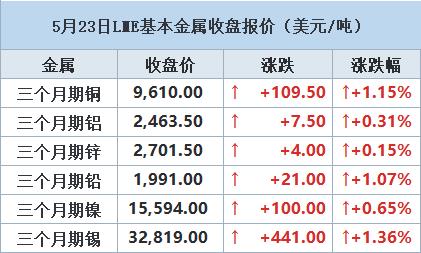
Core Viewpoint - LME copper prices rose over 1% due to a weaker dollar and concerns regarding issues at a major mine in the Democratic Republic of Congo [1][3]. Group 1: Market Performance - On May 23, LME three-month copper closed at $9,610 per ton, up $109.50 or 1.15% [1][2]. - Other base metals also saw price increases, with three-month aluminum up 0.31%, zinc up 0.15%, lead up 1.07%, nickel up 0.65%, and tin up 1.36% [2]. Group 2: Economic Factors - The initial decline in base metal prices was influenced by the announcement of a 50% tariff on EU goods by the U.S. [3]. - A drop in the dollar index to a three-week low made metals priced in dollars more attractive to buyers using other currencies [3]. Group 3: Supply Concerns - Concerns over the Kamoa-Kakula copper mine in the DRC, which is one of the largest copper mines globally, have contributed to rising copper prices [3]. - Recent seismic activity at the mine has led to a suspension of underground operations, potentially impacting annual production plans [3]. - LME copper inventory decreased by 8% to 164,725 tons, while COMEX copper inventory increased by 3% to 174,607 tons [3]. Group 4: Spot Market Conditions - The spot price for copper remains at a premium to LME three-month prices, indicating tightening immediate supply, with the price difference reported at $32 per ton [4].

铝:宏观与基本面共振,价格面临下跌压力
Wen Hua Cai Jing· 2025-05-23 12:31
Macro Perspective - Recent aluminum prices have rebounded, recovering losses from tariff impacts, with prices stabilizing around previous levels for about a week [2] - The U.S. has temporarily suspended the implementation of reciprocal tariffs for 90 days, and positive trade agreement developments between the U.S. and the UK have boosted market sentiment [3] - The expiration of the 90-day suspension on July 8 may lead to renewed focus on high tariff risks, as the U.S. maintains a 10% tariff baseline [3] - The Federal Reserve remains cautious about interest rate cuts, with expectations for potential cuts in Q3 or later, which may indicate economic weakness rather than a positive market signal [3] Demand Dynamics - Demand for aluminum has shown surprising strength, with average apparent consumption in March and April increasing by 6.6% and 6.1% year-on-year, respectively, exceeding initial forecasts [4] - Factors driving current demand include policies promoting the replacement of old consumer goods and pre-tariff export surges, but these may lead to a depletion of future demand [4] - The import of scrap aluminum has increased to 700,000 tons in the first four months of the year, compared to 650,000 tons in the same period last year, indicating strong domestic supply [4] Supply and Import Levels - Domestic aluminum production reached 14.36 million tons in the first four months, a year-on-year increase of 2.6% [6] - The operating capacity of the aluminum industry is at 96.1%, with daily production expected to stabilize around 120,000 tons [6][7] - Aluminum imports in the first four months were 830,000 tons, slightly lower than last year's 940,000 tons, but still among the highest levels in recent years [6] Inventory Trends - Projections indicate that aluminum inventories may begin to increase slightly in the coming months, with demand growth expected to slow to around 2% [9] - If imports exceed expectations while demand declines more significantly, inventory accumulation could be more pronounced [9] Global Production Recovery - Global aluminum production in Q1 2025 was 18.11 million tons, with China contributing significantly to this growth [11] - Several overseas aluminum plants, including those in Germany and New Zealand, are in the process of resuming full production, which may impact global supply dynamics [11] Conclusion - The macroeconomic environment remains challenging with high tariffs potentially hindering global growth, while domestic supply remains robust but demand is showing signs of marginal decline [12] - The interplay between macroeconomic factors and supply-demand dynamics suggests that aluminum prices may face downward pressure in the near future [12]
金属普跌 期铜触及三周低点 因经济和需求不确定性挥之不去【5月22日LME收盘】
Wen Hua Cai Jing· 2025-05-23 00:53
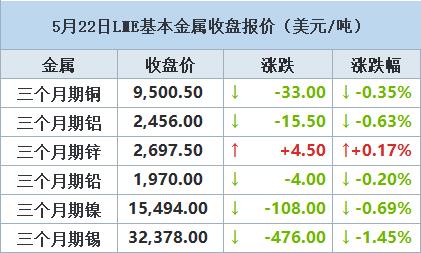
Core Viewpoint - The London Metal Exchange (LME) copper prices hit a three-week low due to ongoing uncertainties in the global economic landscape and demand growth [1] Group 1: Copper Market - On May 22, LME three-month copper closed at $9,500.50 per ton, down $33.00 or 0.35%, with an intraday low of $9,223.20 per ton, the lowest since May 1 [1][2] - Increased copper inventories in China ended a three-week decline, putting additional pressure on copper prices, which are affected by weak demand and stable output from the smelting industry [3] - The Freeport Indonesia smelter is expected to resume operations ahead of schedule after a fire in 2024, which will likely increase supply [3] - Investor confidence remains low due to deteriorating U.S. fiscal outlook, with Moody's downgrading the U.S. rating, leading to a "sell America" sentiment [3] Group 2: Other Base Metals - Three-month lead prices fell by $4.00 or 0.20%, closing at $1,970.00 per ton, previously touching a low of $1,947.50 per ton since May 9 [4] - LME registered lead inventories surged by 91% over two days to 234,000 tons, the highest level since December 2024 [5] - The International Lead and Zinc Study Group (ILZSG) forecasts a shift to a lead supply deficit of 6,700 tons by March 2025, compared to a surplus of 17,700 tons in February [5] - In the first three months of 2025, the global lead market is expected to have a surplus of 16,000 tons, down from a surplus of 65,000 tons in the same period last year [6] Group 3: Industry Insights - Alejandro Tapi, head of the Escondida copper mine, emphasized the need for regulatory and legal changes in Chile to promote investment, as Chile is the largest copper producer globally, accounting for nearly one-quarter of global copper supply in 2024 [3]
关税不确定性加剧铜价波动
Wen Hua Cai Jing· 2025-05-22 02:29
Core Viewpoint - The copper market is experiencing volatility due to ongoing trade policy uncertainties, with a notable decline in the Copper Monthly Metal Index (MMI) by 4.23% from March to April, and analysts are struggling to navigate these changes [1] Trade Policy Uncertainty - Recent trade agreements between the US, China, and the UK have alleviated some concerns regarding tariffs, leading to renewed optimism about the global economy, although demand worries persist [1][3] - The uncertainty surrounding international trade policies may negatively impact global economic prospects and copper demand, with the International Copper Study Group (ICSG) adjusting its growth rate forecasts downward [2] Supply and Demand Outlook - The ICSG does not foresee significant supply issues, predicting a surplus in the copper market for 2025 and 2026, contrary to previous concerns about potential shortages [1][2] - The anticipated surplus for 2025 is expected to more than double compared to earlier estimates, providing a buffer for the market as trade policies evolve [2] Price Trends and Inventory Levels - Global copper inventories have increased in May, failing to support copper prices, with rising inventories indicating stable demand conditions despite fluctuations [4] - The correlation between inventory levels and copper prices is weak, but the increase in COMEX inventories, alongside rising SHFE stocks, has dampened bullish expectations for copper prices [4] Currency Influence - The US dollar index has stabilized, which typically inversely correlates with copper prices, exerting pressure on copper prices as the dollar recovers from previous declines [5] - Speculation about potential US dollar depreciation has increased, although US officials clarified that exchange rate policy is not part of ongoing trade negotiations [5][6] - The Federal Reserve has maintained a cautious stance on interest rate cuts, which could further impact the dollar and subsequently influence copper prices [6]