
HAIDILAO(06862)

Search documents
资本又看上了小火锅赛道?
创业邦· 2025-09-08 00:07
Core Viewpoint - The article discusses the challenges and opportunities in the hot pot industry, particularly focusing on the rising popularity of small hot pot restaurants amidst a backdrop of financial struggles for major players like Xiaobai and Haidilao [6][10]. Group 1: Industry Trends - The small hot pot segment has seen a resurgence, with many restaurant brands entering the market, including Haidilao and cross-industry players like Yang Guofu [8][10]. - As of July 2024, there are over 50,000 small hot pot outlets in China, accounting for approximately 10% of the total hot pot restaurants, with a year-on-year growth in consumption scale of 28.9% [11][17]. - The competition in the small hot pot market is intense, with both national brands and regional players expanding rapidly [10][11]. Group 2: Company Performance - Haidilao reported a 3.7% decrease in revenue and a 13.7% drop in net profit for the first half of 2025, with a decline in table turnover rate from 4.2 to 3.8 times per day [11][12]. - Xiaobai continues to face losses, with an 18.88% decline in revenue and a net loss of 84.08 million, reflecting a nearly 70% drop in net profit [12]. - Yang Guofu has struggled with previous attempts to list on the Hong Kong Stock Exchange and is now exploring new avenues for growth [12]. Group 3: Market Dynamics - The current market entry strategy for many companies is cautious, focusing on leveraging existing capabilities and minimizing risks rather than aggressive expansion [12][15]. - The competition has shifted from price wars to a focus on quality, with new entrants pricing their offerings around 59.9 yuan, targeting the mid-to-high-end market [12][15]. - A significant challenge for both high-end and budget brands is balancing cost control with consumer willingness to pay, as the core consumer group remains price-sensitive [15][16]. Group 4: Challenges in the Small Hot Pot Sector - The small hot pot business is recognized as difficult, with a high percentage (81.6%) of brands having five or fewer outlets, indicating a lack of scale [17]. - Brands focusing on low prices risk compromising quality, leading to a cycle of reduced customer traffic and profitability [16][17]. - Even successful brands like Weila Hot Pot face challenges in differentiating themselves in a crowded market, struggling with the "scale without sound" dilemma [17].



海底捞20250905
2025-09-07 16:19
Summary of Haidilao Conference Call Company Overview - **Company**: Haidilao - **Date**: September 5, 2025 Key Points Industry and Company Performance - Haidilao opened 25 self-operated stores and closed 33 in the first half of the year, totaling 1,299 self-operated stores in Greater China as of June [2][3] - Overall revenue for the first half was 20.703 billion yuan, a decrease of 3.7% year-on-year [3] - Core operating profit was 2.408 billion yuan, down 14% year-on-year, and net profit was 1.755 billion yuan, down 13.7% year-on-year [3] - The table turnover rate was 3.8 times per day, a decline compared to the previous year [3] Revenue Growth in Specific Segments - Under the Red Pomegranate plan, 126 restaurants generated a revenue increase of 227% year-on-year, with takeout revenue growing nearly 60% [2][3] - The takeout segment saw significant contributions from single-serve hot pot and side dishes, with average order values around 30-50 yuan [11] Customer Experience and Innovation - Haidilao observed a notable recovery in customer traffic in July and August, with a peak table turnover rate of 7 times on Qixi Festival [2][5] - The company is innovating through product, scene, and pricing strategies, including the introduction of fresh-cut theme stores and night snack themes [5][6] - New store concepts include high-end selection stores in Beijing and private room-focused stores in Xi'an, enhancing customer interaction and operational efficiency [7] Management and Operational Adjustments - The company is diversifying dining experiences to cater to families and pet owners, providing independent dining environments to enhance customer satisfaction [8][9] - Management has shifted to a more flexible assessment system, focusing on soft indicators like food safety and customer satisfaction rather than strict performance metrics [9][10] Future Strategies and Expansion Plans - Haidilao plans to continue expanding its innovative projects while stabilizing its second growth curve, particularly in the Red Pomegranate initiative [13] - The company aims to introduce high-priced menu items in its rotating hot pot segment to enhance brand value and attract more customers [15] Challenges and Adjustments - The Red Pomegranate brand is experiencing slower growth due to rapid expansion and quality issues, prompting a focus on improving service processes and product quality [17][18] - The company is cautious about dividend payouts due to the cash flow-intensive nature of the restaurant industry, balancing investments with shareholder returns [16] Conclusion - Haidilao is actively working on enhancing customer experiences through innovative dining concepts and operational adjustments while navigating challenges in revenue growth and service quality. The company remains focused on long-term strategies to stabilize and grow its market presence.
为啥现在很多人不愿意下馆子了?老顾客说出原因,句句都是大实话
Sou Hu Cai Jing· 2025-09-06 23:00
Core Insights - The restaurant industry is facing a significant downturn, with a 67% year-on-year decrease in profits for the accommodation and catering sector in Beijing during the first half of 2025, and hotel profits plummeting by 92.9% [1][3] - Consumer spending habits have shifted, with a focus on value for money rather than dining out for social status, leading to a decline in restaurant patronage [4][9] - Rising food prices have outpaced income growth, with restaurant menu prices increasing by 24% since January 2020, compared to a 5.4% increase in disposable income in the same period [3][4] Group 1: Price Increases and Consumer Sentiment - Consumers express dissatisfaction with rising dining costs, feeling that the value does not match the price, as exemplified by a typical meal costing over 100 yuan [3][4] - The psychological impact of high prices affects even affluent consumers, who are reluctant to pay premium prices for food and drinks [3][4] Group 2: Changing Consumption Philosophy - There is a notable shift in consumer priorities from extravagant dining experiences to practical and cost-effective options, with a growing emphasis on quality and value [4][9] - The pandemic has altered spending habits, leading to increased savings and a focus on essential expenditures, as evidenced by a 12.3% year-on-year increase in household savings in 2025 [4][9] Group 3: Cost Pressures and Quality Concerns - The restaurant industry is under severe cost pressure, with operating costs in Beijing reaching 36.019 billion yuan in the first half of 2025, while revenues have declined significantly [6][8] - Many restaurants are reducing ingredient quality to cut costs, leading to consumer dissatisfaction with food quality [6][8] Group 4: Competition from Delivery Services - The rise of food delivery platforms offering substantial discounts has diminished the appeal of dining in restaurants, with significant investments in subsidies from major players like Taobao and Meituan [6][8] - A report predicts that these subsidies could boost restaurant revenue by 12 percentage points in July 2025, but they also create unsustainable business practices among participating restaurants [6][8] Group 5: Adaptation of High-End Dining - High-end restaurants are adapting by offering affordable options, with over 35% of mid to high-end dining establishments introducing lower-priced menus to attract customers [8][9] - Innovative business models, such as community-based dining and simplified menus, are emerging as successful strategies for survival in the current market [11][15] Group 6: Future Outlook for the Industry - The current challenges may lead to the elimination of weaker businesses, while those focusing on quality and value may thrive [15] - Consumers are still eager for quality food, indicating a potential for recovery if restaurants can meet their expectations for value and quality [15]
“有点钱,但不多,不急花”:2025上半年消费者现状
虎嗅APP· 2025-09-06 03:26
Core Viewpoint - The article discusses the evolving landscape of consumer behavior in China during the first half of 2025, highlighting the rise of emotional consumption and the decline of traditional consumption patterns, particularly among younger generations [4][5][6]. Economic Overview - In June 2025, the Consumer Price Index (CPI) rose by 0.1% year-on-year, with the core CPI increasing by 0.7%, indicating a recovery in domestic demand [4]. - The total retail sales of consumer goods reached 24.55 trillion yuan, with a year-on-year growth rate of 5%, surpassing the previous year's growth by 1.5 percentage points [4]. Emotional Consumption - Emotional consumption has become a significant trend, with the market expected to exceed 2 trillion yuan by 2025, growing at an annual rate of 12% since 2013 [8]. - Companies like Pop Mart have seen substantial revenue from emotional products, with LABUBU generating 4.81 billion yuan in revenue in the first half of 2025, contributing to Pop Mart's total revenue of 13.88 billion yuan, a 204.4% increase year-on-year [9]. Traditional Consumption Decline - Traditional consumption, particularly in sectors like high-end liquor and tea, has seen a downturn, with many companies reporting negative growth in revenue and profits [11]. - The white liquor industry experienced a 5% decline in revenue and a 7.5% drop in net profit in the second quarter of 2025 [11]. Shifts in Consumer Preferences - Younger consumers prioritize emotional value over traditional status symbols, leading to a decline in "face consumption" associated with older generations [10][12]. - The trend of seeking high value for money continues, with consumers becoming more cautious and price-sensitive in their spending habits [15][19]. Impact on Various Industries - The restaurant industry has faced challenges, with major chains like Haidilao reporting a 3.7% decline in revenue, while their takeaway business has seen a 59.6% increase [18]. - The airline industry has seen a 5.9% increase in passenger transport, but average ticket prices have dropped by 6.9% [16]. Investment Trends - There is a noticeable shift in consumer investment behavior, with a decline in housing investment and an increase in interest in gold and stock markets [23][25]. - The real estate sector has seen a significant drop in investment, with a year-on-year decrease of 11.2% in development investment [23]. Conclusion - The article emphasizes the need for companies to adapt to changing consumer behaviors, focusing on emotional value and cost-effectiveness, while traditional consumption patterns are declining [26].




餐饮巨头们止跌回血:一边关店砍成本,一边加码做外卖
Hu Xiu· 2025-09-05 12:38
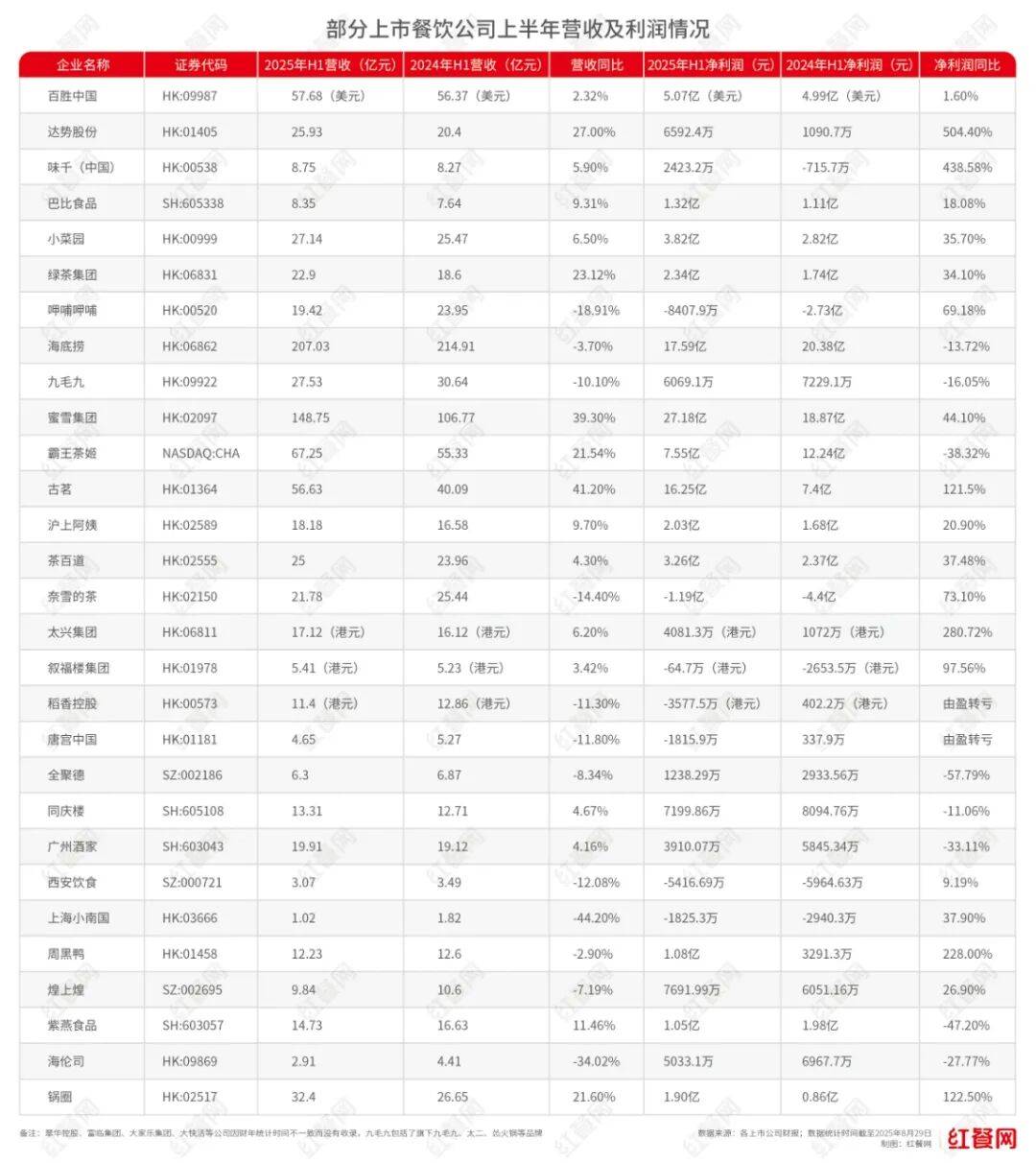
Group 1 - The core viewpoint indicates that despite the ongoing adjustment period in the industry, leading restaurant companies are showing signs of recovery in revenue and net profit [1][3][5] - Among 29 listed restaurant companies, 17 reported year-on-year revenue growth, with Gu Ming leading at a growth rate of 41.26% [3][5] - The overall trend shows an increase in profitable companies, with notable improvements in profitability for several firms [5][6][7] Group 2 - The challenges include a weak consumer environment, policies like alcohol bans, and competition from food delivery services, which necessitate exploration of new growth avenues [2][10][11] - Companies like Da Shi and Wei Qian have shown significant profit increases, with Da Shi's net profit growing by 504.4% year-on-year [6][7] - Some companies, such as Dao Xiang Holdings and Tang Gong China, have transitioned from profit to loss due to various market pressures [10][11] Group 3 - The restaurant industry is experiencing uneven recovery, with some segments like casual dining performing better than traditional high-end dining [11][12] - Fast food brands are generally faring well, with companies like Da Shi and Ba Bi Food achieving revenue and profit growth [12][13] - The trend of closing underperforming stores is evident, as companies aim to enhance operational efficiency [13][22] Group 4 - The shift towards delivery services is becoming increasingly important, with companies like Nai Xue's Tea reporting that nearly half of their revenue comes from delivery [32][36] - Traditional dining establishments are also adapting by exploring delivery options and new business models to remain competitive [39][40] - Many companies are diversifying their offerings by launching sub-brands and entering new markets, such as coffee and light meals [41][44][46]
给生活加点“甜”,海底捞也来“分羹”,2025年甜品市场预计突破1900亿
Yang Zi Wan Bao Wang· 2025-09-05 10:58
Core Insights - The dessert market in China is experiencing significant growth, with projections indicating that the market size will exceed 190 billion yuan by 2025 [1][4] - The emergence of dessert-focused establishments, such as the "super dessert station" by Haidilao in Shanghai, reflects a shift in consumer preferences towards multi-functional spaces that cater to various needs [3][4] Industry Overview - The dessert market in China is expected to reach 171.5 billion yuan in 2024, marking a year-on-year growth of 13.2%, and is projected to grow to 192.8 billion yuan by 2025 [4] - The market is segmented into tea-based desserts (34.6%), traditional desserts (34.9%), and Western desserts (20.5%) [4] - The Z generation (ages 18-25) accounts for 62% of the dessert consumption, with women aged 18-35 contributing 70% of the total consumer base [4] Consumer Behavior - Young consumers are increasingly drawn to dessert shops, as evidenced by the high density of dessert and bakery stores in locations like Nanjing's Jinling Tiandi [2][3] - Promotions such as buy-three-get-one-free and buy-one-get-one-free offers are attracting young shoppers to dessert establishments [2] - The trend of integrating dessert options into dining experiences, as seen with Haidilao's dessert station, caters to the fragmented lifestyle of younger consumers who seek convenience [3]
2025上半年消费图鉴:情绪、性价比与钱的流向
3 6 Ke· 2025-09-05 08:46
Group 1: Consumer Market Overview - The overall consumer market in China shows vitality, with a 5% year-on-year growth in retail sales of consumer goods in the first half of 2025, reaching 24.55 trillion yuan [1][2] - The contribution rate of final consumption expenditure to GDP growth is 52%, indicating that domestic demand is a key driver of economic growth [1] - The Consumer Price Index (CPI) has shown signs of recovery, with a 0.1% year-on-year increase in June and a 0.8% increase in July, suggesting a continuous recovery in domestic demand [1] Group 2: Emotional Consumption Trends - Emotional consumption has become a significant trend, with the emotional consumption market expected to exceed 2 trillion yuan by 2025, growing at a compound annual growth rate of 12% since 2013 [3][4] - Companies like Pop Mart have seen substantial revenue from emotional products, with LABUBU generating 4.81 billion yuan in revenue in the first half of 2025, contributing to Pop Mart's total revenue of 13.88 billion yuan, a 204.4% year-on-year increase [4][5] - The rise of emotional consumption is reflected in various sectors, including toys, gaming, and entertainment, where consumers are willing to pay a premium for products that provide emotional value [3][4] Group 3: Shifts in Consumer Preferences - There is a notable shift from traditional consumption patterns, often referred to as "old consumption," towards emotional and experience-driven purchases, particularly among younger consumers [6][8] - The traditional liquor and high-end tea markets are experiencing declines, with many companies reporting negative growth in revenue and profit, contrasting with the growth seen in emotional consumption sectors [6][7] - The younger generation prioritizes individual satisfaction and emotional value over traditional status symbols, leading to a decline in "face consumption" [8][9] Group 4: Impact on Specific Industries - The restaurant industry is facing challenges, with major chains like Haidilao reporting a 3.7% decline in revenue, while their takeaway business is growing significantly [14] - The tea beverage market is also seeing a divide, with brands like Mixue Ice City performing well, while others like Nayuki's Tea are struggling with losses [15] - The home appliance sector has benefited from government subsidies, with major players like Midea and Haier reporting over 10% revenue growth, while the smartphone market saw a 65% increase in sales during the subsidy period [16][18] Group 5: Real Estate and Investment Trends - The real estate market is experiencing a downturn, with a 11.2% year-on-year decline in real estate development investment in the first half of 2025, leading to cautious consumer sentiment towards property purchases [18][19] - Investment trends indicate a shift towards stock markets and gold, with A-shares and Hong Kong stocks seeing increased liquidity, while gold prices continue to rise, reflecting a preference for safer assets [19][20] - The overall sentiment among consumers is characterized by a cautious approach to spending, with many preferring to save rather than invest in real estate, leading to a significant increase in second-hand property transactions [18][20]
“有点钱,但不多,不急花”:2025上半年消费者现状
Hu Xiu· 2025-09-05 06:26
Group 1: Consumer Market Overview - The overall vitality of the consumer market is improving, with a 5% year-on-year increase in retail sales of consumer goods in the first half of the year, reaching 24.55 trillion yuan [1][2] - The contribution rate of final consumption expenditure to GDP growth is 52%, indicating that consumer spending is a key driver of economic growth [1][2] - The core CPI has shown a continuous upward trend, indicating a recovery in domestic demand [1][2] Group 2: Emotional Consumption Trends - Emotional consumption has become a significant trend, with the emotional consumption market expected to exceed 2 trillion yuan by 2025, growing at a compound annual growth rate of 12% since 2013 [4][11] - Companies like Pop Mart have seen substantial revenue growth from emotional products, with LABUBU generating 4.81 billion yuan in revenue in the first half of the year, contributing to Pop Mart's total revenue of 13.88 billion yuan, a 204.4% increase year-on-year [7][5] - Other companies in the emotional consumption space, such as MINISO, are also adapting their strategies to capture this market, with their sub-brand TOP TOY achieving 740 million yuan in revenue, a 73% increase [8] Group 3: Traditional Consumption Decline - Traditional consumption categories, particularly in the liquor and high-end tea sectors, are experiencing declines, with many companies reporting negative growth in revenue and profit [10][12] - The white liquor industry saw a 5% decrease in revenue and a 7.5% drop in net profit in the second quarter of 2025, with only a few companies maintaining positive growth [10] - The high-end tea market is also struggling, with companies like Tianfu Tea reporting a 17.1% decline in revenue [10] Group 4: Impact of Economic Conditions on Consumer Behavior - Economic uncertainties have led to a cautious consumer sentiment, with many individuals opting for cost-effective options and prioritizing emotional value in their purchases [12][13] - The trend of "old consumption" is fading, as younger consumers focus on personal satisfaction rather than social status, leading to a shift in spending patterns [9][11] - The overall consumer sentiment is reflected in the decline of high-end dining and entertainment, with many consumers opting for more affordable alternatives [17][18] Group 5: Investment and Housing Market Dynamics - The real estate market is facing challenges, with a 11.2% decline in real estate development investment in the first half of 2025, and a 3.5% drop in new housing sales [25][26] - Consumer confidence in real estate has diminished, leading to a decrease in housing purchases and a shift towards investments in stocks and gold [27][29] - The stock market has seen increased activity, with A-shares and Hong Kong stocks experiencing good liquidity, indicating a shift in investment preferences among consumers [27][29]


多家餐饮品牌推出儿童餐
Mei Ri Shang Bao· 2025-09-04 22:20
Core Insights - The children's meal market is rapidly growing, with various brands targeting this segment to capitalize on increasing consumer awareness of children's health and dining frequency [2][4] - Major brands like Haidilao, Xibei, and others have already entered the children's meal space, with Xibei being one of the earliest players since 2017, achieving over 40 million sales of children's meals by early this year [2][4] - The market potential for children's meals is significant, with estimates suggesting a consumption market size of 390 billion to 590 billion yuan based on a 10% penetration rate [4] Brand Activities - Haidilao launched the "Haidilao Little Team" collaboration meal, achieving over 70,000 sales in a single day shortly after its release [3] - Xibei has been active in enhancing its children's meal offerings, including partnerships with animation IPs and introducing themed dining experiences [2][3] - Other brands like Meizhou Dongpo and Yonghe Dawang are also innovating in the children's meal space, focusing on health-conscious options and themed restaurants [3] Market Dynamics - The children's consumption market in China is substantial, with related expenses accounting for over 30% of total family spending [4] - The demographic of 25-35 years old is becoming a significant consumer force in the family dining market, indicating a shift in consumer behavior towards family-oriented dining experiences [4] - Analysts suggest that children's meals can serve as a leverage point for brands to drive family consumption, similar to trends observed in retail environments [4]

海底捞(06862) - 截至2025年8月31日止月份之股份发行人的证券变动月报表
2025-09-04 08:50
股份發行人及根據《上市規則》第十九B章上市的香港預託證券發行人的證券變動月報表 截至月份: 2025年8月31日 狀態: 新提交 致:香港交易及結算所有限公司 公司名稱: 海底捞国际控股有限公司 呈交日期: 2025年9月4日 I. 法定/註冊股本變動 | 1. 股份分類 | 普通股 | 股份類別 不適用 | | | 於香港聯交所上市 (註1) | | 是 | | | --- | --- | --- | --- | --- | --- | --- | --- | --- | | 證券代號 (如上市) | 06862 | 說明 | | | | | | | | | | 法定/註冊股份數目 | | 面值 | | | 法定/註冊股本 | | | 上月底結存 | | 10,000,000,000 | USD | | 0.000005 | USD | | 50,000 | | 增加 / 減少 (-) | | | 0 | | | USD | | 0 | | 本月底結存 | | 10,000,000,000 | USD | | 0.000005 | USD | | 50,000 | 本月底法定/註冊股本總額: USD 50, ...