
SAIC MOTOR(600104)

Search documents
年终盘点2025汽车市场的“龙门一跃”:油退电进,全球登顶
3 6 Ke· 2026-01-12 10:37
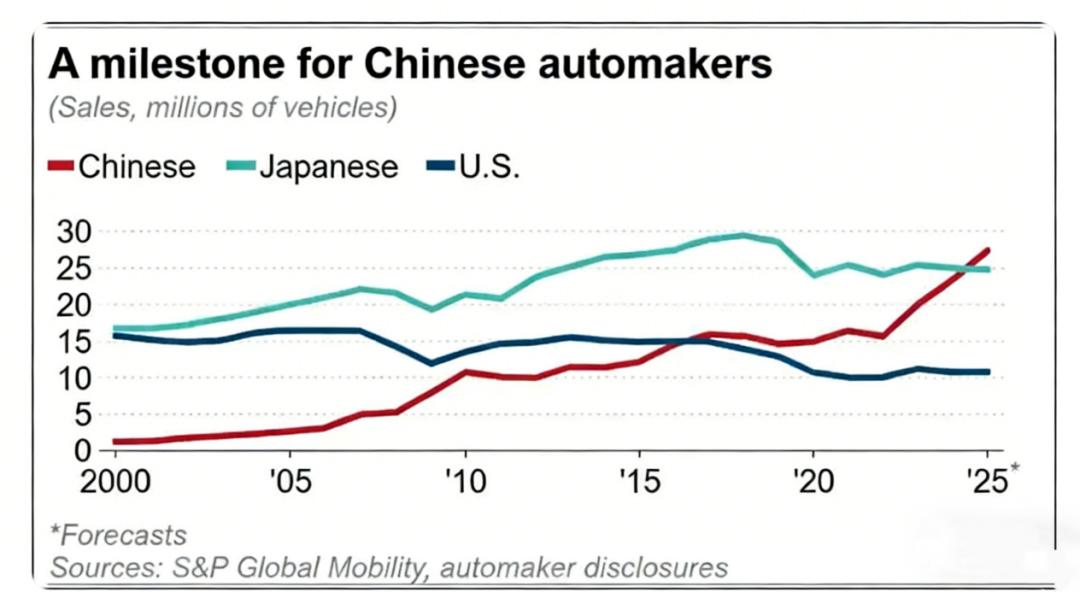
Core Insights - The penetration rate of new energy vehicles (NEVs) in China has surpassed 50%, marking a significant shift in the automotive market dynamics, transitioning from a "policy-driven" to a "product-driven" model [1][10] - The year 2025 is seen as a pivotal moment for the Chinese automotive industry, with the market experiencing a fundamental transformation akin to a "Nokia moment" [1] - The competition is evolving from price wars to value wars, emphasizing technology and product quality over mere volume [11] Industry Overview - In 2025, China's automotive manufacturers are projected to achieve global sales of 27 million vehicles, securing the top position in the global new car sales rankings for the first time [2] - China has overtaken Japan to become the world's largest automobile exporter, with NEVs accounting for a significant portion of this growth [4] - The domestic market's NEV sales are nearing 60%, reflecting a structural change in consumer preferences [4] Sales and Market Penetration - By November 2025, the retail penetration rate of NEVs reached 53.6%, with projections for the full year estimating a rate of 54.0% [6] - The rapid increase in NEV penetration is attributed to a combination of policy support, technological advancements, infrastructure development, and market demand [7] Policy and Technological Developments - The exit of purchase subsidies in 2023 has been offset by continued tax exemptions and various local incentives, which have helped maintain consumer interest in NEVs [7] - 2025 is expected to be a year of technological breakthroughs in NEVs, with advancements in high-voltage platforms, solid-state batteries, and smart driving technologies [8] Infrastructure and Consumer Experience - The expansion of charging infrastructure is crucial for alleviating consumer concerns about range anxiety, with projections of 20 million charging stations by the end of 2025 [9] - The cost advantages of NEVs are becoming increasingly apparent, with electric vehicles offering significantly lower operating costs compared to traditional fuel vehicles [9] Competitive Landscape - The shift from price competition to value competition is reshaping the industry, with companies focusing on technological innovation and profitability [11] - Some companies, like Leap Motor, have emerged as strong competitors, achieving significant sales growth and profitability [13] Global Expansion - In 2025, China's automotive exports are expected to exceed 7 million units, with NEV exports alone projected to reach 2.315 million units, marking a 102.9% increase [21] - Chinese automakers are transitioning to a "global + local" model, emphasizing localized production and R&D to better penetrate international markets [22] Challenges and Future Outlook - Despite rapid growth, challenges such as trade protectionism and compliance costs remain significant hurdles for Chinese automakers in global markets [24] - The automotive industry is expected to continue evolving, with a focus on sustainable growth and value creation as it navigates the transition from a subsidy-driven to a market-driven environment [25]






上汽集团总裁贾健旭拜访华为任正非,商讨尚界品牌合作再深化
Sou Hu Cai Jing· 2026-01-12 10:32
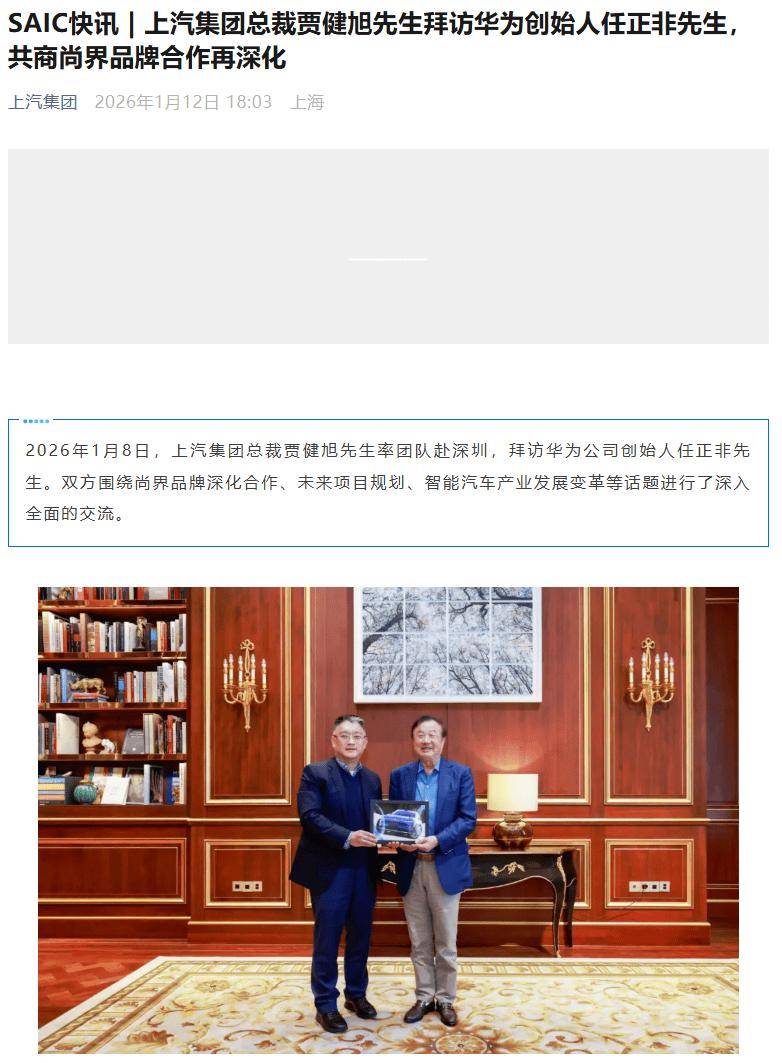
Group 1 - SAIC Group's President Jia Jianxu visited Huawei's founder Ren Zhengfei on January 8, 2026, to discuss deepening cooperation on the Shangjie brand and future project planning in the smart automotive industry [1] - Both companies aim to explore broader cooperation opportunities and jointly promote the upward development of the Shangjie brand [4] - On January 5, executives from Jiangqi Group also visited Ren Zhengfei to discuss trends in the intelligent transformation of the automotive industry and future project plans [5] Group 2 - In 2025, executives from several automotive companies, including Xpeng Motors, GAC Group, Changan Automobile, Dongfeng Motor, and Chery Automobile, also visited Ren Zhengfei [5]
上汽集团总裁贾健旭拜访任正非
Xin Lang Cai Jing· 2026-01-12 10:17
Core Viewpoint - SAIC Motor Corporation's President Jia Jianxu visited Huawei's founder Ren Zhengfei in Shenzhen to discuss deepening cooperation on the Jiangjie brand, future project planning, and the transformation of the smart automotive industry [1] Group 1 - The meeting focused on enhancing collaboration between SAIC Motor and Huawei [1] - Discussions included the strategic planning for future projects in the automotive sector [1] - The dialogue addressed the ongoing transformation in the smart automotive industry [1]
上汽集团入选“2025中国企业ESG百强”榜单
Xin Lang Cai Jing· 2026-01-12 10:04
新浪财经ESG评级中心提供包括资讯、报告、培训、咨询等在内的14项ESG服务,助力上市公司传播ESG理念,提升ESG可持续发展表现。点 击查看【 ESG评级中心服务手册】 | 排名 | 公司名称 | 公司标识 | 得分星级 行业分类 | | | --- | --- | --- | --- | --- | | | 建设银行 SH601939 | ▲ 山国建设计师 | ★★★★★ | 金融 | | | 中国移动 (HK0941) | NA HE BAR | ★★★★★ | 电信服务 | | | 农业银行 (HK1288) | / / 中国 及 机 路 / / / 中国 及 机 路 / / / / / / / 中国 / / / / / 中国 / / / / / / 中国 / / / / / / / 中国 / / / / / / / / 中国 / / / / / / 中国 / / / / 中国 / / / 中国 / / / / 中国 / / / / 中国 / / / / | ★★★★★ | 金融 | | 4 | 腾讯控股 HK0700 | Tencent 腾讯 | ★★★★★ | 信息技术 | | 5 | 中国银行 ...

【联合发布】一周新车快讯(2026年1月1日-1月9日)
乘联分会· 2026-01-12 09:28
Core Viewpoint - The article provides an overview of upcoming vehicle models from various manufacturers, detailing their specifications, market segments, and expected launch dates, highlighting the competitive landscape in the automotive industry for 2026 [2][5][10]. Group 1: Upcoming Models Overview - FAW Toyota will launch the Toyota bZ3 on December 31, 2025, targeting the B NB segment with a price range of 10.98 to 15.98 million yuan [10]. - Geely Auto is set to release the Geely Emgrand on January 1, 2026, in the A NB segment, priced at 7.29 million yuan [18]. - Lynk & Co will introduce the Lynk 08 EM-P on January 1, 2026, as a B SUV with a price of 20.58 million yuan [25]. - Smart will launch the smart 1 on January 1, 2026, in the AO SUV segment, priced at 13.99 million yuan [34]. - SAIC Passenger Vehicle will release the MG7 on January 6, 2026, in the B NB segment, with prices ranging from 13.79 to 17.89 million yuan [41]. - Beijing Hyundai will launch the Hyundai Santa Fe on January 6, 2026, in the B SUV segment, with a price range of 19.58 to 26.88 million yuan [49]. - GAC Toyota will introduce the Toyota Camry on January 7, 2026, in the B NB segment, with prices ranging from 19.58 to 26.88 million yuan [57]. - Dongfeng Honda will launch the Honda HR-V on January 8, 2026, in the A SUV segment, with prices between 15.99 and 17.59 million yuan [65]. - Xpeng Motors will release multiple models including the P7+, G7, G6, and G9 on January 8, 2026, with prices ranging from 18.68 to 27.88 million yuan [71][82][96]. - BYD will introduce the Qin PLUS DM-i and other models on January 8 and 9, 2026, with prices ranging from 7.98 to 12.68 million yuan [102][110][118]. Group 2: Technical Specifications - The Toyota bZ3 features a pure electric engine with a power output of 135 kW and a torque of 303 N·m, offering a range of up to 610 km [10]. - The Geely Emgrand is equipped with a 1.5L engine, producing 88 kW and 150 N·m of torque [18]. - The Lynk 08 EM-P has a 1.5T plug-in hybrid engine with a total power output of 300 N·m [25]. - The smart 1 offers a pure electric engine with a power output of 175 kW and a torque of 300 N·m, with a range of 410 km [34]. - The MG7 features a 1.5T engine with a power output of 138 kW and a torque of 300 N·m [41]. - The Hyundai Santa Fe is powered by a 2.0T engine, producing 182 kW and 353 N·m of torque [49]. - The Honda HR-V has a 1.5T engine with a power output of 134 kW and a torque of 240 N·m [65]. - The Xpeng P7+ offers both range-extended and pure electric versions, with the latter providing a range of 725 km [71]. - BYD's Qin PLUS DM-i features a 1.5L plug-in hybrid engine with a total power output of 210 km range [102].


乘用车板块1月12日涨0.34%,北汽蓝谷领涨,主力资金净流出4.12亿元
Zheng Xing Xing Ye Ri Bao· 2026-01-12 09:04
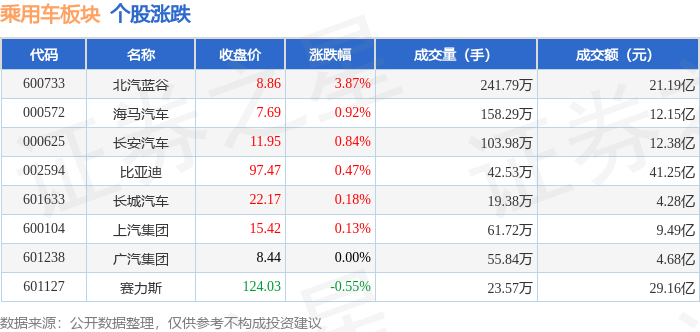
Market Overview - The passenger car sector increased by 0.34% compared to the previous trading day, with Beiqi Blue Valley leading the gains [1] - The Shanghai Composite Index closed at 4165.29, up 1.09%, while the Shenzhen Component Index closed at 14366.91, up 1.75% [1] Individual Stock Performance - Beiqi Blue Valley (600733) closed at 8.86, with a rise of 3.87%, trading volume of 2.4179 million shares, and a transaction value of 2.119 billion [1] - Changan Automobile (000625) closed at 11.95, up 0.84%, with a transaction value of 1.238 billion [1] - BYD (002594) closed at 97.47, up 0.47%, with a transaction value of 4.125 billion [1] - Great Wall Motors (601633) closed at 22.17, up 0.18%, with a transaction value of 428 million [1] - SAIC Motor (600104) closed at 15.42, up 0.13%, with a transaction value of 949 million [1] - GAC Group (601238) remained unchanged at 8.44, with a transaction value of 468 million [1] - Seres (601127) closed at 124.03, down 0.55%, with a transaction value of 2.916 billion [1] Capital Flow Analysis - The passenger car sector experienced a net outflow of 412 million from institutional investors and 218 million from retail investors, while retail investors saw a net inflow of 629 million [1] - Beiqi Blue Valley had a net inflow of 106 million from institutional investors, while retail investors contributed a net inflow of 12.5965 million [2] - Great Wall Motors had a net inflow of 10.2787 million from institutional investors, with retail investors contributing a net inflow of 21.3553 million [2] - BYD experienced a net outflow of 559.3 million from institutional investors, with retail investors contributing a net inflow of 14.6 million [2] - Seres faced a significant net outflow of 344 million from institutional investors, while retail investors had a net inflow of 26.97 million [2]




上汽集团等成立创投合伙企业 出资额27.5亿元
Zheng Quan Shi Bao Wang· 2026-01-12 08:52
Group 1 - Shanghai Fuzhan Venture Capital Partnership (Limited Partnership) has been established with a capital contribution of 2.75 billion yuan [1] - The business scope of the partnership includes venture capital [1] - The partnership is jointly held by China Construction Bank Financial Asset Investment Co., Ltd. and Shanghai SAIC Chuangyuan Venture Capital Partnership (Limited Partnership) under SAIC Group [1]
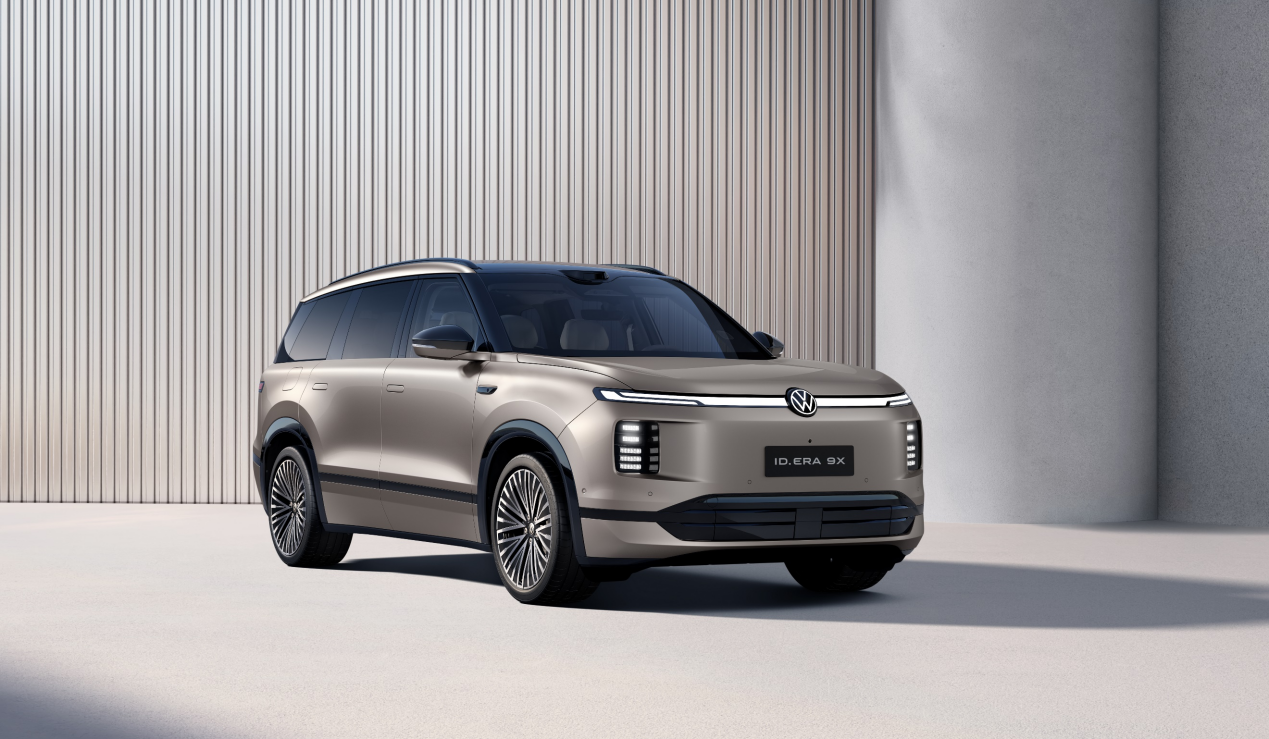
上汽大众首款9系旗舰申报图公布 定名ID. ERA 9X
Yang Shi Wang· 2026-01-12 02:33
Core Viewpoint - SAIC Volkswagen's ID. ERA 9X is the first model in the new ID. ERA series and the first flagship 9 series vehicle from the Volkswagen Group, integrating German automotive craftsmanship with cutting-edge smart technology for the Chinese market [1] Group 1: Vehicle Specifications - The ID. ERA 9X has dimensions of 5207mm in length, 1997mm in width, and 1810mm in height, with a wheelbase of 3070mm [3] - The vehicle features a short front and rear overhang design and a "2+2+2" six-seat configuration, balancing space practicality and passenger comfort [3] Group 2: Powertrain and Performance - The new model is equipped with SAIC Volkswagen's latest Golden Super Hybrid system, utilizing the EA211 engine as a range extender [4] - It benefits from a high-capacity battery from CATL, rated at 65.2kWh, allowing for a pure electric range of over 400km under the CLTC standard [4] Group 3: Design and Features - The design incorporates three characteristic lines: shoulder line, roof line, and skirt line, creating a cohesive overall shape [6] - The vehicle is equipped with a highly recognizable continuous light strip known as the Cosmic Light Wing [6] Group 4: Intelligent Features and Safety - The ID. ERA 9X will feature a combined driving assistance system, providing users with easy and convenient driving support [7] - It adheres to Volkswagen's stringent quality control standards, ensuring structural strength, battery safety, and compliance with global safety regulations throughout the product lifecycle [7] - As a flagship electric SUV from SAIC Volkswagen, it combines manufacturing experience with electric smart technology to deliver a high-quality travel experience [7]
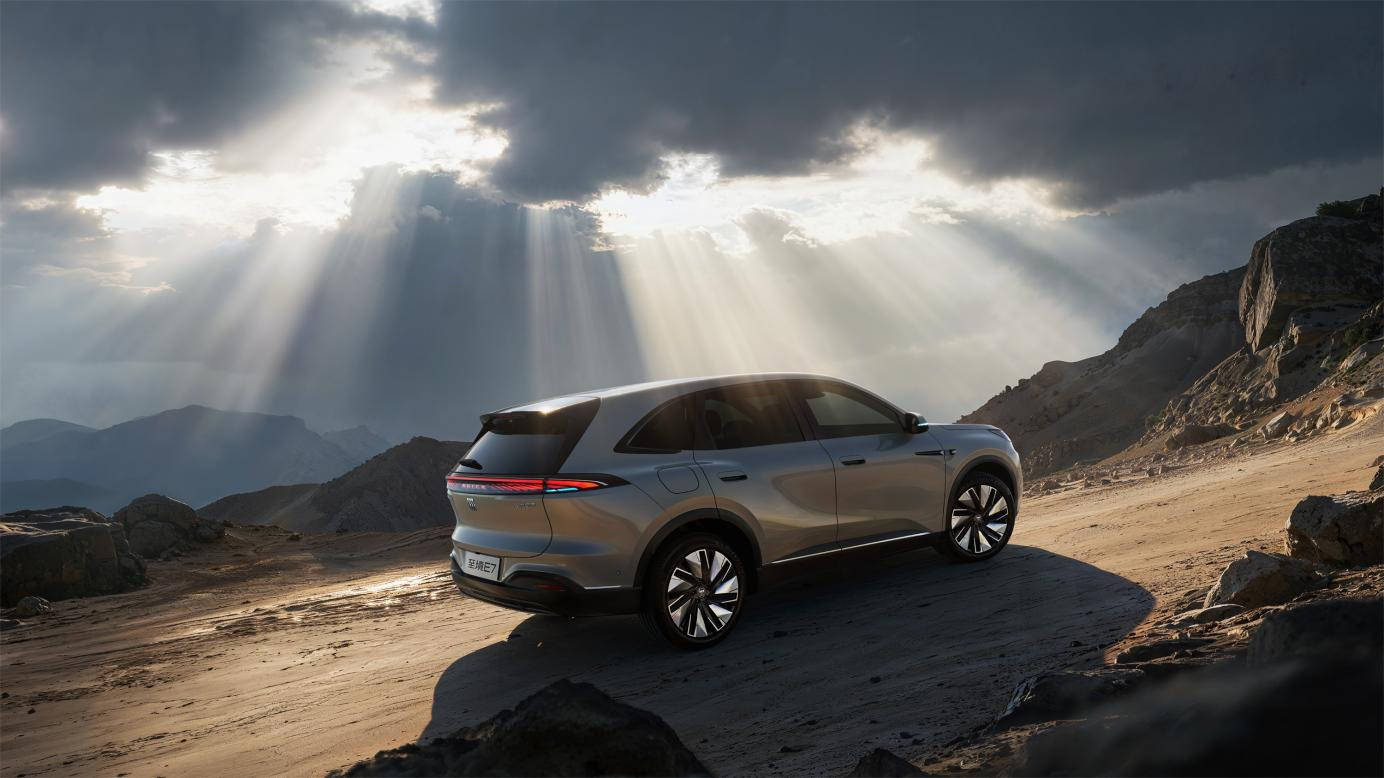
别克新能源子品牌“至境”首款SUV定名“至境E7” 拓展高端电动产品矩阵
Xin Lang Cai Jing· 2026-01-10 12:18
Core Insights - SAIC-GM Buick has officially named its first SUV under the high-end electric brand "Zhijing" as "Zhijing E7," which aims to enhance Buick's product lineup in the electric vehicle sector [1][5] Group 1: Product Overview - The Zhijing E7 is developed based on Buick's "Xiaoyao" super fusion architecture and features advanced driver assistance, an intelligent luxury cabin, and the "True Dragon Plug-in Hybrid Pro" technology [1] - The vehicle dimensions are 4850 mm in length, 1910 mm in width, and 1676 mm in height, with a wheelbase of 2850 mm, showcasing a design that combines aesthetics and practicality [3] Group 2: Powertrain and Performance - The Zhijing E7 is equipped with the "True Dragon Plug-in Hybrid Pro" system, which includes a 1.5T hybrid engine and an electric motor, offering a pure electric range of over 210 km and a total range of up to 1600 km [5] - The vehicle features a predictive RTD continuous damping variable suspension system that scans the road surface 500 times per second and adjusts damping in real-time, enhancing ride comfort [5] Group 3: Intelligent Features - The Zhijing E7 will incorporate the "Xiaoyao Zhixing" driver assistance system, leveraging the Momenta R6 reinforcement learning model for full-scene driving assistance [7] - It is powered by Qualcomm's latest Snapdragon 8775P chip, providing robust computational support for the next-generation intelligent cabin [7] Group 4: Market Positioning - With the launch of the Zhijing E7, Buick has completed its product lineup in the electric vehicle market, including sedans, MPVs, and SUVs, which strengthens its competitive position in the rapidly growing domestic electric vehicle market, particularly in the high-end family segment [7]
上海汽车集团股份有限公司 九届六次董事会会议决议公告
Zhong Guo Zheng Quan Bao - Zhong Zheng Wang· 2026-01-09 23:07
Group 1 - The board of directors of Shanghai Automotive Group Co., Ltd. held its sixth meeting of the ninth session on January 9, 2026, with all eight directors participating and voting [1][3] - The board approved the implementation plan for the reform of the executive compensation system for 2025-2026, which had been previously reviewed and approved by the nomination, compensation, and assessment committee [1] - The board also approved a proposal for SAIC-GM-Wuling Automobile Co., Ltd. to donate 15 million yuan (including in-kind contributions) to the China Red Cross Foundation to establish the "Striver Special Program" aimed at supporting grassroots healthcare and rural revitalization [2]