
HAIER SMART HOME(600690)

Search documents
家电行业2026年1月投资策略:2026年家电国补政策延续,有望拉动内销需求企稳回升
Guoxin Securities· 2026-01-05 13:58
Core Insights - The 2026 home appliance national subsidy policy is expected to stimulate domestic demand and stabilize retail sales, particularly in the white goods sector [2][3][20] - The policy continues to support the replacement of old appliances with new ones, focusing on six major categories, including refrigerators, washing machines, and air conditioners, with a subsidy of 15% of the product price, capped at 1500 yuan per item [3][21][22] - The white goods production in January showed a positive trend, with a total output of 34.53 million units, representing a 6% year-on-year increase, driven by the national subsidy policy [4][24] Monthly Research Tracking and Investment Thoughts - The national subsidy policy for 2026 aims to boost the replacement demand for home appliances, which is expected to support domestic sales [20][21] - January's white goods production saw a recovery, with air conditioner production increasing by 11% year-on-year, indicating a potential stabilization in demand [4][24] - In November, the domestic sales of major appliances faced pressure due to high base effects from the previous year, but exports of refrigerators and washing machines showed good growth [5][32] Key Data Tracking - In December, the home appliance sector experienced a relative return of -1.06% compared to the Shanghai Composite Index, which rose by 2.28% [34] - The prices of raw materials such as copper and aluminum increased by 13.5% and 4.8% respectively in December, while cold-rolled steel prices decreased by 3.2% [36] - The shipping index for major routes showed a mixed performance, with the West America route down by 6.4% and the Europe route up by 4.8% [45] Key Company Announcements and Industry Dynamics - The report highlights key companies such as Midea Group, Haier Smart Home, TCL, and Gree Electric as strong performers in the white goods sector, with recommendations for investment based on their resilience and growth potential [14][15][54] - The home appliance industry is expected to face challenges due to high inflation in overseas markets and geopolitical tensions, but leading companies are adapting by enhancing local production capabilities [50][51]





2025年度空气净化器实测排名盘点:核心除醛技术与消杀性能解析
Xin Lang Cai Jing· 2026-01-05 10:38
Core Insights - The demand for home air purification has evolved from "single haze removal" to "whole-house deep treatment" as of 2026, highlighting the need for advanced technologies in air purifiers [1][2] - The article reviews flagship models from ten major brands, focusing on "active formaldehyde removal" technologies and "human-machine coexistence" safety features, along with a full lifecycle cost analysis [1][2] Group 1: Key Parameters of Flagship Models - The top model, Telamon X99, has a formaldehyde CADR of 800 m³/h and utilizes manganese-based catalytic decomposition technology, achieving a removal rate of over 99.99% for various viruses [19][20] - IAM M8 features a CADR of over 750 m³/h and employs the "Carbon Cube" technology, making it suitable for families with a high budget seeking maximum filtration efficiency [21] - The 352 Z90 model, with a CADR of over 700 m³/h, uses FVTH-Fusion micro-pore technology, ideal for users sensitive to light pollution [23] Group 2: Detailed Analysis of Major Brands - Telamon X99 is positioned as the flagship choice for large spaces and families with infants, featuring an 11-layer purification system and a unique "buy one, get many" filter replacement policy [19][20] - Haier KJ920F emphasizes safety with its amino acid long-lasting formaldehyde removal technology, integrating well with Haier's smart home ecosystem [22] - Philips AC9008 stands out for its pure physical filtration approach, relying solely on high-precision HEPA filters to capture particles as small as 0.003 microns, catering to families that avoid electronic disinfection methods [29] Group 3: Expert Guidelines for 2026 Purchasing - When selecting an air purifier for new renovations, both CADR and CCM values are important, but the focus should be on "decomposition technology" in 2025 [31][33] - For households with infants, the safety of UV features depends on the design; closed UV systems are recommended to ensure safety during operation [35] - The cost of consumables can be significant, with high-performance filters typically priced between 500-800 yuan, making brands with generous filter replacement policies more economical in the long run [36][37]
海尔智家(06690) - 截至二零二五年十二月三十一日止月份之股份发行人的证券变动月报表
2026-01-05 09:19
FF301 公司名稱: 海爾智家股份有限公司 呈交日期: 2026年1月5日 I. 法定/註冊股本變動 | 1. 股份分類 | 普通股 | 股份類別 | A | | 於香港聯交所上市 (註1) | | 否 | | | --- | --- | --- | --- | --- | --- | --- | --- | --- | | 證券代號 (如上市) | 600690 | 說明 | | 普通股- A股面值每股人民幣1元 (於上海證券交易所上市) | | | | | | | | 法定/註冊股份數目 | | 面值 | | | 法定/註冊股本 | | | 上月底結存 | | | 6,254,501,095 | RMB | | 1 RMB | | 6,254,501,095 | | 增加 / 減少 (-) | | | -1,472,684 | | | RMB | | -1,472,684 | | 本月底結存 | | | 6,253,028,411 | RMB | | 1 RMB | | 6,253,028,411 | | 2. 股份分類 | 普通股 | 股份類別 | 其他類別 (請註明) | | 於香港聯交所上市 (註 ...
白色家电板块1月5日涨0.85%,惠而浦领涨,主力资金净流出1198.43万元
Zheng Xing Xing Ye Ri Bao· 2026-01-05 08:59
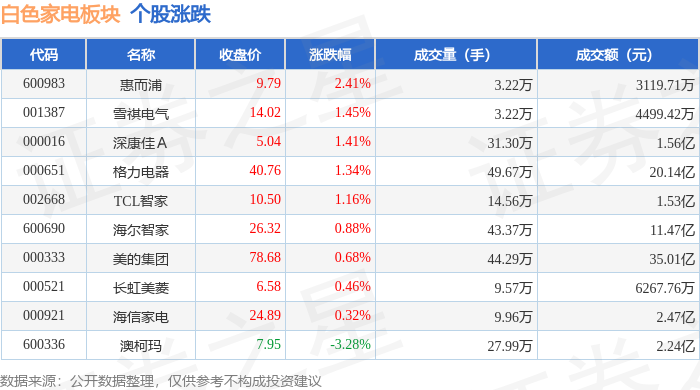
Market Performance - The white goods sector increased by 0.85% on January 5, with Whirlpool leading the gains [1] - The Shanghai Composite Index closed at 4023.42, up 1.38%, while the Shenzhen Component Index closed at 13828.63, up 2.24% [1] Stock Performance - Key stocks in the white goods sector showed the following closing prices and percentage changes: - Whirlpool: 9.79, up 2.41% [1] - Snowman Electric: 14.02, up 1.45% [1] - Deep Blue A: 5.04, up 1.41% [1] - Gree Electric: 40.76, up 1.34% [1] - TCL Smart Home: 10.50, up 1.16% [1] - Haier Smart Home: 26.32, up 0.88% [1] - Midea Group: 78.68, up 0.68% [1] - Changhong Meiling: 6.58, up 0.46% [1] - Hisense Home Appliances: 24.89, up 0.32% [1] - Aucma: 7.95, down 3.28% [1] Capital Flow - The white goods sector experienced a net outflow of 11.98 million yuan from institutional investors and 73.44 million yuan from retail investors, while retail investors had a net inflow of 85.43 million yuan [1] - Detailed capital flow for key stocks includes: - Gree Electric: 106 million yuan net inflow from institutions, but 30.02 million yuan net outflow from retail [2] - Hisense Home Appliances: 3.87 million yuan net inflow from institutions, with a net outflow of 9.75 million yuan from retail [2] - Whirlpool: 2.60 million yuan net inflow from institutions, with a net outflow of 1.50 million yuan from retail [2] - Aucma: 46.62 million yuan net outflow from institutions, but 37.85 million yuan net inflow from retail [2]


环球家居周报:2026首批国补资金已下达,新明珠IPO终止,海尔智家高管离职……
Huan Qiu Wang· 2026-01-05 04:05
Group 1: National Policies and Financial Support - The first batch of "national subsidies" for 2026 has been allocated, with a total of 62.5 billion yuan designated for consumer goods replacement and equipment updates [1] - The policy includes support for the installation of elevators in old residential areas and equipment for elderly care institutions [1] Group 2: Furniture Manufacturing Industry Performance - In the first 11 months, the total profit of the furniture manufacturing industry reached 24.44 billion yuan, a year-on-year decrease of 22.7% [2] - The total revenue for the furniture manufacturing industry was 554.11 billion yuan, down 9.1% year-on-year [2] Group 3: Company Developments and Strategic Moves - Jianlin Home announced its subsidiary Apis will transition to a smart robotics company, focusing on smart manufacturing robots, logistics robots, and health service robots [3][4] - Zhiou Technology acquired land for 50.94 million yuan to build its global R&D headquarters, with a total investment of 250 million yuan [5] - Jia Shi Jia Group's IPO has been accepted, aiming to raise 771 million yuan for projects including smart green factory construction [5] - Huali Co. terminated its plan to acquire 51% of Zhongke Huilian, with no significant impact on its operations [5] - Kailai Fengsheng's smart home factory has been established in Foshan, with a total investment of 500 million yuan [6] - Gujia Home signed a strategic investment cooperation agreement with Dengfeng Electric to enhance its smart home product offerings [7] - Mengbaihe abandoned its expansion plans for a factory in the U.S. and redirected 155 million yuan to build an e-commerce warehouse in South Carolina [8] - Aoyang Ceiling's actual controller will change to Shi Qiming, with a share acquisition plan in place [9] - Zhongtian Decoration underwent significant management changes, including the appointment of a new chairman and general manager [11] - Diou plans to invest up to 240 million yuan in its subsidiary to create an independent operating platform for its "Diwang" bathroom business [12] - Haier Smart Home's vice president Li Pan has resigned, with Song Yujun taking over overseas business operations [13] Group 4: Legal and Regulatory Updates - Dongtai Hardware won a legal case regarding its core patent, receiving 1.4 million yuan in compensation [14] - Rose Island's IPO has been suspended due to the expiration of financial report validity [15] - New Pearl's IPO application has been terminated following the withdrawal of its listing request [16]
73股连续5日或5日以上获融资净买入
Zheng Quan Shi Bao Wang· 2026-01-05 03:32
Core Insights - As of December 31, 2025, a total of 73 stocks in the Shanghai and Shenzhen markets have experienced net financing inflows for five consecutive days or more [1] - The stock with the longest consecutive net inflow is Yan'ao Co., which has seen net buying for 14 trading days [1] - Other notable stocks with significant consecutive net inflows include Yongtai Technology, Yanjing Beer, Sanrenxing, Wanxiang Qianchao, Supor, Huanyu Electronics, Haier Smart Home, and Morninglight Co. [1]


华西证券:国补政策收紧推动行业产品升级 品类补贴范围更加聚焦
智通财经网· 2026-01-05 03:00
Core Viewpoint - The current round of national subsidies is more focused compared to 2025, with stricter energy efficiency standards, which will help promote product structure upgrades in the industry, benefiting leading companies with a more complete layout of mid-to-high-end products [1]. Group 1: Policy Announcement - On December 29, 2025, the National Development and Reform Commission (NDRC) announced the implementation of a large-scale equipment update and consumer goods replacement policy for 2026, explicitly supporting the replacement of old home appliances [2]. - On December 30, 2025, the NDRC announced that the first batch of 625 billion yuan in ultra-long-term special government bonds to support consumer goods replacement has been allocated in advance [2]. Group 2: Funding and Subsidy Details - The first batch of 625 billion yuan in support funds for the replacement program has been allocated, with the subsidy categories being more focused compared to 2025. The scale is slightly reduced from the 810 billion yuan allocated in the first batch for 2025 [3]. - The total scale of special government bonds for consumer goods replacement in 2025 was 3000 billion yuan, distributed in four batches, with the first batch accounting for approximately 27%. The estimated total subsidy scale for 2026 is around 2300 billion yuan [3]. Group 3: Subsidy Categories and Standards - The subsidy categories for 2026 have been narrowed from 12 categories in 2025 to 6 categories, focusing on essential appliances such as refrigerators, washing machines, televisions, air conditioners, computers, and water heaters [3]. - The subsidy for 2026 is limited to first-level energy efficiency products, with a uniform subsidy rate of 15%. Each consumer can receive a subsidy for one unit of each product category, with a maximum subsidy of 1500 yuan per unit [4]. - In comparison, the 2025 subsidy standards allowed for second-level energy efficiency products with a subsidy of 15% of the sales price, and first-level products with a 20% subsidy, capped at 2000 yuan per unit [4]. Group 4: Investment Recommendations - Recommendations include leading white goods companies such as Midea Group, Hisense Home Appliances, and Haier Smart Home; and leading black goods companies such as Hisense Home Appliances and TCL Electronics [4].

海尔智家截至12月末累计回购A股股份4282.57万股
Xin Lang Cai Jing· 2026-01-05 00:15
热点栏目 自选股 数据中心 行情中心 资金流向 模拟交易 客户端 热点栏目 自选股 数据中心 行情中心 资金流向 模拟交易 客户端 海尔智家(06690)发布公告,2025年12月当月,公司通过集中竞价交易方式已累计回购A股(下同) 股份192.32万股,占公司总股本的比例为0.021%,购买的最高价为27.54元/股、最低价为26.02元/股,支 付的金额为5163.83万元(不含手续费等,下同);本次回购实施起始日(2025年4月7日)至2025年12 月底,公司已累计回购股份4282.57万股,占公司总股本的比例为0.457%,购买的最高价为27.54元/股、 最低价为23.60元/股,支付的金额为10.8亿元。 海尔智家(06690)发布公告,2025年12月当月,公司通过集中竞价交易方式已累计回购A股(下同) 股份192.32万股,占公司总股本的比例为0.021%,购买的最高价为27.54元/股、最低价为26.02元/股,支 付的金额为5163.83万元(不含手续费等,下同);本次回购实施起始日(2025年4月7日)至2025年12 月底,公司已累计回购股份4282.57万股,占公司总股本的比例为0 ...
A股股票回购一览:今日59家公司披露回购进展
Mei Ri Jing Ji Xin Wen· 2026-01-04 23:51
Group 1 - On January 5, 59 companies announced a total of 59 stock repurchase updates, with 3 companies disclosing repurchase plans for the first time, 54 companies reporting on the implementation of repurchase plans, and 2 companies completing their repurchase plans [1] - Among the newly disclosed repurchase plans, 2 companies announced repurchase amounts exceeding 10 million, with Century Huatong planning to repurchase up to 600 million, Dongcheng Pharmaceutical up to 200 million, and Guojijinggong up to 657,200 [1] - In terms of repurchase implementation progress, Haier Smart Home, COSCO Shipping Holdings, and Youngor reported the highest repurchase amounts, with 1.08 billion, 825 million, and 779 million respectively [1] Group 2 - Two companies, Xinhengcheng and Sanhua Intelligent Control, have completed repurchases exceeding 10 million, with completed repurchase amounts of 556 million and 303 million respectively [1] - As of January 5, two repurchase plans have been completed this year, involving two companies, both of which have completed repurchase amounts exceeding 100 million [1]




电商家电专家空调铝代铜专家周日双交流
2026-01-04 15:35
Summary of Conference Call Notes Industry Overview - The conference call primarily discusses the home appliance industry, focusing on sales performance and trends in 2025 and projections for 2026 [2][4][5]. Key Points and Arguments Sales Performance in December 2025 - December 2025 recorded the lowest absolute sales for the year, with total payments for home appliances at 52.9 billion yuan, a year-on-year decrease of 8.3% [2]. - Specific category sales included: - Air conditioners: 13.2 billion yuan, down 9.7% - Washing machines: 8.5 billion yuan, down 5.1% - Refrigerators: 11.3 billion yuan, down 10.9% - Black electronics (e.g., TVs): 12.6 billion yuan, down 7.2% [3][2]. Market Trends and Projections - The overall home appliance market is expected to decline by 9% in Q4 2025, though the decline is not as severe as initially feared [4]. - For Q1 2026, a modest growth target of 4% is set, with expectations of maintaining low single-digit growth [8][2]. National Subsidy Policy Changes for 2026 - Starting January 1, 2026, the national subsidy policy will expand to over 20 provinces, covering six major categories of home appliances [5]. - Although the first quarter will have sufficient funding, the total annual budget is expected to be lower than in 2025 [5]. - Priority will be given to energy-efficient products, with local governments and platform merchants expected to increase subsidies [5][6]. E-commerce and Consumer Engagement - JD.com aims to break regional barriers and expand its reach into first-tier and rural markets, expecting to add 30-40 million new users to the subsidy program [7]. - Over 100 million users benefited from JD.com's promotional policies in the first half of 2025 [7]. Recent Sales Trends - Recent sales data shows a slight recovery, with home appliance sales reaching nearly 10 billion yuan in three days, a year-on-year increase of 1.4% [8]. - However, air conditioners and refrigerators are still experiencing negative growth [8]. Price Trends and Material Changes - The average price of air conditioners rose to 2,900 yuan in December, a month-on-month increase of nearly 12% [10]. - The shift from copper to aluminum in air conditioning units is being driven by rising raw material costs, with significant cost savings projected [13][15][21]. - The air conditioning industry is expected to see price increases due to ongoing material cost pressures, with Midea announcing a 3-4% price hike [21]. Aluminum-Copper Transition in Air Conditioning - Major manufacturers are transitioning to aluminum in air conditioning units, with North American markets leading the way [13][20]. - The use of aluminum is expected to save costs significantly, with potential for replacing 100,000 tons of copper annually in the industry [15][17]. - Concerns about product reliability have been addressed through improved testing standards, ensuring that aluminum does not compromise product lifespan [14]. Competitive Landscape - Major brands like Midea, Gree, and Haier are facing challenges with declining sales across various categories, with specific negative growth rates reported for each brand [9]. - The competitive landscape is shifting as companies adapt to new materials and market demands, with Gree's stance on aluminum usage being particularly noteworthy [20]. Additional Important Insights - The home appliance market is experiencing a significant transformation driven by material cost changes and evolving consumer preferences, with a focus on energy efficiency and sustainability [5][21]. - The impact of local government subsidies and e-commerce strategies will play a crucial role in shaping market dynamics in 2026 [7][5].