
CSC(601066)

Search documents
中信建投:铜、铝、黄金中长期配置逻辑清晰 关注投资三大主线
智通财经网· 2025-12-07 23:43
Core Viewpoint - The report from CITIC Securities highlights the increasing investment value of strategic mineral resources due to heightened global macroeconomic and geopolitical uncertainties, emphasizing the clear long-term allocation logic for copper, aluminum, and gold based on current supply-demand dynamics, policy directions, and industry trends [1] Group 1: Copper - Supply-side constraints are intensifying, with global copper supply disruptions occurring frequently, such as Codelco's significant price increase for long-term contracts and accidents at major mines tightening supply [2] - Structural growth in demand is driven by the green economy and AI infrastructure, with increasing copper demand from solar, wind, and electric vehicle sectors, supported by traditional demand resilience from aging infrastructure [2] - Positive macro and policy factors include rising probabilities of interest rate cuts by the Federal Reserve, a weaker dollar alleviating pressure on copper prices, and domestic policies promoting industry upgrades and limiting new capacity [2] Group 2: Aluminum - Supply constraints are reinforced by a domestic production cap of 45 million tons per year and risks from overseas production, such as potential reductions in French and Icelandic aluminum plants due to high energy costs [2] - Demand is driven by explosive growth in the new energy sector, with increased aluminum usage in electric vehicles and photovoltaic applications, alongside resilient traditional demand from grid investments [2] - Policy and liquidity factors are favorable, with government plans targeting a 30% clean energy usage by 2027 and an increase in recycled aluminum production, alongside enhanced financial attributes for aluminum prices due to expected interest rate cuts [2] Group 3: Gold - The financial attributes of gold are strengthening, with over 80% probability of interest rate cuts by the Federal Reserve and a decline in the dollar index, enhancing gold's appeal as a hedge against risks and inflation [3] - Positive policy and funding conditions include new tax policies favoring investment-grade gold products and ongoing purchases by the central bank, which has increased its gold reserves to 7.409 million ounces [3] - The demand for gold is bolstered by its scarcity and the ongoing geopolitical tensions, which elevate risk-averse sentiments among investors [3]

中信建投:预计2026年储能全行业将量价齐升共振受益
Xin Lang Cai Jing· 2025-12-07 23:39
中信建投研报认为,储能需求爆发的大背景下,制造业环节的盈利能力仍处于历史低位的情况是不合理 和不可持续的。当前终端IRR水平较高,预计可接受10-15分/Wh的利润让渡。我们预计2026年制造业环 节价格将上涨10-15分/Wh,税后对终端电站的成本上涨12分/Wh,这对于下游需求的影响是可控的,但 中游制造业利润将大幅增厚,看好储能需求驱动下,制造业上下游量价齐升、共振受益。 ...
机构研究周报:政策定调预计更积极,人民币临近"破7"
Wind万得· 2025-12-07 22:59
Core Viewpoints - The article emphasizes the expectation of a robust economic start in 2026 driven by proactive macro policies and structural reforms as part of the "14th Five-Year Plan" [1][5] - The appreciation of the RMB is anticipated to improve, nearing the "7" mark against the USD [1][19] Focused Commentary - Wu Qing highlights the importance of enhancing the inclusivity and adaptability of capital market systems during the "14th Five-Year Plan" period, focusing on public fund reforms and aligning investor interests [3] - The article discusses the need for a binding mechanism for public funds to ensure investor profit and loss are core to assessments, promoting the development of equity funds and index investments [3] Equity Market - CITIC Securities predicts a more proactive policy direction in the upcoming Central Economic Work Conference, with a focus on consumption expansion, technological innovation, and real estate risk mitigation [5] - Huaxia Fund suggests that the "spring rally" may start earlier due to key meetings, improved macro liquidity, and easing of funding pressures, recommending a focus on AI, domestic demand recovery, and resource sectors [6] -招商证券 notes that December's market will be influenced by the Federal Reserve's meetings and domestic conferences, with a preference for large-cap stocks and blue-chip dividends [7] Industry Research - Galaxy Securities indicates that the power industry will see opportunities for capacity upgrades during the "14th Five-Year Plan," with a focus on stable profitability in thermal power and growth in nuclear power [12] - Harvest Fund expresses optimism for the energy storage sector, highlighting its transition to a growth phase driven by policy and technological advancements [13] - CITIC Construction Investment Securities sees significant growth potential in the low-altitude economy, predicting a market size exceeding one trillion by 2030 [14] Macro and Fixed Income - Huatai Securities anticipates a gradual appreciation of the RMB, with a forecast of 6.82 against the USD by the end of 2026, driven by strong export growth and seasonal currency settlement peaks [19] - Bosera Fund notes a cautious sentiment in the bond market, with a need for clearer signals of policy easing to boost demand [20] - Guotai Fund believes that the bond market may see a recovery opportunity following recent volatility, suggesting it could be a good time for long-term positioning [21] Asset Allocation - CICC recommends maintaining a "barbell" strategy in asset allocation, combining dividend stocks with technology investments, while adjusting weights based on market conditions [23]





中信建投:白酒需求磨底后静待春节行情
2 1 Shi Ji Jing Ji Bao Dao· 2025-12-07 14:30
Core Viewpoint - The report from CITIC Securities indicates that the recent decline in Moutai's price is temporarily suppressing the performance of the sector, while December's policy environment may provide potential catalysts for consumption [1] Group 1: Alcohol Industry - The liquor industry is experiencing a continuous bottoming out in sales [1] - The demand for liquor is expected to stabilize and wait for the Spring Festival market after reaching a bottom [1] Group 2: Consumer Goods - The current valuation of food and beverage is at a relatively low historical level, indicating clear bottom logic for high-quality assets like liquor [1] - The consumer goods sector is focusing on three main lines: improvement in the restaurant supply chain and supermarket customization, high growth in health-oriented and functional products, and optimization of the cost cycle [1] - It is anticipated that the consumer goods sub-sector will continue to outperform the liquor sector [1]
中信建投:茅台批价寻底,关注潜在政策催化下的跨年机会
Xin Lang Cai Jing· 2025-12-07 13:05
Core Viewpoint - The recent decline in Moutai's wholesale prices has temporarily suppressed the performance of the sector, but potential policy-driven consumption catalysts in December are noteworthy. Current valuations in the food and beverage sector are at relatively low historical levels, indicating clear bottom logic for quality assets like liquor. The focus on three main lines in the consumer goods sector presents structural opportunities, with recommendations to continue investing in liquor and consumer goods with specific logic. It is expected that the consumer goods sector will outperform liquor, with liquor demand stabilizing as the market awaits the Spring Festival [1][14]. Group 1: Market Performance - This week, the A-share market rose, with the Shanghai Composite Index closing at 3902.81 points, a weekly change of 0.37%. The food and beverage sector experienced a weekly decline of 1.90%, underperforming the market by 2.27 percentage points, ranking 30th among Shenwan's primary industry classifications [2][15]. - Among the various sub-sectors of food and beverage, the performance from highest to lowest was as follows: pre-processed foods (+1.51%), beer (+1.20%), soft drinks (+0.43%), meat products (-0.11%), health products (-0.17%), seasoning and fermented products (-0.32%), snacks (-0.73%), dairy products (-1.74%), liquor (-2.59%), and other alcoholic beverages (-3.06%) [2][15]. Group 2: Investment Recommendations - Clear signals of industry bottoming are evident, presenting opportunities for undervalued investments. Liquor demand is in a bottoming phase, with sales still under pressure but gradually recovering compared to Q3. Liquor companies are expected to continue the trend of performance clearing, actively alleviating market burdens. The liquor sector's valuation is at historical lows, providing strong bottom configuration value, while potential consumption policy catalysts are also noteworthy [3][16]. - For consumer goods, focus on three structural opportunities: 1) Improvement in the restaurant supply chain and supermarket customization, with a reduction in price wars and lighter channel inventory burdens as the traditional peak season approaches. 2) The health and functional product segment is experiencing high growth, with leading oat brands benefiting from the "oat+" health trend. 3) The price cycle is nearing a turning point, with expected improvements in upstream profitability as raw milk prices stabilize [3][16]. Group 3: Sector-Specific Insights - In the liquor sector, the recent global distributor conference for Fenjiu emphasized the certainty of future growth, with expectations for the domestic economy to stabilize and recover, supported by policy and consumption revival. This is anticipated to lead to a dual leap in cultural value and market scale for liquor as a cyclical industry [4][17]. - The average milk price in major production areas was 3.02 yuan/kg in the last week of November, down 0.1 yuan/kg, indicating a continued bottoming of raw milk prices. The first batch of deep-processed products from Mengniu has passed testing and is expected to contribute to performance improvements in the dairy sector as production capacity increases [20].





中信建投:日债是不是一个问题?
Sou Hu Cai Jing· 2025-12-07 12:56
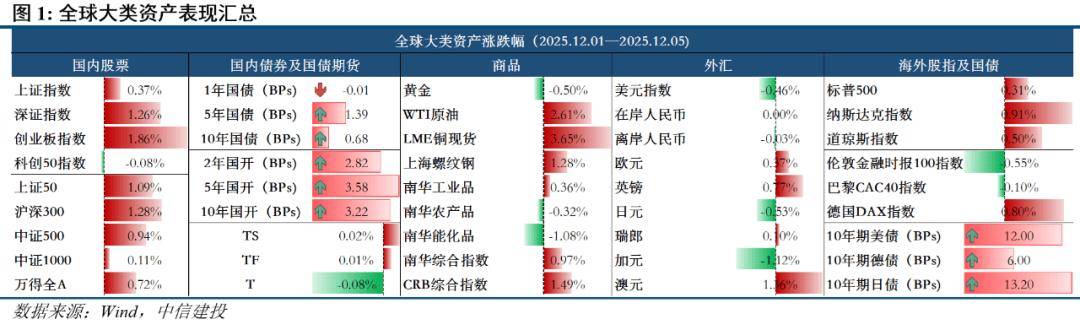
本周全球大类资产表现一览: 核心观点 2024年开始,日债走向公众视野,频繁引发市场关注。因为日债利率影响日本套息交易,进而影响美国资产。 尤其在美股脆弱之际,日债波动放大担忧,加剧美国资产高波动。2024年三季度和2025年二季度,市场已经历了两轮日本套息交易逆转叙事引发的美 股"崩溃"。 结束了20年低利率的日债,近年波动加大,最终是否会引发一轮全球范围内的资产震荡? 日债是境外美元流动性非常重要的观测指标,日本在全球中的定位,决定了日债本身不可能成为全球资产波动的决定因素,但全球美元流动性转向一定会 在日债上得到反馈。与其关注日债,我们更需要跟踪的是美国经济和政策周期。 下周需要关注: 国内中央政治局会议,出口、社融、通胀数据;海外关注美联储议息会议。 摘要 本周A股和港股在震荡中收涨,上证重回3900。宽松预期修正影响下,空头情绪较强,债市延续回调。 本周风险资产波动加大,总体收涨。日本央行鹰派发言,引发全球风险资产调整;随后美国披露就业和通胀数据,美联储降息预期走高,股票和大宗走 强。 一、中国股市:A股、H股震荡反复,总体收涨。 中国AH股回顾: A股:本周市场反复震荡,周五沪指重返3900点,创 ...
中信建投:美国银行板块的历史归因是估值驱动还是基本面驱动?
智通财经网· 2025-12-07 10:01
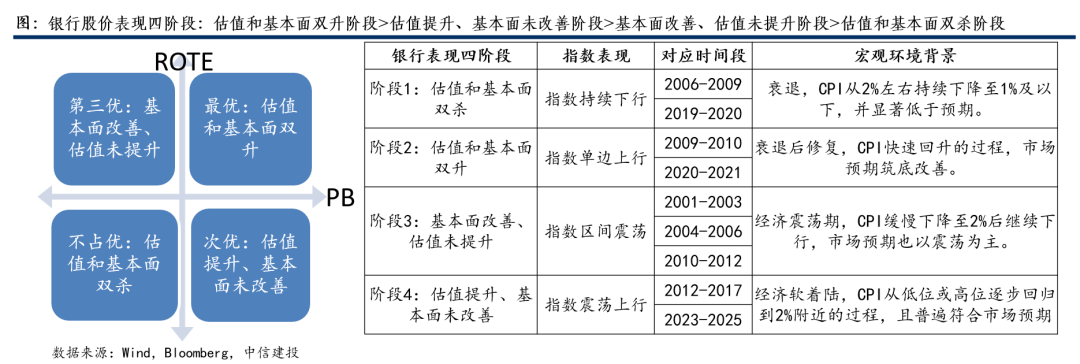
Core Viewpoint - The price movement of U.S. banks is driven more by valuation than by performance, indicating that valuation has a greater direct elasticity on stock prices compared to fundamentals. Valuation determines whether prices rise and the absolute returns, while fundamentals dictate how much prices rise and the relative returns [1][5]. Summary by Stages Stage 1: Dual Decline of Valuation and Fundamentals - This stage occurs during systemic crises, such as the subprime mortgage crisis and global pandemic, where stability is key. Banks with stronger fundamentals experience smaller price declines, while those with similar fundamentals but lower valuations also see less decline [2][9]. Stage 2: Dual Rise of Valuation and Fundamentals - This stage typically follows systemic crises, characterized by significant recovery in both valuation and fundamentals. Banks with substantial positive improvements in fundamentals and lower valuations see greater price increases. Smaller banks perform better when either fundamentals or valuations dominate [3][17]. Stage 3: Improvement in Fundamentals without Valuation Increase - This stage occurs when supportive policies are in place, but market expectations about the economy remain divided. While fundamentals improve across the board, valuations do not rise, making the ability to increase valuation crucial for individual stocks. The two main sources for valuation increases are positive fundamental trends and event-driven catalysts [4][24]. Stage 4: Valuation Increase without Improvement in Fundamentals - This stage generally happens when economic expectations are clear, but monetary policy and operating environments do not favor banks. In this phase, strong fundamentals are the primary driver of excess returns, while low valuations serve as a secondary factor. The best-performing banks are those that achieve a combination of good fundamentals and low valuations [28][30]. Future Outlook - Currently, the U.S. banking sector is in a phase of valuation increase with stable fundamentals. The macroeconomic environment shows no signs of significant recession, with inflation gradually decreasing and expectations for a controlled interest rate environment. The banking sector's return on tangible equity (ROTE) is stabilizing at high levels, supported by a favorable capital market and low credit costs [35][39].


中国证券业协会第八届负责人名单出炉!
Zheng Quan Ri Bao Wang· 2025-12-07 07:35
12月6日,在中国证券业协会第八次会员大会上,选举产生了会 、专职副会 、兼职副会 。其中,常务 理事、会长为国泰海通证券董事长朱健。其余9位兼职副会长中有8位在证券公司任职,分别为中信建投 (601066)证券刘成、申万宏源证券(000562)刘健、中信证券邹迎光、国信证券张纳沙、中金公司 (601995)陈亮、广发证券林传辉、华泰证券周易、招商证券霍达。 ...

中资券商“必答题”:中信建投证券蒋月勤详解国际化破局之道
2 1 Shi Ji Jing Ji Bao Dao· 2025-12-07 01:49
Core Viewpoint - Internationalization is a crucial strategy for Chinese securities firms to achieve the goal of becoming world-class investment banks, as emphasized by the chairman of CITIC Securities International, Jiang Yueqin [1][2]. Group 1: Internationalization Strategy - Jiang Yueqin highlighted that the internationalization process of Chinese securities firms is aligned with national strategies and industry development, marking it as a necessary path to achieve international competitiveness [1][2]. - The China Securities Regulatory Commission has set a goal to establish 2 to 3 investment banks with international competitiveness by 2035, indicating that internationalization is not optional but essential for achieving top-tier status [1][2]. - As of mid-2025, the total assets of leading securities firms' overseas subsidiaries have increased by over 20%, reaching HKD 1.64 trillion, with most firms experiencing year-on-year growth in international business revenue [3]. Group 2: Historical Context and Current Opportunities - The internationalization of American investment banks began in the 1960s and 1970s, driven by internal competition and external globalization opportunities, which created significant demand for cross-border financial services [2]. - Chinese securities firms are currently facing unprecedented strategic opportunities for internationalization, responding to high-level opening-up policies and serving national strategies, with Hong Kong as the starting point for their international expansion [2]. Group 3: Practical Implementation - CITIC Securities International has successfully executed several high-impact projects, showcasing its cross-border comprehensive service capabilities, including significant IPOs and bond issuances [3][4]. - The firm has played a leading role in the Hong Kong IPO market, with notable projects such as the listing of "Lao Pu Gold" and "Horizon Robotics," achieving record speeds and substantial oversubscriptions [3][4]. Group 4: Future Development Trends - The development of internationalization should focus on becoming a "value investment bank," integrating financial functionality with profitability while creating comprehensive value for stakeholders [5][6]. - The transition to a "new quality investment bank" is necessary, emphasizing a shift from traditional services to a partnership model that supports clients throughout their lifecycle [7][8]. - Embracing the "digital investment bank" concept is essential, where data becomes a core asset, and leveraging AI and adaptive algorithms enhances decision-making precision [9]. Group 5: Pathways for Internationalization - The first pathway involves focusing on core advantages and developing differentiated strategies based on unique market positioning and resource endowments [11]. - The second pathway emphasizes strengthening local connections, moving from mere physical presence to deep integration within local business ecosystems [12]. - The third pathway stresses the importance of establishing compliance and risk management frameworks to navigate complex international environments effectively [13].
中信建投:铜产业链2026年投资机遇
Xin Lang Cai Jing· 2025-12-06 12:57
Group 1 - The core viewpoint is that copper, as a high-cost-performance conductive metal, is deeply involved in global energy transformation and industrial development, with a growing supply-demand gap expected to drive copper prices higher [1][39] - Global refined copper demand is projected to reach 28.13 million tons, 28.80 million tons, and 29.45 million tons in 2026, 2027, and 2028 respectively, with year-on-year growth rates of 2.9%, 2.4%, and 2.3% [1][31][39] - The supply-demand balance indicates a continuous gap of 160,000 tons, 360,000 tons, and 610,000 tons from 2026 to 2028, with an expanding long-term gap that supports upward pressure on copper prices [1][31][39] Group 2 - The LME copper price is expected to gradually rise to $9,800/ton, $10,600/ton, $11,200/ton, and $12,000/ton from 2025 to 2028, driven by the scarcity of copper resources and the upward shift in price levels [1][35][39] - The copper mining sector is expected to see concentrated profits due to the scarcity of copper resources and the rising price levels, making copper mining companies a focal point for investment [1][39] - The global copper exploration budget growth is significantly slowing down, with the total budget for 2024 expected to be only 64% of the previous peak, indicating limited new copper mine discoveries [9][11][15] Group 3 - The copper market is experiencing a supply-driven pricing mechanism, with significant supply disruptions throughout 2025, including incidents at major mines, which have bolstered bullish sentiment [2][18] - Major copper mining companies have reported a decrease in production, with a total reduction of 106,000 tons in the first three quarters of 2025, highlighting the vulnerabilities in copper supply [18][20] - The copper market is characterized by a tight balance, with refined copper supply projected to be 27.97 million tons, 28.94 million tons, and 28.84 million tons from 2026 to 2028, reflecting a growth rate of 1.6%, 1.7%, and 1.4% respectively [31][39] Group 4 - The rise of AI and the increasing investment in power infrastructure are expected to significantly boost copper consumption, particularly in the electric power sector [25][27] - The demand for copper in the electric vehicle sector is projected to grow substantially, with copper usage in new energy vehicles expected to reach approximately 201,000 tons by 2025, accounting for 7.4% of global copper consumption [27][28] - The wind and solar energy sectors are also anticipated to contribute to copper demand growth, with projections indicating significant increases in copper usage in these areas from 2025 to 2028 [29][30]