LZLJ(000568)

Search documents
食品饮料行业周报:第二季度白酒超配比例环比下降关注板块中报业绩情况-20250728
Guoxin Securities· 2025-07-28 13:07
Investment Rating - The report maintains an "Outperform the Market" rating for the food and beverage sector [5][6][79]. Core Views - The second quarter saw a decrease in the allocation ratio for the liquor sector, reflecting weak fundamental expectations. The white liquor index rose by 1.0%, but the allocation ratio for actively managed equity funds fell by 2.07 percentage points to 4.50% [2][14]. - The beverage sector is entering a peak season, with strong performance expected from leading companies in basic condiments. The report recommends focusing on companies that are accelerating nationalization and platformization, such as Dongpeng Beverage [3][20]. Summary by Sections 1. Liquor Sector - The allocation ratio for the liquor sector has decreased, indicating weak expectations for fundamentals. The white liquor price index remained stable at 100.00, with a slight increase in the index [2][12]. - Major liquor companies are focusing on market health, with strategies aimed at destocking and promoting sales in the short term, while emphasizing consumer engagement and internationalization in the long term [2][14]. - Recommended stocks include leading companies with proven risk resilience like Kweichow Moutai, Shanxi Fenjiu, and Wuliangye, as well as those with improving digital strategies like Luzhou Laojiao [2][14]. 2. Consumer Goods - The beer sector is entering a peak season, with a slight decrease in fund allocation ratios. Yanjing Beer is prioritized for recommendation due to ongoing internal reforms [3][15]. - The snack sector has seen an increase in fund allocation, with a focus on companies like Salted Fish and Wanchen Group. The report highlights the importance of product differentiation and channel penetration [3][16]. - In the condiment sector, leading companies are expected to perform steadily, with a focus on the upcoming mid-year performance reports. Recommended stocks include Haitian Flavoring and Yihai International [3][17]. 3. Frozen Foods and Dairy - The frozen food sector is stable, with companies actively developing new products to cater to both B-end and C-end markets. Recommendations include stable operators like Anjijia and Qianwei Central Kitchen [3][18]. - The dairy sector is expected to recover gradually, with potential policy catalysts and improved supply-demand dynamics anticipated in 2025. The report recommends focusing on leading dairy companies with a safety margin in valuations [3][19]. 4. Beverage Sector - The beverage industry is expected to maintain its growth momentum, particularly in the no-sugar tea and energy drink segments. Dongpeng Beverage is highlighted for its strong performance, with a reported revenue increase of 36% year-on-year [3][20].





中证中国内地企业全球主要消费综合指数报8671.19点,前十大权重包含农夫山泉等
Jin Rong Jie· 2025-07-28 09:36
金融界7月28日消息,上证指数高开震荡,中证中国内地企业全球主要消费综合指数(CN消费综合, H30379)报8671.19点。 从指数持仓来看,中证中国内地企业全球主要消费综合指数十大权重分别为:贵州茅台(26.08%)、 五粮液(6.78%)、伊利股份(4.97%)、牧原股份(3.67%)、温氏股份(2.71%)、泸州老窖 (2.63%)、山西汾酒(2.59%)、农夫山泉(2.29%)、海天味业(1.85%)、东鹏饮料(1.69%)。 从中证中国内地企业全球主要消费综合指数持仓的市场板块来看,上海证券交易所占比53.35%、深圳 证券交易所占比35.01%、香港证券交易所占比11.16%、北京证券交易所占比0.31%、纽约证券交易所占 比0.14%、纳斯达克证券交易所(Consolidated Capital Market)占比0.01%、纳斯达克全球精选市场证券交 易所(Consolidated Issue)占比0.00%、纳斯达克股票市场证券交易所(Consolidated Large Cap)占比0.00%。 从中证中国内地企业全球主要消费综合指数持仓样本的行业来看,酒占比48.53%、食品占比20 ...



食品饮料周报(25年第30周):第二季度白酒超配比例环比下降,关注板块中报业绩情况-20250728
Guoxin Securities· 2025-07-28 08:54
Investment Rating - The investment rating for the food and beverage sector is "Outperform the Market" [5][6][78]. Core Views - The report indicates a decrease in the allocation ratio for the liquor sector, reflecting weak fundamental expectations. The second quarter performance is expected to show demand pressure, with companies focusing on market health and inventory reduction [2][12][14]. - The beer and beverage sectors are entering a peak season, with stable performance from leading companies in basic condiments. The report recommends companies that are accelerating nationalization and platformization, such as Dongpeng Beverage [3][15][20]. - The report highlights three investment lines in the liquor sector: leading companies with strong risk resistance, companies showing digital transformation feedback, and those with market share growth potential [2][14]. Summary by Sections Liquor Sector - The liquor sector's allocation ratio has decreased, with the white liquor index rising by 1.0%. The allocation ratio for actively managed equity funds fell by 2.07 percentage points to 4.50% [2][14]. - Key recommendations include Guizhou Moutai, Shanxi Fenjiu, and Wuliangye, which have shown strong dividend yields and growth potential [2][14]. Consumer Goods - The beer sector is experiencing a slight decrease in fund allocation, with Yanjing Beer seeing an increase in its fund holding ratio. The report recommends Yanjing Beer due to its ongoing internal reforms [3][15]. - The snack sector has seen a significant increase in fund allocation, particularly for Salted Fish and Wancheng Group. The report recommends products with high growth potential, such as those from Weilong and Salted Fish [3][16]. - In the condiment sector, leading companies like Haitian Flavoring are expected to perform steadily, with a focus on mid-year performance [3][17]. Frozen Foods and Dairy - The frozen food sector is stable, with companies actively developing new products to adapt to market demands. Recommendations include Anjui Foods and Qianwei Central Kitchen [3][18]. - The dairy sector is expected to recover gradually, with policies stimulating demand. The report suggests focusing on leading dairy companies with a safety margin in valuations [3][19]. Beverage Sector - The beverage sector is entering a peak season, with significant growth in no-sugar tea and energy drinks. Dongpeng Beverage is highlighted for its strong performance, with a reported revenue increase of 36% year-on-year [3][20].

白酒巨头狂卷低度战场!年轻人到底买不买账?
Nan Fang Du Shi Bao· 2025-07-28 05:10
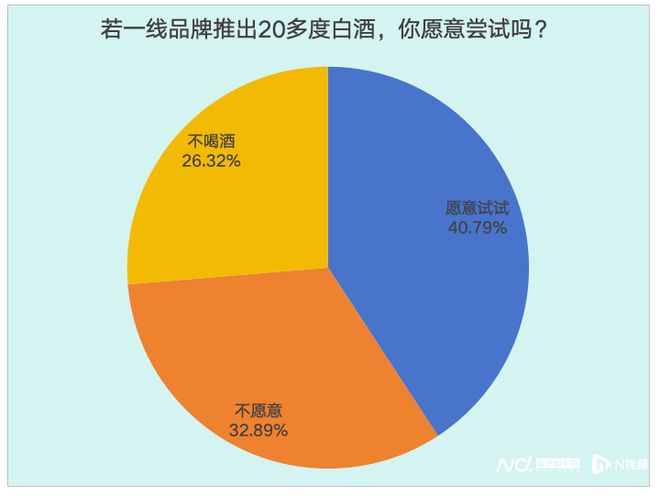
Core Insights - The traditional liquor industry is facing a generational shift, prompting major brands to focus on "lower alcohol content" to attract younger consumers [1][2][5] - Major liquor companies are launching products with lower alcohol levels, such as Wuliangye's 29-degree "Yijian Qingxin" and Luzhou Laojiao's 28-degree Guojiao 1573, in a competitive "lowering alcohol content" race [1][2][10] Group 1: Market Trends - A significant portion of the younger demographic (ages 20-35) prefers beer (52%) and foreign wines (29%) over traditional liquor (19%) [5] - Research indicates that 25.33% of consumers find high-alcohol liquor (over 50 degrees) too strong, with 45.33% believing it does not suit modern preferences [2][5] - The trend towards lower alcohol content is seen as essential for capturing the future of the liquor market, with companies prioritizing product design and innovation to appeal to younger consumers [2][5] Group 2: Consumer Preferences - Younger consumers are shifting towards personalized, lower-alcohol, and aesthetically pleasing products, favoring "light social" drinking scenarios [2][5] - Despite the push for lower alcohol content, 32% of consumers are hesitant to try lower-alcohol products, believing that "20-degree liquor is not real liquor" [6][9] - The perception of lower-alcohol liquor as "bland" poses a challenge, as many consumers associate lower alcohol levels with a loss of flavor and richness [8][9] Group 3: Production Challenges - The process of reducing alcohol content presents technical challenges, including flavor loss and potential cloudiness in the product [8][9][10] - Industry experts emphasize the need for advanced techniques to maintain flavor integrity while lowering alcohol content, indicating that lower alcohol products require higher production standards [9][10] - The complexity of producing lower-alcohol liquor is particularly pronounced in sauce-flavored liquor, which has a more intricate production process compared to strong-flavored varieties [10][12] Group 4: Financial Implications - The introduction of lower-alcohol products raises concerns about lower profit margins, as these products are generally priced lower than their higher-alcohol counterparts [14][16] - Financial reports indicate a decline in profit margins for companies like Luzhou Laojiao, with a noted decrease from 88.3% to 86.51% over recent years [14] - Despite the popularity of lower-alcohol products, there are concerns about their impact on overall revenue, as they are often sold at significantly lower prices compared to traditional high-alcohol products [14][16] Group 5: Industry Outlook - The future of lower-alcohol liquor remains uncertain, with past examples like Jiangxiaobai illustrating the potential pitfalls of market trends that may not sustain long-term consumer interest [17][18] - The industry is at a crossroads, with major brands experimenting with lower-alcohol offerings while facing skepticism about their long-term viability [17][18]

食品饮料周观点:关注中报成长标的,白酒底部看绝对价值-20250727
GOLDEN SUN SECURITIES· 2025-07-27 10:46
Investment Rating - The report maintains an "Increase" rating for the food and beverage industry, indicating a positive outlook for the sector [5]. Core Views - The liquor industry is strengthening its internal capabilities, with companies focusing on management, product, and channel improvements. The industry is currently at a low valuation and is expected to stabilize as sales pressure eases [2]. - In the beer and beverage sector, East Peak Beverage reported impressive mid-year results, while the industry continues to show high growth potential despite intense competition [3]. - The report highlights the ongoing transformation in product selection at Sam's Club, emphasizing operational efficiency through local supply chain adjustments [4]. Summary by Sections Liquor Industry - The liquor sector is in a phase of continuous improvement, with major companies like Guizhou Moutai and Shanxi Fenjiu enhancing their management and product offerings. The industry is currently experiencing a seasonal downturn, but valuations are low, suggesting potential for recovery [2]. Beer and Beverage Sector - The beer segment is advised to focus on high-growth products and structural performance, with companies like Yanjing Beer and Zhujiang Beer being highlighted. East Peak Beverage's revenue for the first half of 2025 reached 10.737 billion yuan, a year-on-year increase of 36.37% [3]. Food Sector - Sam's Club is undergoing a significant product selection transformation, with a shift towards national best-selling items to improve operational efficiency. The report notes that the low-temperature dairy market is performing better than the ambient temperature segment [4][7].


食品饮料行业周报:板块持仓降至低位,耐心等待基本面变化-20250726
Shenwan Hongyuan Securities· 2025-07-26 14:04
Investment Rating - The report maintains a positive outlook on the food and beverage industry, particularly on traditional consumer brands and companies with long-term competitive advantages [3][7]. Core Insights - The report highlights that traditional consumer brands have adjusted and now possess long-term investment value from a dividend and yield perspective. The food sector is expected to see performance differentiation based on company fundamentals [3][7]. - In the liquor segment, the report anticipates continued pressure on sales due to slow macroeconomic recovery and limited consumption scenarios, with key recommendations including Kweichow Moutai, Shanxi Fenjiu, and Luzhou Laojiao [3][7]. - The report emphasizes the growth potential in the dairy sector, driven by supply-demand rebalancing and supportive policies, recommending companies like Yili and Qingdao Beer [3][9]. Summary by Sections 1. Weekly Insights on Food and Beverage - The food and beverage sector saw a 0.74% increase last week, with liquor up 0.94%, but underperformed the broader market by 0.93 percentage points [6][39]. 2. Market Performance of Food and Beverage Sectors - The liquor sector's heavy stock holdings in public funds decreased to 6.79% in Q2 2025, down 1.71 percentage points from the previous quarter, indicating a low position compared to historical averages [8][39]. 3. Industry Events and Updates - The report notes that the liquor sector is currently in a consumption off-season, with significant downward pressure expected in Q3, particularly in August [8][9]. 4. Valuation Table - The food and beverage sector's dynamic PE is at 18.72x, with a premium rate of 29%, while the liquor sector's dynamic PE is at 17.35x, with a premium rate of 19% [22].

磨刀霍霍向白酒
雪球· 2025-07-26 04:03
Core Viewpoint - The article discusses the potential recovery of the liquor industry, particularly the white wine sector, highlighting that stock prices may rebound before actual performance improvements are observed [2][3]. Group 1: Market Dynamics - There is a significant influx of off-market funds into the liquor industry as investors anticipate a recovery, leading to increased buying activity [2]. - Fund holdings in major brands like Moutai are notably low, suggesting that even a slight increase in positions could lead to substantial price increases [2]. - The white wine sector has experienced a price decline for four years, but loyal consumers remain, indicating a potential for price recovery with reduced selling pressure [2]. Group 2: Performance Indicators - A performance turning point for the liquor industry is expected around 2025, with stock price recoveries likely occurring beforehand [3]. - The stock price of Laojiao has already increased by 20% from 107 yuan, which is often seen as a bullish indicator in the market [3]. - The lowest point in this cycle was likely around 98 yuan last September, suggesting that the market has already priced in known risks [3]. Group 3: Consumption Trends - The consumption of liquor is expected to rise due to increased consumer spending driven by stable real estate prices and a bullish stock market [3]. - The article emphasizes that the best time to enter the market is often when the majority feel pessimistic, indicating a contrarian investment opportunity [3]. - The stability of the market price for premium products, such as Feitian at over 1800 yuan, reflects a healthier supply-demand balance than perceived by many [2].

【开源食饮】食品饮料仓位新低,建议布局白酒与新消费潜力股——行业点评报告
Sou Hu Cai Jing· 2025-07-25 20:24
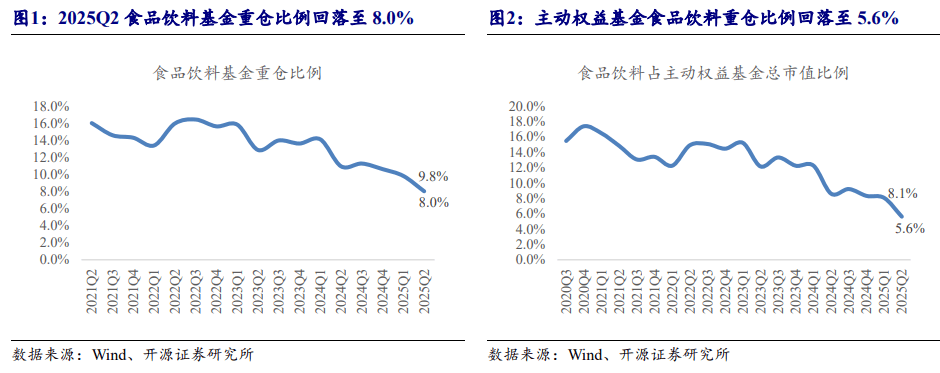
Group 1 - The core viewpoint of the articles indicates a significant decline in the allocation of food and beverage sectors by funds, reaching a new low since 2020, with the allocation ratio dropping from 9.8% in Q1 2025 to 8.0% in Q2 2025 [1][5][6] - Active equity funds have notably reduced their allocation to the food and beverage sector, with a decrease from 8.1% in Q1 2025 to 5.6% in Q2 2025, reflecting a 2.5 percentage point drop [1][5][6] - The decline in the food and beverage sector is attributed to the impact of the alcohol ban, which has further contracted consumption scenarios, particularly affecting traditional sectors like liquor [1][3][5] Group 2 - The proportion of active equity funds heavily invested in liquor has decreased from 6.57% in Q1 2025 to 3.97% in Q2 2025, a decline of 2.6 percentage points, indicating a widespread reduction in liquor holdings [2][11] - The overall market fund allocation to liquor has also fallen from 8.5% in Q1 2025 to 6.8% in Q2 2025, showing a similar trend of reduced investment in liquor [2][11] - Major liquor companies such as Luzhou Laojiao, Wuliangye, and Shanxi Fenjiu have seen significant reductions in fund holdings, while only a few companies like Kuaijishan and Shede Liquor experienced slight increases [2][11][20] Group 3 - The investment recommendation suggests strategically positioning in the liquor sector, as the current low expectations and valuations present potential opportunities for gradual accumulation [3][25][27] - The report anticipates that the liquor industry will find a bottom in the second half of the year, with expectations of a recovery in demand as the market adjusts to the impacts of the alcohol ban [3][27] - For new consumption targets, the focus should be on companies that can leverage channel expansion opportunities and emerging product categories, with recommendations including Ximai Food and Bai Run Shares [3][28]


吃喝板块重挫!“茅五泸汾洋”集体回调,食品ETF(515710)收跌1.28%!机构:食饮需求有望边际企稳
Xin Lang Ji Jin· 2025-07-25 11:58
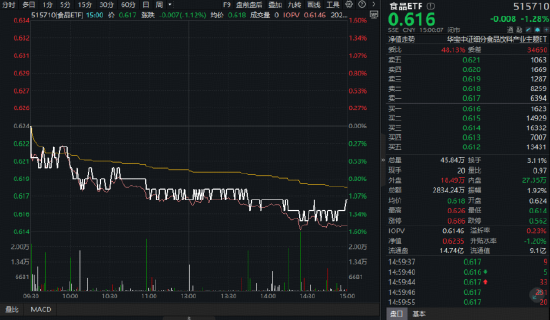
Core Viewpoint - The food and beverage sector is experiencing a pullback, with the Food ETF (515710) declining by 1.28% as of the close on July 25, 2025, despite a recent trend of recovery in stock prices over a longer time frame [1][3]. Group 1: Market Performance - The leading stocks in the liquor segment, including Kweichow Moutai, Luzhou Laojiao, and Shanxi Fenjiu, saw declines exceeding 2%, while Wuliangye and Shede Liquor fell over 1% [1]. - The Food ETF (515710) has a current price-to-earnings ratio of 20.72, which is at the 6.27% percentile of the past decade, indicating a favorable long-term investment opportunity [4]. Group 2: Sector Outlook - According to CICC, the food and beverage sector is expected to stabilize and improve marginally due to ongoing government policies aimed at boosting domestic demand and consumption [3]. - East Asia Securities suggests that as economic stimulus policies are implemented, the overall sentiment in the food and beverage sector may improve in the second half of the year [5]. - Longjiang Securities notes that the food and beverage industry is undergoing significant changes on both the supply and demand sides, with a shift in product strategies indicating a cyclical transformation in the industry [5]. Group 3: Key Holdings - The top holdings in the Food ETF (515710) include leading liquor companies such as Kweichow Moutai, Wuliangye, and Luzhou Laojiao, which collectively account for 27.04% of the ETF's holdings as of the second quarter of 2025 [3][4]. - The ETF's portfolio is heavily weighted towards high-end and mid-range liquor stocks, with approximately 60% allocated to these segments, while the remaining 40% includes leading companies in beverages, dairy, and condiments [6].
从“一酒独大”到“多极共振”!2025年上半年川股“变阵”:2.88万亿元市值版图正被重构
Mei Ri Jing Ji Xin Wen· 2025-07-25 07:22
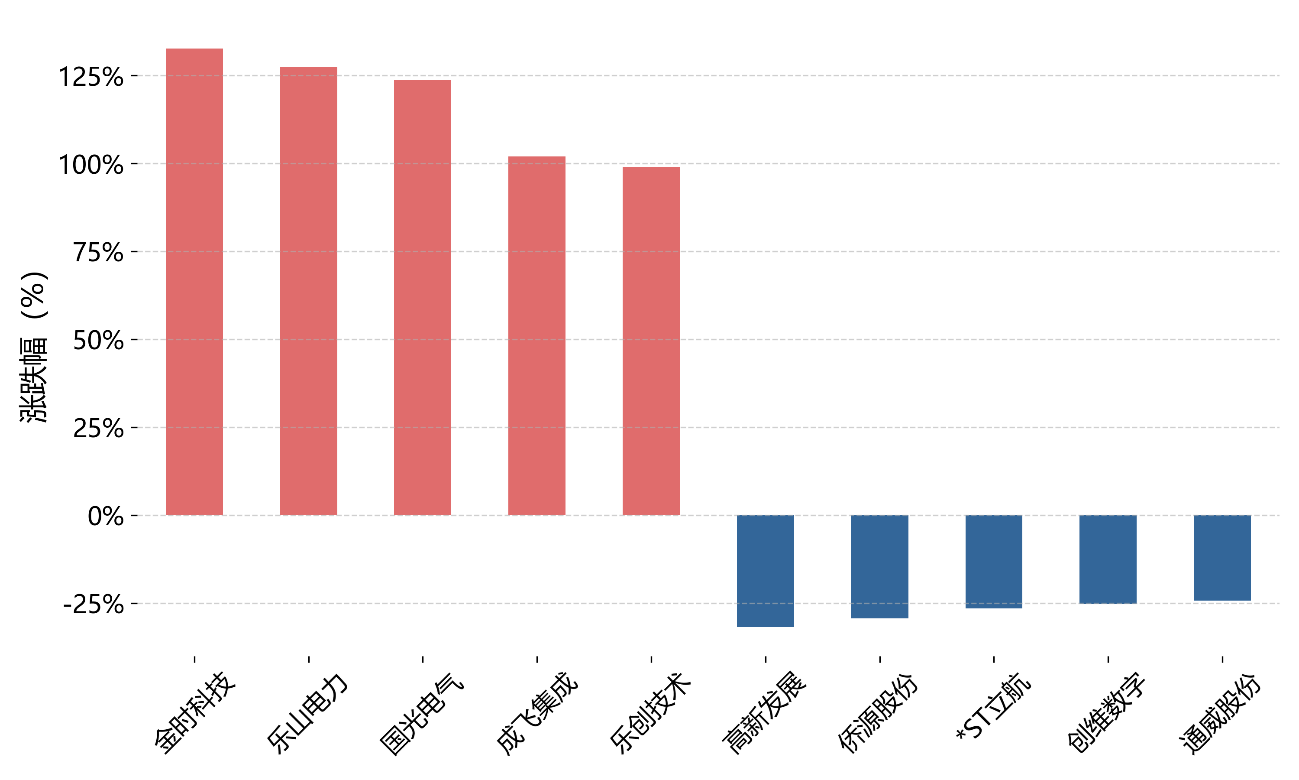
Core Viewpoint - The Sichuan stock market is experiencing a structural transformation, moving away from a reliance on the liquor industry towards a more diversified and balanced economic landscape, with significant growth in industrial and new technology sectors [1][2][3] Group 1: Market Performance - As of June 30, 2025, the total market capitalization of the Sichuan stock market reached 2.88 trillion yuan, reflecting a 6.27% increase from the end of 2024, outperforming major stock indices [1] - The market capitalization of the consumer sector has decreased from 54.63% during the peak of the liquor bull market to 25.55%, a decline of 29.08 percentage points [2] - The industrial sector's market capitalization has increased by 10.26 percentage points over the past five years, with significant contributions from optional consumption and materials sectors [3] Group 2: Structural Changes - The shift from a single dominant sector to a multi-polar support system is evident, with the industrial sector now valued at 0.6 trillion yuan, encompassing traditional strengths such as military, environmental protection, and rail transit [3] - Emerging companies in new sectors have shown remarkable market performance, with notable stock price increases for companies like Jinshi Technology (up 132.69%) and Guoguang Electric (up 123.67%) [3] Group 3: Financial Health and Governance - Sichuan listed companies exhibit a lower equity multiplier of 3.10 compared to the Wind All A index at 6.09, indicating lower financial leverage and more conservative operational strategies [7] - The total dividends distributed by Sichuan listed companies reached 68.3 billion yuan over the past year, with a dividend yield of 2.38%, significantly higher than the shadow index and Wind All A [7] Group 4: Company Ecosystem - State-owned enterprises account for 43.8% of the market capitalization in Sichuan, significantly above the national average of 18.22%, while private enterprises represent 40.81% [8] - The market capitalization distribution in Sichuan shows a healthier "thick tail" characteristic, with the top 10% of listed companies accounting for 55.9% of the total market capitalization, lower than the national average of 66.31% [8] Group 5: Future Outlook - To enhance the quality of listed companies in Sichuan, there is a need to accelerate the listing of high-quality enterprises with new productive capabilities and to focus on high-quality development post-listing [11]