ZGXT(000831)

Search documents
中国稀土管制令已一年,美国仍在大量进口关键矿产?特朗普一招躲过中国禁令,2大“帮凶”已现身
Sou Hu Cai Jing· 2025-07-13 05:34
Core Viewpoint - The article discusses the ongoing "transshipment game" that the U.S. is playing to circumvent China's export controls on rare earth elements, particularly gallium, germanium, and antimony, which are critical for military applications like the F-35 fighter jet [1][2]. Group 1: U.S. Dependence on Rare Earths - The U.S. military heavily relies on rare earth materials, with 83.7% of its supply coming from China, particularly for advanced weaponry like the F-35 [1][2]. - Following China's export controls announced in July 2023, the U.S. faced a potential shortage of these critical materials, prompting the Pentagon to initiate stockpiling measures [2]. Group 2: Transshipment Channels - The U.S. has turned to Thailand and Mexico as primary channels for importing antimony oxide, with imports from these countries reaching 3,834 tons from December 2023 to April 2024, surpassing the total from the previous three years [1][2]. - U.S. companies are utilizing "small batch, multiple shipments" methods to mix rare earths with other goods, effectively bypassing Chinese export controls [2]. Group 3: Price Dynamics and Smuggling - The price of gallium has doubled since the implementation of China's export controls, creating a lucrative market for smugglers [3]. - Chinese companies have demonstrated creativity in circumventing regulations, with reports of approximately 200 kilograms of gallium being smuggled monthly disguised as other metals [3]. Group 4: China's Response - In response to the outflow of rare earth resources, China has initiated a crackdown on smuggling activities and introduced a new export licensing system requiring detailed transaction records [3]. - China is also considering countermeasures against third-party countries involved in transshipment, potentially mirroring U.S. practices in Southeast Asia [3]. Group 5: Long-term Implications - Despite the short-term relief provided by transshipment methods, the U.S. remains vulnerable to supply chain disruptions if China tightens its export controls further [5]. - China's dominance in rare earth refining technology, holding over 90% of the global market share and having production costs significantly lower than U.S. firms, poses a long-term challenge for U.S. military supply chains [5].


DoD入股MP以加速美国稀土磁体独立,但短期全球稀土永磁体生产仍高度集中于中国
HUAXI Securities· 2025-07-13 05:16
Investment Rating - Industry rating: Recommended [3] Core Insights - The U.S. Department of Defense (DoD) has invested billions in MP Materials to accelerate the independence of U.S. rare earth magnets, but global production remains highly concentrated in China in the short term [9][14][45] - Nickel prices have decreased due to a significant drop in demand and production halts in Indonesia, which may impact local mining operations [12][20][23] - Cobalt prices have risen due to supply tightening from the Democratic Republic of Congo, which accounts for approximately 75% of global electric vehicle battery supply [13][31] - Lithium carbonate prices have increased, but future price movements will depend on downstream demand recovery [7][38][44] - Antimony prices have remained stable, with domestic supply still tight, and production expected to decline in the coming months [32][36] Summary by Sections Rare Earth Industry - MP Materials announced a partnership with the DoD to enhance domestic production capabilities, with a new magnet manufacturing facility expected to be operational by 2028 [45][46] - The DoD has committed to a minimum price of $110 per kilogram for NdPr products, ensuring stable cash flow for MP Materials [46][47] Nickel Industry - As of July 11, LME nickel spot price was $14,955 per ton, down 1.09% from July 4, with total LME nickel inventory increasing by 1.83% [20] - Domestic NPI smelting costs remain under pressure, affecting the acceptance of high-priced raw materials [20][23] Cobalt Industry - As of July 11, cobalt prices have shown mixed trends, with electrolytic cobalt at 249,300 yuan per ton, down 0.99%, while cobalt oxide increased by 1.54% [24][31] - The extension of a temporary export ban by the Congolese government is expected to tighten global cobalt supply [31] Lithium Industry - The average price of battery-grade lithium carbonate reached 63,800 yuan per ton, up 2.36% as of July 11 [7][38] - Market sentiment is cautious, with inventory levels remaining high, limiting upward price movement [38][44] Antimony Industry - Domestic antimony ingot prices have stabilized, with supply constraints expected to support future pricing [32][36]




340亿美元大单落地,印尼突然变脸?中国稀土底牌,正被慢慢破解
Sou Hu Cai Jing· 2025-07-12 15:46
Core Viewpoint - Indonesia's recent trade agreement with the United States, valued at $34 billion, marks a significant shift in its economic strategy, driven by the need to mitigate economic pressures from U.S. tariffs and to capitalize on its natural resources, particularly nickel, which is crucial for the global renewable energy sector [1][3][9]. Group 1: Trade Agreement Details - The trade agreement includes substantial purchases of natural gas, agricultural products, electronics, machinery, and medical equipment from the U.S., alongside Indonesia's commitment to implement near-zero tariffs on over 1,700 U.S. goods [5][7]. - Indonesia is also easing investment restrictions for U.S. companies, indicating a welcoming stance towards American investments [7]. Group 2: Economic Context - Indonesia's economy heavily relies on its natural resources, with nickel being a key component, as it is one of the world's major suppliers of nickel, which is increasingly in demand for electric vehicle batteries [11][38]. - The U.S. has expressed a need to reduce its dependence on China for rare earth elements, prompting Indonesia to seek collaboration in supplying nickel and other critical minerals [13][34]. Group 3: Regional Implications - The trade dynamics in Southeast Asia are shifting, with countries like Vietnam and Cambodia also making concessions to the U.S. under similar pressures, highlighting a broader trend of smaller nations adapting to the geopolitical landscape [30][50]. - The agreements reflect a strategic pivot in the region, where economic survival often necessitates alignment with larger powers, showcasing the complexities of global trade relationships [32][50]. Group 4: Financial Trends - There is a notable trend towards "de-dollarization" among Southeast Asian nations, as they increasingly seek alternatives to the U.S. dollar for trade settlements, with the Chinese yuan gaining traction [42][46]. - This shift may indicate a significant change in the global financial landscape, driven by the pressures exerted by U.S. policies on these countries [46].

美国怎么就被中国稀土卡了脖子?原因你肯定想不到
Guan Cha Zhe Wang· 2025-07-12 01:33
Group 1 - The U.S. Department of Commerce restored export licenses for EDA software, aviation equipment, and engines to China, marking the end of a recent ban that began in late May [1][2] - The trade dispute escalated with tariffs increasing by 125% between the U.S. and China, leading to significant trade disruptions [2][4] - The U.S. government's ban on exports was a response to China's tightening of rare earth controls, which the U.S. viewed as a retaliatory measure [2][4] Group 2 - China's strict management of rare earth exports is aimed at preventing strategic resources from being used against its interests, creating a counterbalance in negotiations [4][5] - U.S. companies, particularly in the automotive sector, face supply chain disruptions due to China's rare earth export controls, which could lead to production halts [4][6] - The U.S. has relied on smuggling to obtain rare earth materials, but recent crackdowns by China threaten this supply route [6][10] Group 3 - The U.S. export ban on ethane, EDA software, and aviation equipment may backfire, as it could also harm U.S. exports and industries reliant on these markets [12][13] - EDA software is critical for semiconductor design, but China has made significant strides in developing its own alternatives since facing U.S. sanctions [13][18] - The C919 aircraft's engine options include domestically developed alternatives, such as the AEF1200, which is positioned to meet the aircraft's power requirements [15][16][18] Group 4 - The AEF1200 engine, derived from the WS20 military engine, is designed to compete with established Western models like the CFM56, showcasing China's advancements in aviation technology [15][16] - China's approach to building a self-sufficient supply chain in response to U.S. sanctions reflects a long-term strategy to mitigate risks associated with foreign dependencies [18][19] - The recent approval of rare earth exports to major U.S. automakers under strict conditions indicates a strategic compromise to ensure the continued development of China's aviation industry [18]
深股通本周现身42只个股龙虎榜
Zheng Quan Shi Bao Wang· 2025-07-11 15:19
Group 1 - The article highlights that 42 stocks appeared on the weekly trading list, with 24 showing net purchases from the Shenzhen Stock Connect [1] - The top three stocks with the highest net purchases were Zhongyou Capital, China Rare Earth, and Jingbeifang, with net purchases of 215.28 million, 213.55 million, and 142.71 million respectively [1] - The average increase of stocks with net purchases from Shenzhen Stock Connect was 14.37%, outperforming the Shanghai Composite Index, which rose by 1.09% [1] Group 2 - Among the stocks with net sales, the top two were Shaoneng Co. and Dadongnan, with net sales of 40.50 million and 36.76 million respectively [2] - The stock with the highest increase was Tongguan Copper Foil, which saw a price increase of 43.72% over the week [1] - The trading turnover rate for the stocks with net purchases was notably high, with some stocks like Hengbao Co. and Zhongke Jincai exceeding 170% [1]




龙头业绩暴涨+产品提价,机构关注稀土板块哪些标的丨行业风口
2 1 Shi Ji Jing Ji Bao Dao· 2025-07-11 11:17
Core Viewpoint - The rare earth sector is experiencing significant growth driven by soaring profits from leading companies and rising prices for rare earth materials, leading to a surge in market interest and stock performance [1][2][3]. Group 1: Company Performance - Northern Rare Earth has reported a projected net profit increase of over 55 times, with expected net profit for the first half of 2025 ranging from 900 million to 960 million yuan, marking a year-on-year increase of 1882.54% to 2014.71% [1]. - The company anticipates a non-GAAP net profit of 880 million to 940 million yuan for the same period, reflecting a year-on-year growth of 5538.33% to 5922.76% [1]. - The overall performance of the rare earth sector has improved, with major products like rare earth metals and permanent magnets seeing increased production and sales [2]. Group 2: Price Adjustments - Northern Rare Earth and Baotou Steel announced a price increase for rare earth concentrates, raising the price by 284 yuan per ton, which represents a 1.5% increase from the previous quarter [3]. - As of July 9, 2025, the price of praseodymium-neodymium oxide in China reached 452,500 yuan per ton, with a year-to-date increase of 12.42% and a year-on-year growth of 24.83% [2]. Group 3: Market Dynamics - The rare earth market is currently more active than the previous year, influenced by tightened upstream raw material supply and stimulating policies for downstream consumption [2]. - The Chinese government has implemented regulations to protect rare earth resources, which is expected to support prices in the long term [7][8]. - The crackdown on smuggling and illegal activities in the rare earth sector is likely to have a lasting impact on domestic supply, concentrating the industry around major players [9][10]. Group 4: Institutional Focus - Institutions are focusing on the strategic value of the rare earth sector, emphasizing the unique technological and operational advantages of China's rare earth processing capabilities [10]. - There is a recommendation to pay attention to leading companies in high-performance magnetic materials and those with strong growth potential in the rare earth industry, such as Northern Rare Earth and Kinglong Permanent Magnet [10].


龙虎榜 | 四方新材“天地天”,多席位买入!深股通减仓跨境通1.06亿元
Sou Hu Cai Jing· 2025-07-11 10:51
Market Overview - On July 11, the A-share market saw all three major indices rise, with total trading volume reaching 1.71 trillion yuan, the highest since March 15, and over 2900 stocks increased in value [1] - Market focus was on sectors such as rare earth permanent magnets, large financials, non-ferrous metals, and CRO concepts [1] Stock Performance - A total of 61 stocks hit the daily limit up, with 17 stocks achieving consecutive limit ups, and a limit up rate of 69% (excluding ST and delisted stocks) [3] - Notable stocks included: - Sifang New Material with a five-day consecutive limit up [3] - Jingyi Co. and Yamaton with eight days of five consecutive limit ups [3] - Lianhuan Futures and Shangwei New Material with three consecutive limit ups [3] Key Stocks and Trading Data - **Sichuan Wisdom (300066)**: Price increased by 20.09% to 5.50 yuan, with a trading volume of 198.8 million [4] - **Guochuang Technology (300221)**: Price increased by 20.04% to 12.22 yuan, with a trading volume of 81.21 million [4] - **Jiujiu Changke (300631)**: Price increased by 20.02% to 28.96 yuan, with a trading volume of 22.537 million [4] - **Guorui Technology (300600)**: Price increased by 20.01% to 16.73 yuan, with a trading volume of 55.38 million [4] - **Haoou Bo (888888)**: Price increased by 20.00% to 156.47 yuan, with a trading volume of 46063 [4] Institutional Trading - The top three net buying stocks on the daily leaderboard were: - Fushun Special Steel with a net buy of 247 million yuan [6] - Guorui Technology with a net buy of 190 million yuan [6] - Shanghai Steel Union with a net buy of 174 million yuan [6] Sector Highlights - **Rare Earth Sector**: The price of rare earth concentrate was adjusted to 19,109 yuan/ton, a 1.5% increase from the previous quarter, marking the fourth consecutive quarter of price increases [24] - **Guorui Technology**: The company is a key supplier in the military and new energy ship sectors, with a focus on precision sheet metal processing in the new energy field [14][17] - **Shanghai Steel Union**: The company focuses on big data for commodities and AI applications, with significant trading activity noted [18] Company Financials - **China Rare Earth**: Reported a 141.32% year-on-year increase in revenue for Q1 2024, amounting to 728 million yuan, and a net profit of 72.62 million yuan, marking a return to profitability [26] - **Guorui Technology**: The company is set to remove risk warnings from its stock, enhancing its market position [17] Trading Trends - The trading volume and turnover rates for several stocks indicated strong market interest, with Shanghai Steel Union achieving a turnover rate of 25.57% and a trading volume of 21.10 billion yuan [18] - The overall market sentiment was positive, with significant movements in various sectors, particularly in rare earth and military-related stocks [24][14]




中国稀土新规,让西方炸锅?这招“软刀子”真的绝
Sou Hu Cai Jing· 2025-07-11 10:45
Group 1 - China's sudden requirement for export licenses for heavy rare earths led to a 74% drop in rare earth magnet exports in May, causing significant concern among U.S. military and renewable energy companies [1][3] - The Chinese government has strategically opened a green channel for the EU and granted temporary licenses to U.S. car manufacturers, indicating a nuanced approach to international relations [1][3] - The policy shift is seen as a response to previous WTO rulings against China's quota system, now framed under national security and non-proliferation, allowing for more flexible control over exports [3][5] Group 2 - The U.S. and its allies, including Japan and Australia, are reacting strongly, with the Pentagon discussing "decoupling" from China and Australian companies seeing stock price surges [5][7] - Rebuilding supply chains is expected to take at least five years, during which China may further solidify its position in the rare earth market [5][7] - The current situation highlights a broader geopolitical strategy where China uses rare earths as leverage against U.S. defense industries, with implications for future regulations in biomedicine and lithium batteries [5][7] Group 3 - The U.S. faces a dilemma: imposing similar controls could harm domestic companies, while negotiating could undermine political standing ahead of midterm elections [7] - The EU is proactively working on the Critical Raw Materials Act to mitigate risks while benefiting from China's green channel [7] - The situation serves as a lesson in modern economic warfare, emphasizing the importance of using export licenses to adjust supply chains rather than outright bans [7]

稀土,大爆发!最强主线,午后突变
Zheng Quan Shi Bao· 2025-07-11 09:38
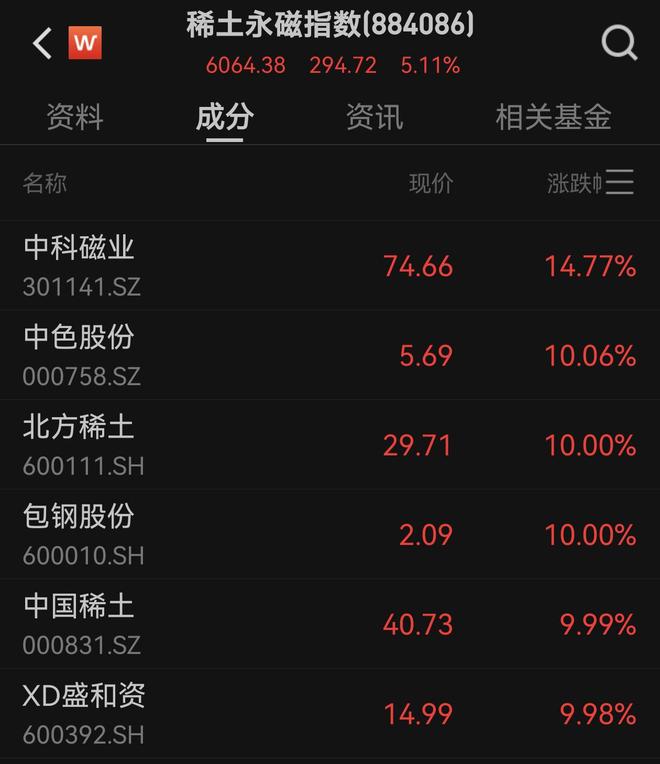
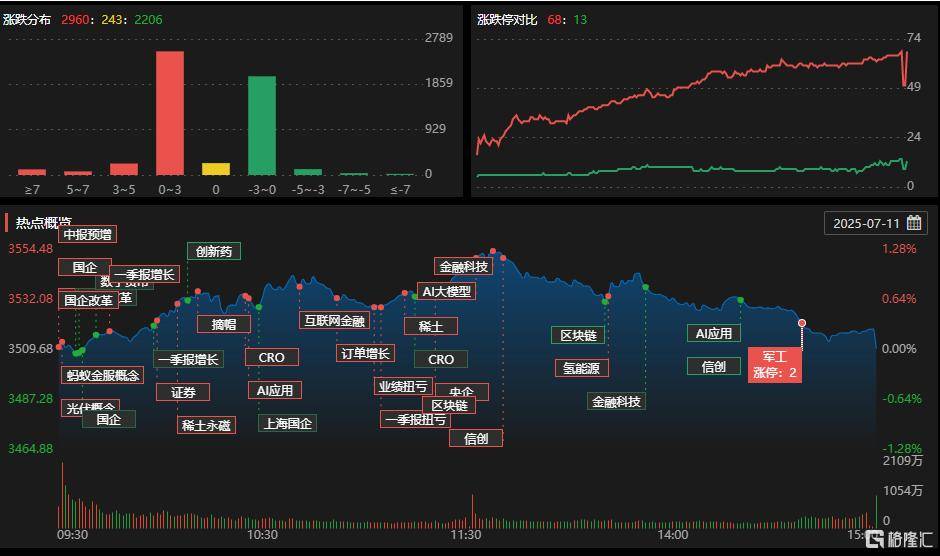
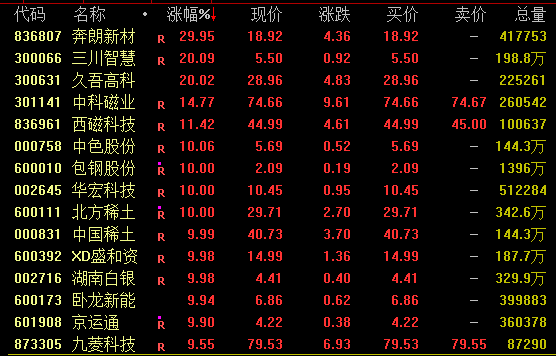
Market Overview - The A-share market experienced a brief surge, with the three major indices rising over 1% at one point, but later fell due to a decline in bank stocks [1] - The Shanghai Composite Index closed slightly up by 0.01% at 3510.18 points, while the Shenzhen Component rose by 0.61% to 10696.1 points, and the ChiNext Index increased by 0.8% to 2207.1 points [1] - The total trading volume in the Shanghai and Shenzhen markets reached 173.69 billion yuan, an increase of over 220 billion yuan compared to the previous day [1] Sector Performance - The brokerage sector led the market gains, with Zhongyin Securities hitting the daily limit for two consecutive days, and other stocks like Harbin Investment and Zhongyuan Securities also reaching the limit [2][7] - The rare earth sector saw significant gains, with Benlang New Materials hitting a 30% limit up, marking a historical high, and other companies like Baotou Steel and Northern Rare Earth also reaching the limit [3][4] - The innovative drug concept stocks surged, with companies like Kailaiying and WuXi AppTec hitting the limit, while Changshan Pharmaceutical rose over 15% [2] Bank Sector Decline - The banking sector experienced a sharp decline in the afternoon, with major banks like Shanghai Pudong Development Bank and Jiangsu Bank dropping over 2% [10][11] - Analysts suggest that the sudden drop in bank stocks may be due to profit-taking by investors at a market peak [12] Rare Earth Pricing and Performance - Baotou Steel announced an adjustment to the pricing mechanism for rare earth concentrates, setting the price for the third quarter of 2025 at 19,109 yuan per ton (excluding tax) [4][5] - Northern Rare Earth also announced a similar pricing adjustment and projected a net profit of 900 million to 960 million yuan for the first half of 2025, representing a year-on-year increase of 1882.54% to 2014.71% [5] Future Outlook - The demand for rare earth materials is expected to improve due to the growth in sectors like new energy vehicles and wind power, with a potential shortage in the global market for praseodymium and neodymium oxides [6] - The securities sector is anticipated to benefit from a stable return environment, with expectations of increased allocations from institutional investors, particularly in high-dividend banks [12]
稀土,大爆发!最强主线,午后突变!
证券时报· 2025-07-11 09:30
Core Viewpoint - The article discusses the fluctuations in the A-share and Hong Kong stock markets, highlighting the significant movements in bank stocks, the surge in the rare earth sector, and the performance of brokerage firms. A-share Market Performance - On July 11, the A-share market initially rose, with the Shanghai Composite Index reaching a new high for the year, but later fell due to a decline in bank stocks. The Shanghai Composite Index closed at 3510.18 points, up 0.01%, while the Shenzhen Component Index rose 0.61% to 10696.1 points. The ChiNext Index increased by 0.8% to 2207.1 points, and the STAR Market 50 Index rose by 1.48% [1][12]. - The total trading volume in the Shanghai and Shenzhen markets reached 173.69 billion yuan, an increase of over 22 billion yuan compared to the previous day [1]. Brokerage Sector Performance - The brokerage sector showed strong performance, with several stocks hitting the daily limit. Zhongyin Securities achieved two consecutive limit-ups, while other firms like Harbin Investment and Zhongyuan Securities also reached their daily limits. Overall, the brokerage sector was a leading performer in the market [1][9][11]. Rare Earth Sector Surge - The rare earth sector experienced a significant surge, with Benlang New Materials hitting a 30% limit-up, marking a historical high. Other companies like Zhongke Magnetic Materials and Baogang Group also saw substantial gains, with many stocks in the sector reaching their daily limits [4][6]. - Baogang Group announced an adjustment in the pricing mechanism for rare earth concentrates, setting the price for the third quarter of 2025 at 19,109 yuan per ton, excluding tax [6]. Bank Sector Decline - The banking sector faced a sharp decline in the afternoon, with major banks like Zheshang Bank, Shanghai Pudong Development Bank, and China Minsheng Bank dropping nearly 3%. Other banks, including Jiangsu Bank and China Bank, fell over 2% [12][13]. - Analysts suggest that the sudden drop in bank stocks may be attributed to profit-taking by investors at market peaks. Despite this, the banking sector is viewed as a stable return option due to its solid fundamentals and dividend levels [14].