BABA(BABA)

Search documents
淘宝闪购元旦消费数据:7500万颗车厘子、1000万颗草莓被「老己」抢购一空
Xin Lang Ke Ji· 2026-01-04 02:17
Core Insights - The holiday consumption market was ignited by a focus on instant gratification and self-reward during the New Year period [1] Group 1: Sales Performance - Taobao Flash Sale reported record high sales for several New Year products, with over 75 million cherries sold [1] - Sales of Dandong Hongyan strawberries exceeded 10 million [1] - Boston lobsters, once considered a luxury, have become a regular choice for young consumers, with over 100 stores selling out of live lobsters [1] - Milk sales reached 1.2 million liters, while both cola and beer sold over 1.5 million liters during the holiday [1] Group 2: Consumer Behavior - The purchasing behavior during the New Year showed distinct characteristics of scene-based and instant consumption [1] - In the morning, consumers focused on seafood and hot pot ingredients, aligning with party preparation needs [1] - From noon to night, sales of gifts, flowers, and snacks increased, catering to social and relaxation needs [1] - Late-night purchases included beer, fruits, and health supplements, reflecting young people's pursuit of a balanced lifestyle between enjoyment and health [1]

淘宝闪购元旦消费数据:7500万颗车厘子、1000万颗草莓被“老己”抢购一空
Xin Lang Cai Jing· 2026-01-04 01:57
Core Insights - The consumption model centered around instant gratification and self-reward has significantly boosted the holiday market during the New Year period [1][2] Sales Performance - Taobao Flash Sale data indicates that several major holiday products achieved record sales, with over 75 million imported cherries sold [1][2] - Sales of Dandong red strawberries surpassed 10 million units, while Boston lobsters, once considered a luxury, became a regular choice for young consumers, leading to a sell-out across over 100 stores [1][2] - Milk sales reached 1.2 million liters, and both cola and beer, essential for holiday gatherings, sold over 1.5 million liters each [1][2] Consumption Patterns - The purchasing behavior during the holiday season displayed distinct characteristics of scenario-based and instant consumption [1][2] - In the morning, consumers focused on seafood and hot pot ingredients, aligning with preparation needs for gatherings; from noon to night, sales of gifts, flowers, and snacks increased, catering to social and relaxation needs [1][2] - Late-night purchases included beer, fruits, and health supplements, reflecting a lifestyle balance sought by young consumers [1][2]


纳斯达克中国金龙指数收盘涨超4% 百度上涨15%
Xin Lang Cai Jing· 2026-01-04 01:29
Core Viewpoint - The Nasdaq Golden Dragon China Index experienced a significant increase of 4.38%, marking a strong start to the week with a cumulative rise of 2.23% [1] Group 1: Index Performance - The Nasdaq Golden Dragon China Index closed up by 4.38% [1] - The index recorded a cumulative increase of 2.23% for the week [1] Group 2: Individual Stock Performance - Baidu saw a notable increase of 15% [1] - Bilibili and NetEase both rose by over 7% [1] - Alibaba experienced a rise of over 6% [1] - JD.com increased by nearly 3% [1]


科技分化加剧,中概股强势爆发,黄金冲高回落
Ge Long Hui· 2026-01-03 22:07
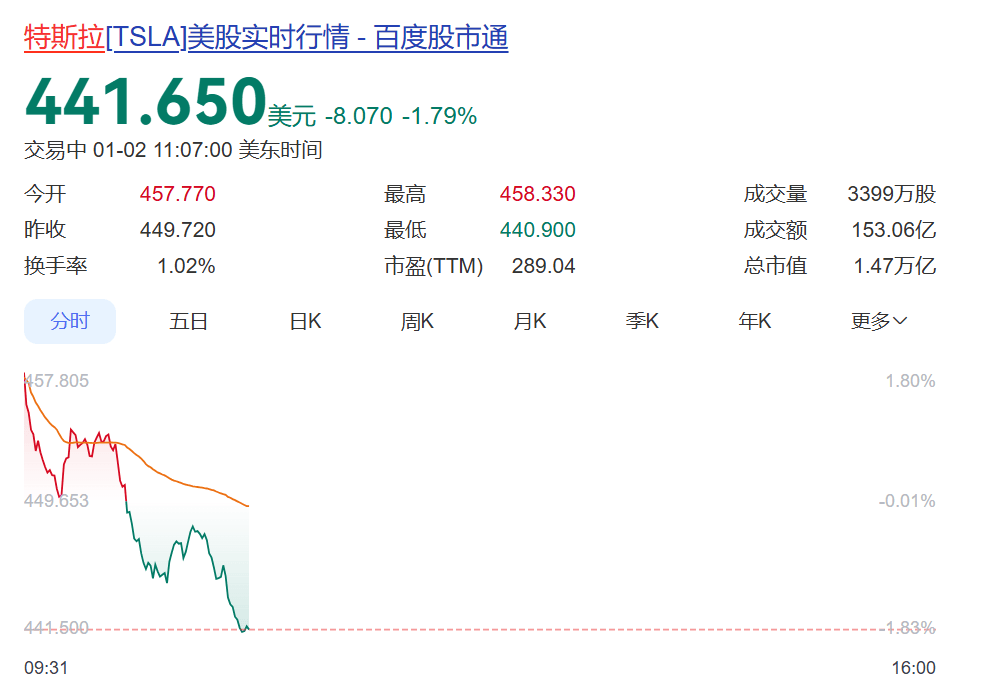
Market Overview - The market experienced a mixed performance with the S&P 500 rising by 0.66%, the Nasdaq declining by 0.03%, and the Dow Jones increasing by 0.19% [1] Banking Sector - The banking sector saw widespread gains, with Goldman Sachs surging by 4.02%, Morgan Stanley increasing by 2.46%, and other major banks like Bank of America, Citigroup, JPMorgan, Zions Bancorporation, and Alliance West Bank all rising by over 1% [3] Technology Sector - The technology sector displayed continued divergence, highlighted by Intel's significant increase of 6.72% and AMD's rise of 4.35%. However, notable declines were observed in Netflix, which fell by 3.95%, Tesla down by 2.59%, and Microsoft decreasing by 2.21%, with Amazon and META also experiencing declines of over 1% [3] Chinese Concept Stocks - Chinese concept stocks experienced a strong rally, with the China Golden Dragon index rising by 4.38%. Baidu saw a remarkable increase of 15.03%, while Bilibili rose by 7.24%, NetEase by 7.22%, Alibaba by 6.25%, and Tencent Holdings and iQIYI also saw gains exceeding 5% [3] Gold Market - The COMEX gold market experienced volatility, initially rising by 1.91% before closing slightly up by 0.02% at $4341.9 per ounce. The intraday trading range saw a low of $4340 and a high of $4414.8 [3]


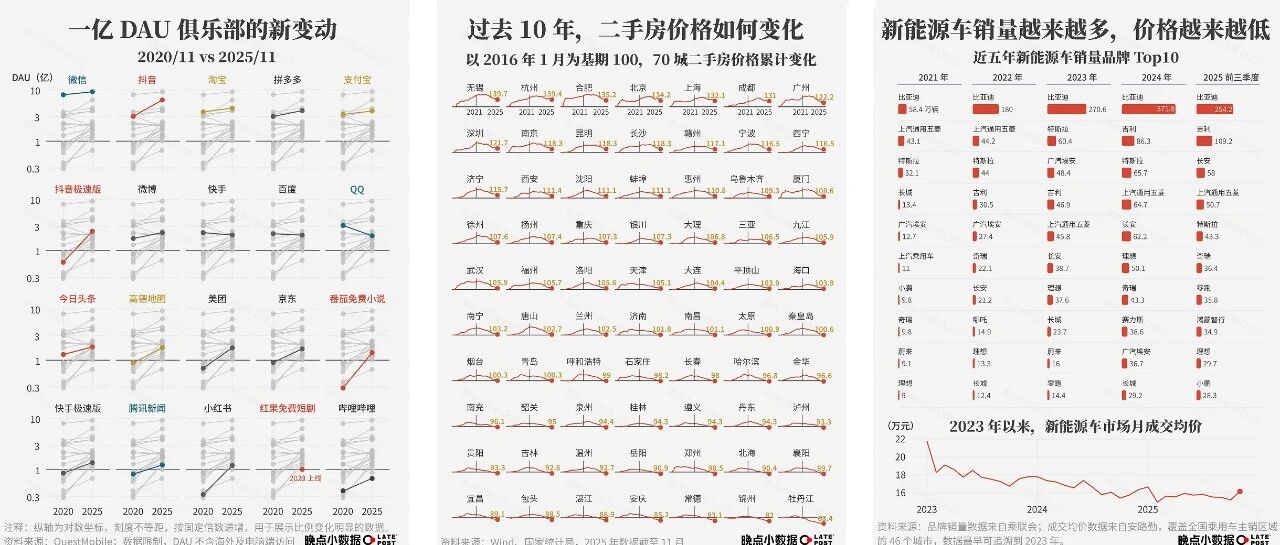
“人们常常低估了五年能有的改变”丨晚点小数据 2025
晚点LatePost· 2026-01-03 15:02
Core Viewpoint - The article emphasizes the long-term changes in consumer behavior and industry dynamics over the past five years, highlighting how events from 2021 continue to shape the current landscape [4][5]. Group 1: Industry Changes - In 2021, several industries were just beginning to emerge, such as AI and new energy vehicles, with companies like Li Auto and NIO selling cars priced at 300,000 to 500,000 yuan, while BYD set mainstream models above 200,000 yuan [5]. - The penetration of internet platforms into daily life was less pronounced five years ago, with platforms like Pinduoduo just starting to become profitable and not yet dominating the market [5]. - By 2025, ByteDance has become a significant player in various sectors, including e-commerce, with its GMV ranking third in the industry, while maintaining high growth rates [12]. Group 2: Company Performance - Alibaba's CFO stated that maintaining profits would be foolish given the competitive landscape, indicating a shift towards aggressive investment strategies among major players [9]. - Pinduoduo has significantly closed the gap with Taobao in terms of user base and shopping habits, focusing solely on retail without diversifying into AI or food delivery [11]. - ByteDance's revenue and profit levels are projected to reach those of Meta by 2025, with a strong focus on AI driving its growth [14]. Group 3: AI Development - The AI sector in China saw significant investment, with ByteDance spending 150 billion yuan in one year, while Alibaba announced a three-year investment plan of 380 billion yuan [33]. - Chinese AI companies are facing different challenges compared to their Silicon Valley counterparts, particularly in user monetization and computational resources [33]. - The user base for AI applications in China is limited, with only about 100 million daily active users across various platforms, indicating a need for more engaging and entertaining products to attract users [43]. Group 4: Consumer Behavior and Market Trends - Over the past five years, consumer spending has increased, but inflation has stagnated, leading to a trend of low-margin sales across industries [50]. - The average price of new energy vehicles in China has dropped to 169,000 yuan, reflecting intense competition and a return to traditional automotive industry dynamics [64]. - The automotive market is characterized by a price war, with companies like Geely and BYD adjusting their strategies to maintain competitiveness [75].

斯坦福报告揭秘中国开源AI全景:本土模型能否领跑全球?
Sou Hu Cai Jing· 2026-01-03 13:19
Core Insights - The report titled "Beyond DeepSeek: China's Diverse Open Weight AI Ecosystem and Its Policy Implications" highlights China's transition from a follower to a leader in the open weight AI model sector, emphasizing the significance of this development in the global context [1][29]. Group 1: Market Position and Growth - China has evolved from a follower to a leader in the open weight AI model field, with open weight models allowing developers to download, use, and modify model parameters [4][30]. - As of December 2025, Alibaba's Qwen model series surpassed Meta's Llama, achieving approximately 385 million downloads compared to Llama's 346 million [4][30]. - Between August 2024 and August 2025, Chinese developers accounted for 17.1% of total downloads on Hugging Face, surpassing the United States' 15.8% for the first time [4][30]. Group 2: Model Development and Ecosystem - The number of derivative models based on Qwen and DeepSeek has significantly increased, with Chinese models representing 63% of new derivative models uploaded to Hugging Face by September 2025 [6][32]. - The report analyzes four representative Chinese model families: Qwen, DeepSeek-R1, Kimi K2, and GLM-4.5, each with unique capabilities and open-source licenses [7][33]. Group 3: Technical Architecture and Efficiency - Many of these models utilize a Mixture of Experts (MoE) architecture, which enhances efficiency by allowing models to perform well with limited computational resources [9][35]. - DeepSeek's V3 model, for instance, has a total parameter count of 671 billion but activates only 37 billion parameters during inference, balancing performance and cost [9][35]. Group 4: Licensing and Policy Support - In 2025, both Qwen3 and DeepSeek R1 adopted more permissive open-source licenses (Apache 2.0 and MIT License, respectively), reflecting a shift towards attracting global developer communities [10][36]. - The Chinese government has played a complex role in supporting the development of open weight AI, with policies emphasizing "openness" and "open-source" as key components of national innovation strategies [11][37]. Group 5: Commercial Strategies and Market Dynamics - Chinese developers are exploring diverse monetization paths, with Alibaba positioning Qwen as an "AI operating system" to drive cloud computing growth through enterprise and government adoption [12][38]. - DeepSeek and Z.ai are pursuing a light-asset approach, collaborating with various cloud and computing service providers to offer localized services [12][38]. Group 6: Global Implications and Geopolitical Context - The report discusses the global implications of China's high-performance models, which provide affordable AI capabilities to low- and middle-income countries, potentially reshaping the competitive landscape [13][26]. - The release of DeepSeek R1 has influenced U.S. policy towards open weight AI, prompting a reevaluation of export controls and regulatory approaches [14][27].

一夜之间,金价突变!
Sou Hu Cai Jing· 2026-01-03 09:22
Market Performance - US stock market opened high but turned negative, with the Nasdaq initially rising over 1% before declining [1] - Chip stocks in the US saw a broad increase, with the Philadelphia Semiconductor Index rising over 4.5%, including significant gains from Nvidia, Intel, and ASML [2] - Major tech stocks such as Apple, Amazon, Microsoft, Google, and Netflix experienced declines [2] Chinese Stocks - The Nasdaq Golden Dragon China Index surged nearly 4%, with Baidu Group soaring over 12% [4] - iQIYI increased by over 9%, while other Chinese companies like GDS Holdings and JinkoSolar also saw significant gains [6] Hong Kong Market - The Hong Kong stock market opened strong, with the Hang Seng Index rising by 2.76%, the Hang Seng China Enterprises Index up by 2.86%, and the Hang Seng Tech Index increasing by 4.0% [6] - Sectors such as AI, semiconductors, commercial aerospace, electrical equipment, home appliances, and automotive showed strong performance throughout the day [6] Investment Outlook - Analysts suggest that the strong performance of Chinese assets at the start of 2026 indicates a continuation of the structural bull market from 2025, with a clear investment focus on hard technology represented by semiconductors, AI, and smart hardware, alongside policy-driven consumption in home appliances and automotive sectors [8] - The offshore RMB exchange rate against the US dollar strengthened, surpassing 6.97, reaching its highest level since May 2023 [8] Currency and Commodities - The performance of the RMB exchange rate is influenced by various factors including international environment, capital flows, and policy changes, with ongoing uncertainties regarding its future trajectory [9] - In precious metals, spot gold initially broke through $4,400 but later retraced most of its gains, while spot silver also saw a significant pullback [10]


马云养的闲鱼,正变异为一条“食人鱼”
商业洞察· 2026-01-03 09:21
Core Viewpoint - The article discusses the transformation of Xianyu from a user-friendly second-hand trading platform to one that imposes hidden fees on sellers, reflecting a shift from its original community-driven ethos to a profit-driven model [4][21]. Group 1: Hidden Traps - Sellers on Xianyu have reported being charged a 10% fee under the "Xianyu Alliance Promotion Service" without their knowledge, leading to significant deductions from their sales [7][9]. - The process for opting into these fees is designed to be obscure, with sellers facing obstacles when trying to opt out, which has been labeled as "obvious霸王条款" (unfair terms) [8][11]. - Complaints about these hidden charges are prevalent on consumer complaint platforms, indicating a widespread issue among users [9][11]. Group 2: Deterioration of Original Intent - Xianyu was founded in 2014 with a vision of being a free and open marketplace, initially not charging commissions and allowing easy transactions [13][15]. - Over time, the platform's commitment to not charging fees has been abandoned, with the introduction of service fees starting in June 2023, marking a shift towards monetization [16][17]. - The recent issues with hidden fees highlight a broader trend of the platform prioritizing revenue generation over user transparency and satisfaction [17]. Group 3: Commercialization Challenges - Xianyu's aggressive commercialization reflects Alibaba's overall strategic adjustments, with the platform being designated as a "strategic innovation business" in November 2023 [19][21]. - The community atmosphere that once defined Xianyu is being diluted by the presence of professional sellers and brands, leading to a crisis in its original community culture [21]. - The shift from a community-focused platform to one driven by GMV (Gross Merchandise Volume) metrics raises concerns about the erosion of user rights and the platform's foundational values [21].

元旦旅游火热开局:最热目的地南京前十,清远、铜川、抚顺增速最快
Yang Zi Wan Bao Wang· 2026-01-03 06:10
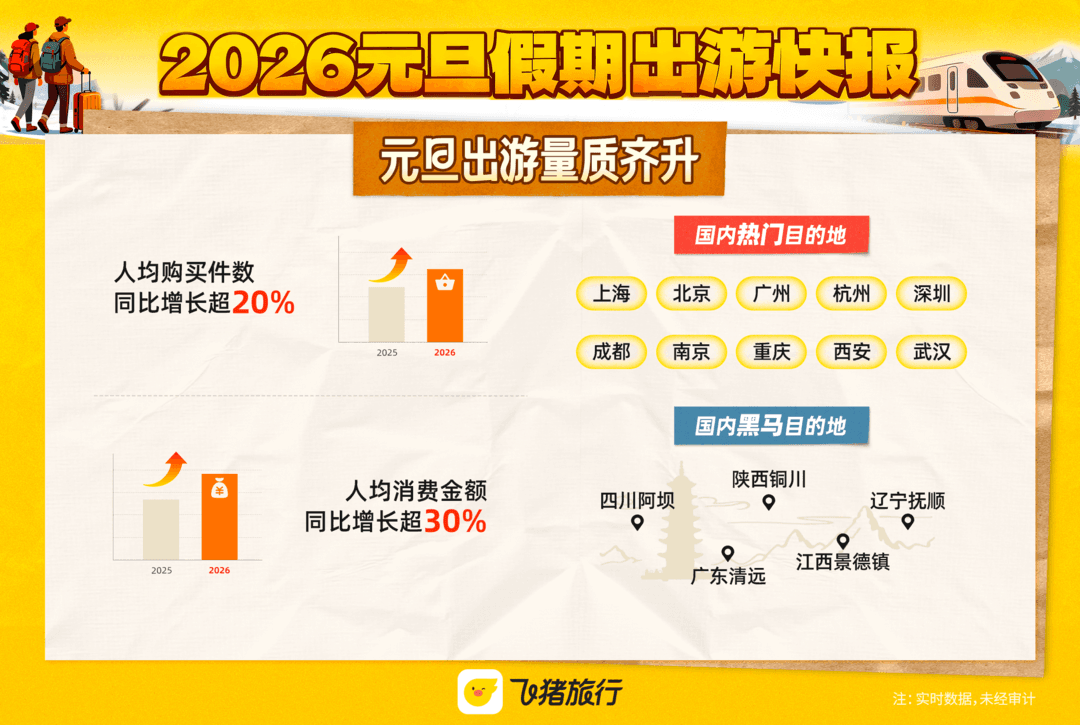
Core Insights - The tourism market for New Year's Day 2026 is experiencing a strong start driven by the "3 days off, 8 days off" holiday strategy, with significant increases in consumer travel intent and spending [1] Group 1: Travel Trends - The most popular destination is Nanjing, with a notable increase in hotel bookings by 280% year-on-year and a 270% increase in domestic leisure product bookings [1] - Major cities such as Shanghai, Beijing, Guangzhou, and others continue to dominate domestic travel due to their transportation advantages and rich cultural offerings [3] - Emerging destinations like Qingyuan, Tongchuan, and others are gaining traction, showcasing unique experiences that attract tourists [3] Group 2: Consumer Behavior - There is a clear segmentation in consumer demand, with family travel increasing by over 80%, and families preferring high-star hotels and full-service resorts for comfort [4] - The Z generation shows a 60% increase in travel product bookings, indicating a willingness to spend on unique and engaging experiences [4] Group 3: Outbound Travel - Outbound travel is seeing a significant rise, with car rental bookings increasing by over 210% and chartered tours growing by more than ten times [6] - Long-haul destinations like Australia and the USA are becoming popular, while East Asia and Southeast Asia remain favored for their accessibility [8]
芯片股引爆全球!中概股深夜爆发,百度狂飙12%,DeepSeek要发大招了,梁文锋署名新论文引爆AI圈!
雪球· 2026-01-03 03:46
Group 1 - The core viewpoint of the article highlights the mixed performance of major U.S. stock indices on the first trading day of 2026, with a notable surge in Chinese tech stocks and a significant increase in the Nasdaq Golden Dragon Index, which rose by 4.38%, marking its largest single-day gain since May 12 of the previous year [2][3][7] - Major technology stocks showed a mixed performance, with ASML and Micron Technology both achieving historical highs, rising over 9% and 10% respectively, while other tech giants like Tesla and Microsoft experienced declines of over 2% [3][5] - The semiconductor sector saw a strong rally, with the Philadelphia Semiconductor Index increasing by over 4.5%, driven by significant gains in companies like ASML and Micron Technology, which are benefiting from the growing demand for AI infrastructure [10][15] Group 2 - Tesla's Q4 delivery data fell short of expectations, resulting in a loss of its title as the world's top electric vehicle seller to BYD, which reported a 27.86% increase in annual electric vehicle sales [22][25][26] - Foreign investment institutions maintain a positive outlook on Chinese assets, with predictions of a 38% increase in the Chinese stock market by the end of 2027, emphasizing structured investment opportunities in technology innovation, green energy, and high-end manufacturing [28]