LI AUTO(LI)

Search documents
理想披露了一些新的技术信息
自动驾驶之心· 2025-11-28 00:49
Core Insights - The article discusses the advancements and challenges faced by Li Auto in the development of its autonomous driving technology, particularly focusing on the end-to-end model and VLA (Vision-Language-Action) integration [2][5][9]. Group 1: Model Performance and Data Utilization - The performance improvement of end-to-end models slows down after reaching a certain amount of training data, specifically after 10 million clips, where the model's MPI (Miles Per Interaction) only doubled in five months [5]. - To enhance model performance, Li Auto adjusted the training data mix, increasing the quantity of generated data, including corner cases, and implementing manual rules for safety and compliance in special scenarios [5][9]. Group 2: VLA Integration and Decision-Making - The introduction of VLA aims to enhance the decision-making capabilities of the end-to-end model, addressing issues such as illogical behavior, lack of deep thinking in decision-making, and insufficient preventive judgment based on scenarios [5][6]. - VLA incorporates spatial intelligence, linguistic intelligence, and action policy, allowing the model to understand and communicate spatial information effectively, and generate smooth driving trajectories using diffusion models [6][9]. Group 3: Simulation and Testing Efficiency - Li Auto upgraded its model evaluation methods by utilizing a world model for closed-loop simulation and testing, significantly reducing testing costs from 18.4 per kilometer to 0.53 per kilometer [9][11]. - The closed-loop training framework AD-R1 was introduced, allowing for efficient data management and reinforcement learning, with high-value data being processed through a series of steps back to the cloud platform [11][12]. Group 4: Computational Power and Resources - Li Auto's total computational power is 13 EFLOPS, with 3 EFLOPS dedicated to inference and 10 EFLOPS for training, utilizing 50,000 training and inference cards [13]. - The emphasis on inference power is crucial in the VLA era, as it is necessary for generating simulation training environments [13].


中国开源AI模型市场超美国,10家航司因锁座被约谈 | 财经日日评
吴晓波频道· 2025-11-28 00:29
Group 1: Artificial Intelligence and Consumer Market - The core viewpoint of the article emphasizes the promotion of artificial intelligence (AI) to enhance consumer goods supply and demand adaptability, with a target to optimize the supply structure by 2027, creating three trillion-level consumption fields and ten hundred-billion-level consumption hotspots [2][3] - The implementation plan includes 19 key tasks focusing on the application of AI across the entire consumer goods industry, encouraging the development of smart home robots, smart appliances, and AI-enabled devices [2] - The article highlights that AI applications are expected to become a significant consumer sector, with the policy guidance aiding the rapid formation of consumption hotspots around generative AI [3] Group 2: Industrial Profit Trends - Data from the National Bureau of Statistics indicates that from January to October, the total profit of large-scale industrial enterprises reached 59,502.9 billion yuan, showing a year-on-year growth of 1.9%, with October profits declining by 5.5% due to high base effects and rising financial costs [4] - The mining sector experienced a profit drop of 27.8%, while manufacturing and electricity sectors saw growth rates of 7.7% and 9.5%, respectively, indicating a mixed performance across different industrial categories [4][5] - The article notes that the overall profit recovery for industrial enterprises faces challenges, particularly with the slowdown in real estate investment affecting related industry demand [5] Group 3: Real Estate Market in Guangzhou - Guangzhou is set to auction residential land parcels worth over 25 billion yuan in December, with 20 plots available, marking a significant increase in land supply [6] - The new housing market in Guangzhou has shown signs of stabilization, with a notable increase in new home transactions, although the overall real estate market recovery remains uneven [7] - The article suggests that despite the attractive land offerings, the success of the auctions may be limited due to ongoing pressures in the broader real estate market [7] Group 4: AI Model Market Competition - A recent study reveals that China has surpassed the U.S. in the open-source AI model market, with Chinese models accounting for 17.1% of downloads compared to 15.8% for the U.S. [8] - Chinese companies are adopting a rapid release cycle for AI models, contrasting with the U.S. approach of less frequent updates, which has contributed to China's competitive edge in this sector [8][9] - While the U.S. maintains a lead in large AI models, the gap is narrowing as Chinese firms focus on cost-effective AI solutions, encouraging broader adoption among businesses [9] Group 5: Airline Industry Practices - A recent investigation by the Jiangsu Consumer Protection Committee revealed that ten domestic airlines have excessive seat-locking practices, with the average locking rate for economy class tickets at 38.7% [10] - The committee has called for airlines to address the issue of over-locking seats and to limit paid seat selection to necessary cases only [10][11] - The article indicates that the lack of clear industry standards on seat locking may lead to consumer rights violations, prompting the need for regulatory clarity [11] Group 6: Apple’s Legal Challenges in India - Apple is challenging a potential fine of up to 38 billion USD under India's new antitrust law, which allows penalties based on global revenue for market dominance abuse [12][13] - The company faces scrutiny for restricting developers in its app store, which has led to similar antitrust actions in other countries [12] - The outcome of this case could significantly impact how multinational companies approach their global operations, especially if India enforces the fine [13] Group 7: Li Auto's Financial Performance - Li Auto reported a revenue of 27.4 billion yuan for Q3, a decline of 36.2% year-on-year, resulting in a net loss of 624 million yuan [14] - The company’s vehicle delivery volume fell by 39.0% year-on-year, with expectations for Q4 deliveries also indicating a significant decline [14][15] - Li Auto is shifting its management approach back to a startup model and redefining its products to focus on AI capabilities, indicating a strategic pivot in response to market challenges [14][15]



理想汽车三季度每交付一辆车亏6700元 李想称回归创业公司管理模式迎接挑战
Chang Jiang Shang Bao· 2025-11-28 00:26
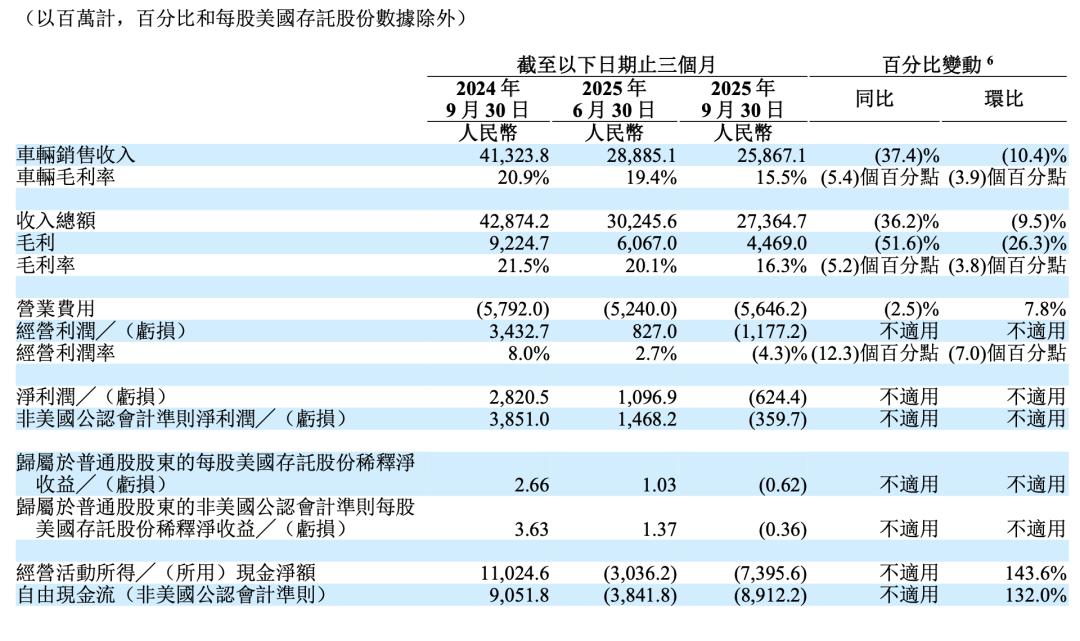
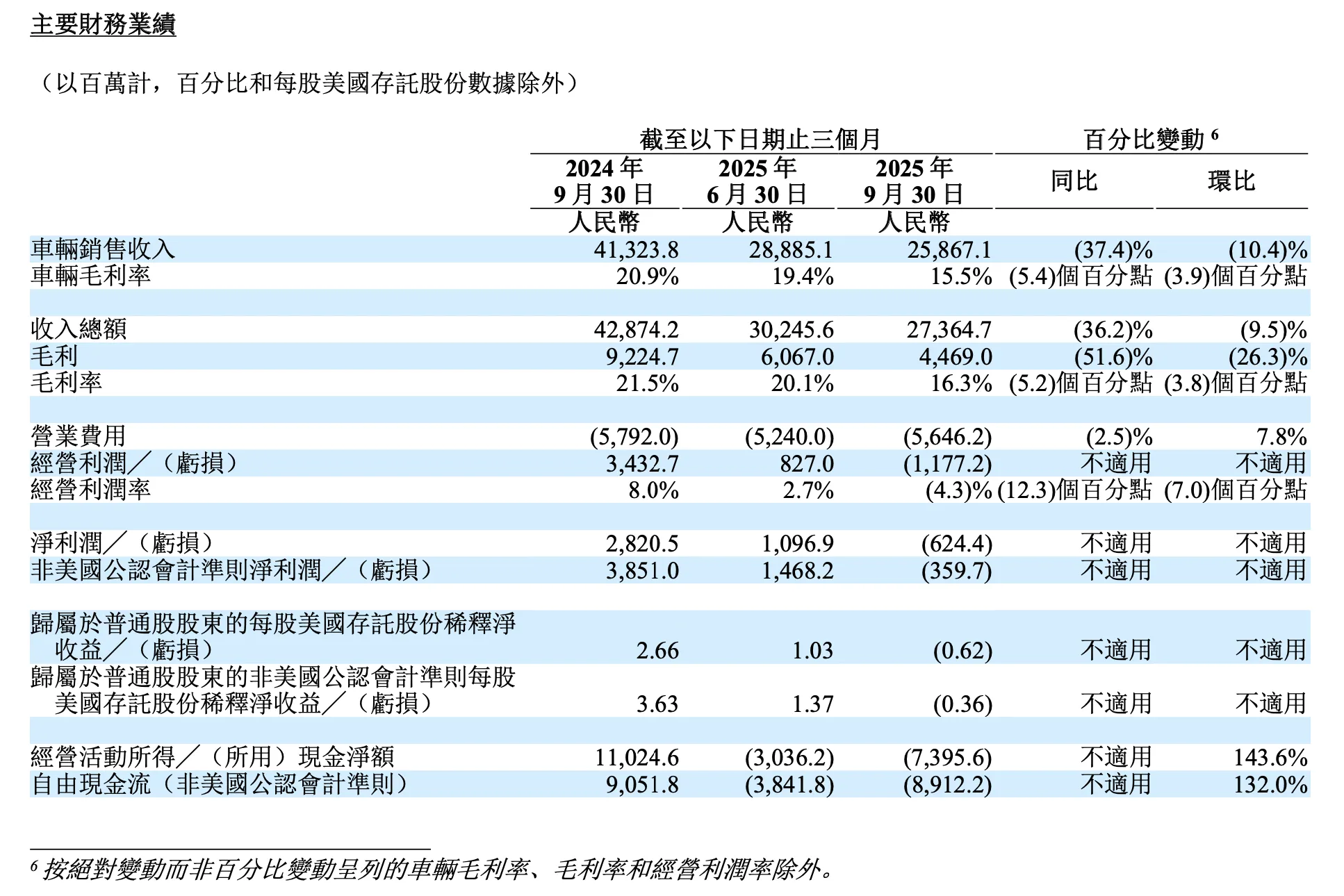
Core Viewpoint - Li Auto, the first profitable company among new car manufacturers, has reported a return to losses in Q3 2025, with significant declines in revenue and vehicle deliveries compared to previous periods [2][8]. Financial Performance - In Q3 2025, Li Auto's total revenue was 27.4 billion yuan (3.8 billion USD), a decrease of 36.2% from 42.9 billion yuan in Q3 2024 and a 9.5% decline from 30.2 billion yuan in Q2 2025 [2][4]. - The company reported a net loss of 624 million yuan (87.7 million USD) in Q3 2025, contrasting with net profits of 2.8 billion yuan and 1.1 billion yuan in Q3 2024 and Q2 2025, respectively [2][4]. - Vehicle sales revenue was 25.9 billion yuan (3.6 billion USD), down 37.4% from 41.3 billion yuan in Q3 2024 and 10.4% from 28.9 billion yuan in Q2 2025 [5]. - The gross profit for Q3 2025 was 4.5 billion yuan (627.8 million USD), a 51.6% decrease from 9.2 billion yuan in Q3 2024 [6]. Vehicle Deliveries - Li Auto delivered 93,200 vehicles in Q3 2025, a decline of 39.01% from 152,800 vehicles in the same period last year [3][9]. - The company has lost its position as the sales champion among new car manufacturers, with a reported 32.89 million vehicles delivered in the first ten months of 2025, down 16.36% year-on-year [11]. Operational Challenges - The company is facing operational challenges, including a significant drop in vehicle deliveries and a need to adjust its management approach back to a startup model to better respond to market changes [4][15]. - Li Auto's operating expenses were 5.6 billion yuan (793.1 million USD) in Q3 2025, a slight decrease from 5.8 billion yuan in Q3 2024 [7]. - The company has adjusted its annual sales target from 700,000 to 640,000 vehicles due to declining delivery numbers [12][13]. Strategic Adjustments - Li Auto plans to accelerate its product development cycle from a four-year major iteration to a two-year cycle to keep pace with competition [14][15]. - The company aims to differentiate its vehicle designs more distinctly rather than relying solely on configuration, moving away from a "cookie-cutter" approach [15].
潜力巨大!“重量级”玩家来了,消费电子再添新赛道
Zheng Quan Shi Bao· 2025-11-28 00:17
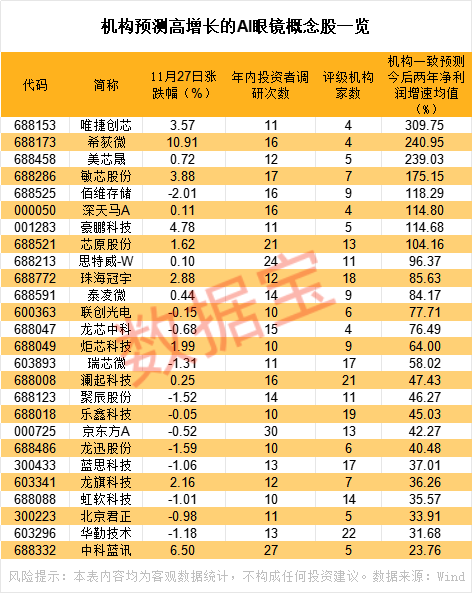
Core Insights - Major technology companies are entering the AI glasses market, with Alibaba launching its Quark AI glasses featuring the latest Qianwen assistant, enhancing user interaction with various Alibaba services [1] - The AI glasses market is projected to experience significant growth, with global shipments expected to reach 4.368 million units by 2025, marking a 64.2% year-on-year increase [2] - The potential market for smart glasses is estimated at around 1 billion units, with a growing share from the Chinese market [3] Industry Trends - AI glasses are becoming a key focus for major tech companies, with Huawei, Xiaomi, and Baidu also entering the market [2] - The "Double Eleven" shopping festival saw explosive sales growth for AI glasses, with Tmall reporting a 2500% year-on-year increase in sales and JD.com showing a 346% increase [2] - By 2026, the smart glasses market is expected to enter a new phase of scaled growth, with global shipments projected to exceed 23.687 million units [2] Investment Opportunities - The AI glasses industry has a long supply chain, including optical components, core chips, and micro-display devices, with nearly 200 related concept stocks in the A-share market [4] - Several companies, such as Haopeng Technology and Hongxin Electronics, are actively involved in the AI glasses sector, providing customized solutions and products [4][5] - A total of 26 concept stocks are predicted to see net profit growth of over 20% in the next two years, indicating strong investment potential [6]
早报|香港大埔火灾已完成灭火程序;宗馥莉正式卸任娃哈哈董事长;李想称理想汽车将回归创业公司模式;昆明列车碰撞事故造成11人死亡
虎嗅APP· 2025-11-27 23:58
Group 1 - The fire in Hong Kong's Tai Po has resulted in 94 fatalities, with 78 injured, including 12 in critical condition [2] - Ideal Auto's CEO Li Xiang admitted to governance errors and announced a return to a startup model, moving away from a professional management system [5] - ByteDance is reportedly in negotiations to sell its subsidiary, Shanghai Mutong Technology, to Saudi Savvy Games Group, with the outcome still uncertain [13][14] Group 2 - Sichuan province has significantly increased marriage leave from 5 days to 20 days and extended maternity leave for women by 90 days, while also increasing paternity leave for men to 30 days [8][9][10] - Xiaomi, OPPO, and Vivo have canceled their Air model projects, shifting the planned eSIM features to regular models due to poor market performance of similar products [16][17] - NIO's CEO Li Bin stated that the automotive industry is entering a decisive phase, predicting a clearer competitive landscape by 2030 [31]

李想终于承认,他们走错了方向
3 6 Ke· 2025-11-27 23:34
Core Viewpoint - Li Auto's recent financial report reveals significant challenges, including a 36.2% year-over-year revenue decline, a 5 percentage point drop in vehicle gross margin, and a shift from profit to loss in net income, alongside negative free cash flow [1][2][8] Financial Performance - Vehicle sales revenue for Q3 2025 was RMB 41.32 billion, down 37.4% year-over-year and 10.4% quarter-over-quarter [5] - Total revenue decreased to RMB 42.87 billion, reflecting a 36.2% year-over-year decline [5] - Vehicle gross margin fell to 15.5%, down from 20.9% in the same quarter last year [6] - Operating profit turned into a loss of RMB 1.18 billion, compared to a profit of RMB 3.43 billion in the previous year [5] - Net profit shifted from a gain of RMB 2.82 billion to a loss of RMB 624 million [5] - Free cash flow was negative at RMB 8.91 billion, indicating a significant cash outflow [8][9] Strategic Shift - Li Auto announced a return to a "startup" management model, ending the "professional manager" approach adopted over the past three years, which was deemed ineffective [2][10] - The company aims to enhance decision-making efficiency by reducing bureaucratic processes and fostering direct communication [11][13] Product Transition Challenges - The company is experiencing difficulties transitioning from range-extended vehicles to a mix of range-extended and pure electric models, leading to a decline in sales and market dominance [6][8] - The new pure electric model i8 has received lukewarm market response, while the i6 model faces production and supply chain challenges [6] AI and Future Vision - Li Auto is focusing on developing "embodied intelligent robots" rather than just electric vehicles, aiming to differentiate itself in a saturated market [14][15] - The company plans to introduce self-developed M100 chips and shift to advanced 3D ViT technology for enhanced vehicle intelligence [15][17] - Future products may include AI glasses and speakers, indicating a broader vision for integrating AI into users' daily lives [17]
理想汽车2025年第三季度营收274亿元 李想称今年Q4开始回到创业公司管理模式
Cai Jing Wang· 2025-11-27 23:11
Core Insights - Li Auto reported a significant decline in Q3 2025 revenue, with a year-on-year decrease of 36.2% to 27.4 billion RMB, primarily due to a drop in vehicle sales and a net loss of 6.244 billion RMB, marking a shift from profitability to loss for the first time in 11 quarters [1][4][5] Financial Performance - Q3 2025 revenue was 27.4 billion RMB, down 36.2% year-on-year and 9.5% quarter-on-quarter [1][3] - Vehicle sales revenue reached 25.9 billion RMB, reflecting a 37.4% year-on-year decline and a 10.4% quarter-on-quarter decline [1] - The net loss for Q3 2025 was 6.244 billion RMB, compared to a profit of 2.8 billion RMB in Q3 2024 and 1.1 billion RMB in Q2 2025 [1][5] - R&D expenses for Q3 were 3 billion RMB, with an expected total R&D investment of 12 billion RMB for the year, including over 6 billion RMB in AI [1] Vehicle Delivery and Sales - Total vehicle deliveries in Q3 2025 were 93,211 units, a 39.0% decrease year-on-year [4][5] - The company anticipates Q4 2025 vehicle deliveries to be between 100,000 and 110,000 units, representing a year-on-year decrease of 37.0% to 30.7% [5] Strategic Adjustments - Li Auto plans to revert to a startup management model starting Q4 2025 to better address new challenges and technologies [5] - The company is focusing on expanding its pure electric vehicle lineup, with two new electric SUVs, Li i8 and Li i6, achieving over 100,000 total orders [9] Impact of Recall - A recall of the MEGA model incurred a one-time cost of approximately 1.1 billion RMB, significantly impacting Q3 financial results [6][8] - The gross margin for Q3 was 16.3%, down from 21.5% in Q3 2024, but would have been 20.4% without the recall costs [6] Market Trends - The market for range-extended vehicles is facing challenges, with a decline in wholesale and retail sales, and a decreasing market share for range-extended vehicles from 51% to 26% [11]
理想汽车结束连续11季度盈利
Sou Hu Cai Jing· 2025-11-27 21:35
Core Insights - The core viewpoint of the article highlights that Li Auto's third-quarter financial results show a decline in revenue and deliveries, marking the end of 11 consecutive profitable quarters, prompting a strategic shift back to a startup model from a professional management approach [1] Financial Performance - In the third quarter, Li Auto reported total revenue of RMB 27.4 billion, a decrease of 36.2% compared to RMB 42.9 billion in the same quarter of 2024, and a 9.5% decrease from RMB 30.2 billion in the second quarter of 2025 [1] - The total delivery volume for the third quarter was 93,200 vehicles, representing a year-on-year decrease of 39.0% [1] - The net loss for the third quarter was RMB 624 million, contrasting with a net profit of RMB 2.8 billion in the same period last year [1] - In the second quarter of this year, the company achieved a net profit of RMB 1.1 billion, marking its 11th consecutive profitable quarter [1] Strategic Shift - Li Auto's founder, Li Xiang, indicated during the earnings call that the company will revert to a startup model starting in the fourth quarter, as the previous professional management structure did not align with the current market environment and the company's actual situation [1] Cash Reserves - As of the end of the third quarter, Li Auto's cash reserves stood at RMB 98.9 billion, providing a solid financial foundation for continued investment in technology research and development, service network construction, and global expansion [1]
理想迎来逆风局
3 6 Ke· 2025-11-27 17:40
Core Viewpoint - The performance of Li Auto in Q3 has significantly declined, with revenue dropping by 36.2% year-on-year to 27.4 billion yuan and a net loss of 624 million yuan compared to a profit of 2.8 billion yuan in the same period last year [3][5][6] Financial Performance - Li Auto's Q3 delivery volume was 93,211 units, a nearly 39% year-on-year decrease and over 16% decline from the previous quarter [3][6] - The gross margin for the i6 model, which is currently the best-selling product, is the lowest in the entire lineup, indicating future pressure on profitability [3][5] Strategic Shift to AI - Li Auto is increasingly focusing on AI as a strategic pivot, moving away from its initial emphasis on range-extended vehicles, which are now facing intense competition and market saturation [5][10] - The company has made significant organizational changes to support its AI strategy, including restructuring teams and management to enhance efficiency and focus on AI development [12][13][14] Competitive Landscape - Li Auto faces stiff competition from other players in the market, with rivals like Xiaopeng and NIO gaining market share, leading to a decline in Li Auto's sales performance [9][10] - The company has initiated price reductions for its L series to combat inventory pressures, with discounts reaching up to 45,000 yuan [9][10] R&D Investment - Li Auto plans to invest 12 billion yuan in R&D this year, with 50% allocated specifically to AI, indicating a strong commitment to this area compared to industry averages [19] - The focus on precise investment in AI, particularly in the VLA model, reflects a strategic shift towards long-term technological development rather than broad-based spending [19]
业绩变脸 理想汽车要回归“创业公司”
Bei Jing Shang Bao· 2025-11-27 16:37
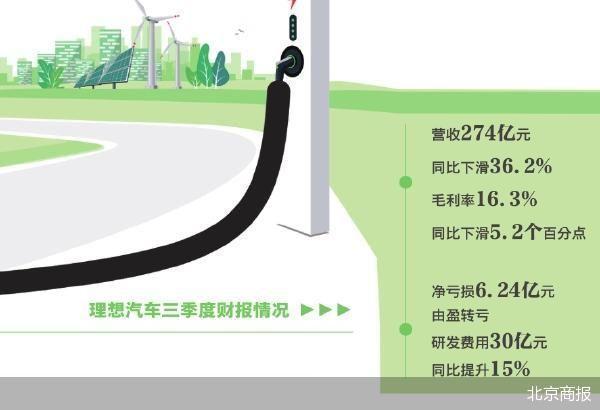
Core Viewpoint - Li Auto has entered a period of performance fluctuation, reporting a revenue decline and a shift from profit to loss in Q3 2023, attributed to various challenges including product cycles, public relations issues, supply chain recovery, and policy impacts [1][3]. Financial Performance - In Q3 2023, Li Auto's revenue was 27.4 billion yuan, a year-on-year decline of 36.2% [3] - The gross margin was 16.3%, down 5.2 percentage points year-on-year [3] - The net loss was 624 million yuan, marking a transition from profit to loss [3] - Vehicle revenue was 25.9 billion yuan, a decrease of 37.4% year-on-year, primarily due to reduced vehicle delivery volumes [3] - Excluding the estimated costs related to the MEGA recall, the vehicle gross margin could reach 19.8%, with an overall gross margin of 20.4% [3] - As of the end of Q3, Li Auto had cash reserves of 98.9 billion yuan, providing support for future development [3] Product Strategy - Li Auto is transitioning to a dual structure of "range-extended + pure electric" vehicles, with plans to launch its first pure electric model, MEGA, in 2024 [4][5] - The new pure electric SUV models, Li i8 and Li i6, are currently in the ramp-up phase, with total orders exceeding 100,000 units [4] - The company plans to enhance its product offerings in the range-extended market, with a major redesign of the Li L series planned for next year [6] Supply Chain and Production - To address production capacity issues, Li Auto has begun using dual suppliers for batteries, ensuring consistent performance and quality standards [6] - The monthly production capacity for the Li i6 is expected to steadily increase to 20,000 units by early next year [6] Research and Development - In Q3 2023, Li Auto's R&D expenses were 3 billion yuan, a year-on-year increase of 15%, with total expected R&D investment for the year reaching 12 billion yuan, including over 6 billion yuan in AI [7] - The company is focusing on developing its AI systems and has achieved a 91% usage rate for its VLA driver model as of October [7] - Li Auto is also expanding its presence in overseas markets, with initial setups in the Middle East, Central Asia, and North Africa, and plans to enter Latin America, Europe, and Southeast Asia next year [7] Management Approach - CEO Li Xiang announced a return to a startup management model starting Q4 2023, recognizing the differences between startup and professional management systems [8] - The company aims to develop vehicles with autonomous and proactive capabilities, emphasizing the importance of a distinct AI system for embodied intelligence [8] Open Source Initiatives - Li Auto has launched its self-developed smart car operating system, "Star Ring OS," with over 1 billion yuan invested in its development [9] - The open-source technology community for "Star Ring OS" has attracted 55 potential partners, with 16 signed agreements [9]