西麦食品

Search documents
食品饮料2026年投资策略报告:曙光渐显,在分化中前行-20251224
Hua Yuan Zheng Quan· 2025-12-24 12:13
Group 1: Core Insights - The report emphasizes the recovery stage of consumer spending, highlighting that different sectors exhibit both commonalities and differences in their recovery rhythms, driven by supply-demand dynamics and industry structure [4][5] - ROA (Return on Assets) is identified as a leading indicator for the operational recovery of consumer companies, with a focus on analyzing various sub-sectors [4][13] Group 2: Sector Performance - The current recovery sequence indicates that soft drinks and snacks are leading, followed by the catering supply chain, condiments, dairy products, beer, and finally, liquor [5][25] - The report draws parallels with Japan's 1990s consumption differentiation, noting that sectors addressing consumer pain points and with low penetration rates are likely to succeed [5][6] Group 3: Investment Strategy - The report suggests focusing on sectors where ROA is stabilizing, indicating potential valuation recovery opportunities, particularly in traditional sectors like liquor, beer, and dairy [6][8] - It recommends identifying sub-sectors with either price or volume growth, with a preference for price-driven strategies [6][8] Group 4: Detailed Sector Analysis - The frozen food sector is showing signs of marginal improvement, with leading companies enhancing operational efficiency through product innovation and channel reforms [27][28] - The snack sector is experiencing high demand, driven by new channel developments, although competition is intensifying [33][35] - The beer industry is under pressure, with a focus on high-end products, but overall growth is slowing due to external economic factors [39][41] - The dairy sector is nearing the end of its adjustment phase, with expectations of improved performance as raw milk prices rise [41][42] - The liquor sector is currently in a phase of inventory reduction, with performance risks gradually clearing as channels stabilize [43][48]




【23日资金路线图】电力设备板块净流入近49亿元居首 龙虎榜机构抢筹多股
Zheng Quan Shi Bao· 2025-12-23 12:47
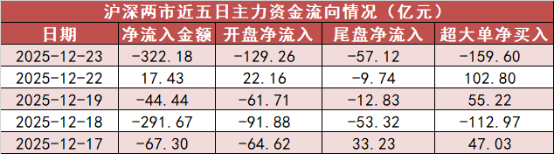
沪深300今日主力资金净流出76.96亿元,创业板净流出89.34亿元,科创板净流出15.25亿元。 | | 各板块最近五个交易日主力资金净流入数据(亿元) | | | | --- | --- | --- | --- | | 日期 | 沪深300 | 创业板 | 科创板 | | 2025-12-23 | -76.96 | -89. 34 | -15. 25 | | 2025-12-22 | 28. 91 | 20. 31 | -12. 07 | | 2025-12-19 | 9.88 | -38. 81 | 9.25 | | 2025-12-18 | -152. 56 | -101. 40 | -7.88 | | 2025-12-17 | 51. 45 | 40. 67 | -15. 20 | | | | 尾盘资金净流入数据(亿元) | | | 2025-12-23 | -14.66 | -19. 42 | -3.50 | | 2025-12-22 | 1. 21 | -2. 24 | 2. 46 | | 2025-12-19 | -3. 61 | -7.53 | 2. 93 | | 2025-12-18 | ...


【23日资金路线图】电力设备板块净流入近49亿元居首 龙虎榜机构抢筹多股
证券时报· 2025-12-23 12:46
12月23日,A股市场整体涨跌互现。 沪深300今日主力资金净流出76.96亿元,创业板净流出89.34亿元,科创板净流出15.25亿 元。 | | 各板块最近五个交易日主力资金净流入数据(亿元) | | | | --- | --- | --- | --- | | 日期 | 沪深300 | 创业板 | 科创板 | | 2025-12-23 | -76.96 | -89. 34 | -15. 25 | | 2025-12-22 | 28. 91 | 20. 31 | -12. 07 | | 2025-12-19 | 9.88 | -38. 81 | 9.25 | | 2025-12-18 | -152.56 | -101.40 | -7.88 | | 2025-12-17 | 51. 45 | 40. 67 | -15. 20 | | | | 尾盘资金净流入数据(亿元) | | | 2025-12-23 | -14.66 | -19.42 | -3. 50 | | 2025-12-22 | 1. 21 | -2.24 | 2. 46 | | 2025-12-19 | -3. 61 | -7.53 | 2.93 ...

西麦食品(002956):业绩提速,利润释放,倍增空间
Haitong Securities International· 2025-12-23 05:14
Investment Rating - The report maintains an "Outperform" rating for the company, with a target price of 27.50 CNY per share based on a 25x PE ratio for 2026E [4][11]. Core Insights - The company is a leading player in the Chinese oatmeal market, with its competitive advantages in brand marketing, product innovation, supply chain, and distribution channels continuing to expand. The report anticipates significant growth potential and profit elasticity for the company in the future [1][4]. - The oatmeal market in China has seen rapid growth, with a compound annual growth rate (CAGR) exceeding double digits over the past seven years, and it is expected to continue growing as health awareness increases [4][26]. Financial Summary - The company's total revenue is projected to grow from 1,578 million CNY in 2023 to 3,221 million CNY by 2027, reflecting a CAGR of approximately 19% [3][11]. - Net profit attributable to the parent company is expected to rise from 115 million CNY in 2023 to 320 million CNY in 2027, with a significant increase in earnings per share (EPS) from 0.52 CNY to 1.43 CNY over the same period [3][11]. - The report forecasts a net asset return (ROE) improvement from 7.9% in 2023 to 18.4% in 2027, indicating enhanced profitability [3][11]. Market Dynamics - The report highlights the increasing health consciousness among consumers, which is driving the rapid penetration of oatmeal in the market. The oatmeal segment has grown from a market size of approximately 40-50 billion CNY in 2018 to around 114 billion CNY in 2023, with expectations to reach 125 billion CNY by 2025 [26][32]. - The company has established a strong market position, surpassing competitors and achieving a market share of over 20% in 2023, solidifying its status as the leading brand in the oatmeal sector [33][35]. Competitive Advantages - The company has a comprehensive competitive edge, including a strong marketing strategy, a full supply chain layout, and robust product innovation capabilities. This has allowed the company to maintain its leadership position in the oatmeal market [4][33]. - The report emphasizes the company's ability to respond quickly to market trends and consumer demands, which has been crucial in expanding its product offerings and market reach [4][33].
静水深流,大象无形 - 食品饮料行业2026年度投资策略
2025-12-22 15:47
Summary of the Food and Beverage Industry Conference Call Industry Overview - The food and beverage industry is expected to end its deep adjustment cycle by 2026, with consumer goods having largely completed inventory destocking [1][4] - The liquor sector, particularly baijiu, is projected to reach a new equilibrium by Q2 2026, with CPI stabilizing to alleviate price deflation pressures [1][4] - Companies with innovation or supply chain optimization capabilities are expected to stand out in the recovery phase [1][4] Key Insights and Arguments - The liquor sector is currently in a bottoming process, with mid-term investment value being significant [1][5] - Consumer goods are benefiting from an efficiency revolution and the transition between old and new growth drivers, with emerging channels and cost advantages continuing [1][5] - In 2025, the food and beverage sector showed mixed performance, with yellow wine, soft drinks, dairy products, and meat products leading in growth, while baijiu faced significant downward pressure from high-end price declines [1][6] Market Dynamics - The CPI and PPI differential has been volatile, with weak price increase expectations; however, a future stabilization of CPI could relieve downward price pressures [1][7] - The liquor price average has returned to a high level, indicating limited future downward space, necessitating companies to maintain a balance between volume and price [1][8] Sector-Specific Trends Liquor Industry - The baijiu sector is expected to reach a new balance by Q2 2026, with a characteristic of low-to-high price movement [1][5] - Companies are advised to focus on maintaining volume-price balance during the destocking phase [1][8] Consumer Goods - The industry is currently in a "channel is king" phase, necessitating the exploration of structural opportunities to meet changing consumer demands for health, personalization, convenience, and cost-effectiveness [1][9] - After completing inventory destocking, traditional sectors may rebound, with new emerging segments expected to thrive [1][9] Dairy Industry - The dairy sector is in a stabilization phase, with raw milk supply expected to contract in 2026, leading to a potential improvement cycle [1][11] - Key companies to watch include Yili, Mengniu, and Miaokelando, which are expected to show growth potential [1][11] Beer and Yellow Wine - The beer industry is stable but experiencing changes due to the rise of new channels, suggesting a focus on leading companies like Qingdao Beer and Yanjing Beer [1][12] - The yellow wine sector is seeing a concentration of market share among leading companies, with structural upgrades expected to continue [1][12] Soft Drinks and Snacks - The soft drink market is facing intensified competition, with notable segments like glucose tea and sports drinks showing promise [1][13] - The snack sector is benefiting from new channel transformations, with companies like Weilong and Chacha expected to perform well [1][13] Restaurant Supply Chain and Food Chains - The restaurant supply chain is recovering from regulatory impacts, with companies like Anji Food and Gaoli Co. being highlighted for their growth potential [1][14] - Food chain companies are accelerating their expansion through optimization and innovation, presenting investment opportunities [1][14] Health Products - The health product market shows potential for significant growth, with key products like coenzyme Q10 and probiotics gaining traction [1][15] Conclusion - Each sub-sector within the food and beverage industry presents unique opportunities and challenges, necessitating tailored investment strategies to capture alpha opportunities and achieve stable returns [1][16]
西麦食品:截至2025年12月19日股东户数为11177户
Zheng Quan Ri Bao Wang· 2025-12-22 11:40
证券日报网讯12月22日,西麦食品(002956)在互动平台回答投资者提问时表示,截至2025年12月19 日,公司的股东户数为11177户。 ...
扩大内需战略解读与推荐
2025-12-22 01:45
Summary of Key Points from Conference Call Records Industry Overview - The focus is on the **expansion of domestic demand** as a long-term structural reform strategy to address challenges such as declining demographic dividends and globalization pressures. The shift is from supply-driven to demand-driven, emphasizing the need to supplement both upstream R&D and downstream consumption [1][2][3]. Core Insights and Arguments - **Increase in Resident Income**: A critical factor for expanding domestic demand. Policies like trade-in subsidies may have a short-term effect but can lead to over-reliance on such measures. The emphasis should be on increasing wage and asset income through fiscal reforms to achieve broad-based benefits [1][6]. - **Consumer Trends**: By 2026, service consumption, high-end consumption, and emerging self-reward consumption are expected to perform well. Policies may favor sectors like tourism and dining, while a declining real estate market could enhance purchasing power for younger consumers [1][9]. - **Investment Focus**: Effective investments are anticipated in water conservancy, energy, municipal infrastructure, and core technology sectors such as AI, biomedicine, and quantum communication. The green transition is expected to unlock consumption potential in areas like eco-tourism and energy-efficient appliances [1][11]. Industry-Specific Insights Home Appliance Sector - The home appliance industry is projected to experience a downturn in the second half of 2025 due to trade-in policies, but a recovery is expected in early 2026 as subsidies are renewed, leading to a replenishment cycle [1][12][13]. - **Sales Data**: By November 2025, air conditioner sales grew by approximately 2%, while refrigerator sales declined by about 1%. The overall industry saw a decline in the latter half of the year, particularly in Q4, where air conditioner sales dropped over 20% [12][13]. Fiscal Policy and Consumer Behavior - The fiscal reform is expected to shift focus from incremental taxation to more comprehensive measures, such as property and capital gains taxes, which will gradually influence overall household income and consumption [7][8]. - The effectiveness of subsidies is questioned, as they may lead to a crowding-out effect on autonomous consumption. For instance, a 300 billion yuan subsidy led to a 2.7 trillion yuan increase in retail sales, but the non-subsidy portion contributed negatively [6]. Investment Recommendations - **Home Appliances**: Companies like Midea, Haier, TCL, and Hisense are recommended for their strong domestic and international performance. The expectation is that these companies will benefit from the renewed subsidy policies in 2026 [15]. - **New Consumption Trends**: Focus on emerging brands in personal care and health products, as well as established brands with significant market barriers, such as Mao Geping and Shanghai Jahwa [18]. - **Health and Wellness Sector**: Companies like Xianle Health and Ximai Foods are highlighted for their growth potential in the health and wellness market, driven by the aging population and increasing health awareness [19][21]. Additional Insights - **Transportation Sector**: The aviation industry is expected to benefit directly from increased demand, while the shipping industry will see indirect benefits from heightened domestic trade activities [28]. - **Agricultural Sector**: Recommendations include focusing on the pet industry and functional ingredients, with companies like Zhongchong and Bailong Chuangyuan showing strong growth potential [31]. Conclusion - The overall sentiment is optimistic regarding the expansion of domestic demand, with significant investment opportunities across various sectors, particularly in health, home appliances, and new consumption trends. The emphasis on increasing resident income and effective fiscal reforms will be crucial in driving this growth [26][27].
大消费景气展望:基数与大促后增速放缓,期待明年政策发力
2025-12-22 01:45
Summary of Conference Call Records Industry Overview - **Consumer Sector Outlook**: The consumer sector is expected to face challenges in the first half of 2026 due to the tapering of the trade-in policy, which may lead to a slowdown in durable goods consumption. However, service consumption is showing strong internal momentum, with growth expected in sectors like elderly care and home services, which may receive more policy support [1][4][5]. Key Points and Arguments - **Consumer Data Trends**: In November 2025, retail sales growth fell to 1.3%, the lowest of the year, primarily due to the early Double Eleven promotions, the impact of the trade-in policy, and weakened consumer confidence due to falling housing prices [2][3]. - **Trade-in Policy Impact**: The decline in the trade-in policy is anticipated to negatively affect consumer spending in early 2026, particularly in durable goods like home appliances and automobiles, which are expected to see continued low growth [3][21]. - **Service Consumption Growth**: Service retail growth has increased from 4.9% at the beginning of the year to 5.4%, with significant contributions from education and dining sectors [4]. - **Investment Recommendations**: Focus on the AI industry and emerging sectors like pet economy and trendy toys. Real estate is expected to recover by 2026-2027, benefiting related industries [1][6][7]. Important but Overlooked Content - **High-End Consumption and Travel Chain**: The service sector in 2026 will focus on high-end consumption and travel, with recommendations for companies in the duty-free, hotel, aviation, and dining sectors, such as China Duty Free Group and hotel chains like Jin Jiang and Huazhu [7]. - **Overseas Expansion Opportunities**: Companies like Anker Innovations and Huakai 100 are recommended for their potential in overseas markets, despite current low stock prices [9][10]. - **Alcohol and Beverage Sector**: The alcohol sector is currently in a low season, but some brands are seeing price recovery due to channel control measures. The soft drink market is also expected to show potential growth despite current sales being slow [11][12][13]. - **Food and Beverage Trends**: The snack sector is seeing positive demand ahead of the Spring Festival, with health-oriented products like konjac and oats showing significant growth. Companies like Wancheng and Yanjinpuzi are highlighted for investment [12]. - **Investment in New Consumption Areas**: The new consumption sector is showing upward trends, particularly in the vaping and AI glasses markets, with companies like Smoore and Kangnai Optical recommended for their growth potential [16]. Conclusion - The consumer sector is navigating a complex landscape with both challenges and opportunities. The focus on service consumption, emerging sectors, and strategic investments in high-potential companies will be crucial for navigating the anticipated economic conditions in 2026.
行业周报:消费筑底政策共振,白酒或至底部重视布局-20251221
KAIYUAN SECURITIES· 2025-12-21 09:14
Investment Rating - The industry investment rating is "Positive" (maintained) [1] Core Viewpoints - Domestic demand policies empower consumption, and the liquor industry is entering a deep adjustment period. The food and beverage index increased by 1.0% from December 15 to December 19, ranking 11th among primary sub-industries, outperforming the CSI 300 by approximately 1.3 percentage points. Sub-industries such as baked goods (+8.0%), snacks (+7.5%), and pre-processed foods (+5.6%) performed relatively well. The recent emphasis on expanding domestic demand as a long-term strategy provides clear policy guidance and support for the consumption and food and beverage industries. The current consumption sector is entering a strategic opportunity period with intensive policy support, and the food and beverage industry, as a core sector of essential consumption, is expected to benefit directly from the domestic demand boost. Health, quality, and cost pressure alleviation are core trends, with leading companies showing resilient profitability. The liquor sector is currently in a bottoming phase, with strong brand power and multi-price range layouts expected to see valuation recovery. Dairy products and beer are also expected to experience a bottom reversal due to policy relief and low base effects. The current consumption sector shows bottom characteristics, with policy dividends and fundamental recovery resonating, presenting configuration value [3][10][12]. Summary by Sections Weekly Viewpoints - Domestic demand policies empower consumption, and the liquor industry is entering a deep adjustment period. The food and beverage index increased by 1.0%, outperforming the CSI 300 by approximately 1.3 percentage points. The sub-industries of baked goods, snacks, and pre-processed foods performed well [10][12]. Market Performance - The food and beverage index increased by 1.0%, ranking 11th among 28 industries, outperforming the CSI 300 by approximately 1.3 percentage points. Leading individual stocks included Huanlejia, Zhuangyuan Pasture, and Huangshi Group, while ST Xifa, Richen Shares, and Jinzi Ham saw declines [12][14]. Upstream Data - Some upstream raw material prices have declined. For instance, the price of whole milk powder fell by 18.7% year-on-year, and fresh milk prices decreased by 2.9% year-on-year. The domestic milk price is expected to continue its downward trend in the short term [17][21]. Liquor Industry Data - The international market for Wuliangye has shown strong growth in 2025, with the company focusing on global expansion and local operations. The liquor industry is currently in a deep adjustment phase, with demand decline driving price reductions. Companies are shifting from scale expansion to stock competition, realigning market shares based on actual consumer demand [45][46]. Recommended Portfolio - Recommended stocks include Guizhou Moutai, Shanxi Fenjiu, Ximai Food, Weilong Delicious, and Bairun Shares. Guizhou Moutai is focusing on sustainable development despite short-term demand pressures. Shanxi Fenjiu has high mid-term growth certainty, while Ximai Food is experiencing stable growth in its main business [4][50].


中金2026年展望 | 食品饮料:筑底接近尾声,聚焦高质量增长
中金点睛· 2025-12-17 23:54
Core Viewpoint - The food and beverage industry is experiencing a new normal with a weak overall consumption environment, emphasizing high quality-price ratios, functionality, health, and emotional consumption trends. The liquor industry continues to face weak demand, while snacks and beverages show better performance. The industry is expected to maintain a weak recovery with strong differentiation, relying on product innovation, fragmented channel layouts, and expanding consumer demographics [2][3][10]. Liquor Industry - The liquor industry is undergoing significant adjustments due to weak demand and new regulations, with expectations for a turning point in the first half of 2026 as the supply-demand balance improves. The impact of policies on demand is expected to weaken, leading to a gradual recovery in consumption [6][7]. - The strategic focus of liquor companies has shifted from inventory pressure to exploring new growth areas, such as targeting younger consumers and embracing new retail channels. This shift is expected to lead to a clearer upward trend in financial reports by 2026 [8][9]. - High-end liquor is anticipated to lead the overall recovery, benefiting from brand loyalty and the resumption of business activities. The mid-range segment may face challenges but is also expected to see some recovery [9]. Snack and Beverage Industry - The overall demand for snacks is stabilizing at a low level, with a focus on quality-price ratios and emotional value. The snack industry is expected to continue expanding, particularly in channels like bulk snacks and membership supermarkets [11][12]. - The beverage industry is benefiting from health trends, with a notable increase in demand for low-sugar and functional drinks. The market for instant retail is also growing, with significant sales increases in snack brands through platforms like Meituan [21][22]. - The competition in the beverage sector is expected to remain intense, but price competition is easing, allowing for improved profit margins for leading companies [22][23]. Dairy and Frozen Food Industry - The dairy industry is experiencing a recovery in operational performance, with expectations for improved profitability as raw milk prices stabilize. The demand for liquid milk is projected to stabilize in 2026, with a potential turning point in the raw milk supply-demand balance [33][34][37]. - The frozen food industry is facing pressure from weak demand but is seeing a stabilization in competition. Companies are focusing on product innovation and new channel development to improve profitability [42][43]. Condiments and Health Products - The condiment industry is expected to see stable demand in 2025, with a focus on product upgrades and innovation from leading companies. The overall competitive landscape is anticipated to become less aggressive as inventory levels normalize [44][48]. - The health product sector is experiencing a shift towards online sales and long-tail brand growth. Leading brands are expected to stabilize their market share through channel expansion and product diversification [55][56].