
赛力斯

Search documents
10月乘用车市场销量分析:新能源板块表现强势 转型步伐持续加速
Zhong Guo Zhi Liang Xin Wen Wang· 2025-11-25 08:05
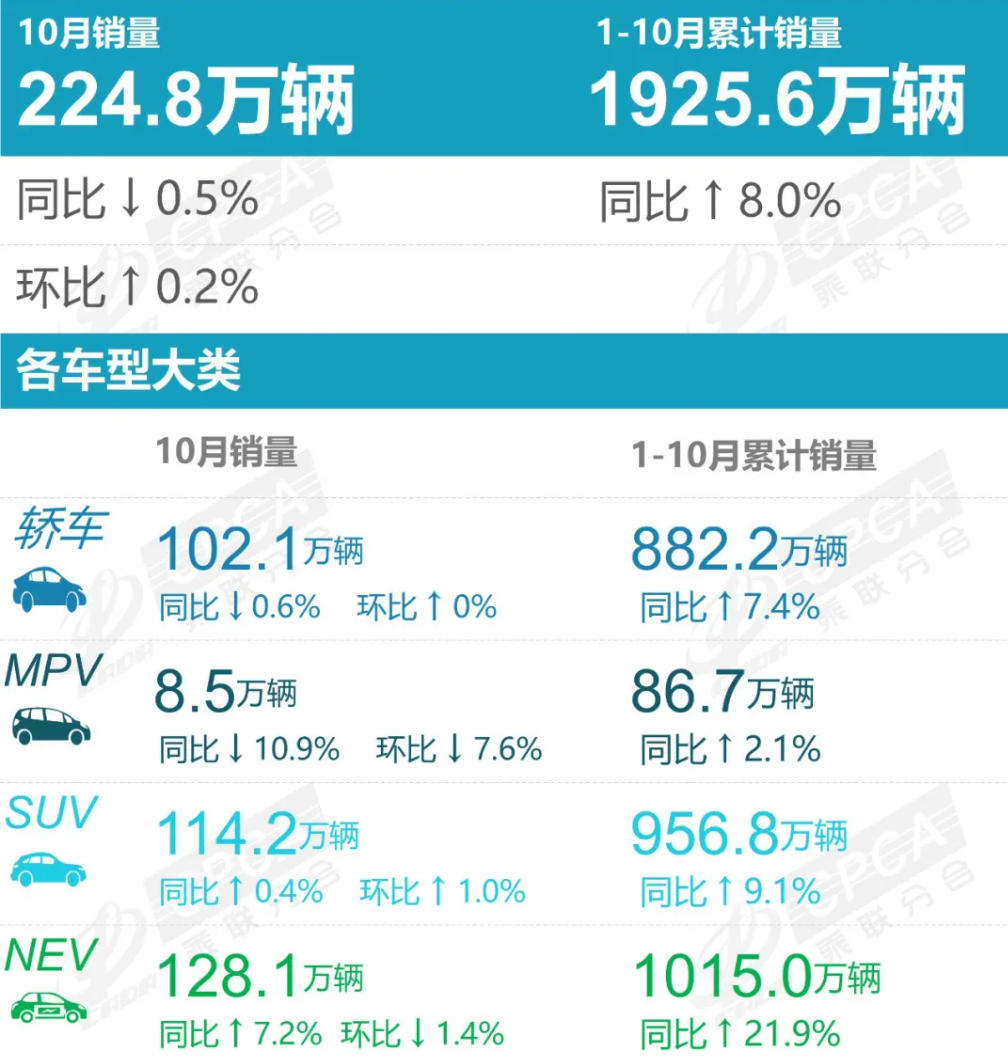
Core Insights - The domestic passenger car market experienced a retail sales volume of 2.248 million units in October 2025, reflecting a year-on-year decline of 0.5% but a month-on-month increase of 0.2% [1] - The market is undergoing a transformation, with strong performances from domestic brands and the new energy sector contrasting sharply with the pressures faced by joint venture brands [1][3] Market Performance - The SUV segment was the only category to achieve positive growth, with sales reaching 1.142 million units, up 0.4% year-on-year and 1.0% month-on-month [3] - New energy vehicle sales in October totaled 1.281 million units, showing a year-on-year increase of 7.2% despite a slight month-on-month decline of 1.4% [3] - The market share of domestic brands reached 68.7%, a year-on-year increase of 3 percentage points, with retail sales of 1.55 million units, up 4% year-on-year and 3% month-on-month [3][4] Brand Performance - Joint venture brands faced significant challenges, with retail sales of mainstream joint venture brands at 510,000 units, a year-on-year decline of 10% [4] - The luxury car market saw retail sales drop to 190,000 units, down 10% year-on-year and 23% month-on-month, with market share falling to 8.4% [4] - BYD led the sales ranking with 295,871 units sold, despite a year-on-year decline of 31.4%, marking the largest drop among the top ten manufacturers [5][4] Sales Rankings - Geely ranked second with 265,565 units sold, achieving a remarkable year-on-year increase of 36.8%, driven by the Geely Galaxy series [5][6] - Volkswagen ranked third with 136,002 units sold, but experienced a year-on-year decline of 3.9% [7] - Changan and Chery followed closely, with sales of 132,229 and 130,128 units respectively, both showing positive growth [7][6] New Energy Vehicle Market - BYD maintained its lead in the new energy vehicle market with a market share of 23.1%, despite a year-on-year decline of 31.4% [15] - Geely's new energy vehicle sales reached 164,256 units, with a year-on-year increase of 54.7%, narrowing the gap with BYD [15][17] - The new energy vehicle penetration rate surpassed 57%, indicating a deepening market acceptance [14][21] Future Outlook - The market is expected to see a release of consumer demand as tax incentives end, coupled with increased promotional efforts from manufacturers [21] - The ongoing trends of electrification and smart technology are anticipated to reshape the Chinese automotive market, with domestic and new energy brands likely to lead the next phase of industry transformation [21]



汽车行业年度策略:破局内卷提质转型,智能网联领航升级
Zhongyuan Securities· 2025-11-25 07:53
Market Overview - The automotive industry index increased by 14.79% as of November 21, 2025, outperforming the Shanghai Composite Index and CSI 300 Index by 0.38 percentage points and 1.61 percentage points respectively [11][12] - The automotive sector's performance was strong in the first half of 2025 but became more aligned with the broader market in the second half [11][12] - The majority of sub-sectors showed positive growth, with motorcycles and other segments leading the gains [17][18] Financial Performance - The automotive industry achieved a revenue of CNY 36,976.27 billion in 2024, a year-on-year increase of 3.35%, and a net profit of CNY 1,363.61 billion, up 9.98% [30] - In the first three quarters of 2025, the industry reported revenues of CNY 28,712.84 billion, reflecting a 10.73% year-on-year growth, and a net profit of CNY 1,165.36 billion, up 10.72% [30][31] - The industry’s gross margin was 15.83% in the first three quarters of 2025, a slight decline from the previous year, while the net margin improved to 4.29% [33] Passenger Vehicle Segment - The passenger vehicle market is expected to reach record sales in 2025, driven by policy support and increased penetration of new energy vehicles (NEVs) [43] - NEV retail sales reached 10.15 million units from January to October 2025, a year-on-year increase of 21.9%, with a market share of 52.73% [45][50] - The market structure is shifting towards domestic brands, which captured nearly 70% of the market share by September 2025, while foreign brands are losing ground [50][51] Commercial Vehicle Segment - The commercial vehicle market showed signs of recovery in 2025, with production and sales increasing by nearly 10% year-on-year in the first three quarters [5] - The growth in the commercial vehicle sector is driven by policies promoting vehicle replacements and the rising sales of new energy commercial vehicles [5][6] Automotive Parts Sector - The national strategy emphasizes "intelligent and connected" technologies as the main axis for upgrading the automotive industry [5] - The penetration of advanced driver-assistance systems (ADAS) is expected to drive market expansion and domestic substitution in core hardware [5][6] Investment Recommendations - The report maintains a "stronger than market" rating for the automotive sector, recommending key companies in the passenger vehicle segment such as BYD, Changan Automobile, and Great Wall Motors [6] - In the commercial vehicle segment, Yutong Bus is recommended, along with a focus on China National Heavy Duty Truck [6] - For the automotive parts sector, companies like Feilong Co., Top Group, and Desay SV are highlighted as potential investment opportunities [6]



智能网联新能源汽车产业专题对接活动在渝举办
Zhong Guo Xin Wen Wang· 2025-11-25 06:25
中新网重庆11月25日电 (梁钦卿)以"智联新生态·绿色新动能"为主题的智能网联新能源汽车产业专题对 接活动25日在重庆举行。本次活动汇聚来自政府机构、行业协会、国内外知名企业及产业链各环节代表 约300人,共同擘画中国智能网联新能源汽车产业高质量发展的新蓝图。 本次专题对接活动搭建了政、产、学、研、用等多方交流的平台,实现了从国家战略、行业趋势、区域 布局、生态构建到企业实践的全链条、全景式展示。 随后,中国汽车工程研究院股份有限公司董事长周玉林梳理了在当前产业变革背景下,我国汽车零部件 产业在行业竞争、开发模式、产品形态、国际化出海及区域布局等方面的发展趋势。他指出,下一步中 国汽研将着力打造《中国汽车零部件产业发展年鉴》及"中国企业评价协会汽车分会"两大平台,助力我 国汽车零部件企业向上发展。 重庆市经济和信息化委员会党组成员王含致辞表示,重庆拥有雄厚的工业基础、完备的产业生态、领先 的应用场景、畅联的区位优势以及精准有力的政策体系,正积极打造世界级智能网联新能源汽车产业集 群,并向全球投资者发出了诚挚的"重庆邀请"。 重庆长安汽车股份有限公司首席专家黄忠强分享了长安汽车在面向智能化、电动化转型过程中的 ...


最新GDP!全国31省GDP大洗牌:四川约5万亿,重庆逼近江西,甘肃增速近5%!
Sou Hu Cai Jing· 2025-11-25 03:38
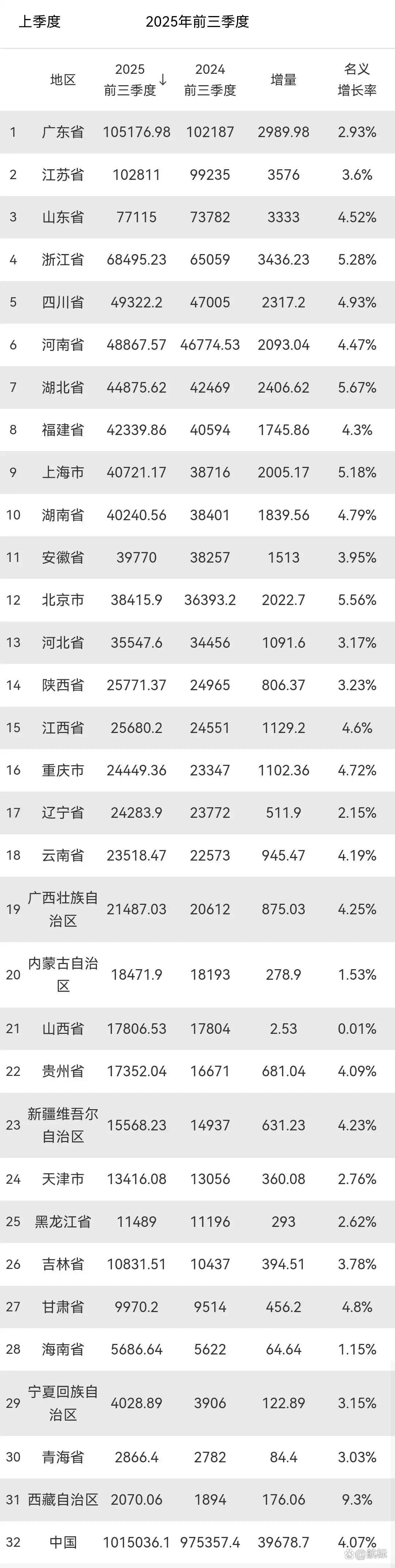
Core Insights - The economic resilience across various regions in China has been highlighted, with a national GDP exceeding 101 trillion yuan, reflecting a year-on-year growth of 4.07% in the first three quarters of the year [1] Group 1: Regional Economic Performance - Guangdong Province leads with a GDP of approximately 105.18 billion yuan, showing a growth rate of 2.93% [2] - Jiangsu Province follows closely with a GDP of about 102.81 billion yuan and a growth rate of 3.6% [2] - Sichuan Province has reached a GDP of 49.32 billion yuan, with a growth rate of 4.93%, driven by the Chengdu-Chongqing economic circle [4] Group 2: Competitive Dynamics - The GDP gap between Chongqing and Jiangxi has narrowed to 230 billion yuan, showcasing a competition between two distinct economic models [5] - Chongqing's automotive manufacturing, particularly in new energy vehicles, has seen a 40% increase in production, while Jiangxi excels in lithium battery and photovoltaic industries [5] - Both regions are competing in the digital economy, with Jiangxi focusing on IoT demonstration zones and Chongqing enhancing industrial internet coverage [5] Group 3: Emerging Growth Areas - Gansu Province has achieved a growth rate of 4.8%, primarily driven by its renewable energy strategy, with significant wind and solar capacity [8] - The province's data center cluster is growing rapidly, attracting major tech companies, although traditional industries still dominate its economic structure [8] - The challenge for Gansu lies in avoiding becoming a "green energy island" and developing a local consumption and high-value conversion system [8] Group 4: Future Outlook - The essence of regional competition is seen as an iteration of development models, with eastern provinces relying on technological innovation while central and western regions explore differentiated paths [10] - The upcoming quarters may reveal which provinces will achieve ranking improvements through the cultivation of new productive forces [10]
信达国际控股港股晨报-20251125
Xin Da Guo Ji Kong Gu· 2025-11-25 02:32
Market Overview - The Hang Seng Index has a short-term support reference at 25,000 points, with recent hawkish signals from the Federal Reserve indicating limited room for rate cuts in 2026. Economic conditions in mainland China are cooling, and corporate earnings in Hong Kong are unlikely to improve significantly in the short term [2][5] - The U.S. stock market has shown volatility, particularly in tech stocks, raising concerns about valuations in the AI industry. The Hang Seng Index has seen substantial gains this year, leading to profit-taking incentives as year-end approaches [2][5] Company News - XPeng Motors (小鵬) has seen a surge in orders for its first range-extended vehicle, prompting the supply chain to increase production by 5,000 units to meet demand. The X9 model was launched at a price lower than its pre-sale price, indicating strong market interest [4][12] - Lei Jun, the founder of Xiaomi (小米), has increased his stake in the company to 23.26% by purchasing over HKD 100 million worth of shares, signaling confidence in Xiaomi's future despite recent stock price declines [4][12] - UBTECH Robotics (優必選) announced a share placement at an 11.4% discount, raising approximately HKD 30.56 billion, with plans to invest in potential acquisitions and business operations [5][12] - The company also secured a contract worth HKD 2.64 billion for humanoid robots, expected to be delivered in December [12] Industry Insights - The insurance sector is benefiting from strong investment returns driven by the performance of A-shares [8] - The coal sector is anticipated to see upward price momentum for thermal coal [8] - The lithium industry is reportedly at the bottom of its cycle and entering an upward phase, with increasing demand from automotive manufacturers and energy storage systems [12]
晨会纪要:2025年第200期-20251125
Guohai Securities· 2025-11-25 00:50
Group 1: Company Performance - The company, 万物新生 (RERE), reported Q3 2025 revenue of 5.149 billion RMB, a year-on-year increase of 27.1%, reaching the high end of previous guidance [3][4] - The breakdown of revenue shows that 1P product revenue was 4.726 billion RMB, up 28.7% year-on-year, driven by increased sales of second-hand consumer electronics [4] - The company expects Q4 2025 total revenue to be between 6.08 billion and 6.18 billion RMB, representing a year-on-year growth of 25.4% to 27.4% [3] Group 2: Profitability and Margins - The gross margin for Q3 2025 was 20.5%, an increase of 0.5 percentage points year-on-year, with 1P business gross margin at 13.4%, up 1.7 percentage points [5] - Non-GAAP operating profit was 140 million RMB, a year-on-year increase of 34.9%, with a Non-GAAP operating profit margin of 2.7% [5] - GAAP net profit reached 91 million RMB, up 407.3% year-on-year, while Non-GAAP net profit was 110 million RMB, a 22.3% increase [5] Group 3: Business Expansion and Strategy - The company is actively expanding its offline store presence, with a total of 2,195 stores by the end of Q3 2025, an increase of 558 stores year-on-year [4] - The 3P service revenue was 423 million RMB, up 11.6% year-on-year, driven by growth in multi-category recycling services [4] - The company is expected to benefit from the expansion of second-hand product acquisition channels and multi-category business growth, maintaining a "buy" rating [6] Group 4: Industry Insights - The bond market sentiment is currently divided, with seller sentiment rising and buyer sentiment declining, indicating a cautious market environment [7][9] - The macro liquidity remains loose, with significant improvements in equity fund issuance, while leverage funds have seen a slowdown [10] - The automotive sector underperformed the Shanghai Composite Index, with significant declines in stock prices for major players during the recent week [12][13]

1-10月中国新能源汽车产量1267.2万辆
Zhong Guo Xin Wen Wang· 2025-11-25 00:49
Core Insights - The Chinese new energy vehicle (NEV) market continues to experience rapid growth, driven by policy support, product innovation, and increasing exports, positioning it as a core driver of the automotive industry [3] Group 1: Market Performance - In the first ten months of 2025, China's NEV production reached 12.672 million units, marking a year-on-year increase of 28.1%, with a cumulative penetration rate of 46.4% [2] - By September 2025, the market share of cars (CAR) was 45.1%, a decrease of 1.7 percentage points compared to the same period last year, while SUVs and MPVs accounted for 43.9% and 3.6% respectively [4] - The passenger vehicle segment saw significant growth, with sedans increasing by 15.1% and SUVs by 15.7%, while the MPV market surged by 39.3% [5] Group 2: Battery and Powertrain Developments - As of September 2025, the installed capacity of NEV power batteries reached 73.7 GWh, reflecting a year-on-year growth of 39.9% [6][7] - The average battery capacity per vehicle was 53.0 kWh, an increase of 17.3% year-on-year, with BYD, Tesla, and Xiaomi being the major contributors to battery installation [8] - In terms of battery cell structure, square cells accounted for 98.6% of the market, while cylindrical and pouch cells made up 1.0% and 0.4% respectively [9] Group 3: Battery Material Trends - The market share of lithium iron phosphate (LFP) batteries continues to grow due to their safety, cost-effectiveness, and longevity, with expectations to maintain dominance in the mid-to-low-end vehicle segment [10] Group 4: Key Players in Battery Supply - By September 2025, the top three battery manufacturers held a market share of 72.2%, with the top ten accounting for 95.4%. CATL led the market with a share of 42.1% [11] - Companies like Contemporary Amperex Technology Co., Ltd. (CATL) and others have shown significant growth, with increases of 102.0% and 143.2% respectively [11] Group 5: Electric Motor Supply Chain - The top ten electric motor suppliers accounted for 62.7% of the market share as of September 2025, with all major players experiencing a rise in supply [12] - Notably, companies like Saike Technology and Grebo have achieved rapid growth due to high sales volumes from brands like Wuling and Geely [12] Group 6: Sodium-Ion Battery Development - Sodium-ion battery technology is advancing quickly, focusing on improvements in cathode and anode materials, with advantages in low-temperature performance, fast charging, and safety [14][15] - Current applications for sodium-ion batteries include home energy storage, large-scale power stations, two-wheeled vehicles, electric cars, and backup power sources [16] - Several companies, including CATL and BYD, are accelerating the development of sodium-ion battery products [18]


汽车人才,扎堆逃离上海......
自动驾驶之心· 2025-11-25 00:03
Core Viewpoint - A significant outflow of automotive talent from Shanghai has been observed since 2023, marking a shift from the city's historical role as a hub for the automotive industry in China [11][12]. Group 1: Historical Context - Shanghai has been the cradle of China's automotive industry, with major joint ventures like Shanghai Volkswagen and Shanghai General Motors attracting talent for over four decades [3][6]. - At its peak, Shanghai was home to approximately 50,000 high-end automotive R&D and marketing professionals [10][13]. Group 2: Recent Developments - The decline of new car manufacturers in Shanghai, starting with the shutdown of WM Motor in December 2022, has led to a significant reduction in job opportunities [11][12]. - Traditional automakers like SAIC Volkswagen and SAIC General Motors have seen their sales drop to about 60% of their peak levels, resulting in multiple rounds of layoffs [12][20]. Group 3: Talent Migration - The automotive job market in Shanghai has shifted from a surplus of opportunities to a situation where job seekers outnumber available positions, leading to a talent migration to other regions [15][17]. - Many former employees have relocated to cities like Wuhu, Hangzhou, and Ningbo, while some have even moved abroad to work for Chinese brands [18][19]. Group 4: Competitive Landscape - While Shanghai's automotive industry contracts, companies from other provinces, such as BYD, Geely, and Chery, are experiencing rapid growth, with sales increasing by 30% to 50% [15][16]. - These companies, previously offering lower salaries, are now able to match or exceed the compensation packages of Shanghai's new car manufacturers due to improved sales and profitability [16]. Group 5: Future Outlook - Despite current challenges, the long-term outlook for the automotive industry remains positive, with significant growth potential in developing countries where car ownership rates are still low [25][26].

广州车展新趋势:新能源大六座排队登场 纯电车企回手拥抱油箱
Nan Fang Du Shi Bao· 2025-11-24 23:16
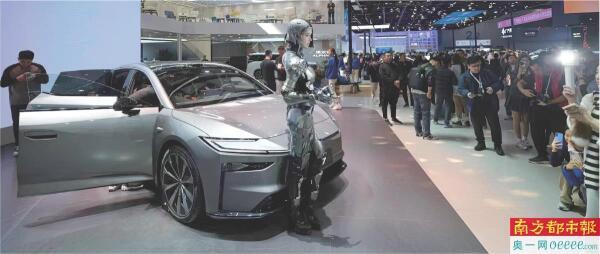
Core Viewpoint - The 2025 Guangzhou Auto Show highlights a surge in the launch of large six-seat SUVs by various automakers, reflecting both market demand and a potential lack of innovation in the industry [2][3][7]. Group 1: Large Six-Seat SUVs - Numerous automakers are introducing large six-seat SUVs at the Guangzhou Auto Show, indicating a competitive market segment with varying price points and features [3][4]. - The entry price for these SUVs is below 300,000 yuan, with models like the Geely Galaxy M9 starting at 180,000 yuan and offering advanced features such as the new generation Raytheon electric hybrid system [4]. - Higher-end models above 300,000 yuan include the Zhiji LS9 priced at 322,800 yuan, showcasing futuristic designs and advanced technology [5][6]. Group 2: Market Dynamics and Concerns - Industry insiders express skepticism about the practicality of large six-seat SUVs, suggesting that many features may not align with consumer needs, leading to potential forced consumption [7][8]. - The competitive landscape is described as "overheated," with automakers rushing to enter the large six-seat SUV market to avoid missing out on perceived opportunities [8]. Group 3: Return of Traditional Fuel Vehicles - A noticeable trend at the auto show is the return of traditional fuel vehicles, with many brands that previously focused on electric vehicles now introducing hybrid and fuel models [9][11]. - The market is expected to see a coexistence of electric and hybrid vehicles, with predictions indicating that internal combustion engine vehicles will still account for about one-third of new car sales by 2040 [10][15]. - Companies like Chery and Geely emphasize their commitment to maintaining a strong presence in the fuel vehicle market, even as they expand their electric offerings [12][14]. Group 4: Consumer Preferences and Market Viability - The rise of hybrid and extended-range vehicles is seen as a response to consumer concerns over range anxiety and charging infrastructure, particularly in regions where electric vehicle adoption is slower [13]. - The profitability of hybrid models is highlighted, with companies like Li Auto achieving financial success through their hybrid offerings [13][14]. - The automotive industry is expected to maintain a diverse energy mix, with both electric and hybrid vehicles playing significant roles in the market [16][17].


广汽“番禺行动”一周年
2 1 Shi Ji Jing Ji Bao Dao· 2025-11-24 23:09
Core Insights - GAC Group has launched the "Panyu Action" to strengthen its independent brand segment, aiming for 60% of total sales from independent brands by 2027, with a target of 2 million units sold [1] - The introduction of the "Qijing" model, a collaboration with Huawei, marks a shift in GAC's strategy towards user-centric product development, moving away from an engineering-focused approach [1][5] - The "Qijing" model aims to position itself as a high-end intelligent electric vehicle targeting young consumers, with a price point around 300,000 yuan [6][7] GAC's Strategic Changes - GAC has reduced its new car development cycle to 18-21 months and improved market response efficiency by over six times [1] - The company has optimized its product planning by reducing the number of models by approximately 20% and increased procurement efficiency by about 50% [1] - The leadership change, with He Xianqing as the new general manager, signifies a shift towards a more matrix-oriented organizational structure [5] Collaboration with Huawei - The "Qijing" model represents a new collaboration approach where GAC retains brand control while leveraging Huawei's technology and expertise [4][5] - Huawei's involvement includes a significant number of personnel dedicated to the project, with over 200 team members and peak involvement of 800 [5] - The collaboration aims to integrate Huawei's IPD and IPMS systems into GAC's processes, enhancing product development and marketing [5][8] Market Positioning and Challenges - The "Qijing" model is designed to compete in the high-end market, with a focus on aesthetics and performance, drawing comparisons to Xiaomi's automotive strategy [6][7] - GAC's previous models under the Aion brand faced challenges due to a focus on B2B sales, prompting a necessary shift to a B2C approach [9][10] - The success of the "Qijing" model will depend on GAC's ability to effectively market and sell the vehicle, as the high-end market is limited in capacity [8] Brand Development and Future Outlook - Aion and other GAC brands are undergoing rebranding efforts to better align with market demands, with Aion's new models focusing on younger, trendier consumers [10][11] - The positioning of the Aion brand is shifting from a performance focus to a more balanced approach that includes technology and business appeal [10][11] - GAC aims to ensure quality and maintain competitive advantages by learning from Huawei's successful operational practices [11]
