三星

Search documents
全球半导体最新展望
智通财经网· 2026-02-18 04:04
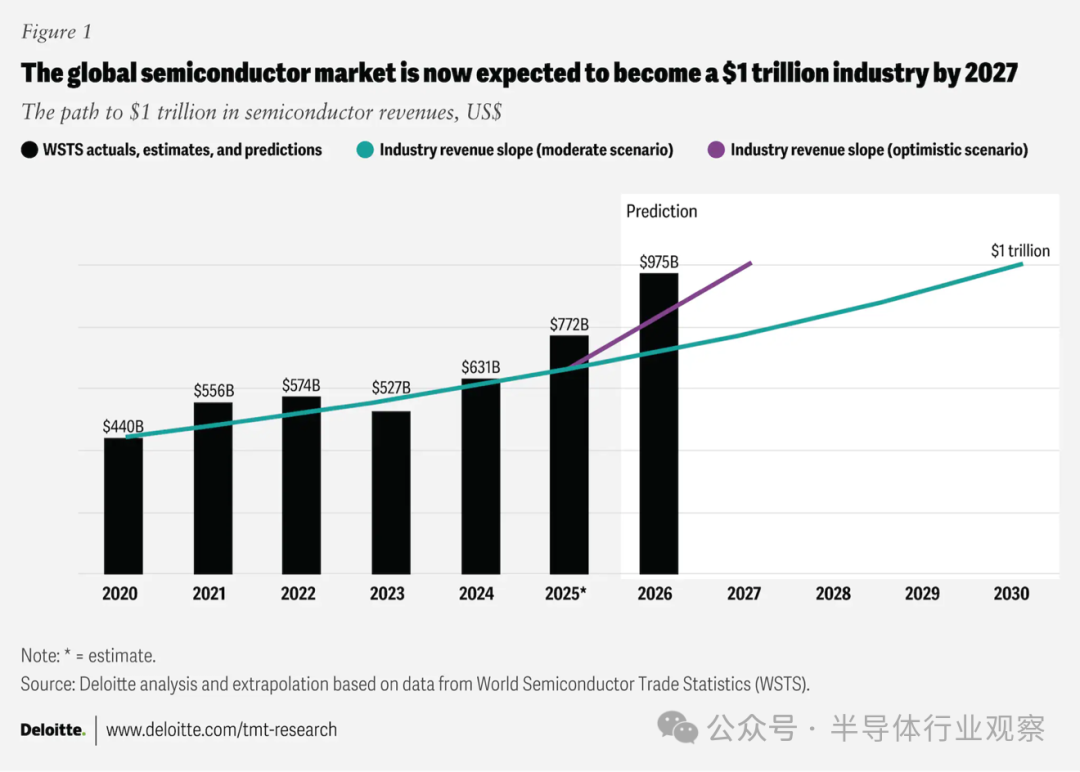
Core Insights - The semiconductor industry is projected to reach a record sales figure of $975 billion by 2026, driven primarily by the growth of artificial intelligence infrastructure [2] - The industry faces a paradox where strong demand from AI is pushing revenues to unprecedented heights, but there are significant risks associated with over-reliance on AI [1][5] - By 2026, AI chips are expected to account for nearly 50% of total industry revenue, yet their production volume remains low, highlighting a structural disparity [5][6] Market Conditions - The semiconductor industry's growth rate is expected to accelerate from 22% in 2025 to 26% in 2026, with long-term projections indicating sales could reach $2 trillion by 2036 [5] - The total market capitalization of the top ten semiconductor companies reached $9.5 trillion by December 2025, a 46% increase from the previous year [5] - The revenue from generative AI chips is forecasted to approach $500 billion by 2026, representing about half of global chip sales [5] Supply Chain Dynamics - The average selling price of chips is projected to be $0.74, with total chip sales expected to reach 1.05 trillion units by 2025 [6] - Memory revenue is anticipated to reach approximately $200 billion in 2026, constituting 25% of total semiconductor revenue [6] - The semiconductor industry is experiencing a supply-demand imbalance, particularly in memory products, leading to significant price increases [7][25] Strategic Considerations - The industry must address potential declines in AI chip demand post-2026 while maintaining high cash levels and low debt [13] - There is a need for strategic partnerships and investments to build ecosystems around semiconductor manufacturing and AI chip platforms [20][22] - The rise of vertical integration among semiconductor and AI infrastructure providers indicates a shift in capital allocation strategies [20][29] Future Outlook - The semiconductor industry is expected to face capacity constraints in 2026, impacting the production of advanced logic processes and memory chips [23][24] - Geopolitical factors and material supply limitations may disrupt procurement and manufacturing processes [19][26] - The transition of AI workloads from training to inference may challenge existing market leaders in AI GPU, CPU, and memory sectors [28]

兴业证券:2026年值得关注的十大产业趋势
智通财经网· 2026-02-18 03:45
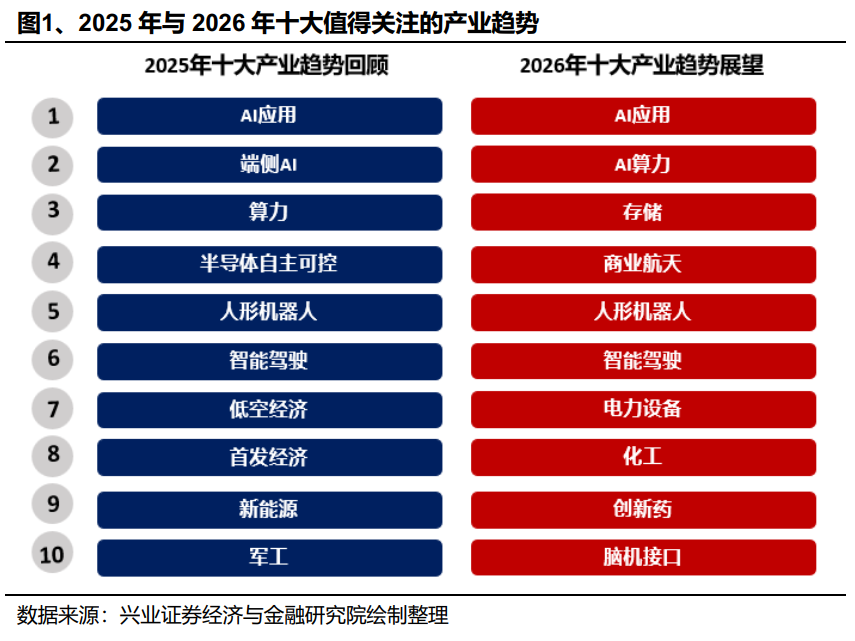
Group 1: AI Applications - The global AI competition is intensifying, with model iterations driving deeper application scenarios, and the focus is on whether significant capital expenditures by tech giants can lead to commercial applications [2][3] - The competitive landscape for AI applications is shifting from dominance by OpenAI to a more multipolar environment, with major players like Google and Meta integrating AI into their ecosystems [3] - In China, AI applications are experiencing a breakthrough, with major tech companies accelerating model iterations and application deployments, leading to a transformation from model landing to scenario monetization [5] Group 2: AI Computing Power - Overseas, major cloud service providers are maintaining high capital expenditures, with a projected increase of 67% in 2026, reflecting a strong demand for AI computing power [7][8] - In China, leading tech companies are increasing capital expenditures and accelerating the iteration of domestic large models, promoting the performance of domestic chips amid tightening supply from foreign sources [9] Group 3: Storage - The demand for storage is entering a new super cycle driven by AI training and inference needs, with AI servers consuming significantly more memory than traditional servers [11][16] - Supply constraints are expected to persist, leading to continued high prices for storage components, as major manufacturers shift production focus to advanced memory types [16] Group 4: Commercial Aerospace - Commercial aerospace is becoming a key battleground in US-China competition, with significant policy support and funding initiatives in both countries to accelerate industry development [19][21] - Domestic companies are achieving breakthroughs in satellite mass production and reusable rocket technologies, transitioning from technical validation to commercialization [22] Group 5: Humanoid Robots - Major overseas companies are ramping up production plans for humanoid robots, benefiting domestic component suppliers, with Tesla aiming for a production capacity of 500,000 units by 2026 [27][30] - Chinese manufacturers are leading in humanoid robot shipments, with significant contracts and production milestones achieved in 2025 [30] Group 6: Intelligent Driving - Domestic policies are expected to facilitate the commercialization of L3 autonomous driving in 2026, with several manufacturers preparing to launch L3 models [32][33] - Tesla's Full Self-Driving (FSD) technology is setting the direction for autonomous driving, with significant advancements in AI capabilities [35] Group 7: Energy Storage - The expansion of AI computing power in North America is driving electricity demand, with domestic power equipment expected to accelerate exports [37][40] - China's "14th Five-Year Plan" includes significant investments in the power grid and energy storage, creating a favorable environment for industry growth [40][43] Group 8: Chemicals - The chemical industry is undergoing a transformation driven by policies aimed at supply-side reform, with a focus on optimizing supply structures and reducing excess capacity [44][47] - New economic sectors are boosting demand for chemical materials, particularly in AI, renewable energy, and robotics, leading to a favorable outlook for new materials [47][48]


【兴证策略】2026年值得关注的十大产业趋势
Xin Lang Cai Jing· 2026-02-18 02:55
Group 1: AI Applications - The global AI competition is intensifying, with significant capital expenditures from tech giants expected to lead to deeper application scenarios in 2026 [1][2] - The competitive landscape for AI applications is shifting from a dominance of OpenAI to a more multipolar environment, with companies like Google and Meta making significant advancements [2] - Domestic AI applications are reaching a tipping point, with major tech companies accelerating their investments and model iterations, leading to a resonance between model development and application penetration [5] Group 2: AI Computing Power - Major cloud service providers in North America are projected to increase their capital expenditures significantly, with a combined guidance of approximately $598.7 billion for 2026, reflecting a 67% year-on-year growth [7][8] - Domestic companies are also ramping up capital expenditures and accelerating the iteration of local models, driven by the need for domestic chip performance improvements [7][8] Group 3: Storage - The demand for storage is entering a new super cycle driven by AI training and inference needs, with AI servers consuming 8-10 times more DRAM and NAND than traditional servers [12][13] - The supply-demand imbalance in the storage sector is expected to persist, with global storage prices rising over 40% in Q4 2025 [13][17] Group 4: Commercial Aerospace - Commercial aerospace is becoming a key battleground in US-China competition, with significant policy support and funding initiatives in place to accelerate the industry [20][21] - Domestic companies are achieving breakthroughs in satellite mass production and reusable rocket technologies, transitioning from technology validation to commercial scale [23] Group 5: Humanoid Robots - Major overseas companies like Tesla and FigureAI are ramping up production plans for humanoid robots, which is expected to benefit domestic component suppliers [25][28] - Chinese manufacturers are leading in humanoid robot shipments, with significant orders and production milestones achieved in 2025 [29] Group 6: Intelligent Driving - The rollout of policies in China is expected to facilitate the commercialization of L3 autonomous driving in 2026, with several manufacturers already launching L3 models [32][33] - Tesla's Full Self-Driving (FSD) technology continues to lead the market, with ongoing enhancements expected to drive the commercialization of Robotaxi services [32] Group 7: Energy Storage - The aging power grid in North America is creating opportunities for domestic power equipment exports, particularly in gas turbines and high-voltage equipment [36][37] - China's "14th Five-Year Plan" includes significant investments in the power grid and energy storage, with a focus on high-value areas [37] Group 8: Chemicals - The chemical industry is undergoing a transformation driven by supply-side reforms, with a focus on optimizing supply structures and reducing excess capacity [41][43] - New economic sectors are driving demand for chemical materials, particularly in AI, renewable energy, and robotics, which are expected to sustain high demand in 2026 [43][46]
全球半导体,最新展望
半导体行业观察· 2026-02-18 01:13
Core Insights - The semiconductor industry is projected to reach a record sales figure of $975 billion by 2026, driven primarily by the growth of artificial intelligence infrastructure [3] - The industry faces a paradox where strong demand from AI is pushing revenues to unprecedented heights, but there are significant risks associated with over-reliance on AI [2] - By 2026, AI chips are expected to contribute nearly 50% of total industry revenue, yet their production volume remains low, accounting for only 0.2% of total chip sales [6][7] Market Conditions - The semiconductor industry's growth rate is expected to accelerate from 22% in 2025 to 26% in 2026, with long-term projections indicating sales could reach $2 trillion by 2036 [6] - The total market capitalization of the top ten semiconductor companies reached $9.5 trillion by December 2025, a 46% increase from the previous year [6] - The revenue from generative AI chips is forecasted to approach $500 billion by 2026, representing a significant portion of global chip sales [6] Supply and Demand Dynamics - The average selling price of chips is projected to be $0.74, with total chip sales expected to reach 1.05 trillion units by 2025 [7] - Memory revenue is anticipated to reach approximately $200 billion in 2026, constituting 25% of total semiconductor revenue [7] - The semiconductor industry is experiencing a supply-demand imbalance, particularly in memory components, leading to significant price increases [8][26] Strategic Considerations - Companies must consider how to maintain high cash levels and low debt while fulfilling capital expenditure commitments in the face of potential demand slowdowns for AI chips [11] - The industry is urged to explore alternative markets if demand for AI chips declines, as well as to reassess the allocation of advanced memory and logic manufacturing capabilities [12] - The rise of vertical integration among AI, semiconductor, and cloud infrastructure providers indicates a new cycle of capital investment in AI computing [21] Geopolitical and Economic Factors - Geopolitical tensions are influencing semiconductor investments, with governments seeking to enhance local manufacturing capabilities for national security and supply chain resilience [22] - The global economic outlook remains strong, with growth rates of 3.2% in 2025 and 3.1% in 2026, yet capacity constraints in semiconductor manufacturing could overshadow technological advancements [25] - The semiconductor industry is facing challenges related to material shortages and production capacity, which could hinder growth despite strong demand for AI-related products [28][27]

只靠 IP 授权,半导体公司还能走多远?
是说芯语· 2026-02-18 01:03
Core Insights - The semiconductor industry is undergoing significant changes, particularly in the business model of intellectual property (IP) licensing, which is shifting towards a more integrated approach that includes design services and system integration [4][5][6]. Industry Trends - The most notable change is industry consolidation driven by the transition to system-on-chip (SoC) designs, particularly for the Internet of Things (IoT), leading semiconductor companies to acquire IP to reduce reliance on third-party sources and enhance product differentiation [2][3]. - Open-source hardware IP is emerging as a disruptive force in the hardware ecosystem, similar to the impact of open-source software, with RISC-V architecture gaining traction in both embedded and high-performance computing applications [3][4]. - The evolution of the semiconductor industry, supported by advanced electronic design automation (EDA) tools and the proliferation of licensable IP, is making custom chip development more accessible, with AI accelerating development speed and reducing costs [3][4]. Changes in IP Business Model - The traditional IP licensing model is declining as a standalone business model, becoming more valuable as part of a broader product and service offering that includes design services and system integration [4][5]. - Companies like Arm and MIPS are adapting to these changes, with Arm expanding its IP offerings and MIPS transitioning to an IP service provider model focused on specific applications [5][6]. Strategic Developments - Following its acquisition by SoftBank, Arm has increased its R&D budget and is now targeting new markets, including high-performance computing, while also offering comprehensive design services [5][6]. - MIPS, after overcoming bankruptcy, is focusing on RISC-V architecture and positioning itself as an IP service provider, reflecting the challenges faced by traditional IP suppliers [5][6]. - GlobalFoundries' acquisition of MIPS is part of a broader strategy to provide custom semiconductor solutions, integrating design and manufacturing capabilities [6][7]. Future Outlook - Despite rapid innovation in semiconductors, structural changes in the industry will take time, with Arm's standard CPU architecture remaining dominant while custom and RISC-V based CPUs are expected to grow [7]. - Successful companies will be those that view IP as part of a broader silicon solution platform rather than as a standalone product [7].
TCL电子(01070.HK)深度研究报告:全球突破与盈利修复正当时
Ge Long Hui· 2026-02-17 22:03
Industry Overview - The global television industry has entered a phase of stock competition driven by structural upgrades, with future core drivers being larger screens and display technology advancements [1] - Consumer demand for larger televisions is increasing, with average global TV size rising from 42.5 inches in 2017 to 52 inches in 2023 [1] - Mini LED televisions are becoming a mainstream upgrade direction, with expected shipments of 8.2 million units in 2024, a 100% year-on-year increase, surpassing OLED televisions at 7 million units [1] Competitive Landscape - The concentration of the upstream supply chain has strengthened the competitiveness of Chinese companies, with the global LCD panel capacity now predominantly located in mainland China [1] - By 2024, the shipment area of mainland liquid crystal panel manufacturers is expected to exceed 70%, following the exit of major Korean companies like Samsung and LG [1] - The global TV market demand remains stable at around 200 million units, but market concentration has increased, with the global TV CR4 rising from 45% in 2018 to 57% in the first half of 2025 [1] Company Performance - TCL Electronics is transitioning to a global leader driven by both profit and market share, with average TV size increasing from 52.4 inches in 2021 to 63.3 inches in 2024 [2] - The share of TCL's TV shipments for sizes 65 inches and above has grown from 11.1% in 2021 to 29% by 2025 [2] - TCL's Mini LED TV market share is projected to increase by 4.1 percentage points to 28.7% in the first half of 2025, making it the market leader [2] Market Expansion - TCL's overseas market share is steadily increasing, with North America rising from 4.5% in 2016 to 18% in 2023, and Western Europe from 2% to 6% in the same period [2] - The company leverages its brand influence and global distribution network to empower innovative business development, including distributed photovoltaic business expected to grow 104% year-on-year to HKD 12.87 billion in 2024 [3] - The AI+AR glasses business is also performing well, with a market share of 45% in the domestic market as of Q1 2025, making it the industry leader [3] Investment Outlook - The integration of the supply chain enhances TCL Electronics' competitiveness, with expectations for continued growth in overseas market share [3] - The company is positioned to benefit from structural upgrades in the industry, with projected EPS of HKD 0.95, 1.12, and 1.31 for 2025 to 2027 [3] - A DCF valuation method suggests a target price of HKD 16.0, corresponding to PE ratios of 13, 11, and 10 for 2025 to 2027 [3]
三天已过,中方公开了黄金储备,美财长急忙刹车:不希望中美分离
Sou Hu Cai Jing· 2026-02-17 16:48
Group 1 - The recent shift in the U.S. stance towards China, particularly from Treasury Secretary Yellen, indicates a desire to avoid decoupling despite previous aggressive rhetoric [1][10] - The U.S. national debt has surpassed $38.4 trillion, which is 1.2 times its annual revenue, leading to significant fiscal pressure [2][12] - Interest payments on U.S. debt amount to $1.2 trillion annually, exceeding military spending, highlighting the unsustainable fiscal situation [2][12] Group 2 - China's gold reserves have reached 74.19 million ounces, marking a 15-month growth streak, while its foreign exchange reserves remain above $3.3 trillion [5][15] - China has reduced its holdings of U.S. Treasury bonds to below $700 billion, the lowest in a decade, indicating a strategic shift away from dollar-denominated assets [5][6] - The decision to increase gold reserves over U.S. debt reflects China's long-term financial security strategy, aiming to reduce reliance on the U.S. dollar system [8][15] Group 3 - The U.S. is attempting to maintain economic ties with China, particularly in low-end goods, while simultaneously imposing restrictions in high-tech sectors [10][12] - The dual approach of the U.S. reflects its economic vulnerabilities, as it seeks to manage inflation and supply chain pressures while competing with China in critical industries [10][12] - China's financial strategy is seen as a response to the risks associated with holding assets in the U.S. dollar, especially after the sanctions imposed on Russia [8][15] Group 4 - The ongoing financial dynamics between the U.S. and China are influencing global financial markets, including currency exchange rates and commodity prices [18][20] - As China strengthens its financial position, it is impacting global trends, with more countries following its lead in reducing dollar assets and increasing gold holdings [15][20] - The evolving geopolitical landscape suggests that the U.S. may struggle to maintain its influence as China's economic resilience grows [22]

东北这座城,最争气
虎嗅APP· 2026-02-17 14:10
Core Viewpoint - Dalian has achieved a significant economic milestone by surpassing a GDP of 1 trillion yuan, marking its role as a key player in the revitalization of Northeast China and setting an example for regional economic growth [5][9][34]. Economic Performance - In 2025, Dalian's GDP reached 1,000.21 billion yuan, reflecting a rapid growth trajectory from 700 billion to 1 trillion yuan since 2018 [5][6]. - The city's industrial added value increased by 11.7% year-on-year, with the petrochemical industry growing by 8.9% and equipment manufacturing by 15.4% [16][17]. Strategic Positioning - Dalian serves as the only coastal city in Northeast China and a critical gateway for international trade, handling over 98% of the region's foreign trade containers [7][16]. - The city has attracted over 100 Fortune 500 companies, with its foreign trade accounting for approximately 40% of the total in Northeast China [16]. Innovation and Development - Dalian has seen a significant increase in technology-driven enterprises, with over 10,000 companies and a 75% growth in high-value invention patents over five years [24]. - The establishment of the Dalian Free Trade Zone has led to 540 institutional innovations, enhancing its role as a hub for global resource allocation [16][40]. Challenges and Opportunities - Despite its achievements, Dalian faces challenges such as an aging population, with 24.71% of residents over 60 years old, and a need for high-quality job creation to retain talent [27][28]. - The city’s per capita GDP of approximately 132,600 yuan, while leading in Northeast China, still lags behind more developed eastern cities like Shenzhen and Hangzhou [28]. Regional Collaboration - Dalian's future growth depends on its ability to foster regional collaboration with neighboring cities like Shenyang and Changchun, enhancing industrial integration and supply chain connectivity [31][38]. - The city must overcome institutional barriers that limit the benefits of its Free Trade Zone to local enterprises, ensuring that regional industries can fully integrate into its economic framework [40].


亚洲第一个倒下的国家即将出现,曾比肩中国,如今走日本的老路?
Sou Hu Cai Jing· 2026-02-17 14:02
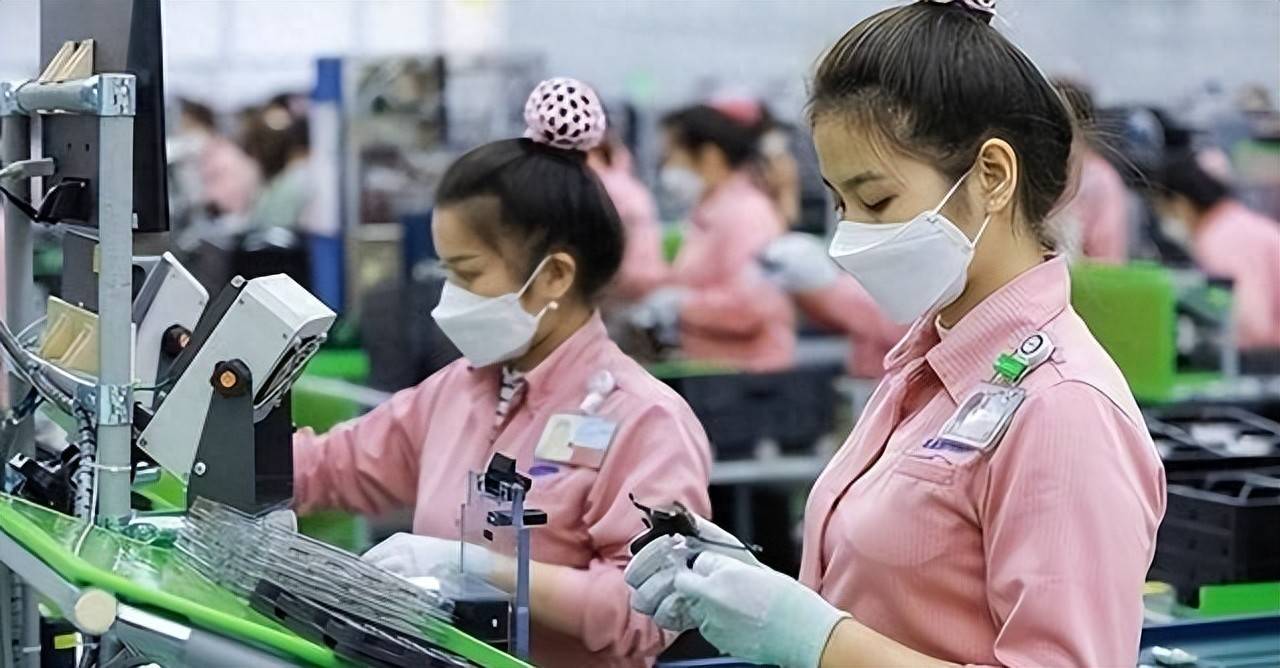
Economic Overview - Vietnam, once seen as the "next Asian miracle," is now facing challenges due to global economic changes, including capital outflows and inflation pressures following the U.S. Federal Reserve's interest rate hikes in 2022 [1] - The country has experienced a significant depreciation of its currency, with the exchange rate moving from 23,000 VND to 25,000 VND per USD, leading to increased import costs for businesses [6] Historical Context - Vietnam's economic transformation began in the late 1980s with the "Doi Moi" policy, which opened the country to foreign investment and led to significant GDP growth, averaging over 6% from 2010 to 2015 [3][4] - The country has become an important part of the global manufacturing supply chain, attracting major companies like Samsung and Nike due to its low labor costs and strategic location [3] Current Economic Challenges - The influx of foreign investment has created a reliance on labor-intensive industries, with core technologies still imported, and infrastructure development lagging behind economic growth [4] - In 2022, Vietnam saw a net outflow of over $30 billion in foreign investment, raising concerns about its economic model and the risk of "hollowing out" its industries [6][8] Future Projections - The Vietnamese government is taking steps to improve infrastructure and attract high-quality foreign investments, with GDP projected to reach $4,763 billion in 2024, growing by 7.1% [10] - By 2025, Vietnam aims for a GDP growth target of at least 8%, with international organizations predicting growth rates between 5.6% and 6.6% [12] Comparative Analysis - Unlike Japan's historical economic bubble, Vietnam has managed to avoid excessive inflation and currency collapse, maintaining a stable exchange rate and a vibrant stock market [14] - Vietnam's early adoption of lessons from China's reform and opening-up has facilitated its industrialization, but it still lags behind China in terms of supply chain completeness and technological reserves [16]
新一轮存储超级周期来了,一辈子只有一次
Hua Er Jie Jian Wen· 2026-02-17 08:21
Core Insights - The storage industry is entering a "once-in-a-lifetime" super cycle driven by the AI boom, with demand for storage chips skyrocketing due to the requirements of AI applications [1][16]. - Phison Electronics, a leader in NAND flash memory controllers, is at the center of this supply-demand battle, indicating that the market is not just facing shortages but a life-and-death struggle from cloud to endpoint [3][4]. Supply and Demand Dynamics - The demand for storage is quantitatively staggering; for instance, NVIDIA's new GPU, Vera Rubin, requires over 20 TB of SSD per unit, which could consume 200 EB of storage if 10 million units are sold, equating to 20% of last year's global NAND Flash production [4][22]. - The current supply-demand imbalance has led to unprecedented pricing and contract terms, including a requirement for buyers to prepay three years' worth of cash for flash memory, a first in the industry [5][29]. Market Impact on Consumer Electronics - The AI-driven demand for storage is severely impacting traditional consumer electronics, with predictions of a reduction in global smartphone production by 200 to 250 million units this year, alongside significant declines in PC and TV shipments [9][30]. - The cost of components has surged dramatically; for example, the price of an 8GB eMMC chip has skyrocketed from $1.5 to over $20, significantly affecting the bill of materials (BOM) for consumer products [10][31]. Long-term Shortages and Production Challenges - Major manufacturers like Samsung and SK Hynix are adopting a cautious approach to expansion due to past losses, with industry experts predicting that the current shortages could last until 2027 or even 2030 [12][36]. - The physical limitations of production capacity and equipment shortages are exacerbating the situation, as the semiconductor equipment supply is limited and the ramp-up time for new facilities is lengthy [13][43]. Future Opportunities in Space Computing - There is potential for space applications to alleviate some of the AI computing bottlenecks, as space environments can provide solutions for power and cooling challenges faced by terrestrial data centers [14][45]. - Successful developments in this area could lead to significant growth in the next 2-3 years, although the high reliability requirements for space applications present substantial challenges [15][48]. Strategic Positioning of Phison Electronics - Phison is focusing on high-value solutions and long-term investments in R&D, with a 50% increase in R&D spending this year, aiming to transition from a low-margin player to a provider of high-value solutions [16][52]. - The company is leveraging its expertise in AI and space applications to differentiate itself in a highly competitive market, emphasizing the importance of maintaining strong relationships with upstream suppliers [60][62].