
九号公司

Search documents
如何看2025年11月消费数据
2025-12-16 03:26
Summary of Key Points from Conference Call Records Industry Overview Retail Industry - In November 2025, the total retail sales of consumer goods grew at a rate of approximately 1%, indicating a slowdown in growth momentum. Restaurant revenue increased by 3.2% year-on-year but showed a month-on-month decline, reflecting weakened overall consumption market dynamics [1][3] - Online retail sales of physical goods accounted for 26% of total retail sales, but the growth rate has declined compared to previous periods. Offline retail, particularly convenience stores and supermarkets, remains relatively robust, while department stores and specialty shops show lower growth rates, indicating an imbalance in the development of online and offline retail formats [1][3] - Essential consumer goods like grain and oil maintain steady growth, while discretionary items such as cosmetics and gold jewelry perform well due to promotions and rising gold prices. However, home appliances are experiencing a year-on-year decline due to policy impacts and demand exhaustion, highlighting consumption differences across categories [1][3] Automotive Industry - The total retail sales of automobiles in November 2025 amounted to 445.4 billion yuan, down 8.3% year-on-year. Despite this, passenger car sales and export volumes continue to grow, with a penetration rate of new energy vehicles remaining high, indicating structural changes in the automotive market and potential for export growth [1][7] - The expected continuation of trade-in subsidies may release pent-up demand, with companies like Geely and Great Wall Motors being highlighted as potential investment opportunities. BYD is noted for its strong overseas market prospects, while XPeng Motors is recommended for its leading smart driving technology [1][7] Duty-Free Industry - The duty-free industry showed steady growth in the first ten months of 2025, with the fourth quarter benefiting from high-value items like gold jewelry and mobile phones. It is expected that Hainan's offshore duty-free sales will maintain positive growth at least until the third quarter of next year, reflecting the growth potential of duty-free consumption [1][6] - Companies to watch include China Duty Free Group, ShouLai JinJiang, Huazhu, and Atour, along with restaurant chains like Haidilao and Baosheng China, which are noted for their strong management capabilities and new brand incubation strategies [1][6] Food and Beverage Industry - The food and beverage sector experienced relatively flat demand in November 2025, with retail sales of tobacco and alcohol declining by 3.4% year-on-year. The overall demand is in a slow recovery phase, influenced by seasonal factors and the timing of the upcoming Spring Festival [1][11] Home Appliance Industry - The home appliance sector faced significant sales declines due to the impact of national subsidy policies, with retail sales down 19.4% year-on-year. However, there is an expectation that these policies may continue into next year, suggesting a focus on resilient demand in white goods and two-wheeler markets, as well as overseas market opportunities [1][2][14] Alcohol Industry - The liquor industry is currently in a phase of active destocking, with high-end brands like Moutai experiencing price corrections that support demand. The upcoming Spring Festival is expected to see marginal improvements in sales, with recommendations to gradually allocate investments in the liquor sector, particularly in high-end brands [1][12] Textile and Apparel Industry - In November 2025, online sales of clothing and textiles grew by 3.5% year-on-year, although there was a month-on-month decline. The overall performance is expected to improve in the fourth quarter, aiding inventory reduction and setting the stage for a favorable market in the following year [1][9] Investment Recommendations - Focus on companies with strong growth potential in the beauty and personal care sector, such as MaoGaoPing and Shangmei, and in the gold jewelry sector, prioritize firms with strong product design and foundational support [1][4] - In the automotive sector, consider companies like Geely and Great Wall Motors, as well as BYD for overseas expansion opportunities [1][7] - For the duty-free sector, keep an eye on leading companies like China Duty Free Group and ShouLai JinJiang, as well as promising restaurant chains [1][6]
扩内需政策效果有所分化:环球市场动态2025年12月16日
citic securities· 2025-12-16 02:57
Market Overview - The Chinese stock market performed poorly on Monday, influenced by a significant drop in US stocks, with technology stocks showing notable declines[3] - European markets saw gains on Monday, buoyed by positive sentiment ahead of upcoming economic data releases[3] Economic Data and Policies - China's November economic data showed a general decline in both supply and demand, with fixed asset investment growth slightly rebounding, while consumer spending remained weak[6] - The Central Economic Work Conference in December emphasized the need for more proactive fiscal policies and moderately loose monetary policies to enhance economic vitality[6] Stock Market Performance - The Dow Jones fell by 0.09% to 48,416.6, while the S&P 500 and Nasdaq dropped by 0.16% and 0.59%, respectively[10] - The Hang Seng Index decreased by 1.34%, with the Hang Seng Tech Index suffering the largest drop of 2.48%[12] Commodity and Currency Trends - International oil prices continued to decline, with NYMEX crude oil down 1.1% to $56.82 per barrel, marking the lowest level since February 2021[28] - The US dollar index fell by 0.1%, while gold prices saw a slight increase ahead of the non-farm payroll data release[28] Fixed Income Market - US Treasury yields showed mixed results, with short to medium-term yields declining by 1-2 basis points, leading to a steeper yield curve[31] - The 2-year Treasury yield decreased by 2.1 basis points to 3.50%, while the 10-year yield fell by 1.2 basis points to 4.17%[31]
家用电器行业周度跟踪:强调龙头配置价值,关注智能终端持续创新-20251215
Western Securities· 2025-12-15 11:28
Investment Rating - The industry investment rating is "Overweight" [5][11] Core Insights - The report emphasizes the value of leading companies in the home appliance sector, highlighting the importance of continuous innovation in smart terminals [1] - The central economic work conference has set the tone for 2026 economic work, focusing on domestic demand and optimizing policies for large-scale equipment updates and consumer goods replacement [1] - The report suggests that if subsidy policies continue into next year, it will help stabilize the domestic home appliance market and ensure the performance stability of leading companies [1] Summary by Sections White Goods - Online sales data for November shows significant declines: refrigerators, air conditioners, and washing machines saw sales drop by 23.17%, 26.13%, and 6.17% respectively, with volumes down by 28.31%, 26.24%, and 13.65% [2] - Offline sales experienced even steeper declines, with refrigerators, air conditioners, and washing machines down by 49.18%, 51.76%, and 40.4% in sales [2] - The report indicates that the pessimistic sales expectations are already reflected in the market, and the industry is moving past the peak of base pressure [2] - A coalition of major air conditioning companies has initiated a self-regulation agreement to replace copper with aluminum, which may help reduce costs and improve product quality [2] - Despite current weak demand, the report anticipates a gradual reduction in domestic sales pressure due to high base effects and subsidy tapering [2] Black Goods - November data shows a decline in online sales for televisions, with sales down by 27.01% and volumes down by 37.52% [3] - The report notes that the trend of structural upgrades in black goods continues, with MiniLED technology driving up average prices and margins [3] - The upcoming World Cup is expected to catalyze sales, as leading companies focus on high-end channels [3] Consumer Technology - The report highlights the impact of subsidy reductions and high base effects on the market for cleaning appliances, with a notable decline in sales for robotic vacuum cleaners [4] - The report suggests that the industry is experiencing a concentration of domestic brands, driven by AI innovations and cost reductions in the supply chain [4] Investment Recommendations - The report recommends focusing on white goods, particularly Haier and Midea, due to their strong market positions and benefits from ongoing transformations [8] - It also suggests selecting consumer technology stocks, including Anker Innovations and Roborock, as well as opportunities in the 3D printing industry [8] - For overseas expansion, TCL Electronics is highlighted as a company with good growth potential [8]
第十九届华夏机构投资者典型案例揭晓
Hua Xia Shi Bao· 2025-12-15 10:39
Core Insights - The 19th Huaxia Institutional Investor Annual Conference and Huaxia Financial (Insurance) Technology Forum was successfully held in Beijing, focusing on the theme "Vitality and Resilience, Innovation and Empowerment" [1] Group 1: Awards and Recognitions - Institutions awarded the "2025 Annual Green Finance Practice Typical Case" include Agricultural Bank of China, Bank of China Beijing Branch, Industrial Bank, China International Capital Corporation, Xinwang Bank, and Huatai Securities [3] - Institutions recognized for the "2025 Annual Financial Assistance for the Disabled Typical Case" are Agricultural Bank of China and Yunnan Trust [3] - Institutions awarded the "2025 Annual Smart Elderly Care Financial Typical Case" include China Minsheng Bank, CITIC Bank, Agricultural Bank of China Wealth Management, New China Life Insurance, Harmony Health, Beijing Bank, and others [3] - Institutions recognized for the "2025 Annual Green Finance Innovation Typical Case" include Agricultural Bank of China Credit Card, People's Insurance Company of China, and Ping An Group [3] - Institutions awarded the "2025 Annual ESG Practice Typical Case" include Yirun Zhike, Dajia Investment Holdings, China Life, and others [3] - Institutions recognized for the "2025 Annual Institutional Investor Education Content Creative Communication Typical Case" include Minsheng Jianyin Fund, Zhejiang Merchants Securities, and others [3] - Institutions awarded the "2025 Annual Financial Empowerment for Rural Revitalization Typical Case" include China Post Insurance, Tianjin Bank Beijing Branch, and others [3] - Institutions recognized for the "2025 Annual Inclusive Finance Digital Transformation Typical Case" include CITIC Baixin Bank, Lexin, and others [3] - Institutions awarded the "2025 Annual Intelligent Risk Control Technology Innovation Application Typical Case" include Foreign Trade Trust, Orange Data Science, and others [3][4] - Institutions recognized for the "2025 Annual Community Elderly Service Typical Case" include Industrial and Commercial Bank of China, ICBC-AXA Life Insurance, and Tianjin Binhai Rural Commercial Bank [5] - Institutions awarded the "2025 Annual Internet Medical Innovation Practice Case" include ZhongAn Insurance [5] - Institutions recognized for the "2025 Annual Technology Financial Typical Practice Case" include Changjiang Securities, Yixin, and others [5] - Institutions awarded the "2025 Annual Listed Company Board of Directors Typical Practice Case" include Annai'er, Bailian Co., Hai Liang Co., and Tianqi Lithium [5]




交银国际_汽车行业2026年展望:穿越周期的新动能智驾商用、储能共振与机器人量产_
2025-12-15 02:13
Summary of the Conference Call Industry Overview - **Industry**: Automotive Industry - **Date**: December 5, 2025 - **Rating**: Leading - **2026 Outlook**: New driving forces through cycles - smart driving commercial use, energy storage resonance, and mass production of robots [1] Key Points Automotive Market Trends - **Passenger Vehicles**: - After stimulus, the market is entering a high-level consolidation phase. - Expected retail sales for 2026 are projected to increase by 0.3% year-on-year to 24.45 million units, with a penetration rate of new energy vehicles (NEV) exceeding 60% [5][19]. - Growth is driven by product iterations and cost advantages from domestic brands in hybrid and pure electric technologies [5][20]. - **Exports**: - Total overseas sales are expected to reach 7.5-8 million units in 2026, with a shift towards localized manufacturing to address trade uncertainties [5][10]. - In the first ten months of 2025, cumulative exports reached 6.51 million units, a year-on-year increase of 23.3%, with NEVs accounting for nearly 40% of exports [10][36]. Heavy-Duty Trucks - **Market Growth**: - Anticipated sales for heavy-duty trucks in 2026 are around 1.1 million units, a 5% increase year-on-year, with better performance expected in the second half of the year [5][10]. - The market is benefiting from policy incentives and accelerated penetration of new energy vehicles [5][10]. Smart Driving - **L3 Commercialization**: - 2026 is expected to be the year of large-scale commercialization for L3 autonomous driving, with several manufacturers accelerating development [9][11]. - The penetration rate for L2 and above smart driving systems reached 87% in the first eight months of 2025 [9]. Robotics - **Market Development**: - The robotics sector is transitioning from "technological breakthroughs" to "commercial realization," with significant advancements expected in 2026 [13][14]. - The sector is entering a consolidation phase, focusing on actual delivery capabilities and performance realization [14]. Lithium Battery Sector - **Demand Growth**: - Global lithium battery demand is projected to grow by approximately 22% in 2026, with energy storage demand expected to grow faster than power batteries [15][16]. - The industry is experiencing a recovery in profitability, but caution is advised regarding the price of lithium carbonate and supply chain uncertainties [16][17]. Investment Recommendations - **Short-term (H1 2026)**: - Market adjustments may occur post-policy withdrawal, but structural opportunities will emerge, particularly in high-level smart driving [11]. - **Mid-term (H2 2026)**: - The entry of L3 into mass production will drive product iterations and new purchasing momentum [11]. - **Long-term (2027 and beyond)**: - Focus on the sustainability of embodied intelligence and the Robotaxi/AI ecosystem [11]. Additional Insights - **Market Dynamics**: - The automotive market is shifting from a growth-driven model to one focused on replacement demand, with significant implications for market structure and competition [19][20]. - **Technological Advancements**: - The integration of advanced technologies in vehicles is reshaping consumer preferences and driving demand for new energy vehicles [27][29]. This summary encapsulates the key insights and projections from the conference call, highlighting the automotive industry's evolving landscape and investment opportunities.




大消费行业周报:中央经济工作会议提出深入实施提振消费专项行动,释放服务消费潜力-20251214
Ping An Securities· 2025-12-14 09:29
Investment Rating - The industry investment rating is "stronger than the market," indicating an expected performance that exceeds the market by more than 5% within the next six months [28]. Core Insights - The Central Economic Work Conference emphasized the implementation of consumption-boosting actions and the development of urban and rural resident income plans, which are expected to enhance the performance and valuation recovery of the consumer sector [3][9]. - The tourism sector is anticipated to see continued growth, with leading companies like Trip.com Group and Huazhu Hotels responding quickly to consumer demand [3]. - The beauty industry is experiencing steady growth, with a focus on companies that can adapt to market changes and integrate products, brands, and channels effectively [3]. - The sports and outdoor apparel sector is expected to benefit from policy support, presenting investment opportunities in leading brands with market share growth potential [3]. - The media sector should focus on niche markets related to consumer sentiment, which may provide opportunities for companies with strong performance certainty [3]. - In the food and beverage sector, leading companies are expected to maintain market share through effective brand management, particularly in high-end and mid-range liquor segments [3]. - The snack segment, particularly konjac products, continues to show strong growth potential, while dairy companies may enter a profit recovery phase [3]. Summary by Sections Social Services - The industry is evolving, with a focus on companies that actively respond to changing consumer demands, particularly in tourism and beauty sectors [3][8]. Macro Dynamics - The Central Economic Work Conference outlined key tasks for 2026, emphasizing the importance of domestic demand and the implementation of consumption-boosting actions [9]. Industry Dynamics - Disney's investment in OpenAI and its strategy to control fan engagement through authorized channels reflects a significant trend in the media industry [10]. Food and Beverage - Alcohol - The majority of liquor companies reported a deeper decline in net profits in Q3 2025 compared to Q2 2025, indicating ongoing challenges in the sector [3][19]. - The high-end liquor segment remains resilient, with leading brands expected to enhance their market positions [3][20]. Food and Beverage - Consumer Goods - The snack segment, particularly konjac products, continues to show strong growth potential, while dairy companies may enter a profit recovery phase [3][25]. Home Appliances - The electric two-wheeler industry faced a significant decline in production and sales in November 2025, indicating challenges in consumer demand [26].
电动自行车新国标误读风波:雅迪们慌了?
3 6 Ke· 2025-12-14 06:34
Core Viewpoint - The implementation of the new national standard for electric bicycles (GB17761—2024) aims to enhance safety and environmental protection, but has led to public confusion regarding its interpretation [1][3][5]. Industry Changes - The new standard requires improvements in battery safety, reliability of power systems, and increased impact resistance for brakes and vehicle bodies, which will have a profound impact on the entire industry [3][5]. - Misinterpretations of the new regulations have led to product designs that do not meet traditional consumer needs, such as seating for children, causing confusion among consumers [5][16]. Company Responses - Yadea, as a leading brand, reported a revenue of 28.236 billion yuan in 2024, a decrease of 18.77% year-on-year, with a net profit drop of 51.81%, marking the first decline in net profit in five years [6][9]. - In contrast, Aima Technology reported a revenue of 21.093 billion yuan for the first three quarters of 2025, an increase of 20.78% year-on-year, with a net profit rise of 22.78% [9][10]. - Ninebot Company achieved a revenue of 18.39 billion yuan for the first three quarters of 2025, a significant increase of 68.63% year-on-year, indicating a successful strategy focused on smart experiences for younger consumers [13][14]. Market Dynamics - The new standard imposes restrictions on speed, weight, battery capacity, and overall dimensions of electric bicycles, signaling a shift towards safer riding experiences [15]. - The core consumer market for electric bicycles remains in lower-tier cities, where price and maintenance convenience are prioritized over smart features, creating competitive pressure for emerging brands [15][16]. - The traditional leading companies are engaged in price wars, further squeezing the market space for new entrants [15][16]. Conclusion - The recent "misinterpretation" incident signifies the end of the "easy win" era for the electric bicycle industry, compelling companies to reassess their products and consumer relationships [16]. - While the short-term impact of the new standard may pressure revenues and profits, the long-term benefits will drive the industry towards safer, smarter, and more environmentally friendly solutions [16].

雅迪站在了新国标岔路口?
3 6 Ke· 2025-12-12 11:19
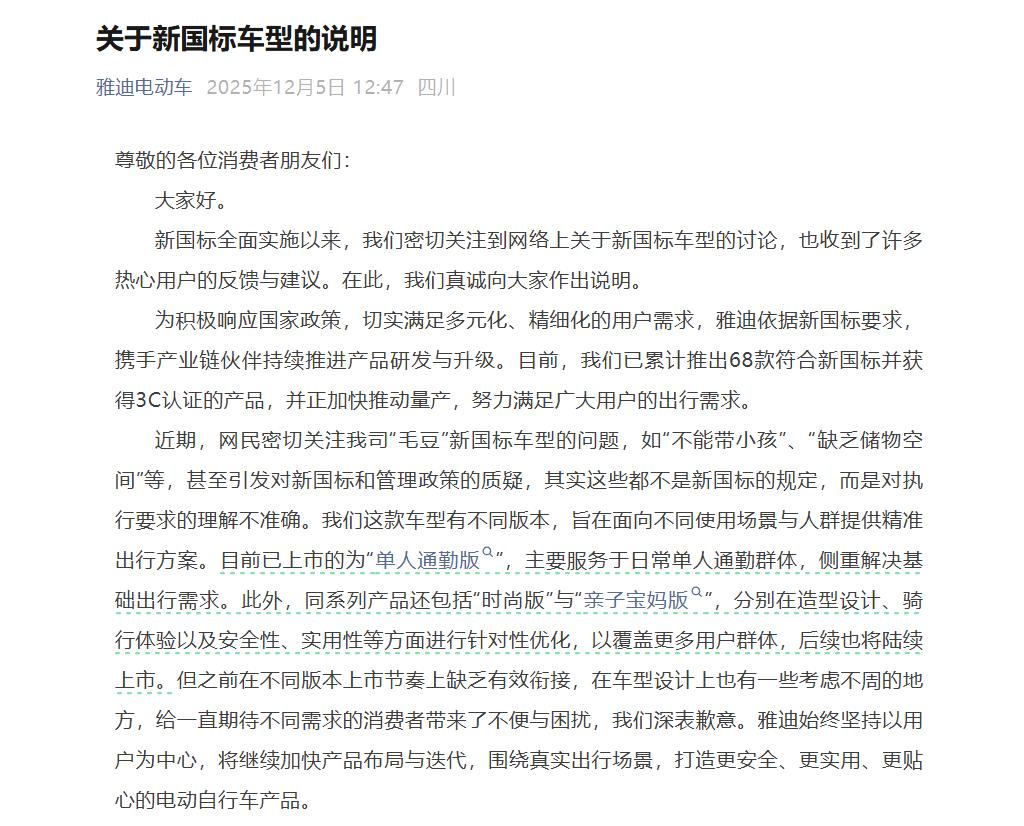
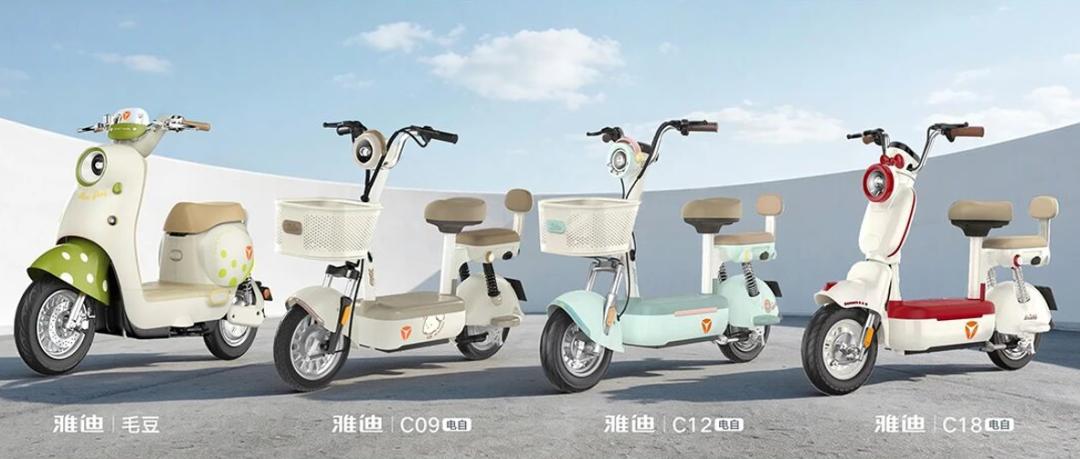
Core Viewpoint - The "Mao Dou" incident highlights the challenges faced by the electric two-wheeler industry during its transformation, indicating a shift from a subsidy-driven growth model to a compliance-focused era with new national standards [1][3][12]. Industry Overview - The electric two-wheeler industry is at a historical turning point, with the end of subsidy programs and the implementation of stringent new national standards marking the end of an era reliant on subsidies and scale expansion [3][12]. - By April 2025, the domestic electric two-wheeler ownership is projected to exceed 420 million units, indicating a saturated market where competition is intensifying [4][12]. Company Performance - Yadea, as the industry leader, reported a 33.1% year-on-year revenue growth to 19.186 billion yuan and a 59.5% increase in net profit to 1.649 billion yuan in the first half of 2025, selling 8.7935 million units [11]. - Despite strong sales, the company faces challenges adapting to new standards and consumer expectations, as evidenced by the backlash against the "Mao Dou" model [12][14]. Competitive Landscape - The competitive environment has evolved into a three-way contest among Yadea, Aima, and Tailg, with new entrants like Ninebot and Niu rapidly gaining ground [7][8]. - Aima has carved out a niche by targeting young female consumers with lightweight designs and appealing aesthetics, while new players are leveraging smart technology to penetrate the high-end market [7][8]. Consumer Trends - Consumer preferences are shifting from merely owning a vehicle to seeking an enjoyable travel experience, emphasizing smart interaction, personalized design, and emotional value [5][12]. - The "Mao Dou" incident reflects a disconnect between Yadea's product offerings and the fundamental needs of Chinese family users for practical features [12][19]. Strategic Imperatives - Yadea must undergo a transformation from a scale-driven approach to a value-driven strategy, focusing on user insights and enhancing the overall customer experience [19][22]. - The company is implementing standardized trial experiences in stores to shift its focus from product-centric to user-centric strategies, aiming to leverage its extensive retail network for better customer insights [21][22]. Future Outlook - The new national standards present an opportunity for the industry to innovate and redefine its competitive landscape, moving beyond price wars to focus on technology and user value [13][23]. - Yadea is positioned to leverage its experience in global markets to adapt and promote its new standards and technological solutions internationally, potentially leading the global green mobility revolution [23][24].

2025CSR盛典暨第一财经善商业论坛正式举行
第一财经· 2025-12-12 02:07
2025 年 12 月 11 日, 2025CSR 盛典暨第一财经善商业论坛在上海世博会博物馆正式举行。本 届论坛以"韧性共生:重塑可持续竞争力新范式"为主题,邀请各机构代表、企业嘉宾、学者齐聚一 堂,共同回顾过往可持续发展的经验,搭建全球可持续对话合作平台, 探讨构建 "商业 - 环境 - 社会"三位一体的韧性体系,贡献可持续发展的 思想成果。 作为论坛主办方,第一财经长期致力于打造可持续发展平台,超越传统 CSR 逻辑,重新定义"可持 续竞争力"。 第一财经 常务 副总经理杜坚 在致辞中提到, 媒体的 责任 在于洞察趋势、凝聚共 识,更在于推动实实在在的产业变革。第一财经始终以推动可持续发展为己任 , 既是产业实践的记 录者,更是价值链接的赋能者 。 第一财经 通过专业报道与深度研究,挖掘企业创新案例,解读政 策市场趋势,搭建跨界沟通桥梁;通过 探寻 " 中国企业社会责任典范 " ,以客观标准发掘先锋样 本,让负责任的商业实践获得广泛认可 , 通过思想碰撞,为 更多 企业破解困境提供新思路。 联合国可持续发展管理学院首席代表、联合国可持续发展目标全球协作项目工作委员会主任柳云虎 带来主题演讲 《 面向未来 ...

新消费2026年度策略报告:星河长明,向阳而生-20251211
Xinda Securities· 2025-12-11 12:48
Group 1: Core Insights - The report highlights a shift in China's stock pricing logic, emphasizing three core trends: China's proactive position in US-China trade, stabilization in the real estate market, and the emergence of new technologies and industries creating structural growth opportunities [2][15]. - Key investment directions include structural growth in new consumption trends, enhanced global resource allocation capabilities, long-term advantages of high dividend strategies, and undervalued consumer blue-chip stocks [2][15]. Group 2: New Consumption Trends - The personal care and pet food sectors are experiencing a dual growth trend, with strong brand loyalty and significant single product effects, while the baby care market is diversifying with a focus on quality and price [3][26]. - The gold and jewelry market is expected to maintain a favorable outlook in 2026, driven by the value retention of gold jewelry and the concentration of market share among leading brands [3][26]. - The collectible toy market is expanding, with leading companies transitioning from single product-driven models to integrated IP and ecosystem strategies [3][26]. - The new tobacco sector is witnessing stricter regulations, but the heat-not-burn (HNB) market penetration is accelerating, with key players like Smoore International positioned for growth [3][26]. - The smart glasses market is projected to grow significantly, with global sales expected to reach 18 million units by 2026, driven by advancements in comfort, aesthetics, and AI interaction [3][26]. - The electric two-wheeler market is optimizing its structure due to new regulations, with leading companies expected to enhance their market share [3][26]. Group 3: Cyclical Trends - The home furnishings sector is anticipated to remain in an adjustment phase through 2025, with a potential stabilization in 2027, driven by demand for soft and smart home products [5][6]. - The paper industry is expected to see a gradual recovery in demand, supported by limited new pulp capacity and a potential increase in pulp prices [5][6]. - The metal packaging industry is experiencing increased concentration, with expectations of slight price increases in 2026 as the industry shifts from market share to profitability [5][6]. Group 4: Export Dynamics - The report notes a reshaping of supply dynamics, with improved order visibility for companies following the US interest rate cuts and easing trade tensions [6][15]. - Leading companies with localized overseas bases are expected to enhance their global market share, with brands like TaoTao and ZhiOu demonstrating resilience in international markets [6][15]. Group 5: Textile and Apparel Insights - The outdoor apparel market is projected to grow significantly, with a CAGR of 9.6% from 2025 to 2029, driven by product innovation [7][26]. - The men's clothing and home textile sectors are showing resilience, with leading brands benefiting from high dividend characteristics and online sales growth [7][26]. - The textile manufacturing sector is optimistic about external demand, with healthy order books and a continued shift of production capacity to countries like Indonesia [7][26].