
黑芝麻智能

Search documents
华泰证券今日早参-20250523
HTSC· 2025-05-23 05:50
Group 1: Macroeconomic Insights - Recent increase in overseas ultra-long-term government bond yields, with Japan's 30-year bond yield reaching 3.15% and the US 30-year bond yield at 5.08%, the highest since October 2023 [2][4] - Concerns over inflation and fiscal policies are driving the rise in yields, with expectations of a potential short-term pullback in Japanese bond yields after temporary factors dissipate [2][4] - The report suggests that the long-term outlook for US Treasury yields may remain elevated [2] Group 2: Currency Dynamics - The US has adjusted tariffs, leading to a slight rebound in the US dollar index and a 0.5% increase in the RMB against the USD [3] - The report indicates that the RMB may have upward appreciation potential due to structural rebalancing in global asset allocations, particularly in Asia [3] Group 3: Fixed Income Market - Global bond yields have risen, with Japan's 10-year bond yield increasing to 1.53% and the US 10-year bond yield reaching 4.58% [4] - The report highlights that the rise in yields is influenced by various factors, including uncertainty surrounding tariff policies and inflation expectations [4] Group 4: Real Estate Sector - The report discusses the "pre-sale + current sale" model used in many overseas real estate markets, emphasizing the importance of third-party fund supervision to protect buyers [5] - This model ensures that most payments are made after project completion, reducing the risk of fund misappropriation [5] Group 5: Oil and Gas Sector - Oil prices have rebounded due to revised demand expectations following tariff reductions and OPEC+ production adjustments, with WTI and Brent prices rising by 5.8% and 2.8% respectively [6] - The report notes that trade tensions and OPEC+ production strategies are key short-term factors affecting oil prices [6] Group 6: Hong Kong Market Dynamics - The report highlights the recent surge in liquidity in Hong Kong's banking system, driven by currency interventions and successful IPOs, such as that of CATL [6] - It suggests that Hong Kong's market may benefit from a structural shift in global capital flows, particularly in the context of de-dollarization [6] Group 7: Company-Specific Insights - Black Sesame Intelligence is highlighted as a leading supplier of AI chips for smart driving and robotics, with a target price of 24.04 HKD and a "buy" rating [14] - Meitu's strategic partnership with Alibaba is expected to enhance growth prospects, with a "buy" rating maintained [16] - ZTO Express reported a revenue of 10.89 billion RMB, with a focus on market share despite short-term profit pressures, maintaining a "buy" rating [18] - Baidu's transition towards AI cloud services is noted, with a "buy" rating based on strong revenue growth in this segment [23]
黑芝麻(000716) - 000716黑芝麻投资者关系管理信息20250521
2025-05-21 10:22
Group 1: Company Performance - In 2024, the company achieved a revenue of 2.465 billion yuan, a year-on-year decrease of 7.92% due to strategic adjustments focusing on quality and efficiency [5] - The net profit attributable to shareholders was 77.7376 million yuan, representing a year-on-year increase of 80.46%, indicating effective quality improvement actions [5] - In Q1 2025, the company reported a revenue of 442 million yuan and a net profit of 2.2511 million yuan [8] Group 2: Strategic Focus - The company is concentrating on the health food industry, particularly black sesame products, to enhance its core competitiveness [6] - Plans to develop new product lines, including medicinal and food-complementary powders, are underway to diversify offerings [5] - The company aims to optimize its product structure and focus on high-margin products to improve profitability [8] Group 3: Market and Risk Management - The company is actively adjusting its e-commerce strategy due to a significant decline in third-party brand e-commerce revenue, focusing on high-margin brand operations [7] - Potential risks and management strategies are detailed in the annual report, specifically in the section discussing future development outlook [3] - The company acknowledges external market factors affecting stock prices but emphasizes ongoing efforts to enhance economic benefits and investment value [9] Group 4: Future Outlook - The food production industry is expected to remain robust due to high demand in China, with the company optimistic about future growth opportunities [8] - The company is committed to continuous improvement in operational efficiency and cost management to sustain profitability [8]

2025上海车展,零部件企业破局重构产业格局
Jing Ji Guan Cha Bao· 2025-05-21 08:32
Core Insights - The 2025 Shanghai Auto Show serves as a significant platform for the automotive supply chain, showcasing a transformation from "supporting players" to "leading players" in the industry [1][16] - The exhibition area for auto parts spans 100,000 square meters, hosting over 1,500 suppliers from 28 countries, marking it as the largest auto parts display in history [2][4] - The event highlights the shift towards smart and electric vehicles, with a notable presence of both traditional suppliers and new tech companies [2][3] Industry Transformation - The automotive supply chain is evolving with technology companies entering the market, changing the competitive landscape from hardware manufacturing to a software-hardware integrated ecosystem [3] - The collaboration between component suppliers and vehicle manufacturers is shifting from "supplying" to "joint development," as seen in partnerships like Huawei with Jianghuai Auto and CATL with SAIC [3][5] Scale and Competition - More than half of the world's top 100 auto parts suppliers participated in the show, showcasing their advanced technologies and products [4][5] - Domestic companies like CATL and Huawei are demonstrating significant growth and technological advancements, indicating a shift in industry power dynamics [5][11] Technological Innovations - The event showcased breakthroughs in battery technology, including CATL's sodium-ion battery and BYD's all-solid-state battery, which address safety and performance concerns [7][8] - Major Tier 1 suppliers are accelerating local R&D efforts, with Bosch and Continental introducing advanced driver assistance systems that leverage local technology [9][10] Local Market Dynamics - Chinese auto parts companies are rapidly gaining ground, with over 1,200 domestic automotive chips displayed, reflecting a shift from being a backup option to a primary choice for automakers [11] - Companies like Huawei and CATL are setting benchmarks in technology and ecosystem development, with innovative solutions like rapid battery swapping and smart vehicle systems [12][13] Global Strategy and Localization - Multinational companies are deepening their local strategies in China, with significant investments and a focus on integrating into the local automotive ecosystem [13][14] - The trend of localization is becoming essential for global suppliers, as they adapt to the unique demands of the Chinese market while also aiming for global outreach [15][16]


智能辅助驾驶竞速与暗战:万亿市值谁领衔,技术功能哪家强?
Bei Ke Cai Jing· 2025-05-21 04:11
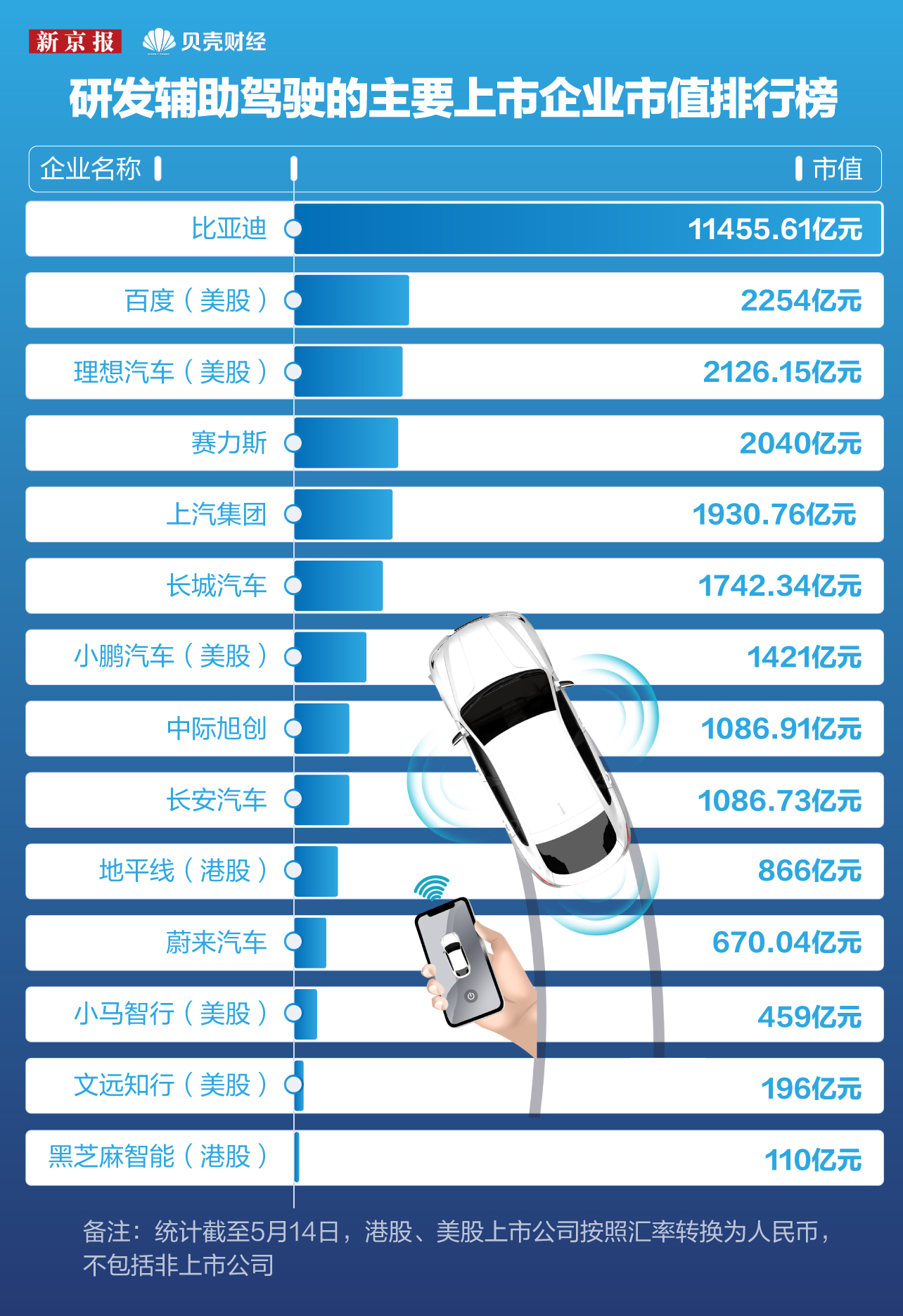
Core Insights - The intelligent driving industry is undergoing rapid transformation driven by advancements in technology such as chips, lidar, AI algorithms, and vehicle-road collaboration, leading to the commercialization of smart assisted driving [1][2] - By 2025, the competition in the smart assisted driving sector will not only be about technical parameters but also about market positioning and strategic partnerships among companies [1][2] - The total number of companies involved in smart assisted driving in China has exceeded 1,000, with at least 300 listed companies in A-shares, Hong Kong, and US markets [1][3] Market Capitalization and Competition - As of May 14, 2025, the top five companies in A-shares related to smart assisted driving by market capitalization are BYD (1.11 trillion yuan), Seres (213.4 billion yuan), SAIC Motor (192.2 billion yuan), Great Wall Motors (172.9 billion yuan), and Zhongji Xuchuang [4] - The competition among the second-tier companies is intensifying, with market capitalizations of Seres, SAIC, and Great Wall Motors closely clustered within a few billion yuan [4][7] - In the US market, companies like Xpeng and Li Auto are also competing closely in terms of market capitalization [4] Sales Performance - BYD leads the global market in new energy vehicle sales, achieving 4.272 million units sold in 2024, a year-on-year increase of 41.26%, which provides a strong data foundation for its assisted driving development [8][9] - The competition for BYD is not only among domestic manufacturers but also with Tesla, with BYD adopting a strategy of making smart assisted driving technology accessible to lower-priced vehicles [9] Ecosystem and Development Strategies - The smart assisted driving technology is rapidly evolving, with companies pursuing either full-stack self-research or collaborative approaches to differentiate their solutions [12][19] - BYD and Xpeng are examples of companies that are leading in self-research, while Huawei is noted for its collaborative "friend circle" model, partnering with multiple automakers [13][19] - Momenta stands out in the supply chain with a broad customer base, collaborating with seven of the top ten global automakers and over 130 production models [21] Supply Chain Dynamics - The competition among supply chain companies is characterized by a wide range of partnerships and diverse customer types, with companies striving to expand their client base [21] - In the lidar sector, companies like Hesai and RoboSense are engaged in fierce competition, with plans to significantly reduce prices to make lidar technology more accessible [21][24] - The chip sector is also highly competitive, with domestic companies striving to replace established players like Mobileye in the L2 market [24] Industry Challenges and Future Outlook - The commercialization of L3 and higher-level autonomous driving technologies faces regulatory hurdles, with no clear guidelines on liability and road regulations yet established [26][27] - Despite the challenges, the intelligent driving industry in China is on a growth trajectory, with companies like BYD and Huawei leading the way in making assisted driving technology more accessible [28] - The ultimate goal of the industry remains to surpass human driving capabilities in terms of safety and efficiency [28]

【周观点】5月第2周乘用车环比+6.5%,继续看好汽车板块
东吴汽车黄细里团队· 2025-05-19 09:43
Core Viewpoints - The automotive sector is expected to continue its upward trend, driven by three main themes: AI robotics, AI intelligence, and favorable market conditions [4][8] - The market showed strong performance in the automotive sector, with passenger vehicles and components leading the gains, influenced by better-than-expected adjustments in US-China tariffs and previous significant corrections in the automotive market [4][8] Weekly Review Summary - In the second week of May, the number of compulsory insurance policies reached 443,000 vehicles, reflecting a week-on-week increase of 6.5% and a month-on-month increase of 29.8% [2][7] - The SW automotive index rose by 2.4%, with the best-performing segments being SW passenger vehicles (+4.4%) and SW automotive components (+2.2%), while commercial vehicles and motorcycles showed declines [2][7] Key Industry Changes - Weipai New Energy launched the 2025 model of the Gaoshan vehicle, equipped with the Coffee Pilot Ultra intelligent driving assistance system [3][7] - BYD was added to the Hang Seng Technology Index [3][7] - Geely Automobile reported Q1 2025 revenue of 72.5 billion yuan, a year-on-year increase of 24.5%, and a net profit of 5.67 billion yuan, up 263.4% year-on-year [3][7] - The acquisition of 100% equity in Wuhu Changpeng was completed, and the company was renamed Wuhu Top [3][7] - Baolong Technology's second phase of the 4.8MW distributed photovoltaic project in Ningguo was completed and accepted [3][7] Sector Configuration Recommendations - The company maintains a positive outlook for 2025, focusing on three main themes: AI robotics, AI intelligence, and favorable market conditions, with the robotics theme expected to have the highest elasticity in May [5][8] - Recommended stocks for the AI robotics theme include Top Group, Junsheng Electronics, and Precision Forging Technology [5][8] - For the AI intelligence theme, preferred stocks include Xpeng Motors, Li Auto, and Xiaomi in Hong Kong, and Seres, SAIC Motor, and BYD in A-shares [5][8] - The favorable market conditions theme includes recommendations for bus manufacturers like Yutong Bus and heavy-duty trucks like China National Heavy Duty Truck and Weichai Power [5][8] Market Performance Tracking - The automotive sector ranked third in A-shares and first in Hong Kong this week, with strong performances in passenger vehicles and components [12][21] - The automotive sector's performance in the SW index showed significant gains, with passenger vehicles leading the way [15][21] Sales Data Overview - In April, the total number of passenger vehicles insured was 443,000, with a year-on-year increase of 29.8% [44] - New energy vehicles accounted for 222,000 units, with a penetration rate of 50.2% [44]




150家公司扎堆排队 赴港上市“燃”起来了
经济观察报· 2025-05-16 10:26
截 至 2025 年 5 月 14 日 , 港 交 所 拟 上 市 公 司 中 显 示 " 聆 讯 通 过"的有2家,显示"处理中"的有150家。 作者:牛钰 封图:图虫创意 前有知名玩具品牌布鲁可(0325.HK)、餐饮界的"雪王"蜜雪集团(2097.HK)在港交所挂牌上 市,后有A股"宁王"宁德时代(300750.SZ)、"药王"恒瑞医药(600276.SH)分别于5月12日、5 月15日启动H股全球公开发售,2025年以来,港股市场迎来一家又一家备受瞩目的行业新贵。 "去香港上市"成了2025年资本圈的热词。 港股正在接纳诸多谋划"A+H"双重上市的A股上市公 司,也迎来了一批消费、医疗、科技等行业的新兴企业。 Wind数据显示,2025年初至5月14日,已经有21家企业登陆港股市场,同比增加6家;合计募资 234.72亿港元,同比增长198.32%。 香港交易所(下称"港交所")在政策层面也给企业赴港上市热添了一把"新柴"。5月6日,港交所推 出"科企专线"上市新政,进一步便利特专科技公司及生物科技公司申请上市,并允许这些公司可以 选择以保密形式提交上市申请。 港交所上市主管伍洁镟表示,港交所始终将吸 ...

开源证券晨会纪要-20250514
KAIYUAN SECURITIES· 2025-05-14 14:41
Group 1: Macro Economic Insights - The US April CPI increased by 2.3% year-on-year and 0.2% month-on-month, which is below market expectations; core CPI rose by 2.8% year-on-year, aligning with market expectations [3][4][5] - Overall inflation in the US has declined for three consecutive months, but core inflation remains stable, indicating potential upward pressure on inflation due to tariff policies [4][5][6] - The expectation is that the Federal Reserve may not lower interest rates in the near term, with the first potential cut possibly occurring in September [7] Group 2: Electric Power Equipment and New Energy - The "Doubling" initiative for charging facilities is expected to drive nearly 200 billion yuan in investment, significantly benefiting the charging pile industry [10][12] - As of April 2025, the number of public charging piles in China reached 3.992 million, with a year-on-year increase of 22.5% in new charging piles [11] - The European electric vehicle market shows signs of recovery, with April 2025 sales in nine countries reaching 211,000 units, a year-on-year increase of 30.7% [25][30] Group 3: Food and Beverage Industry - The food and beverage sector has outperformed the market, with a 0.5% increase from January to April 2025, surpassing the Shanghai Composite Index by approximately 2.9 percentage points [13][14] - The first quarter of 2025 saw a 4.6% year-on-year increase in revenue for the food and beverage sector, although profit growth was only 0.3% [17] - The market outlook is optimistic, with recommendations to focus on leading companies in the sector, particularly in the liquor and snack segments [18]
智驾算力之战:一位芯片“老将”的DeepSeek式攻坚
财富FORTUNE· 2025-05-14 12:56
Core Viewpoint - The article highlights the journey and vision of the company Black Sesame Intelligence, focusing on its development of advanced intelligent driving chips and the broader implications for the automotive and AI industries. The founder, Dan Jizhang, emphasizes the importance of safety in driving and the potential of intelligent driving technology to significantly reduce accident rates. Group 1: Company Overview - Black Sesame Intelligence was founded in 2016 and launched its first mass-produced intelligent driving chip, the "Hua Shan A1000," in 2020, which has been adopted by several major automotive brands [1][2]. - The company has since developed the "Wudang" series of chips, such as the C1236 and C1296, which integrate cockpit management and intelligent driving tasks, thereby reducing costs for automakers [1][2]. Group 2: Technological Advancements - The latest chip, the Hua Shan A2000, utilizes a 7nm process and offers performance comparable to 4nm flagship chips, supporting L3-L4 level autonomous driving [2]. - The company aims to break traditional chip application boundaries by expanding into various forms of robotics, promoting a "one chip, multiple functions" approach [2]. Group 3: Market Trends and Opportunities - The global intelligent automotive market is projected to exceed $500 billion by 2030, with an annual growth rate of over 20%, and China is expected to reach a 40% market share in smart vehicles by 2025 [6]. - The company recognizes the challenges of high R&D costs and the need for substantial investment in software and tools for mass production [6]. Group 4: Strategic Partnerships and Ecosystem - Black Sesame Intelligence positions itself as a full-process technology partner, providing not only chips but also algorithms and development support, which enhances collaboration with automotive manufacturers [7]. - The company emphasizes the importance of an open ecosystem to achieve scale, as the development cost of automotive-grade chips can exceed $100 million [8]. Group 5: Future Outlook - Black Sesame Intelligence plans to go public in Hong Kong, becoming the first listed company focused on automotive-grade chips, which reflects its strategic foresight [9]. - The company is also exploring the integration of vehicle and road technologies, aiming to reduce costs and improve efficiency in traffic management systems [12]. Group 6: Industry Challenges - The intelligent driving chip industry is expected to face a brutal elimination process, with only a few companies likely to survive due to intense competition [12]. - The company is aware of the geopolitical challenges affecting the chip industry but sees opportunities in the growing demand for AI-driven solutions and embodied intelligence [11].

黑芝麻智能(02533):港股公司首次覆盖报告:自动驾驶产品及解决方案龙头,自动驾驶、跨域计算双轮驱动成长
KAIYUAN SECURITIES· 2025-05-13 14:57
Investment Rating - The report assigns a "Buy" rating for Black Sesame Intelligence (02533.HK) as a first-time coverage [1]. Core Views - Black Sesame Intelligence is a leading supplier of automotive-grade intelligent vehicle computing chips and solutions, focusing on autonomous driving products and solutions. The company benefits from the expanding market for autonomous driving solutions driven by the trend of "intelligent driving equality" [5][6]. - Revenue projections for the company are estimated at 792 million, 1.253 billion, and 1.942 billion CNY for 2025, 2026, and 2027 respectively, with year-on-year growth rates of 66.9%, 58.3%, and 55.0% [5][8]. Summary by Sections Company Overview - Black Sesame Intelligence began with high-performance chips for autonomous driving and has expanded into cross-domain computing chips, opening new market opportunities [16]. - The founder holds significant control over the company, and the management team possesses strong technical expertise [18][22]. Main Products - The company offers the Huashan and Wudang series of SoC hardware, focusing on autonomous driving and intelligent imaging solutions. The Huashan series includes the A1000 and A2000 chips, which support various levels of autonomous driving functions [25][26]. - The Wudang series, particularly the C1200 chip, is a pioneer in cross-domain computing, integrating multiple functionalities for smart vehicle control [26]. Financial Analysis - The autonomous driving products and solutions are the primary revenue source, with a projected revenue of 4.38 billion CNY in 2024, accounting for 92.35% of total revenue [38]. - The company has experienced rapid revenue growth due to the mass production of the Huashan A1000 series, with further growth expected from the Wudang C1200 and Huashan A2000 series [39][40]. Market Potential - The global and Chinese markets for ADAS applications are expected to grow significantly, with projected CAGRs of 27.5% and 28.6% from 2023 to 2028 [6][60]. - The company holds a 2.2% market share in the Chinese autonomous driving chip and solution market, ranking fifth, indicating substantial room for growth [67].
智驾芯片,国产替代到哪一步了?
3 6 Ke· 2025-05-13 11:30
Core Insights - The optimistic forecast for the penetration rate of intelligent driving (NOA) suggests an annual growth of 5%, reaching 55% for highways and 25% for urban areas by 2030 [1] - The increase in penetration rates is attributed to competitive pricing strategies among automakers, which have driven down the costs of intelligent driving systems [1] - The domestic production of key components, such as lidar and chips, has significantly contributed to cost reductions in intelligent driving hardware [1] Summary by Categories Intelligent Driving Chip Market - Intelligent driving chips are categorized by computing power: low (<30 TOPS), medium (30-150 TOPS), and high (>150 TOPS) [2] - The domestic replacement rate for low-power chips is high, with products like Horizon J2 and J3 gaining traction due to their cost-effectiveness and local service capabilities [3][4] - Horizon J2/J3 chips are priced at $50 each, significantly lower than Mobileye's EyeQ4, which enhances their market appeal [5] Medium-Power Chips - Medium-power chips support more complex driving algorithms, with products like NVIDIA Xavier and Horizon J5 leading the market [6] - Horizon J5 has achieved a market share of 5.1% with a projected shipment of 26.9 million units by 2024 [6][7] - The Horizon J6 series targets both urban and highway NOA applications, with J6M and J6E designed for different driving environments [7] High-Power Chips - High-power chips are essential for complex urban driving scenarios, with products like NVIDIA Orin-X and Tesla HW series dominating the market [9][10] - NVIDIA's Orin-X holds a 39.8% market share, while Tesla's FSD accounts for 25.1% [11] - The Horizon J6P, with a computing power of 560 TOPS, is positioned as a strong competitor to NVIDIA's offerings [11][12] Emerging Technologies - The NIO-developed Shenji NX9031 chip, with a performance equivalent to four flagship chips at 1000 TOPS, represents a significant advancement in domestic chip technology [13] - The A2000 series from Black Sesame targets various levels of autonomous driving needs, with performance metrics that could rival NVIDIA's Thor chip [12]
