
神火股份

Search documents
动力煤或确立700元关口而向上,煤炭布局稳扎稳打 | 投研报告
Zhong Guo Neng Yuan Wang· 2025-10-14 03:04
Core Viewpoint - The coal industry is experiencing a slight price increase, with thermal coal prices stabilizing above 700 RMB/ton, indicating potential upward momentum in the market [2][3]. Thermal Coal Summary - As of October 10, the Qinhuangdao Q5500 thermal coal price is 705 RMB/ton, having rebounded from a low of 699 RMB/ton [2][3]. - The current period is characterized as a low season for electricity consumption, but non-electric coal demand is expected to become a highlight in the near future [2][3]. Coking Coal Summary - The main coking coal price at Jingtang Port is reported at 1630 RMB/ton, rebounding from a low of 1230 RMB/ton in early July [2][3]. - Coking coal futures have shown a significant rebound, increasing from 719 RMB in early June to 1161 RMB, representing a cumulative increase of 61.47% [2][3]. Investment Logic - Thermal coal prices are expected to recover towards long-term contract prices, with current prices already above local state-owned enterprise contract prices [3]. - The future target price for thermal coal is projected to reach around 750 RMB/ton by 2025, with a potential peak price around 860 RMB/ton [3]. - Coking coal prices are more influenced by supply and demand fundamentals, with target prices based on the price ratio between coking coal and thermal coal [3]. Investment Recommendations - The coal sector is positioned for a rebound due to historical low prices and improving supply-demand dynamics, particularly in the non-electric coal segment during the "golden September and silver October" period [5]. - Companies with strong dividend policies are highlighted, with several coal enterprises maintaining high dividend yields despite overall profit pressures [5]. - Four main investment lines are suggested: 1. Cycle logic: Jin控煤业, 兖矿能源 for thermal coal; 平煤股份, 淮北矿业, 潞安环能 for metallurgical coal 2. Dividend logic: 中国神华, 中煤能源, 陕西煤业 3. Diversified aluminum elasticity: 神火股份, 电投能源 4. Growth logic: 新集能源, 广汇能源 [5].
关税风云再起,看好有色金属增配机会 | 投研报告
Zhong Guo Neng Yuan Wang· 2025-10-14 02:45
Group 1 - The report highlights the resurgence of tariffs between China and the U.S., suggesting an increased allocation towards gold as a safe-haven asset [1][2] - Precious metals continue to show strength, with silver spot prices reflecting insufficient upward momentum, indicating potential risks of a pullback amid trade disputes [1][2] - The long-term trend of de-dollarization is expected to persist, coupled with inflows into ETFs due to short-term interest rate cuts, supporting a positive outlook for the precious metals sector [1][2] Group 2 - Copper prices are anticipated to rise due to supply disruptions, with recent production guidance cuts from Freeport and Teck Resources enhancing the likelihood of a reversal in the global electrolytic copper balance by 2026 [2] - The aluminum market is also waiting for a buying opportunity following recent price increases, with inventory levels showing expected increases without exceeding forecasts [2] - Cobalt prices have surged significantly, with expectations for continued price increases in 2026-2027 due to a projected supply-demand gap of 20,000 to 30,000 tons next year [3][4] Group 3 - Recent export controls on rare earth materials by Chinese authorities are expected to exacerbate supply-demand imbalances, potentially leading to a new upward trend in rare earth prices [4] - The report suggests monitoring specific companies such as Northern Rare Earth, Baotou Steel, and Huayou Cobalt, among others, for investment opportunities in the precious metals and rare earth sectors [5]


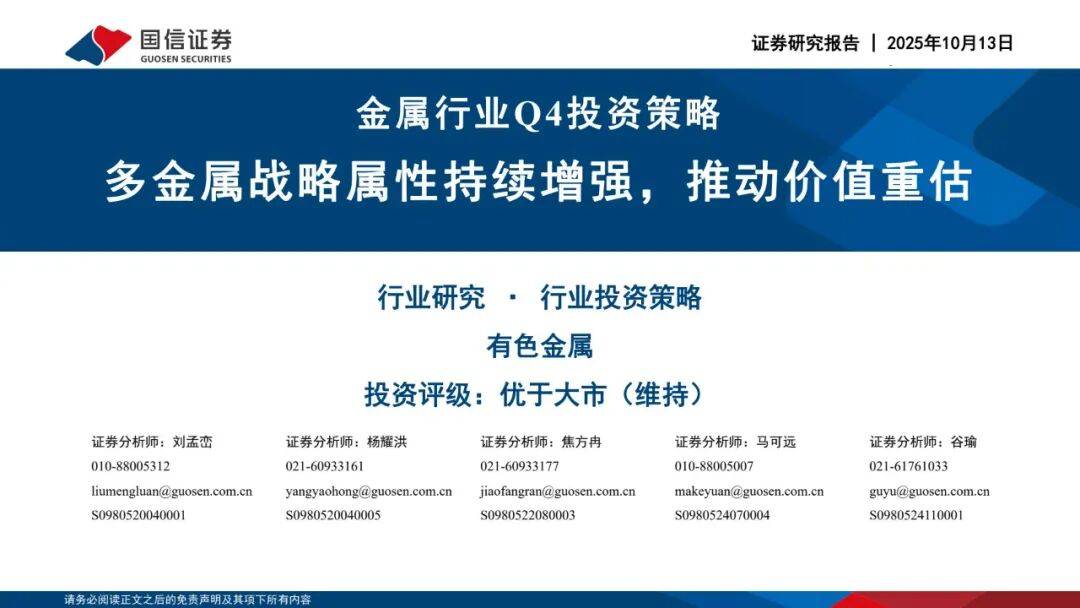
国信金属 | 金属行业Q4投资策略:多金属战略属性持续增强,推动价值重估
Sou Hu Cai Jing· 2025-10-13 14:57
Group 1: Industrial Metals - The copper market is experiencing upward price movement due to large copper mine production cuts, with the current phase being a Federal Reserve rate cut cycle. The supply disruptions in industrial metals are expected to lead to stable price increases, enhancing profits for listed companies in the industry. However, a rapid increase in copper prices may suppress downstream demand, leading to inventory accumulation during peak seasons, which is a signal of potential price peaks. Continuous monitoring of inventory changes is necessary [1][14][30] - The aluminum market is approaching a production peak in China, while foreign construction progress is slow. The next two years are expected to see peak production for China's electrolytic aluminum. The domestic aluminum supply-demand balance is fragile, and any increase in demand or supply disruptions could lead to shortages [1][32][38] Group 2: Precious Metals - Gold prices have reached new highs, driven by signals from Federal Reserve Chairman Powell's speech at the Jackson Hole global central bank conference, indicating rising employment risks and slowing GDP growth. The Fed's recent rate cut aligns with market expectations, and further cuts are anticipated. Global central banks are continuously increasing their gold reserves, suggesting a potential upward trend in gold prices through 2025 [3][11] Group 3: Energy Metals - The implementation of a quota system in the Democratic Republic of Congo is expected to create a significant shortage in the global cobalt market over the next two years, leading to a long-term price increase. The lithium market is currently in a state of relative balance, with supply disruptions not fully resolved but demand expectations rising [4][5][12] Group 4: Minor Metals - The strategic importance of minor metals is increasing, with export controls on rare earths tightening. The price of rare earth minerals has seen significant increases, with prices for certain products rising by 37% quarter-on-quarter. Tungsten prices are also expected to rise due to increased demand and supply constraints [6][13][15] Group 5: Tin - Global visible tin inventories have significantly decreased, with a peak of 22,763 tons in May 2024, followed by a reduction to below 9,000 tons by the end of 2022. This trend indicates a tightening supply situation in the tin market [2][41][52]

周期焦点直击 寻找黄金之外的“核心资产”
2025-10-13 14:56
Summary of Key Points from Conference Call Records Industry Overview - The focus is on the gold market and the broader context of precious and base metals, particularly in light of geopolitical tensions and economic conditions [1][2][4] Core Insights and Arguments - **Gold Market Dynamics**: - Gold has seen a significant price increase, nearly 10% in a week, driven by declining trust in government currencies and rising geopolitical tensions [2] - The price of gold is expected to stabilize after geopolitical tensions ease, but it remains a crucial asset in the precious metals sector [1][7] - The gold-to-silver ratio is currently around 80, expected to correct to below 60 as economic conditions stabilize [2][11] - **Base Metals Outlook**: - The outlook for base metals, particularly copper and aluminum, is optimistic due to supply disruptions from natural disasters and geopolitical events [1][8] - Copper is anticipated to remain in a supply shortage throughout the next year, driven by natural factors affecting production [9][10] - Electrolytic aluminum is highlighted as a strong investment opportunity due to its low valuation and cyclical nature [9] - **Impact of U.S.-China Trade Relations**: - Recent escalations in U.S.-China trade tensions have introduced market uncertainties but also present investment opportunities in scarce assets like base metals and renewable energy [5][6] - The potential for negotiations between the two nations may alleviate current tensions, impacting market dynamics positively [6] - **Phosphate Market**: - Phosphate prices have rebounded to near 2022 highs, driven by demand in agriculture and the renewable energy sector, particularly lithium iron phosphate [2][17] - A global supply gap of 4% is noted due to surging demand from China's renewable energy sector [18] Additional Important Insights - **Investment Strategies**: - Investors are advised to focus on base metals and renewable energy assets as key areas for potential growth amidst current market volatility [4][5] - The steel sector is suggested as a defensive strategy due to expected production declines [2][11] - **Geopolitical Factors**: - The rise of right-wing politics and global political polarization is contributing to a decline in trust in fiat currencies, further driving demand for safe-haven assets like gold and base metals [1][2] - **Market Valuation**: - Base metals are currently valued at historical lows compared to gold, indicating potential for price increases [8] - **Future Projections**: - The copper market is expected to see price increases in the upcoming quarters, driven by ongoing supply constraints and rising demand from new economic sectors [10] This summary encapsulates the critical insights and projections from the conference call, focusing on the gold and base metals markets, the implications of geopolitical tensions, and strategic investment opportunities.
中美博弈或升温,关注避险需求与战略小金属
East Money Securities· 2025-10-13 12:30
Investment Rating - The report maintains an "Outperform" rating for the industry [2][9]. Core Insights - The report highlights the increasing geopolitical tensions between China and the U.S., which may elevate demand for safe-haven assets like gold and strategic metals such as rare earths and tungsten [5][9]. - The copper market is experiencing supply disruptions, with prices trending upward due to tight supply conditions [5]. - Aluminum demand is expected to continue, with potential opportunities for investment following market corrections [5]. - The strategic importance of rare earths and tungsten is emphasized due to recent export controls and geopolitical developments [5][9]. Summary by Sections Copper Sector - Supply disruptions are ongoing, with LME copper prices at $10,735 per ton, reflecting a week-on-week increase of 1.9% [5]. - The processing fee for imported copper concentrate is negative, indicating tight supply [5]. - Companies with rich copper reserves are recommended for investment [9]. Aluminum Sector - LME aluminum prices reached $2,800 per ton, up 3.6% week-on-week [5]. - The operating rate for aluminum processing enterprises has slightly decreased, but demand is expected to remain stable [5]. - Investment opportunities are suggested for companies in the aluminum sector following market corrections [9]. Gold Sector - Gold prices are rising, with SHFE gold at 901.6 RMB per gram, up 3.1% week-on-week [5]. - The report suggests that geopolitical tensions may enhance gold's strategic position as a safe-haven asset [5]. - Investment in gold-related companies is recommended due to their undervalued resource potential [9]. Rare Metals Sector - Rare earth prices remain stable, with praseodymium-neodymium oxide at 683,000 RMB per ton [5]. - Recent export controls on rare earths have heightened their strategic importance amid U.S.-China tensions [5][9]. - Investment opportunities are highlighted in companies involved in rare earth production [9]. Steel Sector - Steel prices are stable, with SHFE rebar at 3,103 RMB per ton, reflecting a week-on-week increase of 1.0% [6]. - The report notes frequent disruptions in iron ore supply negotiations, which may impact future prices [6]. - Companies with high self-sufficiency in iron ore are recommended for investment [9].




实际利率下行趋势叠加海外财政与关税压力推升避险情绪,贵金属续创新高
Soochow Securities· 2025-10-13 06:42
Investment Rating - The report maintains an "Overweight" rating for the non-ferrous metals sector [1]. Core Views - The non-ferrous metals sector experienced a 4.44% increase in the week from October 3 to October 10, ranking first among all primary industries. The industrial metals segment rose by 5.35%, while precious metals also saw significant gains [1][15]. - The report highlights that the ongoing decline in real interest rates, coupled with overseas fiscal and tariff pressures, has heightened risk aversion, leading to new highs in precious metals [1][48]. Summary by Sections Market Review - The Shanghai Composite Index rose by 0.37%, with the non-ferrous metals sector outperforming by 4.08 percentage points [15]. - The industrial metals sector saw a 5.35% increase, while precious metals rose by 4.00% [15]. Industrial Metals - **Copper**: As of October 10, LME copper closed at $10,374 per ton, down 3.05% week-on-week, while SHFE copper rose to ¥85,910 per ton, up 3.37% [2][31]. Supply issues persist, with Freeport indicating a reduction of approximately 470,000 tons due to an incident at Grasberg [2][31]. - **Aluminum**: LME aluminum closed at $2,746 per ton, up 1.63%, and SHFE aluminum at ¥20,980 per ton, up 1.45% [3][35]. Social inventory increased by 7.71% to 642,500 tons, indicating potential short-term pressure on prices [3][37]. - **Zinc**: LME zinc closed at $2,985 per ton, down 1.52%, while SHFE zinc rose to ¥22,270 per ton, up 2.04% [39]. Inventory levels fluctuated, with LME inventory decreasing by 4.65% [39]. - **Tin**: LME tin closed at $35,350 per ton, down 4.85%, while SHFE tin rose to ¥286,350 per ton, up 4.10% [45]. Supply constraints from Indonesia are tightening the market [45]. Precious Metals - **Gold**: COMEX gold closed at $4,035.50 per ounce, up 3.15%, and SHFE gold at ¥901.56 per gram, up 5.48% [4][48]. The report notes that the downtrend in real interest rates and ongoing fiscal pressures are beneficial for gold prices [4][48]. Economic Context - The report discusses the impact of U.S. economic data and the Federal Reserve's consensus on interest rate cuts, which are expected to further influence the metals market [26][48]. The potential for renewed tariffs on Chinese imports adds uncertainty to the market dynamics [4][49].
有色金属行业周报:风险资产大跌,避险情绪将推升贵金属价格-20251013
Huaxin Securities· 2025-10-13 06:33
Investment Ratings - The report maintains a "Buy" investment rating for the gold industry, copper industry, aluminum industry, tin industry, and antimony industry [12]. Core Views - The report indicates that the decline in risk assets and the resulting increase in risk aversion will drive up precious metal prices, particularly gold and silver [4][5]. - The Federal Reserve's recent decision to lower interest rates is expected to support the upward trend in gold prices [5]. - Supply disruptions in copper mining are anticipated to strengthen copper prices as the peak demand season approaches [6][8]. - The aluminum market is expected to experience tight supply conditions, although demand recovery post-holiday is still uncertain [9]. - Tin prices are supported by tightening supply due to issues in refining and mining operations [10]. - Antimony prices are expected to remain weak in the short term due to weak demand, but long-term supply constraints may support prices [12]. Summary by Sections Precious Metals - Gold prices increased to $3974.50 per ounce, up by $88.80 from October 3, reflecting a 2.29% rise. Silver prices rose to $50.76 per ounce, up by $3.16, a 6.63% increase [4][32]. - The SPDR Gold ETF holdings increased by 70,000 ounces to 32.7 million ounces, while SLV Silver ETF holdings rose by 11.35 million ounces to 497 million ounces [32]. Copper - LME copper closed at $10,765 per ton, up by $200 from October 3, a 1.89% increase. SHFE copper closed at 85,900 yuan per ton, up by 2,550 yuan, a 3.06% increase [6]. - Supply disruptions from major mines are expected to support copper prices, with Freeport-McMoran and Teck Resources reducing their production forecasts significantly [8]. Aluminum - Domestic aluminum prices reached 21,020 yuan per ton, up by 290 yuan. LME aluminum inventory decreased to 508,825 tons [9]. - The report notes that while supply remains rigid, demand recovery is still weak, leading to potential inventory accumulation [9]. Tin - Domestic refined tin prices rose to 288,830 yuan per ton, an increase of 10,370 yuan, or 5.16% [10]. - Supply issues are exacerbated by slow recovery in mining operations, particularly in Myanmar and Indonesia [10]. Antimony - Antimony prices fell to 167,500 yuan per ton, down by 1,000 yuan, reflecting a 0.59% decrease. The report highlights weak demand and ongoing supply issues [11].




煤炭行业周报:港口煤价淡季反弹,Q4旺季行情可期-20251013
East Money Securities· 2025-10-13 05:09
Investment Rating - The report maintains an "Outperform" rating for the coal industry, indicating a positive outlook compared to the broader market [2][14]. Core Insights - The coal prices have shown a seasonal rebound, with expectations for a favorable market in Q4 due to increased demand and supply constraints [7]. - The report highlights the impact of "anti-involution" policies and stricter safety regulations on coal supply, which are expected to support price stability and potential increases [7][9]. - The overall sentiment is that coal prices are likely to rise in the upcoming winter season, driven by demand recovery and macroeconomic policies [7][9]. Summary by Sections Market Performance - As of October 11, the Qinhuangdao coal price was 706 RMB/ton, reflecting a year-on-year decrease of 154 RMB/ton, but a slight week-on-week increase of 0.7% [7]. - The average daily coal consumption in power plants across 25 provinces was 5.12 million tons, showing a year-on-year increase of 0.3% [7]. Supply and Demand Dynamics - The report notes that coal supply is expected to remain tight due to "anti-involution" effects and safety inspections, which may limit new supply [7]. - The inventory levels at northern ports were reported at 17.47 million tons, an increase compared to the same period last year [7]. Recommendations - The report suggests focusing on coal stocks that are likely to benefit from the current market conditions, including companies like Lu'an Huanneng, Pingmei Shenma, and Shanxi Coking Coal [9]. - It also highlights the potential for growth in companies like Shenhuo Co. and Electric Power Investment Energy, which are expected to see performance improvements [9].
有色金属行业报告(2025.09.30-2025.10.11):关税风云再起,看好有色金属增配机会
China Post Securities· 2025-10-13 03:08
Investment Rating - The industry investment rating is "Outperform the Market" and is maintained [2] Core Views - The report highlights the potential for price increases in copper due to supply disruptions and tariff impacts, suggesting that recent price pullbacks may present good buying opportunities [6] - The report emphasizes the strong performance of precious metals, particularly gold, amid renewed tariff concerns between China and the US, recommending an increased allocation to gold [5] - The report notes significant price increases in cobalt intermediate products, forecasting continued price growth in 2026-2027 due to supply-demand imbalances [7] - The report discusses the tightening supply of rare earths due to new export controls, which may lead to price increases in the domestic market [7] Summary by Sections Industry Overview - The closing index for the industry is at 7554.83, with a 52-week high of 7783.14 and a low of 4280.14 [2] Price Movements - Basic metals saw price increases: LME copper rose by 0.76%, aluminum by 2.20%, zinc by 0.95%, and lead by 1.44%. Precious metals also saw gains, with COMEX gold up by 3.80% and silver by 1.44% [21] Inventory Changes - Global visible inventory changes included an increase of 14,579 tons in copper, a decrease of 4,602 tons in aluminum, and an increase of 17,175 tons in lead [30]

美关税威胁再起,流动性冲击下铜铝价格回落 | 投研报告
Zhong Guo Neng Yuan Wang· 2025-10-13 02:07
Group 1: Copper Market - The threat of US tariffs has resurfaced, causing a liquidity shock that led to a decline in copper prices, but the long-term upward trend remains intact [2][3] - Recent disturbances in the supply of copper from the world's second-largest copper mine and expectations of US Federal Reserve rate cuts previously pushed LME copper prices to $11,000 per ton and Shanghai copper prices to over ¥88,000 per ton [2][3] - On November 1, 2025, the US will impose an additional 100% tariff on all goods imported from China, which has heightened market risk aversion and led to significant liquidation of long positions, resulting in a 4.5% drop in both Shanghai and LME copper prices [2][3] Group 2: Aluminum Market - The aluminum market is also experiencing a decline due to the renewed threat of US tariffs and liquidity shocks [3] - The price of alumina has decreased by 0.68% to ¥2,930 per ton, while the main futures contract for alumina fell by 4.62% to ¥2,806 per ton [3] - Domestic electrolytic aluminum inventory has increased by 10.15% to 651,000 tons, but the demand season is expected to lead to a destocking cycle, with potential price recovery once liquidity shocks ease [3] Group 3: Lithium Market - Lithium prices are expected to rebound from the bottom as demand enters a destocking cycle during the peak season [4][5] - The price of lithium carbonate remains stable at ¥73,600 per ton, while lithium spodumene has decreased by 2.21% to $839 per ton [4][5] - The production of lithium carbonate has increased by 0.6% to 20,600 tons, and inventory has decreased by 1.5% to 134,800 tons [4][5] Group 4: Cobalt Market - The Democratic Republic of the Congo (DRC) will implement a cobalt export quota system, which is expected to accelerate price increases [6] - The price of cobalt has risen by 4.19% to $19.90 per pound, and domestic cobalt prices have increased by 2.87% to ¥359,000 per ton [6] - The DRC's cobalt export quota for the period from October 16, 2025, to December 31, 2025, is set at 18,100 tons, which is expected to significantly narrow the surplus and potentially lead to a shortage [6]