零跑汽车

Search documents
头部做大、腰部塌陷,但中国车市仍难迎寡头时代
Xin Lang Cai Jing· 2025-12-31 10:11
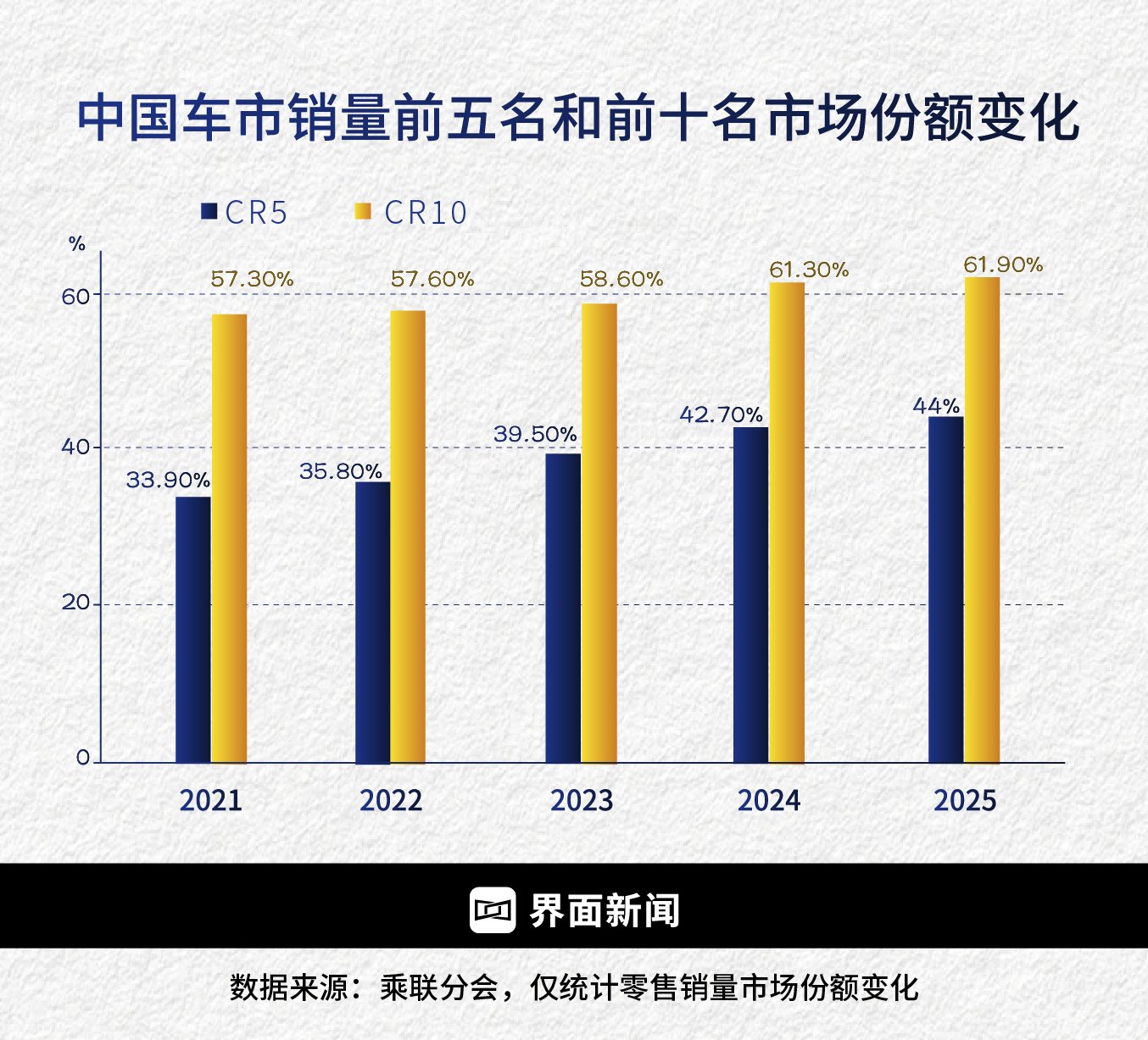
Group 1 - The Chinese passenger car market is undergoing a significant structural transformation, with overall growth slowing and market concentration increasing, leading to a clear advantage for leading companies in terms of sales and resources, while traditional mid-tier brands face severe survival pressures [1] - The market share of the top five automotive companies increased from 33.9% in 2021 to 44% by 2025, while the top ten's market share rose from 57.3% to 61.9%, indicating a shift from multi-brand competition to dominance by a few enterprises [1] - Geely Auto Group has shown the most significant market share growth among leading companies, increasing by approximately 3.5 percentage points compared to 2024, driven by the sales growth of new energy vehicles supported by government subsidies [3] Group 2 - BYD's market share has slightly declined this year but remains close to 15%, attributed to its vertically integrated supply chain that maintains product price advantages and a strong product offensive that ensures the launch of popular models across different market segments [4] - The strategy of using a shared platform for multiple models allows companies to reduce trial and error costs while maximizing market returns, enhancing the marginal returns on R&D investments [4] - Leading automotive companies are strengthening their scale advantages and cost efficiency through internal integration, as the focus shifts from technological leadership to cost competition in a market characterized by product homogeneity and slow technological iteration [7] Group 3 - The rapid collapse of mid-tier companies is evident, particularly in the second-tier joint venture brands, with significant sales declines reported for Dongfeng Nissan and GAC Honda from 2022 to 2024 [8] - New car-making forces like Li Auto, NIO, XPeng, and others are filling the gap left by traditional mid-tier brands, with their sales surpassing those of GAC Honda and Dongfeng Honda, entering the top 20 in annual sales rankings [8] - For mid-tier enterprises to survive, joint venture brands must develop products tailored to the Chinese market rather than simply importing overseas models, while new car-making forces need to achieve profitability and build operational capabilities to support large-scale production [9] Group 4 - The ongoing consolidation efforts among major automotive companies, such as the proposed merger between Changan and Dongfeng, highlight the complexities and challenges of achieving clear leadership in the market due to administrative disparities and high integration difficulties [10] - The current market dynamics suggest that while some foreign brands may exit, the overall number of participants may not significantly decrease, and the competition remains complex and ongoing [10] - The impressive sales figures of leading companies may be viewed as short-term responses to capital market pressures rather than indicators of long-term stability and profitability [10] Group 5 - The absolute dominance of leading companies, the elimination of mid-tier players, and the clearing out of lower-tier brands indicate that the market structure is still maturing, with the final outcome of the competitive landscape in the Chinese automotive market still unfolding [14]

智能汽车产业深度研究:L3车型产品准入,智能汽车发展加速
Shanghai Aijian Securities· 2025-12-31 09:58
Investment Rating - The report rates the automotive industry as "Outperform" [2] Core Insights - The Ministry of Industry and Information Technology approved two models with L3 conditional autonomous driving capabilities, marking the transition of L3 autonomous driving from testing to commercial application in China [2] - The penetration rate of electric vehicles is expected to exceed 50%, with smart technology becoming a survival necessity for automakers. By 2030, smart vehicle sales in China are projected to exceed 30 million units [2][6] - The evolution of high-level autonomous driving technology is expected to accelerate, with significant breakthroughs anticipated in L4/L5 levels around 2027-2028 [2][13] Summary by Sections 1. Automotive Intelligence Transition - Automotive intelligence is moving from an introduction phase to a growth phase, transforming vehicles from traditional fuel-powered tools to AI-driven mobile terminals [6] - The penetration rate of electric vehicles in China is expected to rise from 50% to 80% between 2025 and 2030, with smart technology becoming essential for leading automakers [6] 2. High-Level Autonomous Driving as a Key Technology - High-level autonomous driving (L3-L5) is the main technological development line, with L2+ functionalities becoming widespread and L3 commercial trials beginning [7] - The report highlights the challenges faced in the development of high-level autonomous driving, including regulatory improvements and user acceptance [7] 3. Automotive Industry Chain Overview - The automotive industry chain consists of upstream suppliers providing core components, midstream solution providers integrating systems, and OEM manufacturers responsible for final vehicle performance [22] 4. Upstream Components: Computing Power as a Foundation - Domain controllers are crucial for the evolution of automotive electronic architectures, transitioning from distributed to centralized systems [30] - The demand for high computing power in autonomous driving and cockpit systems is increasing, with SoC chips becoming essential [51] 5. Midstream Vehicle Manufacturing: New Players Leading the Charge - New entrants in the automotive market are leveraging smart technology to gain competitive advantages, with a focus on high-end models priced above 200,000 yuan [2] 6. Downstream Operations: Emergence of New Business Models - The shift towards smart mobility is driving the development of new business models like Robotaxi, with expectations of over 30% penetration in the smart mobility market by 2030 [2][4] 7. Investment Recommendations - The report suggests focusing on leading automakers with full-stack self-research capabilities and component suppliers with technological advantages in high-growth segments [2]



2025年销量破纪录已成定局,鸿蒙智行迎来“狂飙”时刻
Xin Lang Cai Jing· 2025-12-31 09:31
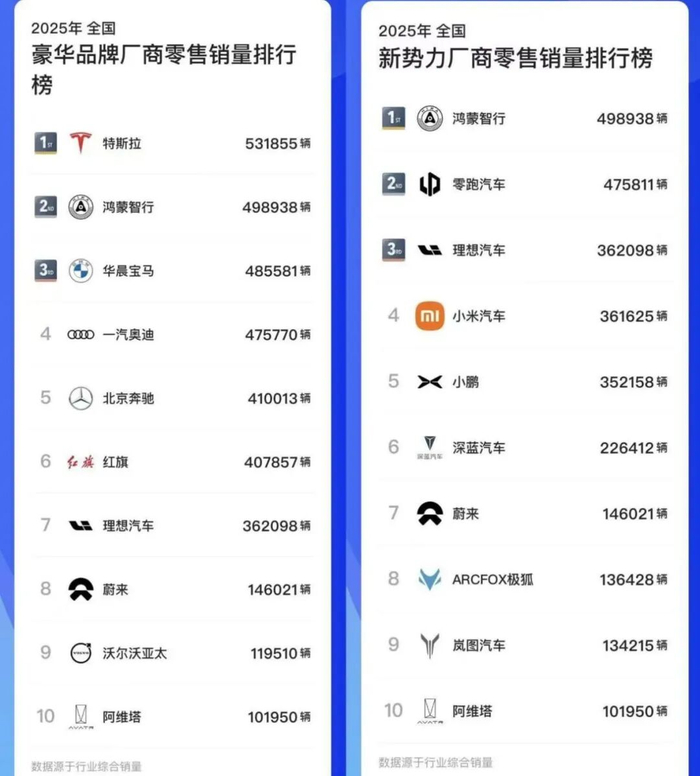
Core Insights - The Chinese automotive market is experiencing a significant shift, with the penetration rate of new energy vehicles (NEVs) surpassing 50% for the first time, leading to a decline in traditional fuel vehicles and a reshaping of the industry landscape [1] - In the luxury car segment, NEV manufacturers like Tesla and Hongmeng Zhixing are dominating sales, while traditional luxury brands are losing ground [3][4] - Hongmeng Zhixing has achieved remarkable sales growth, with November 2025 deliveries reaching 81,864 units, marking a 16.54% month-on-month increase and an 89.61% year-on-year surge [7][9] - The brand's strategic focus on high-end markets and innovative technology has positioned it as a leader in the competitive landscape of NEVs [11][12] Industry Trends - The overall automotive market in China is facing a downturn, with November 2025 retail sales dropping by 8.1% year-on-year and December showing a further decline of 19% [4][7] - Despite the market contraction, Hongmeng Zhixing's sales trajectory remains upward, indicating a strong consumer preference for its offerings [9][11] - The brand's success is attributed to its high-end positioning and the integration of advanced technologies, which resonate with changing consumer preferences [12][20] Competitive Landscape - Hongmeng Zhixing has disrupted the traditional luxury car market, emerging as a phenomenon in the smart vehicle sector [4][11] - The brand's diverse product lineup, including models like the Aito M9 and the Zun Jie S800, caters to various market segments, solidifying its competitive edge [9][14] - The collaboration with Huawei enhances Hongmeng Zhixing's technological capabilities, ensuring a superior user experience and robust product quality [15][20] Future Outlook - The brand is poised for continued growth, with projections indicating a potential sales target of one million units in 2026, supported by a comprehensive product matrix and strategic partnerships [17][19] - Hongmeng Zhixing aims to redefine the high-end automotive market in China, leveraging its technological advancements and ecosystem to challenge foreign brands [21]
错过最佳时机 一汽投资零跑多花了15倍
Zhong Guo Jing Ji Wang· 2025-12-31 09:17
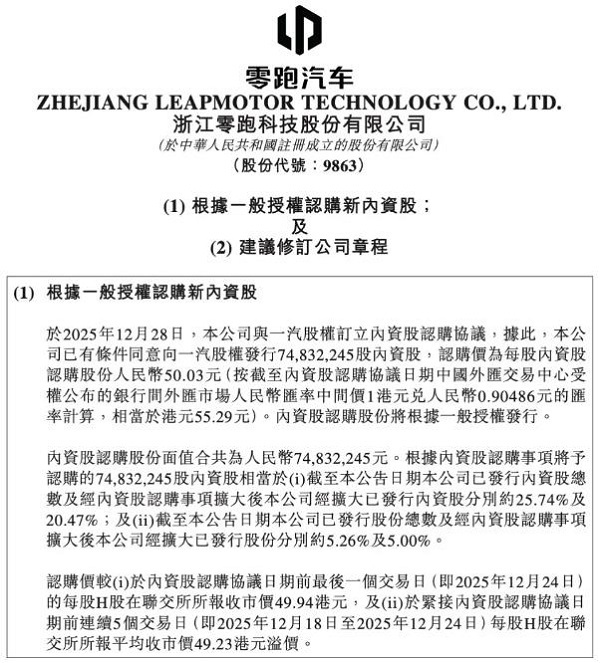
Core Viewpoint - Leap Motor has entered into a domestic share subscription agreement with FAW Group, raising approximately 3.744 billion RMB by issuing 74.8322 million shares at 50.03 RMB per share, making FAW a significant strategic shareholder with a 5% stake in the expanded total shares of 1.497 billion [1][8]. Group 1 - Leap Motor's founder, Zhu Jiangming, emphasized the importance of maintaining control over the company during a media communication session, despite the new investment from FAW and Stellantis [5][10]. - The company has experienced a tumultuous journey over the past decade, including a significant drop in share price upon its Hong Kong debut, but has since achieved a monthly sales record of 70,000 vehicles [7][15]. - The recent investment from FAW is seen as a recognition from a state-owned enterprise, which could enhance Leap Motor's brand credibility and market presence in China [14]. Group 2 - Following the subscription, Stellantis's stake will decrease to 18.99%, while the founding team will still hold the largest single shareholder group at 22.56% [8][9]. - Leap Motor's strategy focuses on stability, with significant investments from established automotive giants, which is expected to strengthen its market position and operational efficiency [14][17]. - The company plans to allocate 50% of the funds raised from the FAW investment towards research and development, ensuring ongoing innovation and sustainability [17].
12款新车展望2026:中国汽车市场开启“耐力赛” | 界面预言家⑧
Xin Lang Cai Jing· 2025-12-31 09:15
Group 1 - The automotive market is transitioning from a high-intensity "sprint" to a "marathon" mode by 2026, with electric vehicle (EV) growth slowing and consumers becoming more cautious about value and reliability [1] - Consumers are increasingly embracing hybrid and plug-in hybrid vehicles as a "bridge solution" to reduce range anxiety and stabilize purchasing decisions [1] - The supply side is experiencing compressed model development cycles, with a shift towards rapid iteration similar to the Chinese model, making "annual updates" and "mid-cycle facelifts" essential [1] Group 2 - The focus for 2026 is shifting towards addressing "problems" rather than just introducing "new cars," including questions about brand coherence and the ability to maintain consumer trust [2] - The success of the SU7 indicates that a clear product positioning and ongoing conversation can mitigate the disadvantages of late market entry, but the YU9 faces a crowded high-end SUV segment [3][7] Group 3 - The YU9 is expected to target the family flagship market with a three-row layout and reduced range anxiety, but it must adapt its sporty narrative to emphasize comfort and long-distance experience [7] - The Z model from Tengshi aims to rebrand the company by packaging its technological capabilities into a more appealing product narrative, enhancing its market presence [35] Group 4 - The iX3 from BMW is positioned to address how joint venture electric vehicles can differentiate themselves in the Chinese market, focusing on comfort and local adaptations while retaining driving characteristics [47][49] - The second-generation Roadster from Tesla, delayed for nearly nine years, needs to redefine its narrative to maintain its market allure amidst increasing competition in the high-performance electric vehicle segment [51][54] Group 5 - The introduction of large GT and convertible models by Genesis is seen as a brand investment rather than a sales strategy, aiming to elevate brand perception and value in the luxury market [56][59]



汽车及汽车零部件行业研究:汽车行业2026 年投资策略:智能提速、格局再塑与全球化持续
SINOLINK SECURITIES· 2025-12-31 09:10
Investment Rating - The report maintains a positive outlook on the automotive industry, particularly focusing on globalization, intelligence, and high-end market opportunities [5]. Core Insights - The automotive industry is experiencing intensified competition in the domestic market while witnessing significant growth in new energy vehicle (NEV) exports [2][3]. - The overall vehicle sales are projected to remain stable in 2026, with a notable increase in NEV sales driven by favorable policies and consumer demand [4][5]. - The report emphasizes the importance of high-end vehicles and intelligent driving technologies as key growth areas for automotive companies [5][14]. Summary by Sections 1. 2025 Review: Intensified Domestic Competition, High Growth in NEV Exports - Total vehicle sales in China for January to November 2025 reached 20.45 million units, a year-on-year increase of 2.0% in retail and 11.2% in wholesale [2]. - Domestic sales showed slight growth, heavily influenced by policy changes, while exports surged, particularly in the NEV segment, which saw a 19% increase year-on-year [2][19]. - The NEV penetration rate reached 40.8% in exports, with significant contributions from plug-in hybrid vehicles [19]. 2. 2026 Outlook: Stability Expected, Acceleration in Globalization and Intelligence - Retail sales of passenger vehicles are expected to reach 22.03 million units in 2026, with NEVs projected to grow by 12% year-on-year [3][4]. - The high-end vehicle segment is anticipated to perform better due to a shift in consumer preferences and the increasing market share of domestic brands [4]. - NEV exports are expected to reach 6.73 million units, with a 34% increase in NEV exports alone, driven by improved product quality and market maturity [4]. 3. Investment Strategy: Favorable Opportunities in Globalization, Intelligence, and High-End Markets - The report highlights the potential for automotive companies that excel in international markets, high-end product offerings, and advanced intelligent driving technologies [5][13]. - Companies like BYD, Geely, and Li Auto are identified as key players likely to benefit from these trends due to their strong export capabilities and innovative products [5][13]. - The report also emphasizes the importance of the AI driving sector, predicting that leading companies will leverage their technological advancements to gain competitive advantages [14][15].
中国智驾淘汰赛:赢者突围、尾部退场,终局未定
Xin Lang Cai Jing· 2025-12-31 08:51
Core Insights - The Chinese intelligent driving industry is experiencing both expansion and contraction, with rapid adoption of assisted driving features in mass-produced vehicles, while financing for some companies is slowing down, leading to exits from mainstream competition [1][2] - The competition in the intelligent driving sector has shifted towards large-scale delivery, cost efficiency, and long-term service capabilities, with opportunities concentrating on a few companies that can prove their value [2][4] - The industry is entering a mature phase, as evidenced by significant orders from conservative automakers like Toyota, indicating a shift from vague to definite market demand [5][6] Industry Dynamics - The competition is no longer about validating technology but about scaling delivery and maintaining cost efficiency, with survival becoming a pressing issue for mid-tier companies [2][4] - The leading companies in the assisted driving sector include Horizon, ZhiYu, Huawei, and Momenta, which have successfully transitioned from technology validation to large-scale delivery [4][5] - The gap between leading companies and newcomers is estimated to be 3 to 5 years, primarily due to data accumulation advantages and algorithm iteration capabilities [4][5] Market Trends - The assisted driving market is seeing a push towards lower-cost models, with major players like Horizon and Momenta targeting vehicles priced under 100,000 yuan, which account for nearly half of China's passenger car sales [8][9] - The competition is intensifying around cost control, as companies strive to keep the cost of assisted driving features within 3% to 5% of the vehicle's price to ensure market acceptance [9][10] - The trend towards self-developed chips is debated, with some companies believing it can lead to differentiation and lower system costs, while others see it as economically challenging [10][11] Competitive Landscape - The intelligent driving sector is unlikely to see a "winner-takes-all" scenario until the L4 or L5 stages of automation, as the current market remains fragmented with multiple strong players [8][11] - Companies that can continuously iterate, validate their solutions through mass production, and respond to market demands will be the ones to secure future growth [11] - The supply chain strategies of automakers suggest that the assisted driving market will not favor a single dominant player, as diverse needs for customization and differentiation persist [7][8]


【快讯】每日快讯(2025年12月31日)
乘联分会· 2025-12-31 08:39
Domestic News - The National Development and Reform Commission and the Ministry of Finance announced a policy to support the scrapping and replacement of vehicles in 2026, offering subsidies of 12% (up to 20,000 yuan) for new energy vehicles and 10% (up to 15,000 yuan) for fuel vehicles with an engine size of 2.0 liters or less [3] - Four departments issued the "Automobile Industry Digital Transformation Implementation Plan," aiming for significant improvements in manufacturing capabilities and digitalization by 2027, including a 10% increase in labor productivity and a 20% reduction in product development and delivery cycles [4] - The National Energy Administration reported that as of November, there are 7.05 million charging facilities built in highway service areas across the country, contributing to a total of 19.32 million charging facilities nationwide [5] - Xiaopeng Motors' chairman stated that the next generation of fully autonomous driving will arrive in 2026, transitioning from L2 to L4 capabilities [6] - Leap Motor announced four service commitments, including free roadside assistance during holidays and clear visibility of maintenance costs through their app [7] - Tesla's global production reached 9 million electric vehicles, with the latest unit being a Model Y produced at the Shanghai Gigafactory [8] - Firefly officially launched in Austria, marking rapid expansion in Europe since its initial release [9] - CATL's "Chocolate" battery swap station network reached its 1,000th station, with plans to expand to over 3,000 stations by 2026 [10] Commercial Vehicles - Weichai's new energy commercial vehicles received a 36-month COP certification in Vietnam, marking a significant step in compliance for the market [16] - Foton Motor announced the mass production of its "Star" series electric light trucks, with a projected output of 32,000 units in 2025 [17] - The 2026 national subsidy policy will prioritize support for the replacement of old commercial vehicles with electric ones [18] - Zhuoyue Technology has initiated a heavy-duty truck NOA project, with the first models expected to be produced in the first half of 2026 [20]

调研速递|万安科技接待山西证券等7家机构 无线充电效能超92% EMB产品2026年将量产
Xin Lang Cai Jing· 2025-12-31 08:20
Core Insights - The company, Wan'an Technology, and its parent company, Wan'an Group, engaged in a specific investor survey to discuss key topics such as aluminum-magnesium alloy product layout, wireless charging project progress, convertible bond issuance plans, performance growth points, and cost control measures [1] Group 1: Business Layout and Project Progress - The aluminum-magnesium alloy business is focused on lightweight chassis components, primarily aluminum alloy products, which are crucial for the new energy vehicle (NEV) sector, with key products like aluminum alloy subframes and fixed calipers already integrated into the supply chains of leading NEV manufacturers such as Leap Motor, NIO, and Xiaomi [2] - The wireless charging project by the subsidiary Yichuang Zhilian has achieved multi-scenario deployment, including passenger vehicles and low-speed unmanned vehicles, with a commercial progress in the low-speed unmanned vehicle sector and partnerships established with companies like Huzhou Columbus and Yingfeng Environment. The wireless charging efficiency in passenger vehicles reaches 92%-93%, leading the industry [3] - The company’s subsidiary Hengchuang Zhixing is set to start small-scale production of electronic mechanical brake systems (EMB) for passenger vehicles in 2026, following the implementation of new regulations. This product is expected to enhance safety and reduce weight, becoming a significant growth driver for the company [4] Group 2: Financial Planning and Cost Control - The company has successfully issued the first phase of convertible bonds and plans to initiate the second phase after the first phase's completion to optimize its capital structure and support business expansion [5] - To mitigate the impact of rising raw material costs, the company is implementing various cost control measures, including procurement cost reduction, product structure optimization, and price linkage mechanisms to ensure stable profitability [6] Group 3: Future Strategy - The company aims to focus on automotive electronic control systems as its core development direction, continuing to advance the marketization of aluminum alloy lightweight components and intelligent driving projects, leveraging existing customer resources and technological accumulation for steady growth [7]


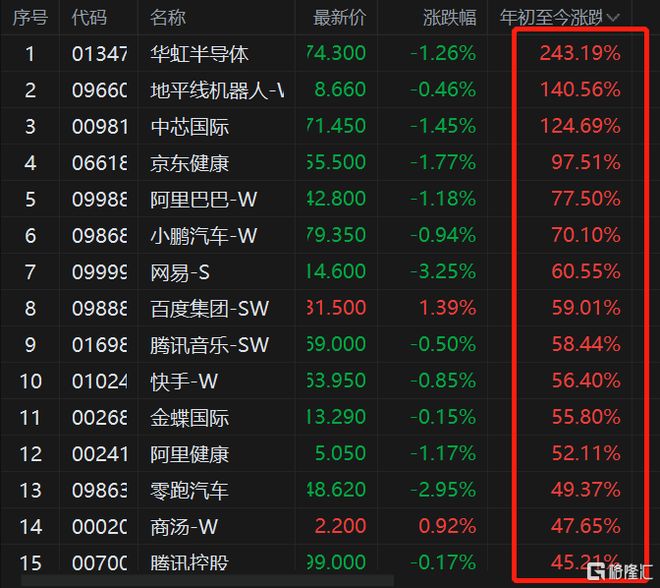
港股25年收官:科指全年累涨23.45%创历史最佳,成份股中芯国际大涨124.69%
Ge Long Hui· 2025-12-31 08:02
Core Viewpoint - The Hong Kong stock market's Hang Seng Technology Index achieved a remarkable annual increase of 23.45% in 2025, marking its best performance since 2020, with 22 out of 30 constituent stocks rising [1] Group 1: Stock Performance - Among the 30 constituent stocks, notable performers included Hua Hong Semiconductor, which surged by 243.19%, Horizon Robotics with a rise of 140.56%, and SMIC increasing by 124.69% [1] - Other significant gainers were JD Health at 97.51%, Alibaba-W at 77.50%, Xpeng Motors-W at 70.10%, Baidu Group-SW at 59.01%, and Tencent Music-SW at 58.44% [1][2] Group 2: Investment Preferences - The first tier of investment preference is in semiconductor manufacturing (Hua Hong, SMIC) and core AI chips (Horizon Robotics), reflecting a strong focus on hard technology and domestic substitution logic [1] - The second tier includes growth sectors such as smart electric vehicles (Xpeng, Li Auto), AI applications (Baidu, SenseTime), and digital health (JD Health), which benefit from industry trends but still face competitive and profitability uncertainties [1] - The third tier consists of value recovery in platform internet giants (Alibaba, Tencent) and mature applications (NetEase, Kuaishou, Tencent Music), with gains primarily driven by profit realization and value reassessment through dividends and buybacks, categorized as "high-quality mature assets" [1]