广义财政收支

Search documents
去年广义财政支出首次突破40万亿,今年支出如何扩大
第一财经· 2026-02-05 15:29
为了稳经济,中国首次在2025年实施更加积极财政政策,广义财政支出规模首次突破40万亿元。 根据财政部数据,2025年广义财政(全国一般公共预算和全国政府性基金预算)支出约为40.03万亿元,同比增长3.7%;广义财政收入约为27.38万 亿元,同比下降约2.9%;广义财政支出超过收入约12.65万亿元,同比增长21.3%。 粤开证券首席经济学家罗志恒告诉第一财经,去年面对收入端多重压力,财政政策通过提高赤字率与扩大债务规模,实施超常规逆周期调节,保持必要 支出强度,有力发挥了宏观政策的支撑作用,推动全年经济平稳运行。 2026.02. 05 本文字数:2644,阅读时长大约4分钟 作者 | 第一财经 陈益刊 去年底全国财政工作会议提出,今年继续实施更加积极的财政政策,包括扩大财政支出盘子,确保必要支出力度等,以推动今年经济实现质的有效提升 和量的合理增长。 罗志恒认为,2026年财政政策预计在现有基础上进一步加力提效,通过提升赤字规模、优化支出结构、创新政策工具等,以更强的政策力度推动经济稳 中向好并切实改善民生。 财政支出为何能保持力度 去年广义财政支出规模创新高,支出增速与名义经济增速相近,折射了财政支 ...


2025年12月财政数据点评
Ping An Securities· 2026-02-02 01:33
Revenue and Expenditure Trends - In 2025, public fiscal revenue decreased by 1.7% year-on-year, a drop of 2.5 percentage points compared to the previous month[1] - Public fiscal expenditure increased by 1.0% year-on-year, down 0.4 percentage points from the previous month[1] - The deficit utilization rate for the first account was 92.5%, which is 9.3 percentage points lower than the average of the past three years[1] Tax Revenue Performance - National tax revenue growth was 0.8%, a decline of 1.0 percentage points from the previous month[1] - Non-tax revenue fell by 11.3%, a decrease of 7.6 percentage points compared to the previous month, primarily due to a high base effect from last year[1] - Tax revenue growth ended an 8-month streak of positive growth, dropping 14.3 percentage points to -11.5% in December[1] Fiscal Spending Focus - Spending on science and technology decreased by 3.1 percentage points to 4.8% year-on-year, influenced by a high base from the previous year[1] - Expenditure in the livelihood sector grew by 4.5%, slightly down from the previous month but still outpacing overall fiscal expenditure growth[1] - Infrastructure spending saw a year-on-year decline of 6.6%, although it rebounded by 1.1 percentage points from the previous month[1] Government Fund Dynamics - Government fund revenue decreased by 7.0% year-on-year, while expenditure increased by 11.3%, both down from the previous month by 2.1 and 2.4 percentage points respectively[1] - In December, government fund revenue fell by 11.7%, while expenditure grew by 1.5%, narrowing the gap in growth rates[1] - Revenue from state land use rights dropped by 14.7%, with a slight improvement in the rate of decline compared to 2024[1] Overall Fiscal Outlook - The broad fiscal revenue growth rate was -2.9%, down 2.6 percentage points from the previous month[1] - Broad fiscal expenditure increased by 3.7%, a decrease of 0.8 percentage points from the previous month[1] - The focus of fiscal policy is shifting towards the 2026 "14th Five-Year Plan," with an emphasis on increased spending and coordinated fiscal-financial policies to stimulate domestic demand[1]
内外兼修-2026年宏观经济与资本市场展望
2025-12-29 01:04
Summary of Key Points from Conference Call Records Industry Overview - **Global Manufacturing and Export Trends**: The global manufacturing sector is expected to show an upward trend in 2026, which will support China's exports. The U.S. inventory cycle is entering a replenishment phase, and the Federal Reserve is anticipated to cut interest rates, which will further boost global industrial production and, consequently, Chinese exports [4][24]. Core Insights and Arguments - **Impact of U.S. Tariffs**: China has gained significant experience in mitigating the negative impacts of U.S. tariffs, leading to a stable export growth despite tariff increases. Future tariff impacts are expected to diminish further [5]. - **Outbound Capacity Strategy**: The current strategy for outbound capacity focuses on "Belt and Road" countries, aiming to find new demand growth points rather than indiscriminate expansion. This approach is expected to enhance brand penetration and positively impact domestic capital goods and intermediate goods exports [6]. - **Real Estate Market Adjustments**: The real estate sector has undergone significant adjustments since 2021, with a negative contribution to fixed asset investment. However, the rate of decline is expected to narrow, although falling property prices and deteriorating household balance sheets may suppress consumer spending [7][8]. - **Durable Goods Subsidy Policy**: The effectiveness of the durable goods subsidy policy is likely to weaken, with recent data showing a negative contribution due to high base effects. Long-term demand may be overstretched, leading to diminishing returns from such policies [10]. - **Consumer Spending Dynamics**: The adjustment in the real estate market affects consumer spending through reduced income and wealth effects. Data indicates a decline in residents' willingness to repay loans and an increase in savings, reflecting a drop in consumer confidence [9]. Additional Important Insights - **Fiscal Policy Challenges**: Broad fiscal revenues are under pressure, with local government debt risks increasing. Central government borrowing is seen as a necessary measure to counteract economic downturns and facilitate fiscal reforms [14][18]. - **Future Economic Growth Targets**: The average GDP growth target before 2035 is set at approximately 4.17%. Short-term adjustments to growth targets for 2026 may occur to alleviate growth constraints [2][19]. - **Investment Focus Areas**: Future investments should prioritize industrial investments over physical assets, with a focus on early-stage technology projects. The central bank is expected to maintain a moderately accommodative monetary policy, potentially involving rate cuts [23][24]. - **Service Sector Growth Potential**: There is significant potential for growth in service sectors such as education, healthcare, and elder care, which are expected to become key drivers of domestic demand in the coming years [12][24]. Conclusion - The overall outlook for 2026 indicates a supportive environment for exports and service consumption, with a focus on fiscal and monetary policy adjustments to stimulate economic growth. The emphasis on strategic investments and service sector development will be crucial for sustaining economic momentum in the face of existing challenges.
前11个月广义财政支出超收入近10万亿
Di Yi Cai Jing Zi Xun· 2025-12-26 02:31
Core Viewpoint - The article discusses the performance of China's broad fiscal revenue and expenditure in the first 11 months of the year, highlighting a slight decline in revenue but an increase in expenditure, reflecting a proactive fiscal policy aimed at stabilizing economic growth and expanding domestic demand [2][5]. Fiscal Revenue - In the first 11 months, broad fiscal revenue reached 24,079 billion yuan, showing a year-on-year decline of approximately 0.2% [2]. - The general public budget revenue increased by 0.8% compared to the same period last year, slightly better than the initial forecast of 0.1% [5]. - The decline in government fund revenue was 4.9%, significantly lower than the expected growth of 0.7%, primarily due to a 10.7% drop in local government land use rights transfer income [6]. Fiscal Expenditure - Broad fiscal expenditure amounted to 34,066 billion yuan, with a year-on-year increase of about 4.5%, aligning closely with the economic growth rate of around 5% [2][7]. - The expenditure growth rate was lower than the initial official forecast, which anticipated a 9.3% increase for the year [7]. - To maintain fiscal expenditure levels, the central government allowed local governments to issue an additional 500 billion yuan in bonds in the fourth quarter to support local financial capacity and major project construction [7]. Government Debt - Net financing from government bonds reached 1.315 trillion yuan in the first 11 months, an increase of 361 billion yuan year-on-year [8]. Fiscal Policy Focus - The fiscal expenditure structure has been optimized, with increased focus on social welfare and public services, such as a 1 billion yuan childcare subsidy [9]. - Experts predict that the fiscal deficit rate for 2026 may be set around 4%, with an expected increase in government debt issuance to support fiscal spending [9].

增量财政资金落地:9月财政数据点评
Shenwan Hongyuan Securities· 2025-10-18 12:11
Revenue and Expenditure Overview - In the first three quarters of 2025, the national general public budget revenue reached 163,876 billion yuan, a year-on-year increase of 0.5%[5] - National general public budget expenditure was 208,064 billion yuan, with a year-on-year growth of 3.1%[5] - By September 2025, the completion rate of general public budget revenue was 68.9%, slightly below the five-year average of 69.9%[6] Fiscal Trends - General fiscal revenue showed a year-on-year increase of 3.2% in September 2025, rebounding by 2.9 percentage points from August[6] - General fiscal expenditure in September 2025 grew by 2.3% year-on-year, a decline of 3.8 percentage points compared to August[6] - The issuance of new special bonds reached approximately 10.3 trillion yuan by September 28, 2025, with an issuance progress of 87%[8] Government Debt and Financing - The net financing of government bonds, including new general and special bonds, totaled 10.3 trillion yuan, which is 2.8 trillion yuan more than the previous year[8] - The issuance of new special bonds was 36,612 billion yuan, with an issuance progress of 83%, lagging behind the same period in 2024 by over 6 percentage points[8] - A new policy-oriented financial tool of 500 billion yuan was established by the end of September 2025, with over 100 billion yuan already allocated to sectors like digital economy and artificial intelligence by mid-October[11] Budget Completion and Spending - The completion rate for general fiscal expenditure in September 2025 was 9.7%, consistent with the five-year average[26] - Government fund expenditure continued to decline, with a year-on-year increase of only 0.4% in September 2025, down over 19 percentage points from August[34] - The completion rate for government fund income in September 2025 was 6.8%, higher than the 5.7% in 2024 but below the five-year average of 7.1%[18]
8月财政数据点评:财政支出趋弱,关注加码可能
Shenwan Hongyuan Securities· 2025-09-18 09:12
Group 1: Fiscal Data Overview - In the first eight months of 2025, national general public budget revenue reached 148,198 billion yuan, a year-on-year increase of 0.3%[1] - National general public budget expenditure was 179,324 billion yuan, showing a year-on-year growth of 3.1%[1] - The budget completion rate for general fiscal revenue was 61.9%, slightly below the five-year average of 62.7%[2] Group 2: Trends in Fiscal Income and Expenditure - General fiscal income growth has slowed, with a year-on-year increase of only 0.3% in August 2025, down 3.3 percentage points from July[4] - General fiscal expenditure growth also declined, with a year-on-year increase of 6% in August 2025, down 6.1 percentage points from July[4] - Government fund income fell significantly, with a year-on-year decrease of 5.7% in August 2025, contributing to the slowdown in general fiscal income growth[20] Group 3: Government Debt and Support Measures - The large-scale support phase from government debt financing is nearing its end, with net financing of government bonds and new special bonds totaling 8.5 trillion yuan by the end of August 2025[9] - The issuance progress of special bonds was 72%, nearly 4 percentage points faster than the same period in 2024[9] - Future fiscal support for the economy may weaken as the issuance of new government debt approaches its limit[3] Group 4: Economic Implications - The decline in fiscal support and the impact of external factors may lead to downward pressure on economic growth[3] - Retail growth for related products has slowed since June due to promotional activities and a "window period" for national subsidies[3] - The completion rate for general fiscal expenditure was 57.3%, slightly below the five-year average of 58.8%[2]
2025年1-8月财政数据解读:财政支出延续偏强态势,关注新型政策性金融工具
ZHESHANG SECURITIES· 2025-09-17 13:29
Fiscal Performance - In August 2025, the national general public budget revenue reached 12,359 billion CNY, a year-on-year increase of 2.0%[3] - The national general public budget expenditure in August was 18,587 billion CNY, showing a year-on-year growth of 0.8%[8] - From January to August 2025, the completion rate of the general public budget revenue was 47.8%, consistent with the same period in 2024[1] - The completion rate of general public budget expenditure was 57.3%, which is higher than the same period in 2024[1] Tax Revenue Insights - Tax revenue in August 2025 was 10,152 billion CNY, with a year-on-year increase of 3.4%[3] - Cumulative tax revenue from January to August 2025 achieved a positive growth of 0.02%, marking the first positive growth since December 2023[4] - Individual income tax grew by 8.9% from January to August 2025, reflecting improved tax collection efforts[4] Non-Tax Revenue Trends - Non-tax revenue in August 2025 was 2,207 billion CNY, declining by 3.8% year-on-year, continuing a negative growth trend since May 2025[3] - The decline in non-tax revenue is attributed to high base effects from 2024 and improved management of non-tax revenue[5] Government Fund Budget Analysis - The government fund budget revenue in August 2025 recorded a year-on-year decrease of 5.7%, primarily due to a drop in land transfer income[10] - Government fund budget expenditure in August 2025 increased by 19.8% year-on-year, indicating strong spending in infrastructure and public projects[10] Policy Recommendations - The report suggests focusing on the implementation of new policy financial tools to support fiscal stability and economic recovery[1] - It highlights the importance of maintaining a balance between fiscal revenue and expenditure to ensure sustainable economic growth[1]
7月财政数据的四大特征
Sou Hu Cai Jing· 2025-08-22 03:28
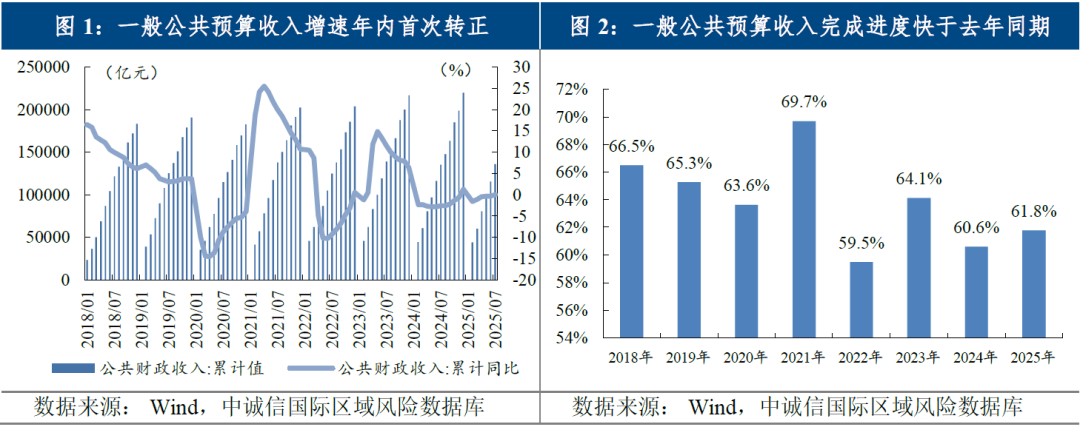
Core Insights - The general public budget revenue has shown significant recovery, with a year-on-year growth of 0.1% from January to July, marking the first positive growth this year, indicating economic resilience [2][4][14] - The land market remains sluggish, with government fund budget revenue growth weak, reflecting ongoing challenges in the real estate sector [2][8] - Fiscal expenditure has ramped up, with a broad fiscal expenditure growth rate of 9.3%, the highest level in recent years, driven primarily by central government spending [3][10][14] - The structure of fiscal expenditure is optimizing, with a focus on social welfare and education, alongside new policies aimed at supporting families and boosting consumption [3][12] Revenue Analysis - From January to July, the general public budget revenue growth rate turned positive for the first time this year, with July showing a 2.6% increase, the highest monthly growth rate [2][4] - Tax revenue recovery is a key driver, with personal income tax, domestic VAT, and domestic consumption tax showing year-on-year growth rates of 8.8%, 3.0%, and 2.1% respectively [6][8] Land Market Insights - The government fund budget revenue saw a year-on-year decline of 0.7% from January to July, with July's growth rate slowing significantly to 8.9% [2][8] - Real estate investment continues to decline, with a 12% year-on-year drop in property development investment from January to July [8][10] Expenditure Insights - Broad fiscal expenditure growth reached 9.3%, significantly higher than the previous year's decline of 2.0%, with central government expenditure growing by 33.9% [3][10] - The issuance of government bonds is at a rapid pace, with a total of 9.11 trillion yuan issued from January to July, a 33.8% increase year-on-year [10][12] Policy and Structural Changes - Recent fiscal policies have focused on social welfare, with expenditures in social security, education, and health exceeding 6 trillion yuan, reflecting a commitment to improving living standards [12][14] - New initiatives such as childcare subsidies and free preschool education have been introduced to stimulate consumption and support families [12][14]
上半年广义财政收支差5.3万亿,中央定调下半年财政政策|财税益侃
Di Yi Cai Jing· 2025-07-31 12:27
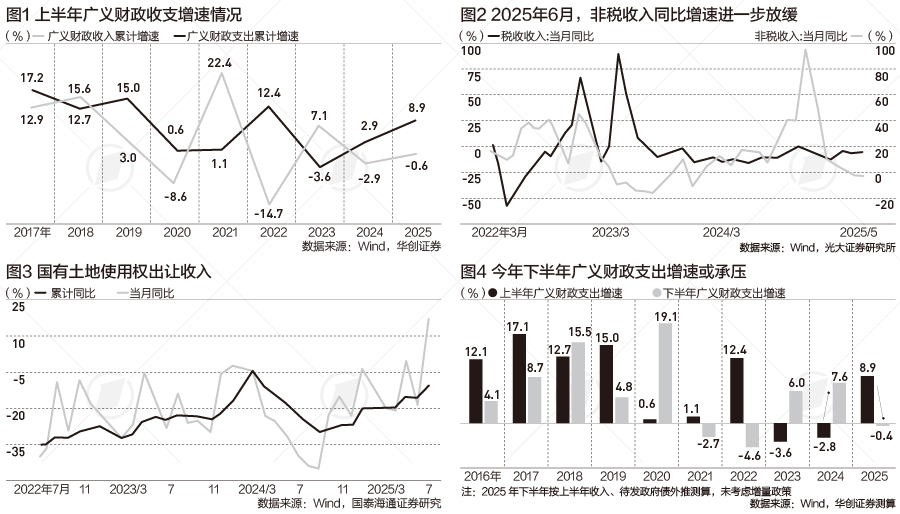
Core Viewpoint - Despite a slight decline in general fiscal revenue in the first half of the year, general fiscal expenditure reached a historical high, indicating a proactive fiscal policy aimed at stabilizing economic growth [1][3][4]. Fiscal Revenue and Expenditure - In the first half of the year, general fiscal revenue was approximately 135,008 billion yuan, showing a year-on-year decrease of about 0.6% [3]. - General fiscal expenditure amounted to nearly 188,800 billion yuan, with a year-on-year growth of approximately 8.9%, significantly higher than the economic growth rate of 5.3% [2][3]. - The fiscal expenditure exceeded revenue by 52,536 billion yuan, reflecting a year-on-year increase of about 45% [3]. Policy Measures and Economic Impact - The central government has emphasized the need for sustained and timely fiscal policy adjustments to support economic stability, particularly in the second half of the year [2][4]. - The Ministry of Finance reported that the fiscal policy has been more aggressive, contributing to a stable economic environment despite pressures [2][4]. - The government plans to accelerate the issuance of bonds and enhance the efficiency of fund utilization to address the fiscal gap [7][11]. Tax Revenue Trends - Tax revenue in the first half of the year was 92,915 billion yuan, down 1.2% year-on-year, indicating a mismatch with nominal GDP growth [4][6]. - Non-tax revenue grew by 3.7% to 22,700 billion yuan, but the growth rate has slowed compared to previous quarters [7]. - The decline in tax revenue is attributed to factors such as tax cuts and changes in the tax base, particularly in traditional industries [6]. Future Outlook - The fiscal space for the second half of the year is estimated to be 60,700 billion yuan, with significant remaining quotas for deficits and special bonds [9]. - The issuance of special bonds has accelerated, with a record monthly issuance of approximately 6,169 billion yuan in July [10]. - The government aims to enhance the management and efficiency of special bonds to ensure effective fund allocation for key projects [11].
财政支出提速能否持续?-6月财政数据点评(申万宏观·赵伟团队)
赵伟宏观探索· 2025-07-27 14:16
Core Viewpoint - The article discusses the fiscal revenue and expenditure situation in China for the first half of 2025, highlighting a notable increase in fiscal spending and the implications for future fiscal policy and economic recovery [2][6][76]. Group 1: Fiscal Revenue and Expenditure Overview - In the first half of 2025, the national general public budget revenue was 115,566 billion yuan, a year-on-year decrease of 0.3%, while expenditure was 141,271 billion yuan, an increase of 3.4% [2][6][76]. - The broad fiscal revenue in June 2025 showed a year-on-year increase of 2.8%, and broad fiscal expenditure increased by 17.6%, with both metrics improving compared to May [7][78]. - The budget completion rate for broad fiscal revenue in the first six months was 47.8%, higher than the five-year average of 47.4%, while the expenditure completion rate was 44.4%, slightly below the average of 45.1% [7][78]. Group 2: Government Debt and Financing - The increase in broad fiscal expenditure is attributed to government debt financing, with a broad fiscal deficit of -5.3 trillion yuan in June, the highest level for the same period historically [12][76]. - As of July 13, 2025, the net financing of government bonds reached approximately 2.9 billion yuan, with an issuance progress of 59.4%, significantly higher than the 51.6% in 2024 [12][76]. Group 3: Special Bonds and Land Revenue - The issuance of new special bonds remains slow, with a total issuance scale of 2.2 trillion yuan and a progress rate of 50.6%, which is lower than the same period in 2022 and 2023 [18][77]. - Land transfer revenue in June increased by 22% year-on-year, indicating a recovery, although the overall real estate sales growth remains sluggish [18][77]. Group 4: Government Fund Revenue and Expenditure - Government fund revenue improved significantly, with a year-on-year increase of 20.8% in June, while general fiscal revenue saw a decline of 0.3% [31][78]. - Government fund expenditure surged by 79.2% year-on-year in June, driven by the recovery in land transfer revenue and accelerated spending from central special bonds [66][78]. Group 5: Future Outlook - The sustainability of high fiscal expenditure growth in the second half of 2025 will depend on the recovery of tax revenue and land transfer income, as well as the potential for continued funding from policy financial tools [24][77].