
反内卷政策

Search documents
铜季报:宏观利多+供应紧缺上行空间仍在
Zhong Hang Qi Huo· 2025-09-26 11:21
1. Report Industry Investment Rating No information provided on the report's industry investment rating. 2. Core Viewpoints of the Report - The copper market will remain in a pattern of "favorable macro - environment + supply shortage" in the fourth quarter. Despite weak traditional demand, the supply - side bottleneck is difficult to ease. With the support of domestic and foreign policies, the copper price has strong downside support and still has upward potential, likely to operate in the range of 78,000 - 85,000 yuan. A strategy of buying on dips is recommended, and attention should be paid to the US tariff policy, the Fed's interest - rate cut path, and the sustainability of domestic demand policies [46]. 3. Summary by Directory 3.1 Market Review - In Q3 2025, copper prices showed a range - bound pattern. The main contract of Shanghai copper fluctuated between 77,570 - 83,090 yuan/ton. In early July, the US unexpectedly announced a 50% tariff on copper imports, causing copper prices to fall under pressure. Subsequently, the market digested the news, and the focus returned to the structural shortage of global copper mine supply and the Fed's interest - rate cut expectations. At the end of the quarter, due to mine - end disturbances, copper prices broke through the range, reaching a maximum of 83,090 yuan/ton [7]. 3.2 Macroeconomic Aspects - **Tariff Policy**: Trump's repeated signals of imposing tariffs on copper imports in 2025 have led to a continuous widening and repeated record - highs of the price difference between COMEX and LME copper. The price - difference change is divided into three stages. The impact of the tariff policy is gradually easing, but macro - uncertainty remains high during Trump's tenure. Attention should be paid to the progress of Sino - US trade negotiations in November [11][12]. - **Inflation**: China's CPI in August 2025 decreased year - on - year, mainly due to the high base of the previous year and lower - than - seasonal food prices. The PPI decline narrowed, and the price of some energy and raw material industries rebounded. The implementation of the "anti - involution" policy may lead to a stable recovery of inflation in the future [17]. 3.3 Fundamentals - **Supply Side** - **Copper Concentrate**: In Q3 2025, the spot TC of copper concentrate remained deeply negative. Although there was a rebound in mid - August, it returned to around - 40 US dollars due to frequent mine - end disturbances. The long - term TC/RC has also reached a historical low, indicating a "strong mine, weak smelting" pattern. In Q4, the spot TC may continue to be deeply negative [21]. - **Refined Copper Production**: In August 2025, China's refined copper production increased year - on - year. However, in September, the number of smelters undergoing maintenance increased, and the production decline was more significant. In Q4, the number of domestic smelters undergoing maintenance will increase, and production may be affected [24][26]. - **Scrap Copper Imports**: In August 2025, China's scrap copper imports decreased month - on - month, mainly due to import losses, extreme weather affecting transportation, and a decrease in overseas scrap copper exports [28]. - **Demand Side** - **Real Estate**: In August 2025, the real estate market continued to decline, with sales, investment, new construction, and completion areas all showing negative growth. Although first - tier cities have introduced policies to support the market, investment and construction are still under pressure [34]. - **Automobile Industry**: In August 2025, the production and sales of traditional cars increased year - on - year, while the proportion of fuel - powered cars decreased. The new - energy vehicle industry maintained strong momentum, with high production and sales growth rates and a large market share [39]. - **Home Appliances**: In August 2025, the production of household refrigerators and air - conditioners increased year - on - year, but the air - conditioner sales decreased slightly. In Q4, the home - appliance sector may face pressure of slowing growth due to the advance of demand by the "trade - in" policy and potential export pressure [42]. - **Inventory**: Since February 2025, the copper inventories of the three major exchanges have shown a divergent trend, with LME copper inventory hitting a record low. As of September 26, the US copper inventory exceeded the sum of LME and SHFE copper inventories. In Q4, the inventory accumulation of COMEX may slow down, and the non - US copper inventory may rebound [45]. 3.4 Future Outlook - **Macroeconomic**: The Fed is likely to cut interest rates twice more this year, which will drive the recovery of the manufacturing industry. The impact of tariffs is gradually easing, and attention should be paid to the trade negotiations in November [47]. - **Copper Market**: The copper market will remain in a pattern of "favorable macro - environment + supply shortage" in Q4. The copper price is likely to operate in the range of 78,000 - 85,000 yuan, and a strategy of buying on dips is recommended [46].
瑞达期货纯碱玻璃市场周报-20250926
Rui Da Qi Huo· 2025-09-26 09:57
Report Summary 1. Report Industry Investment Rating No information provided. 2. Core Views - This week, the soda ash futures price decreased by 1.9%, while the glass futures price increased by 2.96%. The soda ash futures showed a trend of first falling and then rising, and the glass futures declined in the first half - week and rose significantly in the second half - week [6]. - For soda ash, the supply is expected to be abundant and demand to increase, so the price may rise. After the festival, if there is no price - increase expectation, the price is likely to fall back, but there may be variables with the "anti - involution" hype. For glass, if there is no central bank interest - rate cut expectation after the festival, the price is expected to fall again [6]. - The recommended trading range for the SA2601 contract is 1280 - 1380, with a stop - loss range of 1240 - 1400. For the FG2601 contract, the recommended trading range is 1180 - 1280, with a stop - loss range of 1150 - 1300 [6]. 3. Summary by Directory 3.1 Week - on - Week Summary - **Market Review**: Soda ash futures decreased due to increased production news in the first half - week and rebounded later due to glass price increase and inventory decline before the double festivals. Glass futures fell in the first half - week due to poor fundamentals and rose sharply in the second half - week under the guidance of the over - capacity reduction document in the building materials industry [6]. - **Market Outlook**: For soda ash, the domestic operating rate and production are rising. In the long run, some backward production capacity may be phased out, but the natural - alkali production capacity is increasing. The demand from the glass industry remains at a low level, and the demand from photovoltaic glass is expected to weaken. The inventory of domestic soda ash enterprises has decreased significantly. For glass, the supply and demand remain at a low level. The real - estate situation is not optimistic, and the downstream deep - processing orders have increased slightly [6]. - **Strategy Suggestion**: The SA2601 contract is recommended to be traded in the 1280 - 1380 range with a stop - loss of 1240 - 1400, and the FG2601 contract is recommended to be traded in the 1180 - 1280 range with a stop - loss of 1150 - 1300 [6]. 3.2 Futures and Spot Markets - **Futures Prices**: This week, the soda ash futures price closed lower, and the glass futures price closed higher [8]. - **Spot Prices and Basis**: The soda ash spot price increased, and the basis remained flat. The glass spot price strengthened, and the basis increased and is expected to strengthen further. The soda ash - glass price difference weakened this week and is expected to strengthen next week [12][17][22]. - **Specific Data**: As of September 25, 2025, the mainstream price of heavy - soda ash in the Shahe market was 1225 yuan/ton, a week - on - week increase of 10 yuan/ton, and the soda ash basis was - 90 yuan/ton. The price of 5.0mm large - plate glass in the Shahe market was 1132 yuan/ton, an increase of 48 yuan/ton, and the glass basis was - 138 yuan/ton. The glass - soda ash price difference was 45 yuan/ton [15][20][24]. 3.3 Industry Chain Analysis - **Production and Capacity**: The domestic soda ash operating rate and production increased this week, and the production is expected to decline next week. The glass production line cold - repair number remained unchanged, and the production is expected to increase slightly next week. The domestic photovoltaic glass capacity utilization rate and daily melting volume remained flat [26][38][44]. - **Profit and Cost**: This week, the profit of domestic soda ash enterprises decreased, and the cost increased. The profit of glass enterprises increased. It is expected that the soda ash production capacity will decline next week, and the glass production capacity will remain at a low level [33]. - **Inventory**: The inventory of domestic soda ash enterprises decreased slightly, and the inventory of glass enterprises declined. It is expected that the inventory reduction of glass will slow down next week [48]. - **Downstream Demand**: The deep - processing orders of domestic glass increased slightly, but the demand is still low [54]. - **Specific Data**: As of September 25, 2025, the national soda ash operating rate was 88.53%, a week - on - week increase of 3.59%, and the national weekly soda ash production was 776,900 tons, a week - on - week increase of 4.19%. The theoretical profit of China's dual - ton soda ash by the combined - soda process was - 124 yuan/ton, a week - on - week decrease of 51 yuan/ton, and the theoretical cost was 1767 yuan/ton, a week - on - week increase of 28 yuan/ton. The theoretical profit of ammonia - soda process soda ash was - 98 yuan/ton, a week - on - week decrease of 18 yuan/ton, and the theoretical cost was 1323 yuan/ton, a week - on - week increase of 3 yuan/ton. The average weekly profit of natural - gas - fueled float glass was - 151.27 yuan/ton, a week - on - week increase of 8.23%; the average weekly profit of coal - gas - fueled float glass was 95.07 yuan/ton, a week - on - week increase of 1.1%; the average weekly profit of petroleum - coke - fueled float glass was 61.37 yuan/ton, a week - on - week increase of 48.34%. The total number of domestic glass production lines after excluding zombie lines was 296, with 225 in production and 71 cold - repaired. The national float - glass production was 1.1242 million tons, a week - on - week increase of 0.27%. The soda ash enterprise inventory was 1.6515 million tons, a week - on - week decrease of 5.93%, and the total glass enterprise inventory was 59.355 million weight boxes, a week - on - week decrease of 2.54%. As of September 15, 2025, the average order days of national deep - processing sample enterprises were 10.5 days [31][36][52][56].

光伏股尾盘跌幅扩大 机制电价竞价结果出台 机构称四季度光伏装机量或将大幅减速
Zhi Tong Cai Jing· 2025-09-26 07:40
光伏股尾盘跌幅扩大,截至发稿,彩虹新能源(00438)跌5.16%,报2.39港元;新特能源(01799)跌 3.73%,报7.99港元;福莱特(601865)玻璃(06865)跌3.36%,报11.23港元;信义光能(00968)跌 2.63%,报3.33港元。 中信期货则表示,供给端,8月多晶硅产量已经回升至13万吨以上,预计9月份多晶硅高产量将会维持, 中长期来看需要关注反内卷政策是否会限制多晶硅的供应,如若政策迟迟未落地高供应将会持续。需求 端,1-5月份光伏装机增速大幅度提高,累计增速150%,不过也透支了下半年装机的需求,6月份单月 国内光伏装机仅只有14GW,7月份装机量进一步下降。考虑到下半年光伏装机的下降,以及电池片组 件抢出口需求的弱化,多晶硅后续需求有继续走弱的风险。 消息面上,近日,山东省发改委正式向社会公示山东2025年新能源机制电价竞价结果。其中光伏入选电 量12.48亿千瓦时,中标价格为0.225元/千瓦时。新纪元期货指出,"5.31"新政前抢装潮过去以后,推进 光伏电价的市场化改革,近期"反内卷"政策推动落后产能有序退出,四季度光伏装机量或将大幅减速。 ...
芳烃市场周报:旺季表现平淡,效益承压(PX,纯苯,苯乙烯)-20250926
Hong Ye Qi Huo· 2025-09-26 07:29
Group 1: Report General Information - Report title: Aromatic Hydrocarbon Market Weekly Report: Lackluster Performance in Peak Season, Profitability Under Pressure (PX, Pure Benzene, Styrene) [1] - Author: Jiang Zhou Xilin [2] - Institution: Hongye Futures, Financial Research Institute [2] - Date: September 26, 2025 [2] Group 2: PX Market Analysis Cost - International oil prices first declined and then rose recently, supported by geopolitical instability. Current Japanese naphtha is at $608/ton, and PX CFR is at $817/ton. Sinopec's September PX listed price is 7,200 yuan/ton, and the August settlement price was 7,020 yuan/ton [3] Supply - Domestic PX weekly output was 733,200 tons, a week-on-week increase of 1.86%. The weekly average capacity utilization rate was 87.42%, up 1.59% week-on-week. Tianjin Petrochemical's 300,000-ton and Fujia Dahua's two 1.4-million-ton units continued maintenance, planned to restart in early November. Daxie's load increased to 90% in mid-September [3] Demand - Downstream PTA capacity utilization rate dropped to 76.48%, a week-on-week decrease of 0.81% and a year-on-year decrease of 2.75%. Fuhai Chuang restarted as scheduled, but South China units reduced load or stopped due to weather [3] Summary and Outlook - The main 2511 contract has been in a low-level shock after a rapid decline since late August, and has continued its weakness recently. From the second quarter, the intensification of the Israel-Iran conflict in June boosted oil prices, and PX followed suit. Then, the US announced a full ceasefire, reducing the possibility of an oil crisis, and downstream prices declined with the rapid fall in the cost end. Since mid-July, affected by the macro commodity atmosphere, chemicals generally rose under the "anti-involution" policy, and PX oscillated upward supported by strong supply and demand, then fell again as the market cooled. In mid-August, it rose rapidly affected by the macro and commodity market sentiment, then gave back previous gains. Currently, the increase in PX supply due to short-process load increase and postponed maintenance of some units is obvious, while on the demand side, after the significant compression of PTA profits, rumors of production cuts increased, and terminal demand is still below expectations. If terminal demand improves gradually as the peak season approaches and the macro atmosphere is strong, there is still room for an upward trend during the "Golden September and Silver October." However, the demand in the traditional peak season is currently poor, processing fees are under pressure at a low level, and the PX supply-demand situation remains weak. The future market still depends on changes in downstream demand and profits, with a weak oscillation [3] Group 3: Pure Benzene Market Analysis Futures and Spot - The main 2603 contract of pure benzene has been oscillating after a continuous decline since mid-September. The basis between the futures main 2603 contract and East China spot has further narrowed to par, mainly due to the downward adjustment of the spot end. The arbitrage window from East China to Shandong has partially opened. There are currently reports of improved pre-holiday procurement enthusiasm from downstream and active spot buying, with the near-month contract at a premium to the far-month contract (September to October) [4] Supply and Demand - The estimated monthly output of pure benzene in August 2025 was 1.9633 million tons, an increase of 78,900 tons from the previous month and 112,500 tons from the same month last year. Units such as Fuhai Chuang, Dongfang Hualong, and Dongming Petrochemical restarted, while units such as Jincheng Petrochemical, a cracking unit of CNOOC Shell, and a cracking unit of Zhenhai Refining & Chemical stopped [4] Summary and Outlook - The spot and futures prices of pure benzene are currently at a low level. The peak season demand from downstream is currently below expectations, but the room for further decline is limited due to rigid demand procurement. The losses of styrene and phenol are expected to continue to repair. There are also reports of postponed procurement plans from downstream. In the short term, the market is trading on the expectation of styrene inventory accumulation. The spot demand for pure benzene has improved, and the supply-demand surplus has turned into a balance, but the far-month expectation remains weak. In the medium to long term, there is still an expectation of oversupply [4] Group 4: Styrene Market Analysis Futures and Spot - The main 2511 contract of styrene has been weakly oscillating recently, with a slight rebound following the cost end in the middle of the week. The current mainstream price in East China is 6,940 yuan/ton, down from before. The domestic supply of styrene has been continuously decreasing, and downstream demand has been good, maintaining a tight supply-demand balance. However, the terminal inventory has not decreased, and there is an expectation of continuous inventory accumulation, maintaining a weak and bearish expectation. The high-end transaction price of Jiangsu spot is 7,060 yuan/ton, the low-end is 6,840 yuan/ton, and the price difference between high and low ends is 220 yuan/ton [5] Industrial Chain Profit - On a weekly basis, the average profit of non-integrated styrene units in China was -485 yuan/ton, a decrease of 98 yuan/ton from the previous period, a week-on-week decrease of 25.18%. The weekly profit of non-integrated styrene units in China continued to decrease, showing a downward trend. The weekly average decline of pure benzene was lower than that of styrene, and the price difference between pure benzene and styrene further narrowed, ranging from 1,030 to 1,170 yuan/ton during the period. The profitability of non-integrated styrene units decreased [5] Industrial Chain Operating Rate - The total output of styrene factories in China was 345,800 tons, a decrease of 1,000 tons from the previous period, a week-on-week decrease of 0.29%. The factory capacity utilization rate was 73.24%, a week-on-week decrease of 0.2%. The newly put into operation 670,000-ton unit of Jingbo Sida Rui has been included in the total capacity. Production profits led to a decrease in the load of individual units, and the Zhenli Chemical unit stopped. The loss completely covered the increase in production brought by the return of units, resulting in a slight decrease in overall output. It is expected that the impact of stopped and reduced-load units will increase around the holiday, and there are no plans for unit restart and production increase, so the output will continue to decline [5] Downstream - The improvement in exports due to previous tariff cuts was lower than expected. The operating rates of the three major downstream industries have improved significantly compared to before mid-May. The main downstream industries still have profit margins, but the current downstream demand has decreased. Among them, ABS and PS have fluctuated slightly, and some EPS units in South China stopped due to typhoons, leading to a significant decrease in demand. The fundamental problem of poor profitability in the styrene industry has not changed. It is expected that downstream demand will continue to decrease around the holiday [5] Inventory - As of September 22, 2025, the total inventory of the mainstream styrene storage areas in South China was 13,600 tons, a decrease of 8,200 tons from the previous period, a week-on-week decrease of 37.61%. According to the current port inventory data, the overall pick-up has remained stable. Affected by the typhoon weather, the arrival of ships at the port was postponed, resulting in a significant decrease in overall inventory [5] Summary and Outlook - Since mid-May, the previously continuously rising styrene has oscillated and declined. From the perspective of the supply-demand structure, styrene was in a tight supply-demand balance in the second quarter. In May, large-scale units such as Shandong Lihuayi, Zhejiang Petrochemical, and Dalian Hengli were under maintenance, and the factory inventory data decreased tightly. The supply-demand side remained strong, and the decline was mainly due to the回调 of the cost end and the less-than-expected improvement in the export market and downstream. On the one hand, the pressure of increased crude oil production and poor demand prospects in the cost end still exists. On the other hand, the operating rates of the main downstream industries increased in mid-May and then declined, and the spot demand was still poor. Since mid-June, the spot and futures prices have continuously risen, on the one hand, affected by inventory news, and on the other hand, due to the strong cost end. Geopolitical news such as the Iranian parliament's approval to close the Strait of Hormuz once formed a significant positive impact, and then returned to the fundamentals. Styrene has continuously accumulated inventory, and the production and capacity utilization rates have significantly increased, and styrene itself has shifted to a pattern of strong supply and weak demand. In mid-July, affected by the "anti-involution" policy, styrene old units with high energy consumption, backward technology, and small scale have become the focus of policy clearance. Previously, the production capacities of Maoming Petrochemical, Yanshan Petrochemical, and Qilu Petrochemical have been in long-term shutdown, which is in line with the policy orientation. The increase in the futures price was mainly driven by the macro commodity sentiment. Since its own supply and demand was still in a weak off-season state, the production and sales profitability was average. Since the end of July, it has followed the cooling of the commodity market. In late August, it experienced a rapid decline and has recently oscillated and rebounded, but has not returned to the previous high. Currently, the crude oil end has first declined and then risen, the fundamentals of pure benzene itself have improved, and the cost side has a single-sided driving force. In terms of styrene's own supply and demand, the domestic supply still has room for further decline, and the downstream demand is also expected to decrease during the holiday. It is expected that the downstream rigid demand will be maintained during the holiday, and the spot demand will be weakly stable. The supply and demand will be temporarily in a wide balance state. Affected by the relatively low absolute price of styrene, there may be continuous short position reduction before the holiday. In the medium to long term, the profit of styrene units is poor. The supply and demand sides may improve during the traditional "Golden September and Silver October" peak season, but the oversupply pattern of the raw material end may drive the price further down [6]
半导体设备ETF(159516)盘中上涨超2.2%,规模超64亿居同类第一,行业趋势与需求增长引关
Sou Hu Cai Jing· 2025-09-26 06:12
Core Viewpoint - The central government emphasizes anti-involution policies in high-end manufacturing sectors like electronics and semiconductors to enhance international competitiveness and secure a favorable position in global competition [1] Group 1: Industry Insights - Anti-involution policies combined with corporate cash activation are shifting the bull market's main driver towards physical re-inflation, benefiting industries like electronics and semiconductors through supply-side optimization [1] - The short-term performance of the sci-tech sector is active, with a significant increase in the distribution of five-fold stocks in the Sci-Tech Innovation Board and the Growth Enterprise Market [1] - In the medium term, attention is directed towards cyclical industries with tight supply, such as consumer electronics and optical optoelectronics within technology, where inventory and capital expenditure are at low levels, potentially benefiting leading companies' profit recovery due to increased industry concentration [1] Group 2: Market Trends - Anti-involution policies are expected to drive a rebound in inflation expectations, with the electronics and semiconductor sectors showing more resilience in growth styles amid breakthroughs in AI, the Sino-U.S. tech competition, and a global interest rate reduction cycle [1] - The Semiconductor Equipment ETF (159516) tracks the semiconductor materials and equipment index (931743), focusing on upstream materials and equipment in the semiconductor industry, reflecting the overall performance of key enterprises in this sector [1] - The index covers high-tech barrier and growth characteristic sub-sectors, serving as an important reference for investors to grasp opportunities in the semiconductor industry [1] Group 3: Investment Products - Investors without stock accounts can consider the Guotai Zhongzheng Semiconductor Materials and Equipment Theme ETF Initiated Link A (019632) and Link C (019633) [1]
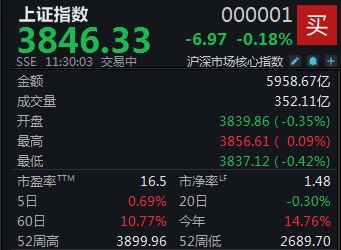
两市缩量调整,沪指半日微跌0.18%
Mei Ri Jing Ji Xin Wen· 2025-09-26 04:47
Market Overview - The A-share market experienced a decline on September 26, with the Shanghai Composite Index falling by 0.18% to 3846.33 points, the Shenzhen Component Index down by 0.79%, and the ChiNext Index decreasing by 1.17% [1][2] - The total trading volume for A-shares reached 1.38 trillion yuan [1] Monetary Policy - The People's Bank of China conducted a 7-day reverse repurchase operation of 165.8 billion yuan at an interest rate of 1.40%, with the same amount being bid and accepted [2] - Additionally, a 14-day reverse repurchase operation of 600 billion yuan was also conducted [2] Pension Fund Investment - The scale of basic pension insurance fund investment operations has reached 2.6 trillion yuan, doubling since the end of the 13th Five-Year Plan, with an average annual return of 5.15% over the past eight years [3] Sector Performance - The petrochemical sector led the market with significant gains, with stocks like Tongkun Co. and Hengyi Petrochemical rising by 6% [3] - Real estate stocks showed signs of recovery, with Hefei Urban Construction hitting the daily limit, and other companies like Shanghai Urban Development and China Merchants Shekou rising by over 4% [3] - The military industry stocks also rebounded, with Xiangdian Co. and Chengfei Integration both hitting the daily limit [3] Sector Analysis - The chemical fiber sector is expected to benefit from the exit of outdated production facilities and the optimization of the polyester filament industry structure, with leading companies likely to gain from these changes [4] - The telecommunications and internet sectors experienced declines, with average decreases of 2.50% and 1.49%, respectively [4] Company Insights 1. **Shenma Co.**: The company is expanding its overseas market presence, establishing a subsidiary in Thailand, and is currently constructing a 20,000-ton nylon 66 differentiated fiber project [7] 2. **Xinfengming**: The company has established an integrated and scaled operation in the "PTA-polyester spinning-texturing" industry chain, with ongoing upstream PTA project developments [7] 3. **Tongkun Co.**: The company is expected to see significant improvements in its chemical fiber business due to favorable policies and recovering demand [7] 4. **Hengyi Petrochemical**: As a leading private multinational in the "refining-chemical-fiber" sector, the company is continuously enhancing its product range and structure, indicating strong growth potential [7]

第一创业晨会纪要-20250926
First Capital Securities· 2025-09-26 04:24
Macroeconomic Overview - The U.S. second quarter real GDP annualized final value increased by 3.8%, exceeding the expected 3.3% and the revised value of 3.3% [3] - The final value of real personal consumption expenditure increased by 2.5%, surpassing the expected 1.7% and the revised value of 1.6% [3] - The second quarter PCE price index annualized final value rose by 2.1%, higher than the expected 2% and the revised value of 2% [3] - The core PCE price index annualized final value increased by 2.6%, above the expected 2.5% and the revised value of 2.5% [3] Industry Insights - U.S. President Trump announced a 50% tariff on imports of cabinets and related products starting October 1, and a 100% tariff on all brand or patented drugs [7] - The tariffs on heavy trucks are expected to have a minimal impact on Chinese manufacturers, while tariffs on home decor products may negatively affect domestic exports [7] - The China Coking Industry Association decided to raise the wet coke price by 50 yuan/ton and dry coke price by 55 yuan/ton, suggesting a continued push against irrational competition in the industry [7] Automotive Sector - The China Passenger Car Association forecasts that total annual sales of automotive manufacturers will reach 40 million units during the 14th Five-Year Plan, with an average annual growth rate of 3% [9] - The growth in the automotive sector is expected to be driven by demand from midwestern and small county markets, as well as the international market [9] - The trend towards larger capacity batteries in range-extended vehicles is anticipated to create a significant new market for high-capacity power batteries, benefiting leading battery manufacturers [11] Consumer Trends - Domestic travel demand is showing strong growth ahead of the National Day holiday, with cross-province travel orders increasing by 58% year-on-year [13] - The inbound tourism market is also active, with a 75% year-on-year increase in Russian traveler bookings due to visa-free policies [13] - The overall high demand for travel during the holiday period is expected to positively impact related industries in the tourism sector [13]

山西证券:25年8月进口煤继续复苏 关注海外价格回升趋势
Zhi Tong Cai Jing· 2025-09-26 04:01
Core Insights - The report from Shanxi Securities indicates a shift in coal market sentiment due to policy changes aimed at reducing "involution," leading to an improved risk appetite in the short term [1] - The coal market is expected to see improvements in the third quarter, particularly in thermal coal, as long-term contract price discrepancies are resolved [1] Group 1: Coal Market Trends - The cumulative import volume of coal from January to August has decreased by 12.2%, continuing a trend of contraction, although the rate of decline is slowing [1] - In August, the total coal import price was $66 per ton, reflecting a year-on-year decline, with a slight month-on-month decrease of $0.84 per ton [1] - All coal types showed positive month-on-month growth in August, with thermal coal and coking coal maintaining negative year-on-year growth [1] Group 2: Domestic Supply and Demand - Domestic coal prices experienced fluctuations in August, with a slight increase in production compared to the previous month, but overall production remains contracted year-on-year [2] - The domestic supply gap continues to support the demand for imported coal, with all four major coal types showing an increase in imports [2] Group 3: Price Dynamics and Import Outlook - The price difference between domestic and imported coal is expected to drive further imports, especially if domestic supply continues to contract [3] - Although the import price did not increase in August, the reduction in the rate of price decline suggests potential for future price recovery [3]

专家分享:从反内卷到全球出清石化行业的结构性机遇
2025-09-26 02:29
Summary of the Conference Call on the Petrochemical Industry Industry Overview - The petrochemical industry in China is facing challenges such as refining capacity nearing its limit and an oversupply of ethylene, necessitating adjustments in supply through anti-involution policies for high-quality development [1][2][4] - The overall profitability of the chemical industry is weak, with only a few resource-advantaged products performing well [1][5] Key Points and Arguments - **Regulatory Changes**: The Ministry of Industry and Information Technology (MIIT) will implement policies to stabilize growth in response to industry demand changes, particularly focusing on refining and ethylene sectors [2][4] - **Capacity Control**: New refining projects will require equivalent replacements, and approvals for small coal-to-methanol projects will become more stringent [1][4][7] - **Old Facility Elimination**: Small, outdated refining and ethylene facilities, especially those over 20 years old, will face elimination, with approximately 60 million tons of capacity targeted for adjustment [1][12][15] - **Investment Trends**: Investment in propane dehydrogenation units is decreasing due to poor profitability, while ethylene capacity is regulated to maintain reasonable industry profitability [5][6] Market Dynamics - **Global Market Opportunities**: As European and Korean petrochemical industries face supply tightness and shutdowns, China is positioned to fill market gaps through modern, large-scale production facilities [2][14][17] - **Export Potential**: China can leverage its cost advantages to export to Europe and Southeast Asia, especially as global ethylene markets are expected to rebalance with increasing demand [2][22] Challenges and Future Outlook - **Approval Challenges**: New projects must incorporate advanced materials technology to gain approval, complicating the project initiation process for many companies [8][9] - **Environmental Standards**: The government is emphasizing energy efficiency and environmental standards, which will impact the approval of new projects and the operation of existing facilities [10][13] - **Employment Impact**: The consolidation of small, inefficient facilities may lead to job losses, but the government plans to mitigate this through retraining and support measures [26][28] Strategic Directions - **Industry Consolidation**: The government aims to increase industry concentration by encouraging the integration of smaller firms into larger, more efficient operations [29][33] - **Focus on High-Quality Development**: The anti-involution policy seeks to reduce ineffective competition and promote larger, more capable enterprises to enhance international competitiveness [33][36] Conclusion - The petrochemical industry in China is undergoing significant structural changes driven by regulatory reforms, market dynamics, and a focus on sustainability. The future will likely see a consolidation of capacity, increased export opportunities, and a shift towards high-quality, environmentally friendly production practices.
旗滨集团20250925
2025-09-26 02:28
Summary of Qibin Group Conference Call Company Overview - **Company**: Qibin Group - **Industry**: Glass manufacturing, specifically focusing on photovoltaic (PV) glass and float glass Key Points and Arguments Industry Dynamics - **PV Glass Revenue Growth**: Qibin Group's PV glass revenue is approaching that of float glass, with expectations to surpass it by 2025. Production capacity is projected to exceed 400 million square meters in 2024 and reach 600 million square meters in 2025, indicating significant expansion speed [2][12] - **Price Increases**: Anti-involution policies have led to price increases in both PV and float glass. Following a Ministry of Industry and Information Technology meeting, PV glass prices rose by 2 RMB per heavy box, while float glass prices increased by 5 RMB per heavy box or 100 RMB per ton [5][10] - **Energy Efficiency Standards**: The introduction of energy efficiency benchmark policies is expected to raise industry standards, prompting technological upgrades and potentially leading to the exit of non-compliant small or high-cost enterprises [8][10] Company Performance - **Production Capacity**: Qibin Group has expanded its PV glass capacity to 11,800 tons, with plans to increase it to 13,000 tons. The company has also ventured into pharmaceutical and electronic glass, with capacities of 65 tons and 345 tons, respectively [4][12] - **Cost Control**: The company benefits from high quartz sand self-sufficiency and direct natural gas supply, which aids in cost control. Qibin's yield rate is above the industry average, indicating effective management practices [15][16] - **Financial Structure Optimization**: Qibin Group is working on optimizing its financial structure to reduce financial costs and enhance profitability. By 2025, net profit per square meter of PV glass is expected to approach that of leading companies [17][18] Future Outlook - **Market Positioning**: Qibin Group is positioned as the third-largest player in the PV glass sector, with significant growth potential. The company aims to achieve profitability in its PV glass segment by 2025, which is crucial for its market valuation [19][28] - **New Material Development**: The company is investing in research and development of glass substrates for chip packaging, which could replace traditional materials like ABF substrates. This new technology presents a potential growth avenue, although challenges related to brittleness and adhesion need to be addressed [23][25] - **Investment Valuation**: The target market valuation for Qibin Group is set at 25 billion RMB, contingent on the realization of profitability in the PV glass sector and potential breakthroughs in float glass supply-side reforms or new materials [3][28] Additional Insights - **Challenges in New Markets**: The electronic and pharmaceutical glass markets are maturing, with foreign companies dominating high-end segments. However, Qibin Group is making strides in these areas, with expectations of breakeven in pharmaceutical glass by 2025 [22] - **Long-term Industry Trends**: The IC substrate market is projected to grow significantly, with Qibin Group aiming to capture a share through innovative glass solutions. The competitive landscape is evolving, with both domestic and international players increasing their investments [26][27] Conclusion - Qibin Group is strategically positioned for growth in the PV glass market, with a focus on cost efficiency and technological innovation. The company's ability to navigate industry challenges and capitalize on emerging opportunities will be critical for its future success and market valuation [29][30][31]
