
宽货币

Search documents
黄金比特币创新高!美政府停摆与日本新首相推升全球“双宽”预期
Di Yi Cai Jing· 2025-10-09 03:25
Core Viewpoint - The global political rightward shift, along with trends of expansive fiscal and monetary policies, indicates increased uncertainty from geopolitical friction and greater unsustainability of global government debt, raising the probability of the economy moving from a soft landing to moderate overheating [1] Market Strategy - Short-term risk appetite for US stocks is expected to weaken due to the ongoing government shutdown, while in the medium term, the combination of right-wing policies and dual expansionary fiscal and monetary measures is likely to lead to geopolitical risks, economic overheating, and weakened fiat currency credit, with expected asset performance ranking as gold > copper > stocks [1] Major Events Impacting Markets - The US government shutdown and the election of Kishi Nobuo as the president of the Liberal Democratic Party in Japan are the two main events driving market sentiment [2] - The US government shutdown, which began on October 1, is expected to last longer than market expectations, leading to increased risk aversion and a rise in gold and Bitcoin prices, with both assets reaching historical highs [2][3] Economic Data - The US ADP employment data showed a negative growth of 32,000 jobs in September, significantly below the expected increase of 51,000, indicating weakness in the labor market [5] - The ISM manufacturing PMI improved to 49.1, while the services PMI fell to 50, reflecting mixed signals in the US economy [5] Political Developments in the US - The US federal government entered a shutdown due to a failure to pass a temporary spending bill, primarily over disagreements on healthcare spending, with potential economic impacts being limited based on historical precedents [6][7] - The shutdown is expected to delay the release of key economic data, including non-farm payrolls and CPI, which are crucial for Federal Reserve monetary policy decisions [7] Political Developments in Japan - Kishi Nobuo's election as the new president of the Liberal Democratic Party is expected to lead to a continuation of expansionary fiscal and monetary policies, which may delay the Bank of Japan's interest rate hike process [8][9] - Kishi's economic policies are characterized by a commitment to "more responsible" fiscal expansion, with a focus on coordinating closely with the Bank of Japan [9]

债市专题研究:国庆假期要闻汇总及思考
ZHESHANG SECURITIES· 2025-10-08 08:44
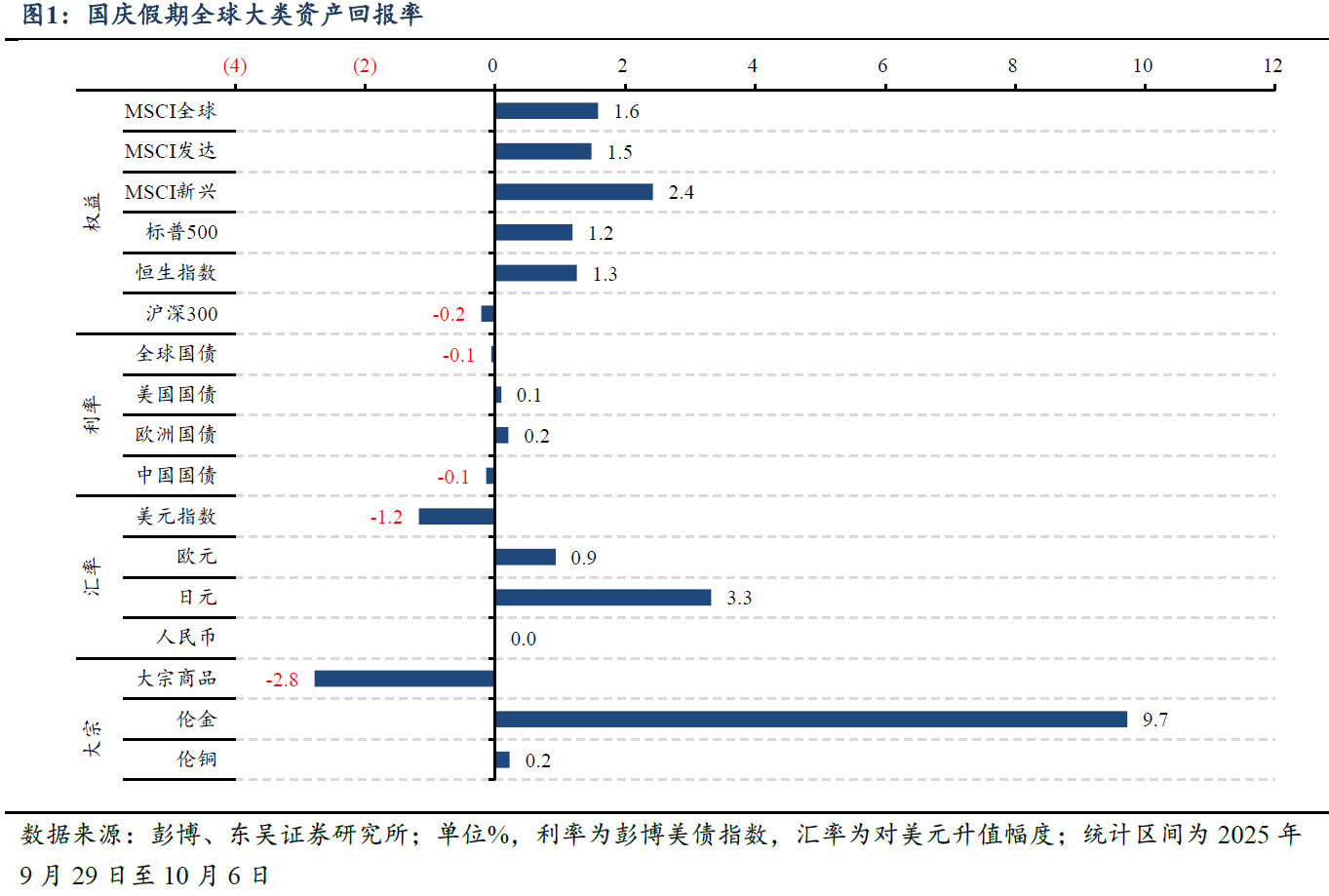
Industry Investment Rating No information provided in the report. Core Views - During the National Day holiday, there were two major trading themes in global assets: the US government shutdown and the victory of Sanae Takaichi as the president of Japan's Liberal Democratic Party. The global risk appetite is expected to rise driven by liquidity. Japanese stock indices and gold led the gains, while long - term bond yields in major countries such as the US and Japan increased due to concerns about loose fiscal policies and debt sustainability [1][11]. Summary by Directory 1. Holiday News Summary and Thoughts - **US Government Shutdown**: On the evening of September 30, the US Senate failed to pass the annual appropriation bill, leading to a government shutdown. The core reason is the disagreement between the two parties on medical insurance welfare spending. The shutdown may delay important economic data releases and the Fed's interest - rate cut decision. The market's concern about the unsustainability of US government debt has increased [11][12]. - **Sanae Takaichi's Victory**: On October 4, Sanae Takaichi won the Liberal Democratic Party's presidential election. Her victory implies a high probability of becoming Japan's prime minister. Her policy style is expected to continue "Abenomics", with a combination of loose fiscal and monetary policies, which may lead to a strong Japanese stock market, a weak Japanese bond market, and a weak yen. The market's expectation of a Japanese interest - rate hike in October has been postponed [12][13]. - **Gold Price Increase**: During the National Day holiday, the COMEX gold price rose 2.49% in three trading days. The rise is driven by the Fed's interest - rate cut expectation, geopolitical risks, and central banks' gold purchases. The US government shutdown further boosted gold's safe - haven demand [14]. 2. Global Asset Class Performance - **Equity Assets**: During the National Day holiday (October 1 - 6), equity asset prices generally rose, with Japanese stock indices performing outstandingly. In the domestic market, A - shares were on holiday, and Hong Kong stocks rose first and then fell. Overseas, most global stock indices rose after the Fed's September interest - rate cut. Sanae Takaichi's victory pushed up the Japanese stock market [15][19]. - **Commodity Market**: The US government shutdown drove up the safe - haven demand for precious metals. Gold, silver, and copper prices rose significantly, while crude oil prices generally fell [19]. - **Bond Market**: Affected by the US government shutdown and concerns about the sustainability of loose fiscal policies, US 10 - year Treasury bond yields first decreased and then increased, with a net increase of 2.0BP. Japanese bonds showed a steepening trend, with 10 - year Treasury bond yields rising 1.5BP. Italian and German 10 - year Treasury bond yields also increased [20]. 3. Overseas News Summary - **US Government Shutdown and Data Delays**: Key economic data were postponed due to the government shutdown. The new ADP employment was negative, but the decline slowed down. The US 9 - month manufacturing PMI was still in the contraction range, but the contraction speed slowed down, and the non - manufacturing PMI rose significantly [27][30]. - **US 9 - month ISM Manufacturing PMI**: The 9 - month ISM manufacturing PMI was 49.1%, a slight increase from the previous month. Except for output, supplier delivery, and prices, other sub - items were in the contraction range. The output item had the largest month - on - month increase, while new export orders had the largest decline [32]. - **Eurozone Inflation**: In September, the Eurozone CPI increased slightly year - on - year, and the core CPI decreased month - on - month. The PPI decreased both year - on - year and month - on - month [36]. - **Sanae Takaichi's Victory and BOJ Expectations**: Sanae Takaichi won the Liberal Democratic Party's presidential election, and the market's expectation of a BOJ interest - rate hike in October was postponed [39]. 4. Domestic News Summary - **Travel**: During the National Day holiday, the cross - regional population flow and private travel volume increased compared with the same period last year. Domestic and international flight operations also increased, especially international flights [44][45]. - **Movies**: During the National Day holiday, the number of moviegoers and box office revenue were close to those of 2024 but far lower than those of 2019. The number of movie screenings was significantly higher than that of 2019 [51]. - **City Subways**: The subway ridership in most first - tier cities decreased during the National Day holiday [51]. - **Catering**: Catering consumption was booming during the National Day holiday. The order volume of "Must - eat List" restaurants increased significantly, and the sales of key retail and catering enterprises increased year - on - year [58]. - **Real Estate**: Shanghai's second - hand housing transactions decreased compared with 2024, while Beijing's real estate market was active during the National Day holiday. The real - estate market's "stabilization" still needs further confirmation [58][61].
天风MorningCall·0924 | 固收-国债买卖与降息/银行-国债买卖/医药-创新药产业/农业-牛专题
Xin Lang Cai Jing· 2025-09-24 10:46
Group 1: Government Bond Trading and Monetary Policy - The expectation for government bond trading is heating up, while the reality is cooling down, with liquidity management remaining a key focus [1] - If interest rate cuts occur, the extent of the cuts will significantly impact the bond market, with a likely continuation of a 10 basis point reduction seen in the first half of the year [1] - The central bank's potential reintroduction of government bond trading tools is expected to enhance banks' asset-liability management stability [5] Group 2: Innovation in Pharmaceutical Industry - The Chinese innovative drug industry is transitioning towards global commercialization, with a strong pipeline of quality projects driving industry growth [8] - Early drug development in China is significantly faster than the global average, saving 30%-50% of time from target validation to product commercialization [8] - Future innovation will further unlock commercial value, with academic and industrial collaborations playing a crucial role in successful drug development [8] Group 3: Dairy and Meat Industry Trends - The dairy sector is experiencing a strong supply contraction, with demand expected to rise due to seasonal consumption and supportive policies [11] - The meat industry is at a super cycle turning point, with reduced import volumes anticipated due to narrowing price differentials [11] - The interconnection between dairy and meat sectors is expected to enhance profitability for livestock companies [11] Group 4: Company Performance and Projections - A company reported a 44.50% year-on-year increase in revenue for the first half of 2025, driven by demand in the smart connected vehicle and edge AI hardware sectors [14] - Another company achieved a 13.55% year-on-year revenue growth in 2024, with a significant market share in the global SSD controller market [16] - A third company reported a 11.02% year-on-year revenue increase in the first half of 2025, with ongoing acquisitions to expand its product offerings [22]

天风证券晨会集萃-20250924
Tianfeng Securities· 2025-09-24 00:13
Group 1: Fixed Income and Monetary Policy - The report discusses the anticipation surrounding the resumption of government bond trading, highlighting a shift from "buying long" to "buying short" under supportive monetary policy, with a focus on liquidity management [2][4][27] - It is expected that if interest rate cuts occur, the impact on the bond market will depend on the magnitude of the cuts, with a likely continuation of a 10 basis point reduction seen in the first half of the year [2][28][29] - The report emphasizes that regardless of whether bond trading resumes, liquidity concerns are manageable due to the central bank's diverse monetary policy tools [27][28][29] Group 2: Pharmaceutical Industry - The Chinese innovative drug industry is transitioning towards global commercialization, with a strong pipeline of quality projects expected to drive growth [6][9] - The report notes that the early drug development process in China is significantly faster than the global average, saving 30%-50% of time [9] - Future prospects for the industry are optimistic, with increased innovation expected to unlock greater commercial value [9] Group 3: Agricultural Sector - The dairy sector is experiencing a strong supply contraction, with expectations that the phase of destocking is nearing its end [10] - The meat cattle sector is entering a super cycle, with domestic supply tightening due to reduced imports and a long replenishment cycle [10] - The report suggests that the interconnection between dairy and meat cattle sectors will enhance profitability for related enterprises [10] Group 4: Technology Sector - The report highlights the rapid growth of Meige Intelligent, driven by demand in the smart connected vehicle and edge AI hardware markets, with a 44.50% increase in revenue year-on-year [32] - The company is expanding its applications in various sectors, including drones, AR glasses, and robotics, showcasing its strong capabilities in edge AI [34][35] - Despite a decline in overall gross margin, the company anticipates improvements in profitability in the latter half of the year [33][36] Group 5: Investment Recommendations - The report recommends focusing on sectors such as innovative pharmaceuticals, new energy, and new consumption, which are expected to benefit from seasonal demand and improving economic conditions [11] - Specific companies to watch include China Shengmu, Guangming Meat, and Fucheng Co., which are positioned well within the agricultural sector [10]



政府债券种类辨析、发行进度和Q4展望:债券周报20250921-20250921
Huachuang Securities· 2025-09-21 10:44
1. Report Industry Investment Rating - The report does not mention the industry investment rating. 2. Core Viewpoints of the Report - As of September 19, 2025, the debt - resolution varieties and special treasury bonds of government bonds are nearly issued, with about 2.1 trillion yuan of remaining varieties to be issued, indicating fiscal room for more efforts. If there is an increase in government bond issuance in Q4, there are several possibilities, and different issuance methods have different requirements and limitations [2][32]. - The urgency of domestic interest - rate cuts at the end of the year is not strong. The 14D reverse repurchase is expected to support a smooth quarter - end transition, and the operation may be more flexible. The Fed's interest - rate cut opens up space for domestic monetary policy easing, but the domestic policy is still "domestically - oriented" [3][57]. - From late September to early October, in order to achieve the annual growth target of 5%, pro - growth policies may disrupt the bond market. For allocation portfolios, when the 10y treasury bond yield is around 1.8%, it gradually becomes cost - effective; trading portfolios need to be cautious [4][61]. 3. Summary by Relevant Catalogs 3.1 Government Bond Classification, Progress, and Outlook 3.1.1 Types of Debt - Resolution Local Bonds - **Replacement Bonds**: General replacement bonds include replacement bonds (used from 2015 - 2019) and replacement - type refinancing special bonds (used from 2024 - 2026). The 2025 quota of replacement bonds is nearly issued. The replacement bonds in 2015 - 2018 issued 12.2 trillion yuan, and in 2019, 1579 billion yuan was issued. From 2024, the replacement - type refinancing special bonds are used, with 2 trillion yuan per year from 2024 - 2026, and as of September 19, 2025, 19747 billion yuan has been issued [14][19][20]. - **Special Refinancing Bonds**: Since 2020, they have become a new tool for local government debt resolution. The issuance can be divided into four stages, with a total issuance of about 31298 billion yuan. As of September 19, 2025, the 4000 - billion - yuan quota added in October 2024 has accumulated an issuance of 3981 billion yuan, and the existing quota is nearly issued [24][25][26]. - **Special Newly - Added Special Bonds**: Some newly - added special bonds not disclosing "one case and two books" are mainly used for resolving implicit debts. From 2024 - 2028, there is an 8000 - billion - yuan quota per year. As of September 19, 2025, 11506 billion yuan has been issued, and the excess may be used to repay government arrears to enterprises [27][31]. 3.1.2 Current Issuance Progress of Government Bond Varieties and Q4 Outlook - As of September 19, 2025, debt - resolution varieties and special treasury bonds are nearly issued, and the remaining varieties to be issued are about 2.1 trillion yuan. If there is an increase in government bond issuance in Q4, for treasury bonds, raising the quota requires approval from the National People's Congress, and there may be a rush - to - issue phenomenon in advance. Using the remaining quota does not require approval from the National People's Congress, but the current space is limited. For local bonds, the remaining quota and replacement bond quota have been allocated, but issuance requires fiscal approval [2][32][36]. 3.2 Monetary Policy 3.2.1 How to View the Tightening of Funds During the Tax Period and at the End of the Month? - In mid - September, due to the central bank's restrained liquidity injection, tax payments, and the freezing of funds for new share subscriptions on the Beijing Stock Exchange, the funds tightened briefly. Looking forward, funds may gradually ease in the last 7 days of the quarter, and the risk of fund fluctuations is relatively limited [44][47]. 3.2.2 How to Understand the Reform of the 14D Reverse Repurchase Bidding Method? - The 14D reverse repurchase bidding method is changed to multiple - rate bidding, which further strengthens the policy - rate status of the 7D reverse repurchase. The theoretical price is currently 1.55%. The 14D reverse repurchase in September is expected to support a smooth quarter - end transition, and subsequent operations may be more flexible [50][51][52]. 3.2.3 Will China Follow the Fed's Interest - Rate Cut? - The Fed's interest - rate cut opens up space for domestic monetary policy easing, but the domestic policy is still "domestically - oriented". The urgency of domestic interest - rate cuts at the end of the year is not strong, and the focus is on structural policy tools to boost broad credit [57][59][60]. 3.3 Bond Market Strategy - From late September to early October, pro - growth policies may disrupt the bond market. For allocation portfolios, when the 10y treasury bond yield is around 1.8%, it gradually becomes cost - effective; trading portfolios need to be cautious, and appropriate strategies include small - band micro - operations, short - credit coupon income, and waiting for better opportunities [61][65][66]. - Some varieties show cost - effectiveness and can be gradually entered during the adjustment process. According to the three - factor interest - rate bond comparison analysis framework, continue to pay attention to the 6y CDB bonds, 7y local bonds, and 10y CDB bonds. Funds with stable liabilities can pay attention to 20y CDB bonds and 30y treasury bonds [67]. 3.4 Interest - Rate Bond Market Review 3.4.1 Funding Situation - The central bank conducted net OMO injections, and the funding situation was balanced but tight [81]. 3.4.2 Primary Issuance - The net financing of treasury bonds and local bonds decreased, while the net financing of policy - financial bonds and inter - bank certificates of deposit increased [83]. 3.4.3 Benchmark Changes - The term spread of treasury bonds widened, and the term spread of CDB bonds narrowed. The short - end varieties of treasury bonds and CDB bonds performed better than the long - end varieties [78][88].
8月M1、M2“剪刀差”再创年内新低
Shang Hai Zheng Quan Bao· 2025-09-12 18:42
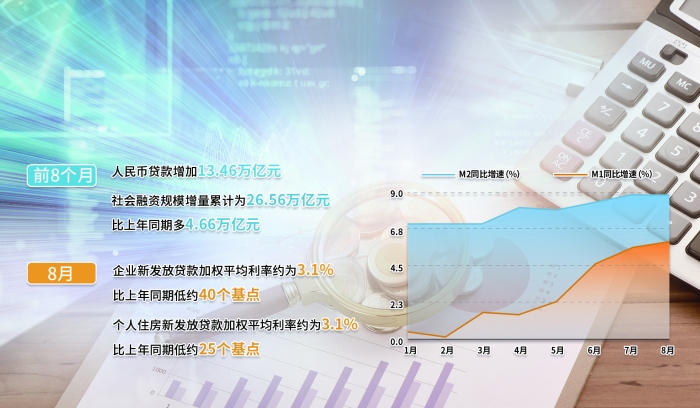
Group 1 - Personal loan growth has been boosted due to traditional summer consumption peaks and policies promoting consumption, leading to increased loan demand [1] - New housing policies in cities like Beijing, Shanghai, and Shenzhen have improved housing demand, resulting in a noticeable increase in personal housing loan consultations and signings [1] - The issuance of special refinancing bonds for replacing local hidden debts reached 1.9 trillion yuan by the end of August, contributing to a higher loan growth rate of approximately 7.8% after adjusting for related impacts [1] Group 2 - The social financing scale reached 433.66 trillion yuan by the end of August, with a year-on-year growth of 8.8%, supported by proactive fiscal policies and moderate monetary policies [2] - Government bond balances increased by 21.1% year-on-year, indicating strong support for social financing growth [2] - M1 and M2 growth rates are narrowing, with M2 at 331.98 trillion yuan and a year-on-year growth of 8.8%, while M1 grew by 6% to 111.23 trillion yuan [2][3] Group 3 - The balance of inclusive small and micro loans reached 35.20 trillion yuan, growing by 11.8%, while medium to long-term loans for manufacturing increased by 8.6% to 14.87 trillion yuan [4] - The weighted average interest rate for new corporate loans was approximately 3.1%, down 40 basis points year-on-year, indicating a favorable lending environment [4] - Analysts expect the macroeconomic environment to remain stable, with a predicted growth target of around 5% for the year, reflecting positive market confidence [4] Group 4 - Structural monetary policy tools are expected to continue playing a role in enhancing financial support for key sectors, while maintaining reasonable total financial growth [5] - The need for optimizing the structure of financial support is emphasized, especially in light of high household leverage and pressure on bank asset quality [5]
8月M1、M2“剪刀差”再创年内新低 更多资金转为活期存款“拿出来花”
Shang Hai Zheng Quan Bao· 2025-09-12 18:42
Group 1 - The core viewpoint of the articles indicates that China's financial metrics, including social financing scale, broad money (M2), and RMB loans, are showing robust year-on-year growth, reflecting a stable financial environment that supports economic activities [2][5][6] - As of the end of August, the social financing scale reached 433.66 trillion yuan, with a year-on-year growth of 8.8%, indicating a strong support for economic activities [5] - The M1 and M2 "scissor difference" has narrowed to 2.8 percentage points, the smallest value this year, suggesting a shift towards more liquid deposits that can facilitate consumption and investment [5][6] Group 2 - The RMB loan balance reached 269.1 trillion yuan by the end of August, with a year-on-year growth of 6.8%, supported by recovering industry sentiment, resilient exports, and seasonal consumption peaks [3][4] - The manufacturing sector has seen a significant increase in loan demand, with new manufacturing loans accounting for 53% of new corporate loans, up 33 percentage points from the previous year [3] - Personal loans have also increased due to traditional summer consumption patterns and policies promoting consumption, indicating a rise in consumer demand [3][4] Group 3 - Recent housing policies in major cities like Beijing and Shanghai have stimulated demand for personal housing loans, leading to a noticeable increase in loan consultations and agreements [4] - The issuance of special refinancing bonds for replacing local government hidden debts reached 1.9 trillion yuan by the end of August, contributing to a higher loan growth rate [4] - The overall loan growth rate, adjusted for the impact of hidden debt replacement, is estimated to be around 7.8%, indicating strong support for the real economy [4] Group 4 - The balance of inclusive small and micro loans reached 35.20 trillion yuan, growing by 11.8%, while medium to long-term loans for manufacturing increased by 8.6%, both outpacing the overall loan growth rate [7] - Loan interest rates remain at historical lows, with the average interest rate for new corporate loans at approximately 3.1%, down about 40 basis points year-on-year [7] - Analysts predict that the macroeconomic environment will continue to support a stable and moderately loose monetary policy, enhancing financial support for key sectors [8][9]
中泰证券:把握煤炭估值修复与业绩弹性双重催化下的投资机会 迎接煤炭上行新周期
Zhi Tong Cai Jing· 2025-09-07 23:27
Core Viewpoint - The coal sector is expected to enter a new upward cycle driven by "loose monetary policy, low interest rates, and improved risk appetite," alongside the "anti-involution" policy that strengthens expectations for capacity reduction [1] Price Review - Coal prices have seen an increase, with long-term contracts still providing strong support - From January to August 2025, coal prices showed a significant year-on-year decline, but after bottoming out in June, a rebound began - Current spot prices: thermal coal (Q5500) at 673 CNY/ton, down 22% year-on-year; coking coal at 1417 CNY/ton, down 35% year-on-year - Long-term contract prices: Qinhuangdao Q5500 at 678 CNY/ton, down 3% year-on-year; Henan premium coking coal at 1532 CNY/ton, down 30% year-on-year - With marginal improvements in supply and demand expected in the second half of 2025, coal prices are anticipated to strengthen amid seasonal fluctuations [2] Supply Side - The effects of "overproduction checks" are becoming evident, reinforcing expectations for supply contraction - Coal production maintained high growth but began to shrink significantly from July 2025 - From January to July 2025, the output of industrial raw coal was 2.78 billion tons, up 3.8% year-on-year; however, July output was 380 million tons, down 3.8% year-on-year, with a month-on-month decline of about 9.5% - The cost-effectiveness of domestic coal is weakening, leading to expectations of reduced import coal volumes; from January to July 2025, coal imports totaled 257 million tons, down 13% year-on-year - The external transportation capacity of Xinjiang coal may have reached its limit, with production expected to be 540 million tons in 2024, up 17.5%, and external transportation via rail at 90.61 million tons, up 50.5% [4][5] Demand Side - Downstream coal demand is increasingly differentiated, with chemical industry demand growth at 12.1%, steel at 0.9%, electricity at -1.8%, and construction materials at -3.1% - Electricity: "thermal power" is lagging, but recovery is expected in the second half of the year; from January to July 2025, national power generation grew by 1.3%, with thermal power down 1.3% - Steel: A growth stabilization plan has been introduced, with daily pig iron production expected to remain high at 2.4 million tons, supporting coal demand growth - Chemical industry: Demand for coal in modern coal chemical processes is expected to continue growing, with stable demand anticipated in the fourth quarter of 2025 - Construction materials: Weakness in the real estate sector is expected to have a diminishing impact on coal consumption demand [6][7][8]

债市 | 迎风而行
Xin Lang Cai Jing· 2025-08-24 14:44
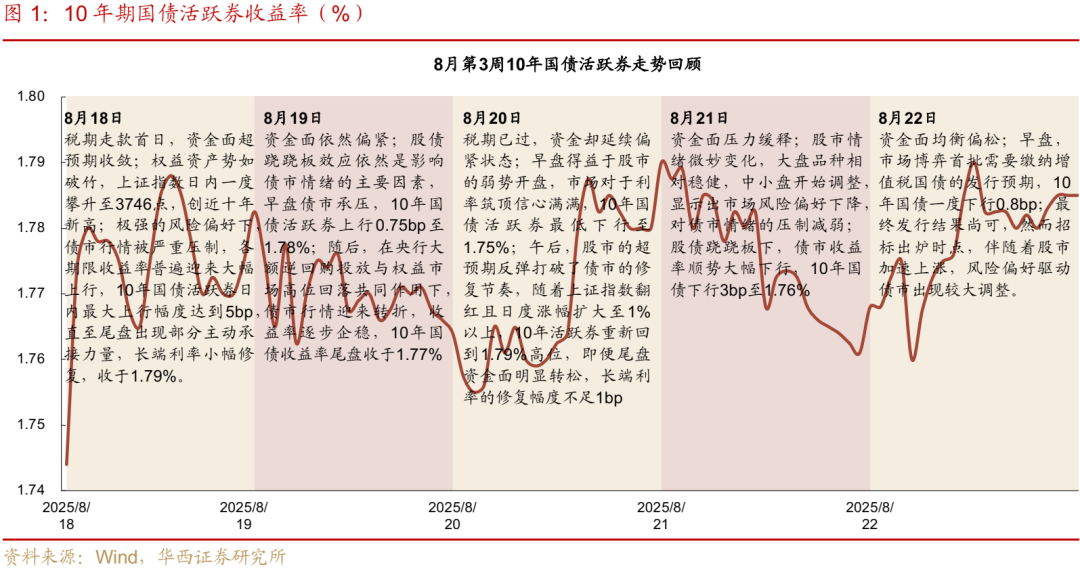
Core Viewpoint - The bond market is experiencing significant pressure due to rising long-term yields and the failure of traditional interest rate pricing frameworks, leading to a state where stock market performance heavily influences bond pricing [1][14][13]. Group 1: Market Dynamics - Since mid-July, the bond market has faced capital losses due to a substantial rise in long-term yields, with 10-year and 30-year government bond yields increasing by 12 basis points and 25 basis points respectively from July 15 to August 22 [13][1]. - The stock market's extreme risk-reward ratio has maintained a rolling 3-month Calmar ratio above 4.0 since July, a level not seen during the previous year's "924" rally, putting additional pressure on the bond market [14][1]. - The bond market is currently in a pricing state dominated by risk appetite, leading to a "look at stocks, act on bonds" approach [1][14]. Group 2: Future Market Logic - Two potential scenarios for the stock market's future are identified: a rapid rise supported by the "93 consensus" or a period of volatility as investors take profits ahead of the September 3 military parade [17][2]. - If the rapid rise scenario occurs, the bond market may face further declines, with long-term rates potentially approaching March highs. Conversely, if the volatility scenario plays out, the bond market could see a recovery as yields decline [17][2]. Group 3: Institutional Behavior and Fund Flows - Institutional behavior indicates a potential for a more optimistic bond market outlook, with reduced net selling of bonds by funds from 358.7 billion yuan in late July to 202.8 billion yuan in mid-August [18][3]. - The bond market is seeing increased buying interest from institutions, including banks and brokerages, as they position for a potential market reversal [18][3]. Group 4: Monetary Policy and Liquidity - The Federal Reserve's dovish signals from the Jackson Hole meeting have shifted market expectations towards potential interest rate cuts, easing global monetary tightening pressures and opening up domestic monetary policy space for rate cuts and liquidity injections [22][3][23]. - The People's Bank of China has been active in maintaining liquidity through reverse repos and MLF operations, indicating a supportive stance for the bond market [4][23]. Group 5: Bond Market Strategy - Current strategies suggest a focus on a "barbell" approach in bond investments, with attention to long-term government bonds and a gradual rebuilding of duration positions as monetary policy space opens up [26][3]. - The average duration of bond funds has been adjusted downwards, indicating a shift in strategy as institutions respond to market conditions [50][3].
华西证券迎风而行
HUAXI Securities· 2025-08-24 13:25
Market Overview - Since mid-July, the bond market has faced significant pressure due to a sharp rise in long-term yields, with 10-year and 30-year government bond yields increasing by 12bp and 25bp respectively from July 15 to August 22[22]. - The traditional pricing framework for bonds has failed, as all three factors—funding, fundamentals, and policy—support a decline in interest rates, yet the market is driven by a single variable: risk appetite[22]. Stock Market Dynamics - The stock market has maintained a strong upward trend, with the rolling 3M Calmar ratio for the Shanghai Composite Index and the Wind All A Shares Index remaining above 4.0 since July, a level not seen during the previous "924" rally[23]. - Two potential scenarios for the stock market are identified: a rapid rise supported by capital inflows or a period of volatility as investors take profits ahead of the September 3 military parade[26]. Institutional Behavior and Bond Market Outlook - Institutional behavior indicates that bond yields may have reached a preliminary value proposition, with net selling by funds decreasing from CNY 3.587 billion in late July to CNY 2.028 billion in mid-August[29]. - The expectation of interest rate cuts is bolstered by dovish signals from Federal Reserve Chair Powell, which has alleviated concerns about a rate hike in September[32]. Liquidity and Monetary Policy - The People's Bank of China (PBOC) has maintained a supportive stance, with timely reverse repos and MLF net injections, suggesting that liquidity conditions are unlikely to reverse sharply in the short term[33]. - The bond market is expected to stabilize as liquidity improves, with September likely seeing a return to lower funding rates[33]. Investment Strategy - A "barbell" strategy is recommended for bond investments, focusing on long-term government bonds and those with a duration of 3.0-3.5 years to balance risk and return[34]. - Institutions have adjusted their duration, with the average duration of bond funds decreasing to 4.47 years as of August 22, down 0.28 years from early August[34].
