
地缘政治

Search documents
2025市场回顾:AI主导全球股市走向,贵金属领跑大宗商品
Di Yi Cai Jing· 2025-12-31 23:25
新一年有哪些风险因素? AI引领股市上扬 经历了对特朗普关税政策的恐慌释放,全球股市自4月初开始触底反弹,摩根士丹利资本国际公司编制 MSCI全球指数全年累计上涨21%——过去七年间,这已是第六次实现两位数年度涨幅。科技板块持续 引领全球行情,半导体与AI相关领域表现尤为突出。 美国三大股指录得连续三年上涨超10%,其中道指涨12.97%,纳指涨20.76%,标普500指数涨16.39%。 自人工智能领域的龙头股英伟达于去年10月成为全球首家市值突破5万亿美元的企业后,科技七巨头的 光环似乎有所褪色。人工智能领域的热潮曾是拉动美股估值上升的重要因素,其中既包括市场对该领域 基础设施建设的巨额投入预期,也涵盖了市场对人工智能应用需求激增的期待。不过近期,市场对人工 智能相关资本支出回报率的质疑情绪升温,拖累科技股及其他人工智能概念股走弱,这一话题也可能成 为2026年市场关注的核心。 | | 2025 年全球主要股市表现 | | | --- | --- | --- | | 美国 | 纳斯达克指数 | +20.76% | | | 标普 500 指数 | +16.39% | | | 道琼斯工业指数 | +12.97 ...


国际地缘政治系列之二:美国国家安全战略对中国矿业的影响
Minmetals Securities· 2025-12-31 14:44
Group 1: U.S. National Security Strategy Changes - The U.S. National Security Strategy (NSS) 2025 marks a significant shift from promoting ideology to defending "Western civilization" and its core territories, emphasizing the importance of mineral resources[1] - The strategy identifies North America as an inviolable core area, while Latin America is viewed as a strategic depth that needs "purification" from external competitors, particularly China[12] - In the Indo-Pacific region, the U.S. aims to curb China through military deterrence and supply chain cooperation with allies like Japan, South Korea, Australia, and India, focusing on economic competition as the decisive factor[15] Group 2: Methods to Contain Chinese Mining - Legal barriers will be implemented through the expansion of "Foreign Entities of Concern" rules, forcing a restructuring of global mining equity and restricting Chinese companies' overseas paths[2] - Financial sanctions will be utilized to cut off financing channels for Chinese companies, block IPOs, and freeze settlement channels, potentially affecting third parties that assist[2] - The U.S. will construct exclusive logistics networks to physically isolate Chinese mining operations and promote standards that exclude Chinese supply chains from high-end markets[2] Group 3: Risk Assessment of Mining Regions - North America is classified as a high-risk area for Chinese mining enterprises, with potential asset confiscation and administrative intervention due to national security concerns[36] - South America is deemed a dangerous zone, where U.S. strategies aim to create operational difficulties for Chinese companies through high tariffs and responsible mining certifications[39] - Africa is identified as a competitive zone, where the U.S. engages in resource competition without seeking to monopolize, allowing for some operational flexibility for Chinese firms[42]
昔日盟友今兵戎相向,沙特与阿联酋在也门公开决裂?
Di Yi Cai Jing· 2025-12-31 11:03
沙特阿拉伯主导的多国联军袭击了在也门的阿联酋船只。 此次遭沙特打击的南方过渡委员会成立于2017年,由时任亚丁省省长祖贝迪成立,组织武装对抗政府。 2020年年底,被国际承认的也门政府与南方过渡委员会组建联合政府,也门南部大部分地区实现了名义 上的统一。 2022年,该组织加入沙特主导的多国联军以打击胡塞武装,且加入也门政府行政机构总统领导委员会, 但仍然坚持要求实现南部地区的"主权",导致其与也门政府在权力分配和资源控制问题上多次发生冲 突。 据新华社报道,2025年12月30日,沙特阿拉伯主导的多国联军,在也门穆卡拉港对从两艘船上卸载的武 器和作战车辆进行了打击,联军说两艘船来自阿联酋。阿联酋则否认船上有武器。 2025年末,也门局势升级,背后沙特与阿联酋的关系也在恶化。 沙特对阿联酋的船只直接动武,使得两国关系骤然紧张。沙特和阿联酋是海湾地区最大的两个经济体, 过往两国虽然在石油额度分配和地缘影响力上有诸多分歧,但在公开场合,都还保持着友好的姿态。 复旦大学中东研究中心研究员邹志强向第一财经记者表示,此次打击是也门反胡塞武装阵营内部矛盾积 累的结果,也是沙特和阿联酋作为反胡塞阵营背后支持者矛盾积累的结果 ...

2025收官:贵金属暴涨,美元重挫10%!2026更疯狂?
Jin Shi Shu Ju· 2025-12-31 09:44
Group 1 - Global stock markets recovered from the April downturn caused by tariffs, rising 21% in 2025, marking the sixth year in seven with double-digit growth [1] - Gold surged nearly 70%, achieving its best annual performance since the 1979 oil crisis, while the dollar fell nearly 10% and oil dropped about 17% [2] - European weapon manufacturers' stock prices soared by 55% due to signals from Trump indicating a reduction in military protection for Europe, prompting rearmament [3] Group 2 - The U.S. bond market was influenced by three interest rate cuts and concerns over debt, with 30-year Treasury yields peaking at over 5.1%, the highest since 2007 [4] - Emerging market currencies experienced a reversal of a 14-year bear market cycle, with significant gains in currencies like the Polish zloty and Czech koruna, which strengthened by 15% to 20% [5] - The anticipated nomination of a new Federal Reserve chair by Trump could significantly impact the central bank's independence [8]
国投期货能源日报-20251231
Guo Tou Qi Huo· 2025-12-31 07:08
Report Industry Investment Ratings - Crude oil: ★★★ (more bullish trend with a relatively appropriate current investment opportunity) [2] - Fuel oil: ★★★ (more bullish trend with a relatively appropriate current investment opportunity) [2] - Low-sulfur fuel oil: ★★★ (more bullish trend with a relatively appropriate current investment opportunity) [2] - Asphalt: ★★★ (more bullish trend with a relatively appropriate current investment opportunity) [2] Core Views - The current fundamental pattern of oil prices is still dominated by oversupply, leading to a downward shift in the oil price center [3] - Geopolitical factors provide short - term support for fuel oil and low - sulfur fuel oil, but do not change the oversupply situation; the market is expected to remain weak [4] - The commercial inventory of asphalt has weak de - stocking, and cost factors provide bottom support [5] Summary by Related Catalogs Crude Oil - The EIA predicts that the average prices of Brent and WTI crude oil in 2026 will be $55/barrel and $51/barrel respectively, and global inventory may increase by over 2 million barrels per day [3] - Geopolitical conflicts lead to pulse - type price increases, but the long - term concern about oversupply persists, and the main tone of loose supply - demand remains unchanged [3] Fuel Oil & Low - Sulfur Fuel Oil - Geopolitical factors such as the slowdown of loading in the Middle East and Russia due to the Russia - Ukraine conflict and sanctions cause short - term market disturbances [4] - The improvement of refinery profit and the US blockade of Venezuelan oil exports may boost the demand for high - sulfur fuel oil as feedstock, but high inventory pressure is significant [4] - Low - sulfur fuel oil supply is expected to gradually recover; demand for marine fuel is weak and the weak trend is difficult to reverse [4] Asphalt - Last week, the commercial inventory of asphalt had weak de - stocking, and the factory inventory ended the de - stocking trend since mid - October and started to increase [5] - The US - Venezuela situation has affected the supply of heavy raw materials, and cost factors provide bottom support for asphalt [5]
港股25年收官:铜、黄金等有色板块大涨,大金融、半导体、创新药集体活跃
Ge Long Hui· 2025-12-31 07:05
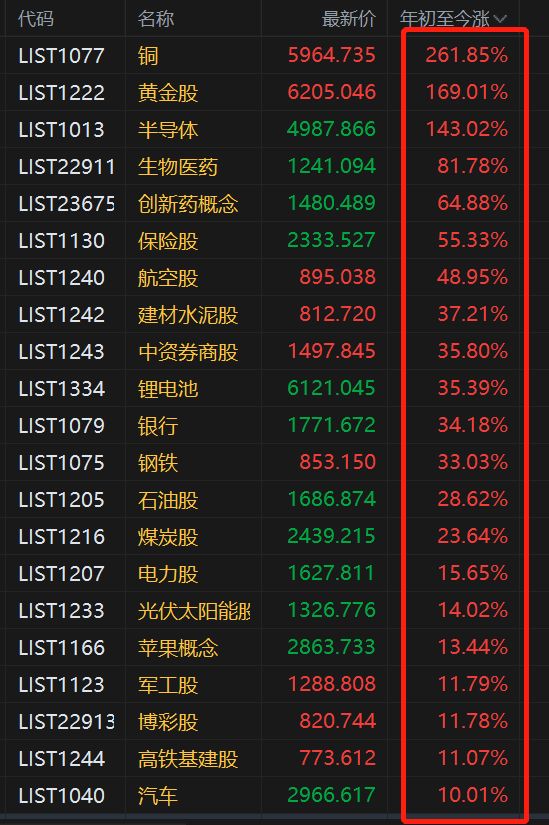
Core Viewpoint - The Hong Kong stock market in 2025 has shown significant performance across various sectors, with the copper sector leading the gains, followed by gold and semiconductors, indicating a strong market response to global re-inflation and geopolitical factors [1] Group 1: Market Performance - The copper sector has seen a remarkable increase of 261.85% year-to-date [2] - Gold stocks have also performed well, with a year-to-date increase of 169.01% [2] - The semiconductor sector has experienced a growth of 143.02% [2] - Other strong performers include biopharmaceuticals (81.78%), innovative drug concepts (64.88%), and insurance stocks (55.33%) [2] Group 2: Market Themes - The strongest theme identified is Resources and Inflation, which includes copper, gold, oil, coal, and steel, reflecting a re-evaluation of the long-term value of resources amid global re-inflation and energy transition [1] - The core theme is Technology and Innovation, represented by semiconductors, innovative concepts, biopharmaceuticals, and lithium batteries, indicating a focus on national industrial upgrades and self-sufficiency [1] - The defensive theme is Financials and Heavy Assets, including insurance, banking, electricity, and infrastructure, which provide stable earnings and high dividend yields amid uncertainty [1]
支撑金价因素依然坚实,关注黄金基金ETF(518800)、黄金股票ETF(517400)回调布局机会
Mei Ri Jing Ji Xin Wen· 2025-12-31 03:38
受到隔夜市场波动影响,12月30日黄金基金ETF(518800)跌2.05%。虽然有观点认为贵金属短期 已经超买,但从中长期来看,支撑金价的降息、去美元化、地缘政治等因素依然坚实。作为资产配置的 一部分,在回调后可能是较好的布局时点。 近期,贵金属价格波动比较剧烈,金价回调一定程度上受到银价溢出效应的影响。在周一夜盘(美 国交易时间),白银现货一度突破84美元/盎司,比上周的收盘价上涨近10%,使得今年以来的涨幅创 下1951年来的记录,但随后快速下跌10%以上。黄金、铂金等贵金属价格也随之回调。 导致这一结果的原因包括但不限于:(1)海外流传中国作为世界第三大白银生产国,可能限制白 银出口,马斯克在X平台发文称"这不是好事,白银在许多工业流程中都是必须的"。这促进了银价早期 的上涨。(2)芝商所将白银期货的保证金上调25%,以应对近期的波动,这可能促使杠杆交易者不得 不部分平仓以符合保证金要求。(3)临近年底,跟踪彭博和标普商品指数的基金将开始调仓,这涉及 数千亿美元的规模,投资者将大概率卖出今年涨幅较多的黄金和白银,以匹配新的权重,一些非指数基 金持有人可能在指数调整前"抢跑"提前卖出。据悉,指数调整将于 ...
也门告急:沙特阿联酋代理人开打,“反胡塞联盟”破裂危及红海局势
Xin Lang Cai Jing· 2025-12-31 03:26
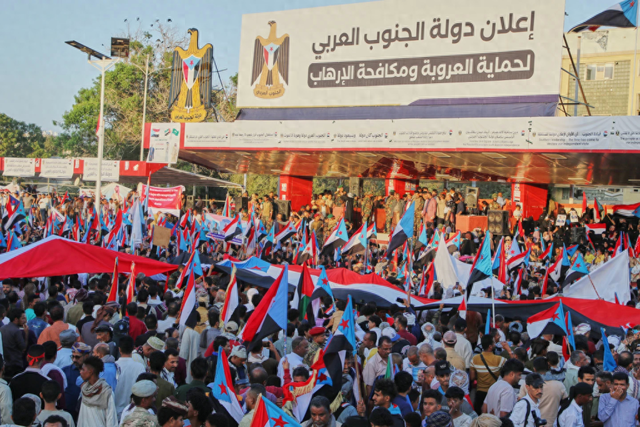
据新华社报道,也门局势12月30日进一步升级,沙特阿拉伯空袭了也门东南部哈德拉毛省首府穆卡拉的 港口;也门总统领导委员会宣布也门全境即日起进入为期90天的紧急状态,并要求所有阿联酋军队及其 人员、南方过渡委员会部队在24小时内撤离也门。 沙特外交部随后发表声明,要求阿联酋响应也门政府的要求,在24小时内撤出其在也门的军事力量,停 止向也门境内任何一方提供任何形式的军事或财政支持。沙特同时指责阿联酋和南方过渡委员会在也门 东南部地区开展军事行动"极其危险",对沙特和也门的国家安全构成威胁,沙特将采取一切必要的应对 措施。 自2021年胡塞武装与沙特领导的国际联军签署停火协议以来,也门内战的冲突已经基本冻结。然而自本 月初以来,阿联酋支持的南方过渡委员会的武装力量夺取了包括也门临时首都亚丁、东南部哈德拉毛省 和迈赫拉省的大片地区,该组织与沙特支持的也门政府之间的紧张关系不断升级。 2025年12月25日,在也门临时首都亚丁,支持南方过渡委员会的民众在集会上挥舞着前南也门国旗。 兰州大学一带一路研究中心特约研究员杨玉龙向智通财经(www.thepaper.cn)表示,南方过渡委员会通 过军事行动接管哈德拉毛省和迈赫 ...
银河期货每日早盘观察-20251231
Yin He Qi Huo· 2025-12-31 02:38
Report Industry Investment Rating No relevant content provided. Core Viewpoints of the Report - The overall market shows a complex and volatile trend at the end of the year. Various factors such as policy, supply - demand, and geopolitical situation affect different sectors. For example, the stock index is expected to maintain a volatile upward trend before the end of the year due to sector rotation; the bond market sentiment is average with limited new information and is waiting for the release of official PMI data; different commodity futures also show different trends based on their own fundamentals and external factors [21][24]. Summary by Category Financial Derivatives - **Stock Index Futures**: The market closes steadily. The index shows a volatile upward trend due to sector rotation. It is recommended to go long on dips, conduct IM/IC futures - ETF arbitrage when the discount widens, and use a bull spread for options [21][22]. - **Treasury Futures**: The performance at the close is differentiated. The market is waiting for the official PMI data. It is recommended to hold short positions in TS and TF lightly and wait and see for arbitrage [24]. Agricultural Products - **Protein Meal**: There is still supply pressure, and the market shows a small - scale shock. It is recommended to lay out a small number of long positions, narrow the MRM spread, and use a short straddle strategy for options [28]. - **Sugar**: The international sugar price drops sharply, and the domestic price follows weakly. It is expected to oscillate near the current platform. It is recommended to wait and see for arbitrage and sell put options [33][34]. - **Oilseeds and Oils**: There is still a lack of obvious drivers, and the rebound space may be limited. It is recommended to hold a light position before the festival, go short after the rebound, and wait and see for arbitrage and options [35]. - **Corn/Corn Starch**: The spot price rises, but the futures price falls from a high level. It is recommended to go long on dips for the 03 and 07 contracts, narrow the 03 corn - starch spread, and wait and see for options [39]. - **Hogs**: The supply pressure decreases, and the spot price continues to be strong. It is recommended to wait and see [42]. - **Peanuts**: The spot price is stable, and the futures price shows a narrow - range shock. It is recommended that the 05 contract oscillates at the bottom, wait and see for arbitrage, and sell the pk603 - C - 8200 option [47]. - **Eggs**: The demand slightly recovers, but the price drops. It is recommended to go long on far - month contracts on dips and wait and see for arbitrage and options [51]. - **Apples**: The demand is average, and the price is mainly stable. It is recommended to oscillate in the short - term range, go long on the 1 contract and short on the 10 contract for arbitrage, and wait and see for options [56]. - **Cotton - Cotton Yarn**: The new cotton sales are good, and the price oscillates strongly. It is recommended that the US cotton oscillates in the range, the Zhengzhou cotton oscillates strongly with a possible short - term callback risk, and wait and see for arbitrage and options [60]. Black Metals - **Steel**: The raw material replenishment starts, and the steel price maintains a range - bound shock. It is recommended to maintain the shock trend, short the coil - coal ratio and the coil - screw spread, and wait and see for options [62][63]. - **Coking Coal and Coke**: They oscillate and wait for new drivers. It is recommended to wait and see mainly or go long on dips lightly, and wait and see for arbitrage and options [66][67]. - **Iron Ore**: The market expectation is repeated, and the price oscillates. It is recommended to oscillate in the short - term [69]. - **Ferroalloys**: The supply - demand margin is expected to improve, and the cost drives the price. It is recommended to go long on dips, wait and see for arbitrage, and sell out - of - the - money put options [72]. Non - ferrous Metals - **Gold and Silver**: They oscillate at a high level. It is recommended to wait and see temporarily [76]. - **Platinum and Palladium**: Pay attention to position management before the New Year's Day holiday. It is recommended to go long on dips, conduct long - platinum and short - palladium arbitrage, and wait and see for options [80][81][82]. - **Copper**: The short - term fluctuation intensifies. It is recommended to control the position, go long on dips in the long - term, and wait and see for arbitrage and options [83]. - **Alumina**: It oscillates mainly after the convergence of the warehouse receipt registration profit. It is recommended to wait and see for arbitrage and options [87]. - **Electrolytic Aluminum**: It oscillates at a high level. It is recommended to go long on dips, pay attention to the arbitrage opportunity of buying spot delivery products and shorting futures, and wait and see for options [91]. - **Cast Aluminum Alloy**: It oscillates at a high level with the sector. It is recommended to wait and see for arbitrage and options [94]. - **Zinc**: Control the position reasonably before the holiday. It is recommended to oscillate widely, wait and see for arbitrage, and wait and see for options [96]. - **Lead**: Pay attention to the impact of funds on the price and control the position reasonably before the holiday. It is recommended to take partial profits on long positions and hold the rest, wait and see for arbitrage, and wait and see for options [99]. - **Nickel**: The news of Indonesia's reduction of nickel ore quotas boosts the price. It is recommended to treat it as an upward trend before a significant inventory build - up, wait and see for arbitrage, and wait and see for options [100][101][102]. - **Stainless Steel**: It follows the nickel price and runs strongly. It is recommended to follow the nickel price to go long and wait and see for arbitrage [105]. - **Industrial Silicon**: It rebounds in the short - term and goes short on rallies in the medium - term. It is recommended to go short on rallies, conduct long - polysilicon and short - industrial silicon arbitrage, and sell out - of - the - money call options [106]. - **Polysilicon**: The long - term fundamentals are favorable, but the short - term trading volume shrinks. It is recommended to be cautious, conduct long - polysilicon and short - industrial silicon arbitrage, and sell put options [108]. - **Lithium Carbonate**: The subsidy policy boosts the sentiment. It is recommended to control the position and be cautious, wait and see for arbitrage, and wait and see for options [110]. - **Tin**: Some long - position funds take profits, and the price drops sharply. It is recommended to oscillate widely after the sharp drop and wait and see for options [113]. Shipping - **Container Shipping**: The MSK's price increase slightly exceeds expectations, and it is expected to oscillate at a high level in the short - term. It is recommended to take most profits on long positions of the EC2602 contract and hold the rest lightly, and wait and see for arbitrage [114][115]. Energy and Chemicals - **Crude Oil**: The market trading is light at the end of the year, and geopolitical conflicts cause fluctuations. It is recommended to oscillate widely, conduct relevant arbitrage, and wait and see for options [117][118]. - **Asphalt**: The raw material contradiction is difficult to resolve, and the price oscillates strongly. It is recommended to oscillate, wait and see for arbitrage, and wait and see for options [123]. - **Fuel Oil**: The near - end fundamentals of high - and low - sulfur fuel oils are weak. It is recommended to go short, conduct relevant arbitrage, and wait and see for options [126]. - **LPG**: The upward space is limited. It is recommended to go short on far - month contracts, wait and see for arbitrage, and wait and see for options [130]. - **PX & PTA**: The polyester sales and cost weaken, and the price drops from a high level. It is recommended to oscillate at a high level in the short - term, conduct relevant arbitrage, and wait and see for options [132]. - **BZ & EB**: The pure benzene inventory build - up pressure slows down, and the supply - demand contradiction is not significant. It is recommended to oscillate strongly, conduct short - pure benzene and long - styrene arbitrage, and wait and see for options [136]. - **Ethylene Glycol**: The port inventory continues to rise. It is recommended to oscillate widely in the short - term and weakly in the medium - term, wait and see for arbitrage, and sell call options [139]. - **Short - Fiber**: The processing fee is under pressure. It is recommended to oscillate, wait and see for arbitrage, and wait and see for options [141]. - **Bottle Chips**: The supply - demand is relatively loose. It is recommended to oscillate, wait and see for arbitrage, and wait and see for options [143]. - **Propylene**: The supply pressure is large, and the downstream product profits are differentiated. It is recommended to oscillate widely, wait and see for arbitrage, and sell both call and put options [146]. - **Plastic PP**: The PP inventory build - up rate slows down. It is recommended to hold long positions of the L 2605 contract, wait and see for the PP 2605 contract, conduct relevant arbitrage and wait and see, and sell and hold the PP2605 put option [148][149]. - **PVC**: It oscillates mainly. It is recommended to rebound continuously, wait and see for arbitrage, and wait and see for options [152]. - **Methanol**: It rises strongly. It is recommended to go long on the 05 contract, conduct relevant arbitrage, and sell put options on dips [154][155]. - **Urea**: It oscillates widely. It is recommended to pay attention to relevant policies and wait and see for relevant operations [157][158]. - **Natural Rubber and 20 - Number Rubber**: The global economic data continues to improve. It is recommended to go short in the short - term, wait and see for arbitrage, and wait and see for options [162]. - **Butadiene Rubber**: The chemical industry production slowdown continues. It is recommended to hold short positions of the BR 03 contract, conduct relevant arbitrage, and wait and see for options [165].
中辉有色观点-20251231
Zhong Hui Qi Huo· 2025-12-31 02:09
中辉有色观点 | | 11 | BEAT A ST 10 | 1 | | --- | --- | --- | --- | | I | | 10.65 1994 - 1 | 20 3 | 金银:会议纪要带来降息预期走高,反弹 | | | 资料来源:Wind,中辉期货 盘面表现:今年以来,贵金属抢眼,供需失衡、美联储降息以及交割月大逼仓致使资金涌入 共同催生了本轮的银铂钯"疯涨"行情。过热之后盘面尚在调整阶段。 ①美联储议息会议纪要公布。今日凌晨,美联储公布的12月会议纪要显示, FOMC在12月 会议上同意降息,但官员们分歧严重。一些与会者表示,根据他们的经济展望,在本次会议 下调利率区间后,可能需要在一段时间内保持目标利率区间不变。纪要同时显示,如果通胀 如预期般逐步下降,大多数官员认为进一步降息是合适的。委员们一致认为,准备金余额已 经下降到充足的水平,委员会将根据需要开始购买短期国债,以持续保持充足的准备金供应 。他们还同意取消对常备回购操作的总额限制。市场认为2026年或降息60个基点。 ②俄乌变数较多。据报道,当泽连斯基提议将15年期限延长至少一倍时,特朗普回应称"会 考虑一下"。泽连斯基表示,他认为 ...