
供需格局

Search documents
焦炭,成本支撑较强
Bao Cheng Qi Huo· 2025-11-06 07:50
Report Industry Investment Rating No information provided Core View The supply of coke remains stable at a high level, demand continues to weaken, and the supply-demand pattern is weak, suppressing coke prices. However, the cost support for coke is strong, and the "weak reality" and "high cost" continue to compete. It is expected that coke prices will continue to fluctuate within a range [6] Summary by Relevant Catalogs Price Performance - Since mid - October, coke futures and spot prices have risen synchronously. The futures main contract reached a maximum of 1,818.5 yuan/ton, approaching the annual high. Recently, due to weaker market sentiment, the futures price has declined but remains at a relatively high level. The spot price is also strong, with the third round of price increases by coke enterprises implemented, and the cumulative increase in port spot ex - warehouse prices reaching 150 yuan/ton [2] Supply Situation - Coke supply is stable at a high level. As of the week ending October 31, the daily average coke output of all - sample independent coke enterprises was 64.59 tons, with a capacity utilization rate of 73.44%, down 2.17 tons and 2.48 percentage points respectively compared to mid - September. The daily average coke output of 247 steel mills was 46.21 tons, rising for two consecutive weeks. The combined daily average output of steel mills and coking plants was 110.80 tons, down 2.27% from the previous high. However, due to poor profitability of coke enterprises and production restrictions in some areas, short - term supply is difficult to increase significantly [3] Demand Situation - Coke demand continues to weaken. Although steel demand has rebounded during the peak season, it has not alleviated the contradictions in the steel industry. With production restrictions, steel mills have increased production cuts, and the demand for raw materials such as coke has continued to decline. As of the week ending October 31, the daily average hot metal output of 247 steel mills was 236.36 tons, declining for five consecutive weeks with an expanding decline. The proportion of profitable steel mills among 247 steel mills was 45.02%, declining for 12 consecutive weeks with a cumulative decline of 23.38 percentage points [4] Cost Support - Rising coal prices have continuously increased the production cost of coke, providing strong support for its price. As of the week ending October 31, the approved capacity utilization rate of 523 coking coal mine samples was 84.78%, and the daily average raw coal output was 190.33 tons, down 1.72 percentage points and 3.80 tons respectively compared to the end of September. Low supply has led to continuous depletion of coking coal inventory, and the current raw coal and clean coal inventories have reached new lows. The low - supply state of domestic coking coal is expected to continue, and with low inventory, coking coal prices are relatively firm [5]
黑色建材日报:市场情绪一般,黑色震荡运行-20251106
Hua Tai Qi Huo· 2025-11-06 03:12
Report Industry Investment Rating No relevant content provided. Core Viewpoints - The market sentiment is average, and the black commodities are oscillating. Steel prices are running weakly, iron ore prices face downward pressure but are difficult to show a trend direction in the short - term, coking coal prices are oscillating, and power coal prices are rising [1][3][4][6] Summary by Related Catalogs Steel Market Analysis - Yesterday, the main contract of rebar closed at 3,024 yuan/ton, and the main contract of hot - rolled coil closed at 3,253 yuan/ton, continuing the weak oscillation. The overall performance of spot steel transactions was average, with the total national building materials trading volume at 9.39 tons, still maintaining a low trading volume [1] Supply - Demand and Logic - The cost - side support for rebar remains, and the policy side needs further observation. Under the current fundamentals, the futures market will continue the weak oscillation pattern. The consumption of hot - rolled coils still has certain resilience. The iron water flows to hot - rolled coils, so the production is at a relatively high level. Since steel mills currently have profits, their willingness to reduce production is low. In November, the number of planned maintenance and production reduction of steel mills increases, and there are also environmental protection restrictions in the north from time to time [1] Strategy - Unilateral: Oscillating weakly; No strategies for inter - period, inter - variety, spot - futures, and options [2] Iron Ore Market Analysis - Yesterday, the iron ore futures prices oscillated. In the spot market, the prices of mainstream imported iron ore varieties fluctuated slightly. The enthusiasm of traders to offer was average, and the quotes mostly followed the market. Steel mills' purchases were mainly for rigid demand. The cumulative transaction volume of iron ore at major national ports was 1.088 million tons, a month - on - month decrease of 25.53%; the cumulative transaction volume of forward - looking spot was 1.499 million tons, a month - on - month increase of 107.62% [3] Supply - Demand and Logic - This week, the arrival volume of iron ore at ports rebounded significantly, a month - on - month increase of 58.6%. The current overall valuation of iron ore is neutral, and the supply - demand pattern of iron ore is changing from tight balance to looseness. The iron ore price faces downward pressure, but it is difficult to show a trend direction in the short - term under the support of downstream restocking demand. With the loss and production reduction of steel mills, the resilience of the demand side of iron ore has loosened, and the iron ore price faces correction pressure. Attention should be paid to the molten iron production and downstream inventory changes in the future [3] Strategy - Unilateral: Oscillating weakly; No strategies for inter - period, inter - variety, spot - futures, and options [3] Coking Coal and Coke Market Analysis - Yesterday, the coking coal and coke futures markets showed an oscillating and sorting trend, with obvious price differentiation between contracts. The closing prices of the main contracts of coking coal and coke both declined slightly. For imported Mongolian coking coal, the recent customs clearance volume has rebounded rapidly, the quotes fluctuate and adjust with the futures market, the trading volume is average, and the market is mostly in a cautious wait - and - see state [4] Logic and Viewpoints - For coking coal, the domestic mine supply has not fully recovered, but the recent rapid rebound of Mongolian coking coal customs clearance volume has a certain impact on the short - term price. From the perspective of inventory, the inventory at all links in the industry is at a medium - low level, and the coking coal inventory is significantly lower than the same period last year, which supports the market fundamentals to maintain resilience. The market's expectation of the subsequent rise of raw material prices continues to increase. The continuous rise of thermal coal spot prices further strengthens the support for coking coal prices. For coke, the supply has shrunk, the third round of price increase is still in progress, and the downstream steel enterprises on the demand side still mainly purchase for rigid demand. Attention should be paid to the implementation of the new round of coke price increase, the steel mills' production reduction plans, and the recovery progress of coking coal supply [5] Strategy - Coking coal: Oscillating; Coke: Oscillating; No strategies for inter - period, inter - variety, spot - futures, and options [5] Power Coal Market Analysis - In the production areas, the coal prices are still strong, and the supply is still tight. With the railway transportation discount again, the platforms and traders are actively pulling and transporting, and the miners' inventory has been at a low level for a long time. Miners are optimistic about the future price increase recently, believing that the supply - demand mismatch is difficult to change in the short - term. At the ports, the port transactions are still mainly long - term agreements. Affected by the upstream price increase, the traders' quotes remain high, but the downstream acceptance of high - priced coal is low. Currently, it is difficult to find low - priced coal at the ports, the inventory accumulation is less than expected, the downstream demand is good, and the short - term price will mainly rise. In terms of imports, the recent import coal market has been actively tendering, the domestic - foreign price difference is large, there is a certain profit in imported coal, and the center of the recently awarded bid prices has also risen [6] Demand and Logic - Affected by the tight supply in the production areas, the short - term price will oscillate strongly. In the long - term, the pattern of loose supply remains unchanged, but the winter heating peak season is coming, and the non - power demand of the downstream is strong. Attention should be paid to the overall consumption and restocking situation in the future [6] Strategy - No strategy provided [6]
焦炭成本支撑较强
Qi Huo Ri Bao· 2025-11-05 23:31
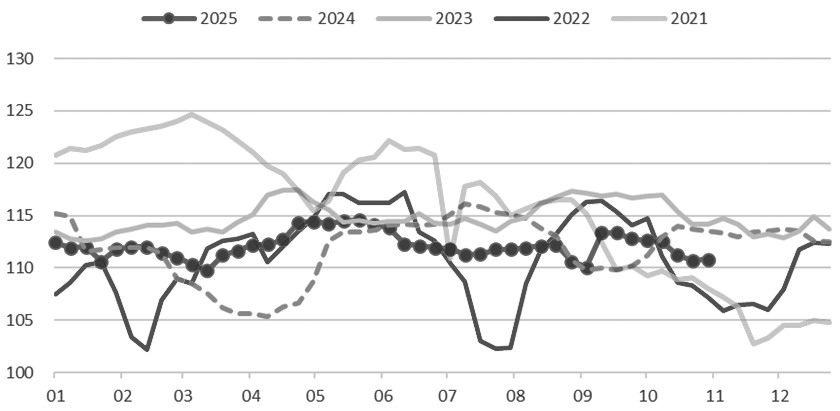
Core Insights - Since mid-October, both coking coal futures and spot prices have risen, with futures reaching a peak of 1818.5 yuan/ton, approaching the year's high. However, recent market sentiment has weakened, leading to a price pullback while remaining at relatively high levels [1] - Coking coal supply remains stable at high levels, with average daily production at 645,900 tons and a capacity utilization rate of 73.44%. Despite a slight decrease in production, the overall supply remains robust due to downstream steel mills' restocking and decent shipment conditions from coking enterprises [2] - Coking coal demand continues to weaken, with average daily pig iron production dropping to 2,363,600 tons, marking a five-week decline. The profitability of steel mills has deteriorated, with only 45.02% of mills reporting profits, a drop of 23.38 percentage points over 12 weeks [3] Supply Dynamics - Coking coal supply is stabilizing at high levels, with production costs rising due to increasing coking coal prices. Despite price hikes by coking enterprises, profitability remains poor, with 64% of coking enterprises reporting losses [2][5] - The average daily production of coking coal is 1,903,300 tons, with a utilization rate of 84.78%. The low supply has led to a decrease in coal inventories, with raw coal inventory at 4,316,100 tons, down 122,600 tons from the previous month [5][8] Demand Trends - The demand for coking coal is declining, exacerbated by production cuts in steel mills. The overall steel industry remains under pressure, with high inventory levels and significant de-stocking pressure [3] - Despite a seasonal uptick in steel demand, it has not alleviated the underlying issues within the steel industry, leading to a continued decline in coking coal demand [3] Price Outlook - The coking coal market is characterized by a weak supply-demand balance, which is expected to exert downward pressure on coking coal prices. However, strong cost support from rising production costs may lead to a range-bound price movement [6]

新能源及有色金属日报:整体商品情绪偏弱,工业硅多晶硅盘面回落-20251105
Hua Tai Qi Huo· 2025-11-05 03:05
Report Industry Investment Rating No relevant information provided. Core Viewpoints - The overall sentiment in the commodity market is weak, leading to a decline in the industrial silicon and polysilicon futures markets. For industrial silicon, the current low valuation may present an opportunity for price increases if relevant policies are introduced. For polysilicon, the market is affected by anti - involution policies and weak reality, with limited upside potential and expected to remain in a wide - range oscillation [3][7]. Summary by Related Content Industrial Silicon Market Analysis - On November 4, 2025, the industrial silicon futures price dropped. The main contract 2601 opened at 9,130 yuan/ton and closed at 8,885 yuan/ton, a change of - 210 yuan/ton (- 2.31%) from the previous settlement. The position of the 2511 main contract was 242,153 lots at the close, and the total number of warehouse receipts was 45,823 lots, a decrease of 338 lots from the previous day [1]. - The spot price of industrial silicon remained stable. In November, the supply is expected to increase as some maintenance devices resume production, while demand shows no significant change, resulting in an oversupply situation. Although the cost of industrial silicon has been oscillating slightly upward recently, it can only provide short - term support for the price of DMC and cannot drive a substantial price rebound [1][2]. - In October 2025, China's industrial silicon production was 452,200 tons, a month - on - month increase of 31,400 tons (7.5%) and a year - on - year decrease of 17,600 tons (4%). From January to October 2025, the cumulative production of industrial silicon was 3.4699 million tons, a year - on - year decrease of 16.6% [1]. Strategy - The intraday correction was mainly affected by the overall commodity sentiment. Production cuts started in the southwest at the end of October, and the supply - demand pattern may improve. The industrial silicon futures market is currently oscillating based on the overall commodity sentiment and policy news. If relevant policies on capacity exit are introduced, there may be room for price increases. Short - term interval trading is recommended, and long positions can be taken at low prices for contracts during the dry season [3]. Polysilicon Market Analysis - On November 4, 2025, the main contract 2601 of polysilicon futures declined, opening at 56,000 yuan/ton and closing at 53,715 yuan/ton, a 3.91% decrease from the previous trading day. The position of the main contract was 128,876 lots (143,844 lots the previous day), and the trading volume was 274,348 lots [4]. - The spot price of polysilicon weakened slightly. The inventory of polysilicon manufacturers and silicon wafers increased. The latest statistics show that the polysilicon inventory was 261,000 tons, a month - on - month increase of 1.16%, and the silicon wafer inventory was 18.93GW, a month - on - month increase of 2.49%. The weekly production of polysilicon was 28,200 tons, a month - on - month decrease of 4.41%, and the silicon wafer production was 14.24GW, a month - on - month decrease of 3.32%. In October, the polysilicon production was about 133,500 tons, an increase from September, exceeding market expectations. In November, production in the southwest region will be significantly reduced, and production is expected to decline [4][5]. Strategy - The supply - demand fundamentals of polysilicon are average, with significant inventory pressure. Both supply and demand may decrease starting in November. The futures market is affected by anti - involution policies and weak market reality. Policy implementation and the downward transmission of spot prices need to be continuously monitored. It is expected that relevant policies will be introduced this year. Without significant improvement in consumer demand, the upside potential of the futures market is limited, and it is expected to remain in a wide - range oscillation. Short - term interval trading is recommended, and the 12 - contract is expected to oscillate between 50,000 and 57,000 yuan/ton [7].
黑色建材日报:市场情绪不佳,钢价延续跌势-20251105
Hua Tai Qi Huo· 2025-11-05 02:35
Report Industry Investment Rating - No industry investment rating provided in the reports. Core Viewpoints - The steel market has poor sentiment, and steel prices continue to decline. The iron ore market has weakening demand expectations, and prices are oscillating downward. The coking coal and coke market has average sentiment, and prices are oscillating downward. The动力煤 market has prices rising, with short - term upward momentum [1][3][5][7]. Summary by Commodity Steel Market Analysis - Futures and spot: The main contract of rebar closed at 3044 yuan/ton, and that of hot - rolled coil at 3265 yuan/ton. The overall spot steel trading was average, with the total national building materials trading volume at 9.27 tons. The trading volume in the East China region decreased significantly, while that in the North and South increased slightly [1]. - Supply and demand logic: The cost of rebar still provides support, and there is a possibility of more favorable policies. The profit of hot - rolled coil is better than that of rebar, so the output is relatively high. As steel mills have profits, the willingness to cut production is low. In November, the number of planned maintenance and production cuts by steel mills increases, and there are occasional environmental protection restrictions in the North [1]. Strategy - Unilateral: Oscillating weakly [2]. Iron Ore Market Analysis - Futures and spot: The iron ore futures price oscillated downward, and the prices of mainstream imported iron ore varieties declined slightly. Traders' enthusiasm for quoting was average, and steel mills' procurement was mainly for rigid demand. The total national main port iron ore trading volume was 146.1 tons, a 12.99% increase from the previous period; the forward - looking spot trading volume was 72.2 tons, a 22.57% decrease [3]. - Supply and demand logic: The arrival volume of iron ore this week increased significantly by 58.6%. The overall iron ore valuation is neutral, the supply - demand pattern is marginally weakening and generally loose, and the ore price is under downward pressure. However, supported by downstream restocking demand, there is no clear trend in the short term. With steel mills' loss - driven production cuts, the resilience of iron ore demand has weakened, and the price faces correction pressure [3]. Strategy - Unilateral: Oscillating weakly [4]. Coking Coal and Coke Market Analysis - Futures and spot: The black commodity sector oscillated weakly, and the closing prices of coking coal and coke futures both declined slightly. The customs clearance volume of imported Mongolian coal continued to rise to a high level, and the trading atmosphere was average, with downstream players mainly in a wait - and - see mode [5]. - Logic and view: For coking coal, due to safety inspections, the supply in some producing areas has not fully recovered, and the overall output is low, with the supply shortage pressure not significantly alleviated. On the demand side, downstream procurement is mainly for rigid demand, but the expectation of a new round of coke price increases has risen, and the inventory - building willingness of some enterprises has increased. For coke, affected by the rising coal price, coke enterprises are still operating at a loss, and some have maintenance plans, so the supply has contracted to some extent. On the demand side, the price of finished steel has declined recently, and the profit of steel mills has shrunk significantly, but the market's expectation of rising raw material prices has increased, and the procurement plan has increased compared with before, providing some support for the coke price [6]. Strategy - Coking coal: Oscillating [6]. - Coke: Oscillating [6]. 动力煤 Market Analysis - Futures and spot: In the producing areas, the coal price is still strong. Affected by safety inspections, the supply is tight. Downstream procurement is active, and the inventory of coal mines is decreasing. Miners believe that due to safety inspections and heating demand, the supply - demand mismatch will continue, and the price is difficult to decline in the short term. At ports, affected by the rising upstream prices, the quoted prices are firm, but downstream procurement is mainly for rigid demand and is resistant to high - priced coal. Although railway transportation has increased and port inventory has accumulated, the accumulation rate is low. With the continuous price increase of upstream coal mines, the arrival cost has risen, so there is a shortage of low - priced coal resources, and the price will continue to rise in the short term. In the import market, the price is also strong, and the price difference between domestic and imported coal is still large, so imported coal still has an advantage [7]. - Demand and logic: Affected by the situation in the producing areas, the price will oscillate strongly in the short term. In the long - term, the supply is still in a loose pattern, but with the approaching of the winter heating season, attention should be paid to the consumption and restocking of non - power coal [7]. Strategy - No strategy provided [7].
合成橡胶:成本坍塌,弱势运行
Guo Tai Jun An Qi Huo· 2025-11-04 01:54
Report Industry Investment Rating - The trend strength of synthetic rubber is -1, indicating a bearish outlook. The取值 range of trend strength is [-2, 2], with -2 being the most bearish and 2 being the most bullish [3]. Report's Core View - The domestic butadiene market continues to decline. With ample supply, downstream support is limited, and the short - term market expectation is bearish. The short - and medium - term fundamentals of butadiene are downward, and the spot price center is gradually moving down. The cost reduction of butadiene drives down the dynamic valuation range of cis - butadiene rubber. Under the background of a neutral fundamental pattern of cis - butadiene rubber itself, the futures price reflects the expectation of price - profit contraction. With weak macro - driving and weak industrial chain fundamentals, cis - butadiene rubber is in a weak operation. Attention should be paid to whether the supply - demand pattern of cis - butadiene rubber will improve in November [2][3]. Summary by Relevant Catalogs 1. Fundamental Tracking - **Futures Market**: The closing price of the 12 - contract of cis - butadiene rubber decreased by 225 yuan/ton to 10,360 yuan/ton. The trading volume increased by 31,566 hands to 149,850 hands, the open interest decreased by 3,695 hands to 37,796 hands, and the trading volume increased by 150,980 ten - thousand yuan to 782,908 ten - thousand yuan [1]. - **Spread Data**: The basis of Shandong cis - butadiene minus the futures main contract increased by 125 to 340, the monthly spread of BR11 - BR12 increased by 30 to 65. The prices of North China, East China, and South China cis - butadiene (private) decreased by 200 - 250 yuan/ton [1]. - **Spot Market**: The market price of Shandong cis - butadiene (delivery product) decreased by 100 yuan/ton to 10,700 yuan/ton. The prices of Qilu styrene - butadiene rubber (models 1502 and 1712) decreased by 50 - 100 yuan/ton. The mainstream prices of butadiene in Jiangsu and Shandong decreased by 200 - 255 yuan/ton [1]. - **Fundamentals**: The operating rate of cis - butadiene remained unchanged at 67.2943%. The theoretical full cost of cis - butadiene decreased by 309 yuan/ton to 9,916 yuan/ton, and the profit decreased by 191 yuan/ton to 584 yuan/ton [1]. 2. Industry News - **Butadiene Market**: The domestic butadiene market continues to decline. Due to ample supply, the support from downstream demand is limited. The short - term market expectation is bearish. The delivery price in Shandong's Luzhong area is about 7,090 - 7,300 yuan/ton, and the ex - tank self - pick - up price in East China is about 6,900 - 7,100 yuan/ton [2]. - **Butadiene Inventory**: As of October 29, the latest inventory of butadiene in East China ports is about 32,000 tons, an increase of 7,400 tons compared to the previous period. The inventory in sample ports has significantly increased due to the arrival of imported ships and the accumulation of some trade inventories. Merchants expect the import volume in November to remain ample [2][3]. - **Market Outlook**: The short - term weakness of butadiene drives down the dynamic valuation range of cis - butadiene rubber. The short - and medium - term fundamentals of butadiene are downward, and the spot price center is gradually moving down. The cost reduction of butadiene leads to an obvious expansion of the processing profit of cis - butadiene rubber. Under the background of a neutral fundamental pattern of cis - butadiene rubber itself, the futures price reflects the expectation of price - profit contraction. With weak macro - driving and weak industrial chain fundamentals, cis - butadiene rubber is in a weak operation. Attention should be paid to whether the supply - demand pattern of cis - butadiene rubber will improve in November [3].
新能源及有色金属日报:库存继续去化,碳酸锂短期仍有支撑-20251031
Hua Tai Qi Huo· 2025-10-31 02:50
Report Summary 1. Report Industry Investment Rating No relevant content provided. 2. Core View of the Report The short - term supply - demand pattern of lithium carbonate is favorable due to continued inventory depletion, consumption exceeding expectations, and slower - than - expected resumption of production at previously shut - down mines, providing some support to the market. However, attention should be paid to consumption and inventory inflection points. If consumption weakens and mine production resumes, the inventory may shift from depletion to accumulation, causing the market to decline [4]. 3. Summary by Related Catalogs Market Analysis - On October 30, 2025, the lithium carbonate main contract 2601 opened at 83,120 yuan/ton and closed at 83,400 yuan/ton, with a 1.19% change in the closing price compared to the previous day's settlement price. The trading volume was 829,117 lots, and the open interest was 532,871 lots (506,882 lots the previous day). The current basis was - 3,780 yuan/ton, and the lithium carbonate warehouse receipts were 27,641 lots, a change of 116 lots from the previous day [2]. - According to SMM data, the price of battery - grade lithium carbonate was 78,200 - 81,800 yuan/ton, a change of 850 yuan/ton from the previous day; the price of industrial - grade lithium carbonate was 77,300 - 78,300 yuan/ton, also a change of 850 yuan/ton. The price of 6% lithium concentrate was 985 US dollars/ton, a change of 30 US dollars/ton from the previous day. The downstream material factory's operating rate is rising, and demand supports spot transactions. New production lines have been put into operation at both the spodumene and salt - lake ends, and the total lithium carbonate production in October is expected to have growth potential. The power market (new energy vehicles) and the energy - storage market are both booming [2]. - On the afternoon of October 30, the auction of Albemarle spodumene concentrate ended. The auction item was 16,400 dry tons of 5.21% spodumene concentrate from Wodgina, with an actual transaction price of 7,058 yuan/ton (tax - included, self - pick - up from Zhenjiang Port) [2]. Inventory Situation - According to the latest weekly statistics, the weekly production decreased by 228 tons to 21,080 tons. The production from spodumene and mica decreased slightly, while the production from salt - lakes and recycling increased slightly. The weekly inventory decreased by 3,008 tons to 127,358 tons. The inventory of smelters and downstream decreased, while the inventory in the intermediate links increased slightly. Recent consumption has strongly supported inventory depletion [3]. Strategy - Short - term: It is advisable to wait and see. Pay attention to inventory and consumption inflection points and choose the opportunity to sell hedging at high prices. It is expected that the willingness of upstream to hedge will increase when the price reaches 85,000 yuan/ton [4]. - For cross - period, cross - variety, spot - futures, and options, there are no relevant strategies provided [5].
农产品日报:上下空间受限,板块整体震荡-20251031
Hua Tai Qi Huo· 2025-10-31 02:46
1. Report Industry Investment Ratings - All three industries (cotton, sugar, and pulp) are rated as neutral [2][5][7] 2. Core Views of the Report - The global cotton market's supply - demand pattern is expected to be loose in the new year, with short - term external markets under pressure and long - term attention on US cotton production and export. In China, short - term cotton price upward space is limited, but long - term prospects are optimistic due to low initial inventory and consumption resilience [2] - The global sugar market in the 25/26 season may be in a bear cycle. Brazilian sugar production may decline in the short term, but long - term rebound is restricted. In China, short - term sugar price rebound space is limited, and the lower space is also restricted [4][5] - The pulp market has a supply - demand imbalance with loose supply and weak demand. The pulp price is expected to remain in a low - level oscillation, and attention should be paid to the actual demand in the peak season [6][7] 3. Summary by Relevant Catalogs Cotton Market News and Key Data - Futures: Cotton 2601 contract closed at 13,600 yuan/ton yesterday, down 20 yuan/ton (-0.15%) from the previous day. Spot: 3128B cotton in Xinjiang factory price was 14,658 yuan/ton, up 8 yuan/ton; national average price was 14,843 yuan/ton, up 3 yuan/ton [1] - India's cotton production is expected to increase to 530 - 570 million tons, and new cotton arrivals are increasing [1] Market Analysis - Internationally, the global cotton market supply - demand will be loose, with short - term external markets under pressure. Domestically, old - season cotton inventory is low, but new cotton supply is increasing. Short - term cotton price upward space is limited, and long - term prospects are optimistic [2] Strategy - Adopt a neutral strategy. Short - term, the cotton price may test the previous low, and long - term, it can be optimistically viewed after the seasonal pressure [2] Sugar Market News and Key Data - Futures: Sugar 2601 contract closed at 5472 yuan/ton yesterday, down 22 yuan/ton (-0.40%) from the previous day. Spot: Sugar price in Nanning, Guangxi was 5750 yuan/ton; in Kunming, Yunnan was 5720 yuan/ton [3] - Brazil's central - southern region in the first half of October crushed 34.037 million tons of sugarcane, up 0.3% year - on - year, and produced 2.484 million tons of sugar, up 1.25% year - on - year [3] Market Analysis - Internationally, Brazilian sugar production may decline in the short term, but long - term rebound is restricted. In China, short - term sugar price rebound space is limited, and the lower space is also restricted [4][5] Strategy - Adopt a neutral strategy. Pay attention to whether 5400 can form a phased support [5] Pulp Market News and Key Data - Futures: Pulp 2601 contract closed at 5224 yuan/ton yesterday, down 18 yuan/ton (-0.34%) from the previous day. Spot: Chilean Silver Star softwood pulp in Shandong was 5500 yuan/ton; Russian softwood pulp was 4990 yuan/ton [5] - Imported wood pulp spot market prices were basically stable, with only individual fluctuations [6] Market Analysis - Supply is loose, with overseas production reduction plans having limited impact and domestic imports increasing. Demand is weak both globally and in China, with low paper mill operating rates and over - capacity in the paper industry [6] Strategy - Adopt a neutral strategy. The pulp price is expected to remain in a low - level oscillation, and attention should be paid to the actual demand in the peak season [7]
能源化工日报-20251031
Wu Kuang Qi Huo· 2025-10-31 01:11
Report Industry Investment Rating No relevant content provided. Core Viewpoints - The short - term outlook for oil prices is not overly bearish. Maintain a range - trading strategy of buying low and selling high, but currently suggest short - term waiting and observing to see if OPEC's exports decline when oil prices fall [2]. - For methanol, with high port inventories, increasing supply, and weakening demand, the high - inventory issue may lead to further price drops. It is recommended to wait and see [3]. - Regarding urea, the supply and demand are both increasing, but the market is in a relatively loose pattern. There is limited upward momentum, and the price downside is also restricted. Pay attention to price rebounds due to short - term demand improvements [6]. - For rubber, the price is weakening. It is recommended to conduct short - term trading and partially build positions for the hedging strategy of buying RU2601 and selling RU2609 [11]. - For PVC, the domestic supply is strong while demand is weak, and the export outlook is poor. There is a risk of continuous inventory accumulation. It is advisable to consider short - selling on rallies in the medium term [12][13]. - For pure benzene and styrene, the prices are falling, but the high - level port inventory of styrene is being reduced, and the price may stop falling temporarily [15][16]. - For polyethylene, the price may remain in a low - level oscillation. The cost - driven downward trend has shifted, and the overall inventory is being reduced [18][19]. - For polypropylene, under the background of weak supply and demand and high inventory pressure, the cost - side supply surplus suppresses the market [20][22]. - For PX, with high load and low downstream PTA load, the inventory is difficult to reduce continuously. It is recommended to wait and see [24][25]. - For PTA, there is a short - term inventory build - up, and the processing fee is difficult to expand. It is recommended to wait and see due to potential negative feedback risks [25][26]. - For ethylene glycol, there is a high supply, and the inventory is expected to accumulate in the fourth quarter. It is recommended to short - sell on rallies [27][28]. Summary by Related Catalogs Crude Oil - **Market Data**: INE main crude oil futures closed down 0.30 yuan/barrel, a 0.07% decline, at 458.90 yuan/barrel; high - sulfur fuel oil futures closed down 40.00 yuan/ton, a 1.43% decline, at 2751.00 yuan/ton; low - sulfur fuel oil futures closed up 20.00 yuan/ton, a 0.62% increase, at 3255.00 yuan/ton [6]. - **Inventory Data**: US commercial crude oil inventories decreased by 6.86 million barrels to 415.97 million barrels, a 1.62% decline; SPR increased by 0.53 million barrels to 409.10 million barrels, a 0.13% increase; gasoline inventories decreased by 5.94 million barrels to 210.74 million barrels, a 2.74% decline; diesel inventories decreased by 3.36 million barrels to 112.19 million barrels, a 2.91% decline; fuel oil inventories decreased by 0.13 million barrels to 21.80 million barrels, a 0.58% decline; aviation kerosene inventories decreased by 1.51 million barrels to 41.42 million barrels, a 3.52% decline [7]. Methanol - **Market Data**: The price in Taicang decreased by 20 yuan, prices in Inner Mongolia and southern Shandong remained stable. The 01 - contract on the futures market decreased by 49 yuan, reporting 2208 yuan/ton, with a basis of - 18. The 1 - 5 spread changed by - 12, reporting - 76 [2]. - **Strategy**: The port price is falling rapidly, and the inventory is high and difficult to reduce. Supply is increasing while demand is weak. It is recommended to wait and see [3]. Urea - **Market Data**: The spot price in Shandong remained flat, that in Henan remained stable, and that in Hubei decreased by 10 yuan. The 01 - contract on the futures market decreased by 17 yuan, reporting 1627 yuan, with a basis of - 57. The 1 - 5 spread changed by - 5, reporting - 78 [5]. - **Strategy**: Supply and demand are both increasing, and the downstream demand is following up. The market is in a relatively loose pattern. Pay attention to price rebounds due to short - term demand improvements [6]. Rubber - **Market Data**: The stock index and industrial products declined, and the rubber price also followed suit. The long and short sides have different views. As of October 30, 2025, the operating rate of all - steel tires in Shandong tire enterprises was 65.33%, up 0.04 percentage points from last week and 3.23 percentage points from the same period last year; the operating rate of semi - steel tires was 74.69%, up 0.20 percentage points from last week and down 4.27 percentage points from the same period last year. As of October 26, 2025, China's natural rubber social inventory was 103.89 tons, a 1% decline; the total inventory of dark - colored rubber was 63.9 tons, a 0.3% decline; the total inventory of light - colored rubber was 40 tons, a 2% decline; the inventory in Qingdao was 42.41 (- 0.34) tons [10]. - **Strategy**: The rubber price is weakening. It is recommended to conduct short - term trading and partially build positions for the hedging strategy of buying RU2601 and selling RU2609 [11]. PVC - **Market Data**: The PVC01 contract decreased by 9 yuan, reporting 4766 yuan. The spot price of Changzhou SG - 5 was 4660 (+ 40) yuan/ton, with a basis of - 106 (+ 49) yuan/ton. The 1 - 5 spread was - 284 (+ 2) yuan/ton. The overall operating rate was 76.6%, a 0.1% decline; the operating rate of the calcium carbide method was 74.4%, a 0.3% decline; the operating rate of the ethylene method was 81.6%, a 0.4% increase. The downstream operating rate was 49.9%, a 1.3% increase. The factory inventory was 33.4 tons (- 2.7), and the social inventory was 103.5 tons (+ 0.1) [11]. - **Strategy**: The enterprise's comprehensive profit is at a low level, the supply is high, and the demand is weak. The export outlook is poor in the fourth quarter. It is advisable to consider short - selling on rallies in the medium term [12][13]. Pure Benzene and Styrene - **Market Data**: The spot and futures prices of pure benzene and styrene are both falling. The BZN spread is at a relatively low level, and the port inventory of styrene is decreasing significantly [15][16]. - **Strategy**: The high - level port inventory of styrene is being reduced, and the price may stop falling temporarily [16]. Polyethylene - **Market Data**: The main - contract closing price was 6968 yuan/ton, a 41 - yuan decline. The spot price was 6990 yuan/ton, a 20 - yuan decline. The basis was 22 yuan/ton, a 21 - yuan increase. The upstream operating rate was 81.28%, a 0.56% decline. The production enterprise inventory was 51.46 tons, a 1.49 - ton decline; the trader inventory was 5.00 tons, a 0.04 - ton decline. The downstream average operating rate was 45.75%, an 0.83% increase. The LL1 - 5 spread was - 62 yuan/ton, a 4 - yuan increase [18]. - **Strategy**: The price may remain in a low - level oscillation. The cost - driven downward trend has shifted, and the overall inventory is being reduced [19]. Polypropylene - **Market Data**: The main - contract closing price was 6651 yuan/ton, a 34 - yuan decline. The spot price was 6630 yuan/ton, a 20 - yuan decline. The basis was - 21 yuan/ton, a 14 - yuan increase. The upstream operating rate was 75.17%, a 0.16% increase. The production enterprise inventory was 63.85 tons, a 4.02 - ton decline; the trader inventory was 22.00 tons, a 1.86 - ton decline; the port inventory was 6.68 tons, a 0.11 - ton decline. The downstream average operating rate was 52.37%, a 0.52% increase. The LL - PP spread was 317 yuan/ton, a 7 - yuan decrease [20][21]. - **Strategy**: Under the background of weak supply and demand and high inventory pressure, the cost - side supply surplus suppresses the market [22]. PX - **Market Data**: The PX01 contract decreased by 64 yuan, reporting 6588 yuan. The PX CFR decreased by 1 dollar, reporting 817 dollars. The basis was 85 yuan (+ 58), and the 1 - 3 spread was - 4 yuan (+ 14). The Chinese load was 85.9%, a 1% increase; the Asian load was 78.5%, a 0.5% increase. The PTA load was 78%, a 0.8% decline. The inventory at the end of September was 402.6 tons, a 10.8 - ton increase from the previous month [24]. - **Strategy**: With high load and low downstream PTA load, the inventory is difficult to reduce continuously. It is recommended to wait and see [25]. PTA - **Market Data**: The PTA01 contract decreased by 66 yuan, reporting 4570 yuan. The East China spot price remained flat, reporting 4535 yuan. The basis was - 71 yuan (+ 5), and the 1 - 5 spread was - 60 yuan (- 8). The PTA load was 78%, a 0.8% decline. The downstream load was 91.7%, a 0.3% increase. The social inventory (excluding credit warehouse receipts) on October 24 was 220.1 tons, a 2.5 - ton increase. The spot processing fee increased by 4 yuan to 157 yuan, and the futures - market processing fee decreased by 24 yuan to 248 yuan [25]. - **Strategy**: There is a short - term inventory build - up, and the processing fee is difficult to expand. It is recommended to wait and see due to potential negative feedback risks [26]. Ethylene Glycol - **Market Data**: The EG01 contract decreased by 68 yuan, reporting 4032 yuan. The East China spot price decreased by 5 yuan, reporting 4147 yuan. The basis was 78 yuan (+ 5), and the 1 - 5 spread was - 83 yuan (- 8). The supply - side load was 76.2%, a 2.9% increase. The downstream load was 91.7%, a 0.3% increase. The import arrival forecast was 19.8 tons, and the East China departure on October 29 was 1 ton. The port inventory was 52.3 tons, a 5.6 - ton decline [27]. - **Strategy**: There is a high supply, and the inventory is expected to accumulate in the fourth quarter. It is recommended to short - sell on rallies [28].
能源化策略周报:地缘再次扰动原油,化?有些供应减量担忧-20251023
Zhong Xin Qi Huo· 2025-10-23 01:09
1. Report Industry Investment Rating The report does not explicitly mention an overall industry investment rating. However, it provides mid - term outlooks for each energy and chemical product, mainly including "oscillation", "oscillation - slightly stronger", "oscillation - slightly weaker", etc. For example, the mid - term outlooks for most products like crude oil, asphalt, high - sulfur fuel oil, etc. are "oscillation" [7][8][9]. 2. Core Viewpoints of the Report - Geopolitical factors such as the Russia - US situation and the US - India trade agreement have led to a rebound in crude oil prices. The short - term rhythm of crude oil is determined by geopolitics, while the medium - term supply - demand surplus pattern remains unchanged [1]. - With the rebound of crude oil and the increase of chemical coal prices, the chemical industry has also started to rebound. There are minor disruptions in the supply of some chemical products, but the overall pattern has not changed significantly [2]. - For different energy and chemical products, their prices are affected by various factors such as geopolitical risks, supply - demand relationships, and cost changes, showing different trends of oscillation, rise, or fall [7][8][9]. 3. Summary by Relevant Catalogs 3.1 Market Conditions and Views - **Crude Oil**: Geopolitical risks have increased, and Russian oil exports are facing new challenges. The US has imposed sanctions on Russian oil companies, and EIA data shows a small reduction in US crude oil and refined product inventories last week. The downward trend of crude oil prices may be delayed, and the spread between domestic and foreign markets is expected to widen [7]. - **Asphalt**: The futures price has broken through the 3200 pressure level. OPEC+ production increase, Saudi Arabia's export price adjustment, and other factors have led to a rebound in asphalt prices. However, the spot price has continued to decline, and the inventory pressure is still large [8]. - **High - Sulfur Fuel Oil**: Tensions between the US and Venezuela have intensified, driving up the futures price. Although there are some negative factors, the market is mainly affected by geopolitical upgrades [9]. - **Low - Sulfur Fuel Oil**: It follows the oscillation of crude oil prices. It is facing multiple negative factors such as a decline in shipping demand and substitution by other fuels, but its current valuation is low [10]. - **PX**: Low prices have attracted market buying interest, and the short - term support has been strengthened under the improvement of supply - demand conditions [11]. - **PTA**: Under supply - demand pressure, the spot processing fee and basis have weakened significantly [12]. - **Short - Fiber**: Downstream consumers tend to buy on rising prices, and the sustainability of increased trading volume needs to be observed [20]. - **Bottle - Chip**: It follows the rise of polyester raw materials [21]. - **Propylene**: The price difference with PP continues to fluctuate in the range of 500 - 550, and PL oscillates [3]. - **PP**: The rebound of oil prices and minor support from maintenance lead to oscillation [28]. - **Plastic**: The rebound of oil prices and increased downstream trading volume result in oscillation [27]. - **Styrene**: It oscillates upward with the rebound of crude oil [16]. - **PVC**: It oscillates at a low valuation with weak expectations [31]. - **Caustic Soda**: The spot price is stable, and the futures market oscillates [31]. 3.2 Variety Data Monitoring 3.2.1 Energy and Chemical Daily Index Monitoring - **Inter - period Spread**: Different products have different inter - period spread values and changes. For example, the M1 - M2 spread of Brent is 0.34 with a change of 0.05, and the 1 - 5 month spread of PX is - 24 with a change of 6 [33]. - **Basis and Warehouse Receipts**: Each product has corresponding basis values, changes, and warehouse receipt quantities. For instance, the basis of asphalt is 81 with a change of - 102, and the number of warehouse receipts is 13040 [34]. - **Inter - variety Spread**: There are also different inter - variety spread values and changes. For example, the 1 - month PP - 3MA spread is - 164 with a change of 57 [35]. 3.2.2 Chemical Basis and Spread Monitoring The report mentions various chemical products such as methanol, urea, styrene, etc., but does not provide specific data analysis in the given text. It only lists the names of these products [36][49][61]. 3.3 Commodity Index - **Comprehensive Index**: The comprehensive index, specialty index, and sector index of commodities are presented. The commodity 20 index is 2531.94 with a decline of 0.48%, the industrial products index is 2204.41 with an increase of 0.87%, and the energy index on October 22, 2025, has a daily increase of 2.01% [279][281].