
再通胀

Search documents
新能源及有色金属日报:绝对价格回落,海内外升贴水走强-20251015
Hua Tai Qi Huo· 2025-10-15 05:26
Group 1: Report Investment Ratings - Investment rating for aluminum: Cautiously bullish [9] - Investment rating for alumina: Neutral [9] - Investment rating for aluminum alloy: Cautiously bullish [9] Group 2: Core Views - The escalation of the Sino - US tariff trade war has led to a decline in the absolute price of SHFE aluminum, increasing downstream purchasing enthusiasm, narrowing the spot discount, and rising overseas premiums. The tariff increase has little impact on the aluminum supply - demand fundamentals, with China's aluminum exports rising in September. Overseas macro - positive factors remain, and domestic consumption is steadily recovering [6]. - The domestic and overseas alumina spot markets have not improved, with stable supply and ongoing cost - side games. The supply of domestic ore in the north is tight, and there is production reduction in Shanxi. The alumina fundamentals show no signs of improvement, but the price is undervalued, and risks increase as the Guinea referendum approaches [7][8]. Group 3: Key Data Summaries Aluminum - Spot prices: On October 14, 2025, the price of East China A00 aluminum was 20,900 yuan/ton, with a change of 100 yuan/ton from the previous trading day; the price of Central Plains A00 aluminum was 20,840 yuan/ton; the price of Foshan A00 aluminum was 20,820 yuan/ton, with a change of 90 yuan/ton from the previous trading day [1]. - Futures prices: The main SHFE aluminum contract opened at 20,885 yuan/ton and closed at 20,860 yuan/ton on October 14, 2025, with no change from the previous trading day. The highest price was 21,035 yuan/ton, and the lowest was 20,845 yuan/ton. The trading volume was 126,426 lots, and the open interest was 159,179 lots [2]. - Inventory: As of October 14, 2025, the domestic social inventory of electrolytic aluminum ingots was 650,000 tons, with a change of 0.1 tons from the previous period; the warrant inventory was 63,176 tons, with a change of 25 tons from the previous trading day; the LME aluminum inventory was 503,950 tons, with a change of - 2,050 tons from the previous trading day [2]. Alumina - Spot prices: On October 14, 2025, the SMM alumina price in Shanxi was 2,905 yuan/ton, in Shandong was 2,870 yuan/ton, in Henan was 2,930 yuan/ton, in Guangxi was 3,120 yuan/ton, in Guizhou was 3,115 yuan/ton, and the FOB price of Australian alumina was 323 US dollars/ton [2]. - Futures prices: The main alumina contract opened at 2,817 yuan/ton and closed at 2,805 yuan/ton on October 14, 2025, with a change of - 20 yuan/ton (- 0.71%) from the previous trading day's closing price. The highest price was 2,829 yuan/ton, and the lowest was 2,791 yuan/ton. The trading volume was 233,289 lots, and the open interest was 356,373 lots [2]. Aluminum Alloy - Prices: On October 14, 2025, the procurement price of Baotai civil raw aluminum was 16,400 yuan/ton, and the procurement price of mechanical raw aluminum was 16,600 yuan/ton, with no change from the previous day. The Baotai quotation of ADC12 was 20,500 yuan/ton, with no change from the previous day [3]. - Inventory: The social inventory of aluminum alloy was 75,700 tons, and the in - factory inventory was 61,500 tons [4]. - Cost and profit: The theoretical total cost was 20,520 yuan/ton, and the theoretical profit was 180 yuan/ton [5]. Group 4: Strategies - Unilateral strategy: Bullish on aluminum with caution, neutral on alumina, and bullish on aluminum alloy with caution [9]. - Arbitrage strategy: Long - short spread trading on SHFE aluminum [9]
新能源及有色金属日报:海外升水快速走高-20251015
Hua Tai Qi Huo· 2025-10-15 05:10
1. Report Industry Investment Rating - The rating for unilateral trading is cautiously bullish, and the rating for arbitrage is neutral [5] 2. Core View of the Report - LME inventory has slightly increased, but the absolute value remains below 40,000 tons, leading to a rapid increase in overseas premiums. The domestic supply pressure persists, but the opening of the export window has reversed the short - allocation logic. The linkage between domestic and overseas zinc prices will strengthen, and there's no need to be overly pessimistic about the long - term impact of tariffs [4] 3. Summary by Related Catalogs Important Data - **Spot**: LME zinc spot premium is $201.60 per ton. SMM Shanghai zinc spot price is 22,210 yuan per ton, with a premium of - 55 yuan per ton; SMM Guangdong zinc spot price is 22,210 yuan per ton, with a premium of - 55 yuan per ton; Tianjin zinc spot price is 22,220 yuan per ton, with a premium of - 45 yuan per ton [1] - **Futures**: On October 14, 2025, the main SHFE zinc contract opened at 22,330 yuan per ton, closed at 22,220 yuan per ton, down 65 yuan per ton from the previous trading day. The trading volume was 124,307 lots, and the position was 95,194 lots. The highest price was 22,335 yuan per ton, and the lowest was 22,210 yuan per ton [2] - **Inventory**: As of October 14, 2025, the total inventory of SMM seven - region zinc ingots was 163,100 tons, a change of 12,900 tons from the previous period. The LME zinc inventory was 38,600 tons, a change of 1,125 tons from the previous trading day [3] Market Analysis - LME inventory has a slight rebound, but the absolute value is still low, causing the overseas premium to quickly break through $200 per ton. The domestic smelting profit has narrowed, but the supply pressure remains. The opening of the export window has changed the short - allocation logic, and the linkage between domestic and overseas prices will strengthen. There's no need to be overly pessimistic about the long - term impact of tariffs [4] Strategy - Unilateral trading is recommended to be cautiously bullish, and arbitrage is neutral [5]
实际利率下行趋势叠加海外财政与关税压力推升避险情绪,贵金属续创新高 | 投研报告
Zhong Guo Neng Yuan Wang· 2025-10-14 02:31
Core Viewpoint - The non-ferrous metal sector has shown strong performance, with a 4.44% increase in the week from October 3 to October 10, ranking first among all primary industries [1][2]. Industry Summary Non-Ferrous Metals Sector Performance - The non-ferrous metals sector's performance includes a 5.35% increase in the industrial metals segment, a 4.64% rise in the small metals segment, a 4.44% increase in the metal new materials segment, a 4.00% rise in the precious metals segment, and a 1.29% increase in the energy metals segment [1][2]. Industrial Metals - Industrial metal prices continued their upward trend from before the National Day holiday, but the "Tariff War 2.0" has raised concerns about potential downward pressure on prices in the short term [2][3]. - As of October 10, copper prices were reported at $10,374 per ton, down 3.05% week-on-week, while domestic copper prices were at 85,910 yuan per ton, up 3.37% week-on-week [3]. Aluminum - As of October 10, LME aluminum was priced at $2,746 per ton, up 1.63% week-on-week, and domestic aluminum was at 20,980 yuan per ton, up 1.45% week-on-week [4][5]. - The theoretical operating capacity of China's electrolytic aluminum industry decreased by 30,000 tons to 44.135 million tons due to maintenance in Shanxi [4]. Precious Metals - Gold prices reached $4,035.50 per ounce, up 3.15% week-on-week, while domestic gold was priced at 901.56 yuan per gram, up 5.48% week-on-week [6]. - The ongoing trend of declining real interest rates and rising concerns over fiscal pressures have contributed to increased demand for gold as a safe-haven asset [6].
涨幅超100%!这类ETF火了
Zhong Guo Zheng Quan Bao· 2025-10-13 12:04
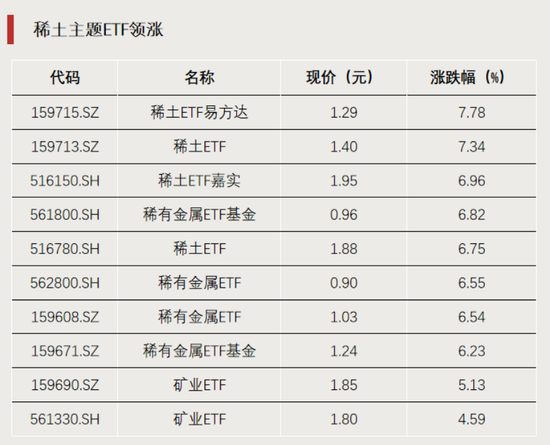
Group 1: ETF Performance - Multiple sectors including rare earth, gold, non-ferrous metals, and technology chips saw significant ETF performance, with two rare earth ETFs rising over 7% in a single day [1][4] - As of October 13, three ETFs have more than doubled in value this year, specifically focusing on the gold industry [2] - On October 13, gold ETFs and non-ferrous metal ETFs increased by over 4%, while several technology chip ETFs rose by over 3% [6][7] Group 2: Capital Inflows - The technology sector experienced substantial capital inflows, with over 30 billion yuan net inflow into the Jiashi Shanghai Stock Exchange Technology Chip ETF from October 9 to 10 [3][8] - Other notable inflows included 27.66 billion yuan into the Huaxia Shanghai Stock Exchange Technology 50 ETF and 11.45 billion yuan into the E-Fund Shanghai Stock Exchange Technology 50 ETF during the same period [9] Group 3: Market Trends and Analysis - The Ministry of Commerce's announcement on October 9 regarding rare earth export controls has led to a supply-demand resonance in the rare earth sector, positioning it as a core resource for high-end manufacturing and strategic emerging industries [4] - Factors supporting gold price increases include rising risk aversion and a decline in global credit currency credibility, with expectations for gold prices being adjusted upward by overseas institutions [10]

贵金属板块活跃走强 西部黄金涨超7%
Zheng Quan Shi Bao Wang· 2025-10-13 03:20
Core Viewpoint - The precious metals sector is experiencing significant gains, with notable increases in stock prices for companies such as Western Gold, Xiaocheng Technology, Zhaojin Gold, and Chifeng Gold, driven by macroeconomic factors and expectations of continued monetary easing [1] Group 1: Market Performance - As of the morning of October 13, the precious metals sector is active and strong, with Western Gold rising over 7%, Xiaocheng Technology up over 6%, Zhaojin Gold increasing over 5%, and Chifeng Gold gaining over 2% [1] Group 2: Economic Analysis - Dongwu Securities highlights that following the key changes in the Federal Reserve's stance during the global central bank conference in August, the persistence of re-inflation and the decline in non-violent service sector inflation have become central to the current macroeconomic narrative [1] - The interplay between tariffs causing inflation to rise and the expectations of interest rate cuts leading to a decrease in nominal rates will continue to influence the market, indicating a period of rapidly declining real interest rates [1] - The outlook for precious metals remains positive, with expectations for continued strength in the sector [1]

债市多种叙事切换,“TACO”交易能否重现?
ZHONGTAI SECURITIES· 2025-10-12 06:24
1. Report Industry Investment Rating No information about the industry investment rating is provided in the report. 2. Core Viewpoints of the Report - In September, most bond varieties saw corrections, with long - end interest - rate bonds and long - end Tier 2 and perpetual bonds (referred to as "Er Yong" bonds) leading the decline, which are the heavy - position bonds preferred by funds. The "killing of funds' heavy - position bonds" in this round has a more significant curve steepening compared to the adjustment in Q4 2022 [1][5]. - Although commodity demand has weakened, inflation expectations remain strong. If PPI is transmitted to core CPI, the year - on - year core CPI in March next year may reach 1.6%, and real interest rates may decline [1][20]. - In the fourth - quarter bond market, from the EVA comparison perspective, 30Y treasury bonds have a high comparison advantage over mortgage loans, while 10Y treasury bonds are relatively neutral. Despite weak fundamentals, the necessity of interest - rate cuts may not be high from the perspective of real interest rates. Currently, the IRS - implied interest - rate cut expectation is low. Insurance bond - allocation growth may be weaker than before, and banks may redeem funds in advance, which is unfavorable to the bond - market supply - demand structure. The impact of the new round of tariff turmoil on the bond market is smaller than that in April [1][23][34]. 3. Summary by Relevant Catalogs 3.1 9 - Month Institutional Behavior Pattern: Killing Funds' Heavy - Position Bonds - **Bond Market Correction in September**: Interest - rate bonds' long - end correction was greater than the short - end, with the curve steepening and long - end spreads widening, while the 5Y - 3Y spread narrowed. The long - end of "Er Yong" bonds led the decline, and the credit spreads of 5 - 7Y varieties widened rapidly [5]. - **Funds' Bond Preferences**: Since 2024, funds have preferred to net - buy 7 - 10Y interest - rate bonds, 20 - 30Y treasury bonds, 1 - 5Y medium - term notes, and 7 - 10Y "Er Yong" bonds, except for short - term financing bonds [8]. - **Comparison with Q4 2022**: Both rounds showed the characteristic of "Er Yong" bonds leading the decline, but in this round, the short - end decline was small, and the curve steepening was more significant [9]. - **Funds' Trading Behavior**: In September, funds mainly sold "Er Yong" bonds, 10Y old policy - bank bonds, and old ultra - long treasury bonds. They had a net - selling of 16 billion yuan of cash bonds in total, with 101.5 billion yuan of other bonds (including "Er Yong" bonds) mainly sold in the 7 - 10Y and over 30Y maturities, and 55.2 billion yuan of old 20 - 30Y treasury bonds sold. At the same time, they also bought new treasury bonds of the same maturities [13]. - **Funds' Selling Progress**: Fund selling has accelerated, but there is still a large clearing space, and funds can still be seen in ultra - long active bonds [16]. 3.2 Commodity Demand Weakens, but Inflation Expectations Remain Strong - **Commodity Market Situation**: The "Golden September and Silver October" in the commodity market was not as expected. After the pre - holiday inventory - replenishment narrative ended, commodities reached the lowest point after the Politburo meeting. There was a differentiation between upstream and downstream, with the downstream dominated by the "supply - demand logic" and the upstream by the "anti - involution" logic [18]. - **Inflation Expectations**: According to the monthly spread of coking coal, the year - on - year PPI in 2026 was priced at 1.2% on September 30th, and it may exceed 2% in April. If PPI is transmitted to core CPI, the year - on - year core CPI in March next year may be 1.6%, and real interest rates may decline, with the effect of re - inflation similar to the interest - rate cut in 2024 [18][20]. - **Travel and Consumption Improvement**: During the 8 - day National Day and Mid - Autumn Festival holiday this year, the number of tourist trips increased by 16.1% year - on - year, and domestic tourism spending increased by 13.5%. The daily average number of tourist trips increased by 1.6%, and consumption increased by 1%. Since 2022, the economic cycle has been in the recovery stage, and by October 2025, the number of tourist trips (+10.4%) and tourism revenue (+3.1%) have exceeded the 2019 levels [21]. 3.3 Fourth - Quarter Bond - Market Highlights: Comparison, Institutional Behavior, and Tariff Re - trading - **EVA Comparison Perspective**: As of the end of September, the after - tax EVA level of 30Y treasury bonds was 2.15%. Even considering the restoration of value - added tax on interest income, it had a high comparison advantage over the existing mortgage loan rate of 1.71%, with the spread reaching the 79% historical quantile since 2015. However, the EVA spread of 10Y treasury bonds compared to general loans only recovered to the 24% historical quantile, with a relatively neutral comparison advantage [23]. - **Fundamental Perspective**: Economic data from July to August was weak. Investment - end sub - items declined significantly, and the previously strong social retail sales also declined. Manufacturing growth turned negative, infrastructure investment declined, and real - estate investment continued to decline. Although this may lead to expectations of interest - rate cuts, from the perspective of real interest rates, the necessity of interest - rate cuts may not be high, and currently, the IRS - implied interest - rate cut expectation is low [26][30][32]. - **Institutional Behavior**: Currently, the market risk preference is high. Insurance bond - allocation growth may be weaker than before, and banks may redeem funds in advance, which is unfavorable to the bond - market supply - demand structure [34]. - **Tariff Turmoil**: The impact of the new round of tariff turmoil on the bond market was smaller than that in April. The decline in the A - share adjustment space on Monday may not be large. Compared with April, the increments in the A - share market include a strong AI industry trend, more familiarity with the "TACO" investment model, but also the risk of high valuations [36][37][38].
内需偏弱下的经济修复与政策应对
Minmetals Securities· 2025-09-26 03:44
Economic Overview - The GDP deflator index has experienced negative growth for 9 consecutive quarters since Q2 2023, marking the longest period of decline since the Asian financial crisis and the global financial crisis, which lasted 6 and 3 quarters respectively[1][11][24]. - The current deflation is structurally different from past instances, lacking external shocks and characterized by prolonged duration and complex structural features[2][24]. Structural Causes of Weak Domestic Demand - The current deflation is not merely due to "insufficient demand," but is a result of a chain reaction involving real estate, debt, and fiscal policies, leading to weakened wealth effects and corporate profits[2][31]. - The decline in real estate prices and sales has adversely affected household wealth and corporate profits, further compressing credit supply and investment[2][31]. International Comparisons and Lessons - Japan's experience with deflation highlights the importance of timely policy responses and the risks of premature tightening, which can lead to a downward spiral in the "nominal-profit-credit" chain[3][48]. - The Eurozone's recovery from deflation relied on coordinated monetary and fiscal policies, emphasizing the need for a combination of measures rather than relying solely on price-driven tools[3][48]. Policy Recommendations - Short-term re-inflation pressures are significant, necessitating fiscal support, monetary easing, and structural reforms to stabilize nominal growth[4][30]. - The fiscal strategy should involve higher deficit rates and long-term bonds to support public investment, while monetary policy should focus on yield curve management and structural tools to enhance credit transmission[4][30].
重磅发布会提振预期?金融科技ETF(159851)反弹超1%!A股迎流动性盛宴,关注金融科技的强贝塔属性
Xin Lang Ji Jin· 2025-09-22 06:04
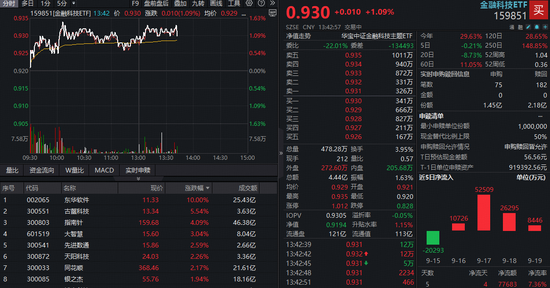
Group 1 - The financial technology sector remains active, with the China Securities Financial Technology Theme Index rising over 1% on September 22 [1] - Notable stocks include Donghua Software reaching the daily limit, Guoao Technology increasing over 6%, and several others like Zhihui and Dazhihui rising over 3% [1] - The financial technology ETF (159851) has a market size exceeding 10 billion yuan, with a trading volume of over 400 million yuan on the same day [1] Group 2 - Goldman Sachs attributes the strong performance of the Chinese stock market this year to "re-inflation" expectations and artificial intelligence, suggesting that improved valuations and liquidity could further benefit the market [3] - A-shares are experiencing a significant liquidity surge, with trading volumes consistently exceeding 2 trillion yuan, and foreign and long-term institutional funds continuing to flow into the market [3] - The financial technology sector is highlighted as a key area of focus, with internet brokerages expected to see a net profit increase of 70% in the upcoming quarterly reports [3] Group 3 - The financial technology ETF (159851) and its linked funds are recommended for investment, covering various themes such as internet brokerages, financial IT, cross-border payments, and AI applications [4] - As of September 17, the financial technology ETF (159851) has a scale exceeding 10 billion yuan, with an average daily trading volume of over 1.4 billion yuan, indicating strong liquidity [4]
格林大华期货早盘提示-20250922
Ge Lin Qi Huo· 2025-09-21 23:30
Report Industry Investment Rating - The report recommends a long position for IF, IC, IM, and IH in the stock index futures of the macro and financial sector [1]. - Goldman Sachs maintains an overweight rating for A - shares and H - shares [1]. - CITIC Construction Investment Research Report is bullish on the overall Hong Kong stock market [1]. Report's Core View - The Chinese stock market's strong performance this year may be driven by "re - inflation" expectations and artificial intelligence, and future improvements in valuation and liquidity may contribute to further prosperity [1]. - International capital is actively increasing its positions in China's technology sector as China has global competitiveness in frontier fields such as AI, robotics, and biotechnology, and the window for stock market valuation repair is opening [1]. - The narrowing of the Sino - US interest rate spread will attract more global funds to focus on RMB assets, and investors will adjust their asset allocation to increase holdings of Chinese bonds and stocks [1]. - After entering September, the A - share market is in a consolidation period, and the advantages of Hong Kong stocks are emerging [1]. - The current stock market is in a rest stage after a sharp decline on Thursday. The traditional industries are strengthening, and the CSI 300 index stabilizes the market. The market is undergoing a phased style shift from growth to defense, but the upward trend remains unchanged [2]. Summary by Relevant Catalogs Market Review - On Friday, the main indexes of the two markets fluctuated and closed slightly lower, with the CSI 300 index rising. The trading volume of the two markets was 2.32 trillion yuan, showing a rapid contraction. The CSI 300 index closed at 4501 points, up 3 points or 0.08%; the SSE 50 index closed at 2909 points, down 3 points or - 0.11%; the CSI 500 index closed at 7170 points, down 29 points or - 0.41%; the CSI 1000 index closed at 7438 points, down 38 points or - 0.51% [1]. - Among industry and theme ETFs, coal ETF, military industry leading ETF, engineering machinery ETF, real estate ETF, and tourism ETF led the gains, while auto parts ETF, robot 50ETF, and integrated circuit ETF led the losses. Among the sector indexes of the two markets, energy metals, engineering machinery, tourism, film and television theaters, and coal mining indexes led the gains, while motor manufacturing, home appliance parts, auto services, reducers, and PEEK material indexes led the losses [1]. - The settlement funds of stock index futures for the CSI 1000, CSI 500, CSI 300, and SSE 50 indexes had net outflows of 5.8 billion, 3.1 billion, 2.6 billion, and 2.2 billion yuan respectively [1]. Important Information - Goldman Sachs believes that "re - inflation" expectations and artificial intelligence may be the key drivers of the Chinese stock market's strong performance this year, and future improvements in valuation and liquidity may contribute to further prosperity [1]. - Goldman Sachs maintains an overweight rating for A - shares and H - shares, and international capital is actively increasing its positions in China's technology sector [1]. - The narrowing of the Sino - US interest rate spread will attract more global funds to focus on RMB assets [1]. - CITIC Construction Investment Research Report shows that after entering September, the A - share market is in a consolidation period, and the attention of domestic and foreign funds to Hong Kong stocks is increasing, and the advantages of Hong Kong stocks are emerging [1]. - Huawei's core strategy is "super - node + cluster", and its Atlas 950 super - node is leading compared with NVIDIA's planned NVL576 in 2027 [1]. - In July, Japan and the UK increased their holdings of US Treasury bonds, while China reduced its holdings by 25.7 billion US dollars to 730.7 billion US dollars, the lowest level since 2009 [2]. - The Bank of Japan announced that it will sell its ETF holdings at a rate of about 330 billion yen per year and real - estate REIT at a rate of about 5 billion yen per year [2]. - The US Department of Energy launched the "Power Acceleration" plan to meet the surging power demand from artificial intelligence and data centers [2]. - Microsoft will invest 3.3 billion US dollars in a data center in Wisconsin, which will be put into use early next year and will be 10 times more powerful than the current fastest supercomputer [2]. Market Logic - The Chinese stock market's current rally is mainly driven by liquidity, with "re - inflation" expectations and AI autonomy as key catalysts [2]. - If the proportion of foreign institutional holdings in the A - share market rises to the average level of emerging or developed markets, it may bring 14 trillion to 30 trillion yuan of potential capital inflows [2]. Future Market Outlook - The narrowing of the Sino - US interest rate spread will attract more global funds to focus on RMB assets, and investors will increase their holdings of Chinese assets [2]. - The current stock market is in a rest stage after a sharp decline on Thursday. The traditional industries are strengthening, and the CSI 300 index stabilizes the market. The market is undergoing a phased style shift from growth to defense, but the upward trend remains unchanged [2]. Trading Strategy - For stock index futures directional trading, in the rest stage, traditional industries are strengthening, and the CSI 300 index stabilizes the market. The market is undergoing a phased style shift from growth to defense, and the upward trend remains unchanged [2]. - For stock index option trading, during the volatile period when the market is undergoing a phased style shift from growth to defense, it is advisable to wait and see [2].
近期债市思考:多空之争
ZHONGTAI SECURITIES· 2025-09-21 12:09
Report Industry Investment Rating - The industry rating is not explicitly mentioned in the report regarding the bond market. However, the general tone seems to suggest a cautious view on the bond market, with potential risks and adjustments ahead [27]. Core View of the Report - The bond market has been weakening recently with a divergence in bond varieties. Both bulls and bears in the bond market are currently confused. The report presents multiple reasons for both bullish and bearish outlooks on the bond market and concludes that the risk in the bond market has not been eliminated, with potential for further adjustments within the year [2][6]. Summary by Related Catalogs Bullish Reasons - **Bond Supply Mismatch in Q4**: This year, the fiscal bond issuance has been front - loaded, with the remaining quotas for national and local bonds in Q4 at 21.5% and 22.1% respectively, lower than last year's 26.3% and 30.5%. Q4 is also the insurance "opening - up" period, leading to increased allocation demand from insurance companies [7]. - **Favorable Economic Data**: The corporate loans in the social financing data have weakened for two consecutive months, and the economic data in August was generally weak. The production slowed down, with the industrial added - value growth rate in August at 5.2%, down 0.5pct from the previous month. The fixed - asset investment also slowed down. Weak economic data is beneficial for the bond market [8]. - **Monetary Policy and Treasury Bond Transactions**: With a weakening economy, weak social financing and credit, and the Fed's rate cut, there is an increased probability of rate cuts and reserve requirement ratio cuts in Q4. The adjustment of the 14 - day reverse repurchase operation by the central bank implies a potential rate cut. The discussion on government bond issuance management and central bank's treasury bond transactions also provides room for speculation [12]. Bearish Reasons - **Nominal GDP and Re - inflation**: The "anti - involution" policy has a positive impact on inflation. PPI has shown signs of bottoming out. Nominal GDP may rise due to the narrowing of the GDP deflator, which could be unfavorable for bond yields. Expectations of inflation are also increasing [16]. - **Mutual Fund Redemption Chain Reaction**: Due to weakening profitability and the potential redemption fee, mutual bond funds may face scale shrinkage, which could lead to liquidity and valuation spread pressures on certain bond varieties favored by mutual funds [20]. - **Weak Monetary Policy Coordination**: The monetary policy has not adjusted policy rates. To cooperate with the "anti - involution" policy, interest rates may not be further reduced. The desired growth rate of loans may decline, and the current interest rate level may be appropriate [23]. - **Sustained Breakthrough in the Equity Market**: The equity market has shifted from a situation of "no fundamental support" to "having performance support from specific sectors". This may lead to a long - term trend of capital flowing from the bond market to the equity market [24]. Outlook for Monday - Two news events, a news conference on the "14th Five - Year Plan" and a positive phone call between the Chinese and US presidents, may boost risk appetite. The bond and equity markets are likely to have a "risk - on" trading pattern. The risk in the bond market has not been eliminated, and there is still room for adjustment within the year [27].