流动性宽松

Search documents
9个月后银行再买国债,新一轮资金投放潮将至?股票、债券或将同步上涨
Sou Hu Cai Jing· 2025-10-29 03:54
Core Viewpoint - The People's Bank of China (PBOC) announced the resumption of open market operations for government bonds, leading to strong market expectations for liquidity easing [1][3]. Group 1: Market Reactions - Following the announcement, government bond yields fell, with 10-year and 30-year yields dropping over 5 basis points in a single day, resulting in a significant increase in bond prices [4]. - The stock market also reacted positively, as liquidity easing typically indicates more available funds, potentially shifting some capital from the bond market to the stock market, particularly benefiting interest-sensitive sectors like technology and consumer goods [6]. Group 2: Operational Context - The resumption of bond buying is a flexible adjustment by the PBOC based on market conditions, with previous operations having provided significant liquidity support, totaling 1 trillion yuan by December 2024 [3]. - The PBOC's operations are not unlimited; they will adjust based on the demand for base currency, market supply and demand, and changes in the yield curve, with historical net purchases typically ranging from 100 billion to 300 billion yuan per month [6]. Group 3: Policy Implications - The decision reflects a coordinated approach between monetary and fiscal policies, as the government has issued a significantly higher volume of debt this year, particularly local government bonds, increasing market supply pressure [8]. - The resumption of bond purchases is expected to provide liquidity support for government debt issuance, lower financing costs, and strengthen the pricing benchmark for government bonds, aligning with the PBOC's stance on maintaining relatively loose social financing conditions [8]. Group 4: Broader Economic Impact - For the general public, the decline in government bond yields may lead to lower returns on low-risk financial products, prompting investors to adjust their asset allocations towards equities [8]. - Enhanced liquidity in the banking sector could result in lower interest rates for loans, benefiting individuals and businesses with financing needs, while improved liquidity conditions may stimulate consumption and employment, fostering a positive economic cycle [8]. Group 5: Market Participants' Focus - Bond traders will closely monitor the direction and scale of PBOC operations, while stock investors will need to observe the effectiveness of liquidity transmission to the real economy [10]. - International investors may view this move as a signal of deeper engagement in the Chinese bond market, potentially increasing the attractiveness of renminbi assets [10].


宁证期货今日早评-20251028
Ning Zheng Qi Huo· 2025-10-28 02:57
Report Summary Key Points of Each Product Steel Products - **Rebar**: On October 27, domestic steel prices mostly rose, with the average price of 20mm third - grade seismic rebar in 31 major cities reaching 3234 yuan/ton, up 15 yuan/ton from the previous trading day. Due to positive macro - expectations, potential balance between supply and demand, and cost support, short - term steel prices may fluctuate upward [1]. - **Iron Ore**: From October 20 - 26, the arrival volume of iron ore at 47 ports in China decreased. Considering supply, demand, inventory, and macro factors, short - term iron ore prices may fluctuate upward [4]. - **Coke**: The average national ton - coke profit is - 41 yuan/ton. With supply weakening due to cost pressure and demand slightly declining, but with relatively strong iron - water production and cost support, the coke market will fluctuate upward [5]. Energy Products - **Crude Oil**: Iraq's oil exports are 3.6 million barrels per day. The market is worried about OPEC supply. With upcoming macro - events and sanctions on Russia under observation, oil prices are likely to fluctuate upward this week, being in a stage of short - term geopolitical bullishness versus long - term supply - demand bearishness [2]. Agricultural Products - **Pig**: On October 27, the national pig price generally rose. With improved consumption due to cooling and reduced end - of - month slaughter pressure, short - term prices are expected to be strong. Pig futures prices have rebounded, but the upward momentum may be limited [6]. - **Palm Oil**: As of October 24, 2025, the commercial inventory of palm oil increased. With concerns about the B50 plan and weakening demand while production increases, palm oil prices will face downward pressure in the short term [7]. - **Soybean**: Imported soybean prices are stable, and domestic demand offsets trade - tension pressure, with short - term soybean futures (bean two) stabilizing. Domestic new - season soybeans are strong, with a bullish market sentiment [8]. Precious Metals - **Silver**: The market believes the probability of a 10 - month interest rate cut is 97%. Silver is long - term bullish but short - term downward - fluctuating, with limited downward space [9]. - **Gold**: The weakening of risk - aversion sentiment has led to a significant correction in gold prices. The expected interest rate cut has limited impact. Gold may oscillate at a high level in the medium term [9]. Financial Products - **Medium - and Long - Term Treasury Bonds**: The resumption of open - market treasury bond trading operations by the central bank is a bullish factor for the bond market. However, due to liquidity and the stock - bond seesaw effect, bond market operations are more difficult, with a mid - term slightly bullish outlook [10]. Chemical Products - **Methanol**: The domestic methanol market has high production, stable demand, and a slight increase in port inventory. The 01 contract is expected to fluctuate in the short term, with support at 2245 [11]. - **Soda Ash**: The domestic soda ash market is stable, with stable production, general demand, and a slight increase in inventory. The 01 contract is expected to fluctuate, with support at 1235 [12]. - **Plastic**: LLDPE supply is expected to remain high, while downstream demand is increasing. The L2601 contract is expected to fluctuate slightly upward in the short term, with support at 7000 [13]. Report's Core View The report analyzes multiple commodities, including steel, energy, agricultural products, precious metals, financial products, and chemical products. It assesses each commodity's supply, demand, inventory, and macro - factors to predict their short - and medium - term price trends, providing investment suggestions such as short - term trading strategies and risk - management advice. Report Industry Investment Rating The report does not provide an overall industry investment rating.
宁证期货今日早评-20251027
Ning Zheng Qi Huo· 2025-10-27 02:10
Report Summary 1. Report Industry Investment Ratings No industry investment ratings are provided in the report. 2. Core Views - **Gold**: The US September CPI data led to market expectations of Fed rate - cuts. The strong US dollar is bearish for gold, but gold buying power remains strong. Gold is expected to oscillate at a high level in the medium - term [1]. - **Soda Ash**: The domestic soda ash market is weakly stable. The 01 contract is expected to oscillate in the short - term, with support at 1220. It is recommended to wait and see or do short - term long on dips [2]. - **Rebar**: The medium - long - term over - capacity in the steel industry may be alleviated, but short - term impact is limited. Rebar demand is improving but at a low level. The price is expected to oscillate at a low level in the short - term [4]. - **Iron Ore**: Supply is relatively stable, and demand is supported by high iron - water levels. However, the profit contraction of steel mills and the end of the peak season limit demand. The price is expected to oscillate in the short - term [5]. - **Coking Coal**: Supply is tightening, and demand from downstream and intermediate sectors is strong. The coal price is strong, and the futures price is expected to be supported in the short - term [6]. - **Pigs**: With increased demand due to lower temperatures and reduced slaughter pressure, the pig price may strengthen after adjustment. The futures price is expected to rebound at the bottom in the short - term [7]. - **Palm Oil**: As the traditional production - reduction season approaches in November, the futures price may recover. However, due to expected ample supply, the spot price is under pressure. The price is expected to oscillate in the short - term [7]. - **Soybeans**: Imported soybean spot market is firm, and domestic demand is strong. Bean 2 is expected to stabilize in the short - term. Domestic new - season soybeans are strong [8]. - **Medium - Long - Term Treasury Bonds**: Liquidity is loose, which supports the bond market. But with the stock market breaking through the previous range, the bond market operation is more difficult. It is expected to oscillate with a slightly bearish bias in the medium - term [9]. - **Silver**: US economic data in October is positive, which is bullish for silver. With a high probability of rate - cuts in October, the downside is limited. It is long - term bullish and short - term oscillating [9]. - **PVC**: Domestic PVC production is expected to increase, while demand is entering the off - season. The price is expected to oscillate in the short - term, with support at 4695 for the 01 contract. It is recommended to wait and see [10]. - **Methanol**: Domestic methanol production is at a high level, and downstream demand is stable. The port inventory is accumulating slightly. The 01 contract is expected to oscillate weakly in the short - term, with resistance at 2300. It is recommended to wait for further stabilization [11]. - **Crude Oil**: The crude oil market is in a game between short - term geopolitical bullish factors and long - term supply - demand bearish factors. A short - term low - level bullish approach is recommended [11]. 3. Summary by Variety Gold - US September CPI rose 3% year - on - year, lower than expected. Core CPI and service inflation slowed. The market fully priced in two 25 - basis - point Fed rate cuts [1]. - The strong US dollar is bearish for gold, but buying power remains strong. Gold may oscillate at a high level in the medium - term [1]. Soda Ash - The national mainstream price of heavy - quality soda ash is 1271 yuan/ton, with stable recent prices. Weekly production is 74.05 tons, down 3.93% week - on - week [2]. - Total inventory of soda ash manufacturers is 170.21 tons, up 0.09% week - on - week. The float glass market has stable start - up, rising inventory, and average trading [2]. Rebar - The blast - furnace start - up rate of 247 steel mills is 84.71%, up 0.44 percentage points week - on - week. The iron - making capacity utilization rate is 89.94%, down 0.39 percentage points [4]. - Steel mill profitability is 47.62%, down 7.79 percentage points week - on - week. Daily average pig - iron output is 239.9 tons, down 1.05 tons week - on - week [4]. Iron Ore - The total inventory of imported iron ore at 45 ports is 14423.59 tons, up 145.32 tons week - on - week. The daily average port clearance volume is 312.65 tons, down 3.07 tons [5]. - The number of ships at ports is 107, down 17. Supply is stable, and demand is supported by high iron - water levels, but profit contraction affects demand [5]. Coking Coal - The capacity utilization rate of independent coking enterprises is 73.47%, down 0.77%. Daily coke production is 64.61 tons, down 0.68 tons [6]. - Coke inventory is 58.64 tons, up 1.35 tons. Coking coal inventory is 1029.70 tons, up 32.33 tons. Supply is tightening, and demand is strong [6]. Pigs - As of October 24, the average slaughter weight of pigs is 123.21 kg, down 0.22 kg. The weekly slaughter start - up rate is 35.3%, down 0.34% [7]. - The profit of purchasing piglets for breeding is - 279.65 yuan/head, up 67.28 yuan/head. The self - breeding profit is - 149.54 yuan/head, up 53.28 yuan/head [7]. Palm Oil - The estimated export volume of Malaysian palm oil from October 1 - 25 is 1283814 tons, down 0.4%. The futures price may recover in November, but spot price is under pressure [7]. Soybeans - In the 43rd week (October 18 - 24), the actual soybean crushing volume of domestic oil mills is 236.74 tons, with a start - up rate of 65.13%. The 44th - week start - up rate is expected to decline slightly [8]. Medium - Long - Term Treasury Bonds - The central bank will conduct 900 billion yuan of MLF operations on October 27, with a net investment of 200 billion yuan. Liquidity is loose, but the bond market operation is difficult due to the stock market [9]. Silver - The US October manufacturing, service, and composite PMI are all better than expected. Economic data is positive for silver, and the downside is limited due to expected rate - cuts [9]. PVC - The price of East China SG - 5 type PVC is 4600 yuan/ton, down 10 yuan/ton. The capacity utilization rate is 76.57%, down 0.12% week - on - week [10]. - Social inventory is 103.52 tons, down 0.13% week - on - week. Domestic production is expected to increase, and demand is entering the off - season [10]. Methanol - The market price of methanol in Jiangsu Taicang is 2240 yuan/ton, down 10 yuan/ton. The domestic weekly capacity utilization rate is 87.4%, down 2.13% [11]. - Port inventory is 151.22 tons, up 2.08 tons week - on - week. The 01 contract is expected to oscillate weakly in the short - term [11]. Crude Oil - After the US sanctions on Russian oil companies, Reliance Industries stops buying Russian oil. The market is in a game between short - term geopolitical and long - term supply - demand factors [11].
有色金属:对有色要有信心,景气向好
2025-10-27 00:31
Summary of Conference Call on Non-Ferrous Metals Industry Industry Overview - The non-ferrous metals industry, including gold, copper, aluminum, and small metals like tungsten and lithium, is experiencing a positive outlook with strong market confidence despite some concerns regarding price fluctuations and supply-demand dynamics [2][14]. Key Points and Arguments Gold Market - Gold prices are expected to find strong support between $3,900 and $4,000, with an adjustment period of 2 to 4 weeks, potentially leading to consolidation until early next year. Inflation may drive future price increases [1][4][15]. - Companies involved in gold production are projected to have a compound annual growth rate (CAGR) of gold output between 10% to 20% from 2026 to 2029, indicating strong investment potential despite price fluctuations [1][5]. Copper Market - The price of copper is anticipated to be influenced more by supply-demand fundamentals rather than movements in gold prices. A significant price increase is expected in 2026, potentially exceeding $11,000, driven by global liquidity easing [1][7][15]. - Supply shortages are projected for copper due to production guidance reductions from several mines, which could lead to a supply shortfall of approximately 2% in 2026 [8]. Aluminum Market - The electrolytic aluminum sector has outperformed expectations, with domestic production peaking and no significant increases in overseas supply. The demand for aluminum alloys and rods is improving, leading to a favorable supply-demand balance [1][9][10]. - Aluminum is characterized by low absolute and relative valuations, with a strong dividend trend, making it a valuable investment opportunity [16]. Small Metals Market - Recent price increases have been observed in small metals such as tungsten, lithium carbonate, and magnesium. Cobalt prices may rise above 400,000 yuan due to supportive supply-demand fundamentals [1][11]. - Tungsten is experiencing a strategic shortage, while lithium's demand is currently strong but supply has not yet caught up, indicating potential for future price increases [11][17]. Steel Market - The steel market faces short-term export pressures but is not expected to collapse. Profit margins for steel companies remain around 55%, although many are operating at minimal profits [3][13]. - Strategic investments in low-valuation, high-dividend steel companies are recommended, especially as some regions begin to reduce production to maintain prices [3][13]. Additional Important Insights - The overall sentiment in the non-ferrous metals sector remains optimistic, with concerns primarily focused on gold price volatility and potential unexpected changes in aluminum supply [2][14]. - The market dynamics for copper and aluminum are largely independent of gold price movements, emphasizing the importance of individual supply-demand fundamentals [6][14]. This summary encapsulates the key insights from the conference call regarding the non-ferrous metals industry, highlighting the positive outlook and investment opportunities across various segments.
矿端紧张叠加流动性宽松,铜价上行突破
GOLDEN SUN SECURITIES· 2025-10-26 09:51
Investment Rating - Maintain "Buy" rating for the sector [5] Core Views - The report indicates that the precious metals market is expected to maintain a bullish trend in the medium to long term due to inflationary pressures and global liquidity easing, despite recent price corrections [1][34] - For industrial metals, copper prices are supported by tight supply conditions and liquidity easing, while aluminum prices are expected to show strong fluctuations due to overseas production cuts and geopolitical tensions [2][3] - Energy metals, particularly lithium, are projected to see strong price performance driven by positive demand expectations, while cobalt prices are also on an upward trend despite cautious purchasing strategies from downstream buyers [3][25] Summary by Sections Precious Metals - U.S. September CPI recorded at 3%, lower than the expected 3.1%, indicating a potential for interest rate cuts by the Federal Reserve [1][34] - The consumer confidence index in the U.S. has declined to 53.6, reflecting weak economic fundamentals [1][34] - The report suggests that the recent pullback in gold prices is considered sufficient, and long-term bullish trends remain intact [1][34] Industrial Metals - Copper prices are supported by tight supply due to disruptions in mining and easing liquidity conditions [2] - Global copper inventory increased by 19,400 tons, with Chinese inventory rising by 17,100 tons [2] - The report highlights that the aluminum industry in China is maintaining production levels, while overseas production cuts are expected to support aluminum prices [2] - Nickel demand remains strong, particularly in the battery sector, with prices expected to rise [2] Energy Metals - Lithium prices are showing strong performance, with battery-grade lithium carbonate prices rising by 5.4% to 80,000 yuan/ton [3][25] - Cobalt prices are also on the rise, supported by strong demand from the ternary material sector, although purchasing strategies are becoming more cautious [3][25] Key Stocks - Recommended stocks include: - Zijin Mining, Shandong Gold, and Chifeng Jilong Gold for precious metals [1] - Luoyang Molybdenum, Nanshan Aluminum, and China Hongqiao for industrial metals [2][8] - Ganfeng Lithium and Tianqi Lithium for energy metals [3][8]


资产猛涨,纳指原油黄金齐动,啥大事件发生?
Sou Hu Cai Jing· 2025-10-25 19:11
Group 1 - The Chinese assets are becoming increasingly attractive, with the Nasdaq Golden Dragon Index rising by 1.66%, driven by significant gains in Alibaba (3.64%), Baidu (2.9%), and JD.com (2.1%) [1] - Goldman Sachs predicts a 30% increase in the Chinese stock market over the next three years, citing an 80% rebound in the MSCI China Index since its 2022 low and expected corporate earnings growth of 12% [1][2] - Morgan Stanley highlights that global capital allocation to Chinese stocks remains "pitifully low," indicating potential for further investment [1] Group 2 - Intel reported a third-quarter revenue of $13.65 billion, marking a significant turnaround from a loss of $0.46 per share last year, with a gross margin of 40% exceeding expectations [2] - The Federal Reserve may halt quantitative tightening (QT) as early as next week, which could lead to increased liquidity in the market, reversing the previous trend of withdrawing liquidity [2] - The WTI crude oil price surged by 5.62% to $61.79 per barrel, signaling a potential shift in global capital allocation as liquidity conditions change [4] Group 3 - Gold prices rose by 1.62% to $4,131 per ounce, with analysts suggesting that central banks and wealthy investors are accumulating gold, anticipating a new era of liquidity [4] - Goldman Sachs maintains a bullish outlook on gold, projecting a target price of $4,900 per ounce by the end of 2026, emphasizing the potential for upward price movement [4] - The current market dynamics suggest that the upcoming FOMC meeting in October could lead to significant shifts in global capital markets, particularly if the Fed stops its tightening measures [6]

新能源及有色金属日报:有色金属集体走强,镍不锈钢价格收涨-20251024
Hua Tai Qi Huo· 2025-10-24 02:22
Group 1: Investment Ratings - There is no information provided regarding the industry investment rating in the report. Group 2: Core Views - The nickel market has high inventories and an oversupplied pattern, so nickel prices are expected to remain in low - level oscillations. The stainless - steel market has weak downstream demand growth, increasing inventories, and weakening cost support, so it is expected to remain in range - bound oscillations [3][5]. Group 3: Nickel Market Analysis Futures - On October 23, 2025, the main contract 2512 of Shanghai nickel opened at 121,100 yuan/ton and closed at 121,380 yuan/ton, a 0.19% change from the previous trading day's close. The trading volume was 93,921 (+20,070) lots, and the open interest was 127,005 (+5,694) lots. The main contract showed a volatile pattern of opening low and closing high, with a fluctuation range of only 0.44%. Supported by the expectation of loose liquidity and strong new - energy demand, along with the overall strength of the non - ferrous sector, the price oscillated upward [1]. Nickel Ore - The nickel ore market is mainly in a wait - and - see state, and prices are stable. There is a certain price difference between supply and demand in the domestic market. In the Philippines, the Surigao mining area is about to enter the rainy season, and shipments are coming to an end. In Indonesia, the domestic trade benchmark price in October (Phase II) increased by 0.06 - 0.11 US dollars, and the current mainstream premium is +26, with the premium range mostly between +25 - 27. Indonesian factories have recently been purchasing raw materials [2]. Spot - Jinchuan Group's sales price in the Shanghai market was 123,300 yuan/ton, a decrease of 100 yuan/ton from the previous trading day. Spot trading was average, and the spot premiums of each brand increased slightly. The previous trading day's Shanghai nickel warehouse receipts were 26,881 (-72) tons, and LME nickel inventories were 250,854 (-24) tons [2]. Strategy - Due to high inventories and oversupply, it is expected that nickel prices will remain in low - level oscillations. The strategy is mainly range - bound operations for the single - side, and no operations for cross - period, cross - variety, spot - futures, and options [3]. Group 4: Stainless - Steel Market Analysis Futures - On October 23, 2025, the main contract 2512 of stainless steel opened at 12,700 yuan/ton and closed at 12,765 yuan/ton. The trading volume was 151,385 (+52,175) lots, and the open interest was 166,411 (-4,171) lots. Driven by the strong nickel price, the main contract showed a volatile and strong trend with increasing volume and price, but there was a short - term oversold rebound. The continuous reduction of open interest in the main contract for 5 days reflects strong risk - aversion sentiment among funds, and the market doubts the sustainability of the rebound [3]. Spot - The driving effect of futures on spot is not obvious, and actual trading remains light. Spot prices remain low. The stainless - steel price in the Wuxi market is 13,000 (+0) yuan/ton, and in the Foshan market is 13,000 (+0) yuan/ton. The 304/2B premium is 335 - 635 yuan/ton. The ex - factory tax - included average price of high - nickel pig iron decreased by 1.50 yuan/nickel point to 934.0 yuan/nickel point [3]. Strategy - Due to weak downstream demand growth, increasing inventories, and weakening cost support, stainless steel is expected to remain in a range - bound oscillation. The single - side strategy is neutral, and no operations for cross - period, cross - variety, spot - futures, and options [5].
债市日报:10月23日
Xin Hua Cai Jing· 2025-10-23 08:29
Core Viewpoint - The bond market showed slight weakness on October 23, with government bond futures closing down across the board, while interbank bond yields experienced a minor rebound. The net liquidity withdrawal from the open market was 23.5 billion yuan, leading to a slight decline in funding rates. Analysts suggest that the new fund redemption regulations set to take effect in November may limit the downward potential of yields for a certain period. Despite ongoing trade uncertainties, the likelihood of liquidity easing remains strong, indicating limited upward risks for bond yields [1][2][6]. Market Performance - Government bond futures closed down, with the 30-year main contract falling by 0.34% to 115.21, the 10-year main contract down by 0.12% to 108.035, the 5-year main contract down by 0.07% to 105.645, and the 2-year main contract down by 0.02% to 102.336 [2]. - Interbank major rate bond yields initially decreased before rising, with the 10-year policy bank bond yield increasing by 0.5 basis points to 1.911%, the 30-year government bond yield up by 1 basis point to 2.196%, and the 10-year government bond yield up by 1 basis point to 1.837% [2]. International Market Trends - In North America, U.S. Treasury yields generally fell, with the 2-year yield down by 0.43 basis points to 3.4403%, the 3-year yield down by 1.12 basis points to 3.4386%, the 5-year yield down by 0.52 basis points to 3.5464%, the 10-year yield down by 0.58 basis points to 3.9474%, and the 30-year yield down by 0.66 basis points to 4.5287% [3]. - In Asia, Japanese bond yields mostly rose, with the 10-year yield increasing by 1.2 basis points to 1.666% [4]. - In the Eurozone, bond yields mostly increased, with the 10-year UK bond yield down by 6 basis points to 4.416%, while the 10-year French bond yield rose by 1.2 basis points to 3.353%, the 10-year German bond yield up by 1.1 basis points to 2.562%, the 10-year Italian bond yield up by 0.5 basis points to 3.346%, and the 10-year Spanish bond yield up by 1 basis point to 3.089% [4]. Primary Market Activity - The Export-Import Bank's 1-year and 3-year financial bonds had winning yields of 1.3649% and 1.6815%, respectively, with overall multiples of 2.31 and 3.94, and marginal multiples of 1.11 and 6.2 [5]. - The China Development Bank's 3-year and 7-year financial bonds had winning yields of 1.7342% and 1.9415%, respectively, with overall multiples of 3.04 and 4.56, and marginal multiples of 3.24 and 3.38 [5]. Liquidity Conditions - On October 23, the central bank conducted a 7-day reverse repurchase operation with a fixed rate and quantity, totaling 212.5 billion yuan at an interest rate of 1.40%. The total amount of reverse repos maturing that day was 236 billion yuan, resulting in a net liquidity withdrawal of 23.5 billion yuan [6]. - The Ministry of Finance and the central bank conducted a tender for 2025 central treasury cash management deposits, with a total winning amount of 120 billion yuan at an interest rate of 1.76% [6]. - The Shibor short-term rates mostly declined, with the overnight rate unchanged at 1.318%, the 7-day rate down by 0.5 basis points to 1.417%, the 14-day rate up by 6.0 basis points to 1.512%, and the 1-month rate down by 0.1 basis points to 1.556% [6]. Institutional Perspectives - Huatai Fixed Income suggests that the supply of Chinese dollar bonds is unlikely to increase significantly in the short term, but supply elasticity may rise. With interest rate cuts, cross-border allocation demand, and a decline in credit risk, the yields on Chinese dollar bonds are expected to decrease further. The focus should be on high coupon rates and capital gains opportunities, with potential disruptions from tariffs, exchange rates, and foreign debt regulations [8]. - CITIC Securities notes that the continued interest rate cuts by the Federal Reserve and the impact of tariff policies on the U.S. economy may lead to a sustained weakening of the U.S. dollar index. The Chinese central bank's policies are expected to be flexible to mitigate expectations of a one-sided currency trend [8].
低利率时代,“固收+”基金受投资者追捧
Guo Ji Jin Rong Bao· 2025-10-23 05:24
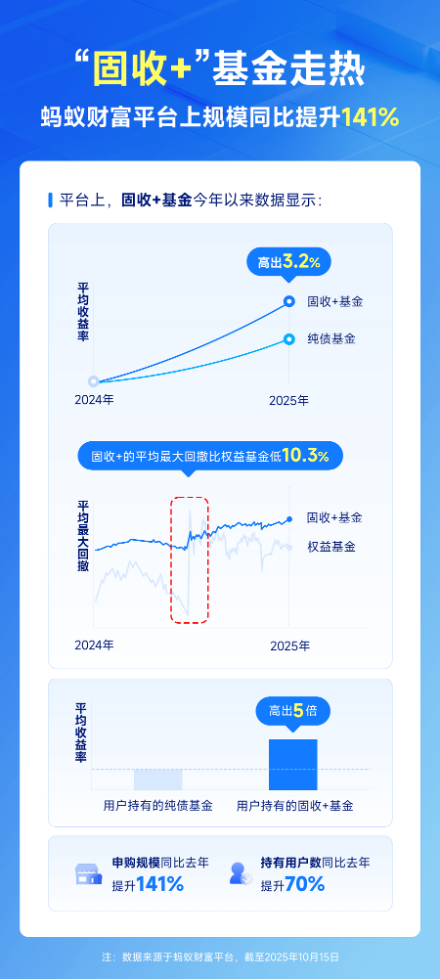
Core Insights - The current market environment is characterized by declining deposit rates and a rising stock market, prompting investors to diversify their asset allocation to enhance returns and reduce volatility [1] - "Fixed Income +" funds have emerged as a popular choice for investors seeking stable returns through a bond base while allocating a small portion to equity assets for additional gains [1] Group 1: Market Trends - As of October 15, 2023, the Ant Wealth platform reported a 141% year-on-year increase in subscription scale for "Fixed Income +" funds, with the number of holding users rising by 70% compared to last year [3] - The performance of "Fixed Income +" funds has been strong this year, with over 3300 out of approximately 3700 funds achieving positive returns in Q3, and a median return of 3.54% [4] - Some top-performing "Fixed Income +" funds have reported returns exceeding 5% this year and over 10% in the past year [4] Group 2: Comparative Performance - The average yield of "Fixed Income +" funds on the Ant Wealth platform is 3.2% higher than that of pure bond funds, with user-held "Fixed Income +" funds yielding five times more than pure bond funds [4] - The average maximum drawdown of "Fixed Income +" funds is 10.3% lower than the average of equity funds, indicating lower risk [4] Group 3: Investment Strategy - Industry experts describe "Fixed Income +" funds as a balanced investment option, with over 80% of the underlying assets in low-risk fixed income securities and no more than 20% in higher-risk equities or convertible bonds [4] - The growing popularity of "Fixed Income +" funds reflects a shift in investor behavior towards a more rational assessment of risk and return, moving away from a singular focus on high returns [4] - For risk-averse investors, low-risk "Fixed Income +" options are recommended, while those with a higher risk tolerance may consider medium to high-risk variants [5] - The overall upward trend in the stock market is expected to continue in a low-interest-rate environment, making "Fixed Income +" products effective for both growth and risk management [5]
地缘冲击之下,对市场波动的慢思考
淡水泉投资· 2025-10-22 10:03
Core Viewpoint - The article emphasizes that while geopolitical events can cause short-term market fluctuations, their long-term impact tends to diminish over time, suggesting that investors should maintain a calm perspective and focus on fundamental trends rather than short-term noise [3][4][7]. Market Reaction to Geopolitical Events - The market exhibits a learning ability, showing diminishing marginal effects in response to repeated geopolitical events. Compared to the market's reaction during the U.S.-China tariff conflict in April, the current market volatility is significantly reduced [4]. - Investors have developed stable expectations regarding U.S.-China negotiations due to multiple rounds of discussions throughout the year, which has lessened panic [4]. - The market has become familiar with Trump's negotiation tactics, which include applying pressure followed by signals of potential meetings, thereby reducing fear among investors [4]. Historical Analysis of Geopolitical Events - Historical data from JPMorgan indicates that major geopolitical events from 1940 to 2022 had a temporary negative impact on the S&P 500 index, with average returns lower in the month and three months following such events. However, returns tend to normalize after six months to a year [7]. - The Shanghai Composite Index also follows a similar pattern, suggesting that the noise created by geopolitical events is often smoothed out over time [9]. Long-term Market Drivers - The article highlights that short-term market fluctuations due to geopolitical shocks do not necessarily indicate a change in long-term trends. It is crucial to assess whether the core drivers of the market, such as macroeconomic fundamentals, industry evolution, and liquidity conditions, remain stable [13]. - Despite external uncertainties, the fundamental logic supporting equity asset performance has not changed. The current liquidity environment is supported by both domestic and international factors, including anticipated interest rate cuts by the Federal Reserve [13]. Economic Indicators and Policy Support - Recent anti-involution measures have stabilized the PPI growth rate, which is closely linked to industrial profits. As these policies deepen, a recovery in PPI is expected to positively impact corporate earnings [17]. - Upcoming macro policy meetings are anticipated to yield supportive measures that will inject momentum into economic development [17]. - There is a positive trend in investment sentiment, as evidenced by the increase in new fund issuance, indicating growing investor confidence in the equity market [20]. Market Opportunities - Geopolitical shocks often lead to emotional overreactions in the market, creating opportunities to purchase quality assets at reasonable prices. Following the panic earlier in the year, valuable companies regained market recognition [22].