
流动性紧张

Search documents
亏损2400亿,美联储爆雷,没有中国兜底,美联储玩不转了?
Sou Hu Cai Jing· 2025-11-30 01:48
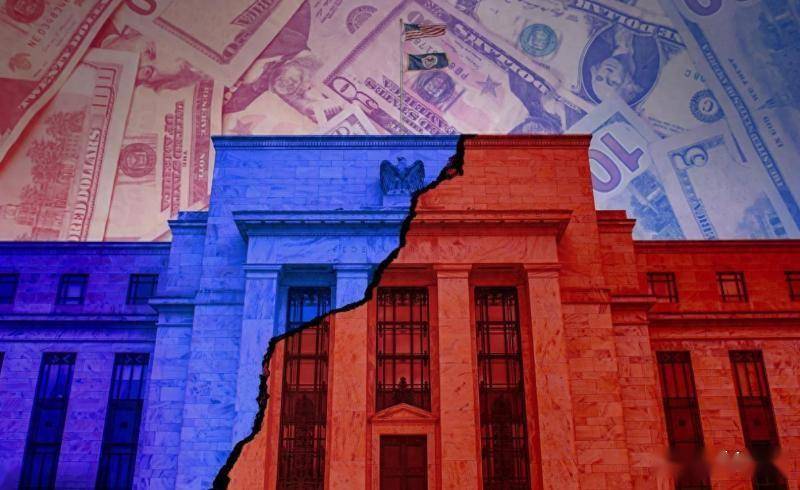
Core Viewpoint - The Federal Reserve's balance sheet, amounting to $6.56 trillion, is causing significant financial strain, leading to a record loss of $240 billion, which threatens the liquidity of the entire U.S. financial system [1][2][5] Group 1: Federal Reserve's Financial Condition - The Federal Reserve's balance sheet currently stands at $6.56 trillion, with a cumulative loss of $240 billion due to high interest payments to financial institutions [2][5] - The unprecedented loss of a central bank raises concerns about its credibility and ability to issue currency, as typically central banks generate profits [2][5] - The losses stem from excessive money printing in previous years and the purchase of high-priced government bonds, which have now depreciated in value due to rising interest rates [5][9] Group 2: Liquidity Crisis Indicators - The use of the Standing Repo Facility (SRF) reached a historical high of $50.4 billion at the end of October, indicating a liquidity crunch among U.S. banks [7] - Despite the Federal Reserve's claims of a "sufficient reserves" system, banks are facing cash flow issues, leading them to exchange government bonds for cash with the Fed [7][9] - The reduction of U.S. Treasury holdings by China exacerbates the liquidity tension, as it increases the supply of bonds while reducing cash availability in the market [9][11] Group 3: Implications of China's Actions - China's decision to reduce its holdings of U.S. Treasuries reflects a lack of confidence in the Federal Reserve's financial health, as it views U.S. debt as a liability [5][11] - The absence of China as a major buyer of U.S. debt complicates the Treasury's ability to issue new bonds, creating a deadlock in the financial system [9][13] - The U.S. financial system's reliance on external liquidity sources, particularly from countries like China, has been disrupted, leading to potential systemic risks [11][13]

广发早知道:汇总版-20251126
Guang Fa Qi Huo· 2025-11-26 03:04
1. Report Industry Investment Rating There is no information provided regarding the report industry investment rating. 2. Core Views of the Report - The domestic stock index shows strong resilience, and it is recommended to wait for stabilization with reduced volatility. It is advisable to mainly observe the market due to the ongoing repricing adjustment of A - shares after the third - quarter reports, with limited downside risks and shrinking trading volume [4]. - For treasury bonds, the long - term bond is affected by the expected implementation of the new regulations on bond fund redemptions, and the curve slightly steepens. A range - bound operation is recommended for the unilateral strategy, and short - position investors can accelerate the position - shifting pace. Attention should be paid to the cash - and - carry strategy for the 2603 contract [6]. - For precious metals, the medium - to - long - term bull market of precious metals is expected to continue. Gold is currently oscillating in the range of $4050 - 4150, and silver is fluctuating in the range of $50 - 52.5. Short - term investors can try to go long on silver if the price rises [10]. - The shipping index (European line) is expected to decline in the short term [11]. - For base metals, the prices of most metals are expected to maintain an oscillating pattern, with different influencing factors and price ranges for each metal [12][15][18][20][23][26][30][33][37][41][43]. - For black metals, steel prices are expected to oscillate within a range, iron ore is expected to oscillate with a slight upward trend, and coking coal and coke are expected to oscillate with a downward trend [48][50][53][57]. - For agricultural products, the domestic soybean meal supply is abundant, and the cost side lacks substantial positive factors [58]. 3. Summary by Relevant Catalogs Financial Derivatives - Financial Futures Stock Index Futures - **Market Conditions**: On Tuesday, A - share major indices opened higher and the market recovered. The Shanghai Composite Index rose 0.87% to 3870.02 points. The four major stock index futures contracts all rose, and the basis discount of the main contracts was repaired [2][3]. - **News**: Domestically, the leaders of China and the US had a phone call, and the situation of Sino - US relations was discussed. Overseas, the US was making progress in promoting the end of the Russia - Ukraine conflict [3][4]. - **Funding**: On November 25, the A - share market trading volume increased slightly compared to the previous day. The central bank conducted 3021 billion yuan of 7 - day reverse repurchase operations, with a net withdrawal of 1054 billion yuan [4]. - **Operation Suggestion**: The domestic stock index is resilient. It is recommended to wait for stabilization with reduced volatility and mainly observe the market [4]. Treasury Bond Futures - **Market Performance**: Treasury bond futures mostly closed down. The 30 - year and 10 - year main contracts declined, while the 2 - year main contract rose slightly [5]. - **Funding**: The central bank conducted 3021 billion yuan of 7 - day reverse repurchase operations and 1 trillion yuan of 1 - year MLF operations, with a net MLF injection of 100 billion yuan in November [5][6]. - **Operation Suggestion**: The bond market is in a range - bound stage. A range - bound operation is recommended for the unilateral strategy, and short - position investors can accelerate the position - shifting pace. Attention should be paid to the cash - and - carry strategy for the 2603 contract [6]. Financial Derivatives - Precious Metals - **Market Review**: US economic data showed divergence. Retail sales growth slowed down, PPI inflation rose, and private - sector employment decreased. The Fed official supported interest - rate cuts, and the market was cautious, with precious metals oscillating [7][8][9]. - **Outlook**: The long - term bull market of precious metals is expected to continue. Gold is oscillating in the range of $4050 - 4150, and silver is fluctuating in the range of $50 - 52.5. Short - term investors can try to go long on silver if the price rises [10]. - **Funding**: The gold ETF changed little, but the silver ETF had a large - scale inflow of over 250 tons [10]. Financial Derivatives - Shipping Index (European Line) - **Shipping Index**: As of November 24, the SCFIS European line index rose 20.7% month - on - month, while the US West route index fell 10.5% month - on - month. As of November 21, the SCFI composite index fell 4% month - on - month [11]. - **Fundamentals**: As of November 20, the global container shipping capacity increased by 7.17% year - on - year. The eurozone's October composite PMI was 52.2, and the US October manufacturing PMI was 48.7 [11]. - **Logic**: The futures market oscillated, and the spot market was weak. The main 02 contract fell 7.78% [11]. - **Operation Suggestion**: It is expected to decline in the short term [11]. Commodity Futures - Non - ferrous Metals Copper - **Spot**: As of November 25, the average price of SMM electrolytic copper and SMM Guangdong electrolytic copper increased, while the average premium decreased. Downstream demand returned to the rigid - demand procurement stage [12]. - **Macro**: Ukraine has basically agreed to the peace agreement proposed by the US, and the probability of a 25 - basis - point interest - rate cut in December has returned to 80% [12]. - **Supply**: The spot TC of copper concentrate is at a low level. In October, the output of electrolytic copper decreased month - on - month, and it is expected to decline slightly in November [12][13]. - **Demand**: The weekly operating rate of electrolytic copper rod increased, and the downstream demand showed strong resilience [13]. - **Inventory**: LME and COMEX copper inventories increased, while the domestic social inventory decreased [14]. - **Logic**: The probability of a December interest - rate cut has increased, and copper prices slightly rose and then fell. In the medium - to - long - term, the supply - demand contradiction supports the upward movement of copper prices [15]. - **Operation Suggestion**: The main contract is expected to oscillate between 85500 - 87500 yuan/ton [15]. Alumina - **Spot**: On November 25, the spot prices of alumina in various regions remained unchanged. The supply pattern is gradually loosening, and the spot price is under pressure [15]. - **Supply**: In October 2025, the output of metallurgical - grade alumina increased year - on - year. It is expected that the supply will remain in surplus in November, and high - cost enterprises may reduce production [16]. - **Inventory**: The port inventory and factory inventory decreased, while the electrolytic aluminum factory inventory increased. The total registered warehouse receipts decreased [16]. - **Logic**: The market oscillated at a low level, and the supply showed signs of contraction. The overall inventory accumulation rate slowed down, and the market may bottom out and oscillate [17]. - **Operation Suggestion**: The main contract is expected to operate between 2700 - 2850 yuan/ton [17]. Aluminum - **Spot**: On November 25, the average price of SMM A00 aluminum increased, and the premium decreased. Market activity and actual transactions increased after the price decline [18]. - **Supply**: In October 2025, the domestic electrolytic aluminum output increased year - on - year and month - on - month. It is expected that the daily output of aluminum ingots may slightly decline in November [18]. - **Demand**: The weekly operating rates of aluminum processing products were divided. High prices restricted downstream demand [18]. - **Inventory**: The domestic mainstream consumption area inventory and LME inventory decreased [19]. - **Logic**: The market showed a high - level position - reduction and correction trend, with a combination of positive and negative factors in the macro and fundamental aspects. It is expected to oscillate at a high level [19]. - **Operation Suggestion**: The main contract is expected to operate between 21100 - 21700 yuan/ton. If the position continues to be reduced, there may be further downward space in the short term [19]. Aluminum Alloy - **Spot**: On November 25, the average prices of SMM aluminum alloy ADC12 in various regions remained unchanged [20]. - **Supply**: In October, the output of recycled aluminum alloy ingots decreased, and the operating rate decreased. It is expected that the operating rate will continue to decline slightly in November due to the shortage of scrap aluminum [20]. - **Demand**: The traditional automobile consumption season is in progress, but the demand transmission is not smooth, and high prices suppress downstream procurement [20]. - **Inventory**: The social inventory and registered warehouse receipts increased [21]. - **Logic**: The market showed a high - level correction trend. The cost side was strongly supported, and the supply was restricted by raw materials. The demand was affected by high prices. It is expected to oscillate in the short term [21]. - **Operation Suggestion**: The main contract is expected to operate between 20300 - 20900 yuan/ton. An arbitrage strategy of going long on AD02 and short on AL02 can be considered when the spread is above 650 [22]. Zinc - **Spot**: On November 25, the average price of SMM 0 zinc ingot increased. The spot purchase was still based on demand, and the transaction was average [23]. - **Supply**: The processing fees of domestic and imported zinc concentrates decreased, and the profit of smelters was compressed. It is expected that the output of refined zinc will decline in November [24]. - **Demand**: The spot premium increased. The operating rates of the three primary processing industries were basically stable, and the downstream purchased on dips. The export space was opened, which may boost the domestic zinc price [25]. - **Inventory**: The domestic social inventory decreased, and the LME inventory increased [25]. - **Logic**: The fundamentals changed little, and the zinc price oscillated. The supply pressure was relieved, and the demand improved structurally. It is expected to continue to oscillate [26]. - **Operation Suggestion**: The main contract is expected to oscillate between 22200 - 22800 yuan/ton [26]. Tin - **Spot**: On November 25, the price of SMM 1 tin increased, and the premium remained unchanged. The market transaction was light [26]. - **Supply**: In October, the import volume of tin ore and tin ingot showed different trends. It is expected that the import volume of tin ore from Myanmar will increase in November, and the import volume of tin ingot will remain at a low level [27][28]. - **Demand and Inventory**: In October, the operating rate of solder decreased. The inventory of LME and the social inventory increased [29]. - **Logic**: The supply of tin ore is tight, and the demand in South China is relatively stable. It is recommended to maintain a long - position on tin due to strong fundamentals [30]. - **Operation Suggestion**: A strategy of buying on dips is recommended [30]. Nickel - **Spot**: As of November 25, the average price of SMM1 electrolytic nickel increased. The supply of refined nickel decreased, and it was difficult to find discounted spot goods [30]. - **Supply**: In the capacity expansion cycle, the output of refined nickel is expected to decrease month - on - month but remains at a high level [31]. - **Demand**: The demand for electroplating is stable, the demand for alloys is good, the demand for stainless steel is average, and the demand for nickel sulfate has short - term support [31]. - **Inventory**: The domestic and overseas inventories are at a high level, and the bonded - area inventory is stable [31]. - **Logic**: The market oscillated and recovered. The upstream production reduction and low valuation drove the market. The macro situation is temporarily stable, and the fundamentals are weak. It is expected to oscillate and recover [32][33]. - **Operation Suggestion**: The main contract is expected to oscillate between 116000 - 120000 yuan/ton [33]. Stainless Steel - **Spot**: As of November 25, the prices of Wuxi Hongwang and Foshan Hongwang 304 cold - rolled stainless steel were stable or increased, and the basis decreased [33]. - **Raw Materials**: The nickel ore market is stable, the price of nickel iron is under pressure, and the cost support of chromium iron is weakening [34]. - **Supply**: In October, the output of stainless steel increased. In November, the production is expected to decrease slightly. The supply pressure is still high [35]. - **Inventory**: The social inventory decreased slowly, and the warehouse receipts decreased [35]. - **Logic**: The market slightly rose, and the spot market purchase price was stable. The macro situation is temporarily stable, the raw material cost support is weakening, and the supply pressure remains. It is expected to oscillate [36]. - **Operation Suggestion**: The main contract is expected to operate between 12300 - 12700 yuan/ton [37]. Lithium Carbonate - **Spot**: As of November 25, the spot prices of battery - grade and industrial - grade lithium carbonate decreased slightly. The trade volume improved but was still average [37]. - **Supply**: In October, the output of lithium carbonate increased. The supply is expected to increase, mainly driven by the increase in lithium extraction from spodumene [37]. - **Demand**: The demand is optimistic. The production schedules of lithium iron phosphate and ternary materials are expected to increase month - on - month [38][39]. - **Inventory**: The total inventory decreased, and the inventory of smelters and downstream decreased, while the inventory of other links increased [39]. - **Logic**: The market was strong. The industry is optimistic about next year, and the market sentiment is bullish. The fundamentals remain strong, and the inventory is decreasing. It is expected to oscillate and adjust in the short term [40]. - **Operation Suggestion**: It is recommended to mainly observe the market [41]. Polysilicon - **Spot Price**: On November 25, the spot prices of polysilicon remained unchanged [41]. - **Supply**: In November, the domestic output of polysilicon is expected to decrease to about 120,000 tons. It is expected to increase to about 123,000 tons in December [41]. - **Demand**: The downstream demand is expected to decline month - on - month, and each link has an expectation of inventory accumulation [42]. - **Inventory**: The inventory increased by 4000 tons to 271,000 tons, and the warehouse receipts decreased [42]. - **Logic**: The spot price is stable, the futures price oscillated and rose, and the backwardation structure deepened. It is expected to oscillate at a high level [43]. - **Operation Suggestion**: It is expected to oscillate between 50000 - 58000 yuan/ton [43]. Industrial Silicon - **Spot Price**: On November 25, the spot prices of industrial silicon in various regions remained unchanged [43]. - **Supply**: In November, the output of industrial silicon is expected to decrease to about 400,000 tons, mainly due to the production reduction in Southwest China [44]. - **Demand**: The demand is not optimistic. The production of polysilicon and organic silicon is expected to decrease, while the demand for aluminum alloy is good [44]. - **Inventory**: The futures warehouse receipts decreased, while the factory inventory and social inventory increased slightly [44]. - **Logic**: The spot price is stable, and the futures price oscillated. The supply and demand are both decreasing, and there is still pressure on inventory accumulation. It is expected to oscillate at a low level [45]. - **Operation Suggestion**: It is expected to oscillate between 8500 - 9500 yuan/ton [45]. Commodity Futures - Ferrous Metals Steel - **Spot**: The futures market strengthened, and the spot price followed. The basis of rebar weakened, and the basis of hot - rolled coil remained stable [45]. - **Cost and Profit**: The prices of coking coal and coke decreased, and the price of iron ore was relatively stable. The profit of steel mills was slightly repaired but is expected to remain at a low level [46]. - **Supply**: From January to October, the output of iron elements increased year - on - year. Recently, the molten iron output decreased, and the output of five major steel products increased [46]. - **Demand**: The domestic demand is weak, and the export is at a high level. The apparent demand in November increased compared to October [46]. - **Inventory**: The inventory of five major steel products decreased rapidly, and the inventory reduction is expected to continue [47]. - **View**: It is expected that the steel price will oscillate within a range. The rebar is expected to oscillate between 3000 - 3200 yuan/ton, and the hot - rolled coil is expected to oscillate between 3250 - 3400 yuan/ton [48]. Iron Ore - **Spot**: As of November 25, the prices of mainstream iron ore
救命啊!黄金怎么也跟着美股“跳楼”了?
凤凰网财经· 2025-11-24 02:09
财经连环话 . 一图看懂财经万象。 以下文章来源于财经连环话 ,作者王者归来的轱辘慧 家人们,慧慧心里苦啊! 本来以为躲过了大A的震荡,避开了美股的过山车,买了点黄金当"定海神针"。 结果上周五一看: 美股跌!比特币跌!连浓眉大眼的黄金也暴跌 2%! 这感觉就像:我想躲雨跑进了亭子,结果亭子漏水了! 这是为啥?难道黄金不避险了? NO!NO!NO! 且听慧慧慢慢说,这背后的真相,其实是市场缺钱了,也就是传说中的—— "流动性紧张" 意思就是: 现在它俩是一根绳上的蚂蚱。 专家说了,这是因为大家都在担心AI泡沫(连那个做空的大佬Michael Burry都出手了),吓得赶紧把能变现的都变现了。 那黄金还能拿吗? 这里有三个 轱辘慧独家锦囊 ,收好不谢: 给大伙打个最通俗的比方: 假如你在股市里亏惨了,或者你的比特币要爆仓了,急需现金去补窟窿(追加保证金)。 这时候,你手里的烂股票卖不掉或者卖了也不够。 你咋办? 你只能把你手里 最值钱、还是赚着钱 的东西卖了换现金救急! 对!那个被卖掉的"倒霉蛋",就是黄金! 所以,大家都在卖黄金换现金,金 价自然就哗啦啦往下掉。 数据是不会说谎的: 历史上黄金和美股通常是跷跷 ...

流动性紧张扰动市场,黄金偏弱震荡
Dong Zheng Qi Huo· 2025-11-09 11:43
Report Industry Investment Rating - Gold: Bearish [1] Core Viewpoints - London gold oscillated slightly down to $4001 per ounce. The 10-year US Treasury yield rose slightly to 4.09%, inflation expectation was 2.28%, real interest rate rose slightly to 1.83%, the US dollar index fell 0.2% to 99.6, the S&P 500 index dropped 1.6%, the RMB oscillated, and Shanghai gold turned to a premium [2] - Gold prices are in a long-short game at the $4000 mark. After a 10% correction from the high, there are signs of bottom-fishing, but potential negative pressures suppress the rebound space of gold prices. The end of the US government shutdown would be short-term negative for gold, market expectations for a December interest rate cut have declined, the Sino-US tariff issue has eased marginally, and the US economic data is fair [3] - The domestic gold tax reform has been implemented, suppressing jewelry demand and potentially boosting investment demand. The domestic market performs better than the international market. The People's Bank of China continued to increase its gold reserves in October, but the increment slowed down, having limited positive impact on gold [4] - In the short term, the gold price is still in a correction trend, and the domestic gold maintains a small premium [5] Summary by Directory 1. Weekly Changes in High-Frequency Gold Data - The domestic basis (spot - futures) was -3.62 yuan/gram, with a weekly change of -2.72 yuan and a change rate of 302.2%. The domestic and foreign futures price difference (domestic - foreign) was 3.50 yuan/gram, with a weekly change of 14.05 yuan and a change rate of -133.2% [12] - The Shanghai Futures Exchange's gold inventory was 89,616 kilograms, an increase of 1,800 kilograms or 2.0% from last week. The COMEX gold inventory was 37,729,455 ounces, a decrease of 438,591 ounces or -1.15% from last week [12] - The SPDR ETF's gold holding was 1042.06 tons, an increase of 2.86 tons or 0.28% from last week. The CFTC gold speculative net long position was 158,616 lots, a decrease of 1,867 lots or -1.2% from last week [12] 2. Tracking of Financial Market - Related Data 2.1 US Financial Market - The US dollar index fell 0.2%, and the US Treasury yield rose slightly to 4.09%. The S&P 500 dropped 1.6%, and the VIX index rose slightly to 19 [19] - The US overnight secured financing rate was 3.92%. Oil prices fell 2.2%, and the US inflation expectation was 2.28% [18] - The real interest rate rose to 1.83%, and the gold price oscillated flat. The spot commodity index closed down, and the US dollar index fell 0.2% [20] 2.2 Global Financial Market - Stocks, Bonds, Currencies, and Commodities - Most developed - country stock markets fell, with the S&P 500 dropping 1.63%. Most developing - country stock markets rose, with the Shanghai Composite Index rising 1.08% [22] - US and German bonds rose, with the US - German yield spread at 1.47%. The UK Treasury yield was 4.47%, and the Japanese bond yield was 1.68% [29] - The euro appreciated 0.25%, the pound sterling appreciated 0.07%, the yen appreciated 0.37%, and the Swiss franc depreciated 0.07%. The US dollar index fell 0.2% to 99.6, and non - US currencies showed mixed movements [27][30] 3. Tracking of Gold Trading - Level Data - The data on gold speculative net long positions was suspended due to the government shutdown. The SPDR Gold ETF holding rose slightly to 1042 tons [33] - The RMB oscillated, and Shanghai gold turned to a premium. Gold and silver corrected, and the gold - silver ratio rose slightly to 82 [36] 4. Weekly Economic Calendar - On Monday, the minutes of the Bank of Japan's meeting will be released. On Tuesday, the US NFIB Small Business Confidence Index for October will be announced. On Wednesday, US Treasury Secretary Bezant will give a speech [37] - On Thursday, the minutes of the Bank of Canada's interest rate meeting will be released. On Friday, China's October retail sales and industrial added value data will be announced [37]
惨!美国政府关门36天破纪录,80万雇员无奈跑外卖,美股要崩了?
Sou Hu Cai Jing· 2025-11-09 04:54
Group 1: Government Shutdown Impact - The U.S. government shutdown has reached 36 days, surpassing the previous record of 35 days set in 2018, indicating a prolonged political standoff [1] - The core issue of the shutdown revolves around healthcare subsidies related to the Affordable Care Act, with both parties entrenched in their positions, leading to a lack of progress in negotiations [3][4] - The shutdown has resulted in significant economic losses, with estimates suggesting a potential GDP growth reduction of 0.2 percentage points per month, translating to over $50 billion in economic damage if it continues until the end of November [10] Group 2: Effects on Employment and Welfare - Approximately 800,000 federal employees are affected, either on unpaid leave or working without pay, leading to increased reliance on charitable organizations for basic needs [7][9] - Food assistance programs for 42 million Americans have been disrupted, with a significant portion of beneficiaries facing delays in receiving aid, marking a historic first in the program's 60-year history [7][10] Group 3: Financial Market Repercussions - The shutdown has triggered liquidity concerns in global financial markets, with the Treasury General Account (TGA) balance exceeding $1 trillion, indicating a reduction in available cash flow in the market [12][14] - The SOFR rate has surged to 4.22%, reflecting increased borrowing costs among banks, while the usage of the Federal Reserve's emergency lending facilities has reached record levels, signaling a cash crunch in the banking sector [12][14] Group 4: Broader Economic Consequences - The shutdown has led to flight cancellations and disruptions in the transportation sector, with a warning that up to 20% of flights could be affected, impacting millions of travelers [9][10] - Local businesses, particularly in Washington D.C., have seen a significant drop in sales, with some reporting declines of 15% to 20%, and small business loan approvals have come to a halt, threatening their viability [10][12]

原油日报:美国流动性紧张推动油价走弱-20251106
Hua Tai Qi Huo· 2025-11-06 03:29
Report Summary 1. Investment Rating No specific industry investment rating is provided in the report. 2. Core View The recent liquidity crunch in the US market due to the extended government shutdown has led to a general decline in risk - asset prices, including crude oil. High tanker freight rates have made it difficult for Western resources to arbitrage, and the market is gradually digesting the impact of Russian oil sanctions. The short - term outlook for oil prices is range - bound, while the medium - term strategy is a bearish allocation [2][3]. 3. Summary by Directory Market News and Important Data - Crude oil futures prices declined: The December - delivery light crude oil futures on the New York Mercantile Exchange fell 96 cents to $59.60 per barrel, a 1.59% drop; the January - delivery Brent crude oil futures in London dropped 92 cents to $63.52 per barrel, a 1.43% decline. The SC crude oil main contract closed down 0.95% at 458 yuan per barrel [1]. - UAE's oil inventory: As of the week ending November 5, the total refined oil inventory at the Port of Fujairah in the UAE was 18.607 million barrels, up 851,000 barrels from the previous week. Light distillate inventory decreased by 1.236 million barrels to 6.713 million barrels, medium distillate inventory decreased by 79,000 barrels to 3.234 million barrels, and heavy residual fuel oil inventory increased by 2.166 million barrels to 8.66 million barrels [1]. - OPEC supply: In September, the daily crude oil supply of 9 OPEC countries with quotas was 23.87 million barrels, an increase of 760,000 barrels from August and 940,000 barrels higher than the target daily output. Saudi Arabia's daily supply was 9.98 million barrels, an increase of 550,000 barrels from August, meeting the target. OPEC+ will further increase production slightly in December but will suspend the production - increase plan from January to March 2026 due to seasonal factors. From January to March next year, Iraq, the UAE, Kazakhstan, and Oman will increase compensatory production cuts monthly, with a total reduction of 822,000 barrels per day in June to compensate for previous over - production [1]. - Libyan oil production plan: Libya's current oil production is close to 1.4 million barrels per day. The goal is to increase production to 2 million barrels per day in the next five years, 1.6 million barrels per day next year, and 1.8 million barrels per day the year after [1]. - Saudi Aramco's demand forecast: Saudi Aramco's CEO expects global oil demand to reach 106 million barrels per day in 2025, with strong demand growth in 2026 [1]. Investment Logic The extended US government shutdown has caused a liquidity crunch, leading to a decline in crude oil prices. High tanker freight rates have hindered Western resource arbitrage, and the market is digesting the impact of Russian oil sanctions. The lack of continuous upward movement in the Dubai month - spread indicates a slowdown in the shift from Russian oil to Middle Eastern oil [2]. Strategy Oil prices are expected to trade in a range in the short term and a bearish allocation is recommended in the medium term [3].
黑色建材日报-20251106
Wu Kuang Qi Huo· 2025-11-06 01:23
Report Industry Investment Rating No relevant content provided. Core Viewpoints of the Report - The overall atmosphere in the commodity market was weak yesterday, with finished steel prices showing a weak and volatile trend. Although the steel demand has officially entered the off - season and there is a risk of inventory accumulation for hot - rolled coils, with the implementation of the Fed's easing expectations and positive signals from the China - US meeting, the market sentiment and capital environment are expected to improve, and the steel consumption end may gradually recover in the future [2]. - For iron ore, the supply is still at a high level in the same period, but the demand continues to weaken, and the inventory pressure remains. After the macro - events are realized, the fundamentals of iron ore are weak, and the price is expected to be weak and volatile in the short term. If the US liquidity problem is alleviated, the price may stabilize [5]. - Regarding manganese silicon and silicon iron, the fundamentals are not ideal, and they are likely to follow the trend of the black sector. The operability is relatively low [10]. - For industrial silicon, the supply pressure persists, and the demand support weakens. The price is likely to fluctuate with the commodity market in the short term, and attention should be paid to the option game near the expiration [13]. - For polysilicon, the supply - demand pattern may improve marginally, but the short - term inventory reduction is limited. The market has strong expectations for the industry meeting, and the price is highly volatile [16]. - For glass, the market expects an improvement in the supply structure, but the price increase is restricted by the low procurement enthusiasm of downstream factories. The sustainability of the market depends on spot transactions and inventory reduction [19]. - For soda ash, the industry operating rate remains high, the loss continues to expand, and the demand is mainly for rigid restocking. The price is expected to continue the weak and volatile pattern in the short term [21]. Summary by Related Catalogs Steel Market Quotes - The closing price of the rebar main contract was 3024 yuan/ton, down 20 yuan/ton (- 0.65%) from the previous trading day. The registered warehouse receipts decreased by 2708 tons, and the main contract positions increased by 65237 lots. The Tianjin and Shanghai aggregate prices decreased by 10 yuan/ton and 30 yuan/ton respectively [1]. - The closing price of the hot - rolled coil main contract was 3253 yuan/ton, down 12 yuan/ton (- 0.36%) from the previous trading day. The registered warehouse receipts remained unchanged, and the main contract positions decreased by 23039 lots. The Lecong and Shanghai aggregate prices decreased by 10 yuan/ton and 20 yuan/ton respectively [1]. Strategy Views - Rebar shows a situation of both supply and demand increasing, with inventory continuously decreasing, performing neutrally overall. Hot - rolled coils have a continuous recovery in demand, but the production is still high, and the inventory level is still relatively high [2]. Iron Ore Market Quotes - The main contract (I2601) of iron ore closed at 776.00 yuan/ton, with a change of + 0.06% (+ 0.50). The positions decreased by 3095 lots to 54.47 million lots. The weighted position was 94.35 million lots. The spot price of PB powder at Qingdao Port was 782 yuan/wet ton, with a basis of 55.23 yuan/ton and a basis rate of 6.64% [4]. Strategy Views - Supply: The overseas iron ore shipment volume decreased slightly but remained at a high level in the same period. The shipments from Australia and Brazil both declined, with FMG having a significant decline. The shipments from non - mainstream countries decreased slightly, and the near - end arrival volume rebounded to the annual high [5]. - Demand: The daily average pig iron output decreased by 3.54 million tons to 236.36 million tons. The number of blast furnaces under maintenance far exceeded those under restart. The steel mill profitability reached a new low, and some blast furnaces started maintenance due to profit decline. Environmental protection restrictions in Hebei also affected pig iron production [5]. - Inventory: Port inventory continued to increase, while steel mill inventory decreased [5]. Manganese Silicon and Silicon Iron Market Quotes - On November 5, the main contract of manganese silicon (SM601) closed up 0.38% at 5776 yuan/ton. The spot price in Tianjin was 5680 yuan/ton, with a basis of 116 yuan/ton [7][8]. - The main contract of silicon iron (SF601) closed up 0.91% at 5560 yuan/ton. The spot price in Tianjin was 5550 yuan/ton, with a discount of 10 yuan/ton to the futures [8]. Strategy Views - The fundamentals of manganese silicon are not ideal, and the potential driver may come from the manganese ore end. If the black sector strengthens, attention should be paid to the possible disturbances in the manganese ore end [10]. - The supply - demand fundamentals of silicon iron have no obvious contradictions and drivers, and it is likely to follow the black sector [10]. Industrial Silicon and Polysilicon Market Quotes - Industrial silicon: The main contract (SI2601) closed at 9020 yuan/ton, up 1.52% (+ 135). The weighted contract positions decreased by 13071 lots to 398388 lots. The spot price of East China non - oxygenated 553 was 9300 yuan/ton, with a basis of 280 yuan/ton; the 421 was 9700 yuan/ton, with a basis of - 120 yuan/ton [12]. - Polysilicon: The main contract (PS2601) closed at 53355 yuan/ton, down 0.67% (- 360). The weighted contract positions decreased by 7354 lots to 230402 lots. The average price of N - type granular silicon was 50.5 yuan/kg, and the basis was - 1155 yuan/ton [15]. Strategy Views - Industrial silicon: The supply pressure persists. Although the production in Southwest China is reduced during the dry season, the production in Northwest China continues to rise. The demand support weakens, and the price is likely to fluctuate with the commodity market in the short term [13]. - Polysilicon: Some production capacities will be overhauled, and the production in November will be reduced to 120,000 tons. The supply - demand pattern may improve marginally, but the short - term inventory reduction is limited. The market has strong expectations for the industry meeting, and the price is highly volatile [16]. Glass and Soda Ash Market Quotes - Glass: The main contract closed at 1097 yuan/ton on Wednesday afternoon, down 0.72% (- 8). The weekly inventory of float glass sample enterprises decreased by 823,000 cases (- 1.24%). The top 20 long - position holders increased 27375 lots, and the top 20 short - position holders increased 45091 lots [18]. - Soda ash: The main contract closed at 1195 yuan/ton on Wednesday afternoon, up 0.50% (+ 6). The weekly inventory of soda ash sample enterprises decreased by 10,000 tons (- 1.24%), with heavy - soda inventory decreasing by 48,100 tons and light - soda inventory increasing by 48,000 tons. The top 20 long - position holders decreased 16327 lots, and the top 20 short - position holders decreased 16452 lots [20]. Strategy Views - Glass: The market expects an improvement in the supply structure, but the price increase is restricted by the low procurement enthusiasm of downstream factories. The sustainability of the market depends on spot transactions and inventory reduction [19]. - Soda ash: The industry operating rate remains high, the loss continues to expand, and the demand is mainly for rigid restocking. The price is expected to continue the weak and volatile pattern in the short term [21].
银河期货有色金属衍生品日报-20251105
Yin He Qi Huo· 2025-11-05 11:11
Group 1: Report Investment Ratings - No investment ratings provided in the report Group 2: Core Views - The long - term shutdown of the US government has increased short - term concerns about market liquidity, which mainly has a short - term impact. The supply of copper mines remains tight, and the supply situation in non - US regions has been alleviated to some extent. The demand for refined copper has been affected by high prices, but the downstream procurement demand has increased after the price decline [2][5] - The supply and demand of alumina are still in a significant surplus. Although there are expectations of production cuts, actual cuts have not occurred, and the import window is open. New projects are progressing smoothly, putting pressure on prices [13] - The US government shutdown has affected market liquidity, but the supply - demand pattern of electrolytic aluminum is still tight. Overseas production cuts have intensified supply concerns, and domestic consumption shows resilience, so the price is expected to rise after corrections [19] - The US government shutdown has a short - term impact on the market. The supply of casting aluminum alloy is tight, raw material costs are rising, and demand is improving, making the price easy to rise and hard to fall [29] - The domestic zinc smelter's winter storage scale has expanded, and the profit margin of smelters has been narrowed. The consumption peak season is over, but the opening of the export window will relieve the oversupply situation [36] - Some domestic lead - storage enterprises have reduced production, while the supply side is expected to increase. Considering the supply increase and the arrival of the consumption off - season, the lead price may decline [41] - The LME nickel inventory accumulation speed has slowed down, and the supply - demand is still loose. The nickel price is in a wide - range shock with a downward - moving center [46] - The terminal demand for stainless steel is not optimistic, and the supply is sufficient. The cost support is not strong, so the price trend is weak [49] - The Fed has differences on interest rate cuts, and the dollar index has reached a new high. The tin ore supply is still tight, and the demand is slowly recovering. The tin price is in a weak shock [57] - In November, the demand for industrial silicon has weakened, and the supply has been reduced. The price has limited downward and upward space, and it is more cost - effective to buy at low prices [61] - In November, the supply and demand of polysilicon have both decreased, and the supply reduction is greater. The spot price has no upward momentum in the short term, and it is advisable to buy after the price stabilizes [69] - In November, the supply and demand of lithium carbonate have tightened, and the price may rebound after a short - term decline. It is advisable to arrange short positions after the rebound [74] Group 3: Summary by Industry Copper - **Market Review**: The main contract of Shanghai copper 2512 closed at 85,670 yuan/ton, down 0.88%. The spot price returned to the 85,000 yuan/ton level, and the downstream replenishment increased [1] - **Important Information**: The US government shutdown affected market liquidity. Glencore plans to shut down a smelter, and some mining companies have adjusted their production plans [2][3] - **Logic Analysis**: Macro factors and supply - demand situations affect the copper market. The supply of copper mines is tight, and the demand has been affected by high prices [5] Alumina - **Market Review**: The futures price of alumina 2601 decreased by 3 yuan to 2,772 yuan/ton. The spot prices in different regions showed different changes [7] - **Related Information**: Some electrolytic aluminum plants purchased alumina, and some alumina enterprises had production adjustments due to environmental factors. New projects are in progress [8][12] - **Logic Analysis**: The supply - demand surplus and factors such as production cuts and new projects affect the price [13] - **Trading Strategy**: Unilateral: Weak shock; Arbitrage: Temporary wait - and - see; Options: Temporary wait - and - see [14][15] Electrolytic Aluminum - **Market Review**: The futures price of Shanghai aluminum 2512 decreased by 85 yuan to 21,395 yuan/ton. The spot prices in different regions declined [17] - **Related Information**: The US government shutdown affected market liquidity, the LME planned to formulate rules, and some aluminum plants had production adjustments [17][18] - **Trading Logic**: The US government shutdown affected the price, but the supply - demand pattern is tight, and the price is expected to rise after corrections [19] - **Trading Strategy**: Unilateral: Buy on dips; Arbitrage: Choose the opportunity to go long on SHFE aluminum and short on LME aluminum; Options: Temporary wait - and - see [20][21][22] Casting Aluminum Alloy - **Market Review**: The futures price of casting aluminum alloy 2512 decreased by 120 to 20,795 yuan/ton. The spot prices in different regions declined [24] - **Related Information**: The US - China tariff adjustment and economic data were released, and the US government shutdown affected market liquidity [24][27] - **Trading Logic**: The US government shutdown has a short - term impact. The supply is tight, costs are rising, and demand is improving, making the price easy to rise [29] - **Trading Strategy**: Unilateral: Buy on dips; Arbitrage: Temporary wait - and - see; Options: Temporary wait - and - see [30] Zinc - **Market Review**: The futures price of Shanghai zinc 2512 decreased by 0.15% to 22,650 yuan/ton. The spot market had active trading among traders [32] - **Related Information**: Some mining companies' zinc production data changed [33][34][35] - **Logic Analysis**: The smelter's winter storage and profit situation, consumption season, and export window affect the market [36] - **Trading Strategy**: Unilateral: Hold profitable long positions; Arbitrage: Arrange to buy SHFE zinc and sell LME zinc; Options: Temporary wait - and - see [37] Lead - **Market Review**: The futures price of Shanghai lead 2512 increased by 0.17% to 17,475 yuan/ton. The spot market had different trading attitudes among holders and downstream enterprises [39] - **Related Information**: A lead - zinc mine obtained a production license [40] - **Logic Analysis**: The production situation of lead - storage enterprises and the supply - side situation affect the price [41] - **Trading Strategy**: Unilateral: Hold profitable short positions; Arbitrage: Temporary wait - and - see; Options: Temporary wait - and - see [42][43] Nickel - **Market Review**: The main contract of Shanghai nickel NI2512 decreased by 290 to 120,030 yuan/ton. The spot premiums changed [45] - **Important Information**: The sales volume of new energy vehicles increased, and the nickel price and production situation in Indonesia changed [46] - **Logic Analysis**: The LME nickel inventory and supply - demand situation affect the price, which is in a wide - range shock [46] - **Trading Strategy**: Unilateral: Weak shock; Arbitrage: Temporary wait - and - see; Options: Sell the 2512 contract wide - straddle combination [48] Stainless Steel - **Market Review**: The main contract of stainless steel SS2512 decreased by 35 to 12,535 yuan/ton. The spot prices of cold - rolled and hot - rolled products were given [49] - **Important Information**: India relaxed the import restrictions on stainless steel [49] - **Logic Analysis**: The terminal demand and supply situation, as well as cost factors, affect the price trend [49] - **Trading Strategy**: Unilateral: Sell on rallies; Arbitrage: Temporary wait - and - see [50][51] Tin - **Market Review**: The main contract of Shanghai tin 2512 closed at 282,090 yuan/ton, down 0.89%. The spot price decreased, and the downstream purchasing sentiment improved [53] - **Related Information**: The US government shutdown, and some semiconductor - related events occurred [54][56] - **Logic Analysis**: The Fed's attitude, tin ore supply, and demand situation affect the price, which is in a weak shock [57] - **Trading Strategy**: Unilateral: Weak shock; Options: Temporary wait - and - see [58][59] Industrial Silicon - **Important Information**: The furnace - starting situation in Yunnan changed, and the electricity price increased, affecting the production of industrial silicon [61] - **Logic Analysis**: The supply and demand situation in November affects the price, with limited downward and upward space [61] - **Strategy Suggestion**: Unilateral: Buy on dips; Arbitrage: None; Options: Sell out - of - the - money put options [62][63][64] Polysilicon - **Important Information**: Hubei launched a new energy project price - settlement mechanism bidding [66] - **Logic Analysis**: The supply and demand situation in November affects the price, and it is advisable to buy after the price stabilizes [69] - **Strategy Suggestion**: Unilateral: Buy after the price correction; Arbitrage: Reverse spread on far - month contracts; Options: None [71] Lithium Carbonate - **Market Review**: The futures price of lithium carbonate 2601 decreased by 360 to 79,140 yuan/ton. The spot prices decreased [72] - **Important Information**: Some lithium - related companies' production and project progress were reported [73] - **Logic Analysis**: The supply and demand situation in November affects the price, which may rebound after a short - term decline [74] - **Trading Strategy**: Unilateral: Arrange short positions after the rebound; Arbitrage: Temporary wait - and - see; Options: Sell out - of - the - money call options [75]
慌,美国政府停摆要引发 “美元荒” ?
3 6 Ke· 2025-11-05 02:27
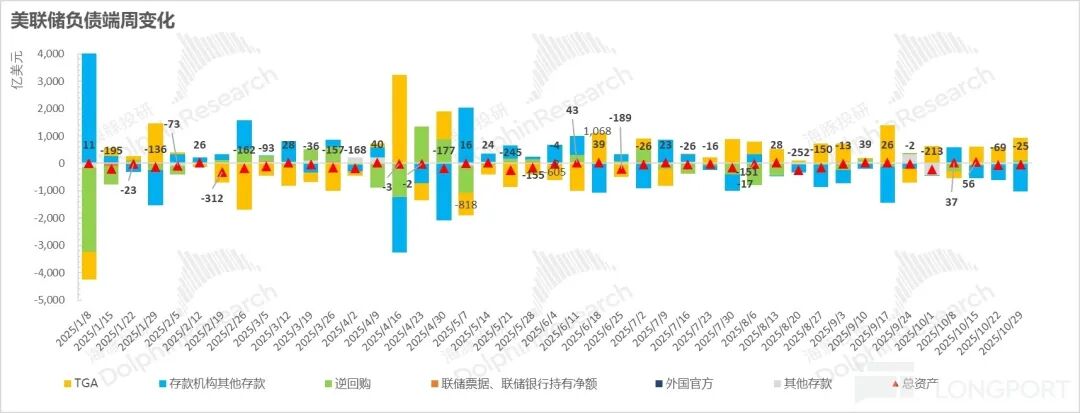
Core Viewpoint - The recent tightening of dollar liquidity is impacting various assets, including Bitcoin and overvalued tech stocks, as the market experiences a withdrawal of liquidity due to government shutdown and ongoing quantitative tightening by the Federal Reserve [1][5]. Group 1: Government Shutdown and TGA - The U.S. Treasury has been unable to distribute funds to the economy due to the government shutdown, leading to a situation where it is effectively "sucking" liquidity from the market [1]. - The Treasury General Account (TGA) has increased from under $300 billion to nearly $1 trillion, absorbing approximately $700 billion from the market, with $160 billion accumulated since November [2]. Group 2: Federal Reserve's Quantitative Tightening - The ongoing quantitative tightening by the Federal Reserve is exacerbating liquidity issues, despite indications that it may end on December 1 [5]. - The Federal Reserve's target federal funds rate is set at 3.75%-4%, but the effective federal funds rate (EFFR) is being influenced by the interest on reserve balances (IORB) and overnight reverse repurchase agreements (ON RRP) [7][8]. Group 3: Indicators of Liquidity Tightness - The widening spread between official rates and market rates indicates liquidity tightness, with the SOFR rate currently at 4.22%, exceeding the Federal Reserve's target range [8]. - The current conditions suggest that the Federal Reserve may not intervene unless the EFFR exceeds the target range significantly, which has not yet occurred [13]. Group 4: Future Outlook - The resolution of the liquidity crisis hinges on the timing of the government reopening and potential actions by the Federal Reserve to release liquidity [11]. - Market expectations suggest that a resolution may occur in mid-October, which could lead to a resurgence in liquidity-sensitive assets once the government reopens [12][14].
美联储如期降息,美元继续震荡
Dong Zheng Qi Huo· 2025-11-02 09:44
Report Industry Investment Rating - The rating for the US dollar is "oscillation" [6] Core Viewpoints - The Fed cut interest rates as expected in October and announced the end of balance sheet reduction on December 1st. Market expectations for a December rate cut have declined, and internal differences within the Fed have increased, which is expected to lead to increased market volatility [3][12] - The ECB and the BoJ kept their policies unchanged with dovish stances, and the market's expectations for Japanese fiscal expansion and monetary easing have increased, driving up the Japanese stock market [3][12] - During the APEC meeting, the US and China made some adjustments to tariffs and export controls, but no formal agreement has been signed, slightly falling short of market expectations [3][12] - The US government shutdown has led to a lack of economic data, but corporate earnings, financial reports, and future capital expenditure plans support the high - level operation of the US market [3][12] Breakdown by Directory 1. Global Market Overview This Week - Market risk appetite remained high, with stock markets rising and falling, and bond yields also showing mixed trends. The US Treasury yield slightly rose to 4.07%. The US dollar index rose 0.86% to 99.8, most non - US currencies depreciated, the offshore RMB slightly rose 0.05%, the euro fell 0.79%, the pound fell 1.2%, the yen fell 0.74%, the Swiss franc fell 1.12%, the Korean won, Australian dollar, Malaysian ringgit, and Thai baht rose, while the New Zealand dollar, peso, rand, and Canadian dollar fell. Gold prices dropped 2.7% to $4002 per ounce, the VIX index rose to 17.4, the spot commodity index rose, and Brent crude oil fell 1.9% to $65.2 per barrel [2][10] 2. Market Trading Logic and Asset Performance 2.1 Stock Market - Global stock markets showed mixed trends, with US and A - shares rising. The S&P 500 rose 0.71%, the Shanghai Composite Index rose 0.11%, the Hang Seng Index fell 0.97%, and the Nikkei 225 index soared 6.31%. The US government shutdown will further drag on the economy, and the Fed's interest - rate cut and end of balance - sheet reduction, along with internal differences, are expected to increase market volatility. The market's expectations for Japanese fiscal and monetary policies have boosted the Japanese stock market. The China - US trade situation has slightly disappointed the market, and the divergence between the stock market and fundamentals in China is expected to gradually correct [11][12] 2.2 Bond Market - Global bond yields showed mixed trends, with the 10 - year US Treasury yield slightly rising to 4.07%. The US government shutdown, the Fed's policy adjustments, and the ECB's stance have affected bond yields. The 10 - year Chinese Treasury yield fell to 1.797%, and the Sino - US yield spread inverted and rebounded to 228bp [15][16][21] 2.3 Foreign Exchange Market - The US dollar index rose 0.86% to 99.8, and most non - US currencies depreciated. The offshore RMB slightly rose 0.05%, while the euro, pound, yen, and Swiss franc fell, and some Asian and Oceanian currencies showed mixed trends [24][27] 2.4 Commodity Market - Gold prices fell 2.7% to $4002 per ounce, continuing the downward trend. The Fed's policy and changes in Chinese gold consumption tax have had a negative impact on gold prices, and it is expected that there is still room for decline. Brent crude oil fell 1.9% to $65.2 per barrel as concerns about the supply side eased, while the industrial products rebounded and the commodity spot index rose [28][30] 3. Hot - Spot Tracking - The Fed cut interest rates by 25bp in October and stopped balance - sheet reduction. This is an important signal of an inflection point in absolute liquidity, but the Fed's internal differences and the uncertainty of a December rate cut have short - term impacts on the market [31][34][35] 4. Next Week's Important Event Reminders - Monday: US October ISM Manufacturing PMI - Tuesday: Reserve Bank of Australia interest - rate meeting decision - Wednesday: US October ADP employment, ISM Non - Manufacturing PMI - Thursday: Bank of England interest - rate meeting decision - Friday: US November University of Michigan Consumer Confidence [36]