AI叙事

Search documents
宏观策略研究海外宏观周报(2026年第9期):中东局势骤然升级,全球市场面临大幅波动-20260302
民银国际· 2026-03-02 12:24
Key Points - The report highlights a significant escalation in the Middle East, particularly regarding Iran, which has led to increased volatility in global markets. The situation includes military actions by the U.S. and Israel against Iran, resulting in the death of Iranian leaders and the closure of the Strait of Hormuz, a critical oil shipping route [4][10][12]. - Global asset prices have begun to reflect the impending geopolitical conflict, with gold and oil prices rising significantly. Gold prices increased from $4,800 to over $5,200 per ounce, while Brent crude oil prices rose from $66 to $73 per barrel over the past two weeks [11][12]. - The report identifies four key factors that will influence future global asset trends: the duration of the Strait of Hormuz's closure, the potential change in Iran's regime and its response, the U.S. government's subsequent actions, and the Federal Reserve's policy adjustments in response to rising oil prices and inflation [12][14][15]. Group 1: Major Asset Movements - U.S. Treasury yields have decreased, with the 10-year yield falling from 4.06% to 3.945% due to increased demand for safe-haven assets [11]. - The S&P 500 index has shown a slight decline of 0.44%, while energy and defense stocks have performed better amid the geopolitical tensions [11][12]. - Non-U.S. equity markets have seen a positive response, with European and Japanese markets experiencing notable gains over the past two weeks [11]. Group 2: Economic Indicators - The U.S. Producer Price Index (PPI) has exceeded expectations, with a year-on-year increase of 2.9% and a month-on-month increase of 0.5% [20]. - In Europe, Germany's Consumer Price Index (CPI) has decreased to 1.9%, while France's CPI has rebounded to 1.0% [27]. - Japan's Tokyo CPI has shown a slight increase to 1.6%, indicating a modest inflationary trend [31].
伊朗问题对股债商汇等大类资产的影响
Soochow Securities· 2026-03-02 00:02
Geopolitical Impact - On February 28, 2026, military strikes by the US and Israel against Iran escalated geopolitical tensions in the Middle East, leading to retaliatory actions from Iran and explosions in several Gulf countries[1] - The Strait of Hormuz, a critical oil transport route, handles approximately 20% of global oil consumption, with a daily transport volume of about 20 million barrels; any blockage could lead to a significant spike in international oil prices[3] Commodity Market Effects - Short-term market reactions indicate a surge in gold and oil prices due to heightened risk aversion, with inflation expectations likely driving up prices of industrial metals like copper, aluminum, and nickel[3] - If the geopolitical situation escalates into a prolonged regional conflict, it could disrupt global supply chains and lead to sustained high oil prices, potentially forcing central banks to adopt tighter monetary policies[4] Currency Market Dynamics - The US dollar is expected to strengthen in the short term due to inflows of risk-averse capital, but may face long-term depreciation pressures if the conflict leads to increased US fiscal deficits[3] - The Chinese yuan is projected to maintain a stable appreciation trend, supported by strong domestic demand and a favorable trade balance, with a short-term trading range against the dollar expected between 6.80 and 6.95[3] Stock Market Reactions - Initial impacts of the geopolitical conflict may lead to downward pressure on global stock markets, including A-shares, but the long-term outlook for A-shares remains positive due to strong domestic economic fundamentals[4] - Sectors directly benefiting from the conflict, such as gold, oil, and military industries, may see positive performance, while other sectors could experience short-term volatility[4] Bond Market Outlook - Increased risk aversion is likely to drive capital into the bond market, particularly Chinese government bonds, which are favored during periods of yuan appreciation[5] - The direction of the Chinese bond market will primarily depend on domestic fiscal and monetary policies, with expectations of continued liquidity support from the central bank[5]
2026年国际货币秩序重构仍是全球资产主线 | 券商晨会
Sou Hu Cai Jing· 2026-02-27 01:37
Group 1 - The restructuring of the international monetary order will remain a key theme for global assets in 2026, with trends supporting a bull market for Chinese stocks and gold, and favoring Chinese stocks over US stocks [1] Group 2 - In the domestic blood products industry, the proportion of domestic albumin batch approvals is increasing, with stable performance in albumin, immunoglobulin, and fibrinogen approvals expected in 2025 [2] - The growth rate of approvals for VIII factor and PCC is rapid, while the approvals for certain products like immunoglobulin are also showing good growth [2] - Companies are focusing on the development of recombinant products and new immunoglobulins, with ongoing research and development efforts [2] - The blood products industry in 2026 should focus on plasma station expansion, industry mergers and acquisitions, and progress in new product development [2] Group 3 - The insurance sector is expected to continue benefiting from strict regulations and a competitive environment over the next 3-5 years, leading to increased market share concentration among major players [3] - The low interest rate environment is driving savings deposits towards insurance companies, creating a win-win situation for banks, insurance companies, and customers, which is likely to persist long-term [3] - There is high certainty for growth in policy sales, investment income, and profits in 2026, especially given the low base in 2025, with recent adjustments in AI narratives providing investment opportunities [3]



国盛证券:增长韧性与通胀粘性博弈延续 5月后美联储政策空间或现转机
智通财经网· 2026-02-15 02:09
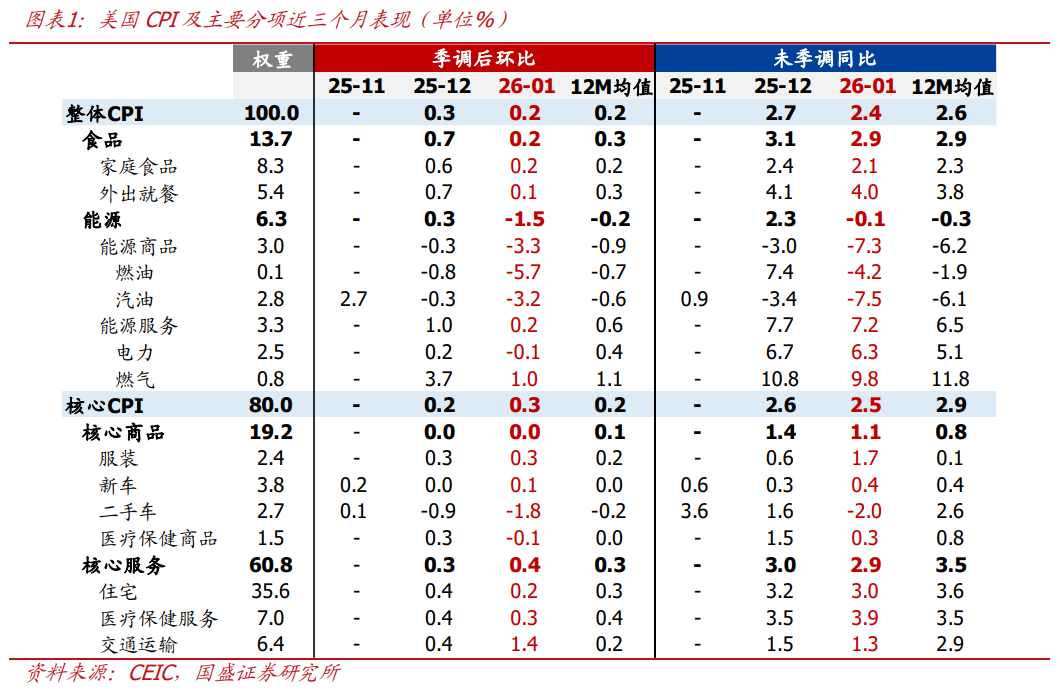
Core Viewpoint - The report from Guosheng Securities indicates that the recent strong non-farm payrolls and weak CPI data have caused significant disturbances in asset prices, leading to fluctuating expectations for Federal Reserve interest rate cuts. The combination of these data suggests that the weaker CPI has somewhat alleviated the hawkish pressure from the strong non-farm data. The firm believes that the Fed may struggle to provide clear signals for easing in the short term, and asset prices will continue to oscillate around the dynamics of growth resilience and inflation stickiness. A significant change in policy space is likely to occur after the leadership transition in May, with potential adjustments under Warsh's leadership possibly opening up more room for rate cuts in the second half of the year [1][23]. CPI Summary - In January, the CPI was reported at 2.4% year-on-year, lower than expectations and previous values, marking a three-month decline. The core CPI remained at 2.5%, in line with expectations but below the previous value. The seasonally adjusted CPI increased by 0.2% month-on-month, matching the 12-month average, while the core CPI rose by 0.3%, exceeding the 12-month average of 0.2% [2][3]. - Key components of the CPI showed a decline in food prices from 3.1% to 2.9% year-on-year, and energy prices fell from 2.3% to -0.1%. Core goods and services also exhibited slight decreases in inflation rates, indicating persistent service inflation pressures [2][3]. Non-Farm Payroll Summary - The January non-farm payrolls added 130,000 jobs, significantly exceeding the expected 65,000, marking the highest increase since April 2025. The unemployment rate fell to 4.3%, below expectations and the previous rate of 4.4%, reaching a new low since September 2025. The labor force participation rate was 62.5%, higher than anticipated [6][11]. - Job growth was primarily concentrated in the education and healthcare sectors, which contributed nearly 80% of the new jobs. Other sectors like professional services and construction showed modest improvements, while information and finance sectors continued to decline [11][16]. Asset Price Movements - Following the non-farm report, U.S. stock indices and bond yields initially rose before declining, with gold prices experiencing similar fluctuations. After the CPI release, stock indices showed mixed results, while bond yields and the dollar index fell, and gold prices increased [18][20]. - Market expectations for Fed rate cuts fluctuated, with a decrease in anticipated cuts following the non-farm data, but a slight increase after the CPI release. The implied number of rate cuts for 2026 decreased from 2.4 to 2.12 after the non-farm data, while it rose from 2.36 to 2.53 after the CPI data [20][23]. Future Outlook - The combination of strong non-farm data and sticky service inflation suggests that while employment remains resilient, inflation pressures persist. The Fed is unlikely to signal clear easing in the short term, and asset prices will continue to be influenced by these dynamics. A potential shift in policy may occur after the leadership change in May, with the possibility of more significant rate cuts in the latter half of the year [23][24].


博时宏观观点:风险偏好有望企稳回升
Xin Lang Cai Jing· 2026-02-09 14:08
Group 1: Economic Indicators - In January, the US manufacturing and services PMI exceeded expectations, indicating overall robust growth overseas [1] - In contrast, China's manufacturing PMI fell back into contraction territory, with both supply and demand components weakening compared to seasonal levels [1][10] - The price index has risen further, reflecting a rapid increase in upstream raw material prices, which is expected to suppress manufacturing supply and demand in the short term [1] Group 2: Market Sentiment and Strategies - Market risk appetite has declined, leading to weaker performance in A-shares and Hong Kong stocks, while bonds saw a slight increase [1][11] - The bond market experienced volatility, with the long end performing stronger due to a rebound logic and hedging demand, despite overall bond market gains falling short of expectations [1][10] - In the equity market, there is a potential for stabilization in risk appetite as volatility is digested, with a focus on high-yield assets and long-duration assets for value allocation [1][11] Group 3: Sector Analysis - The A-share market sentiment has weakened due to fluctuations in overseas markets, but there is potential for recovery in cyclical sectors and consumption as selling pressure from state-owned entities eases [11] - Small-cap and growth sectors may present good opportunities, with improved cost-effectiveness in growth stocks and a favorable calendar effect for small-cap stocks post-Spring Festival [11][12] - The Hong Kong market is currently in a phase of benefiting from liquidity, but its fundamentals remain weak, with the improvement of price levels by 2026 being crucial [12] Group 4: Commodity Insights - Recent geopolitical tensions have driven up gold prices due to increased safe-haven demand, although a subsequent drop occurred due to overheating in trading and expectations surrounding the Federal Reserve [3][12] - Oil prices have been influenced by threats against Iran and cold weather, but significant improvements in the oil supply-demand fundamentals are still under observation [12]
国信证券:资产走势趋同的终局思维
智通财经网· 2026-02-08 01:07
Core Viewpoint - In 2023, global asset correlation has surged again, driven by the end of the Kondratiev wave depression, geopolitical risks, and the AI narrative, leading to a strong "tech stocks + precious metals" combination, while the synchronization of the US and China monetary cycles increases the difficulty of risk diversification [1] Group 1: Global Asset Correlation - The correlation of global major assets has reached a new high in 2023, measured by the correlation of similar assets priced in China and overseas [1] - The logic behind the resonance of global major assets includes the end of the Kondratiev wave depression, the Ukraine crisis, global trade frictions, and the AI wave driving a dual combination of "tech stocks + precious metals" [1] - The correlation between commodities and stocks has also reached a new high, while the monetary cycles of the US and China are transitioning from divergence to synchronization [1] Group 2: Historical Context - In the past 20 years, global major assets have only reached similar high correlation levels twice: in mid-2013 and in the first quarter of 2020 [2] - The high correlation in mid-2013 was due to the taper tantrum, where the 10-year US Treasury yield rose sharply from 1.63% to around 3.0%, leading to a rare synchronous decline in gold, US Treasuries, and emerging market stocks and bonds [2] - The first quarter of 2020 saw extreme risk aversion and a dollar liquidity crisis, characterized by a spike in the VIX index to 85.47, with all assets forced to act as liquidity instruments [3]

金属概念午后爆发,湖南黄金涨停,有色金属ETF基金(516650)涨超5.7%
Sou Hu Cai Jing· 2026-02-03 06:32
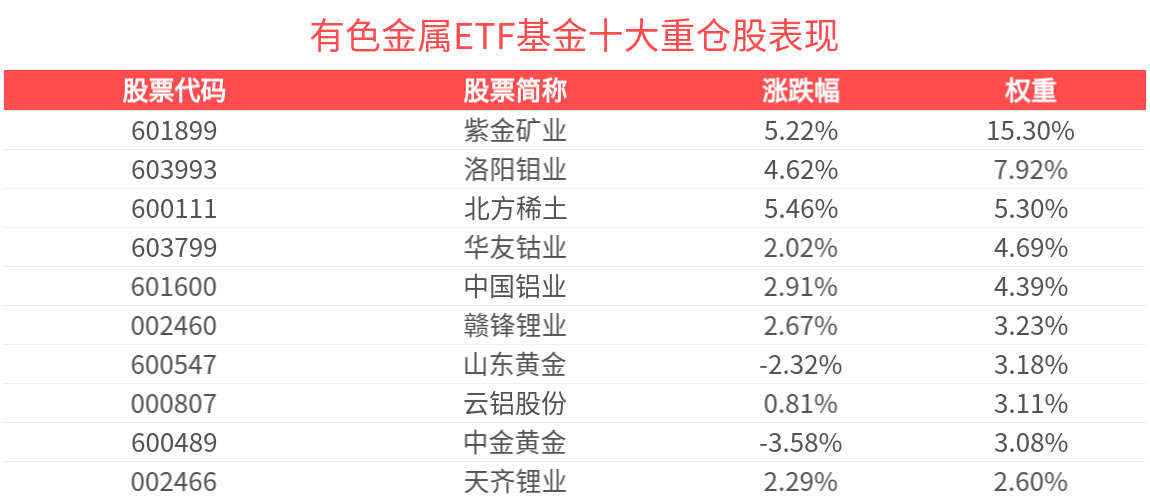
Core Viewpoint - The metal sector is experiencing a resurgence, with significant gains in various metal ETFs and stocks, indicating a potential shift in market sentiment and logic restructuring [1] Group 1: Market Performance - As of February 3, the non-ferrous metal ETF (516650) surged by 5.71%, with notable stocks like Hunan Gold hitting the daily limit and others like Zhong Rare Earth and Shenghe Resources rising by 8.77% and 7.23% respectively [1] - The trading volume for the non-ferrous metal ETF reached 50.03 billion yuan, with a turnover rate of 23.26%, reflecting active market participation [1] Group 2: Influencing Factors - The market is gradually stabilizing from extreme sentiments, suggesting a potential restructuring phase for the metal sector [1] - Central bank gold purchases and the increase in gold ETF holdings are expected to support gold prices [1] - Basic metals are likely to face macroeconomic adjustments, but ongoing narratives around AI and supply disruptions, particularly in copper, are expected to provide price support [1] Group 3: Sector Opportunities - Metals such as aluminum (lightweight), tin ("computing metal"), and lithium carbonate (energy storage and power batteries) are anticipated to benefit from the ongoing green industry and technological trends [1] - The CSI Non-ferrous Metal Industry Theme Index (000811) has its top ten weighted stocks, including Zijin Mining and Luoyang Molybdenum, accounting for 51.85% of the index [1]





白银现货涨超5%,湖南黄金冲击涨停,有色矿业ETF招商(159690)涨超2%,机构:此次调整不是贵金属终点
Sou Hu Cai Jing· 2026-02-03 06:32
Group 1 - The non-ferrous sector is experiencing a rebound, with companies like Hunan Gold and Northern Rare Earth seeing significant price increases, while the non-ferrous mining ETF has also risen over 2% [1] - Precious metals faced a historic downturn due to trading congestion and external pressures, with silver and gold experiencing maximum daily declines of over 30% and 10% respectively [1][12] - Short-term volatility in precious metal prices is expected due to profit-taking, but long-term trends indicate that the de-dollarization process will continue, suggesting that the current adjustment is not the end of the precious metals market [1][14] Group 2 - The non-ferrous mining ETF tracks an index focused on the upstream mining sector of the non-ferrous metal industry, which shows strong price elasticity and higher beta in commodity bull markets [1] - The non-ferrous mining index has shown a cumulative increase of 353.53% over the past decade, with an annualized return of 16.83% and a Sharpe ratio of 0.7, indicating higher volatility compared to similar indices [9][11] - The index is heavily weighted towards copper, gold, and aluminum, which together account for over 58% of its composition, highlighting its strategic importance in both industrial development and financial markets [4]





贵金属历史性行情后,有色板块怎么走?
Sou Hu Cai Jing· 2026-02-03 06:04
Group 1 - The non-ferrous sector is experiencing a rebound, with companies like Hunan Gold and Northern Rare Earth seeing significant gains, while the non-ferrous mining ETF is also up over 2% [1] - Precious metals faced a historic downturn due to trading congestion and external pressures, with silver and gold experiencing maximum daily declines of over 30% and 10% respectively [1][14] - Short-term volatility is expected in precious metal prices due to profit-taking, but long-term trends indicate that the de-dollarization process will continue, suggesting that the current adjustment is not the end of the precious metal rally [1][18] Group 2 - The non-ferrous mining index has shown a strong performance over the past year, with a return of 146.48% and a maximum drawdown of -13.76% [3] - The index focuses on the upstream mining segment of the non-ferrous metal industry, with copper, gold, and aluminum making up over 58% of its composition [5] - Historical performance indicates that the non-ferrous mining index has a cumulative increase of 353.53% over the past decade, with an annualized return of 16.83% [10][12] Group 3 - The market outlook for 2026 suggests that central bank gold purchases and rising gold ETF holdings will continue to support gold prices, while copper prices are expected to find support amid supply disruptions [19] - The aluminum market is facing downward pressure due to seasonal factors and a decline in processing activity, with a reported drop of 1.5 percentage points in aluminum processing [19]


宋雪涛:金银巨震非“沃什”之过
雪涛宏观笔记· 2026-02-03 05:04
Core Viewpoint - The long-term logic of US dollar credit remains unchanged, but the underlying capital flows, asset preference shifts, and leveraged trading have never ceased. The frequent occurrence of global black swan events has led to a reduction in risk appetite, while rising inflationary pressures in the US have tightened interest rate cut expectations, potentially leading to a resonance of these factors at some point [2]. Group 1: Market Dynamics - The recent sharp decline in gold and silver prices is not fundamentally caused by the nomination of Kevin Warsh but is more of a coincidental catalyst that triggered emotional volatility. The core driving force behind the decline is large-scale profit-taking following significant price increases, leading to a chain reaction of deleveraging [5]. - Historically, significant price increases in gold (20%-30%) typically require about six months to digest, but the current cycle has been compressed to a monthly level. The rapid price increases have led to a situation where the market must undergo a severe correction to alleviate overbought pressures [5][6]. - The volatility in gold and silver prices exhibits clear "MEME" characteristics, with pricing no longer solely dependent on "de-dollarization" but driven by liquidity and AI narratives. The demand for hedging has caused gold prices to move in tandem with US stocks, while silver has seen even greater volatility due to its dual role as a financial asset and an industrial demand driven by AI [6]. Group 2: AI and Economic Interactions - The current market's upward momentum is primarily driven by the strength of the AI trend, with both US stocks and precious metals benefiting from this narrative. In contrast, cryptocurrencies have shown weakness due to their disconnection from the AI narrative and competition for resources with the AI industry [8]. - The extreme demand for electricity and computing power from the AI industry has directly impacted cryptocurrency mining costs, leading traditional mining companies to pivot towards investments in computing power centers, thereby increasing the operational costs of cryptocurrencies [8]. - Regardless of who becomes the Federal Reserve Chair, gold and silver may experience significant declines due to previous rapid price increases and the requirement for exchanges to raise reserve requirements, leading to profit-taking and deleveraging [8][9]. Group 3: Monetary Policy and Political Influences - Warsh's nomination as the next Federal Reserve Chair does not alter the dovish policy expectations. The market's insensitivity to his nomination is reflected in the stable interest rate cut expectations and the performance of long-term US Treasury bonds [8][9]. - The Federal Reserve's decisions on interest rate cuts will depend more on economic performance and political will rather than the change in leadership. Warsh's focus on inflation risks and previous opposition to quantitative easing may not align with current economic realities [9][12]. - The current liquidity levels in the dollar market are slightly above adequate levels, and excessive balance sheet reduction could lead to a repeat of the 2019 repo crisis, which the Federal Reserve aims to avoid [12]. Group 4: Fiscal Risks and Economic Outlook - Fiscal risks are emerging as significant instability factors, with political conflicts over immigration regulations complicating budget coordination, potentially leading to government shutdowns. This political maneuvering could create liquidity risks that are more damaging than monetary policy changes [16]. - Rising electricity prices driven by AI demand and significant price increases in key components like storage chips are beginning to affect consumer electronics and durable goods, posing new challenges to purchasing power and potentially reigniting inflation risks [16][17]. - The sustainability of the AI narrative relies on continuous monetary and fiscal support to counteract rising costs and the absence of a significant economic downturn. The profitability of AI-related sectors remains high, but many companies are resorting to layoffs as a cost-control measure, exacerbating economic disparities [17][20].