
两新政策

Search documents
中央定调明年继续“国补”
第一财经· 2025-12-11 10:36
Core Viewpoint - The article discusses the outcomes of the Central Economic Work Conference held on December 10-11, which outlines China's economic work for 2026, emphasizing the continuation and optimization of the "two new" policies aimed at boosting domestic consumption and market strength [3]. Group 1: Policy Implementation - The "two new" policies refer to large-scale equipment updates and the consumer goods trade-in program, which is particularly relevant to the public as it is known as the "national subsidy" [3]. - The conference confirmed that the "national subsidy" policy will continue in 2026, with specific optimizations to be made [3]. - In 2024, China issued 150 billion yuan in long-term special bonds for the consumer goods trade-in program, which will increase to 300 billion yuan in 2025, doubling the subsidy amount from 2024 [3]. Group 2: Impact on Consumption - From January to November this year, the consumer goods trade-in program has driven sales exceeding 2.5 trillion yuan, benefiting over 360 million people [4]. - The program included the trade-in of over 11.2 million vehicles, more than 12.8 million home appliances, and over 9 million digital products [4]. - Experts suggest that the subsidy amount for 2026 may see a moderate increase from 2025, with a focus on optimizing funding allocation to enhance service consumption and further stimulate economic growth [5].


通胀回归:2026年国内经济展望
CMS· 2025-12-10 01:58
Economic Outlook - The GDP growth rate for 2026 is projected to be around 5%, with a recovery pattern characterized by "front low, back high" dynamics[12] - The first quarter is expected to show a growth of 4.7%, influenced by the ongoing decline in real estate investment and seasonal factors[28] - The second quarter is anticipated to stabilize at 4.9%, driven by new policy implementations and increased manufacturing investment[28] - The third quarter is forecasted to accelerate to 5.2%, with PPI expected to turn positive, enhancing industrial production[28] - The fourth quarter is projected to maintain a growth rate of 5.0%, supported by improved corporate profits and consumer spending[29] Investment Trends - Manufacturing investment is expected to grow by 5%, driven by long-term policies and profit improvements in high-tech industries[37] - Real estate investment is projected to decline by 8%, indicating a continued natural clearing process in the market[13] - Infrastructure investment is forecasted to grow by 3%, reflecting a balance between debt management and development needs[13] Price Dynamics - CPI is predicted to rise to a central level of 0.5% in 2026, marking a reversal from near-zero growth in 2024-2025[8] - PPI is expected to turn positive in Q3 2026, with an end-of-year forecast of a 0.5% increase, signaling a significant improvement in upstream profitability[8] Consumer Behavior - Retail sales are projected to grow by approximately 4.2%, with a shift towards income distribution optimization and targeted subsidies[8] - Service consumption is anticipated to outpace goods consumption, driven by policy support and changing consumer preferences[8] Export and Import Outlook - Exports are expected to grow by 5%, supported by the U.S. inventory replenishment cycle and market diversification strategies[8] - Imports are projected to increase by 2.5%, driven by improved industrial profits and a stable RMB exchange rate[8]
重磅经济数据即将发布
第一财经· 2025-12-09 13:35
Core Viewpoint - The article discusses the fluctuations in China's macroeconomic indicators due to weak domestic demand and increased external uncertainties, while suggesting that major economic indicators such as industrial production and consumption may stabilize in November due to coordinated policy efforts and resilient external demand [3][4]. Economic Indicators - The predicted year-on-year growth rate for industrial added value in November is 5.0%, slightly higher than the previous month's 4.9% [4][6]. - The forecast for the year-on-year growth rate of retail sales of consumer goods in November is 3.09%, up from 2.9% in the previous month [4][9]. - The predicted year-on-year growth rate for fixed asset investment from January to November is -2.1%, lower than the previous month's -1.7% [4][13]. Industrial Growth - Industrial added value is expected to see a slight increase, with predictions ranging from 5.0% to 5.3% year-on-year growth for November [6][7]. - The manufacturing PMI improved to 49.2%, indicating a slight recovery in market confidence, although it remains below the threshold [6][8]. Consumer Spending - The "old-for-new" consumption policy has significantly supported consumer spending, with related sales exceeding 2.5 trillion yuan and benefiting over 360 million people [9]. - The "Double 11" shopping festival contributed to a 17.6% year-on-year increase in total online sales, although the average daily sales showed a decline of 6.0% compared to the previous year [10]. Investment Trends - Fixed asset investment is under pressure, with predictions indicating a further decline in November due to reduced infrastructure spending and weak manufacturing investment [13][14]. - The introduction of new policy financial tools aims to support investment in high-tech manufacturing and digital economy sectors [14][15]. Infrastructure Investment - The expansion of infrastructure REITs is seen as a key measure for stabilizing investment, with a significant number of projects already launched [16][17]. - The government has allocated substantial funds for long-term special bonds to support major investment projects, reflecting a strategic approach to infrastructure development [15][16].

“两新”加力扩围,内需潜力加速释放
Sou Hu Cai Jing· 2025-12-08 07:54
大规模设备更新在推动产业转型升级方面也发挥了重要作用。根据国家税务总局公布的税收数据,前三季度,信息、科技行业设备 更新投入力度加大,企业数字化设备更新动力较足,民营企业设备更新支撑作用凸显,政策红利正在有效转化为产业转型升级的新 动力。 2024年,"两新"(大规模设备更新和消费品以旧换新)政策实施成效明显,有力激发了全年经济增长动能。当年中央经济工作会议强 调,加力扩围实施"两新"政策。一年来,政策在更深层次、更广领域持续释放红利,成为提振消费需求、促进转型升级的关键引 擎。 今年,用于加力扩围实施"两新"政策的超长期特别国债资金规模大幅增加。5000亿元资金中,3000亿元用于支持消费品以旧换新, 比上年增加1500亿元;2000亿元用于支持设备更新,比上年增加500亿元。 同时,政策支持范围也有所扩大,设备更新扩大至电子信息、安全生产、设施农业等领域;以旧换新对个人消费者购买手机、平 板、智能手表手环等3类数码产品给予补贴。不仅如此,政策还进一步提高农业机械报废更新、新能源城市公交车及动力电池更新 等补贴标准,加大家装消费品换新的支持力度。在机制方面,设备更新审批流程进一步简化,消费品以旧换新的资金分 ...

乘联分会:11月全国乘用车新能源市场零售135.4万辆 同比增长7%
智通财经网· 2025-12-03 08:52
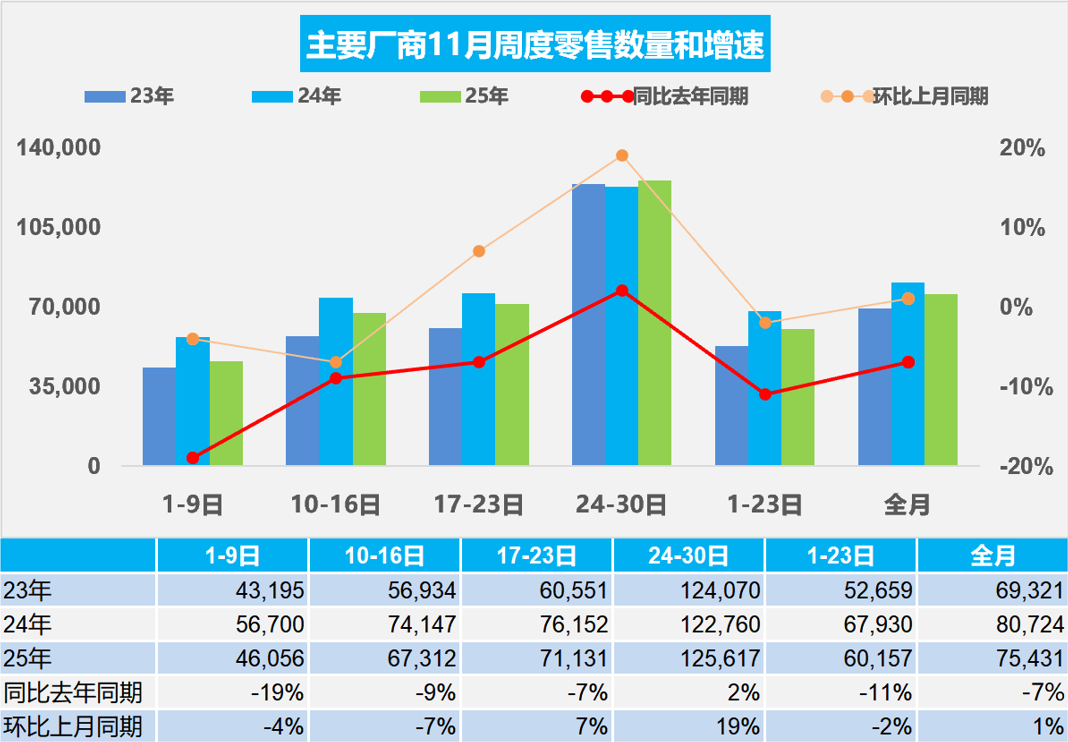
Group 1: New Energy Vehicle Market Performance - In November 2025, the retail sales of new energy vehicles reached 1.354 million units, a year-on-year increase of 7%, and a month-on-month increase of 6%, with a cumulative retail of 11.504 million units for the year, up 20% [1] - The wholesale of new energy vehicles in November 2025 was 1.72 million units, a year-on-year increase of 20%, and a month-on-month increase of 7%, with a cumulative wholesale of 13.777 million units for the year, up 29% [1] - The penetration rate of new energy vehicles in the retail market was 59.8%, while the wholesale penetration rate was 57.5% in November 2025 [1] Group 2: Overall Passenger Car Market Trends - The total retail sales of passenger cars in November 2025 were 2.263 million units, a year-on-year decrease of 7%, but a month-on-month increase of 1%, with a cumulative retail of 21.519 million units for the year, up 6% [4] - The wholesale of passenger cars in November 2025 was 2.992 million units, a year-on-year increase of 2%, and a month-on-month increase of 2%, with a cumulative wholesale of 26.766 million units for the year, up 11% [9] Group 3: Weekly Sales Performance - In the first week of November 2025, the average daily retail sales were 46,000 units, a year-on-year decrease of 19% [2] - In the second week, the average daily retail sales were 67,000 units, a year-on-year decrease of 9% [3] - The average daily retail sales in the fourth week reached 126,000 units, a year-on-year increase of 2% [4] Group 4: Economic and Policy Impact - The macroeconomic environment remains stable, with consumer confidence relatively strong, but the tightening of trade-in and scrapping subsidies has led to a negative growth in retail sales in October [6] - The market has experienced a significant overshoot effect due to multiple rounds of policy subsidies earlier in the year, leading to a cautious consumer sentiment [6] Group 5: Automotive Industry Profitability - From January to October 2025, the automotive industry generated a profit margin of 4.4%, which is lower than the average profit margin of 6% for downstream industrial enterprises [12] - The automotive industry’s revenue for the same period was 887.78 billion yuan, a year-on-year increase of 7.9%, while costs increased by 8.7% [12] Group 6: Export Performance - In the first ten months of 2025, China exported 6.46 million vehicles, a year-on-year increase of 22%, with a strong performance in October, exporting 820,000 vehicles, up 40% year-on-year [17] - The export of new energy vehicles in October 2025 reached 328,000 units, a year-on-year increase of 65% [17]
中国汽车流通协会:新能源车在北方加速普及 10月北上广大型SUV等表现较强
智通财经网· 2025-12-01 09:04
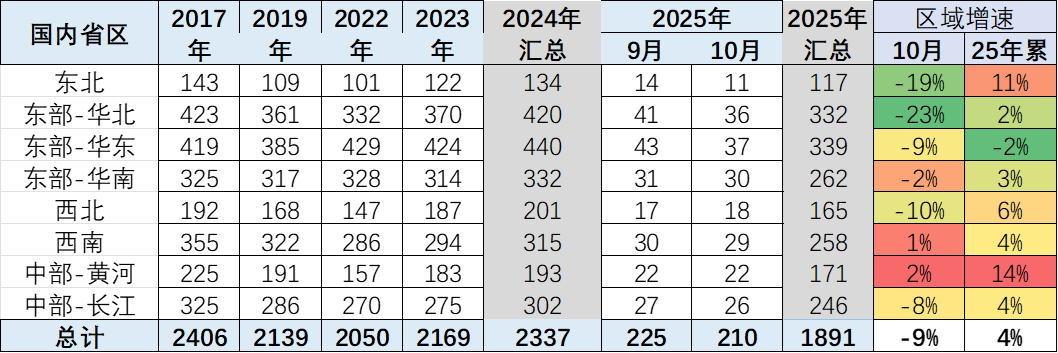
Core Insights - The report from the China Automobile Dealers Association indicates that the structure of the regional car market is changing due to economic development and diversified domestic demand and exports. The retail sales of passenger cars in China are expected to grow by 7% year-on-year by October 2025, reflecting strong growth characteristics in the domestic car market from February to October [1]. Market Trends - The "North Strong, South Weak" pattern continues, with the northern car market showing strength, particularly in Northeast and Central Yangtze regions. Although the market share in the North decreased by 0.2 percentage points in October 2025 compared to the previous year, it increased by 5.6 percentage points compared to 2022 [3][4]. - The A00 and A0 class electric vehicles are performing well in North China and Northeast regions, benefiting significantly from subsidy policies aimed at promoting economic vehicles [1][3]. Regional Performance - The Northeast region's market share increased to 6.4% in October 2025, while the East China region's share decreased to 17.9%. The Central region's market share increased by 1.2 percentage points compared to the previous year, indicating a recovery in the Central Yangtze area [3][4]. - The overall car market in the North is expected to outperform the South, with significant growth in regions like Heilongjiang, Shanxi, and Ningxia, while the South shows relatively weaker performance [5][6]. Policy Impact - The "Two New" subsidy policies have effectively encouraged the growth of low-end and economic vehicles, demonstrating fairness in policy implementation. The subsidies have significantly benefited the sales of small and micro electric vehicles [1][11]. - Recent changes in subsidy policies have led to complex market structure changes, with some regions like Qinghai and Guizhou announcing the suspension of vehicle replacement subsidies [6][8]. Vehicle Type Trends - The SUV segment is experiencing strong growth, particularly in the Central and Western regions, while the demand in Eastern regions is relatively weaker. The market for SUVs is robust in mountainous and hilly areas, aligning with regional geographical characteristics [7][9]. - The penetration rate of new energy vehicles is increasing, especially in Northern regions, where the growth of pure electric vehicles is notable. In contrast, traditional fuel vehicles still hold a significant market share in the Central and Western regions [9][10]. Consumer Behavior - The report highlights a shift towards more rational consumption, with the majority of regions benefiting from the "Two New" subsidy policies, which have positively impacted the sales of economic vehicles. The subsidies for new energy vehicles are more favorable compared to traditional fuel vehicles, encouraging consumer enthusiasm for purchasing [11][12].
【乘联分会论坛】2025年10月乘用车区域市场流向分析
乘联分会· 2025-12-01 08:39
Core Viewpoint - The article discusses the evolving structure of the domestic automotive market in China, highlighting the significant growth in the northern regions compared to the southern regions, driven by government policies and changing consumer preferences [2][4]. Group 1: Regional Market Trends - The northern automotive market is showing strong growth, particularly in the Northeast and Northwest regions, while the southern market remains relatively weak [4][5]. - In October 2025, the northern market's share decreased by 0.2 percentage points compared to the previous year, but it increased by 5.6 percentage points compared to 2022 [3][4]. - The overall retail market for passenger vehicles is expected to grow by 7% year-on-year by 2025, reflecting a robust growth trend from February to October [2]. Group 2: Policy Impact on Market Structure - Government subsidies have significantly benefited the economy segment, particularly in the A00 and A0 electric vehicle categories, promoting fairness in the market [2][5]. - The policy changes have led to a complex market structure, with varying performances across different regions, particularly in October [4][6]. - The central and western regions are outperforming the eastern regions, with the central region's market share increasing by 1.2 percentage points compared to the previous year [5]. Group 3: Vehicle Category Market Structure Changes - The SUV segment is experiencing strong growth, especially in the central and western regions, while the eastern regions show weaker demand for SUVs [8]. - The demand for entry-level sedans is rebounding due to higher subsidies for new energy vehicles, particularly in eastern regions [8][9]. - The overall market structure is shifting towards more economical vehicles, with the government subsidies favoring lower-end models [10]. Group 4: New Energy Vehicle Dynamics - New energy vehicles, particularly pure electric and hybrid models, are showing strong performance, with traditional fuel vehicles still holding a significant market share in the central and northern regions [8][9]. - In regions like Hainan and Guangxi, the penetration rate of new energy vehicles has surpassed 60%, indicating robust growth [9]. - The overall penetration rate of new energy vehicles is expected to reach 56.6% by October 2025, with significant growth in the northern regions [8].

2026年期货市场展望:废钢供给结构变革,价格震荡运行
Hua Tai Qi Huo· 2025-11-30 08:09
华泰期货研究 2026 年期货市场展望 2025 国内钢材消费存在韧性,铁水产量长时间维持高位,废钢消费同比出现正增长。2026 年作为中国"十五五"的开局之年,宏观政策 的出台将为废钢市场带来新的动力,因此预计 2026 年废钢供应和需求均有小幅增长。价格方面,全球宏观经济格局存在较多变化,影响 大宗商品价格,预计废钢消费稳中小幅增加,整体矛盾不大,价格跟随黑色板块区间震荡运行……。 废钢供给结构变革,价格震荡运行 钢铁煤炭与建材研究 Research on Ferrous and Construction Commodities 王海涛 从业资格号:F3057899 投资咨询号:Z0016256 从业资格号 F03108558 投资咨询号:Z0021505 从业资格号:F3054449 投资咨询号:Z0016137 邝志鹏 从业资格号:F3056360 投资咨询号:Z0016171 余彩云 从业资格号 F03096767 投资咨询号:Z0020310 刘国梁 华泰期货研究院钢铁煤炭与建材研究 2025 年 11 月 30 日 本期分析研究员 邢亚文 期货研究报告 | 废钢年报 2025-11-30 废钢供 ...
人民财评:“两新”精准,彰显宏观调控前瞻性有效性
Ren Min Wang· 2025-11-11 08:37
Group 1 - In the first three quarters of this year, investment in equipment and tools increased by 14.0%, while the total retail sales of consumer goods reached 36.59 trillion yuan, growing by 4.5% year-on-year, indicating a strong synergy between investment and consumption that supports economic stability and quality improvement [1][2] - The contribution rate of final consumption expenditure to economic growth reached 53.5%, highlighting its role as a primary driver of economic growth [1] - The implementation of policies such as the old-for-new consumption scheme has effectively activated large-scale consumption potential, with over 10 million applications for automobile trade-in subsidies submitted by October 22 [1] Group 2 - The investment in equipment and tools has driven overall investment growth by 2.0 percentage points, with policy subsidies supporting approximately 8,400 projects and demonstrating a leverage effect of 1:5.3 [2] - Companies have directly benefited from policy incentives, as seen with Guangdong Midea Refrigeration Equipment Co., which received 60 million yuan in subsidies for equipment upgrades, resulting in improved production efficiency and reduced equipment failure rates [2] - The penetration rate of new energy passenger vehicles reached 57.8%, and sales of smart wearable devices and robotic vacuum cleaners increased by over 15% in September, indicating a shift towards digital and green consumption [1][2] Group 3 - The effectiveness of the "Two New" policies stems from their precise design and efficient implementation mechanisms, which ensure that policy benefits reach businesses quickly [3] - The policies are focused on both immediate demand expansion and long-term structural optimization, creating a virtuous cycle of supply quality improvement and demand expansion [3] - The ongoing implementation of these policies is expected to enhance the quality, structure, and efficiency of economic development, supporting the achievement of annual economic goals [3]
稳投资、扩消费、促转型 前三季“两新”政策成效显著
Ren Min Ri Bao· 2025-11-10 00:42
Group 1 - The core viewpoint of the articles highlights the significant growth in investment in equipment and tools, with a 14.0% increase, and a 4.5% rise in total retail sales of consumer goods, indicating a positive trend in domestic consumption and investment [1][3] - The government has allocated 300 billion yuan in special long-term bonds to support the replacement of old consumer goods, contributing to a stable growth in the consumption market, with retail sales reaching 36.59 trillion yuan in the first three quarters [1][3] - The sales of products related to the old-for-new policy have shown rapid growth, with significant increases in retail sales of communication equipment, furniture, and cultural office supplies, alongside a 6.3% rise in passenger car sales [1][3] Group 2 - The funding scale for equipment updates supported by special long-term bonds has increased to 200 billion yuan, expanding to various sectors including electronic information and agricultural facilities, ensuring effective policy implementation [2][3] - Approximately 8,400 projects have been supported by the investment subsidy funds, leading to a total investment exceeding 1 trillion yuan, demonstrating a leverage effect of 1:5.3 [3] - The promotion of large-scale equipment updates and the old-for-new policy is driving domestic demand and benefiting enterprises and consumers, with a focus on ensuring the effective use of subsidy funds and maintaining project quality [3]
