信用利差

Search documents
超长信用债探微跟踪:2.4%的超长信用债有机会吗?
SINOLINK SECURITIES· 2025-09-17 14:23
Report Industry Investment Rating No relevant information provided. Core Viewpoints The report analyzes the market conditions of ultra - long credit bonds from multiple aspects, including the adjustment of yields in the stock market, the increase in new bond supply in the primary market, and the decline in index prices and weak trading sentiment in the secondary market. It also points out that institutions should pay attention to market sentiment changes around the listing of the second batch of Sci - tech Innovation Bond ETFs when participating in the ultra - long credit bond market [2][3][4]. Summary by Directory 1. Stock Market Characteristics - Ultra - long credit bond yields continued to adjust. Due to the impact of new public fund regulations on the bond market this week, assets with insufficient safety margins, such as medium - and long - duration secondary bonds and general credit bonds over 7 years, faced significant adjustment pressure. The number of stock ultra - long credit bonds with a yield of 2.4% - 2.5% increased to 353 compared with last week [2][12]. 2. Primary Issuance Situation - The supply of new ultra - long credit bonds increased significantly. The total issuance scale of new ultra - long credit bonds this week was 40.19 billion, reaching the highest point this year, mainly affected by the large - scale issuance of ultra - long individual bonds by Everbright Group. Due to the overall pressure on the bond market, the market's sentiment towards primary - market allocation was cautious, and the coupon rates of new ultra - long credit bonds generally continued to rise. However, investors had a certain degree of recognition for the high - quality ultra - long new bonds of Everbright Group, as shown by the rebound in the subscription enthusiasm for new ultra - long industrial bonds in the latest week [3][21]. 3. Secondary Trading Performance - The price of the ultra - long credit bond index continued to fall. This week, the price index trends of various bonds continued to diverge. Medium - and short - duration credit bonds were more resilient, while long - duration varieties faced price pressure. The index of AA + credit bonds over 10 years decreased by 1.02% month - on - month [29]. - The trading sentiment of ultra - long credit bonds remained sluggish. This week, due to redemption pressure, the selling pressure of trading desks on ultra - long credit bonds intensified. Although the number of transactions of credit bonds over 7 years increased slightly, the average transaction yield increased significantly compared with last week. In terms of spreads, the spread between industrial bonds over 10 years and 20 - 30 - year treasury bonds widened to over 35bp [32]. - Correspondingly, the proportion of TKN of ultra - long credit bonds over 10 years was less than 50% this week, and the average discount of 20 - 30 - year urban investment individual bonds reached over 5BP, highlighting the heavy selling pressure from sellers [37]. - In terms of investor structure, due to concerns about the stability of the liability side, funds have been reducing their holdings of ultra - long credit bonds for five consecutive weeks. The net selling scale of ultra - long credit bond varieties in the latest week exceeded 3 billion, intensifying the market selling pressure. Institutions such as insurance and wealth management participated slightly during the adjustment, reflecting the allocation demand for high - coupon long - term bonds [43]. - From a more microscopic perspective, the spreads between active ultra - long credit bonds of each maturity and treasury bonds of similar maturities continued to widen this week. The spreads of varieties around 10 years have risen to over the 60th percentile since 2024. In the future, there are still liquidity flaws in ultra - long credit bonds. If institutions intend to participate, they need to avoid excessive selling and pay attention to the market sentiment changes around the listing of the second batch of Sci - tech Innovation Bond ETFs [46].
申万宏源证券晨会报告-20250917
Shenwan Hongyuan Securities· 2025-09-17 00:43
Core Insights - The report highlights the significant rise in long-term interest rates in developed countries since August, particularly in France and the UK, reaching levels not seen since 2011 and 1998 respectively, raising concerns about potential liquidity pressures in risk assets [2][8] - The increase in long-term rates is primarily driven by inflationary pressures, which have weakened the likelihood of interest rate cuts, with the UK facing greater challenges than the Eurozone [2][3] - The report identifies four key events over the past three years that have caused volatility in equity and currency markets due to rising interest rates, including the UK pension crisis in 2022 and the US debt supply shock in 2023 [3][8] Market Performance - The Shanghai Composite Index closed at 3862 points, with a slight increase of 0.04% over one day, and a 4.47% increase over five days [1] - The Shenzhen Composite Index showed a stronger performance, closing at 2490 points with a 0.74% increase over one day and an 8.22% increase over five days [1] - Among industry sectors, home appliance components saw the highest growth, with a 6.28% increase yesterday and a 25.04% increase over the past six months [1] Interest Rate Trends - The report notes that the rise in long-term interest rates is expected to continue in the short term, with specific indicators to monitor for potential liquidity shocks in equity markets [3][4] - The report emphasizes that when the historical volatility of US Treasury rates exceeds 10%, it is crucial to be aware of potential liquidity risks [3][4] - Long-term interest rates reflect both economic investment returns and social financing costs, with rising rates potentially leading to systemic risks if they constrain government actions [4][9] Economic Indicators - The report suggests that the current credit spread indicators for corporate bonds in the US, Europe, and Japan are below the 5% threshold of the past five years, indicating manageable credit risk [4][9] - It highlights the importance of monitoring fiscal expansion events that could lead to debt pressure, particularly in the context of high valuation levels in global equity markets [3][9] Conclusion - The report concludes that while the short-term outlook for long-term interest rates remains upward, the potential for systemic risks increases if rates rise to levels that constrain government fiscal policies [4][9] - Investors are advised to keep an eye on key economic indicators and market conditions that could signal shifts in liquidity and risk profiles [3][4]
大类资产周报:资产配置与金融工程美元弱势,降息在即,全球风险资产上行-20250915
Guoyuan Securities· 2025-09-15 15:17
Group 1 - The macro growth factor continues to rise, while inflation indicators show a weakening rebound, with domestic CPI turning negative at -0.4% and PPI's decline narrowing to -2.9%, indicating persistent internal demand issues [4] - The Federal Reserve's interest rate cut expectations are driving upward global liquidity expectations, benefiting Asian equity markets, with the Korean Composite Index rising by 5.94% and the Hang Seng Tech Index by 5.31% [4][9] - The A-share market shows a preference for growth styles, with the Sci-Tech 50 Index increasing by 5.48%, while small-cap indices outperform large-cap blue chips [4] Group 2 - Recommendations for asset allocation include favoring high-grade credit bonds in the bond market, adjusting duration flexibly, and focusing on bank and insurance sector movements [5] - In the overseas equity market, the report suggests monitoring interest rate-sensitive sectors due to limited short-term rebound potential for the dollar and significantly raised interest rate cut expectations [5] - For gold, it is recommended to increase allocations to gold and silver as they are core assets during the interest rate cut cycle, with expectations for Shanghai gold to break previous highs [5] Group 3 - The report indicates that the overall liquidity environment remains supportive for market valuation recovery and structural trends, with a significant decrease in average daily trading volume in the A-share market [56] - The A-share valuation levels have increased, with the price-to-earnings ratio rising to 50.38 times and the price-to-book ratio reaching 5.60 times, suggesting that market expectations for future corporate earnings may be overly optimistic [60] - The report highlights that the earnings expectations for A-shares are weaker than historical averages, with a projected rolling one-year earnings growth rate of 10.3% and revenue growth rate of 5.9% [61]
流动性周报:债券定价中的“三个利差”-20250915
China Post Securities· 2025-09-15 07:05
Report Industry Investment Rating - Not provided Core Viewpoints - Short - term bond market is under pressure. If 1.8% is verified as the top level of 10 - year treasury bonds, the bond - bull logic can be maintained. In the medium term, the recovery of risk preference is reflected in the term spread premium, which may reach 50 - 60BP. In September 2025, the bond market may experience a weak recovery [3][9]. - After the stock - bond market desensitizes, the bond market has not recovered. The uncertainty of the public fund liability side still exists, and the bond market is still hovering between adjustment and recovery [3][10]. - After the long - term yield reaches a new high, the sensitivity to fundamental and liquidity positives will increase. The decline of government bond net financing scale will promote the return of allocation - disk power and the stabilization of the bond market [3][13]. - Liquidity is still loose. The short - term yield has slightly increased, and there is still room for a central decline if the policy rate is cut [4][15]. - The term spread has fully priced the change in risk preference. The bond's allocation value has emerged, and the probability of extreme compression of the term spread is low [4][24]. Summary by Directory 1 Bond Pricing in the "Three Spreads" - **Short - and Medium - Term Market Outlook**: Short - term bond market is under pressure. Verifying the top level of 10 - year treasury bonds can maintain the bond - bull logic. In the medium term, the term spread premium may reach 50 - 60BP, and the bond market in September may have a weak recovery [3][9]. - **Current Bond Market Situation**: After the stock - bond desensitization, the bond market sentiment has not recovered. The uncertainty of the public fund liability side exists, and the bond market is in adjustment and recovery [10]. - **Long - Term Yield and Market Reaction**: After the long - term yield reaches a new high, the sensitivity to positives increases. The decline of government bond net financing will promote market stabilization [13]. - **Liquidity Analysis**: Liquidity is loose. The short - term yield has increased slightly, and there is room for a central decline if the policy rate is cut [4][15]. - **Measurement of Risk Preference Pricing**: - The spread between inter - bank certificates of deposit and funds is at the upper edge of the fluctuation range [4][17]. - The spread between ultra - long - term and long - term bonds is fully priced, and the long - short spread is close to the historical center [4][19]. - The adjustment of credit spread is relatively lagged and is protected by defensive strategies and wealth - management allocation disks [22]. - **Conclusion**: The term spread has fully priced the change in risk preference. The bond's allocation value has emerged, and the probability of extreme compression of the term spread is low [24].
信用分析周报:博弈调整之后的信用补涨机会-20250914
Hua Yuan Zheng Quan· 2025-09-14 11:27
Report Industry Investment Rating No industry investment rating is provided in the report. Report's Core View The report analyzes the credit market from September 8 - 12, 2025. It anticipates that the bond market will continue to recover, with the 10Y Treasury yield expected to be between 1.6% - 1.8% in the second half of the year. The interest rate recovery may catalyze a supplementary rally in ultra - long credit bonds. However, currently, the ultra - long credit bonds do not show obvious cost - performance advantages. Conservative investors are advised to wait and see, aiming to capitalize on the potential supplementary rally driven by the subsequent decline in interest rates [3][42]. Summary by Relevant Catalogs 1. Market Overview This Week - **Primary Market**: The issuance volume and net financing of traditional credit bonds increased compared to last week, while the repayment volume decreased. The net financing of asset - backed securities increased by 12.5 billion yuan. The weighted average issuance rates of AA + urban investment bonds and AAA financial bonds rose by over 20BP, and that of AA + industrial bonds increased by 11BP [1][9][17]. - **Secondary Market**: The trading volume of credit bonds increased by 110.6 billion yuan compared to last week. The turnover rate of urban investment bonds decreased, while that of other varieties increased. Affected by factors such as the new fund redemption fee regulations, the yields of credit bonds adjusted along with interest - rate bonds, with the long - end (over 7Y) adjusting by 6 - 9BP. The credit spreads of AA + electronics and steel industries narrowed significantly, while those of other industries and ratings fluctuated within 5BP [2][18][24]. - **Negative News**: The implied ratings of a total of 113 bond issues from 10 entities were downgraded, including 35 issues from China Merchants Shekou Industrial Zone Holdings Co., Ltd., 34 from China Overseas Land & Investment Limited, and 23 from Poly Property Group Co., Ltd. [2][38] 2. This Week's Market Analysis and Investment Suggestions - **Market Analysis**: There were 1.0684 trillion yuan of reverse repurchases due in the open market this week. The central bank conducted 1.2645 trillion yuan of reverse repurchase operations, resulting in a net injection of 196.1 billion yuan. The DR001 rate rose from 1.30% at Monday's close to 1.41% at Friday's close, but the overnight funding rate remained low, and the overall funding situation was loose [6][41]. - **Investment Suggestions**: The credit spreads of AA + electronics and steel industries narrowed significantly this week, while those of other industries and ratings fluctuated within 5BP. For urban investment bonds, the credit spreads within 1Y slightly widened, while those over 1Y compressed to varying degrees. For industrial bonds, the credit spreads widened compared to last week. For bank capital bonds, the credit spreads of bank Tier 2 and perpetual bonds of different terms and ratings widened, with the 3 - 5Y spreads widening by over 10BP in most cases [6][41]. 3. Outlook and Recommendations Considering factors such as the central bank's continuous easing and the decreasing bank liability cost, the bond market is expected to continue to recover. The report maintains the view that the 10Y Treasury yield will be between 1.6% - 1.8% in the second half of the year. The end of the quarter may bring balance - sheet return pressure on wealth management products, and after the quarter, it may be a suitable time to increase the allocation of ultra - long credit bonds. Currently, the cost - performance advantage of ultra - long credit bonds is not obvious, so conservative investors are advised to wait and see [3][42].
债欲静而风未止
Shenwan Hongyuan Securities· 2025-09-14 08:44
Group 1 - The current market status indicates increasing pressure in the bond market, primarily due to redemption pressures from fixed income products rather than the stock-bond relationship [7][12][15] - The risk in the bond market may have exceeded the influences of fundamentals, liquidity, and the stock-bond relationship, with the stock market showing signs of structural volatility without alleviating bond market pressure [22][26][30] - Institutional buying power for bonds is weak, and trading desks are in a phase of reducing positions under pressure, indicating a lack of enthusiasm for bond purchases compared to previous years [15][19][20] Group 2 - Observing signals for market sentiment turning points is crucial, including monitoring deposit certificate rates, which can indicate liquidity conditions and the attractiveness of bond assets [32][33] - The bond market is still returning to reasonable valuation levels, with current adjustments potentially setting the stage for a bullish trend by the end of 2024 [37][41][44] - The bond market may be in a phase of accelerated risk release, with limited opportunities for bullish positions until clearer signals of easing emerge [37][39][45]
【固收】各品种信用债发行环比普增,各行业信用利差整体上行——信用债周度观察(20250908-20250912)(张旭/秦方好)
光大证券研究· 2025-09-14 00:05
Group 1: Primary Market - In the week from September 8 to September 12, 2025, a total of 303 credit bonds were issued, with a total issuance scale of 372.67 billion yuan, representing a week-on-week increase of 123.89% [4] - Among the issued bonds, industrial bonds accounted for 120 issues with an issuance scale of 123.70 billion yuan, up 124.04% week-on-week, making up 33.19% of the total issuance [4] - Local government bonds had 136 issues with an issuance scale of 92.58 billion yuan, up 18.32% week-on-week, representing 24.84% of the total [4] - Financial bonds had 47 issues with an issuance scale of 156.40 billion yuan, up 373.94% week-on-week, accounting for 41.97% of the total [4] - The average issuance term for credit bonds was 2.97 years, with industrial bonds averaging 2.15 years, local government bonds 3.98 years, and financial bonds 2.20 years [4] - The overall average coupon rate for credit bonds was 2.27%, with industrial bonds at 2.19%, local government bonds at 2.46%, and financial bonds at 1.88% [4] - Six credit bonds were canceled during the week [4] Group 2: Secondary Market - In terms of credit spread, the largest increase for AAA-rated industries was in pharmaceuticals, up 5.6 basis points; for AA+-rated industries, the largest increase was in chemicals, up 6.9 basis points, while the largest decrease was in steel, down 49.2 basis points [5] - For AA-rated industries, the largest increase was in real estate, up 12.7 basis points, while the largest decrease was in commercial trade, down 1.5 basis points [5] - Among local government bonds, the largest increase in AAA-rated credit spreads was in Shaanxi, up 7.7 basis points, while the largest decrease was in Inner Mongolia, down 1.9 basis points [5] - For AA+-rated credit spreads, the largest increase was in Fujian, up 8.8 basis points, while the largest decrease was in Jilin, down 12.5 basis points [5] - The largest increase for AA-rated credit spreads was in Hebei, up 26.3 basis points, while the largest decrease was in Yunnan, down 0.9 basis points [5] Group 3: Trading Volume - The total trading volume of credit bonds was 1,199.55 billion yuan, representing a week-on-week decrease of 6.75% [6] - The top three categories by trading volume were commercial bank bonds, corporate bonds, and medium-term notes [6] - Commercial bank bonds had a trading volume of 379.95 billion yuan, down 15.44%, accounting for 31.67% of the total trading volume [6] - Corporate bonds had a trading volume of 332.49 billion yuan, up 6.12%, making up 27.72% of the total [6] - Medium-term notes had a trading volume of 272.84 billion yuan, down 4.65%, representing 22.75% of the total [6]


信用利差周报2025年第34期:体育产业发债再获政策支持,基金费率调整对债市有何影响?-20250911
Zhong Cheng Xin Guo Ji· 2025-09-11 11:04
1. Report Industry Investment Rating No relevant content provided. 2. Core Views - The State Council's new policy on sports industry will increase the supply of sports industry credit bonds and promote innovation in asset - securitized products, but also poses higher requirements for credit risk assessment and prevention [4][11]. - The adjustment of the bond market under the stock - bond rotation shows new characteristics, and the new regulations on fund sales fees have attracted market attention. The new regulations may suppress short - term bond fund investment demand and guide long - term investment [5][15]. - In August, China's import and export growth rates were lower than market expectations, with different performances among trading partners [6][17]. - The central bank's open - market operations led to a net capital withdrawal last week, and the money market was generally stable with most money prices falling [7][20]. - The issuance scale of the primary credit bond market decreased, and the issuance cost fluctuated. The secondary market trading activity cooled, and bond yields showed differentiation [8][36]. 3. Summary by Directory Market Hotspots - **Policy Support for Sports Industry Bond Market**: The State Council's "Opinions" support sports enterprises in financing through the bond market, which may increase the supply of sports industry credit bonds and promote innovation in asset - securitized products. However, it also requires higher credit risk assessment and prevention [4][11]. - **Stock - Bond Rotation and New Fund Sales Regulations**: The A - share market adjusted last week, weakening the "stock - bond seesaw" effect. The bond market adjustment showed new characteristics. The new regulations on fund sales fees may suppress short - term bond fund investment demand and guide long - term investment [5][15]. Macroeconomic Data - In the first eight months of 2025, China's total import and export value was $5412.9 billion, with a year - on - year increase of 3.1%. In August, exports were $3218.1 billion (up 4.4% year - on - year), imports were $2194.8 billion (up 1.3% year - on - year), and the trade surplus was $1023 billion. The growth rates of imports and exports were lower than market expectations. Exports to ASEAN and the EU were stable, while exports to the US continued to decline significantly [17]. Money Market - The central bank net withdrew $421.8 billion through open - market operations last week. On September 5, it conducted a $1 - trillion 3 - month outright reverse repurchase operation. The money market was generally stable, and most money prices fell, with changes ranging from 1 - 10bp [7][20]. Primary Credit Bond Market - The issuance scale of credit bonds decreased to $133.451 billion last week. The issuance scale of each bond type generally decreased, especially for ultra - short - term financing bills and medium - term notes. The net financing of infrastructure investment and financing, power production and supply, and transportation industries had large outflows. The average issuance cost of credit bonds fluctuated, with changes not exceeding 15bp [8][23]. Secondary Credit Bond Market - The trading volume of the secondary bond market was $7247.247 billion last week, and the trading activity cooled for two consecutive weeks. Bond yields showed differentiation. The 10 - year Treasury yield fell 1bp to 1.83%. Short - term credit bond yields mostly declined, while long - term yields rose slightly. Short - term credit spreads narrowed, and long - term credit spreads widened. Rating spreads changed little [36][37].
中金固收2025年债市宝典-信用策略分析框架:低利差环境下的信用债投资策略
中金· 2025-09-06 07:23
Investment Rating - The report does not explicitly state an investment rating for the credit bond industry Core Insights - The report discusses the challenges of achieving excess returns in credit bond investments due to a low interest rate and low credit spread environment, emphasizing the need for effective investment strategies [5] - It outlines a framework for analyzing credit bonds, including market segmentation, historical performance during "asset scarcity" phases, and a five-factor model for credit spreads [5][7] - The report highlights the rapid expansion of the Chinese credit bond market, with total outstanding credit bonds reaching CNY 46.99 trillion by July 2025, of which non-financial credit bonds account for CNY 31.96 trillion [13][14] Summary by Sections 1. Overview of the Chinese Credit Bond Market - The credit bond market in China has expanded significantly since 2009, with a notable increase in the variety of products available [11][13] - As of July 2025, the total balance of credit bonds is CNY 46.99 trillion, with non-financial credit bonds making up 68% of this total [13][14] 2. Analysis Framework for Credit Bond "Asset Scarcity" - The report analyzes four phases of "asset scarcity" since 2015, identifying key characteristics and predictive indicators for investors [5][7] 3. Historical Review of Credit Spreads - A historical review of credit spreads since 2008 reveals significant fluctuations, with a focus on the factors influencing these changes [5][7] 4. Research Framework for Credit Spreads - The report presents a five-factor model for analyzing credit spreads, noting that while the factors remain the same, the focus has shifted in the current market context [5][7] 5. Common Investment Strategies in the Credit Bond Market - The report discusses various investment strategies, including duration management, credit selection, leverage operations, and tactical trading, which are crucial for navigating the current low spread environment [5][7]
【机构观债】2025年8月信用债整体调整 可转债交易逆势活跃
Xin Hua Cai Jing· 2025-09-05 13:44
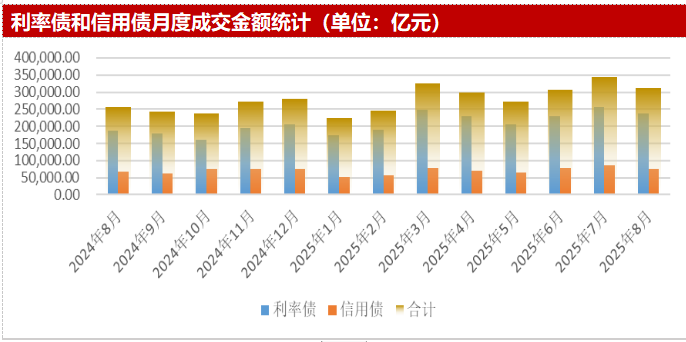
Group 1 - In August, the overall trading activity in the secondary bond market decreased, with a significant contraction in credit bond trading and a narrow fluctuation in credit spreads [1][3] - The total transaction amount in the bond secondary market for August was 372,335.79 billion, representing a year-on-year increase of 17.28% but a month-on-month decrease of 10.06% [1] - The trading volume of credit bonds in August was 74,448.61 billion, showing a year-on-year increase of 10.09% but a month-on-month decline of 14.27% [3] Group 2 - The trading characteristics of credit bonds indicate a trend of credit quality downgrading and duration shortening, with an increase in the popularity of convertible bonds [3] - The transaction amount of urban investment bonds decreased by 12.58%, showing a similar trend of credit quality downgrading, albeit to a lesser extent [3] - The overall credit spread exhibited a trend of first narrowing and then expanding, remaining at a low level for the year [3][4] Group 3 - As of August 29, the median credit spreads for various industries showed significant variation, with home appliances and real estate having the highest spreads at 163.96 bp and 101.10 bp respectively [4] - The home appliance industry experienced a substantial widening of credit spreads by 99.97 bp, attributed to intensified competition [4] - The outlook for the credit bond market suggests a potential recovery in trading activity after a brief consolidation, although the economic recovery remains to be validated by more data [5]