内需

Search documents
5月PMI数据点评:内、外需表现分化
Bank of China Securities· 2025-06-05 03:07
Economic Indicators - The manufacturing PMI for May 2025 is at 49.5%, a month-on-month increase of 0.5 percentage points, indicating a slight recovery but still in the contraction zone[1] - The new orders index for May is at 49.8%, up 0.6 percentage points, while the new export orders index increased by 2.8 percentage points to 47.5%, highlighting external demand's contribution to manufacturing recovery[1][5] - The production index rose to 50.7%, a month-on-month increase of 0.9 percentage points, returning to the expansion zone[1][5] Supply Chain and Inventory - The raw materials inventory index is at 47.4%, up 0.4 percentage points, while the finished goods inventory index decreased to 46.5%, down 0.8 percentage points, indicating inventory adjustments in response to demand changes[1][5] - The supplier delivery time index is at 50.0%, down 0.2 percentage points, suggesting stable delivery times despite the overall supply chain pressures[1][5] Sector Performance - High-tech manufacturing PMI stands at 50.9%, remaining in the expansion zone for four consecutive months, with significant growth in computer and communication equipment exports, where the export orders index exceeded 10% growth[2][9] - The electrical machinery and specialized equipment sectors saw export order indices increase by over 10% in May, indicating strong external demand recovery[2][9] Risks and Outlook - There are concerns regarding the potential for increased recession risks in major overseas economies and heightened geopolitical uncertainties[3][17]
本周油价小幅下跌,农药关注度较高
Orient Securities· 2025-06-03 05:45
Investment Rating - The industry investment rating is maintained as "Positive" [10][18]. Core Viewpoints - Oil prices have slightly decreased this week, but the focus remains on agricultural chemicals due to the ongoing spring farming season [10][18]. - The report emphasizes the importance of companies with strong fundamentals and low correlation to oil prices, suggesting a bottom-fishing strategy [10][18]. - Recommendations include companies like Wanhua Chemical, Huangma Technology, Runfeng Co., Guoguang Co., and Hualu Hengsheng, highlighting their respective strengths and market positions [10][18]. Summary by Sections Oil and Chemical Price Information - As of May 30, Brent oil price decreased by 1.35% to $63.90 per barrel, with concerns about supply growth impacting the market [14]. - U.S. crude oil commercial inventory stood at 440.4 million barrels, a weekly decrease of 2.8 million barrels [14]. - Among 188 monitored chemical products, hydrochloric acid saw the highest weekly price increase of 35.4%, while acrylic acid experienced the largest decline of 9.7% [15][16]. Price and Spread Changes - The top three products with the highest weekly price increases were hydrochloric acid (up 35.4%), liquid chlorine (up 21.8%), and international potassium chloride (up 8.4%) [10][15]. - The highest price spread increases were seen in the following products: BDO spread (up 71.6%), lithium hexafluorophosphate spread (up 54.9%), and carbon black spread (up 39.3%) [10][19]. - Monthly price changes showed hydrochloric acid leading with a 43.4% increase, while the BDO spread saw a significant monthly increase of 588.0% [10][19].



5月PMI:内外分化加深——中采PMI点评(25.05)(申万宏观·赵伟团队)
申万宏源宏观· 2025-06-02 05:10
Core Viewpoints - The manufacturing PMI for May increased marginally to 49.5%, indicating a slight recovery in manufacturing activity, although it remains below the expansion threshold of 50 [2][10] - The new export index is low, but domestic demand, particularly in consumer goods and equipment manufacturing, shows significant improvement [2][21] - The service sector PMI also saw a slight increase, driven by improvements in life services, particularly during the "May Day" holiday [40][67] Manufacturing Sector - The manufacturing PMI rose by 0.5 percentage points to 49.5%, with production and new orders indices increasing by 0.9 and 0.6 percentage points to 50.7% and 49.8%, respectively [2][52] - The production index has recovered above the expansion line, while the new orders index remains in contraction territory, indicating a disparity between production acceleration and weak demand [2][10] - Industries with strong domestic demand, such as equipment manufacturing and consumer goods, showed better performance, with PMIs rising by 1.6 and 0.8 percentage points to 51.2% and 50.2% [21][24] New Orders and Exports - The internal demand orders index rose above the expansion line to 50.1%, while the new export orders index increased by 2.8 percentage points to 47.5%, indicating a divergence in recovery between domestic and export orders [3][24] - The average value of new export orders over April and May remains lower than in March, suggesting ongoing pressure on exports [3][24] Non-Manufacturing Sector - The non-manufacturing PMI decreased slightly to 50.3%, primarily due to a decline in the construction sector, which fell by 0.9 percentage points to 51% [67][29] - Despite the decline in construction, civil engineering activities are accelerating, with the civil engineering PMI rising to 62.3% [29][84] - The service sector PMI increased by 0.1 percentage points to 50.2%, supported by active consumer spending during the holiday period [40][67] Future Outlook - Uncertainties surrounding U.S. tariff policies remain significant, with ongoing monitoring of fiscal policies' support for domestic demand [45][45] - The focus will be on the potential for fiscal measures to bolster service consumption and infrastructure investment, which are expected to enhance domestic demand support [45][45]

智通财经港股06月投资策略及十大金股
Zhi Tong Cai Jing· 2025-06-01 23:54
Group 1 - The Hong Kong stock market showed a positive trend in May, with the Hang Seng Index fluctuating between 22,058.30 and 23,917 points, driven by optimism following the US-China tariff reductions [1] - The US suspended a planned 24% tariff on Chinese goods, reducing overall tariffs from 145% to 30%, while China reciprocated with a 10% tariff on US goods [1] - The IPO market in Hong Kong saw a resurgence, with major listings like CATL raising over 30 billion RMB, marking a significant recovery from last year's downturn [1] Group 2 - The innovative drug sector remains strong, with companies like Three Life Pharmaceutical and Stone Pharmaceutical announcing significant collaborations, leading to stock price surges [2] - The shipping sector benefited from tariff reductions, with companies like Orient Overseas International and SF Express seeing positive market reactions [2] - The overall outlook for the Hong Kong stock market in June is less optimistic due to a lack of strong catalysts and an increase in bearish news [2] Group 3 - The US faces significant fiscal challenges, including a downgrade of its credit rating by Moody's and a projected budget deficit increase of approximately $2.7 trillion over the next decade [3] - A substantial amount of US debt is set to mature in June 2025, raising concerns about the government's ability to refinance these obligations [3] - US-China trade negotiations are stalled, with potential new regulations targeting Chinese companies, indicating ongoing geopolitical tensions [3] Group 4 - The Federal Reserve's decision on interest rate cuts in June will depend on economic data, with recent inflation indicators showing a slowdown [4] - OPEC+ is expected to discuss oil production increases, which could further influence market conditions [4] Group 5 - Geopolitical developments show some promise, with Russia and Ukraine set to hold peace talks, although a resolution remains distant [5] - Tensions between India and Pakistan continue, with ongoing conflicts affecting regional stability [5] Group 6 - The Lujiazui Forum in June is anticipated to announce significant financial policies, which could positively impact market sentiment [6] - Southbound capital inflows have reached historical highs, indicating strong investor interest in the Hong Kong market [6] Group 7 - The investment strategy for June focuses on exploring domestic demand potential, as the market's upward momentum is expected to be driven by internal factors rather than external [7] - The innovative drug sector is likely to attract continued investment, supported by recent business development collaborations [8] Group 8 - Companies like China Biologic Products and Innovent Biologics are positioned for growth due to their strong product pipelines and recent approvals [10][12] - Environmental companies like Conch Venture Holdings are facing challenges but are expected to improve profitability through operational efficiency [14][16] - Infrastructure firms like Anhui Expressway are benefiting from acquisitions and increased traffic, leading to significant profit growth [17][18] Group 9 - China Resources Power is leveraging its market position and operational efficiency to maintain profitability, with a focus on renewable energy expansion [19][20] - China Shipbuilding Industry Corporation is experiencing strong demand in the shipbuilding sector, with expectations for continued growth [22] Group 10 - Jitu Express is seeing robust growth in package volume, particularly in Southeast Asia, driven by increased e-commerce activity [23][24] - Tongcheng Travel is reporting strong revenue growth, particularly in its core OTA business, with expectations for continued performance improvement [26][27] Group 11 - Anta Sports is experiencing significant growth in brand revenue, supported by successful product launches and channel innovations [28][29] - Multi-Point Intelligence is focusing on digital transformation solutions for local retailers, positioning itself as a leading SaaS provider in the sector [30][31][32]
机构:整体方向仍看成长,500质量成长ETF(560500)近1周新增份额居可比基金首位
Sou Hu Cai Jing· 2025-05-27 05:40
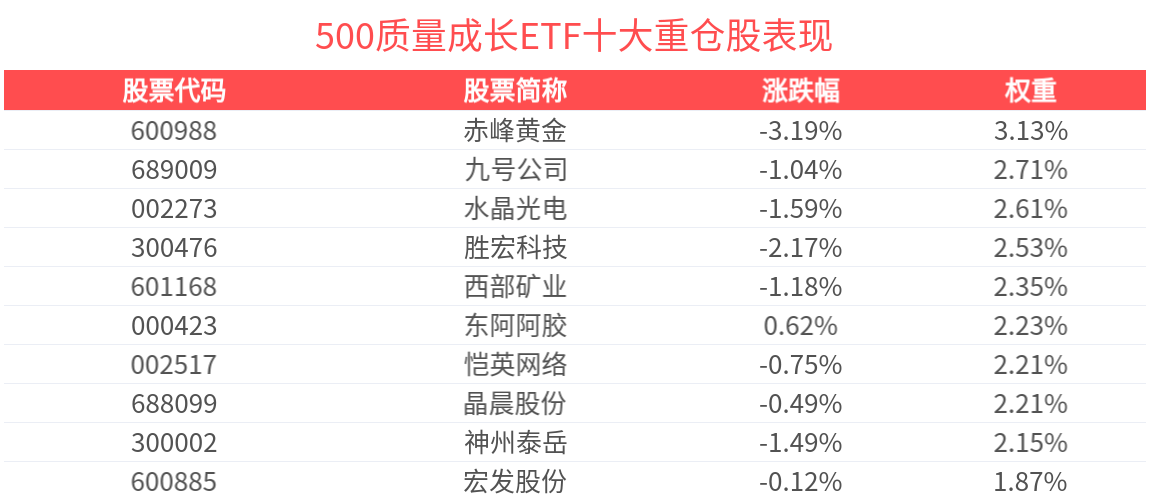
Core Viewpoint - The overall market trend is focused on growth, with an emphasis on domestic demand and domestic substitution as key investment dimensions [1]. Group 1: Market Performance - As of May 27, 2025, the CSI 500 Quality Growth Index (930939) decreased by 0.55%, with component stocks showing mixed performance [1]. - Among the top gainers, Debon Securities (603056) rose by 8.37%, while the biggest decliner, Jincheng Mining (603979), fell by 4.08% [1]. - The CSI 500 Quality Growth ETF (560500) also saw a decline of 0.32%, with the latest price at 0.93 yuan [1]. - The ETF experienced a significant increase in shares, growing by 3 million shares over the past week, ranking it in the top third among comparable funds [1]. Group 2: Index Composition - The CSI 500 Quality Growth Index is composed of 100 listed companies selected from the CSI 500 Index, focusing on those with high profitability, sustainable earnings, and strong cash flow [2]. - As of April 30, 2025, the top ten weighted stocks in the index accounted for 24.07% of the total index weight, with Chifeng Gold (600988) being the largest at 3.13% [2][4].

品牌工程指数 上周报1657.60点
Zhong Guo Zheng Quan Bao· 2025-05-25 20:38
Group 1 - The market experienced a slight adjustment last week, with the brand index closing at 1657.60 points, while several component stocks rose against the trend, including Xinlitai, Tigermed, and Stone Technology [1][2] - Xinlitai led the gains with an increase of 14.96%, followed by Tigermed at 12.48%, and Stone Technology at 11.47%. Other notable gainers included Three Squirrels and Supor, which rose by 7.69% and 6.07% respectively [2] - Since the beginning of 2025, Maimai Biological has seen a significant increase of 51.27%, with Shanghai Jahwa and Xinlitai also showing strong performance with gains of 47.96% and 47.71% respectively [3] Group 2 - Looking ahead, the market is expected to gradually shift towards a more positive trend as investors remain sensitive to favorable factors, with ongoing accumulation of positive elements supporting economic expectations and fundamentals [4] - The current market structure indicates a potential for mid-term positive performance, driven by policy support, domestic technological breakthroughs, and a favorable external environment, which may enhance liquidity in the domestic capital market [4] - In the medium to long term, opportunities may arise in sectors such as domestic demand, technology, and overseas expansion, with a focus on defensive dividend sectors and aggressive technology sectors, including internet and robotics [5]





对美直接出口上行——实体经济图谱 2025年第19期【陈兴团队·财通宏观】
陈兴宏观研究· 2025-05-24 10:23
Group 1: Domestic Demand - New housing sales growth rate continues to narrow, while second-hand housing prices rise but sales decline [1] - Retail sales of passenger vehicles have decreased, while wholesale sales have increased; the operating rate of semi-steel tires remains stable [1] - The tourism market shows marginal improvement, with hotel occupancy rates and revenue per available room increasing [1] Group 2: External Demand - Direct exports to the U.S. have rebounded, with container booking volumes from China to U.S. ports showing year-on-year growth [2][3] - The U.S. plans to impose a 50% tariff on European goods, which may benefit China's exports to Europe, particularly in the machinery sector [4] Group 3: Production - Weak terminal construction demand due to increased rainfall in southern regions, leading to a decline in steel prices and production [5] - Prices for PTA, polyester chips, and POY have continued to rise due to maintenance and rising oil prices, although inventory levels have slightly increased [6] Group 4: Prices - Gold prices have rebounded, while copper and crude oil prices are fluctuating within a range; domestic chemical products continue to rise, and steel prices have decreased [7] - Geopolitical tensions in the Middle East and uncertainties regarding U.S. tariff policies have supported gold prices, despite OPEC+ production increases [8] Group 5: Future Focus - Attention is directed towards corporate profit data and PMI data for further insights into economic conditions [9]

这类基金买股票趋势刚开始!创金合信基金黄弢:内需股已具有逆向配置逻辑
券商中国· 2025-05-20 15:00
Core Viewpoint - The article discusses the increasing interest of bond-type fund managers in enhancing the flexibility of product net values amid optimistic market sentiment and the growing attractiveness of equity assets [1][2]. Group 1: Market Dynamics - The decline in market volatility is encouraging more funds to enter the market, with the 10-year government bond yield returning to around 1.6%, leading to asset allocation concerns among institutional and individual investors [3]. - Since September of the previous year, there has been a significant increase in investors' risk appetite, and the involvement of stabilizing funds has contributed to reduced volatility in the A-share market [3]. Group 2: Investment Strategies - The investment strategy of the fund emphasizes a contrarian approach and value investing, focusing on low drawdown and stable returns by integrating macroeconomic judgments with individual stock valuations and earnings [4]. - The current investment framework includes adjusting overall stock positions based on macroeconomic assessments, adjusting industry weights based on mid-level economic conditions, and selecting leading stocks for diversified holdings [4]. Group 3: Sector Preferences - The fund manager prefers to focus on industry selection rather than individual stock picking, maintaining a balanced industry allocation while being responsive to changes in industry conditions and valuation [8]. - The fund is particularly optimistic about sectors related to domestic consumption, healthcare, midstream manufacturing, and cyclical recovery, which are expected to see a resurgence in the latter half of the year [9]. Group 4: Consumer Trends - The article highlights a strong performance in the new consumption sector, which is seen as a unique bright spot amid overall consumption recovery, driven by new product categories and companies with strong operational capabilities [10][11].

经济数据点评:地产探底对内需拖累加深
Huafu Securities· 2025-05-19 14:17
Consumption Trends - In April, the year-on-year growth of social retail sales was 5.1%, down 0.8 percentage points from the previous month, while retail sales of above-limit goods were 6.6%, down 2.0 percentage points[3] - Automobile consumption saw a significant decline, with a year-on-year growth rate dropping 4.8 percentage points to 0.7%, indicating instability in consumer confidence amid the ongoing real estate cycle[3] - Essential goods and services showed resilience, with food and oil prices rising 14.0% year-on-year, a slight increase of 0.2 percentage points from the previous month[3] Investment and Real Estate - Fixed asset investment growth fell to 3.5% year-on-year in April, a decrease of 0.8 percentage points from the previous month, with real estate development investment down 11.3%, deepening by 1.3 percentage points[4] - The residential sales area saw a year-on-year decline of 2.4%, worsening by 1.9 percentage points, while new construction area dropped 17.8% year-on-year[5] - The construction completion area experienced a significant decline of 25.8% year-on-year, marking the steepest drop since the beginning of the year[5] Industrial Production - Industrial value-added growth fell to 6.1% year-on-year in April, down 1.6 percentage points from the previous month, with mining industry value-added dropping 3.6 percentage points to 5.7%[6] - Manufacturing value-added decreased by 1.3 percentage points to 6.6% year-on-year, primarily affected by fluctuations in investment and consumer demand[6] - The second wave of export growth began, with electrical machinery and equipment, and computer communication equipment increasing by 13.4% and 10.8% year-on-year, respectively[6] Economic Outlook - The overall economic data for April indicates a simultaneous cooling in consumption and investment, primarily driven by the real estate cycle's downturn affecting domestic demand[6] - The central bank's recent actions, including a 50 basis point reserve requirement ratio cut and a 10 basis point interest rate reduction, aim to stabilize the real estate market and consumer confidence[6] - There is a possibility of further interest rate cuts in June to enhance support for the real estate market and consumer spending[6]
生产保持强劲——4月经济数据解读【陈兴团队•财通宏观】
陈兴宏观研究· 2025-05-19 12:07
Core Viewpoint - The April economic data indicates a mixed performance in China's economy, with strong industrial production and consumption, but a decline in investment and real estate sectors [1][13]. Demand Side - April's external demand faced challenges due to reciprocal tariffs, leading to a significant drop in exports to the US; however, transshipment trade helped maintain export resilience [1][2]. - Internal demand showed a decline in both investment and consumption, although consumption remained at a high level; investment was dragged down by the real estate and manufacturing sectors [1][7]. Production Side - Industrial production maintained a high level, with April's industrial value-added growth rate dropping to 6.1%, supported by equipment manufacturing and high-tech manufacturing [3][5]. - The service sector's production index slightly decreased, but still benefited from low base effects and consumption recovery [3]. Investment Trends - National fixed asset investment growth rate fell by 0.8 percentage points to 3.5%, with real estate investment continuing to decline significantly [7]. - High-tech industry investments performed well, particularly in information services and computer manufacturing, with year-on-year growth rates of 40.6% and 28.9% respectively [7]. Consumption Patterns - Retail sales growth rate decreased by 0.8 percentage points to 5.1%, while service retail sales showed an upward trend, particularly in tourism-related sectors [9]. - Essential consumer goods saw a decline in growth, while sectors benefiting from trade-in programs performed strongly [9]. Real Estate Market - Real estate sales area growth rate worsened to -2.1%, with new construction area also declining significantly [11]. - Despite the drop in sales volume, housing prices continued to rise, with the decline in new and second-hand housing prices narrowing [11]. Employment and External Factors - The unemployment rate remained stable at 5.1%, indicating a steady employment situation despite external challenges [13]. - Future export performance may exceed expectations due to potential European recovery, although this could lead to a more cautious domestic policy response [13].