
高端化战略

Search documents
从B端之痛到流量陷阱 谁来“救赎”哪吒汽车?
Mei Ri Jing Ji Xin Wen· 2025-08-15 09:08
Core Viewpoint - Neta Auto, once a promising player in the Chinese electric vehicle market, is facing significant challenges, including a sharp decline in sales and internal management issues, leading to its current status as a "dishonest executor" in the eyes of the Guangzhou Haizhu District Court [1][2][3] Group 1: Company Background and Initial Success - Neta Auto was founded in 2017 and quickly gained traction, achieving the title of "domestic new force car company annual sales champion" in 2022, surpassing competitors like NIO and Xpeng [1][3] - The company initially focused on B-end markets, securing significant orders from ride-hailing and car rental companies, which helped it establish a foothold in the industry [4][6] Group 2: Financial Struggles and Management Changes - By 2024, Neta Auto's sales plummeted to 127,000 units, only half of its initial target for the year, leading to significant internal restructuring and management changes [1][6] - The company faced a survival crisis as it struggled to attract investment, with many potential investors showing little interest [6][7] Group 3: Strategic Missteps and Market Position - Neta Auto's shift towards high-end models, such as the Neta S and Neta GT, failed to resonate with consumers, resulting in poor sales performance [10][12] - The company’s internal conflicts and lack of cohesive strategy hindered its ability to capitalize on market opportunities, leading to missed chances for partnerships and market expansion [8][13] Group 4: Recent Developments and Future Outlook - Despite the challenges, Neta Auto is seeking to attract new investors, with 66 interested parties responding to its call for restructuring [18] - The company’s remaining value is still seen as attractive, indicating potential for recovery if managed effectively [18]
重庆啤酒:上半年高档产品增长“停滞” 高端化战略承压|直击业绩会
Xin Lang Cai Jing· 2025-08-15 07:04
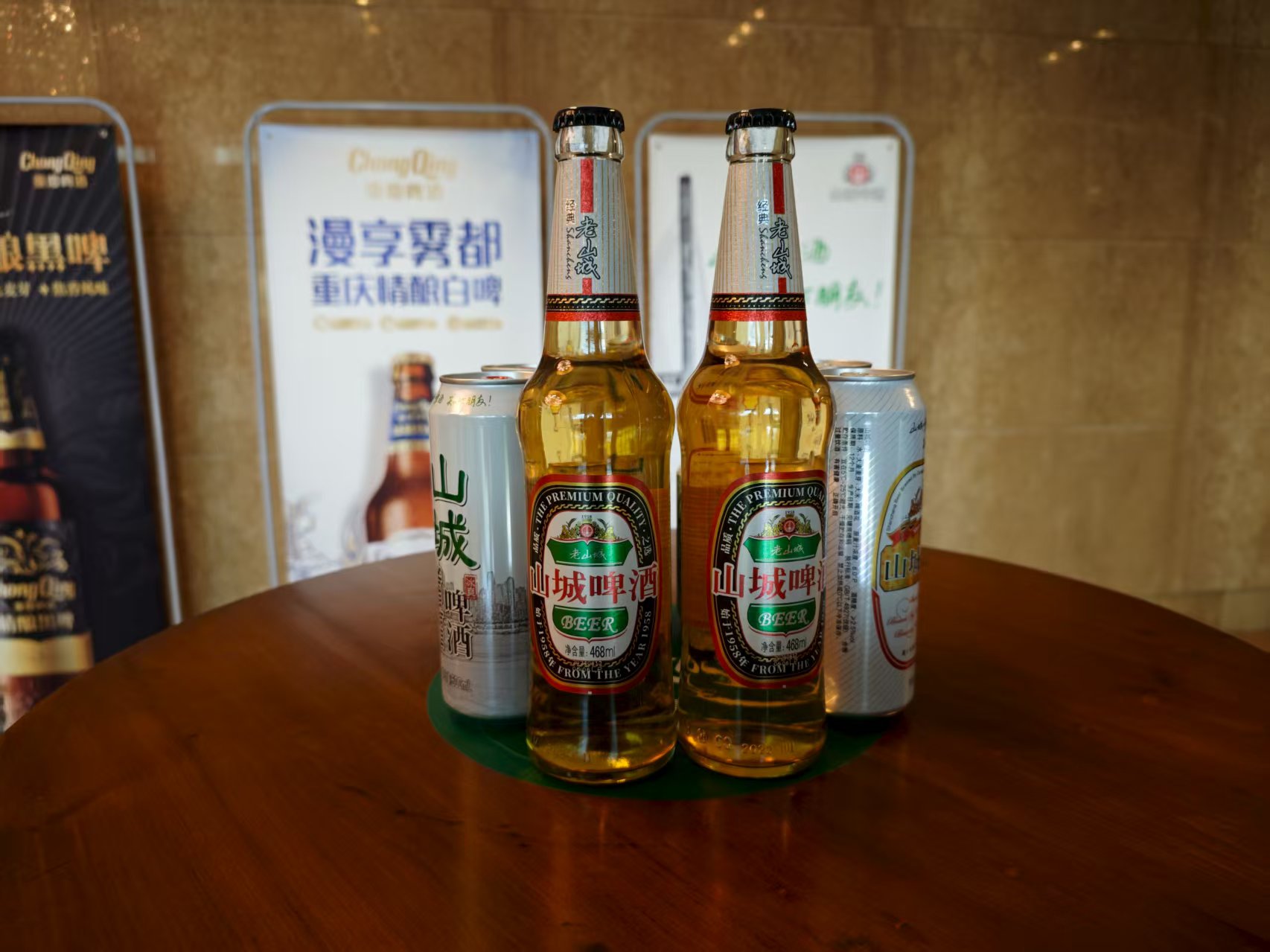
Core Viewpoint - Chongqing Beer reported a decline in both revenue and net profit in the first half of the year, indicating challenges in its high-end product strategy amid weak consumer demand [1][4]. Financial Performance - The company achieved operating revenue of 8.839 billion yuan, a year-on-year decrease of 0.24% [1]. - Net profit attributable to shareholders was 865 million yuan, down 4.03% year-on-year [1]. - Sales volume reached 1.8008 million kiloliters, a year-on-year increase of 0.95%, outperforming the industry average [1]. Product Performance - Revenue from high-end products (priced at 8 yuan/bottle and above) was 5.265 billion yuan, showing almost no growth [2]. - Revenue from mainstream products (priced at 4-8 yuan/bottle) decreased by 0.92% to 3.145 billion yuan [2]. - Economic products (priced below 4 yuan/bottle) saw a growth of 5.39%, generating 196 million yuan [2]. Regional Performance - The Northwest region experienced revenue growth of 1.75%, totaling 2.596 billion yuan, being the only region with an increase [2]. - The Central region's revenue declined by 0.7% to 3.532 billion yuan [2]. - The Southern region's revenue fell by 1.47% to 2.479 billion yuan [2]. Strategic Challenges - The company's high-end strategy is facing significant challenges, with high-end product revenue growth nearly stagnant [4]. - The shift in branding strategy has led to a noticeable decline in sales of the local brand "Shancheng" beer since the acquisition by Carlsberg Group [4].


净利暴跌97%!特仑苏降价撕开蒙牛″虚假繁荣″面具?
Sou Hu Cai Jing· 2025-08-14 02:00
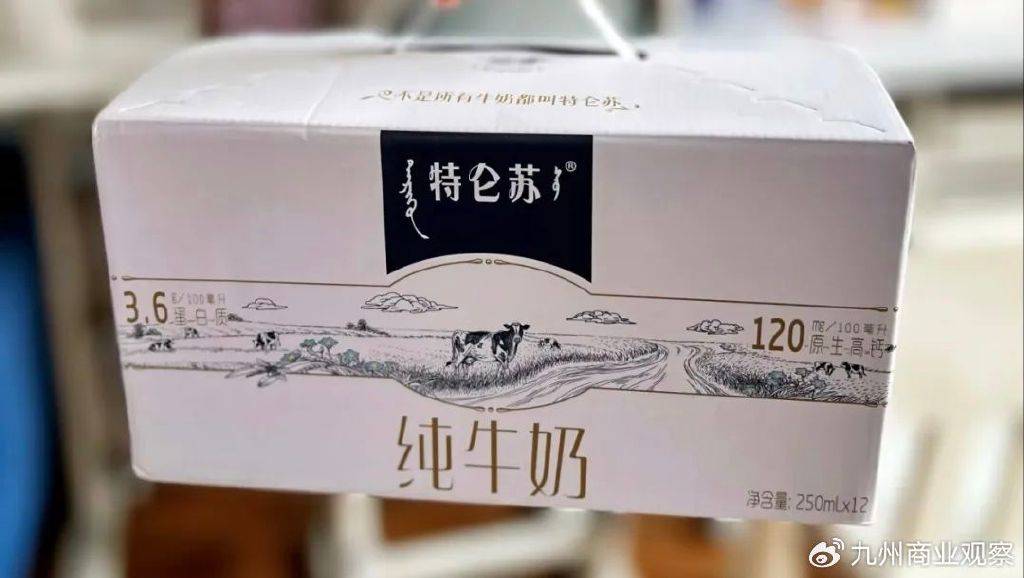
Core Insights - The decline of Mengniu's premium brand, Te Ruan Su, reflects a broader strategic confusion and growth dilemma within the company as it faces market challenges [2][4][9] Group 1: Market Dynamics - Te Ruan Su, once a symbol of high-end dairy in China, has seen significant price reductions, indicating a collapse of its premium pricing strategy [3][4] - The overall dairy market is experiencing oversupply, with a production growth rate of 30% in 2024, while consumption only increased by 3%, leading to aggressive price wars [4][8] - The confusion in pricing across different sales channels is damaging consumer trust and brand integrity, as seen with the price discrepancies for the same product [3][4] Group 2: Financial Performance - Mengniu's financial results for 2024 show alarming declines, with total revenue at 886.75 billion yuan, down 10.09% year-on-year, and net profit plummeting by 97.83% to just 1.05 billion yuan [5][6] - The liquid milk segment, which constitutes 82.4% of Mengniu's revenue, also saw a decline of 10.97%, highlighting the company's heavy reliance on this single category [5][6] Group 3: Strategic Challenges - Mengniu's attempts at diversification through acquisitions have largely failed, with significant impairments recorded, such as a 39.81 billion yuan write-down for the Bellamy's acquisition [6][8] - The company's high-end strategy has been criticized for lacking a solid foundation, as it equated premium branding with price increases rather than genuine quality improvements [6][8] - The need for a strategic overhaul is evident, focusing on innovation and value creation rather than mere capital expansion [8][9] Group 4: Future Outlook - The dairy industry in China is transitioning from a phase of rapid growth to one of meticulous refinement, necessitating a reevaluation of Mengniu's business model [9] - The ability to redefine premium value, move away from single business dependency, and find new growth engines will be crucial for Mengniu's recovery [9]

“内卷”退热 中国汽车产销增速超10%
Zhong Guo Chan Ye Jing Ji Xin Xi Wang· 2025-08-14 01:01
Core Insights - The automotive industry in China is experiencing a critical transformation period, with a focus on high-quality development and green, low-carbon transition [1] - In the first half of 2025, the Chinese automotive market showed strong growth, with production and sales both exceeding 10% year-on-year, particularly in the new energy vehicle sector [1] - Despite positive sales data, the industry faces challenges with profitability, as many companies are experiencing pressure on profit margins and the "incremental growth without profit" issue persists [2] Group 1 - The automotive market in China is expected to maintain stable growth throughout the year, supported by government policies and industry efforts [1] - The average profit margin for China's automotive manufacturing has declined from 7.8% in 2017 to 3.9% in the first quarter of 2025, which is below the overall industrial average [2] - The global average sales return for automotive companies is 4.3%, nearly double that of Chinese firms, highlighting operational efficiency concerns [2] Group 2 - The automotive industry is urged to adopt a technology-driven and value-oriented approach to ensure sustainable development amid global restructuring [3] - Companies with low gross margins (below 15%) may struggle to cover expenses, especially in a challenging financing environment [3] - Some firms are pursuing "dislocated competition" strategies, achieving better overall operational quality through successful exports and high-end market positioning [3][4] Group 3 - Different strategies are being adopted by companies, with some focusing on enhancing their unique product features while others follow market trends, which may compromise profitability for market share [4] - The high-end market presents significant opportunities for domestic brands, as there is still a lack of quality supply in this segment [4] - The automotive industry's stability is crucial for the overall economy, prompting regulatory actions against unhealthy competition [5]
鼎阳科技20250813
2025-08-13 14:53
Summary of Dingyang Technology Conference Call Company Overview - **Company**: Dingyang Technology - **Industry**: Electronic Testing and Measurement Key Financial Metrics - **Revenue**: 87.57 million yuan in H1 2025, up 31.54% YoY [2][3] - **Net Profit**: 75.68 million yuan in H1 2025, up 31.54% YoY; Non-GAAP net profit of 75.52 million yuan, up 33.80% YoY [2][3] - **R&D Investment**: 60.22 million yuan in H1 2025, up 37.08% YoY, accounting for 21.66% of revenue [2][6] Product Development and Innovation - **New Products**: Launched 42 new products since 2020, including 21 high-end products [2][3] - **High-End Product Revenue**: High-end products accounted for 30% of total revenue in H1 2025, up 71.92% YoY [2][5] - **Sales Performance**: Sales of products priced above 30,000 yuan increased by 51.37% YoY [5] Market Position and Strategy - **Market Demand**: High demand for new products such as the 8G 12-bit digital oscilloscope and the Galaxy series [4][12] - **Domestic vs. International Sales**: Domestic market growth outpaced international market growth in H1 2025 [25] - **Competitive Advantage**: Strong brand recognition and customer base contributed to successful market penetration [13][23] R&D and Future Plans - **R&D Focus**: Continuous investment in R&D to enhance product offerings and maintain competitive edge [6][15] - **Future Product Plans**: Next-generation products expected to include digital oscilloscopes reaching 16-30GHz and RF sources exceeding 67GHz [7] Production and Capacity - **Manufacturing Base**: The Malaysia factory is operational and aims to support global markets, with production capacity expected to increase [16][18] - **Cost Structure**: Initial production costs in Malaysia are higher than in China, but expected to decrease as production scales up [19] Sales and Marketing Strategy - **Sales Growth**: Direct sales are increasing, with a focus on high-end products [21] - **Local Hiring**: Local employees have been hired in key international markets to enhance sales efforts [22] Challenges and Opportunities - **Market Competition**: The industry is still dominated by foreign competitors, making domestic substitution a long-term goal [14] - **Growth Sustainability**: The company anticipates stable growth driven by high-end product launches and market expansion [14][24] Conclusion Dingyang Technology is positioned for continued growth through strategic R&D investments, a focus on high-end product offerings, and an expanding global market presence. The company is navigating challenges in production costs and market competition while capitalizing on its strong brand and customer relationships.

换道造车,雷老板的最后一次创业,小米的第五次升级尝试
Quan Jing Wang· 2025-08-13 05:51
Core Insights - Xiaomi has transitioned from a budget smartphone brand to a more premium positioning, facing challenges in balancing its "cost-performance" reputation with high-end aspirations [1][5][14] - The launch of the Su7 electric vehicle marks a significant step in Xiaomi's strategy to redefine its brand and expand into new markets, aiming to enhance its high-end image [9][14] Group 1: Historical Context and Challenges - Xiaomi's initial success was built on high cost-performance products, but this strategy has limited its market share and profitability [1][4] - The company's attempts to enter the high-end market have faced setbacks, including the poor reception of the Xiaomi Note series and the MIX series, which struggled with design and user experience issues [2][3][4] - The brand's identity became muddled as it attempted to compete in both low and mid-range markets, leading to confusion among consumers [5][6] Group 2: Strategic Shifts - In 2019, Xiaomi separated the Redmi brand to focus on different market segments, allowing for a dual-brand strategy that aims to optimize product structure and enhance brand value [5][6] - The introduction of the Xiaomi 9 marked a shift in pricing strategy, but consumer expectations remained tied to the brand's low-cost roots, leading to mixed reactions [6][7] - The launch of the Xiaomi 10 series in 2020 saw a successful entry into the high-end market, with significant sales figures indicating a potential turnaround [7][8] Group 3: Recent Developments and Future Outlook - The Su7 electric vehicle has generated significant interest, with rapid sales and a strong market response, indicating a successful entry into the automotive sector [12][14] - Xiaomi's financial performance has improved, with a reported revenue of 111.3 billion yuan in Q1 2025, reflecting a 47.4% year-on-year growth [14][16] - The company's focus on high-end products and integration of its IoT ecosystem has led to increased average selling prices and market share in the smartphone segment [15][16]

大时代中的小米:扬科创之帆 赴星辰大海
Xin Hua Wang· 2025-08-12 05:49
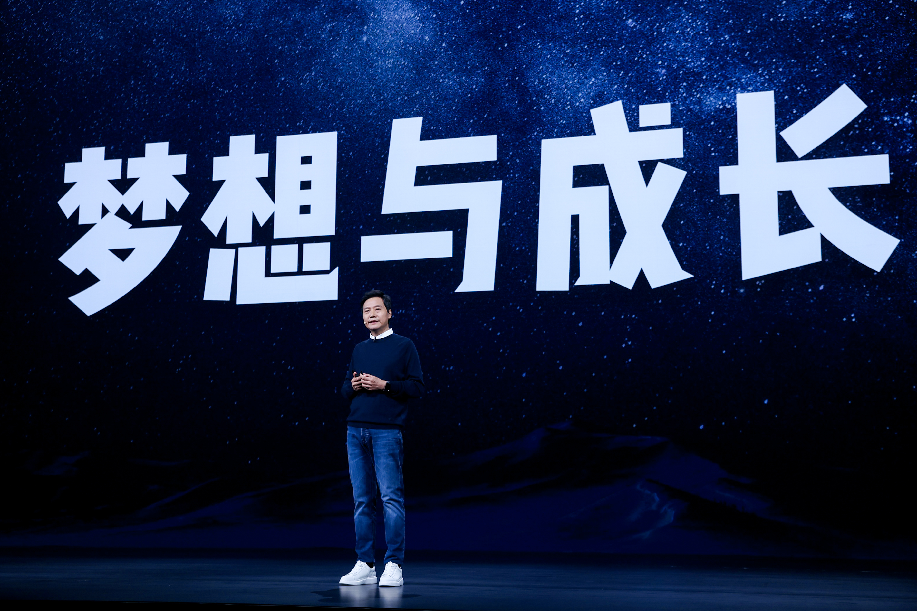
Core Insights - Xiaomi is undergoing a strategic upgrade focused on long-term technological investments that contribute to human civilization [1][16] - The company's founder, Lei Jun, emphasized the importance of high-end market positioning as a critical path for growth and competitiveness [5][6] Group 1: Company Growth and Strategy - Xiaomi's annual speeches reflect the evolution of the company and the broader Chinese tech industry, transitioning from a phase of catching up to one of innovation and core competitiveness [3][4] - The company has established three key principles for high-end smartphone development: no shortcomings in high-end features, deep integration of hardware and software, and prioritizing user experience over specifications [8] - Xiaomi's average selling price (ASP) for smartphones reached a historical high in Q1 2023, with a year-on-year increase of over 18% [8] Group 2: Innovation and R&D - Xiaomi's R&D investment has seen a compound annual growth rate of 38.4% from 2017 to 2022, with expectations to exceed 20 billion RMB in 2023 and over 100 billion RMB in the next five years [13] - The company has entered 12 technology fields, including 5G, big data, cloud computing, and artificial intelligence, with over 32,000 global patents as of March 31, 2023 [12] - Xiaomi's self-developed large model technology has achieved significant breakthroughs, with a focus on lightweight and local deployment, indicating a shift towards integrating advanced AI capabilities into its products [20] Group 3: Market Position and Future Outlook - Xiaomi is positioned as a leading player in the high-end smartphone market, aiming to reshape the competitive landscape dominated by foreign brands [9] - The company is committed to continuous innovation and adaptation to market changes, which is essential for maintaining its competitive edge in the evolving tech landscape [18][22] - The introduction of new products, including the Xiaomi MIX Fold 3 and advancements in AI technology, showcases the company's commitment to technological leadership and market responsiveness [14][15]

小米第三季度营收925亿元,“人车家全生态”全面发力助推业绩创新高
Xin Hua Wang· 2025-08-12 05:38
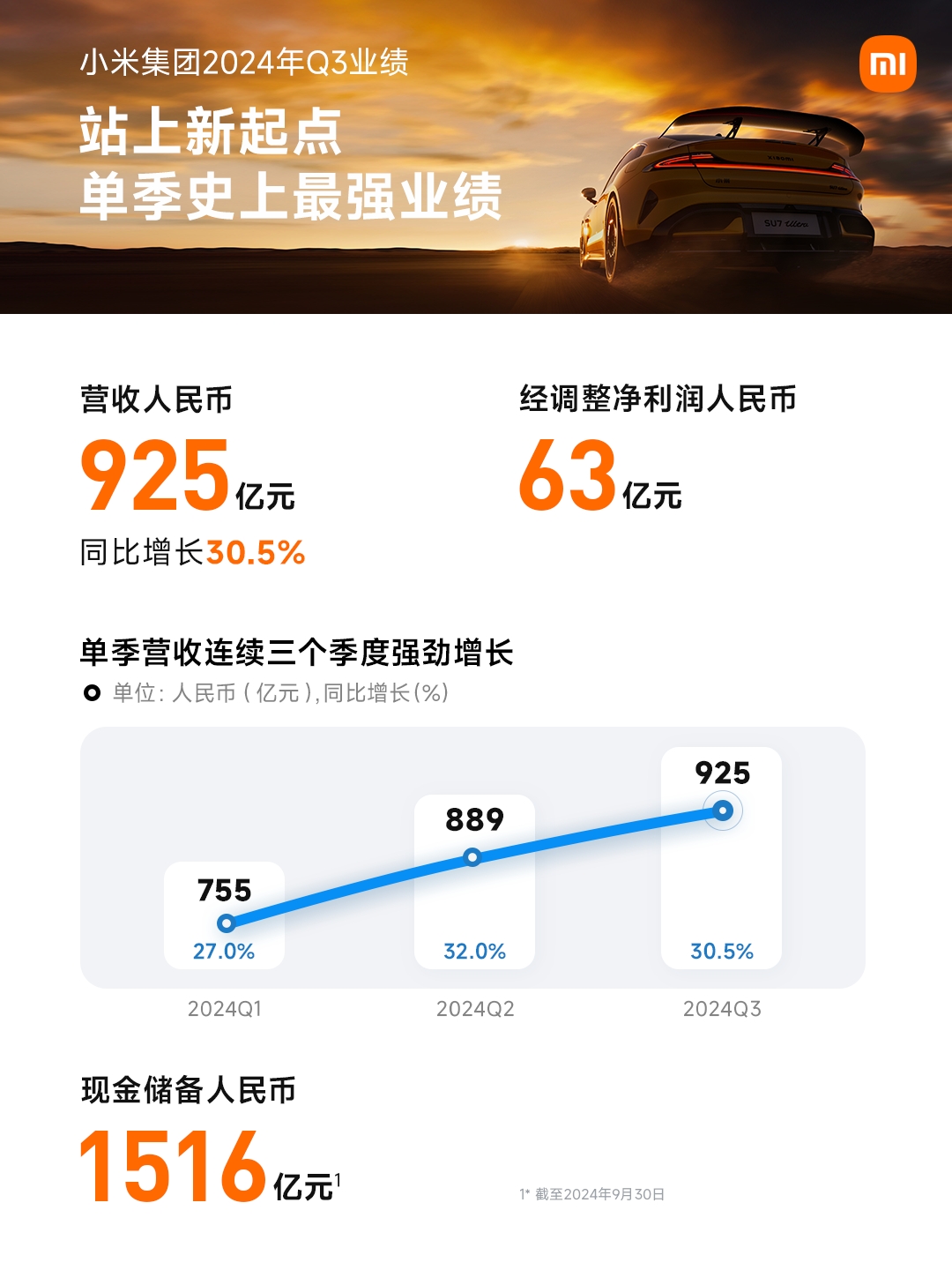
Core Insights - Xiaomi Group reported a total revenue of RMB 92.5 billion for Q3 2024, marking a continuous growth for three consecutive quarters, with adjusted net profit at RMB 6.3 billion, maintaining a historical high [1] - The company’s cash reserves reached a new high of RMB 151.6 billion as of September 30, 2024, despite ongoing investments in automotive ventures [1] Group Performance - All business segments of Xiaomi achieved quality growth, including smartphones, tablets, wearables, TVs, and home appliances, with a global growth trend [6] - Xiaomi's high-end strategy has gained momentum, with significant increases in market share across various price segments for smartphones in China [7] Product Performance - In Q3 2024, Xiaomi's smartphone revenue reached RMB 47.5 billion, with a year-on-year growth of 13.9%, and global smartphone shipments increased to 43.1 million units [18] - The IoT and lifestyle products segment generated RMB 26.1 billion in revenue, a 26.3% year-on-year increase, with a record gross margin of 20.8% [9] - Xiaomi's wearable products saw over 50% year-on-year growth in shipments, with smartwatches and TWS earphones reaching new highs [12] Strategic Developments - Xiaomi's internet services revenue hit a record high of RMB 8.5 billion in Q3 2024, with a gross margin increase to 77.5% [13] - The launch of the Xiaomi SU7 Ultra prototype car marked a significant milestone in the company's automotive ambitions, achieving a notable lap time at the Nürburgring [13] Market Outlook - Analysts express optimism regarding Xiaomi's growth prospects from 2024 to 2026, highlighting the company's high-end strategy in smartphones and IoT as reshaping consumer perceptions [19] - The "human-vehicle-home ecosystem" is expanding, creating new growth opportunities and strengthening Xiaomi's competitive edge in the market [17][19]
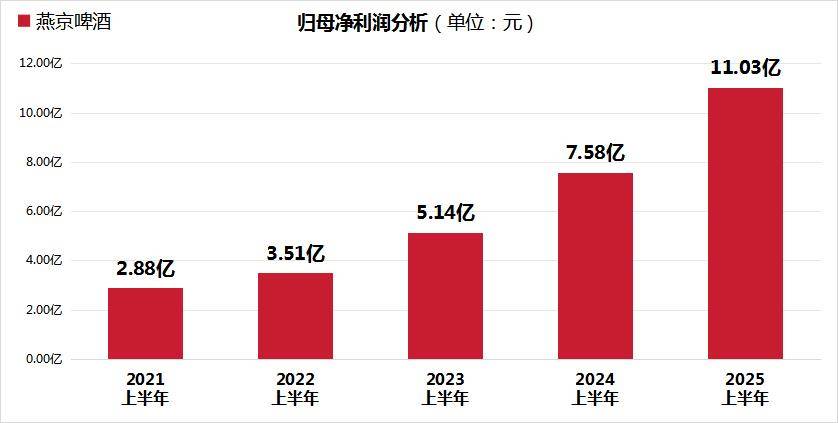
燕京啤酒2025年上半年归母净利润增长45.45%,高端化战略成效斐然
Sou Hu Cai Jing· 2025-08-12 02:33
Core Viewpoint - Yanjing Beer reported a significant increase in net profit and revenue for the first half of 2025, driven by a high-end product strategy and effective marketing initiatives [1][2][6]. Financial Performance - Yanjing Beer achieved a net profit of 1.103 billion yuan, a year-on-year increase of 45.45%, surpassing the total net profit of 1.056 billion yuan for the entire previous year [1][2]. - The company's revenue reached 8.558 billion yuan, reflecting a growth of 6.37% compared to the same period last year [2]. - The gross profit margin improved from 39.90% in the first half of 2022 to 45.50% in the first half of 2025, while the net profit margin increased from 10.84% to 14.83% [4]. Product Strategy - The revenue from mid-to-high-end products, represented by Yanjing U8, grew by 9.32% to 5.536 billion yuan, increasing its share of total revenue from 68.54% to 70.11% [7]. - The gross profit margin for mid-to-high-end products reached 51.71%, up by 1.40 percentage points from the previous year [7]. Market Position and Shareholder Confidence - Yanjing Beer’s stock price reached a historical high of 14.27 yuan, reflecting strong market confidence in the company's performance [11]. - The presence of social security funds among the top ten shareholders indicates institutional recognition of Yanjing Beer’s growth potential [11][12]. Brand Value and Recognition - Yanjing Beer was recognized at the 22nd "World Brand Conference" for its brand value of 237.916 billion yuan, marking an increase from previous years [13].

日妆四巨头半年考:难守海外市场 祭出高端牌
Bei Jing Shang Bao· 2025-08-11 16:39
Core Insights - The four major Japanese cosmetics companies, Shiseido, Kao, POLA, and Kose, have reported mixed results for the first half of the year, with Kao and Kose showing sales growth while Shiseido and POLA experienced declines [1][2] - The Japanese domestic market remains a crucial pillar for these companies, but they collectively face challenges in overseas markets, prompting a shift towards high-end strategies [1][3] Sales Performance - Kao's sales reached 809 billion yen, a 2.7% increase year-on-year; Kose's sales were 160.5 billion yen, up 0.9%; Shiseido's net sales fell to 469.831 billion yen, down 7.6%; POLA's sales decreased to 83.253 billion yen, down 0.7% [2] - In terms of operating profit, Kao reported 69.5 billion yen, a 19.9% increase; Shiseido's operating profit was 23.372 billion yen, up 21.3%; POLA's profit was 8.217 billion yen, a 12.3% increase; Kose's profit fell to 11.3 billion yen, down 17.7% [2] Domestic Market Focus - The Japanese market has been a stronghold for these companies, with Kose's sales in Japan growing by 6% year-on-year, and Kao attributing its growth to competitive product launches [3] - Shiseido's performance is also credited to structural reforms in the domestic market, which helped offset declines in other regions [3] Overseas Market Challenges - All four companies faced difficulties in overseas markets, with Kose's North American sales down 8.6% and Chinese sales down 3.4%; Kao noted weak growth in overseas markets [3] - POLA highlighted adverse impacts from certain Asian regions, particularly China, affecting overall overseas performance [3] Brand Perception and Competition - Japanese cosmetics brands have seen a decline in visibility among consumers, with no brands from these companies making it to the top 20 beauty brands on Douyin in recent years [4] - The rise of domestic brands has intensified competition, with local brands gaining significant market share [5] High-End Strategy - In response to stagnant domestic growth, these companies are focusing on expanding overseas markets, with high-end positioning as a key strategy [6] - Shiseido's sales from the Japanese market account for about 30%, while Kose and POLA exceed 50%, indicating limited growth potential in the domestic market [6] Future Plans - Companies are implementing strategies to enhance their overseas presence, with POLA's mid-term plan emphasizing overseas business development and Kose's "Milestone 2030" focusing on investment and structural reforms [6][7] - High-end branding is central to their strategies, with Kao planning to develop six major brands and Shiseido focusing on its "Core3" and "Next5" high-end brands [7] Innovation and R&D - The global beauty market is increasingly competitive, with a focus on high-end products requiring significant R&D investment [8] - Companies like Shiseido and Kao are investing in innovation to attract younger consumers and adapt to changing market dynamics [8]