经济增长

Search documents
Treasury official: The Fed can cut rates next year, even in the face of strong growth
Yahoo Finance· 2025-12-24 12:00
The Trump administration said Tuesday that it expects the economy to grow at a pace of 3% and that the Federal Reserve can continue to lower interest rates in that environment. Joe Lavorgna, counselor to Treasury Secretary Scott Bessent, told Yahoo Finance in an interview that the economy is experiencing a boom without inflation tied to President Trump’s deregulatory, pro-growth policies, boosted by capital spending. Read more: How the Fed rate decision affects your bank accounts, loans, credit cards, a ...
Dollar Falls as Japanese Yen Rises on Intervention Hopes
Barrons· 2025-12-24 08:20
Core Viewpoint - The dollar is trading near an 11-week low against a basket of currencies, influenced by the recovery of the Japanese yen and potential government interventions [1] Group 1: Currency Market Dynamics - The Japanese yen is recovering due to expectations of government actions to stabilize the currency [1] - Japanese Finance Minister Satsuki Katayama indicated that the government is prepared to intervene against excessive currency fluctuations [1] Group 2: Economic Data Impact - Recent data revealed that the U.S. economy grew more than anticipated in the third quarter, which provided temporary support to the dollar [1]
美国三季度GDP增速超预期,家庭债务创新高
Guo Ji Jin Rong Bao· 2025-12-24 08:20
Core Insights - The U.S. GDP grew by 4.3% in Q3, marking the fastest growth in two years, driven primarily by consumer spending and significant investments in artificial intelligence infrastructure [1][2] Consumer Spending - Consumer spending in Q3 saw an annualized growth rate of 3.5%, becoming the main engine of economic growth, with notable contributions from healthcare services, international travel, legal services, and technology products [2][3] - The top 10% of income earners in the U.S. accounted for nearly half of total consumer spending, supported by a booming stock market that bolstered high-end consumption and service demand [2][3] Artificial Intelligence Investment - Investment in artificial intelligence has slowed from previous highs but still contributed significantly to economic growth, with AI-related investments and high-income household consumption together accounting for nearly 70% of the growth in the quarter [3][4] Economic Imbalances - The economic growth is characterized by imbalances, with consumer confidence indices remaining low and durable goods spending slowing down, reflecting public concerns over high prices and the job market [3][4] - Non-residential fixed asset investment showed signs of weakness, and residential investment declined for the second consecutive quarter, with an annualized drop of 5.1% [3][4] Inflation and Income Dynamics - The core Personal Consumption Expenditures (PCE) price index rose to an annualized rate of 2.9%, up from 2.6% in the previous quarter, indicating a slight uptick in inflation [3][4] - After adjusting for inflation, disposable personal income remained flat, suggesting that income growth is barely keeping pace with rising prices, which is particularly challenging for low-income households [3][4] Household Debt Trends - U.S. household debt reached a record high of $18.6 trillion in Q3 2025, with mortgage debt being the largest component at $13.07 trillion [4][5] - The credit market is experiencing a "K-shaped" divergence, where low-income households face increasing financial pressure, while high-income borrowers benefit from stock market gains and rising property values [5]
BBMarkets:美国三季度GDP超预期,经济学家却依旧不看好
Sou Hu Cai Jing· 2025-12-24 01:21
Economic Growth - The U.S. economy's real GDP annualized growth rate for Q3 reached 4.3%, significantly exceeding the expected 3.3% and up from 3.8% in the previous quarter [3] - Real personal consumption expenditures for Q3 recorded an annualized growth rate of 3.5%, surpassing the expected 2.7% and showing a notable increase from the previous value of 2.5% [3] Inflation and Market Reactions - The core PCE price index for Q3 had an annualized growth rate of 2.9%, aligning with market expectations and slightly up from the previous 2.6% [3] - Following the economic data release, gold prices experienced a decline while the U.S. dollar index rebounded, indicating a shift in market expectations regarding future Federal Reserve interest rate cuts [3] Economic Outlook - Economists express caution regarding the sustainability of the current high growth, predicting a potential slowdown in Q4 due to the impact of a government shutdown that began on October 1, which has adversely affected government spending, business investment, and consumer confidence [3] - The overall GDP growth rate for the year is expected to stabilize around 2%, reflecting ongoing constraints on economic expansion [4] - A more optimistic outlook for 2026 suggests a moderate rebound in the U.S. economy, as economists anticipate improved conditions [4]

欧盟经济整体温和增长
Jing Ji Ri Bao· 2025-12-23 22:49
在经济增长方面,2025年欧盟GDP预计将实现1.4%的温和扩张,高于2024年的1%。这一增长主要由私 人消费和投资驱动。受益于工资上涨和通胀放缓,欧盟居民实际可支配收入增加,推动了零售和服务业 复苏。但值得注意的是,成员国经济预测差异显著:波兰得益于基础设施投资和欧盟资金注入,预计 2025年GDP将增长3.2%;西班牙由于旅游业和房地产逐步复苏,预计将增长2.9%。相较之下,德国作 为欧盟最大经济体,预计增长0.2%,其中,制造业下滑是主要拖累因素。整体而言,今年欧盟经济总 量预计将达19.99万亿美元(名义值),约占全球经济的六分之一。 通货膨胀得到控制是2025年欧盟经济的一大亮点。11月欧元区消费者通胀年率稳定在2.1%,与10月持 平,接近欧洲央行的中期目标水平,这主要得益于能源价格回落和供应链恢复。今年年初,能源通胀曾 因中东地缘政治紧张而短暂上升,但欧洲央行通过多次降息有效抑制了价格压力。在成员国中,爱沙尼 亚的年通胀率最高,为4.7%,其次是克罗地亚(4.3%)和奥地利(4%)。与2024年相比,2025年欧盟 通胀更趋稳定,为货币政策转向刺激增长提供了空间。 总体而言,2025年欧盟经济 ...
加拿大央行不确定下一次政策利率调整会在何时以及朝哪个方向
Xin Lang Cai Jing· 2025-12-23 20:27
Core Viewpoint - The Bank of Canada has decided to maintain the overnight rate at 2.25%, with uncertainty regarding the direction of the next policy adjustment, whether it will be another rate cut or a rate hike [2][6]. Group 1: Monetary Policy - The Bank of Canada officials expressed "high uncertainty" making it difficult to predict when and in which direction the next interest rate adjustment will occur [2][6]. - The decision-making committee discussed the potential impact of the US-Mexico-Canada Agreement (USMCA) on economic prospects, noting that a breakdown of the agreement could severely damage the economy [2][6]. Group 2: Economic Outlook - Recent quarterly GDP data has shown significant volatility, highlighting the challenges in assessing potential economic trends [4][8]. - The Bank of Canada anticipates a weak GDP for the fourth quarter, with increases in consumption, housing activity, and government spending offsetting weak business investment and net exports [4][8]. - Preliminary estimates indicate that the Canadian economy experienced slight expansion in November, following a contraction of 0.3% in October, suggesting that economic growth for the quarter is likely to be negative [4][8].
US stocks wobbly at open as GDP surprise dampens Fed rate cut hopes
Invezz· 2025-12-23 14:45
Core Viewpoint - US stocks experienced volatility at market open due to revised economic data indicating stronger than expected growth in the American economy, leading investors to reevaluate their expectations for future interest-rate cuts [1] Group 1: Economic Data Impact - Delayed economic data revealed that the American economy grew significantly faster than previously estimated [1] - This unexpected growth prompted a reassessment of interest-rate cut expectations among investors [1] Group 2: Market Reaction - The Dow Jones Industrial Average saw a decline of 53 points, approximately 0% at the market open [1]

TMGM:印度卢比近期为何走弱?进口商购汇需求成关键因素
Sou Hu Cai Jing· 2025-12-23 08:50
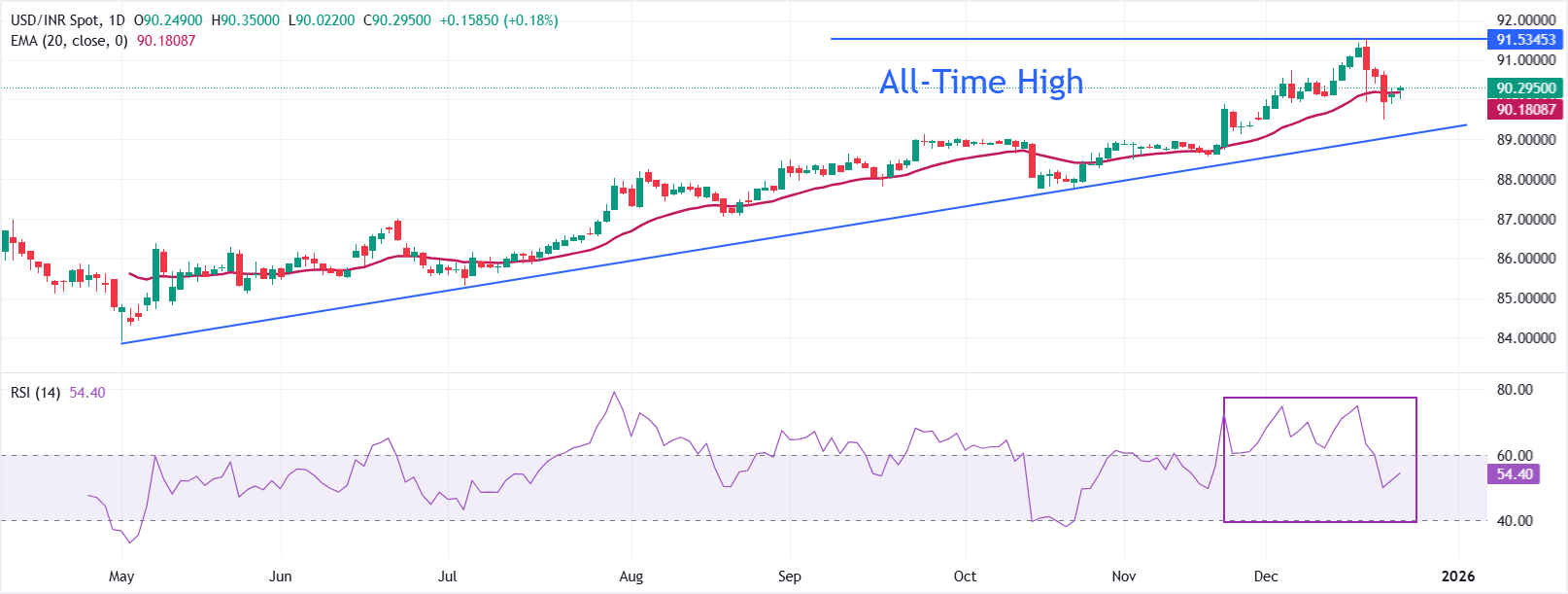
Core Viewpoint - The Indian Rupee has experienced fluctuations against the US Dollar, influenced by both domestic and external factors, including interventions by the Reserve Bank of India and foreign institutional investor activities [1][2]. Group 1: Currency Fluctuations - The USD/INR exchange rate rebounded after hitting a three-week low of 89.25, driven by Indian importers buying dollars at specific price levels [1]. - The Rupee had previously appreciated significantly, reaching a historical low near 91.55, supported by the Reserve Bank of India's interventions in the spot and non-deliverable forward markets [1]. Group 2: Foreign Investment Activity - From December 17 to 19, foreign institutional investors turned net buyers, increasing their holdings in the Indian stock market by 35.9838 billion Rupees, providing short-term support for the Rupee [1]. - This trend was not sustained, as foreign investors became net sellers on the following Monday, offloading 4.5734 billion Rupees worth of shares, indicating volatility in capital flows [1]. Group 3: External Economic Environment - The US Dollar index fell approximately 0.2%, trading around 98.00, with market attention on the upcoming preliminary GDP data for Q3, which is expected to slow from 3.8% to 3.2% annualized growth [2]. - There is a weak expectation for a rate cut by the Federal Reserve, with only a 20% probability of a 25 basis point cut in January, as indicated by the CME FedWatch tool [2]. - Despite multiple rounds of negotiations, India and the US have yet to reach a trade agreement, maintaining stable demand for dollars from Indian importers, which continues to pressure the Rupee [2]. Group 4: Domestic Economic Indicators - The Reserve Bank of India's monthly report highlighted robust economic growth in November, with strong urban and rural demand, emphasizing the collaborative effect of fiscal, monetary, and regulatory policies in maintaining economic resilience throughout the year [2]. Group 5: Technical Analysis - The USD/INR exchange rate is currently trading around 90.2950, with the 20-day moving average at 90.1809, indicating a positive short-term trend as prices remain above this average [4]. - The 14-day Relative Strength Index has retreated from the overbought zone to a neutral level of 54, suggesting a moderation in upward momentum [4]. - Key support is identified at approximately 89.1409, corresponding to an upward trend line formed from 83.8509; maintaining above the 20-day moving average limits potential pullback [4].
两大“痼疾”掣肘,2026年英国经济增长将继续疲弱
Xin Hua Cai Jing· 2025-12-23 08:05
Economic Overview - The UK economy is projected to continue its weak growth into 2026, with various macroeconomic indicators signaling a downturn [1][7] - Recent retail data shows a decline in social retail sales, with November figures down 0.1% month-on-month, following a 0.9% drop in October, indicating a pessimistic outlook among consumers [2][7] Labor Market - The unemployment rate in the UK for August to October 2025 stands at 5.1%, higher than the same period last year and the previous three months, reflecting a weakening labor market [2][3] - Employee wage growth is slowing, with a year-on-year increase of 4.6% excluding bonuses and 4.7% including bonuses for the same period, indicating further labor market challenges [2][3] Inflation and Economic Sentiment - The Consumer Price Index (CPI) dropped from 3.6% in October to 3.2% in November, exceeding market expectations, but concerns about inflationary pressures remain [3][7] - The Bank of England's Deputy Governor expressed worries about upward risks to inflation, suggesting a cautious approach to interest rate cuts [3][7] Investment Climate - Business investment remains low due to increased national insurance tax rates, which have raised costs for employers and dampened investment enthusiasm [5][7] - Predictions indicate that business investment growth will decline from 3.5% in 2025 to 2.2% in 2026, highlighting ongoing economic challenges [5][7] Consumer Confidence - Consumer confidence remains low, with a slight improvement in December's index from -19 to -17, but overall sentiment is still negative due to cost-of-living pressures and economic uncertainty [6][7] - Retail sales have seen a continuous decline over three months, reflecting persistent consumer pessimism [6][7] Economic Growth Forecasts - Various research institutions have downgraded their growth forecasts for the UK economy, with predictions of 1.4% growth in 2025 and only 1% in 2026 from KPMG [7] - The British Chambers of Commerce also forecasts a similar trend, with growth expected to be 1.2% in 2026, indicating a lack of effective government measures to stimulate the economy [7]
日本财务大臣片山皋月称必要时“可以放手”就日元采取大胆行动
Xin Lang Cai Jing· 2025-12-22 15:04
Core Viewpoint - Japan's Finance Minister, Shunichi Suzuki, indicated a willingness to take bold actions against speculative currency fluctuations that do not align with economic fundamentals, particularly in light of the yen's continued weakness following the central bank's interest rate hike [1][4]. Group 1: Currency Intervention - Suzuki issued a stern warning to speculators regarding the recent significant depreciation of the yen, emphasizing that the current trend is driven by speculation rather than fundamentals [1][4]. - The yen strengthened after Suzuki's remarks, with the USD/JPY briefly falling below the 157 level [1]. - The Finance Minister hinted at potential direct intervention in the currency market, suggesting that she has received tacit approval from Washington to act without further consultation if necessary [4][7]. Group 2: Economic Growth and Fiscal Policy - Suzuki acknowledged that the government's push for stronger economic growth under Prime Minister Fumio Kishida may temporarily worsen Japan's fiscal situation, which is a point of concern for investors [4][7]. - She mentioned that any deterioration in fiscal conditions is expected to be temporary, with anticipated increases in investment and tax revenue over the next one to two years as the government implements spending to stimulate the economy [8]. - Suzuki stated that the initial fiscal data following a shift to more aggressive fiscal policies may show deterioration, but this is not a concern, as past measures have failed to accelerate economic growth [5][8].