自主可控

Search documents
创业板首家未盈利IPO,来了!
2 1 Shi Ji Jing Ji Bao Dao· 2025-12-25 13:15
Core Viewpoint - The IPO approval of Shenzhen Dapu Microelectronics Co., Ltd. reflects the support of the ChiNext board for high-quality innovative enterprises and demonstrates the capital market's efforts to enhance inclusivity and adaptability in serving technological innovation [2][5]. Company Overview - Dapu Micro is primarily engaged in the research and sales of enterprise-level SSD products for data centers, being one of the few domestic semiconductor storage providers with full-stack self-research capabilities in "main control chips + firmware algorithms + modules" [2][3]. - The company has achieved international advanced levels in key performance indicators such as sequential and random read/write speeds and latency, and has successfully mass-produced new forms of products like SCM SSDs and computational storage SSDs [3][4]. Financial Highlights - Dapu Micro plans to issue no more than 43.62 million shares, raising approximately 1.878 billion yuan, primarily for the R&D and industrialization of next-generation main control chips and enterprise-level SSDs, as well as for a production testing base project and to supplement working capital [3]. - The company reported revenues of 557 million yuan, 519 million yuan, and 962 million yuan for the years 2022 to 2024, with a projected revenue of 2.158 billion yuan in 2025, representing a 124% year-on-year growth [4]. Industry Context - The demand for enterprise-level SSDs is accelerating due to artificial intelligence storage needs, with significant growth potential in the Chinese market, although domestic brand market share remains low [3][4]. - There is an increasing need for domestic manufacturers with self-controllable capabilities in the context of national emphasis on data security and the safety of critical information infrastructure [3][4]. Capital Market Support - The approval of Dapu Micro's IPO is seen as a significant step in enhancing the inclusivity and adaptability of the capital market, particularly in supporting high-quality innovative enterprises [5][6]. - The ChiNext board has recently activated standards for listing unprofitable innovative companies, which has received positive feedback from the market, indicating a broader trend of supporting early-stage technology firms [5][6].


创业板首家未盈利IPO,来了!
21世纪经济报道· 2025-12-25 12:26
Core Viewpoint - The successful IPO approval of Shenzhen Dapu Microelectronics Co., Ltd. marks the first unprofitable company to be listed on the ChiNext board, reflecting the board's support for high-quality innovative enterprises and the capital market's increasing inclusivity and adaptability [1][3]. Company Overview - Dapu Micro specializes in the research and sales of enterprise-level SSD products for data centers, being one of the few domestic semiconductor storage providers with full-stack self-research capabilities in "main control chips + firmware algorithms + modules" [3]. - The company has achieved international advanced levels in key performance indicators such as sequential and random read/write speeds and latency, and has successfully mass-produced new forms of products like SCM SSDs and computable storage SSDs [5]. Market Context - The demand for storage driven by artificial intelligence is accelerating the growth of the enterprise-level SSD market, with significant potential in the Chinese market, although domestic brands currently hold a low market share [5]. - The need for domestic manufacturers with self-controllable capabilities is emphasized in the context of national priorities on data security and critical information infrastructure safety [5]. Financial Highlights - Dapu Micro plans to issue up to 43.62 million shares, raising approximately 1.878 billion yuan, primarily for the development and industrialization of next-generation main control chips and enterprise-level SSDs, as well as for a mass production testing base project [5]. - The company reported revenues of 557 million yuan, 519 million yuan, and 962 million yuan for the years 2022 to 2024, with an expected revenue of 2.158 billion yuan in 2025, representing a 124% year-on-year growth [6]. Industry Implications - The increasing demand for a self-controllable ecosystem for domestic enterprise-level SSDs is crucial for supply chain security and the development of the domestic semiconductor industry [6]. - The ChiNext board's recent activation of the unprofitable listing standard supports high-quality innovative companies, facilitating their access to capital and encouraging increased R&D investment [8].

创业板又迎科技新兵 国内专注企业级SSD第一股大普微过会
Zheng Quan Ri Bao Wang· 2025-12-25 11:37
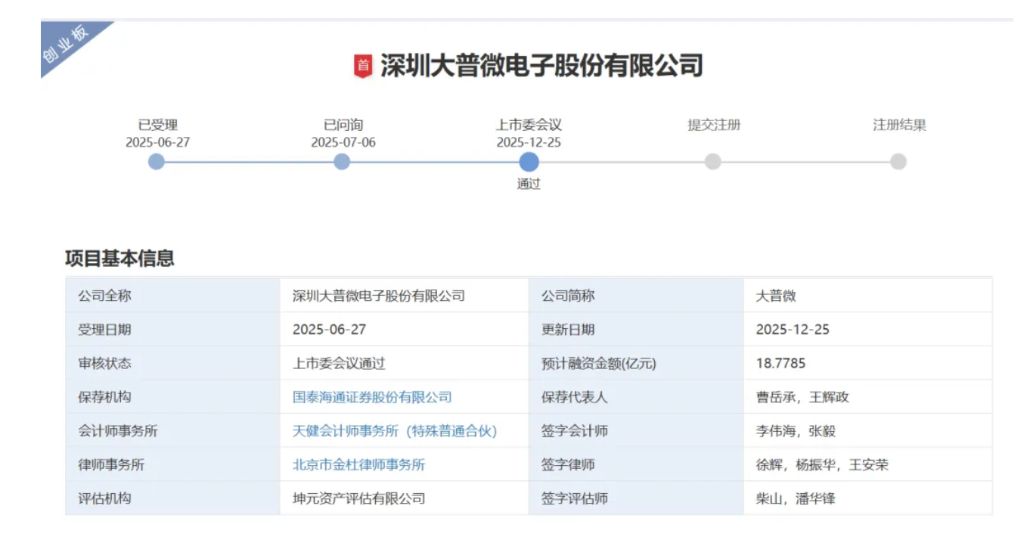
作为国家级专精特新重点"小巨人"企业,大普微技术研发实力雄厚,累计斩获发明专利156项。研发投 入数据显示,近三年大普微累计研发费用达7.37亿元,研发投入强度高达36.15%。财务层面,2022年至 2024年大普微分别实现营业收入5.57亿元、5.19亿元、9.62亿元;2025年公司营收预计攀升至21.58亿 元,同比增幅达124%,并计划于2026年实现整体扭亏为盈。 当前,人工智能存储需求加速企业级SSD(固态硬盘)市场增长,中国市场发展潜力尤为突出,但国产品 牌市占率整体仍然较低。企业级SSD作为数据中心服务器产业链中的重要环节之一,在国家高度重视自 主可控、数据安全和关键信息基础设施安全的背景下,亟需具备自主可控能力的本土厂商脱颖而出。 12月25日,深圳证券交易所(以下简称"深交所")上市委审议通过深圳大普微电子股份有限公司(以下简 称"大普微")IPO申请,标志着创业板首家未盈利企业成功过会。 在市场人士看来,此次大普微IPO过会,反映了创业板对优质创新企业的支持力度,也是资本市场提升 包容性和适应性、更好服务科技创新的生动体现。 国内专注企业级SSD第一股 据悉,大普微深度聚焦数据中心存储 ...
创业板首家!科技新兵大普微过会
证券时报· 2025-12-25 11:02
Group 1 - The core viewpoint of the article highlights that Shenzhen Dapu Microelectronics Co., Ltd. has become the first unprofitable company to successfully pass the IPO review on the ChiNext board, marking a significant milestone in the capital market's support for innovative enterprises [2][6]. - Dapu Micro focuses on data center storage scenarios and is one of the few semiconductor storage product providers in China with comprehensive self-research capabilities in "main control chips + firmware algorithms + modules," achieving mass production [4][5]. - The company has achieved significant revenue growth, with projected revenues of CNY 21.58 billion in 2025, representing a 124% year-on-year increase, and aims to turn profitable by 2026 [4]. Group 2 - The demand for a domestically controlled enterprise-level SSD ecosystem is increasing, which is crucial for supply chain security and the development of the domestic semiconductor industry [5]. - The ChiNext board has enhanced its inclusivity and adaptability, with nearly 90% of its listed companies being high-tech enterprises, reflecting the capital market's commitment to supporting innovative growth [6][7]. - The introduction of the unprofitable listing standard has been positively received, allowing for better financing channels for innovative companies, which is essential for overcoming early-stage funding bottlenecks [7].

ETF盘中资讯|自主可控逻辑强化!美国暂不对中国芯片加征关税,科创人工智能ETF(589520)溢价频现,买盘资金强势!
Jin Rong Jie· 2025-12-25 03:16
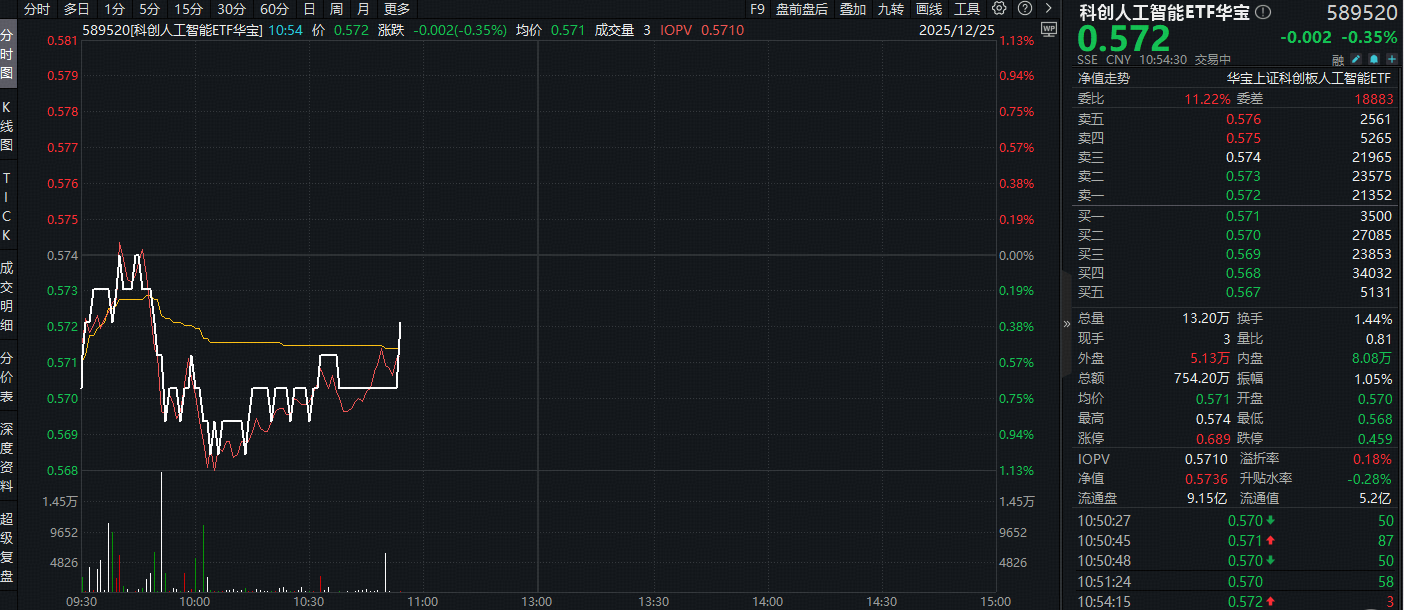
Group 1 - The market is currently consolidating, with the domestic AI industry chain-focused ETF (589520) experiencing a slight decline of 0.35%, indicating strong buying interest as evidenced by frequent premiums in the market [1] - The U.S. government has decided to end the previous administration's investigation into Chinese chips, delaying additional tariffs for at least 18 months, which is seen as a signal for stabilizing U.S.-China relations [2] - Domestic AI industry chain is gaining attention due to the urgency of localizing the semiconductor supply chain, as the U.S. has imposed comprehensive controls on advanced logic and memory industries [3] Group 2 - East China Securities recommends focusing on the domestic AI industry chain, highlighting the low global supply share of self-controlled enterprises in various sectors, indicating significant potential for domestic growth [3] - The rise of AI applications is driving the need for high-end chips, which may accelerate technological upgrades among domestic chip manufacturers [3] - The Sci-Tech Innovation Artificial Intelligence ETF (589520) and its linked funds are strategically positioned in the domestic AI industry chain, with over 70% of the top ten holdings concentrated in the semiconductor sector, indicating a high level of aggressiveness [4] Group 3 - In terms of stock performance, Zhongke Xingtou led with a rise of over 3%, while other companies like Xinghuan Technology and Aobi Zhongguang also saw gains, while companies like Chip Origin and Daotong Technology experienced declines [7]
自主可控逻辑强化!美国暂不对中国芯片加征关税,科创人工智能ETF(589520)溢价频现,买盘资金强势!
Xin Lang Cai Jing· 2025-12-25 03:07
中信建投指出,AI端侧应用兴起,高端芯片亟需国产。科技摩擦加剧背景下,有望推动我国芯片厂商 技术升级,加速AI芯片等高尖端科技领域突破。AI芯片领域国产替代有助于国内企业把握产业发展机 遇,实现产业升级。 【国产替代之光,科创自立自强】 12月25日早盘,市场盘整,重点布局国产AI产业链的科创人工智能ETF(589520)随市回调,场内价格 现跌0.35%,值得关注的是,该ETF场内溢价频现,显示买盘资金更为强势,或有资金逢跌进场布局! 成份股方面,中科星图领涨超3%,星环科技涨逾2%,奥比中光、云天励飞、亚信安全等个股跟涨。另 一方面,芯原股份跌近6%,道通科技、海天瑞声跌逾1%,跌幅居前,拖累指数表现。 | 序号 名称 | | 涨跌幅 ▼ | 两日图 | 申万一级行业 | 申万二级行业 | 申万三级行业 | 总市值 | 成交額 | | --- | --- | --- | --- | --- | --- | --- | --- | --- | | 1 | 中科星图 | 3.92% | STATUTE AND THE FORM | 计算机 | 日服务Ⅱ | IT服务Ⅲ | 407亿 | 8.21亿 | | 2 ...
20cm速递|科创芯片ETF国泰(589100)涨超1.2%,行业数据凸显半导体需求扩张
Mei Ri Jing Ji Xin Wen· 2025-12-24 07:34
Core Viewpoint - Micron's Q1 FY2026 performance exceeded expectations, driven by surging storage demand amid the AI wave, with quarterly revenue reaching $13.64 billion, a significant year-on-year increase of 57% [1] Group 1: Company Performance - Micron's revenue for the next fiscal quarter is projected to rise further to approximately $18.7 billion (±4%) [1] - The company maintains a leading position and growth momentum in the high-end storage market [1] Group 2: Industry Trends - The electronic industry is experiencing a sustained recovery, with effective supply clearance and rising storage chip prices [1] - The demand for high bandwidth memory (HBM) is expected to grow significantly, with the overall effective market projected to expand at a compound annual growth rate of about 40%, from approximately $35 billion in 2025 to around $100 billion by 2028 [1] - AI investments continue to exceed expectations, contributing to the rising prices of storage chips [1] Group 3: ETF and Market Indicators - The Guotai Science and Technology Chip ETF (589100) tracks the Science and Technology Chip Index (000685), which has a daily price fluctuation limit of 20% [1] - The index selects no more than 50 large-cap stocks from the sci-tech board, covering the entire semiconductor industry chain, including materials, equipment, design, manufacturing, and packaging/testing [1] - This index serves as a representative indicator of the performance of listed companies in the core areas of the domestic chip industry [1]
科创50ETF(588000)冲击4连阳
Mei Ri Jing Ji Xin Wen· 2025-12-24 07:23
展望2026年,AI算力、自主可控有望进入景气兑现期,将为科创板基本面提供一定支撑,在政策支 持"硬科技"导向明确的背景下,科创板有望在AI浪潮下持续受益。 截至14点39分,A股三大指数全线上涨,上证指数涨0.51%,深证成指涨0.79%,创业板指涨0.70%。科 创50ETF(588000)上涨0.85%,冲击日线4连阳,今日最新报价1.422元,盘中成交额达26.25亿元,换 手率3.49%。成分股方面涨跌互现,天岳先进领涨6.62%,恒玄科技上涨6.28%,中芯国际上涨2.74%, 澜起科技上涨0.64%,海光信息上涨0.22%;华海清科领跌2.26%,拓荆科技下跌2.25%,百利天恒下跌 2.19%,惠泰医疗下跌2.03%,金山办公下跌0.36%。 资金流入方面,科创50ETF近10个交易日内,有6个交易日获资金净流入,合计净流入10.15亿元,日均 净流入达1.02亿元。 (文章来源:每日经济新闻) ...
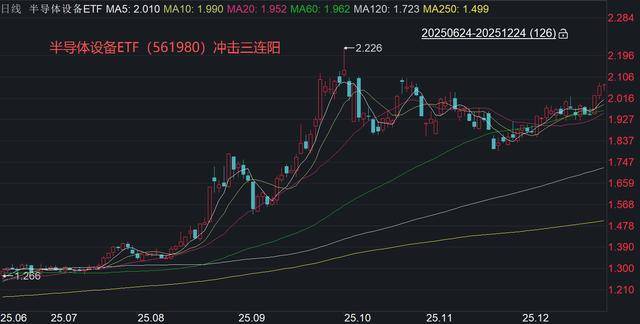
存储与先进逻辑需求双轮驱动,半导体设备ETF(561980)午后翻红冲击三连阳
Sou Hu Cai Jing· 2025-12-24 07:19
Core Viewpoint - The semiconductor equipment industry continues to show strong performance, with significant gains in related stocks and ETFs, reflecting a robust market environment for semiconductor companies [1][3]. Group 1: Market Performance - The semiconductor equipment ETF (561980) has seen a year-to-date increase of 64.76%, outperforming other major semiconductor indices [3]. - Key stocks such as Huahai Chengke and Tianyue Advanced have experienced notable price increases, with Huahai Chengke rising over 12% and Tianyue Advanced increasing over 7% [1]. Group 2: Market Capitalization Insights - As of mid-December 2025, 35 of the top 100 semiconductor companies globally are from Greater China, indicating a significant presence in the market [3]. - The market capitalization of semiconductor companies is subject to fluctuations, reflecting a complex interplay of industry variables rather than just short-term market sentiment [3]. Group 3: Valuation Changes - The valuation framework for semiconductor companies is evolving, particularly in the storage chip sector, where demand for HBM is surging, and in the GPU sector with companies like Moer Thread and Muxi entering the market [4]. - The shift from price-to-earnings (PE) to price-to-sales (PS) ratios indicates a market reassessment of growth potential and technological barriers [4]. Group 4: Future Growth Projections - The global semiconductor manufacturing equipment sales are projected to reach $133 billion in 2025, marking a 13.7% year-on-year increase, with continued growth expected in the following years [5]. - The semiconductor equipment ETF (561980) has a composition where nearly 60% is focused on equipment, with over 90% of the index comprising semiconductor equipment, materials, and integrated circuit design sectors [5].

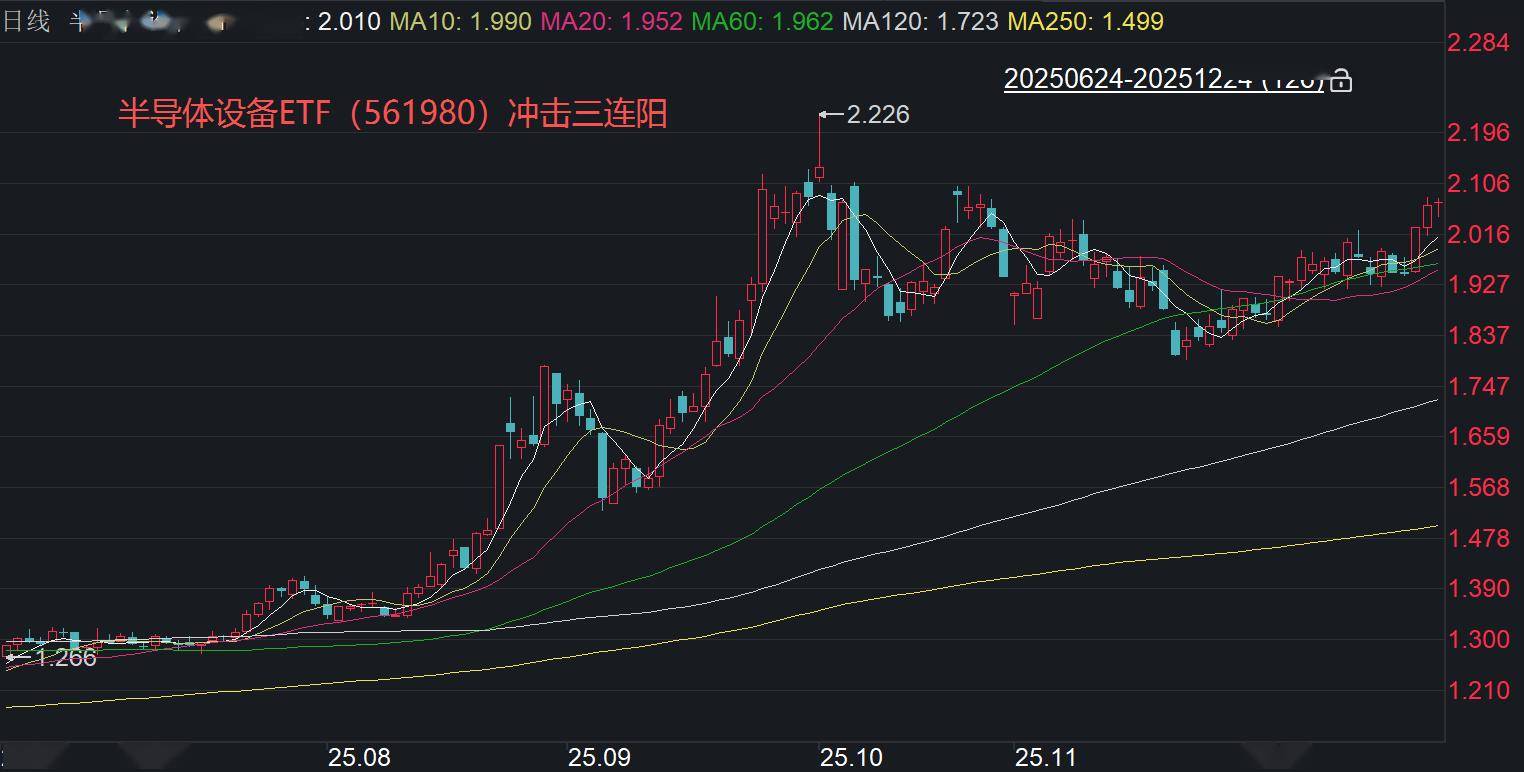
GPU新势力重塑全球半导体格局,半导体设备ETF(561980)午后翻红冲击三连阳
Sou Hu Cai Jing· 2025-12-24 07:19
Core Insights - The semiconductor equipment industry continues to show strong performance, with significant gains in related stocks and ETFs [1][3] Group 1: Market Performance - The semiconductor equipment ETF (561980) has seen a year-to-date increase of 64.76%, outperforming other major semiconductor indices [3] - Key stocks such as Huahai Chengke and Tianyue Advanced have risen by over 12% and 7% respectively, indicating robust market activity [1] Group 2: Market Capitalization - As of mid-December 2025, 35 of the top 100 semiconductor companies globally are from Greater China, accounting for approximately 35% of the total market capitalization [3] - The market capitalization of semiconductor companies is subject to fluctuations, reflecting a complex interplay of industry variables rather than just short-term market sentiment [3] Group 3: Industry Trends - The valuation system for semiconductor companies is undergoing significant changes due to the explosive growth in downstream markets like AI and automotive electronics [4] - The demand for high-bandwidth memory (HBM) is surging, and domestic GPU companies are accelerating capital operations through A+H share listings [4] - The global semiconductor manufacturing equipment sales are projected to reach $133 billion in 2025, marking a 13.7% year-on-year increase, with continued growth expected in the following years [4] Group 4: Investment Opportunities - The semiconductor equipment ETF (561980) focuses on the upstream sectors of the semiconductor industry, with nearly 60% of its index comprising equipment [4] - The top ten companies in this ETF, including Zhongwei Company and North Huachuang, represent nearly 80% concentration, making it an ideal tool for investing in a self-controlled semiconductor ecosystem [4]