房地产市场

Search documents
CMF展望2026年经济 多维度向好可期
Sou Hu Cai Jing· 2026-01-11 09:33
Economic Outlook for 2026 - The report anticipates a "gradual warming" of the Chinese economy in 2026, with GDP growth expected to rebound seasonally, and actual GDP growth projected to be in the range of 4.5% to 5% for the year, approaching the upper limit [1] - Nominal GDP growth is expected to show a more significant rebound, with the macro and micro "temperature difference" gradually disappearing [1] Price Trends - Consumer Price Index (CPI) is expected to gradually rise to a moderate range, while the decline in Producer Price Index (PPI) is expected to narrow, alleviating negative effects related to prices [1] Consumption Sector - The consumption market is projected to operate steadily in 2026, with a recovery in dining consumption, emergence of new consumption formats driven by AI and robotics, and growth in service consumption being the main drivers of consumption growth, with total retail sales of consumer goods expected to return to a growth rate of around 4% [2] Investment Sector - Investment is expected to stabilize, with infrastructure investment recovering first and a significant reduction in the decline of real estate investment; a notable structural optimization combining "investment in physical assets" and "investment in people" (such as education and healthcare) is anticipated [2] Foreign Trade and Employment - Foreign trade is expected to remain at a high level, with a moderate appreciation of the RMB exchange rate, overall employment stability, synchronized growth in residents' income, a "soft landing" in the real estate market, and an estimated annual stock market increase of about 10% [2] Expert Insights - Experts emphasize the importance of stabilizing prices as a core policy for 2026, aiming to bring CPI closer to a target of 2%, while controlling real estate supply and stabilizing housing prices to avoid negative impacts on consumption and investment [2] - The real estate market is currently experiencing a "decline in both volume and price," and further price adjustments are needed to convert potential demand into effective demand [3] - The long-term trend of RMB appreciation is seen as a necessary step for China to transition to a high-income country, with policies needing to accommodate this trend [3] - Balancing "technological self-reliance" with "improving livelihoods" is crucial, focusing on breakthroughs in AI and advanced manufacturing while enhancing social security for vulnerable groups [3]
海外高频 | 海外风险偏好集体回升,地缘冲击下金油大涨 (申万宏观·赵伟团队)
申万宏源宏观· 2026-01-11 03:33
Group 1 - The core viewpoint of the article highlights a collective rebound in overseas risk appetite, with geopolitical tensions leading to significant increases in gold and oil prices [2][5]. - Major developed market indices saw gains, with the Nikkei 225, DAX, and Dow Jones Industrial Average rising by 3.2%, 2.9%, and 2.3% respectively, while the Hang Seng Index fell by 0.4% [5]. - Emerging market indices also experienced growth, with the Korean Composite Index, Istanbul Stock Exchange National 30 Index, and Ho Chi Minh Index increasing by 6.4%, 5.9%, and 4.7% respectively [5]. Group 2 - The S&P 500 and Nasdaq indices rose by 1.6% and 1.9% respectively, while the WTI crude oil price increased by 3.1% to $59.1 per barrel, and COMEX gold prices rose by 3.6% to $4,473.0 per ounce [2][32]. - The U.S. Treasury General Account (TGA) balance decreased to $783.6 billion, and the net issuance of U.S. debt fell, with the 15-day rolling net issuance amount dropping to -$27.03 billion [47]. - The U.S. fiscal deficit for the calendar year 2025 reached $1.82 trillion, lower than the $1.91 trillion recorded in the same period of 2024 [50]. Group 3 - The U.S. unemployment rate fell to 4.4% in December, despite non-farm payrolls adding only 50,000 jobs, which was below market expectations [64]. - The ISM Manufacturing PMI for December was reported at 47.9, marking a third consecutive month of decline, primarily driven by inventory destocking [66]. - The article notes that the labor market is experiencing a "low-growth balance," with potential for continued economic resilience driven by consumer spending and fiscal stimulus [64].



中国房地产指数系统百城价格指数报告(2025年12月)
中指研究院· 2026-01-11 01:36
Investment Rating - The report does not explicitly provide an investment rating for the real estate industry. Core Insights - The average price of new residential properties in 100 cities in December was 17,084 RMB/square meter, with a month-on-month increase of 0.28% and a year-on-year increase of 2.58% [3][8] - The average price of second-hand residential properties in the same cities was 13,016 RMB/square meter, showing a month-on-month decrease of 0.97% and a year-on-year decrease of 8.36% [3][12] - The average rental price in 50 cities was 34.16 RMB/square meter/month, reflecting a month-on-month decrease of 0.60% and a year-on-year decrease of 3.62% [3][17] Market Performance - In December, new residential prices saw structural increases in cities like Shenzhen, Beijing, and Shanghai, while the overall market remains in a bottoming phase [5][6] - The second-hand housing market continues to experience high listing volumes, with significant month-on-month price declines [5] - The rental market is in a traditional off-season, with low demand and continued price declines in rental properties [5] Policy Developments - The Central Economic Work Conference emphasized stabilizing the real estate market and implementing city-specific policies to control inventory and improve supply [4] - Recent policy changes include reducing the value-added tax on personal housing sales and easing purchase restrictions for non-local residents and families with multiple children in cities like Beijing and Shanghai [4] - The government aims to accelerate the construction of affordable housing and improve the housing provident fund system [4][6] Price Index Analysis - In December, 26 cities experienced an increase in new residential prices, while 68 cities saw declines [9] - The average price of new residential properties in first-tier cities increased by 0.81% month-on-month, while second-tier cities saw a 0.16% increase [8] - For second-hand properties, 100 cities reported a uniform price decline, with 27 cities experiencing declines exceeding 1% [13] Future Outlook - The year 2026 is expected to be crucial for stabilizing the real estate market, with policies likely to be implemented to optimize restrictions in core cities and promote the acquisition of existing properties [6] - The report forecasts a 6.2% year-on-year decrease in new residential sales area in 2026, with price performance expected to remain differentiated [6]
PVC周报:冠通期货研究报告-20260105
Guan Tong Qi Huo· 2026-01-05 11:50
1. Report's Industry Investment Rating - No information provided 2. Core View of the Report - The report predicts that PVC will fluctuate. The current supply - side PVC start - up rate has increased, but the downstream start - up rate has decreased. The export situation is not good, social inventory is high, and the real estate market is still in the adjustment stage. Although the market sentiment of bulk commodities has been boosted, the overall situation is complex, leading to the expected fluctuating operation of PVC [3][4] 3. Summary According to Relevant Catalogs 3.1 Market Analysis - The calcium carbide price in the upstream northwest region is stable. The supply - side PVC start - up rate has increased by 1.40 percentage points to 78.63%, reaching a neutral level in recent years. In winter, the downstream start - up rate of PVC has decreased by 0.58 percentage points, and the orders for downstream products are not good. Last week, export orders decreased slightly. The price in the Indian market is low, and the demand in India is limited. The CFR China price of Formosa Plastics in Taiwan in January remained flat compared with the previous period, while the CFR India and CFR Southeast Asia prices decreased by $20/ton and $30/ton respectively. Social inventory continued to increase last week and is still at a high level, with relatively large inventory pressure [3] - From January to November 2025, the real estate market was still in the adjustment stage. The year - on - year decline in investment, new construction, construction, and completion areas was still large, and the year - on - year growth rates of investment, sales, new construction, and completion further declined. The weekly transaction area of commercial housing in 30 large and medium - sized cities continued to rebound but remained at the lowest level in recent years. The real estate market needs more time to improve. A new production capacity of 300,000 tons/year from Jiaxing Jiahua has recently started trial production [3] - The anti - involution sentiment has further increased. In December, China's manufacturing PMI, non - manufacturing business activity index, and comprehensive PMI output index all rose to the expansion range, which boosted the market sentiment of bulk commodities. The comprehensive gross profit of chlor - alkali decreased, and the start - up expectations of some production enterprises declined, but the current output decline is limited. The futures warehouse receipts are still at a high level, the calcium carbide price is stable, the price in the Indian market is low, and the demand in India is limited. January is the traditional off - season for domestic PVC demand. Social inventory continues to increase. After the spot price rises, the market trading is light [3] 3.2 PVC Basis - The current 05 basis is - 215 yuan/ton, and the basis is at a relatively low level [12] 3.3 PVC Start - up Rate - The start - up rate of PVC has increased. After the devices of Jiangsu Xinpu and Ningbo Hanwha resumed production, the PVC start - up rate increased by 1.40 percentage points to 78.63%, reaching a neutral level in recent years [17] 3.4 Real Estate Data - In terms of demand, the real estate market is still in the adjustment stage. The year - on - year decline in investment, new construction, and completion areas is still large, and the year - on - year growth rates of investment, sales, new construction, construction, and completion further declined. From January to November 2025, the national real estate development investment was 785.91 billion yuan, a year - on - year decrease of 15.9%. From January to November, the commercial housing sales area was 787.02 million square meters, a year - on - year decrease of 7.8%; among them, the residential sales area decreased by 8.1%. The commercial housing sales volume was 751.30 billion yuan, a decrease of 11.1%, and the residential sales volume decreased by 11.2%. From January to November, the housing new construction area was 534.57 million square meters, a year - on - year decrease of 20.5%; among them, the residential new construction area was 391.89 million square meters, a decrease of 19.9%. From January to November, the housing construction area of real estate development enterprises was 6.56066 billion square meters, a year - on - year decrease of 9.6%. From January to November, the housing completion area was 394.54 million square meters, a year - on - year decrease of 18.0%; among them, the residential completion area was 281.05 million square meters, a year - on - year decrease of 20.1%. The overall real estate market needs more time to improve [23] - As of the week of January 4, the commercial housing transaction area in 30 large and medium - sized cities decreased by 26.09% week - on - week and was at a relatively low level in recent years. Attention should be paid to whether the real estate favorable policies can boost commercial housing sales [23] 3.5 PVC Inventory - As of the week of December 31, the PVC social inventory increased by 1.45% week - on - week to 1.0766 million tons, a year - on - year increase of 36.24%. Social inventory continued to increase and is still at a high level (Longzhong increased the social storage capacity in East China and South China from 21 to 41) [24][25]
26年第1周成交涨跌互现,跨年市场稳健有利开局
Haitong Securities International· 2026-01-05 05:18
Investment Rating - The report indicates a stable market outlook for the real estate industry in 2026, with expectations of continued policy support [1][13]. Core Insights - Last week, real estate transactions in major cities showed mixed results, with policies remaining stable, which is expected to support a steady market in 2026 [1][13]. - New home sales in 30 major cities reached 3.15 million square meters in the first week of 2026, reflecting a 5.2% increase from the previous week but a 20.6% decrease year-on-year [14]. - First-tier cities saw a significant increase in sales, with 710,000 square meters sold, up 31.0% week-on-week but down 24% year-on-year [14]. - Second-tier cities sold 1.98 million square meters, up 2.83% from the previous week, down 15% year-on-year [14]. - Third-tier cities experienced a decline in sales, with 470,000 square meters sold, down 12.3% week-on-week and down 34.5% year-on-year [14]. - Cumulative sales in 30 cities as of January 1, 2026, were 90,000 square meters, down 61.8% from December 2025 [14]. - Second-hand home sales in 24 cities fell to 2.04 million square meters, down 7.50% from the previous week and down 14.5% year-on-year [15]. - The land transaction growth in 100 cities continued to decline, with land supply at 10.28 million square meters and transactions at 33.30 million square meters, resulting in a supply-to-sales ratio of 0.31 [16]. - The cumulative land supply in 100 cities was down 27% year-on-year, with cumulative transaction growth down 24.8% year-on-year [16]. - The inventory clearance cycle in 35 cities rose to 24.54 months, indicating a longer time required to clear existing inventory [17].
房地产:26年第1周成交涨跌互现,跨年市场稳健有利开局
GUOTAI HAITONG SECURITIES· 2026-01-04 11:32
Investment Rating - The industry investment rating is "Increase" [2][18] Core Insights - The report indicates that the real estate market has shown mixed results in transaction volumes, with a stable and fluctuating trend expected to continue due to ongoing accommodative policies [2][3] - The report anticipates that the policy environment will remain supportive, which will help stabilize the market in 2026 [3] Summary by Sections Transaction Data - In the first week of 2026, the new housing transaction area in 30 major cities was 3.15 million square meters, a week-on-week increase of 5.2% but a year-on-year decrease of 20.6% [3] - First-tier cities saw a sales area of 710,000 square meters, up 31.0% week-on-week but down 24% year-on-year [3] - Second-tier cities recorded a sales area of 1.98 million square meters, a week-on-week increase of 2.83% and a year-on-year decrease of 15% [3] - Third-tier cities had a sales area of 470,000 square meters, down 12.3% week-on-week and down 34.5% year-on-year [3] Cumulative Transaction Data - As of January 1, 2026, the cumulative transaction area in 30 cities was 90,000 square meters, down 61.8% year-on-year [3] - Cumulative transaction areas for first-tier, second-tier, and third-tier cities were 30,000 square meters, 40,000 square meters, and 10,000 square meters respectively, with significant year-on-year declines [3] Land Transaction Data - The land supply area was 1.028 million square meters, with a transaction area of 3.33 million square meters, resulting in a supply-to-sales ratio of 0.31 [3] - The total land transfer amount was 121.8 billion yuan, with a year-on-year decrease of 15.9% [3] Inventory and Clearance Cycle - The inventory clearance cycle in 35 cities increased to 24.54 months, up 6.64% month-on-month and down 12.09% year-on-year [3]
深入推进改革,提振经济前景
Shi Jie Yin Hang· 2026-01-03 08:40
Economic Performance - In Q3 2025, China's GDP grew by 1.1% quarter-on-quarter, up from 1.0% in Q2, resulting in a year-to-date growth rate of 5.2%[19] - Final consumption contributed 2.7 percentage points to GDP growth in Q3, accounting for 56.7% of the overall growth[29] - Retail sales growth averaged only 0.06% month-on-month from July to October, down from 0.2% in Q2[19] Investment and Consumption - Investment contribution to GDP growth fell from 1.3 percentage points (24.7% of growth) in Q2 to 0.9 percentage points (18.9% of growth) in Q3[29] - Real estate investment continued to decline, with manufacturing and infrastructure investments also slowing due to profit pressures and fiscal constraints[31] Labor Market and Consumer Behavior - The urban unemployment rate remained stable around 5%, but youth unemployment reached 17.7% in September, influenced by a surge in university graduates[30] - Structural factors, including social security gaps and income inequality, have led to high precautionary savings among residents, with savings at 31% of disposable income in 2023[24] Fiscal and Monetary Policy - Broad fiscal deficit increased from 5.3% of GDP in the previous year to 6.1% in 2025, driven by weak land sales revenue and rising debt[60] - Despite a loose monetary policy, private sector credit demand remains weak, with non-financial sector credit growing by only 8.7% year-on-year[62] Trade and External Factors - China's current account surplus rose to 3.5% of GDP in the first three quarters of 2025, up from 2.2% in 2024, despite capital outflows[44] - Exports to developing countries increased, with a 4.7% year-on-year growth in goods exports from July to October, offsetting a 27% decline in exports to the US[41]
【白银etf持仓量】12月30日白银ETF较上一交易日上涨149.46吨
Jin Tou Wang· 2025-12-31 09:00
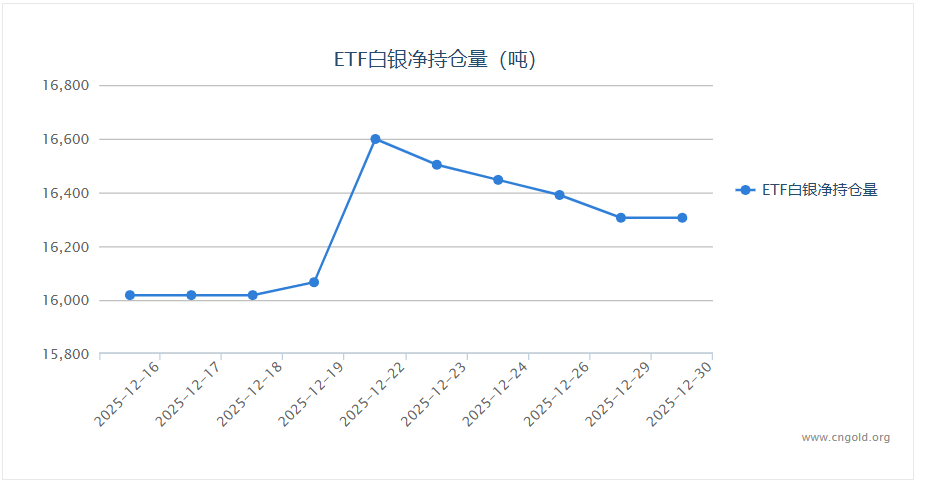
Group 1 - The iShares Silver Trust, the world's largest silver ETF, reported a holding of 16,455.42 tons of silver as of December 30, an increase of 149.46 tons from the previous trading day [1] - On December 30, the spot silver price closed at $76.18 per ounce, up 5.58%, with an intraday high of $78.05 and a low of $71.12 [1] Group 2 - U.S. home prices showed a year-over-year increase of 1.7% in October, marking the lowest annual growth rate in over 13 years, indicating a gradual recovery in housing affordability [3] - The Federal Housing Finance Agency (FHFA) revised the September home price increase to 1.8%, which is the lowest annual price growth since March 2012 [3] - The latest Federal Reserve meeting minutes revealed that the FOMC agreed to lower interest rates in December, but there was extensive debate regarding the risks facing the U.S. economy [3]
2026年宏观经济展望:着力扩大内需,宏观政策延续稳增长取向
Dong Fang Jin Cheng· 2025-12-29 23:30
Economic Outlook - The actual GDP growth rate for China in 2026 is projected to be around 4.8%, maintaining a medium-high growth level[2] - Global GDP growth is expected to slow to 3.1% in 2026, down from 3.2% in 2025[4] - China's fixed asset investment growth is forecasted to turn positive at 2.5% in 2026, recovering from a negative growth of -3.0% in 2025[4] Trade and Export Impact - China's export growth is anticipated to decline significantly from approximately 5.0% in 2025 to around 1.0% in 2026 due to increased U.S. tariffs[15] - The average U.S. import tariff rate is projected to rise to 19.5% in 2026, impacting global trade dynamics[8] Policy Measures - The target fiscal deficit rate for 2026 is set to remain at 4.0%, with an increase in new special bond issuance expected to reach 5.0 trillion yuan[41] - A reduction in interest rates by 0.3 percentage points is anticipated in 2026, with a focus on maintaining liquidity in the market[52] Consumer and Investment Trends - Consumer retail sales growth is expected to accelerate to 5.0%-6.0% in 2026, up from 3.9% in 2025, driven by enhanced consumption policies[65] - Infrastructure investment growth is projected to increase to 5.0% in 2026, significantly higher than the previous year's performance[71] Inflation and Price Levels - The Consumer Price Index (CPI) is expected to rise to 0.4% in 2026, indicating a slight improvement in the low inflation environment[76] - The Producer Price Index (PPI) is forecasted to decline by -1.8% in 2026, reflecting ongoing price pressures in the economy[76]
LPR连续7个月不变,明年怎么安排?
Jing Ji Wang· 2025-12-26 02:04
Core Viewpoint - The Loan Prime Rate (LPR) has remained unchanged for seven consecutive months, reflecting a stable macroeconomic environment and reduced reliance on short-term stimulus policies [3][4]. Group 1: Economic Environment - The current macroeconomic environment shows strong growth resilience, with exports performing better than expected and new productivity sectors developing rapidly, indicating that the need for aggressive counter-cyclical adjustments has diminished [3]. - The central economic work conference has emphasized the flexible and efficient use of various policy tools, suggesting that monetary policy will actively support growth targets [4][8]. Group 2: Future LPR Adjustments - Although the LPR has been stable, there is still potential for future adjustments, particularly in the first quarter of 2026, as the central bank may implement new rounds of reserve requirement ratio (RRR) cuts or interest rate reductions [4][6]. - The timing for potential LPR cuts is likely around the Chinese New Year, a critical period for policy measures aimed at stabilizing expectations and promoting consumption [6]. Group 3: Rationale for Potential LPR Cuts - Four key reasons support the possibility of LPR cuts: 1. Clear national policy direction provides operational space for interest rate reductions [8]. 2. The need to maintain a healthy yield curve due to significant government bond issuance this year [8]. 3. The LPR pricing mechanism has room for transmission, as liquidity has been injected into the banking system, lowering funding costs [8]. 4. Balancing market supply and demand with risk pricing is essential, as adjustments must consider both promoting lower financing costs and maintaining financial system stability [8]. Group 4: Benefits of LPR Cuts - A reduction in LPR would lower costs for homebuyers, boosting confidence in the housing market and stabilizing expectations [9][12]. - It would also decrease financing costs for the real economy, particularly benefiting small and medium-sized enterprises and sectors related to new productivity [12]. - Overall, LPR cuts could help stabilize and boost the macroeconomy by increasing disposable income and enhancing consumption willingness, thereby driving total demand [12].