
流动性

Search documents
下周供给冲击再度到来,关注国债买入对冲规模
Xinda Securities· 2025-11-09 09:35
Group 1: Report's Industry Investment Rating - Not mentioned in the provided content Group 2: Report's Core View - The central bank's 7D OMO net withdrawal this week reached the highest level since February 2024, but the liquidity remained generally loose at the beginning of the month. After the large - scale maturity of the 3M repurchase on Friday, the liquidity tightened marginally, but the DR001 remained stable at slightly above 1.3%. The central bank may increase hedging after such a tightening, and the liquidity is expected to return to stability [3][7]. - The government bond net payment scale will rise to a new high since mid - July next week. The central bank's possible increase in the scale of buying treasury bonds in the open market to replace repurchase operations to supplement medium - and long - term liquidity is worthy of attention [3][18]. - It is estimated that the government bond issuance scale in November will be about 1.84 trillion yuan, with a net financing of about 1.15 trillion yuan, an increase of about 620 billion yuan compared with October. The government bond issuance in December is expected to be about 2.37 trillion yuan, with a net financing of about 77 billion yuan [3][30]. Group 3: Summary by Related Catalogs I. Money Market 1.1 This Week's Liquidity Review - The central bank's 7D OMO net withdrawal was 1.5722 trillion yuan this week, reaching the highest level since February 2024. The 3M repurchase operation on Wednesday offset the maturity on Friday. The liquidity remained loose at the beginning of the month and tightened marginally on Friday after the 3M repurchase maturity, but the DR001 remained stable at slightly above 1.3% [3][7]. - After the cross - month period, the repurchase market activity increased. The average daily trading volume of pledged repurchase rose by 1.27 trillion yuan to 7.97 trillion yuan compared with last week. The overall scale of pledged repurchase returned above 12 trillion yuan but decreased significantly on Friday [3][14]. - The new - caliber liquidity gap index fluctuated downward to - 838.3 billion on Thursday and rebounded to - 488.7 billion on Friday, still lower than last Friday. The weekly excess reserve ratio dropped to 0.9%, a new low since mid - September [3][14][18]. 1.2 Next Week's Liquidity Outlook - The treasury bond payment scale next week is expected to be 315.9 billion yuan, and the local bond issuance scale in 12 regions is 285.1 billion yuan, with an actual payment scale of 230.5 billion yuan. The government bond net payment scale will rise from 36.8 billion yuan this week to 424.2 billion yuan, a new high since mid - July [20][22]. - The 7 - day reverse repurchase maturity scale next week will decrease from 2.07 trillion yuan to 495.8 billion yuan. The new stock issuance of Nante Technology on the Beijing Stock Exchange may bring some disturbances to the exchange liquidity price from Tuesday to Wednesday. The central bank is expected to increase liquidity injection to stabilize the market [3][38]. II. Inter - bank Certificates of Deposit - The 1Y Shibor rate dropped 1.7BP to 1.65% this week, and the secondary rate of 1 - year AAA - rated inter - bank certificates of deposit rose 0.2BP to 1.63% [3][39]. - The net financing scale of inter - bank certificates of deposit rose by 1.01 billion yuan to 163.8 billion yuan this week. The net financing scales of state - owned banks, joint - stock banks, city commercial banks, and rural commercial banks were 23.9 billion yuan, - 57.5 billion yuan, 170.6 billion yuan, and 33.1 billion yuan respectively. The issuance proportion of 1Y certificates of deposit decreased to 24%, and the 6M certificates of deposit had the highest issuance proportion at 38% [3][42]. - The issuance success rates of state - owned banks and joint - stock banks decreased this week, while those of city commercial banks and rural commercial banks increased. The issuance spread between city commercial banks and joint - stock banks for 1Y certificates of deposit widened [43]. - The supply - demand relative strength index of certificates of deposit first decreased and then increased this week. The 3M supply - demand index rose, while the other maturity varieties decreased slightly [54]. III. Bill Market - The bill rates rebounded significantly this week but remained at a low level overall. The 3M and 6M national bill rates rose 36BP and 41BP respectively compared with October 31, reaching 0.37% and 0.61% [59]. IV. Bond Trading Sentiment Tracking - The bond market adjusted slightly this week, and the credit spread narrowed slightly. The willingness of large banks to increase bond holdings weakened, while the willingness of trading - type institutions to increase bond holdings decreased significantly, and the willingness of allocation - type institutions to increase bond holdings increased [62].
流动性和机构行为跟踪:存单期限拉长,市场杠杆抬升
GOLDEN SUN SECURITIES· 2025-11-09 07:03
Report Industry Investment Rating - No information provided in the report. Core Viewpoints - This week, the funds remained stable with minor fluctuations. The central bank conducted precise adjustments to liquidity through "short - term withdrawal and long - term injection." The bond market entered an oscillation period again, and the yields of bonds and certificates of deposit (CDs) showed slight upward trends. The net financing of CDs decreased slightly, and the average issuance term increased. Next week, the net issuance and net payment of government bonds are expected to increase, and the inter - bank leverage ratio rose slightly this week [1][2][3]. Summary by Directory 1. Funds - **Fund prices**: This week, R001 closed at 1.39% (previous value: 1.41%), DR001 at 1.33% (previous value: 1.32%), R007 at 1.47% (previous value: 1.49%), and DR007 at 1.41% (previous value: 1.46%). The spread between DR007 and the 7 - day OMO was 1.30bp. The 6M national and share - holding bank acceptance bill transfer and discount rate was 0.61% (previous value: 0.20%) [1]. - **Central bank operations**: This week, the central bank's reverse repurchase issuance was 495.8 billion yuan, with 2,068 billion yuan in reverse repurchase maturities, resulting in a net reverse repurchase withdrawal of 1,572.2 billion yuan. On November 5th, a 700 - billion - yuan 3 - month term buy - out reverse repurchase operation was carried out, injecting medium - term liquidity into the market for the sixth consecutive month [1]. - **Bond market situation**: After the central bank announced the resumption of treasury bond trading last week, the market entered an oscillation phase again. This week, the central bank announced 20 billion yuan in treasury bond trading in October. With a relatively calm news background, the bond market entered an oscillation period again. Coupled with the good performance of the equity market, which still had an impact on the bond market, bond yields fluctuated slightly upward. The 1 - year treasury bond yield rose 2.19bp to 1.40%, the 10 - year yield rose 1.88bp to 1.81%, and the 30 - year yield rose 1.50bp to 2.16% [2]. 2. Certificates of Deposit - **Yield changes**: This week, the 3M CD yield rose 0.50bp to 1.56%, the 6M yield rose 0.50bp to 1.60%, and the 1Y yield rose 0.25bp to 1.63%. The spread between the 1 - year CD and R007 widened by 2.71bp to 16.23bp [2]. - **Net financing and issuance term**: The net financing of CDs this week was 15.1 billion yuan (previous value: 17.06 billion yuan). The average issuance term increased, with a weighted average issuance term of 7.6M (previous value: 6.9M). The 3M CDs were issued at 5.99 billion yuan, 6M at 19.852 billion yuan, and 1Y at 12.917 billion yuan. The 1 - year CD issuance rates of state - owned banks, joint - stock banks, city commercial banks, and rural commercial banks were 1.63%, 1.64%, 1.76%, and 1.72% respectively [2]. 3. Institutional Behavior - **Government bond issuance and payment**: This week, the net issuance of treasury bonds was 22.58 billion yuan, and the net issuance of local government bonds was - 3.3641 billion yuan, with a total net issuance of government bonds of 19.22 billion yuan and a total net payment of 1.51 billion yuan. Next week, it is expected that the net issuance of treasury bonds will be 17.6 billion yuan, the net issuance of local government bonds will be 24.28 billion yuan, the net government bond financing will be 41.88 billion yuan, and the total net payment will be 41.92 billion yuan [3]. - **Inter - bank leverage ratio**: This week, the average daily trading volume of pledged repurchase in the inter - bank market was 7.97 trillion yuan (previous value: 6.70 trillion yuan), and the average daily inter - bank market leverage ratio was 108.06% (previous value: 107.66%) [3].
流动性跟踪:政府债发行提速,净缴款将升至4000+亿
HUAXI Securities· 2025-11-08 14:59
Liquidity Overview - In the first week of November (3-7), the central bank conducted a net withdrawal of CNY 1.57 trillion, maintaining a loose liquidity environment despite a slight tightening on Friday[1] - Overnight rates (R001) stabilized around 1.36%, while 7-day rates (R007) hovered near 1.46% until a marginal increase on Friday[1] Government Debt Issuance - The net payment for government bonds from November 10-14 is projected to be CNY 4,042 billion, significantly higher than the previous week's CNY 368 billion and above the annual median of CNY 2,626 billion[2] - The increase in net payments is attributed to a rise in local bond issuance, which decreased net payments from CNY 119 billion to CNY 1,733 billion, and a deferral of CNY 2,060 billion in national bonds from the previous week[5] Market Trends - The weighted issuance rate for interbank certificates of deposit (CDs) decreased to 1.63%, down 1.0 basis points from the previous week[6] - The total issuance of CDs from November 3-7 was CNY 5,268 billion, with a net financing of CNY 1,627 billion, continuing a trend of positive net financing for five consecutive weeks[6] Future Outlook - The liquidity environment is expected to remain stable in the upcoming week (November 10-14), with a manageable amount of CNY 4,958 billion in reverse repos maturing, which is lower than the median of CNY 9,907 billion for the year[3] - The central bank is anticipated to provide liquidity support to offset the impact of government bond payments, particularly through regular operations of 6-month reverse repos[2] Risks - Potential risks include unexpected changes in liquidity and adjustments in monetary policy due to economic data exceeding expectations or significant shifts in overseas monetary policies[6]
X @Yuyue 🥊
Yuyue· 2025-11-08 13:58
从资管角度来说,BTC 如何生息其实是一个还没被完全发掘好的问题。有大量闲置的 BTC 存在一定的理财需求,但 BTC 本身并不是 POS 的机制,也没有原生的利息存在。绝大多数 BTC 的持有者第一关心的事情就是安全性,但传统的 DeFi 协议其实并没有匹配这部分群体的需求今天看见 @ArchNtwrk 说的这件事,那就是比特币正是大多数加密货币闲置资金的所在地,可靠的收益取决于可持续的流动性。这个思路我和 @Mercy_okx 之前聊 okx 的 xBTC 的时候就讨论过降息之后 BTC 假如能起到足够的抗通胀效果,那么肯定也有很多人想要最大化利用自己手上的 BTC 来打工,这部分理财需求怎么能得到安全性的保障是个难题Arch Network (@ArchNtwrk):Reliable yield depends on sustainable liquidity.High-yield opportunities driven by token airdrops are short-lived. Users quickly move to the next chain or protocol chasing ...
全球降息潮或已达顶峰,流动性盛宴后市场能否高位屹立?
Zhi Tong Cai Jing· 2025-11-07 11:35
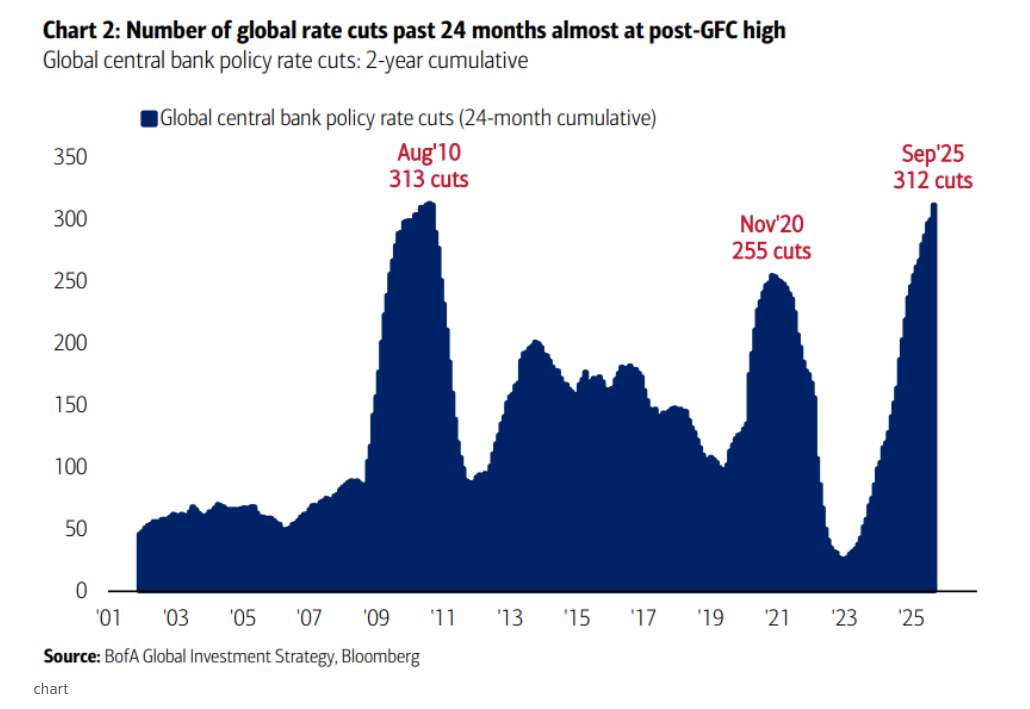
分散持仓,板块轮动 法国兴业银行分析师表示,宽松周期顶峰可能对华尔街构成看涨信号。他们认为,这标志着盈利增长将 扩大范围并加速。 法国兴业银行美国股票策略主管马尼什.卡布拉称,周期顶峰是向小盘股和杠杆率较低股票等其他市场 领域分散投资的"强烈信号"。他指出,通常要等到投资者开始计入加息周期启动时,才会减少股票敞 口。 全球降息周期可能已达顶峰。如今的问题是,当前高歌猛进的市场何时,或者是否会开始感受到压力。 美国银行数据显示,过去两年全球降息次数已超过2007-2009年全球金融危机时期。尽管这仅统计降息 次数而非宽松幅度,但也反映出2022-2023年为对抗通胀而实施的历史性加息规模。 但如今这一周期似乎已出现转折。这并不意味着全球宽松已经停止,包括美联储在内的多国央行仍有望 进一步降息。相反,未来累计降息次数将有所减少。 表面来看,超宽松货币政策的终结意味着未来金融环境将不再那么宽松。但或许与直觉相反,历史数据 显示并非如此。过去三次全球主要宽松周期达到顶峰后,均出现盈利周期扩大和股市稳健上涨的局面。 这样的情况会再次上演吗?或许有可能,但考虑到当前许多市场的泡沫化估值,此次结果并非板上钉 钉。 罗伯森认 ...
全球降息周期或已见顶!流动性退潮,股市还能继续涨吗?
Jin Shi Shu Ju· 2025-11-07 09:00
Group 1 - The global interest rate cut cycle may have peaked, raising questions about when or if the currently robust market will begin to feel pressure [1][4] - Over the past 25 months, global central banks have matched the number of interest rate cuts seen during the 2007-09 financial crisis, indicating a significant scale of historical rate hikes implemented to combat inflation in 2022-23 [1][4] - The end of ultra-loose monetary policy suggests that the financial environment will no longer be as accommodating, although major central banks like the Federal Reserve are still expected to cut rates further [4] Group 2 - Analysts from Societe Generale suggest that the peak of the easing cycle could signal a bullish outlook for Wall Street, indicating that profit growth will accelerate and spread across sectors [5] - The peak of the easing cycle traditionally means that the market is confident in accelerating profit growth, as evidenced by strong market performance following previous peaks in August 2020 and September 2009 [5] - Current market valuations are notably different from those periods, as the stock market is at unprecedented highs, raising concerns about potential bubbles [5] Group 3 - Almost all major asset classes have risen this year, driven by various factors, with the AI boom providing a significant boost to Wall Street [6] - Standard Chartered highlights that the common force behind the rise in asset prices is liquidity, which has been abundant [6][7] - The concept of liquidity is influenced by factors beyond monetary policy, including bank reserves, private sector credit availability, and overall risk appetite [7]

2025年11月流动性展望:资金面重回稳定宽松DR001能否突破1.3%意义下降
Xinda Securities· 2025-11-06 09:31
Group 1: Liquidity and Financial Indicators - The excess reserve ratio increased by 0.3 percentage points to 1.4% in September, remaining stable compared to June[6] - The general fiscal deficit reached a record high of 2.11 trillion yuan in September, significantly exceeding expectations by approximately 360 billion yuan[6] - Government deposits decreased by 780.4 billion yuan in September, marking the largest decline for the same period in recent years[6] Group 2: October Projections and Market Conditions - In October, government deposits are expected to rise by approximately 380 billion yuan, which is significantly lower than the same period in previous years, reducing negative liquidity impacts[15] - The average interest rates for DR001 and DR007 reached new lows for the year in October, indicating a continued state of liquidity easing[28] - The anticipated excess reserve ratio for November is around 1.3%, remaining stable compared to October and slightly higher than the same period in the past two years[3] Group 3: Monetary Policy and Future Outlook - The central bank's recent actions suggest a maintained easing stance, with expectations for potential interest rate cuts in the future to support economic stability[3] - The central bank's balance sheet showed an increase in claims on other deposit-taking institutions by 897.4 billion yuan in September, aligning with high-frequency data[14] - Risks include potential underperformance in fiscal spending and monetary policy not meeting expectations, which could impact liquidity and market stability[3]
降息还钱荒!美联储陷两难,借贷成本飙升,全球资本撤离美国市场
Sou Hu Cai Jing· 2025-11-06 06:18
Group 1 - The current financial situation in the U.S. is unstable, with rising borrowing costs despite the Federal Reserve's interest rate cuts, causing concern among institutions and investors [1][3] - The Federal Reserve's intention to ease borrowing through rate cuts has backfired, leading to a spike in short-term lending rates, which was unexpected even for the Fed [3][5] - The U.S. government’s increasing debt, now exceeding $38 trillion, is creating a cash crunch in the financial system as the Treasury issues new bonds while the Fed tightens liquidity [5][9] Group 2 - There is a growing hesitance among financial institutions to take risks or lend money, with fewer entities willing to engage in borrowing compared to previous years, indicating a more severe pressure than in 2019 [5][11] - The Federal Reserve is experiencing internal disagreements on whether to intervene in the market, leading to market sensitivity and a lack of confidence despite announcements of rate cuts [7][13] - The outflow of foreign investment from the U.S. to regions like China and Europe is diminishing the domestic funding pool, reducing the U.S.'s influence in the global market [9][11] Group 3 - The ongoing cash shortage is impacting not only the U.S. financial sector but also has global repercussions, affecting trade dynamics in Europe and increasing risks for emerging markets [11][15] - The potential for the Federal Reserve to either inject liquidity or maintain its current stance poses a dilemma that could have significant implications for both the U.S. economy and global financial markets [13][15]
流动性预期改善债券市场情绪转暖
Jing Ji Wang· 2025-11-06 02:30
Core Viewpoint - The monetary market continues a loose tone into November, with the bond market sentiment gradually recovering, supported by stable fiscal spending and reduced medium to long-term liquidity pressure [1][2]. Group 1: Monetary Market Conditions - The liquidity supply-demand relationship in November shows significant improvement compared to October, with a decrease in medium to long-term liquidity pressure by approximately 100 billion yuan and a reduction in tax payment scale by about 800 billion yuan [2]. - Historical patterns indicate that November is typically a relatively stable period for liquidity, with short-term interest rates expected to remain below policy rates [2][4]. - The central bank is anticipated to continue a gentle "supportive" approach, maintaining a stable and loose liquidity stance through operations like reverse repos and medium-term lending facilities (MLF) [2][4]. Group 2: Bond Market Sentiment - The improvement in liquidity is gradually transmitting to the bond market, with the 30-year government bond futures price rebounding from a low of 113 yuan to above 116 yuan since mid-October, indicating a clear recovery in market sentiment [3][4]. - The recent drop in short-term funding rates, particularly the 1-year interbank certificate of deposit rate to around 1.63%, reflects a stable short-term funding price, which supports the bond market's recovery [4][5]. Group 3: Year-End Market Outlook - Multiple institutions express cautious optimism regarding the overall year-end bond market, predicting that short-term configuration value will stand out while long-term bonds have room for recovery [5][6]. - The current low funding rates and limited funding stratification suggest that institutional demand for configuration will be steadily released, contributing to a gradually improving trading sentiment [5][6].