
反内卷政策

Search documents
数据点评 | 利润走弱的两大缘由(申万宏观·赵伟团队)
申万宏源宏观· 2025-12-27 13:10
Core Viewpoints - Industrial enterprise profits continued to decline, primarily due to a significant drop in other gains and ongoing cost pressures [3][64] - In November, industrial enterprise profits fell by 4.6 percentage points year-on-year to -13.4%, with profit margins also decreasing [6][33] - The decline in profits is attributed to a notable decrease in contributions from other gains, which fell by 9.4 percentage points to -5.1% [3][64] Revenue - In November, industrial enterprise revenue showed improvement, with a year-on-year increase of 1.6%, slightly down from 1.8% in the previous month [2][8] - The actual revenue growth rate, excluding price factors, rose by 3.1 percentage points to 3.1%, positively impacting profit comparisons [4][27] - Revenue growth was observed across major industrial chains, with the petrochemical, metallurgy, and consumer chains all experiencing increases [4][27] Costs - Industrial enterprises faced significant cost pressures in November, with the overall cost rate at 84.9%, up 0.2 percentage points from the previous year [4][23] - The metallurgy chain experienced the highest cost pressure, with a cost rate of 85.4%, which is 0.7 percentage points higher than the previous year [4][23] - Certain sectors, such as non-ferrous rolling and instrumentation, saw notable increases in cost rates, while the petrochemical and consumer chains experienced slight declines [4][23] Industry Performance - Specific industries, such as beverages and food, saw a dramatic decline in profit growth, with beverage profits dropping by 93.4 percentage points to -90.4% [3][17] - The negative contributions from industries like non-ferrous processing and oil and gas extraction further impacted overall profit performance [3][17] - Despite some revenue recovery in these sectors, the decline in other gains significantly affected profit margins [3][17] Inventory - The nominal inventory of industrial enterprises increased by 0.9 percentage points year-on-year to 4.6% in November, indicating a slight rise in actual inventory growth [6][50] - The actual inventory growth rate, adjusted for price factors, was 7.7%, reflecting changes in inventory levels across different stages of production [6][50] Summary - High cost rates remain a key constraint on profit recovery, with ongoing "anti-involution" policies being implemented to address these pressures [5][66] - The current profit pressures are largely due to rigid cost increases driven by downstream investment practices [5][66] - Future monitoring will focus on the effectiveness of policies aimed at alleviating cost pressures and their impact on industrial profitability [5][66]


2025年11月工业企业盈利数据点评:盈利承压,分化加剧
EBSCN· 2025-12-27 12:07
Profit Trends - In November 2025, industrial enterprise profits fell by 13.1% year-on-year, worsening from a decline of 5.5% in October 2025[4] - Cumulative profit growth for industrial enterprises from January to November 2025 was 0.1%, down from 1.9% for the first ten months[2] - Cumulative revenue growth for industrial enterprises from January to November 2025 was 1.6%, slightly down from 1.8% for the first ten months[2] Structural Analysis - Only the midstream equipment manufacturing sector showed stable profit growth, while upstream and downstream sectors experienced varying degrees of decline[3] - Cumulative profit growth for the mining sector from January to November 2025 was -27.2%, while manufacturing sector profit growth dropped to 5.0%[13] - The cumulative profit margin for the manufacturing sector was 4.62%, an increase of 0.08 percentage points compared to the previous year[13] Market Dynamics - The profit margin for industrial enterprises in November 2025 was 5.65%, a decrease of 0.73 percentage points year-on-year[5] - The cost per 100 yuan of revenue for large industrial enterprises increased by 0.18 yuan from January to November 2025[5] - The PPI (Producer Price Index) year-on-year growth rate in November 2025 was -2.2%, slightly down from -2.1% in October 2025[5] Future Outlook - Industrial profits are expected to remain under pressure in December 2025 due to high year-on-year comparisons[3] - The implementation of new policies in 2026 is anticipated to stimulate demand and support profit recovery for enterprises[29] - The midstream sector is projected to continue its positive profit trend, benefiting from "anti-involution" policies[3]
2025年1-11月工业企业利润分析:利润增速压力显现
Yin He Zheng Quan· 2025-12-27 07:48
Profit Growth Pressure - Industrial enterprises' profits from January to November 2025 reached 66,268.6 million, showing a slight increase of 0.1% year-on-year[1] - The profit growth rate has narrowed to 1.9%, down from 13.1% in the previous year, indicating significant pressure on profit growth[1] - The decline in production and profit margins, along with the diminishing low base effect, are the main reasons for the slowdown in profit growth[1] Production and Price Trends - Industrial production in November 2025 decreased by 4.8%, while the Producer Price Index (PPI) showed marginal improvement at 0.1%[1] - The profit margin for industrial enterprises fell to 5.29%, a decrease of 0.04 percentage points compared to the previous year[1] - Manufacturing profit margins improved, but mining and utility sectors saw a decline compared to October 2025[1] Internal Demand and Cash Flow - Weak domestic demand has led to passive inventory accumulation, with inventory levels increasing by 6.92% in November 2025[1] - Companies are facing accumulating cash flow and operational pressures, with cash flow indicators showing a decline[1] Future Outlook and Risks - The profit growth for the entire year is under pressure, with potential impacts from anti-competitive policies that may temporarily suppress profit totals[2] - Future policies related to domestic demand expansion and external demand risks will be crucial for profit recovery[2] - Investment strategies should consider the structural adjustments in industries and the potential for profit pressures in the short term[2]
宏观解读 | 地产持续调整,内需动能待增强——2025年11月宏观数据点评
Sou Hu Cai Jing· 2025-12-26 09:46
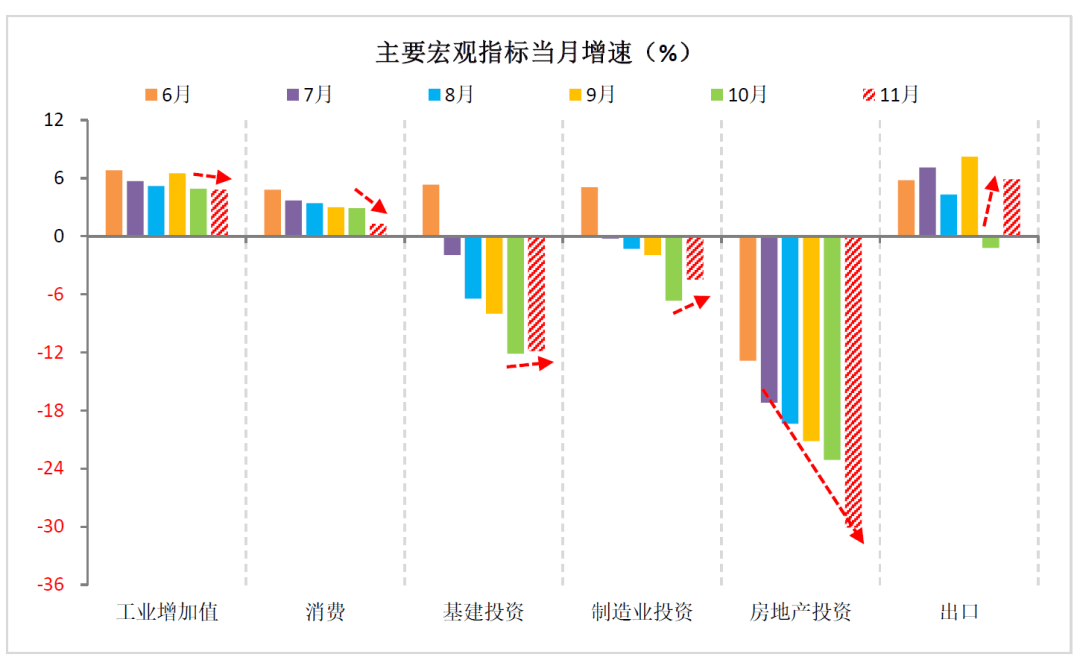
Core Viewpoint - The economic indicators in November show a divergence characterized by "strong production but weak demand, strong external demand but weak internal demand," indicating significant short-term downward pressure on the economy. Industrial production and export resilience are supported by ongoing industrial upgrades, while consumption growth is slowing, and investment continues to decline, highlighting insufficient domestic demand [1][3]. Group 1: Economic Dynamics - The economic indicators reflect a need for policy intervention to stabilize domestic demand as consumption growth slows and investment remains at low levels [3]. - Industrial production remains stable, with a year-on-year increase of 6.0% from January to November, slightly above last year's growth rate [4]. - The service sector shows signs of slowing down, with a year-on-year growth of 5.6% from January to November, indicating pressure from real estate and travel-related sectors [5]. Group 2: Consumption Trends - In November, the total retail sales of consumer goods grew by 1.3% year-on-year, reflecting increased pressure on consumption [8]. - The decline in consumption is notably influenced by the automotive sector and the "old-for-new" policy, which have both turned negative [8]. - Despite the overall slowdown, consumption among low- and middle-income groups remains stable, with service retail growth slightly improving [8]. Group 3: Investment Insights - Fixed asset investment decreased by 2.7% year-on-year from January to November, with a notable decline in real estate investment [12]. - Manufacturing investment shows initial signs of stabilization, with a year-on-year growth of 1.9% from January to November, indicating a potential recovery [14]. - Infrastructure investment remains steady, supported by new policy financial tools and fiscal funding, although traditional sectors face ongoing challenges [14]. Group 4: Export Performance - November exports saw a significant year-on-year increase of 5.9%, driven by low base effects and improved export volumes [18]. - Exports to the EU rebounded significantly, while exports to the US continued to decline due to previous import surges [18]. - The overall export resilience is supported by improvements in various product categories, including home appliances and textiles [18]. Group 5: Inflation Trends - The Consumer Price Index (CPI) rose by 0.7% year-on-year in November, supported by low base effects and rising food prices [22]. - The Producer Price Index (PPI) decreased by 2.2% year-on-year, with a slight month-on-month increase, indicating a mixed inflationary environment [22]. - Future inflation is expected to continue rising, influenced by domestic policies aimed at expanding demand [24]. Group 6: Financing Conditions - Social financing data in November showed a year-on-year increase of 160 billion yuan, indicating marginal improvements in financing demand driven by policy tools [28]. - However, credit growth remains weak, with new loans significantly lower than previous periods, reflecting ongoing challenges in consumer and housing market confidence [28][29]. - The M1 and M2 money supply growth rates continued to decline, indicating underlying weaknesses in the economy [29].
房不再是人生“必选”,钱要怎么配置才能保值增值?
天天基金网· 2025-12-26 09:24
Core Viewpoint - The article discusses the changing dynamics of wealth management in light of declining interest rates and increased market volatility, emphasizing the need for strategic asset allocation rather than mere trading [1][3]. Group 1: Investment Philosophy - The concept of "quality assets" is highlighted, defined by sustained demand and relatively limited supply, which applies to both traditional consumer goods and emerging sectors like AI and semiconductors [3]. - The importance of returning to the fundamentals of supply and demand and maintaining independent judgment is emphasized as a key strategy for navigating market cycles [3]. Group 2: Asset Management Strategies - The discussion includes the significance of asset allocation, advocating for a gradient strategy that starts with defensive assets before moving to more aggressive investments [5]. - The "pyramid accumulation strategy" is introduced, where investors gradually increase their positions in risk assets during market downturns, with specific thresholds for adding to positions to manage risk [6]. Group 3: Market Dynamics - The article contrasts the regulatory environments of A-shares and Hong Kong stocks, noting that Hong Kong's more accommodating regulations allow for greater innovation and the emergence of significant companies [7][8]. - The impact of anti-involution policies on industry development is discussed, particularly in the context of the photovoltaic industry, where government intervention is seen as necessary to alleviate competitive pressures [10].
碳酸锂突破13万关口!宁德时代关键锂矿将复产,电池ETF(561910)盘中大涨3.36%
Sou Hu Cai Jing· 2025-12-26 03:29
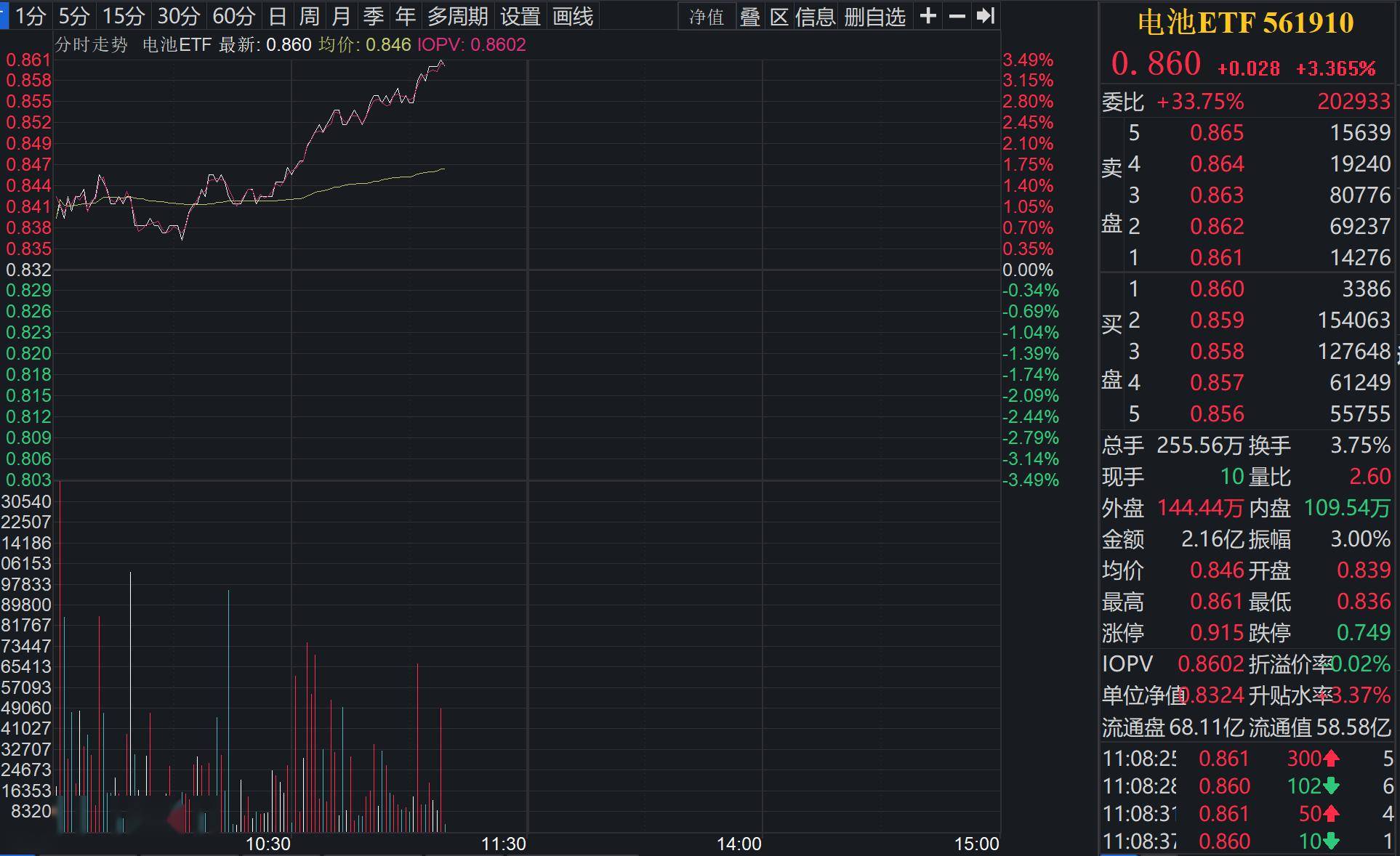
Core Viewpoint - The lithium battery industry is experiencing significant growth, driven by strong demand for energy storage and advancements in solid-state battery technology, with key market players showing substantial stock price increases. Group 1: Market Performance - Major stock indices rose collectively on the last trading day of the week, with lithium carbonate futures surpassing 130,000 yuan, leading to a strong opening across the lithium battery supply chain [1] - The energy storage ETF (561910), which has a composition of over 60% energy storage and over 40% solid-state batteries, surged more than 3.36% during trading, with real-time transaction volume exceeding 217 million yuan [1] Group 2: Company Developments - Companies such as Enjie, Tianhua New Energy, and others saw significant stock price increases, with Enjie hitting the daily limit and Tianhua New Energy rising over 11% [2] - CATL's Jiangxi lithium mine has been under suspension since August due to licensing and environmental issues, with expectations for full operational recovery by February 2026 [3] Group 3: Industry Trends - The industry is moving towards a phase of regulatory oversight to curb "involution" competition, focusing on maintaining fair competition and enhancing industry concentration [3] - Strong demand for dynamic storage and the implementation of "anti-involution" policies are expected to benefit the supply chain, with projected growth rates of over 15% for power batteries and over 40% for energy storage batteries by 2026 [3] Group 4: Solid-State Battery Developments - The solid-state battery sector is transitioning from technology validation to mass production preparation, with breakthroughs in equipment and materials [4] - China FAW aims to mass-produce solid-state batteries by 2027, with ongoing collaboration among 27 entities to accelerate development [5] - The battery ETF (561910) has seen a 514.7% increase in shares this year, with a current scale of 5.67 billion yuan and an annual index growth of over 67% [5]

白银狂飙141%,硅料大涨,光伏组件想涨价却涨不动
Xin Lang Cai Jing· 2025-12-25 23:31
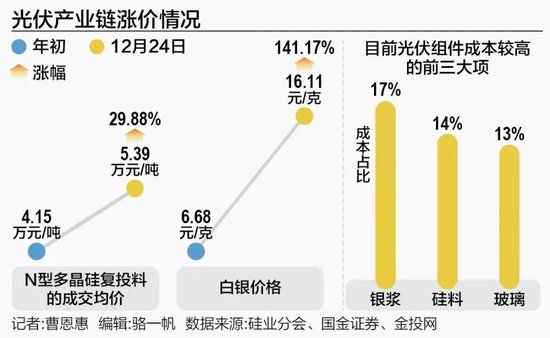
Core Viewpoint - The recent price increase of photovoltaic (PV) modules is primarily driven by rising upstream material costs, particularly silver paste, which has seen significant price hikes due to soaring silver prices [1][3][4]. Group 1: Price Increases and Market Dynamics - Major PV manufacturers like Longi Green Energy and JinkoSolar have raised module prices by 0.02 to 0.05 yuan per watt due to increased costs of raw materials [1][3]. - Silver futures and spot prices have surged, with increases exceeding 130% and 150% respectively this year [1][3]. - The price increase of PV modules has lagged behind other components in the supply chain, with module prices rising less than 2% compared to significant increases in silicon wafers and battery cells [4][12]. Group 2: Cost Structure Changes - The cost structure of PV modules has shifted, with silver paste now accounting for 17% of the total cost, surpassing silicon materials which have decreased in cost share [11][12]. - The average transaction price of N-type multi-crystalline silicon has risen from 41,500 yuan per ton at the beginning of the year to 53,900 yuan per ton by December 24, marking a 29.88% increase [12]. - The price of silver has increased from 6.68 yuan per gram to 16.11 yuan per gram, reflecting a 141.17% rise [12]. Group 3: Investment Returns and Market Sentiment - The internal rate of return (IRR) for PV projects has been negatively impacted by declining electricity prices, with current IRR estimates for domestic projects ranging from 6% to 7% [4][13]. - There is a strong correlation between module prices and the IRR for solar power plants, suggesting that rising module prices could deter investment due to lower expected returns [5][13]. - Industry experts express skepticism about the sustainability of the recent price increases, questioning whether they can be maintained in the face of limited market demand [6][14]. Group 4: Future Market Outlook - The China Photovoltaic Industry Association has not provided forecasts for new installed capacity for 2026, indicating increased uncertainty regarding future demand [8][16]. - From January to October, China's newly installed PV capacity reached 252.87 GW, attributed to a surge in installations earlier in the year [8][16]. - The global PV market is expected to experience a slowdown in growth, with future demand projected to stabilize rather than increase rapidly [9][16].



南华期货2026钢材年度展望:供需再平衡,区间震荡起涟漪
Nan Hua Qi Huo· 2025-12-25 11:01
1. Report Industry Investment Rating No relevant information provided. 2. Core Viewpoints of the Report - In 2026, the steel market is expected to achieve a re - balance between supply and demand, with steel prices showing a range - bound pattern. The upper pressure mainly comes from the decline in steel consumption in real estate and infrastructure, the possible weakening of manufacturing demand growth, and tightened export controls. The lower support stems from anti - involution policy expectations, capacity regulation, the concentrated implementation of projects at the beginning of the 15th Five - Year Plan, consumption expansion policies, and overseas interest rate cuts. The price may first experience a bottom - grinding and pressure - bearing stage, and then the price center may rise if supply contraction continues and demand recovers [2]. - The reference operating ranges are: rebar (2900 - 3500) and hot - rolled coil (3000 - 3600) [2]. 3. Summary by Relevant Catalogs 3.1 2025 Steel Market Review - In the first half of 2025, steel prices rebounded briefly at the beginning and then declined slowly due to weak consumption demand. The cost - pricing logic dominated, and the continuous decline of coking coal prices dragged down steel prices. Frequent negative news about Sino - US tariff policies also deepened the market's expectation of weakening steel prices [3]. - In the third quarter, the "anti - involution" policy expectation and the notice of coal over - production review led to a rise in coking coal prices, driving up finished steel prices. However, after the Politburo meeting in August, the policy statement was adjusted, the policy premium was partially withdrawn, and the steel price oscillated downward [4]. - In the fourth quarter, the market trading logic was mainly macro - oriented. The improvement of Sino - US relations and the US interest rate cut cycle boosted market sentiment at first, but after the policy was implemented, the market sentiment declined rapidly. The loose supply of coking coal and the off - season of steel consumption also led to a continuous decline in steel prices [5]. 3.2 Core Concerns 3.2.1 Whether Negative Feedback Production Cuts Will Occur - The current profitability rate of steel enterprises is 35%, far higher than the 15% critical point for negative feedback. The cost reduction from coking coal has improved the profits of blast furnaces and electric furnaces. Therefore, the probability of widespread negative feedback in the industry in the short term is low [10]. - Considering capacity regulation policies and high inventory levels, the industry is expected to implement moderate production cuts to relieve inventory pressure and achieve a dynamic balance between production and profitability [10]. 3.2.2 Whether Export Controls Will Affect Steel Exports - Export controls will affect steel exports. The implementation of steel export license management in 2026 and the formal collection of EU CBAM carbon tariffs will lead to an expected 10% decline in steel exports. However, it will also guide steel enterprises to transform towards high - end products and optimize the export structure [12][13]. 3.2.3 Whether the Demand for Steel in the Manufacturing Industry Can Continue to Increase - The steel demand structure is clearly differentiated. The steel consumption in the manufacturing industry has become the core support for demand growth, effectively offsetting the decline in demand from real estate and infrastructure. Although the growth rate may slow down in 2026, the overall resilience can still be maintained due to consumption - boosting policies and structural growth in some fields [14]. 3.3 Valuation and Supply - Demand Outlook 3.3.1 Valuation - In terms of term structure, rebar and hot - rolled coil show a C - shaped structure. If this structure remains unchanged, steel prices may continue to be weak. In terms of basis, the valuation of steel is relatively neutral. The basis of rebar is more stable than that of hot - rolled coil [15]. - Steel profits mainly come from raw material price concessions. In 2026, with weak steel demand, the cost - pricing logic will prevail, and profits will depend on raw material price concessions [15]. 3.3.2 Supply - As of October 2025, China's cumulative crude steel production was 817 million tons, with a year - on - year decrease of 3.90%. The apparent contradiction between the increase in molten iron production and the decrease in crude steel production may be due to factors such as crude steel production control policies, the cost - effectiveness of molten iron, and the diversion of molten iron [18]. - In 2026, due to factors such as the decline in steel demand in real estate and infrastructure, the continuation of crude steel production control policies, and the implementation of export controls, crude steel production is expected to continue to decline by about 30 million tons, with an annual output of 931 million tons, a year - on - year decrease of about 3.1% [1][19]. 3.3.3 Demand - **Real Estate**: In 2025, the real estate market was in a downward adjustment, with new construction area, development funds, and investment all declining. The demand for steel in real estate was dragged down. In 2026, the decline in steel consumption in real estate is expected to slow down, with an estimated consumption of about 167 million tons, a year - on - year decrease of about 9.43% [31][32]. - **Infrastructure**: In 2025, infrastructure investment growth slowed down. Although the scale of special bonds remained high, the investment in traditional infrastructure decreased. In 2026, as the beginning of the 15th Five - Year Plan, major projects may be launched intensively. The scale of special bonds may increase, and infrastructure steel consumption is expected to increase by about 1% year - on - year [45][47]. - **Manufacturing**: In 2025, the steel consumption in the manufacturing industry became the core support for demand growth. In 2026, the demand growth rate in the manufacturing industry may slow down. The demand for steel in the automotive and home appliance sectors may decline, while the machinery and shipbuilding sectors are expected to have stable growth [55][58][59]. - **Export**: In 2025, steel exports increased significantly. However, in 2026, due to the implementation of export license management and the collection of EU carbon tariffs, steel exports are expected to decline by about 10% [62][63]. 3.3.4 Inventory - Rebar inventory was relatively low in 2025 due to weak demand in real estate and infrastructure and low - production strategies of steel mills. Hot - rolled coil had a fast de - stocking speed in the first half of the year but experienced super - seasonal inventory accumulation later. In the future, if the profit of steel mills recovers, the de - stocking speed may slow down [73].
涨价投资机遇梳理 -五大行业
2025-12-25 02:43
Summary of Key Points from Conference Call Records Industry Overview - **Chemicals Industry**: Benefiting from anti-involution policies and domestic demand recovery, with specific sectors like pesticides, refrigerants, organosilicon, and phosphate chemicals seeing improved profitability. The chemical sector index has significantly risen since July 2025, indicating a potential oil price bottom in the first half of 2026 [1][3][6]. - **New Energy Materials**: Experiencing explosive growth in downstream demand, particularly in electric vehicles and energy storage, while upstream resources are limited and midstream capacity expansion lags behind demand, leading to price increases for lithium and cobalt [1][3]. - **Electronics Industry**: Supported by AI hardware demand, semiconductor capacity expansion, and domestic policies, with increased demand for electronic chemicals and storage chips [1][4]. - **Non-ferrous Metals**: Supply constraints due to resource scarcity, rising extraction costs, and geopolitical disturbances, alongside sustained demand from photovoltaics and energy storage, have driven prices of copper, gold, and silver to historical highs, with expectations for copper prices to continue rising in the first half of 2026 [1][4][19]. Core Insights and Arguments - **Chemical Sector Performance**: The chemical sector index has risen nearly 40% since July 2025, despite marginal performance declines in Q2 to Q4. The reversal in supply-demand dynamics, particularly on the supply side, has been a key driver of stock price increases [6][12]. - **Investment Opportunities**: The polyester industry chain, particularly PTA and its derivatives, is highlighted as having significant price elasticity and potential for investment due to high concentration and recent price increases driven by global oil demand [7][9]. - **Refrigerants Market**: The refrigerants industry is expected to see price increases due to changes in supply-demand dynamics and anti-dumping measures, with applications in automotive and liquid cooling sectors [10][11]. Additional Important Insights - **PPI Recovery**: The Producer Price Index (PPI) has shown signs of recovery, with a notable decrease of 2.3% year-on-year in September, but the decline has narrowed significantly [5]. - **Weak Dollar Environment**: The overall weak dollar trend is expected to persist, providing unexpected opportunities despite changes in interest rate expectations [5]. - **Electronics Price Trends**: Significant price increases have been observed in the electronics supply chain, particularly in wafer manufacturing, storage, and analog devices, driven by increased demand and supply constraints [13]. - **Communication Sector**: The optical device sector is experiencing price increases due to rising demand for 1.6T optical modules and 800 laser modules, with expectations for continued price growth in the fiber optics market [15][16]. Future Outlook - **Chemical Industry**: The chemical sector is still in the early stages of a bull market, with expectations for significant performance improvements in 2026 [12]. - **Non-ferrous Metals**: Continued price increases are anticipated for major metals like copper and aluminum, with a focus on demand-side changes in the latter half of 2026 [22]. - **Lithium Battery Materials**: Prices for lithium and its derivatives are expected to rise due to strong demand growth outpacing supply, with projections for lithium carbonate prices to reach 150,000 to 200,000 yuan [24][25]. - **Copper Foil and Membrane Materials**: The copper foil industry is expected to see significant elasticity due to potential supply-demand gaps, while the membrane industry is facing challenges due to long expansion cycles [27][28].
中泰期货晨会纪要-20251225
Zhong Tai Qi Huo· 2025-12-25 01:24
Report Industry Investment Rating - Not provided in the content Core Viewpoints - The report provides comprehensive analysis and trading suggestions for various futures products, covering macro finance, black commodities, non - ferrous metals, agricultural products, and energy chemicals. It also analyzes the impact of macro - policies, supply - demand relationships, and market sentiment on different products [10][13][20] Summary by Directory 1. Based on Fundamental and Quantitative Indicators - **Fundamental**: Trend空头 includes silicon ferrosilicon and manganese silicon; Trend多头 is not mentioned; Others are in a state of shock or shock - biased [2] - **Quantitative**: Products with a bearish trend include Zheng cotton, PTA, etc.; Those in a shock state are soybean oil, hot - rolled coil, etc.; And products with a bullish trend are rapeseed oil, iron ore, etc. [4] 2. Macro - information - Beijing optimizes housing purchase restrictions, relaxes conditions for non - Beijing households, and adjusts mortgage and down - payment policies. The RMB exchange rate is approaching 7, and precious metal futures have risen sharply, causing a collective upsurge in related LOFs. The central bank plans to conduct 400 billion yuan of MLF operations in December, with a net injection of 100 billion yuan. The US plans to impose tariffs on Chinese semiconductor products in 2027, and the semiconductor industry has seen a new round of price hikes. Ukraine announced a "peace plan" draft, and Japan may reduce the issuance of ultra - long - term bonds [6][7][8] 3. Macro - finance **Stock Index Futures** - Pay attention to the sustainability and structure of liquidity repair. If realized, the index may strengthen. A - shares have been rising in shock, with the Shanghai Composite Index rising 0.53% to 3940.95 points, and the market turnover reaching 1.9 trillion yuan. The central bank's net injection of MLF and other factors will affect the market. Overseas, the US GDP growth in Q3 has exceeded expectations [10][11] **Treasury Bond Futures** - Short - and medium - term bonds may be in a shock - biased - strong state, but the odds are more important than the direction. The capital market is in a balanced and loose state, and the central bank's MLF operation plan has been announced. Without interest rate cuts, market sentiment may decline, and bonds within 10 - year terms will remain in shock [12] 4. Black Commodities **Steel and Ore** - In the short term, steel and ore are expected to fluctuate and consolidate, and in the long term, the idea is to be bearish on rallies. The demand for building materials is weak, while the demand for coils is okay. Steel mills' profits are low, and iron ore and other raw material prices are stable [13] **Coking Coal and Coke** - The prices of coking coal and coke may rise in the short - term shock, but the rebound space is limited due to factors such as coal production restrictions and weak steel demand [15][16] **Ferroalloys** - The hedging pressure of silicon and manganese alloys increases with the rise in prices. In the short term, focus on factors such as the resumption of silicon ferroalloy plants and the progress of new manganese silicon capacity. In the medium term, the idea is to be bearish on rallies [17] **Soda Ash and Glass** - For soda ash, it is advisable to wait and see; for glass, try long positions after the market sentiment stabilizes. Soda ash production is affected by maintenance and new capacity, and glass is expected to have supply - side cold repairs [18] 5. Non - ferrous Metals and New Materials - The short - term price may be strong, and pay attention to buying opportunities on dips. The demand in the power sector may weaken in Q1 of next year, but the supply recovery delay of some mines will support prices [20] **Industrial Silicon and Polysilicon** - Industrial silicon has some valuation repair space, but the rebound is under pressure. Polysilicon is expected to have a strong price due to factors such as production - reduction expectations and strong spot prices [21][24] 6. Agricultural Products **Cotton** - The short - term supply is loose, but the long - term supply is expected to shrink. The rebound of cotton prices may be under pressure at high levels, and short - term long positions need to be cautious [24] **Sugar** - Domestic sugar has entered a season of strong supply and demand, and Zhengzhou sugar has a low valuation and a technical rebound. It is advisable to wait and see. The global sugar supply may be in surplus, and domestic sugar is affected by seasonal and import factors [27][28] **Eggs** - The short - term may be strong, but the upside space of 01 - 03 contracts is limited. The far - month contracts have support due to the expected decline in inventory. The current egg supply - demand is still loose [30][31] **Apples** - The futures price may fluctuate. The apple出库 is slightly reduced year - on - year, and the sales in the consumer market are slow. The price of high - quality goods is firm [32] **Corn** - Pay attention to the changes in the spot price in the production area, and the idea is to short the far - month contracts on rallies. The supply - demand mismatch is being alleviated, and the far - month contracts face pressure [33] **Jujubes** - Closely monitor the market performance in the peak consumption season. Currently, it is expected to fluctuate. The supply pressure is emerging, and the price may fluctuate in the short term [34][35] **Pigs** - The pattern of strong supply and weak demand remains unchanged. The spot price is expected to decline in shock. It is advisable to short the near - month contracts on rallies [36] 7. Energy and Chemicals **Crude Oil** - The situation in Venezuela has led to a rapid rebound in oil prices. In the medium term, the oil market may face an over - supply situation. Short - term attention should be paid to the further escalation of the situation in Venezuela [38] **Fuel Oil** - The price of fuel oil will fluctuate with the oil price. The supply is loose, and the demand is weak. The short - term trading focus is on geopolitical factors [39] **Plastics** - Polyolefins have a large supply pressure and weak downstream demand. The price may have some support but no strong upward drive. It is advisable to adopt a shock - trading idea [40] **Rubber** - It is advisable to reduce long positions on rallies and wait and see the rest. The trading sentiment has improved, but the upside space may be limited [42] **Synthetic Rubber** - Exit short - positions and stop - profit on the arbitrage strategy. The short - term may be in a strong shock, but high prices are difficult to maintain [43] **Methanol** - The real - world supply - demand of methanol has slightly improved, and the inventory has started to decline. It is not advisable to continue to be bearish in the short term. Consider a slightly long - biased allocation for far - month contracts after the inventory decline is smooth [44] **Asphalt** - The price fluctuation of asphalt is expected to increase. The focus is on the price bottom after the winter - storage game. Geopolitical factors have increased the risk of asphalt raw materials [45] **Polyester Industry Chain** - It is advisable to reduce long positions on rallies. The market's positive expectations have been gradually fulfilled, and the downstream negative feedback has increased [46] **Liquefied Petroleum Gas** - The LPG futures price has entered the delivery logic. The supply is relatively abundant, and the demand has a certain support, but it is difficult to drive the price up. The price is expected to fluctuate [48] **Pulp** - The fundamentals of pulp are gradually improving, but it may face hedging pressure. It is advisable to wait and see in the short term. Consider selling out - of - the - money call options on the 03 contract for hedging [49] **Logs** - The fundamentals of logs are in a weak balance, and the price is expected to fluctuate. The domestic and international market prices are affected by different factors [50] **Urea** - The urea market is expected to fluctuate. Pay attention to the basis pressure when the futures expectations are too strong [51]