
服务消费

Search documents
观开门红电话会议-内外兼修-中国经济展望
2026-01-07 03:05
Summary of Conference Call on China's Economic Outlook Industry Overview - The conference call focuses on the outlook for the Chinese economy in 2026, highlighting the impact of global manufacturing cycles, U.S. inventory replenishment, and fiscal policies under the Trump administration on China's export growth, which is expected to remain around 5% [1][3] - The real estate market's drag on the industrial economy is expected to diminish, but its impact on consumer spending remains a concern [1][4] Key Points and Arguments - **Service Consumption as Growth Driver**: Service consumption is projected to become a new growth point, taking over from real estate as a key pillar of the Chinese economy [1][2][4] - **U.S. Inventory Cycle**: The U.S. is expected to enter a replenishment phase starting in late 2024, which will last until mid-2026, positively influencing China's exports [1][6] - **Monetary Policy Impact**: Anticipated interest rate cuts by the Federal Reserve in 2026 are expected to stimulate global industrial production and capital expenditure, benefiting Chinese exports [1][6] - **Currency Competitiveness**: The depreciation of the RMB against non-USD currencies enhances China's price competitiveness in foreign trade, with over 60% of listed companies maintaining high gross margins [1][7] - **Belt and Road Initiative**: Exports to Belt and Road countries, particularly in Africa, have seen significant growth, driven by China's outward direct investment in these regions [1][8] Additional Important Insights - **Real Estate Market Trends**: The real estate market has shifted from contributing positively to negatively since 2021, with its share of the economy declining from 8% to 6% [1][9] - **Price Downturn Effects**: Ongoing declines in housing prices are affecting consumer confidence and spending willingness, with rental yields not covering mortgage costs, leading to a negative sentiment towards property ownership [1][10] - **Durable Goods Subsidy Policy**: The impact of durable goods subsidies is seen as a short-term boost that may lead to reduced future demand, as evidenced by past policies [1][11] - **Long-term Consumption Growth**: Future economic growth will rely on increasing consumer spending rather than reverting to investment-driven growth, with a focus on enhancing public service spending [1][12][15] Conclusion - The Chinese economy is poised for a transition towards consumption-driven growth, with service consumption expected to play a crucial role in this shift. The external environment appears favorable for exports, but challenges remain in the real estate sector and consumer confidence.
2026首批“国补”落地 新政“新”在哪儿?
Yang Shi Xin Wen· 2026-01-06 23:57
Group 1: Core Insights - The "National Subsidy" policy has significantly boosted consumer spending, with an expected sales increase of 3.92 trillion yuan benefiting 494 million consumers from 2024 to 2025 [1] - The 2026 "National Subsidy" policy will focus on broader coverage and stronger product promotion capabilities, particularly for green, low-carbon, and smart digital products [2] Group 2: Policy Adjustments - The 2026 subsidy will optimize the range of products eligible for support, concentrating on six categories of home appliances and emphasizing energy-efficient products [2] - The policy will expand the scope of smart products eligible for subsidies, including new categories like smart glasses, to promote technological innovation [2] Group 3: Market Impact - The 2026 policy aims for a more balanced and stable distribution of subsidy funds throughout the year, addressing previous issues of fund exhaustion in the latter quarters [3] - This approach is expected to stabilize market expectations and enhance the effectiveness of the policy in driving and guiding consumer spending [3] Group 4: Beneficiary Industries - Industries focusing on green, low-carbon, and smart digital products are likely to benefit from the 2026 subsidy, enhancing technological updates and product quality [4] - The subsidy will encourage companies to innovate and improve their products, expanding market opportunities for advanced technology [4] Group 5: Service Consumption - There is potential for service consumption products to receive "National Subsidy" support, as service spending constitutes about 47% of household expenditures and is on the rise [5] - The government has already initiated various policies to promote service consumption, indicating a future focus on supporting this sector with innovative subsidy policies [6]
“两新”换出新动能新年消费热力足
Zhong Guo Zheng Quan Bao· 2026-01-06 20:42
Group 1 - The "National Subsidy" program has stimulated consumer enthusiasm at the beginning of 2026, with a total of 625 billion yuan allocated for the consumption upgrade plan [1][2] - During the New Year holiday, the "National Subsidy" led to significant sales growth across various categories, with Guangdong province reporting 1.3 billion yuan in old-for-new subsidies, driving total sales of 9.9 billion yuan [1] - The sales of 1st-level energy efficiency appliances have become mainstream due to targeted subsidies, reflecting a shift towards green consumption [2] Group 2 - The 2026 "Two New" policy has optimized the project application mechanism for equipment updates, lowering investment thresholds and increasing support for small and medium-sized enterprises [3] - The policy now covers 22 categories of equipment updates, with most having no thresholds, ensuring project quality and effective use of funds [3] - Local governments, such as Hunan, have acted quickly to lower financing thresholds for equipment updates, enhancing support for industrial enterprises [3] Group 3 - The policy aims to enhance the quality and efficiency of the consumption supply system, fostering new consumption formats and creating a cycle of investment and consumption [4] - The early allocation of 625 billion yuan for the consumption upgrade plan demonstrates the government's commitment to stabilizing growth and boosting consumption at the start of 2026 [4] - The policy's focus on electric vehicles, green appliances, and high-rise elevators is expected to leverage fiscal funds to stimulate incremental consumption [4] Group 4 - Experts anticipate that service consumption will play a significant role in market growth, with policies aimed at unleashing service consumption potential [5] - Future policies may focus on enhancing quality services in sectors like AI, green technology, and cultural entertainment to meet diverse consumer needs [6] - There is a possibility of a mid-term plan to boost service consumption, emphasizing investment in human resources and supply-side improvements [6]
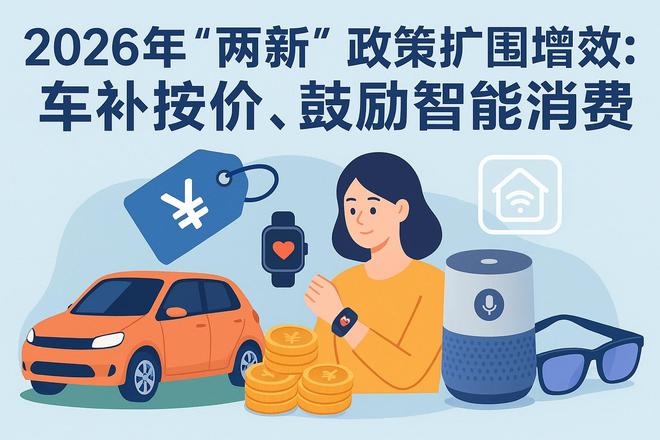
2026年“两新”政策扩围增效:车补按价、鼓励智能消费
Zhong Guo Jing Ying Bao· 2026-01-06 09:09
Core Viewpoint - The 2026 "Two New" policy aims to proactively address economic challenges and promote high-quality development through early implementation and expanded support for equipment updates and consumer goods replacement programs [2][8]. Group 1: Policy Implementation - The National Development and Reform Commission and the Ministry of Finance have issued a notice detailing the support scope and subsidy standards for the 2026 "Two New" policy [2]. - The policy is designed to maintain continuity with the 2025 economic work conference's emphasis on optimizing the "Two New" policy implementation [2]. Group 2: Coverage Expansion - The 2026 policy expands its coverage to include updates for old community elevators, equipment for elderly care institutions, and commercial facilities such as shopping centers and supermarkets [3]. - New subsidies for smart products have been introduced, covering smart watches, smart glasses, and smart home products, including those designed for elderly users [3]. Group 3: Structural Adjustments - The subsidy standards have been optimized, with a focus on electric vehicles and higher-priced consumer goods [6]. - The adjustment in subsidies for automobiles from fixed amounts to a percentage of the vehicle price indicates a shift towards supporting higher-value purchases [6]. Group 4: Funding and Timing - The first batch of 625 billion yuan in special long-term bonds for 2026 has been allocated earlier than in 2025, indicating a focus on quickly realizing policy effects [6][7]. - The total funding for the 2026 "old for new" program is estimated to be around 250 billion yuan, which is expected to generate approximately 625 billion yuan in consumption growth [7]. Group 5: Long-term Strategy - The policy aims to balance short-term economic support with long-term transformation by leveraging market forces to upgrade demand and innovate supply [8].

旅游消费以40%增长意愿登顶榜首
Jiang Nan Shi Bao· 2026-01-05 23:18
Core Insights - Consumption is a persistent driver of economic growth and reflects the quality of life for residents in Jiangsu, with a significant shift towards high-quality, intelligent, and green consumption patterns expected by 2026 [1] Group 1: Consumer Trends - The survey indicates that by 2026, tourism is expected to see a nearly 40% increase in spending, making it the top area of growth, followed by education and health-related consumption [2] - 46% of respondents plan to increase their investment in quality education, with this figure rising to 51.6% in rural areas, highlighting a collaborative improvement in educational consumption perspectives between urban and rural residents [2] - The younger demographic (ages 18-25) and women are identified as the main consumers, with 51.8% of young individuals planning to increase their travel expenditures in 2026 [2] Group 2: Health and Wellness Consumption - The shift in health consumption from disease treatment to preventive measures is evident, with expected growth in sports and wellness spending ranking third and fourth respectively by 2026 [3] - Different age groups exhibit varying preferences, with younger consumers favoring smart wearables and image management, while older consumers are willing to pay a premium for high-end nutritional products and traditional Chinese medicine [3] - 59.6% of residents prefer home-based elderly care, but 48.2% prioritize community health services, indicating a strong demand for integrated healthcare solutions [3] Group 3: Emerging Consumption Areas - The cultural and entertainment sector shows robust growth, with Jiangsu being the second-largest movie ticket market in China, where 58% of respondents choose to spend on films [4] - The demand for home services is expanding, particularly among the 26-45 age group, which constitutes 66.7% of high-spending consumers, reflecting a trend towards professional and customized services [4] - The "pet economy" is gaining traction, with 64.1% of pet owners being from the post-80s and post-90s generations, indicating a shift from functional to emotional spending on pets [4]
2026年投资策略-重视服务消费布局元年
2026-01-05 15:42
Summary of Key Points from Conference Call Records Industry Overview - The focus is on the service consumption sector, which is expected to be a key area for investment in 2026, driven by structural opportunities in the consumer market and the shift in consumer behavior from basic needs to entertainment and experience-based consumption [1][4]. Core Insights and Arguments - **Consumer Market Dynamics**: The total retail sales are projected to reach 50 trillion, primarily concentrated in goods and dining, showcasing strong resilience [1]. - **Service Consumption Potential**: There is significant potential in service consumption, supported by policies that increase holidays and enhance consumer capacity. The aging population, particularly the 60s demographic, is driving demand for healthcare and wellness services, making the silver economy a growth engine [1][5]. - **Travel Industry Opportunities**: Key areas in the travel industry include duty-free, hotels, scenic spots, and OTA (Online Travel Agency). The OTA sector has exceeded expectations due to supply chain recovery, while the duty-free sector benefits from a rebound in high-end consumption [1][6]. - **Population Dividend**: Four demographic groups (50s, 60s, 90s, and 10s) present new investment opportunities, corresponding to healthcare, silver economy, single economy, and parent-child education [1][7]. - **Technological Impact**: The application of technology is fostering a positive cycle of supply and demand for emerging products, with innovations attracting consumer interest [1][8]. Additional Important Insights - **Hainan Duty-Free Policy**: The ongoing duty-free policy in Hainan is expected to release significant consumption potential, particularly among local residents, and the introduction of domestic goods in duty-free stores is anticipated to drive growth [1][9][10]. - **Hotel Industry Outlook**: The hotel sector is expected to return to healthy growth in 2026, with leading companies likely to improve their valuations and performance due to supply-side improvements [1][11]. - **Tourism Sector Expectations**: The tourism industry is projected to thrive in 2026, supported by increased holiday days and potential service consumption subsidies, with a focus on the silver economy and pilgrimage tourism [1][12]. - **Restaurant Industry Trends**: The restaurant sector is expected to adapt well in a weak economic environment, with opportunities arising from new business lines and improved operational capabilities [1][14]. Investment Strategies - **Social Service Sector**: Investment strategies for 2026 focus on two main lines: incremental markets with marginal changes (duty-free, hotels, silver economy) and stable long-term opportunities in chain businesses and supply chains [2]. - **Education Sector**: The education sector is expected to see growth in vocational and AI education, with policies supporting resource allocation to match demographic structures [3][19]. Recommendations - **Key Companies to Watch**: - **Vocational Education**: Huatu Shanding, China Oriental Education, Action Education - **AI Education**: Duolingo, Kevin Education, TAL Education, New Oriental, Youdao, and Hong Kong-listed Fenbi [20]. This summary encapsulates the critical insights and strategic directions discussed in the conference call, highlighting the potential investment opportunities across various sectors.
研究了10000名消费者,我们为2026写下30条新消费暴利的秘密 |「万字长文」
新消费智库· 2026-01-05 13:23
Group 1 - The core consumption logic in China is shifting from "cost-performance" and "emotional value" to "quality-price ratio" and "comprehensive self-satisfaction" as consumers become more rational and discerning in their purchases [2][3] - The Z generation (ages 18-27) views consumption as a means of expressing identity and belonging, prioritizing "identity consumption" over mere "need consumption" [4][6][10] - The "谷子经济" (Guzi Economy) is emerging as a significant market, driven by emotional value and the willingness of consumers, especially the Z generation, to pay for intangible assets like fandom and community [10][11] Group 2 - The Z generation is increasingly skeptical of influencer marketing, with only 11% trusting recommendations from online personalities, preferring authentic and relatable brand interactions [12][13] - The trend of "micro-luxury" consumption is rising, where consumers seek small indulgences that provide immediate happiness and a sense of control over their lives [12][13] - The demand for convenience is leading to a rise in "extreme time-saving" solutions, with consumers willing to pay for products that simplify their daily routines [15][16] Group 3 - The second-hand market is gaining traction as consumers seek unique, high-quality items while also valuing sustainability, with platforms for vintage and second-hand goods becoming social hubs [16][17] - Digital assets are being accumulated for their potential future value, with consumers finding satisfaction in owning a vast array of digital content, even if unused [18][19] - A trend towards "aesthetic minimalism" is emerging, with consumers favoring simpler, less polished designs that emphasize authenticity over excessive packaging [20][23] Group 4 - The younger generation is increasingly seeking authentic experiences, often traveling to less commercialized areas to escape urban monotony and engage with local cultures [24][25] - The Z generation is characterized by "precise ambiguity," using specific labels to express their multifaceted identities, which brands must understand and respect [26][27] - The "小镇中年" (Small Town Middle-Aged) demographic is becoming a stable consumer base, relying heavily on community recommendations and valuing local pride [30][32] Group 5 - The "leisure economy" is thriving, with consumers prioritizing leisure activities that enhance their quality of life, such as local dining and short trips [33][34] - Social currency is becoming a key driver of consumption, where purchases are made not just for personal use but also to enhance social standing within local communities [35][36] - The preference for trusted national brands is evident, with consumers favoring mid-range products that offer reliability and value for money [36][37] Group 6 - The rise of service consumption reflects a shift towards valuing time and convenience, with consumers willing to pay for services that simplify their lives [46][47] - The "healing economy" is emerging as a significant market, with consumers regularly engaging in emotional wellness activities to cope with modern stressors [48][50] - Anti-aging products are evolving into a more systematic and scientific approach, with consumers investing in comprehensive anti-aging solutions [51][52] Group 7 - Membership-based shopping models are gaining popularity, as consumers seek curated selections that save time and ensure quality [52][54] - The revival of physical media, such as books and vinyl records, highlights a desire for tangible experiences and the ritualistic aspects of consumption [57][58] - The "new middle-class women" are redefining self-satisfaction, investing in holistic self-improvement across various aspects of life [61][62]

消费者服务行业周报(20251229-20260104):元旦假期消费数据亮眼,看好2026服务消费-20260105
Huachuang Securities· 2026-01-05 11:26
Investment Rating - The report maintains a "Recommended" investment rating for the consumer services industry, indicating an expectation of exceeding the benchmark index by 10%-20% over the next six months [1]. Core Insights - The core focus of the report is on the strong performance of the travel market during the New Year holiday, with significant recovery in both domestic and international travel. The Ministry of Culture and Tourism estimates that 142 million domestic trips were made during the three-day holiday, with total spending reaching 84.789 billion yuan, reflecting a 19.4% increase compared to 2023 and a 1.1% increase compared to 2024 [4][5]. - The report highlights the dual advantages of time and space for travel during the 2026 New Year holiday, as some travelers could extend their holiday to eight days by taking three days off work. This has led to notable growth in outbound travel, nearby trips, winter sports tourism, duty-free shopping, and hotel bookings [4]. - The report expresses optimism for the performance of service consumption-related sectors in 2026, citing specific companies in various segments such as hotels, human resources services, duty-free shops, gaming, internet platforms, catering, tourism, and sports [4]. Summary by Sections Industry Basic Data - The consumer services industry comprises 55 listed companies with a total market capitalization of 498.804 billion yuan and a circulating market capitalization of 457.081 billion yuan [1]. Relative Index Performance - The consumer services sector experienced a decline of 0.72% this week, while the overall A-share market fell by 0.33%, and the CSI 300 index decreased by 0.59% [7]. Important Announcements - Key announcements include leadership changes at companies like 科锐国际 and 天立国际控股, as well as financial performance updates from various firms [32]. Upcoming Shareholder Meetings - Several companies, including 西安旅游 and 凯撒旅业, have scheduled shareholder meetings in January 2026 [34]. Industry News - The report covers various industry developments, including the surge in domestic travel bookings and the launch of new services by companies like 京东 and 拼多多, indicating a vibrant market environment [35][36].
高盛发布2026年中国经济展望:看好中国出口前景
Zheng Quan Ri Bao Wang· 2026-01-05 10:46
Group 1 - The core viewpoint of the report is that Goldman Sachs is optimistic about China's export prospects, forecasting a real export growth rate of approximately 8% in 2025 and 5% in 2026, with nominal export growth remaining robust at 5.6% in 2026 compared to 5.5% in 2025 [1] Group 2 - The resilience of China's exports is attributed to three main factors: rapid expansion of exports to emerging market economies driven by strong competitiveness of Chinese products and demand generated by Chinese foreign investments [2] - China holds a dominant position in rare earth and other critical mineral sectors, contributing to export strength [3] - There is potential for growth in high-tech exports, supported by policy initiatives and capital expenditure cycles related to the global artificial intelligence industry [3] Group 3 - In terms of consumption, the continuation of the "old-for-new" subsidy plan for consumer goods in 2026 is expected to support service consumption growth, which is anticipated to outpace goods consumption growth [3] - Investment growth is expected to slow in the second half of 2025 due to local government financing restrictions and "anti-involution" policies targeting overcapacity in certain industries [3] - However, with a policy emphasis on stabilizing investment in 2026, Goldman Sachs projects a rebound in fixed capital formation growth from 1.5% in 2025 to 3.5% in 2026 [3]

万联晨会-20260105
Wanlian Securities· 2026-01-05 01:17
Core Insights - The report indicates that the domestic service consumption has increased to 47% of total consumption, entering a phase of rapid growth and becoming a major component of household spending. The long-term stability and focus of policies on service consumption have been emphasized, highlighting its growing importance in policy frameworks. The current valuation of the social service sector remains below the average of the past five years, indicating potential for recovery [9][8]. Market Review - On the last trading day of 2025, the Shanghai Composite Index rose by 0.09% to close at 3968.84 points, while the Shenzhen Component Index fell by 0.58% and the ChiNext Index dropped by 1.23%. The total trading volume in the Shanghai and Shenzhen markets reached 2.05 trillion yuan. In terms of industry performance, sectors such as defense, media, and real estate led the gains, while communication, agriculture, and electronics lagged behind. Concept stocks related to Xiaohongshu, Kuaishou, and China Shipbuilding saw increases, whereas sectors like silicon energy and liquid cooling servers experienced declines [6][2]. Important News - The State Council has set a target for the comprehensive utilization of major solid waste to reach 4.5 billion tons annually by 2030, with a focus on recycling 510 million tons of major renewable resources. The plan emphasizes the elimination of outdated production capacity and the prohibition of new mining projects without supporting waste disposal facilities [7][3]. - Ctrip's report indicates a strong start for the domestic tourism market in 2026, with a fourfold increase in ticket bookings compared to the previous year. The report highlights that the post-00s generation represents the largest demographic of travelers at 39%, followed by the post-90s at 33% [7][3]. Industry Insights - The travel chain sector is expected to see marginal improvements due to the introduction of the Spring and Autumn holiday system, which will extend consumption periods and accelerate travel demand [11]. - The duty-free market at airports is undergoing significant changes, with the introduction of international retailers and investment in airport equity expected to revitalize the market. The policy benefits and the effects of duty-free shopping are anticipated to stimulate consumer interest [11]. - The restaurant industry is experiencing accelerated chain development, with leading companies expanding rapidly through standardized operations and brand recognition. The industry is expected to undergo a significant consolidation phase, with regional brands expanding nationally [11]. - Emerging consumption trends include service platforms that enhance user engagement and efficiency, concert experiences that cater to younger audiences, and sports events that leverage star athletes and strong operational models to create a sustainable ecosystem [11].