
PPI

Search documents
10月物价前瞻:CPI同比或回升,核心通胀有望延续复苏态势
Sou Hu Cai Jing· 2025-11-07 23:57
Group 1: CPI Insights - The National Bureau of Statistics will release October's consumer price index (CPI) data on November 9 at 9:30 AM [1] - In September, the national CPI decreased by 0.3% year-on-year and increased by 0.1% month-on-month, while the core CPI rose by 1.0%, marking the first return to 1% in nearly 19 months [2] - Multiple institutions predict a rebound in October's CPI, with estimates ranging from -0.1% to 0.1% [2] - Pork prices continue to negatively impact the CPI, with wholesale prices declining year-on-year from -26.3% to -27.2% in October [2] - Prices for 28 monitored vegetables and 7 monitored fruits are expected to improve, with year-on-year declines narrowing from -18.7% and -5.3% to -10.0% and -2.7%, respectively [2] Group 2: PPI Insights - Institutions anticipate a slight increase in the year-on-year decline of the Producer Price Index (PPI) for October, reflecting weak short-term economic performance [4] - In September, the national PPI decreased by 2.3% year-on-year and remained flat month-on-month [4] - Forecasts for October's PPI year-on-year change range from -2.2% to -2.6% [4] - The PMI for major raw material purchase prices and factory prices fell by 0.7 percentage points compared to September, indicating a potential month-on-month PPI decline [5] - The fluctuation in PPI is influenced by international commodity prices and domestic industry competition, with expectations of a year-on-year PPI decline of -2.6% and a month-on-month decline of -0.6% [5]
10月份CPI同比增速有望回升
Zheng Quan Ri Bao Zhi Sheng· 2025-11-07 16:12
Group 1 - The overall price trend in October is expected to remain stable, with a potential recovery in CPI growth due to the National Day and Mid-Autumn Festival boosting tourism and consumption prices [1] - CPI is projected to turn positive at 0.1% year-on-year, while PPI is expected to show a slight decline, with a year-on-year drop of 2.5% [2] - Food prices are experiencing structural increases, particularly in vegetables and fruits, while pork and egg prices are declining due to reduced demand post-holidays [1][2] Group 2 - The service sector's business activity index has risen to 50.2%, indicating a slight recovery, influenced by holiday spending and upcoming promotional events [2] - The CRB index has decreased by 1.2% month-on-month, primarily due to a significant drop in Brent crude oil prices, while metal prices have increased by 3.9% [3] - Domestic industrial product prices are declining, with the South China Industrial Products Index down by 2.0% month-on-month, reflecting limited demand support [3]
21评论丨经济企稳回升支撑A股中长期向上
2 1 Shi Ji Jing Ji Bao Dao· 2025-11-06 22:39
横向对比全球其他主要经济体,中国经济已经呈现出领先于全球经济复苏的特征。以美国为例,截至今 年8月,美国新增非农3个月均值已经回落至2.9万人。历史经验表明,当这个指标回落至10万人以下, 明明(中信证券首席经济学家) 11月6日,沪指收盘涨近1%重返4000点,在近期全球主要股市调整过程中,A股也走出独立上涨行情, 展现出较强韧性。今年以来,中国股市持续走强,既体现了中国经济企稳回升,也代表了以AI、机器 人为代表的新质生产力突破性发展。展望未来,随着"十五五"规划逐步推进,中国资本市场将迎来更大 的发展机会。 从经济周期的绝对水平看,我国宏观环境稳中向好的迹象越发明晰,这突出表现为需求端对经济的拖累 正在弱化。一方面,地产是过去几年中国经济的最大变化,而由于过去几年地产投资的较快速收缩,今 年地产投资规模的跌幅仅为2023年的一半左右。这也导致了地产投资在固定资产中的占比已经从2019年 的25%左右下行至2025年前三季度的14%左右,地产对经济的拖累已经明显减弱;另一方面,消费正在 企稳,且对外部的刺激更加敏感。综合社零总量和结构的变化,可以看出今年消费出现了两大积极变 化。第一大变化是社零的弹性正在 ...


经济企稳回升支撑A股中长期向上
2 1 Shi Ji Jing Ji Bao Dao· 2025-11-06 22:22
Group 1 - The core viewpoint is that the Chinese stock market has shown resilience and independent growth amidst global market adjustments, reflecting a recovery in the Chinese economy and advancements in new productivity driven by AI and robotics [2] - The macroeconomic environment in China is stabilizing, with reduced drag from the real estate sector, which has seen a significant decline in investment, dropping from approximately 25% of fixed assets in 2019 to around 14% in the first three quarters of 2025 [3] - Consumer spending is stabilizing, with notable growth in sectors benefiting from government subsidies, indicating an improvement in consumer sentiment [3] Group 2 - Leading indicators suggest that the economic cycle is in the final stage of preparing for a rebound, with improvements in M1 money supply indicating better expectations in the real economy [4] - The Producer Price Index (PPI) is expected to show further recovery in the coming quarters, which historically aligns with economic cycles, suggesting a potential rebound in the economy [4][5] - Compared to other major economies, China's economic recovery is ahead, with signs of a decoupling from the U.S. economic cycle, which is currently facing recessionary pressures [5] Group 3 - The performance of equity assets is closely tied to economic conditions, with expectations of strong stock performance in the upcoming year as the economic cycle is anticipated to recover [6] - Investor risk appetite is expected to remain high, correlating with the anticipated recovery in the economic cycle, which supports a positive outlook for stock performance [6]

欧元区9月PPI环比下降0.1%
Mei Ri Jing Ji Xin Wen· 2025-11-05 10:13
Core Insights - Eurozone's Producer Price Index (PPI) decreased by 0.1% month-on-month in September, against an expectation of 0% [1] - The previous value was revised from -0.30% to -0.4% [1] Summary by Category - **Economic Indicators** - The PPI decline indicates a potential easing in inflationary pressures within the Eurozone [1] - The revision of the previous month's PPI suggests a more significant contraction than initially reported [1]
国内高频 | 港口货运量大幅上行(申万宏观·赵伟团队)
申万宏源宏观· 2025-11-04 15:23
Core Viewpoint - The article discusses the current state of industrial production, construction, and demand trends in China, highlighting a mixed performance across various sectors, with some showing signs of recovery while others remain weak. Industrial Production Tracking - The operating rate of blast furnaces has significantly declined, with a week-on-week decrease of 3% to 81.7%, and a year-on-year drop of 3.3 percentage points [2][6] - Steel apparent consumption has increased by 2.7% week-on-week and returned to positive territory year-on-year, up 2.9 percentage points to 2.8% [2][8] - Social inventory continues to decline, down 2.1% week-on-week [2] Construction Industry Insights - Cement production and demand have shown slight improvement but remain weaker than the same period last year, with a grinding operating rate up 1% to 46.3% week-on-week and a year-on-year increase of 2.8 percentage points [24][25] - Cement shipment rates increased by 0.8% week-on-week but are down 8.8% year-on-year [24][28] - The cement inventory ratio continues to rise, up 2.3% week-on-week [24][31] Demand Tracking - The transaction volume of commercial housing continues to decline, with a week-on-week drop of 11.3% and a year-on-year decrease of 4.3 percentage points to -25% [47][48] - The average daily transaction area in 30 major cities has seen significant declines, particularly in first-tier cities, which experienced a year-on-year drop of 20.1 percentage points [47][51] - Port cargo throughput has rebounded significantly, with a year-on-year increase of 16.5% [57][64] Price Trends - Agricultural product prices are showing mixed performance, with vegetable prices rising by 8.1% week-on-week, while pork and egg prices have decreased by 0.8% and 0.5%, respectively [99][100] - The overall industrial product prices are on the rise, with the South China Industrial Product Price Index increasing by 1.8% week-on-week [111][112]

限额以下消费或回升——10月经济数据前瞻
Huachuang Securities· 2025-11-04 11:13
Group 1: Economic Outlook - In October, limited consumption is expected to rebound, with a projected growth rate of around 5% for limited goods consumption, up from 3.77% in September[2] - The average growth rate for limited goods consumption (excluding catering) is forecasted to be 2.7% in 2023, 3.55% in 2024, and 4.24% in the first three quarters of 2025[3] - The contribution of limited goods consumption (excluding catering) to total retail sales is significant, accounting for 52.2% in 2024[3] Group 2: Price Trends - CPI is expected to show a slight year-on-year decline of around -0.1% in October, with a month-on-month change of approximately 0%[4] - PPI is projected to decrease by -0.2% month-on-month and slightly worsen to -2.4% year-on-year in October[4] Group 3: Production and Trade - Industrial production growth is anticipated to slow to about 5.5% in October[5] - Export growth is expected to decline to around 3.5% year-on-year in October, while imports are projected to grow by 1%[5][13] Group 4: Investment and Real Estate - Fixed asset investment growth is forecasted to drop to -0.8% for the period from January to October, with real estate investment down by -14.5%[5][17] - Real estate sales area growth is expected to be around -15% in October, with major developers experiencing a 41.9% year-on-year decrease in sales[5][18] Group 5: Financial Indicators - New social financing is expected to reach 1.1 trillion yuan in October, a decrease of 200 billion yuan compared to the previous year[6][24] - M2 growth is projected to be around 8.4% year-on-year, while new M1 is expected to be approximately 6%[6][24]
信用指标修正,价值因子得分提高——量化资产配置月报202511
申万宏源金工· 2025-11-04 08:02
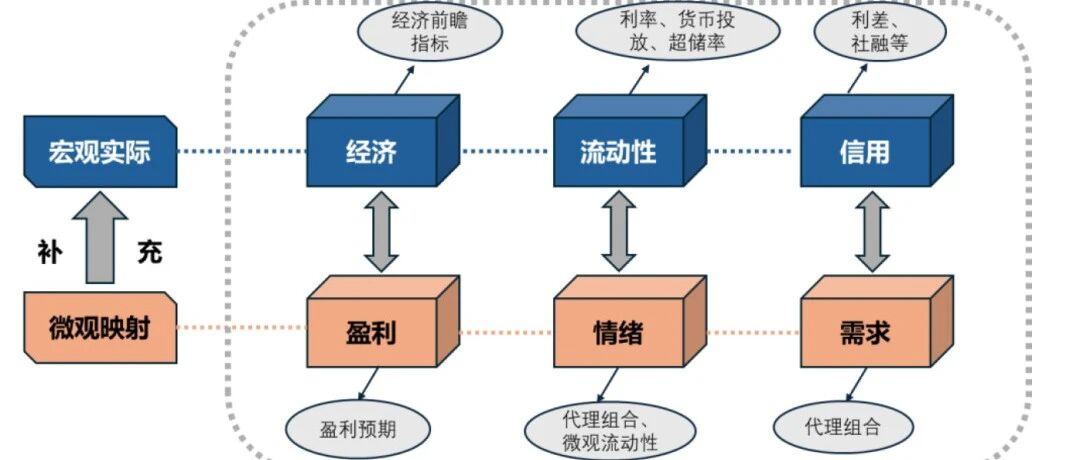
Core Insights - The article discusses the integration of macro quantification and factor momentum to identify resonant factors for investment strategies, emphasizing the importance of economic, liquidity, and credit indicators in shaping market expectations [1][3]. Group 1: Factor Scores and Market Indicators - The macroeconomic indicators show signs of recovery, with economic growth expected to improve, while liquidity is slightly weak and credit conditions are tightening [3][4]. - Value factors have seen a significant increase in scores, becoming resonant factors in the CSI 300 index, while growth factors have declined [4][6]. - The article presents a table of factor scores across different indices, indicating a preference for value and low volatility factors in the current market environment [4]. Group 2: Economic Outlook and Leading Indicators - The economic leading indicators model suggests that the economy is in a rising cycle since September 2025, with a slight upward trend expected in the coming months [6][9]. - Specific indicators such as PMI and fixed asset investment are analyzed, showing a mixed outlook with some indicators in a rising phase while others are nearing a peak [11][12]. - The article highlights the importance of monitoring leading indicators to anticipate future economic cycles and potential downturns [9][10]. Group 3: Liquidity and Credit Conditions - The liquidity environment is assessed as slightly loose despite some tightening in interest rates, with a focus on the net monetary supply and excess reserve rates [12][16]. - Credit indicators show a mixed picture, with overall credit volume and structure remaining low, but some signs of recovery are noted [17][18]. - The article suggests a cautious approach to credit-sensitive investments due to the ongoing tightening in credit conditions [17]. Group 4: Asset Allocation and Market Focus - The asset allocation strategy is adjusted to reflect a neutral to positive stance on A-shares, while reducing exposure to gold and bonds due to changing market dynamics [18]. - The focus on PPI and liquidity as key market drivers indicates a shift in investor sentiment towards these macroeconomic variables [19]. - The article emphasizes the importance of selecting industries that are sensitive to economic changes but less affected by credit conditions, with a preference for sectors like utilities and coal [21].
从M1、M2到资产配置——四季度M1同比的拆解预测
一瑜中的· 2025-11-03 16:04
Core Viewpoints - The static forecast indicates that the old-caliber M1 is expected to decline from 6.2% in September to around 3.4% by the end of the year, while M2 is projected to decrease from 8.4% in September to approximately 8.0% by year-end, both remaining higher than the end of 2024 [2] - The analysis framework for M1 and M2 growth involves understanding the components of M1 as part of M2, with M1 being derived from M2 minus other currencies [7][17] Group 1: M2 Growth Factors - M2 growth is influenced by five main factors: corporate leverage, household leverage, foreign exchange derivation, government leverage, and other factors [8][20] - The forecast for M2 growth indicates a decline of 900 billion, with M2 expected to decrease to around 8.0% by year-end due to factors such as reduced government leverage and a decline in corporate loans [8][22][28] Group 2: M1 Growth Analysis - The old-caliber M1 is expected to decline by 1.6 trillion year-on-year, with a forecasted drop to 3.4% by year-end, influenced by factors such as a decrease in household deposits and a stable level of non-bank deposits [9][10][52] - The analysis of other currencies shows that household deposits are expected to decrease by 620 billion, while non-bank deposits are projected to increase by 1.9 trillion [46][47] Group 3: Impacts on Capital Markets - Changes in M1 are seen as leading indicators for price improvements, with M1 growth typically preceding changes in PPI and industrial product inventory by three to four quarters [54] - Non-bank deposits are closely linked to trading volumes in the financial market, with higher non-bank deposits correlating with increased trading activity [55] - The relationship between corporate and household deposits can predict corporate profits and ten-year treasury yields approximately one year in advance [57] Group 4: Potential Scenarios for M1 Changes - Several scenarios for potential M1 changes in Q4 are proposed, including increased corporate loans and infrastructure investment, which could lead to upward pressure on M1 and M2 [63] - Another scenario suggests that a decrease in M2 and household deposits, alongside an increase in corporate deposits, could indicate improved economic cycles and profitability [64]

11月期货财经日历来了
Qi Huo Ri Bao· 2025-10-31 23:58
Group 1 - The article outlines key economic indicators and events scheduled for November 2025, including U.S. employment data and manufacturing indices [2][3] - It highlights the release of various economic reports such as the U.S. trade balance for September and the ADP employment report for October [2][3] - The calendar includes significant dates for central bank meetings, including the Reserve Bank of Australia's interest rate decision and the Bank of England's rate announcement [2][3] Group 2 - The article mentions the upcoming release of China's October CPI and PPI, which are critical for assessing inflation trends [2] - It notes the importance of the U.S. non-farm payroll report and unemployment rate for October, which are key indicators of labor market health [2][3] - The article also references the OPEC monthly report and its implications for the oil market, alongside weekly EIA crude oil inventory data [2][3]
