
成本支撑

Search documents
需求压制整体偏弱 聚丙烯继续下行空间不大
Qi Huo Ri Bao· 2025-11-04 02:22
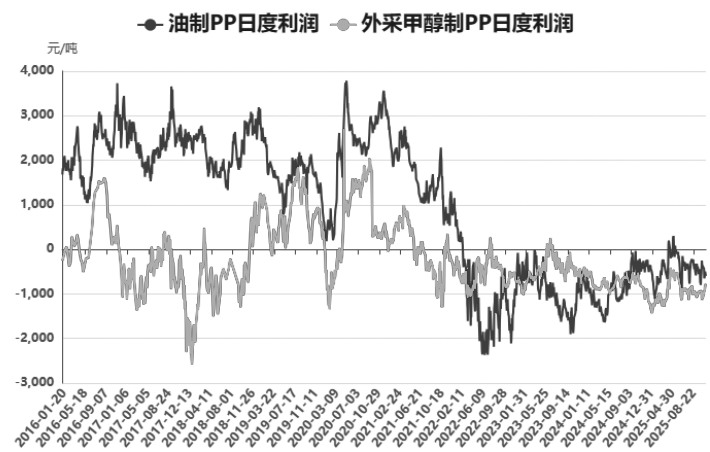
Core Viewpoint - The polypropylene (PP) prices have declined unexpectedly after the traditional peak demand season, primarily due to weaker-than-expected demand and falling oil prices, leading the industry into a state of overall losses [1][5][11] Demand and Supply Analysis - The traditional peak demand season, known as "Golden September and Silver October," did not exhibit significant characteristics this year, with the global economic downturn impacting PP's essential demand [1][9] - In September, domestic plastic product output was 7.303 million tons, a year-on-year decrease of 2.54%, marking two consecutive months of decline [1] - BOPP demand has shown limited improvement, with downstream sectors such as e-commerce, food packaging, and clothing packaging underperforming expectations, resulting in a 15% year-on-year decrease in orders for injection molding enterprises [3] - The PP industry is experiencing severe oversupply, with many companies, particularly PDH enterprises, reducing production or shutting down due to losses, which may help alleviate inventory pressure [9][11] Price and Profitability Trends - Oil prices have significantly dropped, with WTI crude oil falling from $78 per barrel to $55 per barrel, a nearly 30% decline, which has negatively impacted chemical products, including PP [5] - As of early November, the losses for various PP production methods are as follows: oil-based PP at 550 yuan/ton, coal-based PP at 300 yuan/ton, methanol-based PP at 1000 yuan/ton, propylene-based PP at 250 yuan/ton, and PDH-based PP at 800 yuan/ton [5] - The overall profitability of PP has been compressed, with the industry entering a comprehensive loss state [5][11] Production and Operational Insights - The PP maintenance season primarily occurs from April to July, with a notable increase in operating rates post-August, reaching over 85%. However, unplanned maintenance has led to a decline in operating rates below 85% in September and further down to 80% by the end of October, nearing historical lows [6][9] - The expansion of PP production capacity has mainly occurred in the first half of the year, resulting in limited market impact from new capacities in the second half, thus alleviating supply pressure [9][10] Trade Dynamics - In September, China's polypropylene imports reached 290,200 tons, a month-on-month increase of 17.49%, while cumulative imports from January to September totaled 2.4578 million tons, a year-on-year decrease of 9.01% [10] - Conversely, September's polypropylene exports were 237,600 tons, a month-on-month decrease of 13.88%, with cumulative exports from January to September amounting to 2.3411 million tons, a year-on-year increase of 28.27% [10] - The changing import-export dynamics have somewhat alleviated domestic supply-demand imbalances, with some months seeing higher export volumes than imports, indicating a potential shift from a net importer to a net exporter of PP [10]

丙烯月报:市场承压,丙烯高供应弱需求格局难改-20251103
Yin He Qi Huo· 2025-11-03 10:49
Report Industry Investment Rating No relevant content provided. Core View of the Report The propylene market is under pressure, and the pattern of high supply and weak demand is difficult to change. In the absence of strong cost pull and significant improvement in demand, the market drive will return more to fundamental logic. The follow - up needs to closely monitor OPEC+ production policies, the actual impact of winter energy demand on propane and coal prices, and changes in downstream demand [3][52]. Summary by Directory 1. Market Review - In October, the center of propylene prices moved down overall. The propylene futures 2601 contract fell below 6,000 yuan/ton on October 21. After the National Day, the supply increased due to the restart of PDH units, and the cost support of PDH - made propylene weakened. In late October, the sanctions on Russian oil companies by the US led to a rebound in international oil prices and drove up propylene prices. However, high supply and inventory suppressed the price, and it dropped at the end of the month [2]. - In October, the average load of domestic propylene units was 78.47%, an increase of 1.34% compared to September. Although some units were under maintenance, the overall load remained high. The production in September decreased by 110,000 tons to 5.52 million tons compared to August, and it was expected to rebound in October. The demand was weak due to the low operating rate of polypropylene, and the supply - demand pattern remained loose [8]. 2. Market Outlook - Supply side: OPEC+ is expected to maintain a small increase in production, which may lead to a long - term supply surplus of global crude oil. Domestic propylene load is expected to remain at a high level of about 78%, and the restart of large - scale units in November and December will further increase supply [3][27][52]. - Cost side: The cost support may show a differentiated trend. The long - term supply surplus of crude oil may make the support of oil - based cost unstable. The seasonal increase in propane's combustion demand in winter may support CP prices and slow down the decline of PDH process costs, but its impact on propylene prices depends on downstream acceptance [3][52]. - Demand side: The recovery of demand is not optimistic. The operating rate of polypropylene, the largest downstream product, remains low, and the poor profit situation of most downstream derivative industries is difficult to improve in the short term [3][52]. 3. Strategy Recommendation - Unilateral: Consolidation in a range [5][53]. - Arbitrage: 1 - 2 reverse spread [5][53]. - Options: Double - selling options [5][53].
黑色产业链日报-20251103
Dong Ya Qi Huo· 2025-11-03 10:45
Report Industry Investment Rating No relevant content provided. Core Views - The overall finished steel is supported by raw material costs and the warming of macro - sentiment, but consumption demand has entered the off - season, and it is difficult for subsequent apparent demand to rebound. It is expected that the finished steel will fluctuate and adjust [3]. - The iron ore market is currently facing a situation of "exhausted macro - benefits and pressured fundamentals" in the short term. With supply remaining high, port inventories accumulating, and demand suppressed by shrinking steel mill profits and falling hot metal production, coupled with the strong coking coal squeezing profits, the upside space for iron ore prices is limited [20]. - Policy on checking over - production and safety production restricts the supply elasticity of coking coal. Coupled with the upcoming winter storage inventory transfer, the downward adjustment space for coking coal spot prices may be relatively limited. If the supply of coking coal continues to tighten in the fourth quarter and the winter storage demand is released in mid - to - late November, the overall valuation center of the black industry is expected to move up [33]. - After the landing of macro - sentiment, ferroalloys return to their fundamentals of high inventory and weak demand, but are supported by the cost side below. It is expected that ferroalloys will fluctuate [49]. - Soda ash is mainly priced by cost. Although the cost side is expected to be firm, with strong expectations for thermal coal and the current low and stable salt price (no trend - like increase has been seen), the valuation has no upward elasticity without production cuts. The medium - to - long - term supply of soda ash is expected to remain high, and normal maintenance continues. Photovoltaic glass has started to accumulate inventory at a low level, and daily melting remains stable. The overall rigid demand for soda ash has stabilized, and the heavy soda balance remains in surplus. In September, soda ash exports exceeded 180,000 tons, which met expectations and continued to relieve domestic pressure to some extent. The high inventory of the upstream and mid - stream restricts the price of soda ash, but the cost support below limits the downward space [60]. - The coal - to - gas conversion in Shahe will be gradually implemented this month, which may affect market supply and sentiment in the short term. However, with the arrival of the off - season and high inventory in the mid - stream, it is rationally considered that the impact is limited and needs to be observed. Currently, the position of the glass 01 contract has reached a new high, and the game may continue until near the delivery. There are still structural contradictions in glass. Without unexpected production cuts, the price of the 01 contract glass will eventually decline, but the realization path may wait until near the delivery. In the long - term, there is cost support and policy expectations [86]. Summary by Related Catalogs Steel - **Futures Prices and Spreads** - On November 3, 2025, the closing prices of rebar 01, 05, and 10 contracts were 3079, 3145, and 3168 yuan/ton respectively; those of hot - rolled coil 01, 05, and 10 contracts were 3295, 3304, and 3324 yuan/ton respectively. Rebar and hot - rolled coil month - spreads remained mostly unchanged compared to October 31, 2025 [4]. - **Spot Prices and Basis** - On October 31, 2025, the rebar summary price in China was 3265 yuan/ton, and prices in different regions such as Shanghai, Beijing, and Hangzhou remained stable compared to October 30. The basis of different rebar contracts in Shanghai and Beijing also showed certain changes. For hot - rolled coil, prices in different regions such as Shanghai, Lecong, and Shenyang had some fluctuations, and the basis of different contracts also changed [8][10]. - **Other Ratios** - The 01, 05, and 10 rebar/iron ore ratios were all 4, and the 01, 05, and 10 rebar/coke ratios were all 2 on November 3, 2025, remaining unchanged compared to October 31 [17]. Iron Ore - **Price Data** - On November 3, 2025, the closing prices of 01, 05, and 09 contracts were 782.5, 760.5, and 740.5 respectively, showing a decline compared to October 31. The basis of each contract increased, and the prices of different types of iron ore in Rizhao such as PB powder, Carajás fines, and Super Special also had some changes [21]. - **Fundamental Data** - In late October 2025, daily average hot metal production decreased, 45 - port desilting volume increased, global and Australia - Brazil shipments increased, 45 - port arrivals increased significantly, 45 - port inventory increased, 247 - steel mill inventory decreased, and the available days of 247 steel mills decreased [27]. Coking Coal and Coke - **Disk Prices and Spreads** - On November 3, 2025, the coking coal warehouse - receipt cost of Tangshan Mongolian 5 remained unchanged, and the basis of different coking coal types and contracts had certain changes. For coke, the warehouse - receipt cost and basis of different regions and contracts also changed, and the month - spreads of coking coal and coke contracts showed some fluctuations [34][37]. - **Spot Prices and Profits** - On November 3, 2025, the prices of different types of coking coal such as Anze low - sulfur main coking coal and Mongolian 5 coal showed different trends, and the prices of different types of coke such as Jinzhong quasi - first - grade wet coke and Lvliang quasi - first - grade dry coke also had some changes. The import profits of different countries' coking coal and the export profit of coke also changed [38][39]. Ferroalloys - **Silicon Iron** - On November 3, 2025, the basis of silicon iron in Ningxia increased, and the month - spreads of different contracts showed certain changes. The spot prices of silicon iron in different regions such as Ningxia, Inner Mongolia, and Qinghai had some fluctuations, and the prices of raw materials such as semi - coke and steam coal remained stable [49]. - **Silicon Manganese** - On October 31, 2025, the basis of silicon manganese in Inner Mongolia increased, and the month - spreads of different contracts changed. The spot prices of silicon manganese in different regions such as Ningxia, Inner Mongolia, and Guizhou had some fluctuations, and the prices of raw materials such as ores and chemical coke remained stable [52]. Soda Ash - **Disk Prices and Spreads** - On November 3, 2025, the prices of soda ash 01, 05, and 09 contracts all declined compared to October 31. The month - spreads of different contracts also changed, and the basis of heavy soda in Shahe and Qinghai remained unchanged [61]. - **Spot Prices and Spreads** - The prices of heavy and light soda ash in different regions such as North China, South China, and East China remained stable on November 3, 2025, and the spreads between heavy and light soda ash in different regions also remained unchanged [62][64]. Glass - **Disk Prices and Spreads** - On November 3, 2025, the prices of glass 01, 05, and 09 contracts all increased compared to October 31. The month - spreads of different contracts changed, and the basis of different contracts in Shahe and Hubei also had some changes [87]. - **Daily Sales and Production** - From October 27 to November 2, 2025, the sales - to - production ratios of glass in Shahe, Hubei, East China, and South China showed different trends [88].
广发期货《有色》日报-20251103
Guang Fa Qi Huo· 2025-11-03 06:05
Report Industry Investment Rating No relevant information provided. Core Viewpoints Copper - After interest rate cuts and tariff implementation, the market may enter a macro "vacuum period" in November. The next key macro events are the December FOMC meeting, the domestic Politburo meeting, and the Central Economic Work Conference. Pay attention to the Fed's interest rate cut rhythm and China - US tariff situation. - The shortage of copper ore supply supports the price floor. If by - product prices like sulfuric acid continue to fall and TC remains low, smelters may face cash - flow losses and experience phased production cuts. - Downstream demand for copper is resilient. Although there is price - aversion sentiment, there is still significant procurement after price drops. In the medium - to - long - term, supply - demand contradictions support the upward movement of the copper price floor, but short - term sharp increases may suppress demand. Pay attention to marginal changes in demand and US tariff conditions, with the main support level at 86,000 - 86,500 [2]. Aluminum - In October, the alumina futures price was under pressure, and it is expected to remain weakly volatile in November with limited rebound space. The market should focus on whether large - scale production cuts will occur if prices continue to fall. - In October, the electrolytic aluminum market was strong. In November, the Shanghai aluminum price is expected to remain high and volatile with limited upside. Although high prices may suppress downstream procurement, the overall macro environment is positive. However, domestic supply is under pressure due to high operating capacity and expected import arrivals, and downstream demand is not strong enough [4]. Aluminum Alloy - In October, the casting aluminum alloy futures followed the aluminum price and strengthened. The supply of scrap aluminum is tight, squeezing enterprise profits. In November, the ADC12 price is expected to remain strong and volatile, with an operating range of 20,200 - 21,000 yuan/ton. Pay attention to scrap aluminum supply, downstream demand, and policy implementation [6]. Zinc - The supply - loosening logic has spread from the zinc ore end to the zinc ingot end. Supply growth may be limited due to compressed smelting profits. Demand has no unexpected performance, but the low overseas inventory creates a risk of a short squeeze on LME, supporting the zinc price. The domestic zinc ingot supply is relatively loose, and export windows are intermittently open. In the short - term, the zinc price will be volatile and strong, but the fundamentals may limit its upward movement. It is expected to remain range - bound between 22,000 - 23,000 [11]. Tin - The supply of tin ore remains tight, and the improvement in supply may be limited this year. Demand is weak, and although some consumption is driven by AI and photovoltaics, it cannot offset the decline in traditional demand. In the short - term, the tin price may fall due to the Fed's hawkish stance. If the supply from Myanmar recovers well, the price may weaken; otherwise, it will remain strong [13]. Nickel - The nickel market is range - bound with no clear one - way trend. The production of refined nickel remains high, and the price of nickel ore is firm. The price of ferronickel is under pressure, and the demand for stainless steel is weak, while the demand for ternary materials has inventory - building needs but may not be sustainable. The market should pay attention to the 2026 RKAB approval in Indonesia. The price is expected to be range - bound between 118,000 - 126,000 [14]. Stainless Steel - The stainless steel market is volatile, with supply pressure and insufficient demand improvement. The price of nickel ore is firm, and the price of ferronickel is under pressure. The chromium iron market is weakly stable. The supply of 300 - series stainless steel remains high, and demand is mainly for rigid needs. The social inventory is slowly decreasing. In the short - term, the price is expected to be range - bound between 12,500 - 13,000 [17]. Lithium Carbonate - Last week, the lithium carbonate futures were strong, but the market was affected by supply - side news. The fundamentals are currently strong, with a slight decrease in weekly production and an unexpected improvement in downstream demand. In November, the supply - demand change is expected to be limited, and the price is expected to be widely volatile between 78,000 - 87,000 [20]. Summary by Directory Copper Price and Basis - SMM 1 electrolytic copper price decreased by 0.56% to 87,570 yuan/ton, and the SMM 1 electrolytic copper premium increased by 55 yuan/ton to 0 yuan/ton. - The refined - scrap price difference decreased by 10.31% to 3,966 yuan/ton, and the import profit and loss improved by 89.84 yuan/ton to - 793 yuan/ton [2]. Fundamental Data - In October, the electrolytic copper production was 109.16 million tons, a decrease of 2.62% from the previous month. In September, the electrolytic copper import volume was 33.43 million tons, an increase of 26.50% from the previous month [2]. Aluminum Price and Spread - SMM A00 aluminum price increased by 0.38% to 21,280 yuan/ton, and the premium increased by 10 yuan/ton to 0 yuan/ton. - The import profit and loss improved by 44.7 yuan/ton to - 2,471 yuan/ton, and the Shanghai - London ratio increased by 0.01 to 7.45 [4]. Fundamental Data - In October, the alumina production was 778.53 million tons, an increase of 2.39% from the previous month, and the electrolytic aluminum production was 374.21 million tons, an increase of 3.52% from the previous month. In September, the electrolytic aluminum export volume was 2.90 million tons, an increase of 13.07% from the previous month [4]. Aluminum Alloy Price and Spread - SMM Southwest ADC12 price increased by 0.47% to 21,400 yuan/ton, and the 2511 - 2512 monthly spread decreased by 95 yuan/ton to - 145 yuan/ton [6]. Fundamental Data - In September, the production of recycled aluminum alloy ingots was 66.10 million tons, an increase of 7.48% from the previous month, and the production of primary aluminum alloy ingots was 28.30 million tons, an increase of 4.43% from the previous month [6]. Zinc Price and Spread - SMM 0 zinc ingot price increased by 0.13% to 22,280 yuan/ton, and the premium increased by 10 yuan/ton to - 30 yuan/ton. - The import profit and loss improved by 483.90 yuan/ton to - 4,273 yuan/ton, and the 2511 - 2512 monthly spread increased by 35 yuan/ton to - 5 yuan/ton [11]. Fundamental Data - In October, the refined zinc production was 61.72 million tons, an increase of 2.85% from the previous month. In September, the refined zinc import volume was 2.27 million tons, a decrease of 11.61% from the previous month [11]. Tin Spot Price and Basis - SMM 1 tin price increased by 0.14% to 284,400 yuan/ton, and the LME 0 - 3 premium increased by 247.83% to 40 US dollars/ton. - The import profit and loss decreased by 1.75% to - 15,516.50 yuan/ton, and the 2511 - 2512 monthly spread decreased by 7.14% to - 600 yuan/ton [13]. Fundamental Data - In September, the tin ore import volume was 8,714 tons, a decrease of 15.13% from the previous month, and the SMM refined tin production was 10,510 tons, a decrease of 31.71% from the previous month [13]. Nickel Price and Basis - SMM 1 electrolytic nickel price decreased by 0.20% to 121,950 yuan/ton, and the 1 Jinchuan nickel premium increased by 100 yuan/ton to 2,550 yuan/ton. - The futures import profit and loss improved by 7.21% to - 1,429 yuan/ton, and the 2512 - 2601 monthly spread decreased by 60 yuan/ton to - 190 yuan/ton [14]. Fundamental Data - In October, the Chinese refined nickel production was 32,200 tons, an increase of 1.26% from the previous month. The refined nickel import volume in the relevant period decreased by 3.00% [14]. Stainless Steel Price and Spread - The price of 304/2B (Wuxi Hongwang 2.0 coil) decreased by 0.39% to 12,900 yuan/ton, and the 2512 - 2601 monthly spread decreased by 5 yuan/ton to - 45 yuan/ton. - The Chinese 300 - series stainless steel crude steel production in 43 factories was 176.19 million tons, a decrease of 0.99% from the previous month, and the stainless steel export volume was 41.85 million tons, a decrease of 6.55% from the previous month [17]. Lithium Carbonate Price and Basis - SMM battery - grade lithium carbonate average price increased by 0.69% to 80,220 yuan/ton, and the SMM electric - carbon - industrial - carbon price difference remained unchanged at 2,200 yuan/ton. - The basis (based on SMM electric carbon) increased by 167.93% to 1,250 yuan/ton, and the 2511 - 2512 monthly spread remained unchanged at - 1,420 yuan/ton [20]. Fundamental Data - In October, the lithium carbonate production was 92,260 tons, an increase of 5.73% from the previous month, and the lithium carbonate demand in September was 116,801 tons, an increase of 12.28% from the previous month [20].
长江期货聚烯烃月报-20251103
Chang Jiang Qi Huo· 2025-11-03 05:59
Report Industry Investment Rating - Not provided in the document Core Views - Polyolefins face significant upward pressure and are expected to trade within a range. Key factors to watch include downstream demand, Fed rate cuts, China-US talks, the Middle East situation, and crude oil price fluctuations. The cost side provides short-term support at the bottom, but due to insufficient supply-demand improvements, upward pressure remains high. The PE main contract is expected to oscillate within a range, with support at 6900, while the PP main contract is expected to weaken with support at 6600. The LP spread is expected to widen [8][9] - Plastics still have supply-demand contradictions and are expected to move in a sideways pattern [10] - PP faces significant trend pressure and is expected to weaken in the short term [51] Summary by Directory Plastic Market Review - On October 31, the closing price of the plastic main contract was 6,899 yuan/ton, a month-on-month decrease of 3.55%. The average price of LDPE was 9,136.67 yuan/ton, a month-on-month decrease of 2.92%. The average price of HDPE was 7,650 yuan/ton, a month-on-month decrease of 3.32%. The average price of LLDPE (7042) in South China was 7,421.76 yuan/ton, a month-on-month decrease of 1.70%. The South China basis of LLDPE closed at 522.76 yuan/ton, a month-on-month increase of 31.68%. The 1-5 month spread was -75 yuan/ton (-178) [12] Key Data Tracking - **Month Spread**: The 1-5 month spread was -75 yuan/ton (-178), the 5-9 month spread was -53 yuan/ton (-39), and the 9-1 month spread was 128 yuan/ton (+217) [19] - **Spot Price**: The spot prices of various polyethylene products in different regions showed different degrees of change, with some prices rising and some falling [20][21] - **Cost**: In October, WTI crude oil closed at $60.88 per barrel, a decrease of $1.55 from the previous month, and Brent crude oil closed at $64.58 per barrel, a decrease of $1.57 from the previous month. The quotation of anthracite at the Yangtze River port was 1,090 yuan/ton (+10) [23] - **Profit**: The profit of oil-based PE was -357 yuan/ton, an increase of 9 yuan/ton from the previous month, and the profit of coal-based PE was 201 yuan/ton, a decrease of 320 yuan/ton from the previous month [28] - **Supply**: The production start-up rate of polyethylene in China this month was 80.86%, a decrease of 0.98 percentage points from the end of last month. The weekly output of polyethylene was 643,500 tons, a month-on-month decrease of 0.71%. The maintenance of petrochemical enterprise equipment remained at a high level this week, with a maintenance loss of 112,100 tons, an increase of 54,000 tons from last week [33] - **2025 Production Plan**: A total of 5.43 million tons of new polyethylene production capacity is planned to be put into operation in 2025, with some already in operation and some still under construction [36] - **Maintenance Statistics**: Multiple polyethylene production lines of various enterprises are under maintenance, with some having uncertain restart times [38] - **Demand**: The overall start-up rate of domestic agricultural film this week was 49.53%, an increase of 16.67% from the end of last month; the start-up rate of PE packaging film was 51.30%, a decrease of 1.07% from the end of last month; the start-up rate of PE pipes was 32.17%, unchanged from the end of last month [39] - **Downstream Production Ratio**: Currently, the production ratio of linear film is the highest, accounting for 33.5%, which is 1.8% different from the annual average level. The difference between the high-pressure film and the annual average data is significant, currently accounting for 8.8%, which is 1.8% different from the annual average level [43] - **Inventory**: The social inventory of plastic enterprises this week was 527,400 tons, a decrease of 7,400 tons from the end of last month, a month-on-month decrease of 1.38% [45] - **Warehouse Receipts**: The number of polyethylene warehouse receipts was 12,706 lots, a decrease of 30 lots from the end of last month [48] PP Market Review - On October 31, the closing price of the polypropylene main contract was 6,590 yuan/ton, a decrease of 262 yuan/ton from the end of last month, a month-on-month decrease of 3.82% [52] Key Data Tracking - **Downstream Spot Price**: The prices of various polypropylene products showed different degrees of change, with some prices rising and some falling [54][56] - **Basis**: On October 31, the spot price of polypropylene reported by Business Society was 6,723.33 yuan/ton (-2.84). The PP basis was 133 yuan/ton (+65), and the basis widened. The 1-5 month spread was -40 yuan/ton (-19), and the month spread narrowed [58] - **Month Spread**: The 1-5 month spread was -84 yuan/ton (-128), the 5-9 month spread was -19 yuan/ton (-85), and the 9-1 month spread was 103 yuan/ton (+213) [63] - **Cost**: In October, WTI crude oil closed at $60.88 per barrel, a decrease of $1.55 from the previous month, and Brent crude oil closed at $64.58 per barrel, a decrease of $1.57 from the previous month. The quotation of anthracite at the Yangtze River port was 1,090 yuan/ton (+10) [68] - **Profit**: The profit of oil-based PP was -606.91 yuan/ton, a decrease of 113.03 yuan/ton from the end of last month, and the profit of coal-based PP was -269.20 yuan/ton, a decrease of 607.60 yuan/ton from the end of last month [73] - **Supply**: The start-up rate of Chinese PP petrochemical enterprises this week was 77.06%, an increase of 1.54 percentage points from the end of last month. The weekly output of PP pellets reached 789,200 tons, a week-on-week increase of 1.48%, and the weekly output of PP powder reached 78,200 tons, a week-on-week increase of 4.82% [77] - **Maintenance Statistics**: Multiple PP production lines of various enterprises are under maintenance, with some having uncertain restart times [80] - **Demand**: The average start-up rate of downstream industries this week was 52.61% (+0.30). The start-up rate of plastic weaving was 44.20% (-0.20%), the start-up rate of BOPP was 61.57% (+0.16%), the start-up rate of injection molding was 59.06% (+0.72%), and the start-up rate of pipes was 36.807% (-0.07%) [82] - **Import and Export Profit**: The import profit of polypropylene this week was -$337.83 per ton, an increase of $208.99 from last month, and the export profit was -$31.12 per ton, a decrease of $23.89 from last month [87] - **Inventory**: The domestic inventory of polypropylene this week was 595,100 tons (-6.80%); the inventory of the two major state-owned oil companies decreased by 9.19% month-on-month, the inventory of traders decreased by 2.91% month-on-month, and the port inventory decreased by 2.25% month-on-month [90] - **Warehouse Receipts**: The number of polypropylene warehouse receipts was 14,569 lots, an increase of 471 lots from the end of last month [103]
《特殊商品》日报-20251103
Guang Fa Qi Huo· 2025-11-03 05:58
Group 1: Glass and Soda Ash Report Industry Investment Rating Not provided Core Viewpoints - For soda ash, the post - National Day price has been weakly oscillating, with low demand and obvious over - supply. The mid - term demand is expected to remain at the previous rigid level. It is recommended to take profit on previous short positions and wait for shorting opportunities on rebounds. [1] - For glass, the weekend news of production line shutdown in Shahe may have a positive impact on the market sentiment. Although there is still some peak - season demand expectation in November, the industry still needs capacity clearance in the long - term. It is recommended to close previous short positions and look for short - term long opportunities. [1] Summary by Directory - **Prices and Spreads**: Glass and soda ash spot prices in different regions remained unchanged on November 3, 2025. Glass 2505 decreased by 0.88%, and Glass 2509 increased by 0.08%. Soda ash 2505 decreased by 0.60%, and Soda ash 2509 increased by 0.08%. [1] - **Supply**: Soda ash's weekly output decreased by 1.71% to 75.76 tons, and its operating rate decreased by 1.72% to 86.89%. Floating - glass daily melting volume remained unchanged, while photovoltaic daily melting volume decreased by 0.84%. [1] - **Inventory**: Glass factory inventory increased by 4.72% to 65790,000 weight - cases, soda ash factory inventory increased by 2.54% to 1.702 million tons, and soda ash delivery - warehouse inventory decreased by 3.18% to 676,900 tons. [1] - **Real Estate Data**: New construction area increased by 0.09%, construction area decreased by 2.43%, completion area decreased by 0.03%, and sales area decreased by 6.50%. [1] Group 2: Natural Rubber Report Industry Investment Rating Not provided Core Viewpoints - In the short - term, rubber prices are under pressure due to the Fed's hawkish stance on December's interest - rate cut. The prices may decline further if raw - material supply is smooth; otherwise, they are expected to oscillate between 15,000 - 15,500. [2] Summary by Directory - **Prices and Spreads**: Most natural rubber spot prices decreased on October 31, 2025. The 9 - 1 spread decreased by 6.67%, the 1 - 5 spread increased by 22.22%, and the 5 - 9 spread decreased by 16.67%. [2] - **Fundamentals**: In August, Thailand's production decreased by 0.43%, Indonesia's decreased by 4.30%, India's increased by 11.11%, and China's increased. Tire production in August increased by 9.10%, and tire exports in September decreased by 10.65%. [2] - **Inventory Changes**: Bonded - area inventory decreased by 1.20%, and natural - rubber factory - warehouse futures inventory increased by 4.73%. [2] Group 3: Logs Report Industry Investment Rating Not provided Core Viewpoints - Although the log futures price is at a relatively low level and the import cost provides some support, the market is still expected to oscillate at the bottom due to the weak supply - demand situation. [3] Summary by Directory - **Prices and Spreads**: On October 31, 2025, most log futures prices changed slightly. The 11 - 01 spread decreased by 22.0, and the 11 - 03 spread decreased. [3] - **Supply**: From October 27 to November 2, 2025, the number of pre - arriving New Zealand log ships at 13 Chinese ports increased by 33% week - on - week, and the arrival volume increased by 19%. [3] - **Demand**: As of October 24, the national coniferous log inventory decreased by 80,000 cubic meters week - on - week, and the daily log delivery volume increased by 120,000 cubic meters. [3] Group 4: Industrial Silicon Report Industry Investment Rating Not provided Core Viewpoints - In November, the industrial silicon market still faces inventory pressure. Although supply may decline slightly and demand may remain stable, the flow of warehouse receipts to the spot market will increase supply. The price is expected to oscillate at a low level, with a main range of 8,500 - 9,500 yuan/ton. [5] Summary by Directory - **Prices and Spreads**: On October 31, 2025, most industrial silicon spot prices remained stable or increased slightly. The 2511 - 2512 spread decreased by 8.86%, and the 2601 - 2602 spread increased by 300.00%. [5] - **Fundamentals**: In October, the national industrial silicon production increased by 7.46%, the national operating rate increased by 10.86%. Organic silicon DMC production decreased by 0.29%, and polysilicon production increased by 3.08%. [5] - **Inventory Changes**: Most industrial silicon inventories decreased slightly, with the social inventory decreasing by 0.18% and the warehouse - receipt inventory decreasing by 0.33%. [5] Group 5: Polysilicon Report Industry Investment Rating Not provided Core Viewpoints - In November, the polysilicon market is expected to be in a situation of weak supply and demand, with a high - level range - bound oscillation. Investment strategies include short - term long positions in futures, selling put options, and buying ETFs or related stocks. [6] Summary by Directory - **Prices and Spreads**: On October 31, 2025, polysilicon spot prices decreased slightly, and the futures price increased by 2.66%. The month - to - month spreads changed to varying degrees. [6] - **Fundamentals**: Weekly silicon - wafer production decreased by 3.33%, and polysilicon production decreased by 4.41%. Monthly polysilicon production increased by 3.08%, and the net export volume decreased by 56.83%. [6] - **Inventory Changes**: Polysilicon inventory increased by 1.16%, silicon - wafer inventory increased by 2.49%, and polysilicon warehouse receipts increased by 2.79%. [6]
《能源化工》日报-20251103
Guang Fa Qi Huo· 2025-11-03 05:58
1. Report Industry Investment Ratings No information provided in the reports. 2. Core Views of the Reports Polyester Industry Chain - PX: In November, with few PX unit overhauls in Asia and China, but concentrated PTA unit overhauls, PX supply - demand is expected to be weak. PX absolute prices are expected to gradually face pressure. The strategy is to follow crude oil for unilateral trading and go short on rallies, and try to shrink the PX - SC spread [1]. - PTA: In November, there are still many PTA unit overhaul plans. With better - than - expected terminal and polyester demand in October and low polyester inventory, PTA supply - demand is expected to be slightly loose with a small inventory accumulation expectation. PTA will continue to oscillate at a low level. The strategy is to follow crude oil for unilateral trading and go short on rallies, and treat TA1 - 5 as a rolling reverse spread [1]. - Ethylene Glycol (MEG): In November, domestic supply is high, overseas shipments are concentrated, and inventory accumulation is expected to be high, putting pressure on the price. The strategy is to sell out - of - the - money call options on rallies and do a reverse spread on EG1 - 5 on rallies [1]. - Short Fiber: In November, supply is expected to remain high, demand may weaken seasonally, and cost support is limited. Short - fiber prices will gradually face pressure. The strategy is similar to PTA for PF12, and try to shrink the PF processing margin when it is above 1000 [1]. - Bottle Chips: In November, supply changes little, demand is in the off - season, and the supply - demand pattern remains loose. Bottle - chip prices will follow the cost side, and the processing margin will fluctuate with raw material costs. The strategy is similar to PTA for PR, and the main - contract processing margin is expected to fluctuate between 300 - 450 yuan/ton [1]. Chlor - Alkali Industry - Caustic Soda: In November, supply is expected to increase, demand support is weak, and prices are expected to be weakly stable. The overall trend is bearish, and it is necessary to track downstream restocking rhythm [2]. - PVC: In October, PVC prices continued to decline. In November - December, supply pressure will continue due to new capacity and high - season operation, and demand is in the off - season. Prices are expected to continue to oscillate at the bottom [2]. Methanol Industry The current market is trading the "weak reality" logic centered on high port inventory. Before the Iranian gas restriction, the weak reality will continue to be priced in. The 01 - contract inventory problem cannot be solved [3][4][5]. Pure Benzene - Styrene Industry - Pure Benzene: In November, supply is expected to be loose, demand support is limited, and although the East China port inventory decreased in October, it may increase later. Pure - benzene prices are expected to have weak driving force, but attention should be paid to unit changes [8]. - Styrene: In November, supply may slightly decrease, demand is expected to change little, and the supply - demand may be in a tight - balance state. However, high port inventory will limit price increases. The strategy is to be bearish on EB12 price rebounds [8]. Polyolefin Industry PP supply recovery has slowed down due to unplanned overhauls, while PE supply is expected to increase. Demand has recovered, but the agricultural film peak is approaching. Overall, supply will increase and demand will decrease, and there is inventory pressure on the 01 - contract. The 05 - contract may have long - term low - buying opportunities, and the monthly spread is suitable for reverse spreads [10]. 3. Summaries According to Relevant Catalogs Polyester Industry Chain Price and Spread - Upstream: Brent crude oil (December) dropped 0.1% to $65.00/barrel, WTI crude oil (December) dropped 0.7% to $60.57/barrel, CFR Japan naphtha rose 1.4% to $573/ton, etc. [1] - Downstream: POY150/48 price remained unchanged at 6415 yuan/ton, FDY150/96 price remained unchanged at 6690 yuan/ton, etc. [1] - PX: CFR China PX rose 0.4% to $820/ton, PX spot price (RMB) dropped 2.4% to 6753 yuan/ton [1]. - PTA: PTA East China spot price dropped 0.6% to 4535 yuan/ton, TA2601 futures rose 0.4% to 4586 yuan/ton [1]. - MEG: MEG port inventory dropped 9.7% to 52.3 million tons, MEG arrival expectation rose 273.6% to 19.8 million tons [1]. 开工率 - Asian PX开工率 dropped 0.5% to 78.1%, Chinese PX开工率 rose 1.1% to 87.0%, PTA开工率 dropped 0.8% to 78.0%, etc. [1] Chlor - Alkali Industry Price and Spread - Shandong 32% liquid caustic soda (converted to 100%) remained at 2500 yuan/ton, East China calcium - carbide - based PVC market price dropped 1.1% to 4610 yuan/ton [2]. 开工率 - Caustic soda industry开工率 rose 0.1% to 85.6%, PVC total开工率 dropped 1.9% to 73.7% [2]. 库存 - Liquid caustic soda East China factory inventory dropped 3.8% to 18.8 million tons, PVC upstream factory inventory dropped 7.4% to 33.4 million tons [2]. Methanol Industry Price and Spread - MA2601 closed at 2180 yuan/ton, down 1.27% from the previous day, and the regional spread between Taicang and Inner Mongolia's north line dropped 9.09% to 150 yuan/ton [3]. 库存 - Methanol enterprise inventory rose 4.36% to 37.606%, methanol port inventory dropped 0.38% to 150.6 million tons [4]. 开工率 - Upstream domestic enterprise开工率 dropped 0.09% to 75.78%, downstream external - procurement MTO device开工率 rose 7.63% to 84.06% [5]. Pure Benzene - Styrene Industry Price and Spread - CFR China pure benzene rose 0.4% to $677/ton, styrene East China spot price rose 1.1% to 6470 yuan/ton [8]. 库存 - Pure benzene Jiangsu port inventory dropped 14.1% to 8.50 million tons, styrene Jiangsu port inventory dropped 4.7% to 19.30 million tons [8]. 开工率 - Asian pure benzene开工率 dropped 0.5% to 78.8%, domestic styrene开工率 dropped 3.7% to 66.7% [8]. Polyolefin Industry Price and Spread - L2601 closed at 6968 yuan/ton, down 0.99% from the previous day, PP2601 closed at 6590 yuan/ton, down 0.92% from the previous day [10]. 库存 - PE enterprise inventory dropped 19.16% to 41.6 million tons, PP enterprise inventory dropped 6.80% to 59.5 million tons [10]. 开工率 - PE device开工率 dropped 0.73% to 80.9%, PP device开工率 rose 1.5% to 77.1% [10].
瓶片短纤数据日报-20251031
Guo Mao Qi Huo· 2025-10-31 03:52
Group 1: Report Industry Investment Rating - No relevant content provided. Group 2: Core Viewpoints of the Report - PTA prices rapidly declined due to no clear news of "anti-involution" in the PTA industry. Despite the continuous recovery of crude oil prices, PTA prices only rebounded slightly before. Although the overall load of domestic PTA plants decreased due to low processing fees, the polyester industry's profits were still constrained by overcapacity pressure caused by new production capacity and the commissioning of overseas plants. With the cost support provided by rising crude oil prices, PTA prices rebounded rapidly after a long period of low - level operation. The current downstream polyester operating rate remained above 91%, with demand slightly exceeding expectations and recent polyester sales generally high. Also, with positive news from China - US economic and trade negotiations, the market sold on positive news [2]. Group 3: Summary of Data Changes Spot and Futures Prices - PTA spot price remained unchanged at 4535, MEG inner - market price decreased by 5 to 4147. PTA closing price dropped by 66 to 4570, and MEG closing price decreased by 68 to 4032 [2]. Short - fiber - related Data - 1.4D direct - spinning polyester staple fiber price decreased by 10 to 6430, short - fiber basis decreased by 11 to 140, 11 - 12 spread increased by 8 to 28, and polyester staple fiber cash flow increased by 6 to 246. The price difference between 1.4D direct - spinning and imitation large - chemical fiber decreased by 10 to 1030 [2]. Bottle - chip - related Data - Polyester bottle - chip prices in the Jiangsu and Zhejiang markets decreased, with the average price down 5 yuan/ton. The processing fee for bottle - chip spot decreased by 7.33 to 447 [2]. Yarn - related Data - T32S pure - polyester yarn price remained unchanged at 10320, and its processing fee increased by 10 to 3890. The price of polyester - cotton yarn 65/35 45S remained unchanged at 16300, and its profit increased by 2.85 to 1539 [2]. Other Fiber - related Data - The price of primary three - dimensional hollow (with silicon) fiber increased by 15 to 7010, and the cash flow of hollow staple fiber 6 - 15D increased by 16.68 to 543. The price of primary low - melting - point staple fiber increased by 10 to 7420 [2]. Operating Rates and Sales Ratios - Direct - spinning short - fiber load (weekly) decreased by 0.01 to 94.40%, polyester staple fiber sales ratio increased by 2% to 43.00%, polyester yarn startup rate (weekly) remained unchanged at 63.50%, and recycled cotton - type load index (weekly) decreased by 0.01 to 51.00% [3].
《有色》日报-20251031
Guang Fa Qi Huo· 2025-10-31 02:32
1. Report Industry Investment Ratings No relevant information provided. 2. Core Views of the Report Copper - After the implementation of interest rate cuts and tariff policies, the copper market may enter a macro "vacuum period" in November. The shortage of copper ore supply strengthens the price bottom, but short - term rapid price increases may suppress demand. The long - term supply - demand contradiction supports the upward movement of the copper price bottom, and the main contract should focus on the support around 87,000 yuan/ton [1]. Aluminum and Alumina - Aluminum prices are expected to remain high and fluctuate. Macro factors such as Sino - US economic and trade consultations and domestic policies support market confidence, while the supply - demand structure shows that supply is restricted and demand has structural highlights. Alumina prices are expected to continue to be under pressure in the short term, with the main contract oscillating between 2,750 - 2,950 yuan/ton, and the market has shown signs of bottoming out [3]. Aluminum Alloy - The casting aluminum alloy market continues to oscillate at a high level. Cost support is prominent, supply is shrinking, demand is moderately recovering, and social inventory is accumulating. The price of ADC12 is expected to maintain a strong - side oscillation, with the main contract reference range of 20,200 - 20,800 yuan/ton [5]. Zinc - Zinc prices are expected to oscillate. The supply is relatively loose, but the smelting profit is compressed, and the subsequent supply increase may be limited. The demand is generally stable, and the LME has the risk of a short squeeze, which supports the zinc price. The main contract reference range is 21,800 - 22,800 yuan/ton [8]. Tin - Tin prices may decline in the short term due to the hawkish statement on interest rate cuts. The supply of tin ore is tight, but the demand is weak. If the supply in Myanmar recovers well, tin prices may weaken; otherwise, they will continue to run strongly [11]. Nickel - The nickel market is expected to oscillate. Macro factors are stable, but the inventory is accumulating, and the medium - term supply is loose. The main contract reference range is 118,000 - 126,000 yuan/ton [13]. Stainless Steel - The stainless - steel market is expected to be weak and oscillate. Macro sentiment has improved, but downstream demand during the peak season is insufficient, and the supply side has pressure from production scheduling and social inventory. The main contract reference range is 12,500 - 13,000 yuan/ton [15]. Lithium Carbonate - Lithium carbonate prices are expected to remain strong in the short term. The downstream demand is better than expected, and the industry is continuously destocking. The main contract reference range is 83,000 - 87,000 yuan/ton [17]. 3. Summary by Relevant Catalogs Copper Price and Basis - SMM 1 electrolytic copper price is 88,065 yuan/ton, up 0.34% from the previous day. The import profit and loss is - 883 yuan/ton, and the month - to - month spread shows different changes [1]. Fundamental Data - In September, electrolytic copper production was 112.10 million tons, a month - on - month decrease of 4.31%. The import volume was 33.43 million tons, an increase of 7 million tons compared with the previous month. The domestic mainstream port copper concentrate inventory decreased by 0.38% [1]. Aluminum and Alumina Price and Spread - SMM A00 aluminum price is 21,200 yuan/ton, up 0.14%. The import profit and loss is - 2,515 yuan/ton, and the month - to - month spread has different changes [3]. Fundamental Data - In September, alumina production was 760.37 million tons, a month - on - month decrease of 1.74%. Electrolytic aluminum production was 361.48 million tons, a decrease of 3.16%. The import volume increased by 13.57%, and the export volume increased by 13.07% [3]. Aluminum Alloy Price and Spread - SMM aluminum alloy ADC12 price is 21,300 yuan/ton, up 0.47%. The month - to - month spread shows different changes [5]. Fundamental Data - In September, the production of recycled aluminum alloy ingots was 66.10 million tons, a month - on - month increase of 7.48%. The production of primary aluminum alloy ingots was 28.30 million tons, an increase of 4.43%. The import volume of non - wrought aluminum alloy ingots increased by 15.77%, and the export volume decreased by 19.24% [5]. Zinc Price and Spread - SMM 0 zinc ingot price is 22,250 yuan/ton, down 0.18%. The import profit and loss is - 4,757 yuan/ton, and the month - to - month spread has different changes [8]. Fundamental Data - In September, refined zinc production was 60.01 million tons, a month - on - month decrease of 4.17%. The import volume decreased by 11.61%, and the export volume increased by 696.78% [8]. Tin Spot Price and Basis - SMM 1 tin price is 284,000 yuan/ton, down 0.42%. The LME 0 - 3 premium is 10.02 US dollars/ton, down 74.95% [11]. Fundamental Data - In September, the import of tin ore was 8,714 tons, a month - on - month decrease of 15.13%. SMM refined tin production was 10,510 tons, a decrease of 31.71%. The export volume increased by 6.59%, and the average operating rate decreased by 31.77% [11]. Nickel Price and Spread - SMM 1 electrolytic nickel price is 122,200 yuan/ton, up 0.25%. The import profit and loss is - 1,540 yuan/ton, and the month - to - month spread has different changes [13]. Supply and Inventory - The production of refined nickel products is 32,200 tons, an increase of 1.26%. SHFE inventory is 36,075 tons, an increase of 4.81%. Social inventory is 48,802 tons, an increase of 2.29% [13]. Stainless Steel Price and Basis - The price of 304/2B (Wuxi Hongwang 2.0 coil) is 12,950 yuan/ton, unchanged. The spot - futures price difference is 385 yuan/ton, up 25.40% [15]. Fundamental Data - The production of 300 - series stainless - steel crude steel in China (43 enterprises) is 182.17 million tons, an increase of 0.38%. The import volume increased by 2.70%, and the export volume decreased by 6.55% [15]. Lithium Carbonate Price and Basis - SMM battery - grade lithium carbonate average price is 80,000 yuan/ton, up 1.07%. The basis is - 1,740 yuan/ton, down 5.45% [17]. Fundamental Data - In September, lithium carbonate production was 87,260 tons, an increase of 2.37%. The demand was 116,801 tons, an increase of 12.28%. The import volume decreased by 10.30%, and the export volume decreased by 59.12% [17].
广发期货-《有色》日报-20251030
Guang Fa Qi Huo· 2025-10-30 07:06
Report Industry Investment Ratings - No industry investment ratings are provided in the reports. Core Views Copper - The Fed cut interest rates by 25bp as expected, and the market is watching the Sino-US summit. The copper price was strong yesterday. In the medium to long term, the supply-demand contradiction supports the upward movement of the copper price's bottom center. In the short term, the rapid increase in price suppresses demand. The market should focus on the marginal changes in demand and Sino-US tariffs, with the main contract supported around 87,000 [1]. Aluminum - The alumina market has shown signs of stabilizing at a low level, with futures prices rebounding slightly and spot market trading activity increasing. The supply pressure is significant, and the demand is weak. The alumina price is expected to remain under pressure in the short term, with the main contract oscillating between 2,750 - 2,950 yuan/ton. The aluminum price has continued to be strong, breaking through 21,300 yuan/ton. The market is in a tight balance, and the aluminum price is expected to remain high and volatile in the short term, with the main contract ranging from 20,800 - 21,400 yuan/ton [3]. Aluminum Alloy - The casting aluminum alloy followed the aluminum price and oscillated at a high level. The cost support is strong, and the supply-demand relationship is in a tight balance. The inventory is gradually decreasing. The ADC12 price is expected to remain strongly oscillating in the short term, with the main contract ranging from 20,200 - 20,800 yuan/ton [5]. Zinc - Overseas interest rates were cut as expected, and the macro environment is warm. The zinc price oscillated strongly yesterday. The supply is relatively loose, and the demand is stable. The LME has the risk of a short squeeze, and the export window for zinc ingots is intermittently open. The zinc price is supported in the short term but may continue to oscillate [8]. Tin - The supply of tin ore is tight, and the demand is weak. Powell's hawkish remarks on the December interest rate cut may cause the tin price to fall in the short term. Considering the strong fundamentals, a low-buying strategy on dips is recommended. The market should focus on macro changes and the supply recovery in Myanmar in the fourth quarter [11]. Nickel - The nickel price oscillated yesterday. The macro sentiment has improved, and the ore price is firm, providing cost support. However, the inventory accumulation exerts some pressure. The nickel price is expected to oscillate in the medium term, with the main contract ranging from 118,000 - 126,000 yuan/ton [13]. Stainless Steel - The stainless steel price oscillated and rose slightly yesterday. The macro environment is positive, but the nickel-iron and ferrochrome prices are under pressure. The supply is expected to increase, and the demand is weak. The stainless steel price is expected to oscillate weakly in the short term, with the main contract ranging from 12,500 - 13,000 yuan/ton [14]. Lithium Carbonate - The lithium carbonate price was strong yesterday. The production has increased, and the demand is optimistic. The raw material supply is tight, and the inventory is decreasing. The lithium carbonate price is expected to remain strong in the short term, with the market watching whether it can break through 83,000 yuan/ton [16]. Summary by Directory Copper Price and Basis - SMM 1 electrolytic copper price decreased by 140 yuan/ton to 87,905 yuan/ton, a decline of 0.16%. The SMM 1 electrolytic copper premium decreased by 5 yuan/ton to -60 yuan/ton [1]. Fundamental Data - In September, the electrolytic copper production was 1.121 million tons, a month-on-month decrease of 4.31%. The import volume was 334,300 tons, a month-on-month increase of 26.50% [1]. Aluminum Price and Spread - SMM A00 aluminum price increased by 10 yuan/ton to 21,170 yuan/ton, an increase of 0.05%. The SMM A00 aluminum premium increased by 10 yuan/ton to -30 yuan/ton [3]. Fundamental Data - In September, the alumina production was 7.6037 million tons, a month-on-month decrease of 1.74%. The electrolytic aluminum production was 3.6148 million tons, a month-on-month decrease of 3.16% [3]. Aluminum Alloy Price and Spread - The SMM ADC12 price remained unchanged at 21,200 yuan/ton. The average price difference between refined and scrap aluminum in Foshan decreased by 107 yuan/ton to 1,774 yuan/ton, a decline of 5.69% [5]. Fundamental Data - In September, the production of recycled aluminum alloy ingots was 661,000 tons, a month-on-month increase of 7.48%. The production of primary aluminum alloy ingots was 283,000 tons, a month-on-month increase of 4.43% [5]. Zinc Price and Spread - The SMM 0 zinc ingot price increased by 20 yuan/ton to 22,290 yuan/ton, an increase of 0.09%. The SMM 0 zinc ingot premium increased by 5 yuan/ton to -40 yuan/ton [8]. Fundamental Data - In September, the refined zinc production was 600,100 tons, a month-on-month decrease of 4.17%. The export volume was 2,500 tons, a month-on-month increase of 696.78% [8]. Tin Spot Price and Basis - The SMM 1 tin price increased by 900 yuan/ton to 285,200 yuan/ton, an increase of 0.32%. The SMM 1 tin premium remained unchanged at 200 yuan/ton [11]. Fundamental Data - In September, the domestic tin ore import volume decreased by 15.13% month-on-month. The SMM refined tin production was 10,510 tons, a month-on-month decrease of 31.71% [11]. Nickel Price and Basis - The SMM 1 electrolytic nickel price decreased by 250 yuan/ton to 121,900 yuan/ton, a decline of 0.20%. The 1 Jinchuan nickel premium increased by 100 yuan/ton to 2,400 yuan/ton [13]. Supply and Inventory - China's refined nickel production in September was 32,200 tons, a month-on-month increase of 1.26%. The import volume was 17,010 tons, a month-on-month decrease of 3.00% [13]. Stainless Steel Price and Spread - The 304/2B (Wuxi Hongwang 2.0 coil) price remained unchanged at 12,950 yuan/ton. The 2512 - 2601 spread decreased by 5 yuan/ton to -15 yuan/ton [14]. Fundamental Data - In September, the production of 300-series stainless steel crude steel in China (43 manufacturers) was 1.8217 million tons, a month-on-month increase of 0.38%. The import volume was 120,300 tons, a month-on-month increase of 2.70% [14]. Lithium Carbonate Price and Spread - The SMM battery-grade lithium carbonate average price increased by 650 yuan/ton to 79,150 yuan/ton, an increase of 0.83%. The SMM industrial-grade lithium carbonate average price increased by 650 yuan/ton to 76,950 yuan/ton, an increase of 0.85% [16]. Fundamental Data - In September, the lithium carbonate production was 87,260 tons, a month-on-month increase of 2.37%. The demand was 116,801 tons, a month-on-month increase of 12.28% [16].