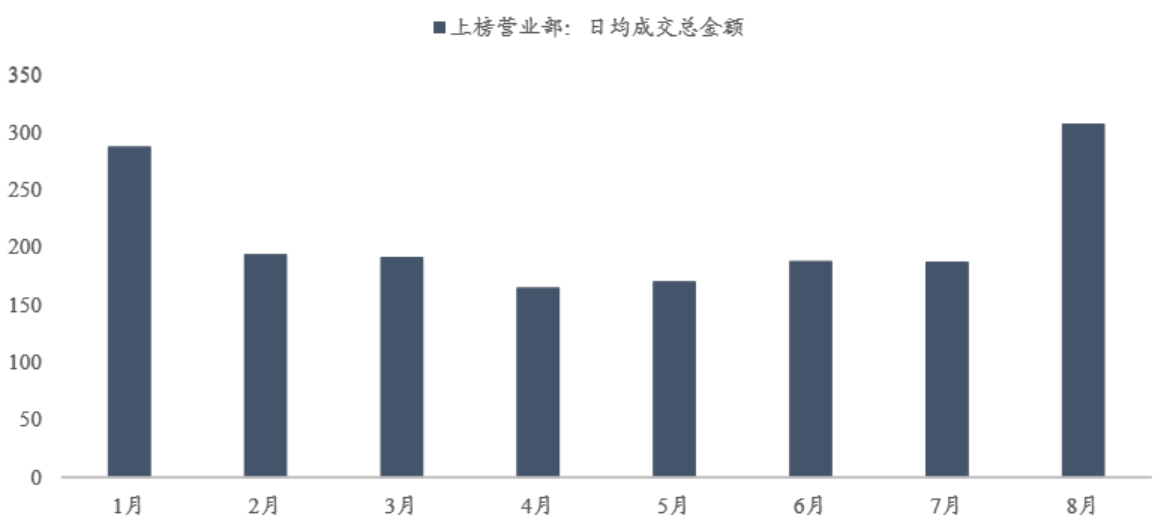
增量资金

Search documents
A股流动性与风格跟踪月报:短期震荡不改成长风格主线,大盘股更优-20250903
CMS· 2025-09-03 13:03
Market Style Outlook - The current liquidity-driven environment remains the main characteristic of the short-term stock market, with changes in market risk appetite dominating market rhythm. As September approaches, the anticipated interest rate cut by the Federal Reserve is expected to influence market expectations. The current heat of financing funds has reached a relatively high level, and future inflows may slow down slightly. However, with the potential for the Fed to restart rate cuts, the appreciation of the RMB, and the stabilization of domestic PPI, foreign capital may gradually shift towards inflow. Historically, during the pullback phase of a bull market, previously strong styles may experience larger corrections, but the market quickly returns to the previous strong main style after a brief pullback. Therefore, the market style in September is likely to favor large-cap stocks, with growth styles expected to continue to dominate [1][4][12]. Liquidity and Fund Supply-Demand - In September, incremental funds are expected to continue net inflow, with positive feedback from incremental funds likely to persist. The central bank continues to use various liquidity management tools to meet liquidity needs, maintaining a strong willingness to protect liquidity. The overall funding rates are expected to remain low. External liquidity conditions are also favorable, with market expectations for a high probability of a Fed rate cut in September, which may lead to a weaker dollar index. In August, the net inflow of funds in the stock market expanded significantly, with financing funds becoming the main source of incremental capital. The supply side shows a rebound in the scale of newly issued equity funds, and the market's risk appetite continues to improve [2][3][20]. Market Sentiment and Fund Preference - In August, market risk appetite further rebounded, with the overall A-share risk premium falling below the historical average. Major indices broke through previous resistance levels, showing an accelerated upward trend. The technology style performed well, with the ChiNext 50 and the Growth Enterprise Market leading the gains. The performance of sectors related to communication electronics and AI computing was particularly strong, with notable performances in computer, power equipment, and machinery sectors [3][31][41]. Major Asset Performance Review - The A-share market led global markets in August, with major indices breaking previous loss resistance levels and showing an accelerated upward trend. The market's upward slope has slowed down towards the end of August, with a shift in style from small-cap to large-cap stocks. The ChiNext 50 and small-cap growth indices led the gains, while the value and dividend styles performed relatively weakly [31][36][37].
A股融资余额再创近10年新高!A500ETF龙头(563800)连续3日上涨,机构:核心资产仍是市场关注焦点
Xin Lang Cai Jing· 2025-09-01 10:27
Group 1 - The A-share market experienced a collective rise on September 1, 2025, with a trading volume of approximately 27,499.61 billion yuan, driven by sectors such as gold, CPO, innovative drugs, and storage chips [1] - As of August 29, 2025, the A-share financing balance reached a new high of 22,454.72 billion yuan, just 211.63 billion yuan short of the historical peak, with the Shenzhen market financing balance also hitting a record [1] - Market sentiment has been buoyed by factors such as the expectation of a Federal Reserve interest rate cut, significant upcoming events, structural prosperity in mid-year reports, and advancements in the domestic AI industry, leading to substantial inflows of incremental capital [1] Group 2 - The A500 index rose by 0.85% as of September 1, 2025, with the leading A500 ETF (563800) increasing by 0.62%, marking three consecutive days of gains [2] - Financial institutions suggest that the A-share market's chip structure has improved following significant fluctuations, with the "anti-involution" policy and demand-side policies being crucial for market performance [2] - Core assets are becoming a focal point for the market, with expectations of a recovery in ROE as net profit margins improve and turnover stabilizes, indicating a potential end to the downward cycle [2] Group 3 - The market is expected to maintain a trend of oscillating upward in September, although at a potentially slower rate compared to August, driven by positive feedback from incremental capital inflows [3] - The external environment appears stable, with high expectations for the Federal Reserve to initiate interest rate cuts, enhancing the attractiveness of RMB assets [3]
牛市赚钱策略:谁是行情推手?紧盯这两路“聪明钱”!(下)
市值风云· 2025-08-29 10:16
Group 1 - The core viewpoint of the article emphasizes that incremental capital is a direct driving force behind the rise of stocks and the stock market, highlighting the importance of understanding where this capital is flowing [3]. - The previous article discussed how high-net-worth individuals are channeling funds into the stock market through wealth management insurance and private equity, indicating a trend in capital movement [3]. - This article aims to explore two additional channels through which incremental capital is entering the stock market, suggesting a broader analysis of capital flows [3].


可转债周报:从增量资金看转债表现的可持续性-20250826
Changjiang Securities· 2025-08-26 15:23
1. Report Industry Investment Rating - No industry investment rating is provided in the report. 2. Core View of the Report - During the week from August 18 to August 23, 2025, the convertible bond market continued to be strong, with the price center rising and risk appetite recovering. Amid valuation differentiation, high - price bonds showed stronger elasticity, medium - and low - price varieties recovered, while those around 100 yuan were under pressure. In terms of funds, the willingness of bank wealth management, ETFs, and insurance funds to increase allocations strengthened, and the trading volume of northbound funds increased, with potential for further growth. The equity market was dominated by the growth style, with technology sectors such as communication, electronics, and computer leading the gains. The cycle and manufacturing sectors were also actively traded, and capital concentration increased. Clause and redemption events were frequent, and market gaming intensified. Overall, it is recommended to follow the technology and manufacturing mainlines, focus on individual bonds with both underlying stock support and elasticity, and be vigilant against fluctuations in high - congestion sectors while balancing and seizing structural opportunities [2][6]. 3. Summary According to Relevant Catalogs 3.1 Incremental Funds and Market Support - The current incremental funds in the convertible bond market come from diverse sources. Bank wealth management, ETFs, and insurance funds are important driving forces. Bank wealth management subsidiaries have a stronger willingness to allocate to equity - related assets due to the increasing proportion of fixed - income + products. The scale of stock - type and convertible - bond - type ETFs has been continuously expanding, and recent capital inflows have effectively supported the market. After the recovery of premium income, insurance funds also show the motivation to increase allocations to equity - related and equity markets. Northbound funds' trading volume has increased, providing potential support for the equity and convertible bond markets. The optimization of the incremental fund structure is expected to strengthen market resilience [10]. 3.2 A - share Market Performance - The major A - share stock indices continued to be strong during the week, with the ChiNext Index leading the gains and the small - and medium - cap growth style being prominent. Although the main funds still had a net outflow, the outflow pressure was marginally relieved, and market sentiment improved. Industry performance was significantly differentiated. Technology - growth sectors such as communication, electronics, and computer led the gains, and there were signs of recovery in the consumer sector, while some cycle sectors were under pressure. Capital was highly concentrated in directions such as electronics and computer, and technology - growth became the core mainline of the market. It is recommended to seize the rotation opportunities within the sectors, be vigilant against the risk of crowded trading, and maintain a flexible and balanced allocation [10]. 3.3 Convertible Bond Market Performance - The convertible bond market continued to be strong during the week, with mid - cap bonds performing better and large - cap bonds relatively weaker. The risk appetite of funds continued to recover. The valuation structure continued to be differentiated, with the high - price range strengthening significantly, some mid - price varieties recovering, and the core range around 100 yuan still under pressure. The implied volatility fluctuated upwards, indicating an increased market expectation of subsequent fluctuations. In terms of industries, machinery and equipment and power equipment were actively traded, and capital concentration increased. Among individual bonds, those with the highest gains were mostly driven by underlying stocks and had the advantages of high elasticity and long duration. It is recommended to focus on varieties with strong underlying stock support and elasticity and beware of risks in high - level sectors [10]. 3.4 Convertible Bond Primary Market - The supply of the convertible bond primary market was stable during the week. One new bond started subscription, and many companies updated their issuance plans, with sufficient subsequent reserves. In terms of clauses, 6 bonds announced that they were expected to trigger downward revisions, 4 bonds clearly stated not to make downward revisions, and 1 bond proposed a downward revision. On the redemption side, 8 bonds were expected to trigger redemption, 8 bonds announced not to redeem in advance, and 8 bonds announced the implementation of forced redemptions. It is recommended that investors pay attention to the marginal impact of clause events on pricing and seize the structural allocation opportunities brought by gaming [10]. 3.5 Market Theme Weekly Review 3.5.1 Equity Theme Weekly Review - During the week, the trading themes in the equity market were active. The stock - trading software index led the gains with a cross - week increase of 27.3%, followed by the consecutive - limit - up index with a 23.8% increase. AI and computer hardware, semiconductor and chip, and communication sectors all performed well, while only the bank - selected index and the system - important financial institution index declined. Short - term funds were highly active, and capital was concentrated in trading themes such as consecutive - limit - up and technology directions such as AI computing power [34]. 3.5.2 Convertible Bond Weekly Review - The convertible bond market remained strong during the week, with mid - cap bonds leading the gains, small - cap bonds rising in tandem, and large - cap bonds lagging behind. The risk appetite of funds continued to recover. The valuation was significantly differentiated, and the implied volatility fluctuated at a high level. The electronics, machinery and equipment, and power equipment sectors were actively traded, and consumer sectors continued to recover. It is recommended to seize the repair opportunities in technology and cycle directions, be vigilant against fluctuations in high - valuation sectors, and make a balanced allocation [36]. 3.6 Market Weekly Tracking 3.6.1 Major Stock Indices and Industry Performance - Major A - share stock indices continued to be strong during the week, with mid - and small - cap stocks performing better. The Shanghai Composite Index rose 3.5%, the Shenzhen Component Index rose 4.6%, and the ChiNext Index rose 5.9%. Although the main funds continued to flow out, the outflow pressure increased marginally, and market sentiment tended to be cautious. The comprehensive, communication, and electronics sectors led the gains, and the consumer sector generally recovered. Capital was concentrated in technology - growth sectors such as communication and electronics [39][43]. 3.6.2 Convertible Bond Market Performance - The convertible bond market continued to strengthen during the week, with the mid - cap index leading the gains. The risk appetite of funds increased. The valuation stretched overall according to the parity range and showed a differentiated pattern according to the market - price range. The implied volatility fluctuated upwards, and the median price of convertible bonds continued to rise. The performance of convertible bonds in all sectors was generally strong, and capital concentration increased slightly. Most individual bonds strengthened, and those with the highest gains were mostly driven by underlying stocks [56][64][71]. 3.7 Issuance and Clause Tracking 3.7.1 Primary Market Issuance Plan - A total of 12 listed companies updated their convertible bond issuance plans during the week, including 1 in the approval - registration stage, 3 in the exchange - acceptance stage, 2 in the shareholders' - meeting stage, and 6 in the board - of - directors' - plan stage. The total disclosed scale of projects in the exchange - acceptance stage and later was 547.6 billion yuan [77][78]. 3.7.2 Downward Revision and Redemption Clauses - Six convertible bonds announced that they were expected to trigger downward revisions, 4 announced not to make downward revisions, and 1 proposed a downward revision. Eight convertible bonds were expected to trigger redemption, 8 announced not to redeem in advance, and 8 announced the implementation of forced redemptions [86][92].
外资投行:市场上涨可持续吗?
淡水泉投资· 2025-08-26 09:49
Core Viewpoint - The A-share market has seen accelerated upward momentum since late June, with the Shanghai Composite Index surpassing 3,800 points, reaching a ten-year high, driven by improved market sentiment and increased foreign institutional interest in Chinese stocks [1]. Group 1: Market Uptrend Sustainability - The sustainability of the current market rally is a key topic among institutions, with overseas entities attributing the rise to several factors, including improved macroeconomic expectations and targeted consumption policies [4]. - The 10-year and 30-year government bond yields have been on the rise since June, indicating a more optimistic outlook among investors, which has facilitated a shift of funds from the bond market to the stock market [4]. - The focus on micro-level structural highlights, such as AI computing power, innovative pharmaceuticals, robotics, and smart driving, is seen as crucial for supporting overall market profitability [7]. - Significant inflows of incremental capital have contributed to liquidity, with long-term funds like insurance capital entering the market, resulting in over 1 trillion yuan in new capital [10]. - Upcoming policy catalysts, such as the Fourth Plenary Session of the 20th Central Committee and the next five-year growth plan, are expected to provide clearer insights into the "anti-involution" policy and its implications for economic rebalancing [10]. Group 2: "Anti-Involution" Policy Focus - The "anti-involution" policy has gained significant attention from foreign institutions, with discussions centered on its timing, similarities and differences with the 2016-2018 supply-side reform, and key areas of focus [14]. - The policy aims to alleviate supply chain financing risks, curb excessive investment expansion, enhance product quality, and optimize resource allocation, thereby strengthening the long-term resilience of the Chinese economy [14]. - The current economic recovery foundation is still fragile, leading to expectations that the impact of this policy on economic growth may be less significant than that of the previous supply-side reform [15]. Group 3: Foreign Investor Sentiment - Foreign investor interest in the Chinese stock market has reached a near-high level, driven by factors such as the need to diversify risks from the U.S. market and the potential for renminbi appreciation [16]. - In July, net inflows from foreign capital into the Chinese stock market accelerated to $2.7 billion, up from $1.2 billion in June, primarily led by passive funds [17]. - As of late July, passive funds had accumulated a total inflow of $11 billion into the Chinese stock market for the year, surpassing the $7 billion for the entire year of 2023 [17]. - The trend of capital inflows has continued into August, with hedge funds net buying Chinese stocks at the fastest pace in seven weeks [19]. - Despite the recovery in foreign capital sentiment, active funds remain underweight in their allocation to Chinese stocks, indicating potential for further inflows [21].

东方财富陈果:增量资金或推动A股牛市第二阶段加速演绎!本轮牛市较近2轮牛市高点仍有明显距离
Sou Hu Cai Jing· 2025-08-25 04:00
Group 1 - The core viewpoint of the article indicates that the Shanghai Composite Index has surged past the 3700 and 3800 points, reaching a 10-year high, driven by a recovery in risk appetite and a rebalancing of valuation between stocks and bonds [1][5][8] - The market is experiencing a second phase of a bull market, with significant participation from retail investors, private equity, and foreign capital, leading to increased liquidity and trading volume [2][5][12] - The shift from a "barbell strategy" to a more balanced investment approach is confirmed, as sectors like technology and domestic semiconductor industries gain traction [5][10][22] Group 2 - Recent behavior of different types of incremental capital shows that retail investors are increasingly optimistic about the bull market, with a notable rise in discussions and investments in ETFs [14][17] - The Federal Reserve's signals regarding potential interest rate cuts have improved the liquidity environment, particularly benefiting Hong Kong stocks, which are now seen as more attractive compared to A-shares [3][26] - The current bull market is still in its second phase, with many indicators suggesting that there is significant room for growth compared to previous bull market peaks [4][25][27]

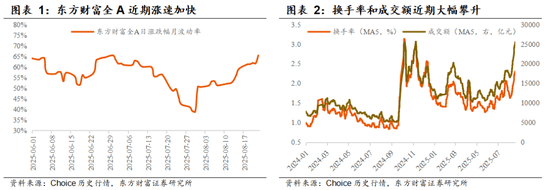
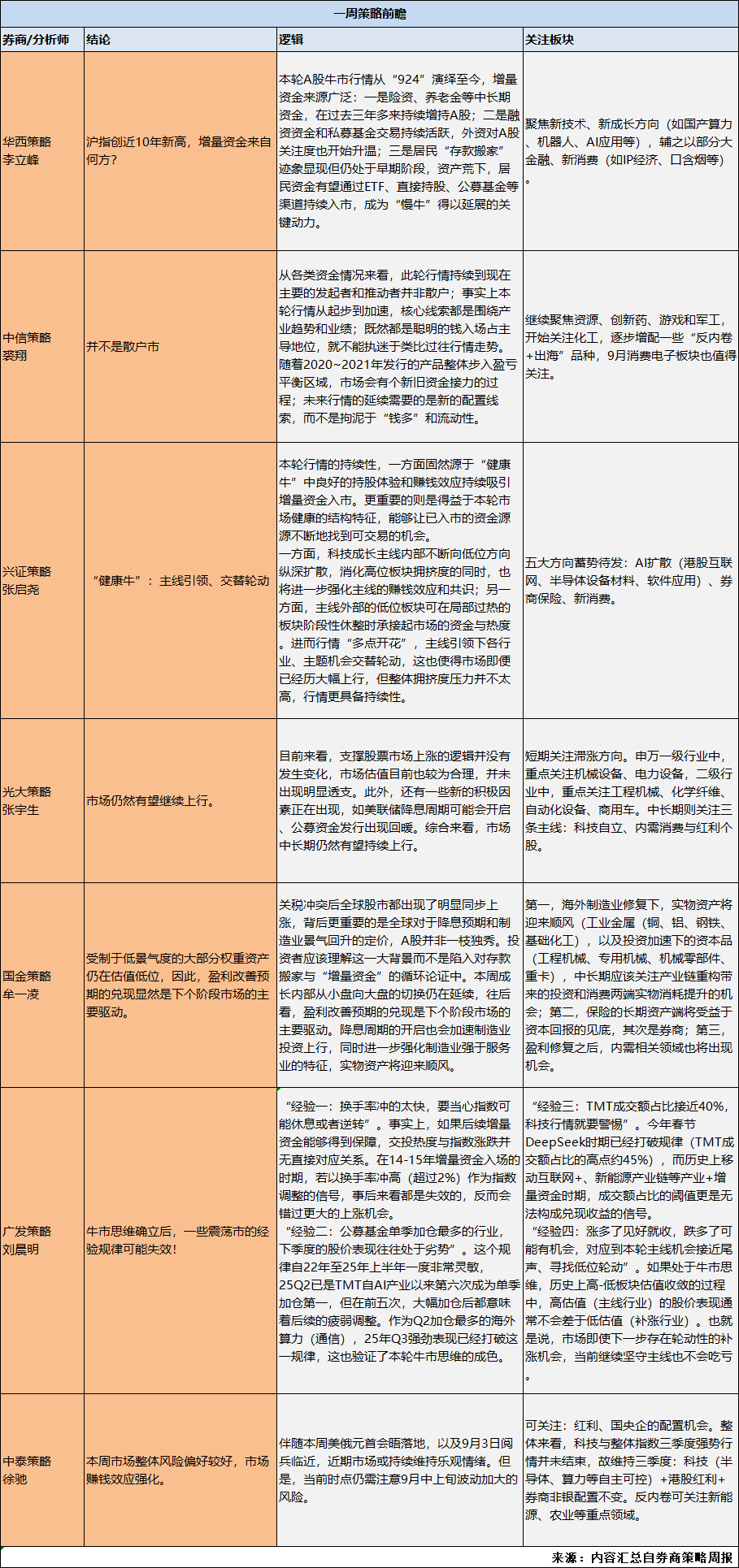
【十大券商一周策略】散户并非行情推动者!新旧资金正在接力,关注盈利改善兑现
券商中国· 2025-08-24 14:21
Group 1 - The current market rally is primarily driven by institutional investors rather than retail investors, with a focus on industrial trends and earnings [2] - The market's settlement funds to circulating market value ratio remains reasonable, indicating ongoing profit accumulation [2] - Future market performance will depend on new allocation themes rather than just liquidity and abundant funds [2] Group 2 - Recent market highs are supported by ample liquidity, with positive signals from the movement of household deposits [3] - The consensus on an upward market trend is strengthening, with key factors such as domestic fundamentals and liquidity showing improvement [3] - Strategic allocations should focus on sectors like AI, innovative pharmaceuticals, military, and large financial institutions [3] Group 3 - The Federal Reserve's dovish stance suggests a likely interest rate cut in September, which may improve dollar liquidity and benefit Hong Kong stocks [4] - The current market phase is characterized by a fund-driven environment, with a focus on sectors like innovative pharmaceuticals and domestic AI [4] - Analysts have raised profit forecasts for various sectors, indicating potential strong performance in areas like cross-border e-commerce and medical outsourcing [4] Group 4 - The market is experiencing a "healthy bull" phase, with moderate sector crowding and opportunities across various themes [9] - Future strategies should focus on low-position sectors within the tech growth line and cyclical sectors with strong growth expectations [9] - Key areas of interest include Hong Kong internet, semiconductor equipment, and new consumption [9] Group 5 - The current bull market is supported by diverse sources of incremental capital, including long-term funds and active private equity [12] - The ongoing "deposit migration" trend may become a significant source of future capital inflow into the market [12] - Focus on new technology and growth sectors, such as domestic AI applications and robotics, alongside traditional financial sectors [12]

A股分析师前瞻:策略普遍看好行情延续性,这些方向或蓄势待发
Xuan Gu Bao· 2025-08-24 12:09
Group 1 - The current bullish trend in A-shares is supported by various sources of incremental capital, including long-term funds such as insurance and pension funds, active trading by margin financing and private equity, and increasing foreign interest in A-shares [1][2][3] - There are signs of residents moving their savings into the market, although this is still in the early stages, which could provide a key driving force for the continuation of a "slow bull" market [1][3] - The focus for future investments should be on new technologies and growth sectors, such as domestic computing power, robotics, and AI applications, alongside major financial and new consumption sectors [2][3] Group 2 - The current market is characterized by a "healthy bull" phase, where good holding experiences and profit effects continue to attract incremental capital [2][3] - The market's sustainability is attributed to its healthy structural characteristics, allowing existing capital to continuously find trading opportunities [2][3] - Future market trends will require new allocation clues rather than merely relying on liquidity and the abundance of capital [2][3] Group 3 - Analysts emphasize that this market rally is not driven by retail investors but rather by smart money, focusing on industrial trends and performance [2][3] - As products issued in 2020-2021 approach breakeven, a transition between old and new capital is expected, which will be crucial for the market's continuation [2][3] - The market is anticipated to maintain upward momentum, supported by a potential interest rate cut cycle and a recovery in manufacturing investment [4]
散户投资者的牛市赚钱策略:跟着机构“喝汤”(上)
市值风云· 2025-08-22 10:14
Core Viewpoint - The article highlights that the value gap in the market is rapidly being filled by a surge of incremental capital, indicating a strong bullish sentiment in the stock market [1]. Group 1: Market Performance - From early July to August 18, over 5,400 A-shares had a median increase of approximately 8.15%, while the CSI 300 ETF rose by 8.66%, ranking around 2,600 among A-shares. The ChiNext ETF saw a significant increase of 21.05%, ranking around 1,040, suggesting that holding the ChiNext ETF could outperform over 80% of A-shares [3]. - The current bull market is characterized by the substantial financial strength of investment institutions, which are actively establishing their presence in the A/H share market [4]. Group 2: Institutional Investment Dynamics - The article emphasizes the importance of tracking the movements of incremental capital, particularly from large institutional investors, as these trends can last for a year and a half, providing opportunities for retail investors to benefit [4]. - Understanding the investment preferences, styles, and specific targets of different institutional funds, such as public funds, private equity, and insurance capital, can help investors capitalize on the continuous influx of institutional capital [5].

【资金观察】沪指连续突破,谁在做多?谁在“畏高”?这只ETF规模大逆袭
Sou Hu Cai Jing· 2025-08-22 01:13
Core Insights - The market is experiencing a significant shift in ETF fund preferences, with a notable net redemption of over 200 billion yuan in ETFs this year, excluding state-owned enterprises' increases [1] - Despite the overall market facing redemption pressures, the CSI 2000 Enhanced ETF (159552) has seen a remarkable net inflow of 1.154 billion yuan this year, with a share increase of over 5000%, making it the fastest-growing ETF in the market [1][9] Group 1: Market Dynamics - The recent market uptrend is primarily driven by three types of active funds: retail investors, leveraged funds, and private equity [2] - Retail investors have shown caution, with new A-share accounts in July remaining flat at 1.96 million, significantly lower than the levels seen in February and March [6] - Leveraged funds have seen a continuous net inflow since late June, with a cumulative scale exceeding 200 billion yuan, pushing the financing balance above 2 trillion yuan [5] Group 2: Retail Investor Behavior - Retail investors are exhibiting a "fear of heights" sentiment, leading to limited participation in the current market rally [6] - The net inflow of small retail funds has been marginal, with a recent weekly net inflow of 113.4 billion yuan, still below the average of 131.2 billion yuan seen in the first quarter [8] - There has been a significant redemption of ETFs, with a total net redemption exceeding 200 billion yuan this year, and a recent weekly outflow of 16.1 billion yuan, marking a new high for 2024 [8] Group 3: Enhanced ETF Performance - The CSI 2000 Enhanced ETF (159552) has achieved a year-to-date growth in scale, with a share increase of over 50 times, driven by its outstanding performance [9] - As of August 11, the ETF has recorded a one-year return of 111.83%, outperforming the benchmark index by 34.43% [9][12] - The ETF's ability to provide excess returns makes it an attractive option for investors seeking certainty amid market volatility [12] Group 4: Future Capital Inflows - Despite low retail participation, there is a broader trend of asset allocation towards equity markets, driven by a low-interest-rate environment [13] - There are indications of a shift in resident deposits, with a decrease of 1.1 trillion yuan in July, suggesting funds are moving towards capital markets [13][14] - Institutional funds, including foreign and insurance capital, are expected to continue flowing into the market, providing solid support [14][15]