
反内卷政策

Search documents
桐昆股份(601233):2025年业绩符合预期,长丝及炼化景气回暖盈利大幅增长:桐昆股份(601233):
Shenwan Hongyuan Securities· 2026-02-25 05:47
桐昆股份 –2025 年业绩符合预期,长丝及炼化景气回暖盈利大幅 增长 THE TH 2026 年 02 月 25 日 | 报告原因:有业绩公布需要点评 | | --- | | 2 (维持) | | 市场数据: 2026 年 02 月 24 日 | | --- | | 收盘价(元) 24.51 | | 一年内最高/最低(元) 24.80/9.63 | | 市净率 1.6 | | 股息率%(分红/股价) 0.41 | | 流通 A 股市值 (百万元) 58,723 | | 上证指数/深证成指 | | 注:"股息率"以最近一年已公布分红计算 | | 基础数据: | 2025年09月30日 | | --- | --- | | 每股净资产 (元) | 15.75 | | 资产负债率% | 66.30 | | 总股本/流通 A 股 (百万) | 2,400/2,396 | | 流通 B 股/H 股 (百万) | -/- | 年内股价与大儒对 桐昆股份 沪深300指数 收益有 相关研究 申万宏源研究微信服务号 投资要点: 财务数据及盈利预测 | | 2024 | 202501-3 | 2025E | 2026E | 20 ...

桐昆股份(601233):2025年业绩符合预期,长丝及炼化景气回暖盈利大幅增长
Shenwan Hongyuan Securities· 2026-02-25 05:25
Investment Rating - The investment rating for the company is "Buy" (maintained) [2] Core Views - The company's performance in 2025 is in line with expectations, with significant profit growth driven by the recovery in polyester filament and refining sectors [6] - The demand for polyester filament is rebounding, leading to price recovery, with major companies agreeing on production cuts [6] - The PTA segment is expected to face pressure in 2025, but no new capacity is anticipated in 2026, suggesting a potential rebound in profitability [6] - The investment income from Zhejiang Petrochemical is showing signs of recovery, with expectations for improved refining conditions [6] - The profit forecast for 2025 has been adjusted to 2.046 billion (originally 2.127 billion), with 2026 and 2027 estimates maintained at 3.693 billion and 4.987 billion respectively [6] Financial Data and Profit Forecast - Total revenue projections for 2025 are 99,065 million, with a year-on-year decline of 2.2% [5] - Net profit attributable to the parent company is expected to be 2,046 million in 2025, reflecting a year-on-year increase of 70.2% [5] - Earnings per share are projected to be 0.85 in 2025, increasing to 1.54 in 2026 and 2.10 in 2027 [5] - The gross margin is expected to improve from 6.5% in 2025 to 8.8% in 2027 [5] - The return on equity (ROE) is projected to rise from 5.3% in 2025 to 10.6% in 2027 [5]
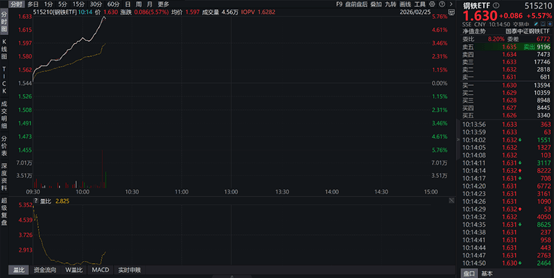
供给端边际改善叠加“反内卷”政策预期升温,钢铁ETF(515210)盘中涨超5.7%
Sou Hu Cai Jing· 2026-02-25 04:17
Core Viewpoint - The steel sector is experiencing a rebound driven by marginal improvements on the supply side and rising expectations for "anti-involution" policies, leading to a significant increase in the steel ETF (515210) by over 5.7% during trading [1] Supply Side - The capacity utilization rate of 247 steel mills increased to 86.4%, up by 0.7 percentage points, with daily molten iron output rising to 2.306 million tons, an increase of 19,000 tons [4] - The "anti-involution" policy expectations are strengthening the logic for production cuts, which could accelerate the rebalancing of supply and demand in the steel industry [4] - Historical trends indicate that improvements in steel industry profitability typically arise from either strong demand driving price increases or supply reductions improving industry dynamics [4] Inventory and Demand - Social inventory of the five major steel products reached 10.267 million tons, a 9.2% increase, while steel mill inventory rose by 4.7% to 4.161 million tons [5] - Apparent consumption of the five major steel products decreased by 9.4% to 6.891 million tons, with rebar consumption dropping by 31.0% [5] - The current inventory increase is attributed to seasonal factors, and if demand rebounds post-holiday, a downward trend in inventory could be anticipated [6] Raw Materials and Profit Margins - The Platts 62% iron ore price index fell to $96.5 per ton, a decrease of 3.7% week-on-week, indicating a weakening trend in raw material prices [7] - The immediate gross profit for long-process rebar was -175 yuan per ton, and for hot-rolled coil, it was -357 yuan per ton, showing marginal improvement despite remaining in a loss position [7] - Historical data suggests that steel stock prices often lead gross profit by 1-2 quarters, indicating that the market is already pricing in expected profit improvements [7] Valuation and Allocation - The steel sector has undergone significant valuation recovery, moving from extreme undervaluation to a moderately low range, still offering absolute return potential [8] - The steel sector's pricing logic is shifting from "pessimistic clearance" to "profit recovery," driven by supply-side policies and macroeconomic stabilization [8] - The steel ETF (515210) serves as a representative product for the industry, reflecting changes in the profitability cycle and offering advantages in diversifying individual stock risks while capturing overall industry trends [8]

A股马年开门红,逢低关注“科技+资源品”双主线
British Securities· 2026-02-25 01:27
Market Overview - The A-share market experienced a "red opening" on the first trading day of the Year of the Horse, with the Shanghai Composite Index surpassing the 4100-point mark and the Shenzhen Component Index rising over 1%, setting a positive tone for post-holiday market trends [2][9][10] - Despite the positive opening, there was a notable structural differentiation in market performance, with cyclical sectors like petrochemicals and non-ferrous metals leading gains, influenced by external factors such as the escalating US-Iran situation and internal price increase logic [2][10] Capital Flow and Market Sentiment - The return of capital post-holiday was in line with expectations, significantly boosting market liquidity, as evidenced by a notable increase in trading volume, with total turnover reaching 22,021 billion [6][10] - However, the weak performance of the Hong Kong market has somewhat dampened risk appetite in the A-share market, indicating a cautious overall market sentiment on the first trading day [10][11] Future Market Outlook - The upcoming important meetings are expected to clarify policy directions for the "14th Five-Year Plan," with anticipated policy benefits likely to gradually materialize, suggesting a probable continuation of a fluctuating upward trend in the market [3][9] - Key areas to monitor include the sustainability of price increase logic in cyclical sectors and signs of stabilization in the technology sector following recent corrections [3][9] Investment Strategy - Investors are advised to focus on the dual main lines of "technology + resource products," specifically targeting cyclical sectors benefiting from price increases and geopolitical catalysts, such as petrochemicals and non-ferrous metals [3][9] - Additionally, long-term trends in technology sectors, including AI computing power, semiconductors, and humanoid robots, should be considered for opportunistic investments during any temporary pullbacks [3][9]
外围市场向好,A股或迎“开门红”
Xin Lang Cai Jing· 2026-02-24 00:04
Group 1 - The A-share market is expected to experience a "good start" due to consumer recovery and ample liquidity, with analysts noting a positive sentiment in the bond market as well [4][20][30] - During the Spring Festival, key retail and catering enterprises reported an average daily sales increase of 10.6% year-on-year, with significant growth in foot traffic and sales in major commercial areas [4][19][30] - The U.S. stock market showed a positive trend during the Spring Festival, with major indices rising, while the European Stoxx 600 index reached a historical high [4][19][30] Group 2 - Analysts predict a 76% probability of A-shares rising in the week following the Spring Festival, with an average increase of 1.3%, and an 80% probability of a 5.1% increase in the following ten days [20][30] - The bond market sentiment is expected to remain optimistic, supported by the central bank's actions and the recent decline in the 10-year government bond yield [21][30][31] - The performance of the bond market is influenced by the strong demand for institutional holdings during the holiday period, which is expected to continue supporting the market [30][31] Group 3 - The technology sector, particularly AI applications and semiconductors, remains a key investment theme globally, with potential for valuation recovery in consumer-related sectors following positive consumption data [5][20][30] - The U.S. effective tariff rate may decrease from 16.9% to 9.1% if certain tariffs are fully refunded, which could positively impact market sentiment, although uncertainties remain regarding international trade conflicts [21][30] - The domestic economic data and policy expectations will be crucial in determining the strength of the post-holiday market performance, with a focus on the upcoming economic indicators [30][31]

港股异动 | 三一国际(00631)午后涨超3% 近一个月累涨逾六成 公司矿卡业务将持续取得进展
智通财经网· 2026-02-23 05:52
Core Viewpoint - Sany International (00631) has seen a significant stock price increase of over 60% in the past month, with a current rise of 3.54% to HKD 15.52, supported by a trading volume of HKD 73.91 million [1] Industry Insights - According to a report from Credit Lyonnais, three key drivers are emerging in the Chinese industrial sector amid ongoing anti-involution policies: increased demand for mining equipment, maturity of humanoid robot supply chains, and consolidation in the express delivery industry [1] - The report anticipates a continued equipment replacement cycle, alongside record investments in power grids and renewable energy, which are expected to drive excavator sales growth by approximately 10% [1] Company Performance - CMB International believes that Sany International's mining truck business will continue to progress, contributing 15% to 16% of total revenue between 2026 and 2027, with high growth expected for large mining trucks that have higher value and profit margins [1] - The firm also notes that due to an order backlog exceeding 12 months, revenue growth and profit margin improvement in the large port machinery business are highly certain [1]
中国光伏行业协会PPT:我国光伏行业发展变化分析
Sou Hu Cai Jing· 2026-02-18 09:28
Core Insights - The report highlights the transformation of the photovoltaic (PV) industry in China, emphasizing the need for innovation and adaptation to changing market dynamics [1][2] - It identifies the dual trends of consumption structure upgrades and accelerated technological iterations as key drivers reshaping the industry landscape [1][2] Industry Development Trends - The PV industry is experiencing a restructuring of its competitive landscape, with companies that possess core technological barriers and efficient supply chain management demonstrating greater resilience [1][9] - The report notes a shift from pure competition to a "co-opetition" model, where companies collaborate for mutual benefit [1][2] - Differentiated product and service positioning is crucial for companies to break through in a saturated market, enhancing user loyalty and brand premium [1][2] Market Dynamics - Rational and quality-focused consumption has become mainstream, prompting companies to enhance product value and service systems [2][9] - The rise of new consumer demographics is creating new consumption scenarios and business models, necessitating an omnichannel approach for user engagement [2][9] Production and Export Data - In the first ten months of 2025, the production of polysilicon, silicon wafers, battery cells, and modules showed mixed results, with polysilicon production down by 29.6% year-on-year [9][13] - The total export value of PV products decreased by 13.2% year-on-year, with a notable recovery in export volumes observed in the third quarter due to policy changes in key markets [28][29] - The average prices of polysilicon, silicon wafers, battery cells, and modules have seen increases, indicating a potential stabilization in the market [9][29] Financial Performance - The main PV industry chain reported a revenue decline of 16.9% in the first three quarters of 2025, but the rate of decline is gradually narrowing [31][38] - Losses in the industry are decreasing, with total losses reaching 31.04 billion yuan in the first three quarters, a significant reduction compared to previous periods [31][38] - The gross profit margin is improving, reflecting a shift towards higher-quality orders and a response to cost-based pricing strategies [31][38] Policy and Governance - The industry is actively responding to "involution" competition through policy evolution and governance frameworks aimed at promoting orderly competition [36][37] - Central authorities are emphasizing the need for self-regulation within the industry to prevent price wars and enhance product quality [36][37]

2026物价展望:CPI有望温和回升 PPI或将转正
Zhong Guo Jing Ji Wang· 2026-02-18 08:56
Group 1 - In 2025, consumer prices (CPI) remained stable year-on-year, while industrial producer prices (PPI) decreased by 2.6% [1][2] - Food prices fell by 1.5% in 2025, with pork prices shifting from a 7.7% increase to a 6.1% decrease, impacting CPI by approximately 0.08 percentage points [2] - Energy prices saw a significant decline of 3.3%, influenced by international oil price fluctuations, with gasoline and diesel prices dropping by 7.2% and 7.8% respectively [2] Group 2 - The PPI showed a narrowing decline in the second half of 2025, with a decrease of only 1.9% by December, the smallest drop since September 2024 [3] - Factors contributing to the PPI's performance included improved domestic market competition and varying impacts from external factors, such as rising prices in the non-ferrous metals sector and declining oil prices [3] - The low price environment remains a concern for the Chinese economy, affecting corporate revenues, profits, and government finances [3] Group 3 - For 2026, macroeconomic indicators suggest a potential recovery in both CPI and PPI, supported by policies aimed at expanding domestic demand and addressing supply-side issues [4][5] - The financial outlook for 2026 anticipates CPI to rise by approximately 0.8%, with PPI expected to turn positive around the second quarter [6][5] - Structural characteristics of the PPI recovery will depend on demand strength and the effectiveness of policies aimed at stimulating consumption and investment [6][7]
恒力石化逆板块下跌,资金流出与基本面承压成主因
Jing Ji Guan Cha Wang· 2026-02-14 06:31
Core Viewpoint - Hengli Petrochemical (600346.SH) experienced a decline of 2.96% on February 13, 2026, while the overall oil and petrochemical sector dropped by 3.09% [1] Fund Flow Situation - The decline was directly linked to fund flow performance, with a net outflow of main funds amounting to 70.89 million yuan, representing 10.48% of the total transaction volume on that day [2] - This was a reversal from the previous trading day (February 9), which saw a net inflow of 125 million yuan [2] - Additionally, there was a net repayment of 3.49 million yuan in financing, indicating that some leveraged funds opted to exit [2] Company Fundamentals - Despite expectations of recovery in the chemical industry due to the "anti-involution" policy, Hengli Petrochemical's Q3 2025 report showed a year-on-year revenue decline of 11.46% and a net profit attributable to shareholders down by 1.61% [3] - The company's PTA product gross margin was only 3.39%, facing challenges from intensified industry competition and weak demand [3] - Hengli Petrochemical's debt ratio remained high at 76.41%, with financial expenses reaching 3.518 billion yuan, which may affect investor perceptions of its short-term profitability [3] Stock Price Situation - Technical analysis indicates that the stock price is under pressure, with the price below the 20-day Bollinger Band middle line (25.397 yuan) as of February 13 [4] - The MACD indicator showed a negative histogram (-0.45), suggesting weak short-term momentum [4] - The KDJ indicator's J value was 56.077, indicating a neutral zone without signs of overselling, lacking technical rebound support [4]

圆通国际预亏扩大,圆通速递1月业务量增近三成
Jing Ji Guan Cha Wang· 2026-02-14 05:01
Group 1 - The core viewpoint of the news is that YTO Express International anticipates a net loss of approximately HKD 145 million to HKD 154 million for the fiscal year 2025, primarily due to fluctuations in the international freight market and increased investments in business optimization [1] - YTO Express has launched local delivery services in Kazakhstan, achieving same-day delivery within the city and five-day delivery across cities, with a logistics punctuality rate exceeding 99% [1] - In January, YTO Express reported a year-on-year increase of 29.75% in express business volume, although the revenue per shipment declined by 4.57% [1] Group 2 - As of February 13, 2026, YTO Express A-shares closed at CNY 17.86, down 1.27%, with a trading volume of CNY 124 million, while YTO International's Hong Kong shares closed at HKD 1.11, up 1.83% [2] - The consensus target price for YTO Express A-shares is CNY 21.50, indicating a potential upside of 26.99% from the current price, with 36 institutions predicting a 7.33% year-on-year growth in net profit for 2025 [2] - Analysts believe that the company will benefit from the "anti-involution" policy leading to price recovery, AI technology aiding cost optimization, and its international expansion potentially creating a second growth curve in the long term [2]
