
春季躁动

Search documents
南方基金:“春季躁动”或继续,核心-卫星策略仍是配置优选!
Sou Hu Cai Jing· 2026-01-29 06:55
Group 1 - The market is currently experiencing a "performance verification period," shifting from a liquidity-driven valuation expansion to a focus on companies with real profits and orders [3] - The external environment is changing, with the Federal Reserve's interest rate path stabilizing, making RMB assets an attractive option for global diversification [4] - Long-term industry trends, such as AI development, global technology cycles, and domestic supply-side optimization policies, are forming a solid foundation for the market's mid-term outlook [4] Group 2 - The recommended asset allocation focuses on technology and cyclical sectors, with technology being driven by the ongoing global AI trend and its transition from training to real-world applications [5] - In the cyclical sector, there is a suggestion to consider non-ferrous metals and securities, with expectations of price increases driven by the Federal Reserve's interest rate cuts and improving fundamentals [5][6] - Three reinforcing logics include the rigid supply of key resources, rising macro hedging demand for precious metals, and the strategic importance of resource security in national policy [6][7][8] Group 3 - For balanced asset allocation, broad-based indices like the CSI A500 and the Growth Enterprise Market Index are recommended, along with defensive assets suitable for long-term holdings [9]
中信证券港股2月展望:春季行情延续 关注三大主线
Zhi Tong Cai Jing· 2026-01-29 01:21
Core Viewpoint - The report from CITIC Securities indicates that the Hong Kong stock market is expected to continue its spring rally from late December 2025, with a focus on large-cap stocks before the Lunar New Year and better performance in growth sectors supported by policy directions [1] Group 1: Market Performance and Trends - The performance expectations for Hong Kong stocks have significantly adjusted, with a slowdown in the downward revision of earnings forecasts since late December 2025 [1] - The average return of the Hang Seng Index during the spring rally over the past eleven years is 2.4%, with a weekly win rate of 70.8%, particularly strong in 2019, 2021, and 2023, averaging a 10.6% increase [2] - The upcoming earnings reports for Hong Kong stocks are expected to be concentrated from late March to early April, indicating a period of performance vacuum [1][2] Group 2: Investment Focus Areas - Short-term investment focus should be on three main lines: 1) "14th Five-Year Plan" policy directions including biomanufacturing, embodied intelligence, and 6G; 2) food delivery platforms and real estate benefiting from policy-driven expectations; 3) non-bank financials benefiting from the spring rally [1] - The "15th Five-Year Plan" is expected to guide long-term investment opportunities, with strategic emerging industries like new energy, new materials, and quantum technology likely to receive policy support [3] Group 3: Liquidity and Market Dynamics - The liquidity outlook for Hong Kong stocks is expected to improve as the market approaches the next peak of stock unlocks, with significant reductions in unlock amounts in January and February 2026 [1] - Historical data shows that net inflows from southbound trading in January and February account for an average of 19.3% and 27.9% of the annual total, respectively [2]

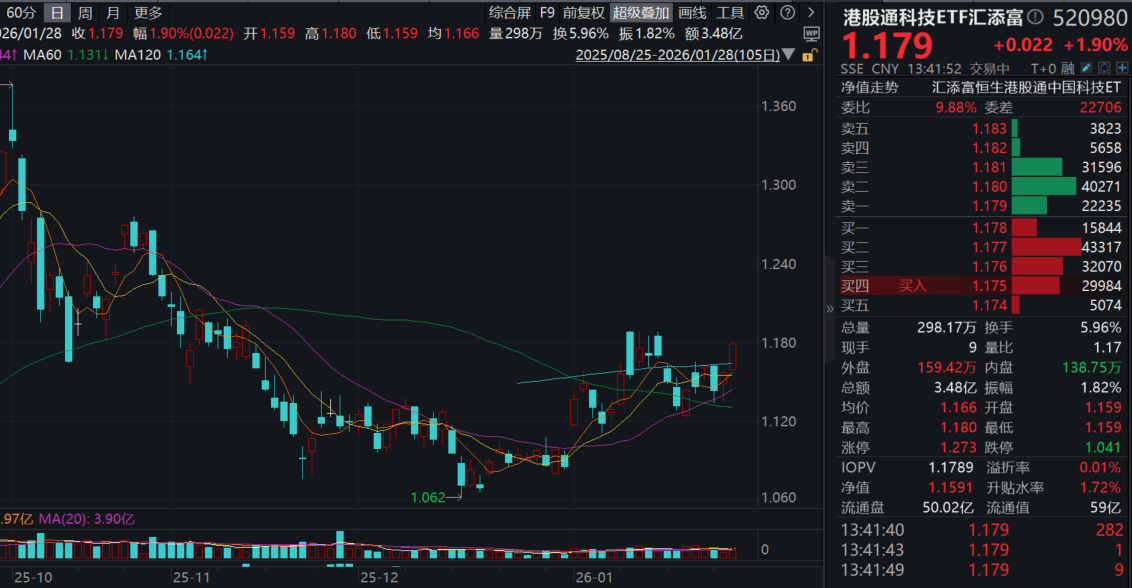
DeepSeek重大发布,国产AI大模型再掀狂潮!港股通科技ETF汇添富(520980)、恒生科技ETF汇添富(513260)双双涨2%!
Sou Hu Cai Jing· 2026-01-28 06:22
Group 1 - The core viewpoint of the news highlights a significant surge in Hong Kong tech stocks, with the Hang Seng Tech ETF experiencing a notable increase in trading volume and inflows [1][5][8] - The DeepSeek team released a new paper and open-sourced the DeepSeek-OCR 2 model, which enhances AI's ability to dynamically rearrange image components based on their meanings [3] - Alibaba's Qwen3-Max-Thinking model outperformed leading models like GPT-5.2 and Claude Opus 4.5 in key performance benchmarks, setting new global records [3] Group 2 - Cloud service providers are facing a price increase trend, with Google Cloud announcing price adjustments effective May 1, 2026, citing network optimization and significant infrastructure investments [4] - Tencent is launching a Spring Festival event on February 1, offering cash red envelopes, which is expected to boost user engagement on its platform [6] - The majority of popular tech stocks in Hong Kong saw gains, with notable increases in shares of Huahong Semiconductor, SMIC, Kuaishou, BYD, and Tencent [6][7] Group 3 - Southbound capital continues to flow into Hong Kong stocks, with Xiaomi Group leading in net purchases over the past week [8][9] - Analysts from various institutions suggest that the current market conditions are favorable for a "spring rally," driven by high growth expectations in the new economy and supportive domestic policies [10][12] - The valuation of Hong Kong stocks is near historical averages, with expectations for an upward shift in valuation due to improved liquidity and a favorable investment environment [12][11]


A股午评 | 沪指半日涨0.49% 有色、油气等资源股爆发 半导体板块再度走强
智通财经网· 2026-01-28 03:50
盘面上,资源主线强势,有色、贵金属概念再掀涨停潮,中国黄金4连板,豫园股份等超10股涨停,油 气股再度走高,千亿中国海油涨超6%续创历史新高,此外,煤炭、化工、钢铁等板块均有所表现;半 导体产业链再度走强,存储芯片领涨,盈新发展等多股涨停;算力产业链反复活跃,美利云涨停。下跌 方面,光伏、军工、医药等方向跌幅居前。 信达证券认为,春节前流动性环境大概率较好,市场可能继续偏强,1月在资金情绪分化的背景下可能 会有一些波动,但春季躁动难言见顶,下行风险可控,向上弹性可观,短期波动或是逢低布局时机。2 月或是更确定的窗口期,增量资金的潜在利多在于险资增配权益、理财产品股债转换、公募基金发行回 暖等。配置方面,有色金属等行业供需格局较好,价格持续上行,景气较高。 1月28日,A股早盘震荡分化,市场超3500股飘绿,半日成交额1.91万亿,较上个交易日放量393亿。截 至午间收盘,沪指涨0.49%,深成指涨0.09%,创业板指跌0.37%。 展望后市,信达证券认为,春节前流动性环境大概率较好,市场可能继续偏强,1月在资金情绪分化的 背景下可能会有一些波动,2月或是更确定的窗口期。 热门板块 1、贵金属概念延续强势 黄金 ...

经济和市场会有开门红吗
2026-01-28 03:01
需求端三驾马车中,哪些因素可能支撑 2026 年一季度的经济表现? 经济和市场会有开门红吗?20260127 摘要 预计 2026 年一季度实际 GDP 增速约为 5%左右,名义 GDP 增速约为 4.5%,GDP 平减指数为负 0.6%,较上一季度有所收窄,经济下行趋 势或将逆转。 投资是 2026 年一季度经济增长的关键驱动力,预计固定资产投资增速 将大幅回升,受益于政策支持和"十五"规划重大项目的前置。 预计 2026 年一季度消费将有所回升,商品消费增速预计提升至 3%- 4%,服务消费受益于春节效应和以旧换新补贴政策的推动。 当前货币政策强调高效灵活,降息降准概率较低,主要通过调整利率变 化速度来稳定汇率波动,除非二月数据超预期,否则短期内新增货币政 策工具可能性不大。 人民币汇率近期升值,央行主要通过调控节奏和波动率来稳定人民币兑 美元汇率,而非直接干预汇率方向。 2026 年财政政策预计更注重结构性调整,狭义赤字率维持在 4.0%左右, 广义赤字率可能下降,资金更多向科技创新和现代化产业体系倾斜。 2026 年资本市场前景乐观,股票最具潜力,关注 PPI 回升对企业盈利 的支撑,看好科技板块(人 ...
️政策暖风吹热1月:A股日历效应的变与不变
Xin Lang Cai Jing· 2026-01-26 11:09
Core Viewpoint - The article discusses the changing dynamics of the A-share market in January 2026, highlighting the impact of policy easing and liquidity on market behavior, contrasting it with historical trends and emphasizing the importance of understanding market rhythms rather than strictly adhering to calendar patterns [1][4]. Group 1: Market Dynamics - January 2026 is characterized by a shift from the usual tight liquidity to a more relaxed environment due to ongoing policy easing, with funds quietly flowing into the market [1][4]. - The "calendar effect" in A-shares reveals that historical patterns are not absolute but can reflect underlying trends in funds, sentiment, and policy [1][4]. Group 2: Cautionary Months - January and April are identified as months requiring caution; January sees funds withdrawing from the market due to year-end cash needs and concentrated earnings disclosures, leading to potential risks for underperforming stocks [5][6]. - April is noted for the "annual report crisis," where companies reveal their performance, often resulting in panic selling and mispricing of stocks, necessitating a focus on blue-chip and high-dividend stocks as safer options [6]. Group 3: Opportunities in the Market - February is highlighted as a "spring excitement" period, with capital returning post-Spring Festival and positive policy expectations, leading to increased interest in emerging industries and small-cap stocks [2][6]. - Other months like May, July, and November present unique opportunities; May often sees policy support, July allows for recovery of undervalued stocks, and November is a crucial month for institutional fund managers aiming to boost year-end performance [2][6]. Group 4: Market Adaptability - The article emphasizes that market patterns are reflections of the interplay between funds, sentiment, and policy over time, suggesting that rigid adherence to calendar dates can lead to missed opportunities [3][6]. - Understanding the underlying logic of market movements, being cautious during high-risk months, and seizing opportunities when they arise is deemed more effective than a confrontational approach to market fluctuations [3][6].
【公募基金】“春季躁动”行情分化,逐步切换至绩优方向——公募基金指数跟踪周报(2026.01.19-2026.01.23)
华宝财富魔方· 2026-01-26 10:17
Key Points - The article discusses the recent performance of the equity market, highlighting a significant divergence in market trends due to regulatory policies and liquidity conditions. Major sectors like consumption, pharmaceuticals, and finance saw declines, while growth sectors, particularly commercial aerospace, gained attention after adjustments [3][7][9] - The earnings season is beginning, and the market may shift towards profit recovery and valuation repair. The ongoing anti-involution policies are leading to negative investment growth across various industries, indicating future supply contraction, while demand stabilizes under fiscal stimulus and economic recovery, benefiting leading companies in sectors like non-ferrous metals and chemicals [3][9] - The bond market experienced a rise in short-term yields and a decline in long-term yields, with the 1-year government bond yield increasing by 3.95 basis points to 1.28%, while the 10-year and 30-year yields decreased by 1.26 and 1.65 basis points, respectively. This shift is attributed to a "cooling" stock market prompting funds to seek refuge in bonds [4][10] - The China Securities Regulatory Commission released guidelines for public fund performance benchmarks, maintaining consistency with previous drafts and introducing specific adjustments regarding benchmark changes and reporting requirements [12] Equity Market Review - The Shanghai Composite Index rose by 0.84%, while the CSI 300 and ChiNext indices fell by 0.62% and 0.34%, respectively. The average daily trading volume in the A-share market decreased to 27.972 trillion yuan, indicating a reduction in market activity [7] - ETF funds experienced a net outflow, with the CSI 300 ETF seeing a reduction of 49.603 billion units. Other ETFs also faced significant outflows, reflecting a shift in investor sentiment and the effectiveness of regulatory measures aimed at attracting long-term capital [7][8] Bond Market Review - The bond market saw a narrowing of yield spreads, with the short-term funding environment remaining favorable. The People's Bank of China indicated potential for further monetary easing, which could support market sentiment [4][10] Public Fund Market Dynamics - The recent release of performance benchmark guidelines for public funds aims to standardize evaluation criteria and ensure consistency in fund management practices, reflecting a regulatory push towards greater transparency and accountability in the fund industry [12]

周期行业-春季躁动-周期看好哪些方向
2026-01-26 02:49
Summary of Key Points from Conference Call Records Industry Overview Fiberglass Industry - The fiberglass industry is benefiting from the growth in demand for wind power and new energy vehicles, with both roving and electronic yarn showing structural demand improvement and simultaneous price increases. Companies have issued price increase notices, and it is expected that performance will reflect this in 2026. Leading company China Jushi has a cost advantage and is likely to benefit from an increase in the proportion of mid-to-high-end products [1][2][3] Construction Materials - Consumer building materials companies are transforming channels and focusing on small B-end and C-end markets, leading to significant improvements in cash flow and profitability. Companies like Sanke Tree are focusing on home decoration wall paint, while Rabbit Baby is steadily developing the small B-end market. Price increases have been announced, and market supply is gradually easing [1][2][3] Cement Industry - The cement industry is expected to see a decline in demand in 2026, but there are positive supply-side factors such as government production limits, market consolidation, and increased investment in western infrastructure. The overseas market demand is strong, particularly for companies like Conch Cement and Huaxin Cement, which are expected to show growth [1][2][3] Coal Market - The thermal coal market is currently experiencing weak price fluctuations due to sufficient port coal stocks and imports. The new safety regulations will raise compliance costs and delay capacity release for some companies, while the demand for coking coal remains supported by pre-holiday stockpiling [1][4][5] Electricity and Power Sector - China's electricity consumption continues to grow, with a significant investment plan of 4 trillion yuan announced by the State Grid to promote the intelligent and digital transformation of the distribution network. Companies like Dongfang Electric are highlighted as key players in the power automation sector [1][6][8] Key Insights and Arguments Demand and Price Trends - The construction materials sector has seen a notable increase in prices, driven by structural demand improvements and channel transformations. The fiberglass sector, particularly in roving and electronic yarn, is expected to perform well in both volume and price [2][3] Market Dynamics - The dye industry is experiencing price increases due to rising costs of key intermediates, benefiting integrated producers like Zhejiang Longsheng and Runtu. Stricter environmental policies are expected to increase industry concentration, favoring leading companies [2][11][12][13][14] Real Estate Market - The real estate market recovery is driven more by supply-side factors, with cities like Dalian, Changchun, and Shenyang showing signs of price increases due to reduced land supply and new project sales [9][10] Additional Important Information - The coal market is entering a traditional weak supply-demand period as production slows down due to holidays, leading to a potential for weaker price fluctuations in the short term [4][5] - The electricity sector is projected to see a significant increase in demand, with a focus on renewable energy development and infrastructure investment [6][8] - The dye market is expected to undergo consolidation as smaller companies face financial pressures due to rising costs, leading to a more concentrated and competitive market landscape [12][14]



廖市无双-如何应对当下指数分化格局
2026-01-26 02:49
Summary of Conference Call Records Industry Overview - The current market is experiencing a bull market that has lasted for 24 months, entering its mid-to-late stage, benefiting from a downturn in the real estate and trust industries, leading to capital inflow into the securities market. The outlook for the next decade remains positive, but the spring offensive in 2026 should be viewed as a mid-game break [1][4]. Market Performance - The Shanghai Composite Index has shown slight upward movement, while the Shanghai 50 and CSI 300 have entered a correction phase, indicating a consolidation of heavyweight indices. Conversely, small and mid-cap growth stocks have performed strongly, with the CSI 500, CSI 1000, and National CSI 2000 reaching new highs since September 2024 [1][5][6]. - In the recent week, 17 out of 24 sectors in the Shenwan primary industry index saw gains, with small and mid-cap sectors showing significant excess returns [7]. Sector Analysis - Underperforming sectors include construction materials, oil and petrochemicals, steel, real estate, environmental protection, and textiles, while sectors such as non-ferrous metals, defense, and basic chemicals have shown strong performance [8]. - The recent rebound in underperforming sectors is attributed to the market entering a mid-to-late stage, with a rotation and broad-based rally emerging. Stocks that had been stagnant are beginning to rise, particularly in construction materials and oil and petrochemicals [9]. Investment Strategy - A dual strategy is recommended: 1. Invest in indices like CSI 500, CSI 1000, and National CSI 2000 for relative returns. 2. Focus on sectors with high growth potential and reasonable valuations, such as electronics, semiconductor storage, and renewable energy [3][14]. - Investors are advised to avoid panic selling due to corrections in heavyweight indices, as adjustments are not expected to be severe. Short-term strategies should avoid blind chasing of high prices [12][13]. Future Market Outlook - The heavyweight indices may continue to adjust, while growth indices like CSI 500 and CSI 1000 are expected to maintain upward momentum. The Shanghai Composite Index is currently above the 20-day moving average, indicating potential for upward movement, but caution is advised as the slope has flattened [11]. Regulatory Impact - New regulations set to take effect on March 1 will require disclosure of deviations and gradually increase external monitoring, leading to a decrease in investment freedom. Prior to this, optimizing portfolios for maximum returns is essential, while post-regulation, a focus on balanced allocation will be necessary [22][25]. Key Focus Areas - Attention should be given to the banking and non-banking financial sectors, which have seen significant declines. The telecommunications sector also requires close monitoring due to signs of weakness in leading stocks [10]. Conclusion - The market is characterized by structural differentiation, with small-cap stocks showing superior performance. Investors should remain vigilant and adjust strategies according to market conditions, particularly during the spring rally period [21][23].
股指期货:偏强震荡,关注政策走向
Guo Tai Jun An Qi Huo· 2026-01-26 00:57
Report Summary 1. Investment Rating No investment rating for the industry is provided in the report. 2. Core Views - Last week, the K-shaped divergence in the market widened, with the small-cap growth style significantly outperforming the large-cap value style. The core drivers of the divergence include the absence of major systemic risks in the stock market, concerns about domestic policies cooling the market, and positive news in the industrial sector [1]. - In the pre-holiday period, with the macro environment remaining stable and the economy being supported, the "Spring Rally" in the stock market is expected to continue. However, the government's intention to regulate the pace of the slow bull market may affect market volatility. Attention should be paid to the growth targets set in local two sessions and the Federal Reserve's interest rate meeting and the selection of the new chairman [1]. 3. Summary by Directory 3.1 Market Review and Outlook - **Stock Market Performance**: Last week, global stock indices showed mixed performance. In the US, the Dow Jones Industrial Average fell 0.53%, the S&P 500 declined 0.35%, and the Nasdaq Composite dropped 0.06%. In Europe, the UK's FTSE 100 fell 0.9%, Germany's DAX declined 1.57%, and France's CAC 40 dropped 1.4%. In the Asia-Pacific market, Japan's Nikkei 225 fell 0.17%, and the Hang Seng Index declined 0.36%. The Shanghai Composite Index rose 0.84% [7]. - **Sector Performance**: In terms of weekly sector performance, building materials, petroleum and petrochemicals, and steel led the gains, while banks, communications, and non-bank finance were the top three decliners [1]. 3.2 Strategy Recommendations - **Short - term Strategy**: For intraday trading, refer to the 1 - minute and 5 - minute K - line charts. Set stop - loss and take - profit levels for IF, IH, IC, and IM at 91/114 points, 74/45 points, 179/251 points, and 221/294 points respectively [3]. - **Trend Strategy**: Adopt a bullish approach. The core operating ranges for the IF2602, IH2602, IC2602, and IM2602 contracts are 4591 - 4803 points, 2962 - 3099 points, 8398 - 8961 points, and 8219 - 8772 points respectively [3]. - **Cross - variety Strategy**: Hold the strategy of shorting IF (or IH) and going long on IC (or IM) [3]. 3.3 Index Valuation Tracking As of January 16, the price - to - earnings ratio (TTM) of the Shanghai Composite Index was 17.14 times, that of the CSI 300 Index was 14.25 times, and that of the SSE 50 Index was 11.76 times. The price - to - earnings ratio (TTM) of the CSI 500 Index was 37.53 times, and that of the CSI 1000 Index was 50.31 times [12][14]. 3.4 Market Fundamentals Review - **Margin Trading**: The balance of margin trading in the two markets and the share of newly established equity - biased funds are presented in relevant charts [14]. - **Funding Rates**: Last week, the funding rate remained flat, and the central bank made net injections [15].