
反内卷

Search documents
讹酒店的时代,快结束了?
虎嗅APP· 2026-01-13 13:35
以下文章来源于旅界 ,作者theodore熙少 旅界 . 跟踪时代浪潮,讲述文旅商业好故事。 本文来自微信公众号: 旅界 ,作者:theodore熙少,头图来自:AI生成 一 周末,我刷到一条新闻,大致内容是国内开始规制恶意索赔,防止经营者合法权益受侵害。 市场监管总局明确提出,不得滥用投诉举报权利牟取不正当利益。 背景则并不复杂,近年来,滥用投诉举报制度的索赔行为明显增多,一小部分人以打假为名行碰瓷之 实,刻意追求小错大赔、小过重罚,不少中小商家因此不堪其扰,甚至被迫关门停业。 针对这一现象,监管部门要求投诉人提供真实身份信息和相应事实依据,对虚假材料、冒用他人名 义、拒不配合核验身份的投诉不予受理,并明确对敲诈勒索、骗取赔偿等违法索赔终止调解,依法移 送公安机关处理。 看到这条新闻,我的第一反应是这些年酒店行业同样不堪其扰,甚至可以说是重灾区。 去年,一个00后女孩在上海住了十几晚酒店,每次退房都说:皮肤过敏、房间不干净、影响睡眠, 堪称酒店界皮肤科豌豆公主,外加研究酒店羊毛的爱因斯坦。 结果怎么样? 家家中招,十几家酒店房费全退,最终因为一张病历单被保洁人员捡到,这才戳破了她的伪装。 但如果没有被发现呢 ...


晶澳率先预告全年“成绩单”!光伏龙头的突围难题
Bei Jing Shang Bao· 2026-01-13 13:03
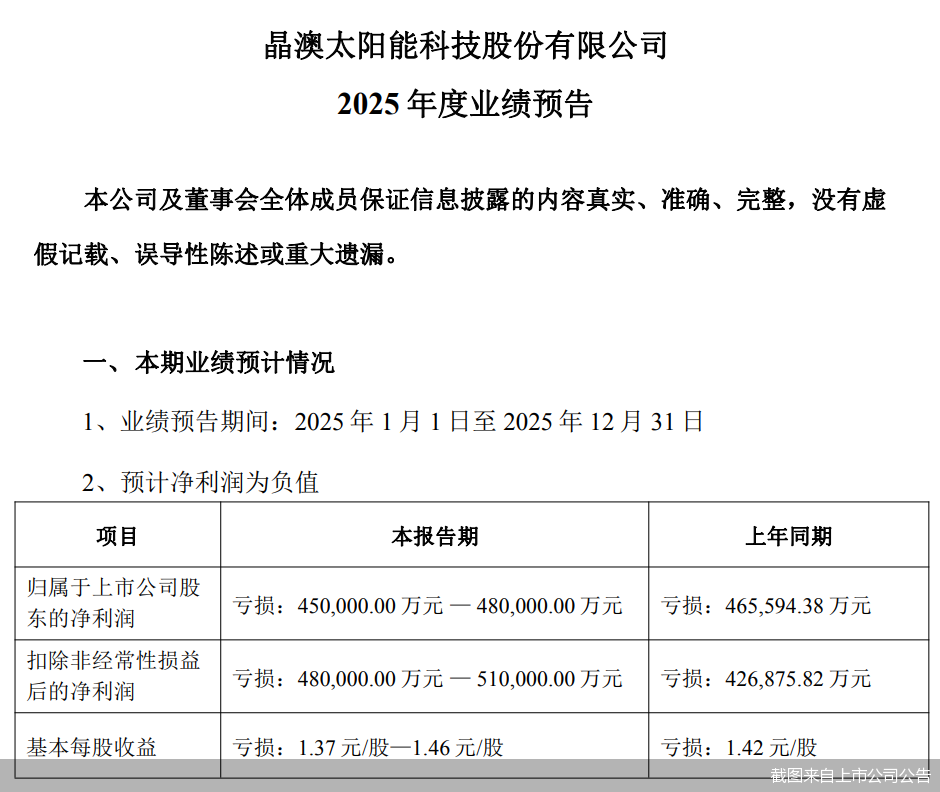
Core Viewpoint - JA Solar Technology (晶澳科技) has forecasted a net loss of 45 billion to 48 billion yuan for 2025, indicating that the company's performance is expected to remain similar to the previous year's loss, reflecting the ongoing challenges in the photovoltaic industry during a period of adjustment [1][4]. Financial Performance - The projected net loss for 2025 is between 45 billion and 48 billion yuan, compared to a loss of approximately 46.56 billion yuan in 2024 [4]. - The expected net loss after excluding non-recurring gains and losses is between 48 billion and 51 billion yuan, compared to a loss of about 42.69 billion yuan in the previous year [4]. - Basic earnings per share are projected to be a loss of 1.37 to 1.46 yuan per share, compared to a loss of 1.42 yuan per share in the previous year [3][4]. - Revenue figures for JA Solar from 2022 to 2025 show a decline, with revenues of approximately 729.89 billion yuan in 2022, 815.56 billion yuan in 2023, 701.21 billion yuan in 2024, and 368.09 billion yuan in the first three quarters of 2025 [4]. Market Dynamics - The photovoltaic industry is experiencing a "cold winter," characterized by significant losses among leading companies due to oversupply and intensified competition [1][4]. - The cancellation of export tax rebates for photovoltaic products, effective April 1, 2025, is expected to increase export costs and compress profit margins for companies [8][9]. - JA Solar's market capitalization has decreased from a peak of 190 billion yuan in June 2022 to approximately 40 billion yuan currently [5]. Industry Trends - The integration of solar and storage solutions is becoming a significant trend, with JA Solar launching various energy storage products [6]. - The company is also preparing for an IPO in Hong Kong, aiming for an "A+H" listing [6]. - The overall financial performance of the photovoltaic sector remains weak, with major companies like Trina Solar, JinkoSolar, and LONGi Green Energy also reporting substantial losses [7].

凯基:中国股市估值修复与盈利增长双轮驱动,投资策略转向进攻
2 1 Shi Ji Jing Ji Bao Dao· 2026-01-13 12:57
21世纪经济报道记者 张伟泽 实习生 周静怡 香港报道 1月13日,凯基首席投资总监梁启棠在2026年环球市场展望发布会上表示,新质生产力的崛起与政策宽 松将成为内地和香港股市的核心驱动力,市场投资策略正从"防守"全面转向"进攻"。 梁启棠指出,内地和香港股市已经进入估值修复与盈利增长双轮驱动阶段。当前恒生指数预测市盈率约 13倍,若上调至13.5倍,叠加8%的盈利增长,将支撑恒指冲击30000点,潜在升幅约14%。 凯基投顾董事长朱晏民指出,随着美联储开启降息并转向宽松政策,全球资金预计将回流新兴市场。在 此背景下,估值优势显著的内地及香港股市有望直接受益。 谈及近期上市的纯大模型企业股价波动,梁启棠认为,这主要反映出港股投资者对该类公司的商业模式 与估值逻辑尚需时日熟悉与消化。 对于港股AI板块的差异化特征,梁启棠对21世纪经济报道记者补充道,港股企业布局AI多采用"技术赋 能主业"模式,也就是并非依赖AI直接创收,而是通过AI优化原有业务,进而提升整体盈利能力,这与 纯AI上市公司的盈利逻辑形成本质区别。 在技术发展层面,朱晏民对21世纪经济报道记者表示,中国正凭借其庞大的市场和百万级的年度科创人 才储 ...
中国股票策略:2026 年 A 股短期及全年展望-China Equity Strategy_ Near-term and full-year 2026 A-share outlook in charts
2026-01-13 11:56
Summary of Key Points from the Conference Call Industry Overview - The focus is on the **A-share market** in China, which has shown volatility in Q4 2025 but is expected to stabilize and grow in 2026 due to various positive catalysts [2][4][7]. Core Insights and Arguments - **Market Volatility and Recovery**: The A-share market experienced a volatile Q4 2025, influenced by global equity trends, profit-taking by investors, and peak investor interest in tech stocks. However, a new uptrend is anticipated in 2026, supported by a broad rally in tech stocks and renewed investor interest [2][4]. - **Earnings Growth Expectations**: A-share earnings growth is projected to accelerate from 6% in 2025 to 8% in 2026, driven by faster nominal GDP growth and supportive policies. The equity risk premium for A-shares remains above historical averages, indicating potential for further re-rating [4][56]. - **Market Activity Indicators**: The A-share market has seen an increase in average daily turnover to **Rmb 2.46 trillion** in 2026 from **Rmb 1.73 trillion** in 2025, with margin financing reaching a record **Rmb 2.58 trillion** [2][4]. - **Sector Preferences**: The report favors sectors benefiting from innovation and liquidity, including electronics, telecom, non-bank financials, national defense, non-ferrous metals, chemicals, and electrical equipment. Cyclicals are expected to outperform defensives [5][132]. Additional Important Insights - **Catalysts for Market Growth**: Key catalysts include upcoming earnings results from ChiNext and STAR Market, market activity metrics, and the pace of fund issuance. These factors are crucial for assessing the growth trajectory of tech earnings [3]. - **Household Savings and Fund Inflows**: There is a significant amount of household excess savings, which could drive continued inflows into the A-share market. The balance of insurance funds' investments in equity assets has also increased, indicating a positive trend for market liquidity [27][105]. - **Government Policies**: The unveiling of the national consumer goods subsidy program and calls for stabilization in the property market are expected to bolster market confidence and economic growth [2][4]. Conclusion - The A-share market is poised for a positive outlook in 2026, supported by earnings growth, favorable market conditions, and strategic sector allocations. Investors are encouraged to focus on growth-oriented sectors and monitor key market indicators for potential investment opportunities [4][5][132].
白菜价机票买不到了?民航开始“反内卷”
Feng Huang Wang· 2026-01-13 11:35
Core Viewpoint - The civil aviation industry should shift towards technology and service-driven strategies to enhance profitability, rather than relying on price control measures [1][11]. Group 1: Industry Challenges and Responses - The civil aviation sector suffered cumulative losses of nearly 400 billion during the pandemic, with 2023 showing a significant reduction in losses, yet still exceeding any year prior to the pandemic [3]. - In 2025, the industry is projected to achieve a profit of 6.5 billion, driven by a 10.5% increase in total transport turnover and a 5.5% rise in passenger transport volume [3]. - The average economy class ticket price is expected to decline by 12.7% in 2024 and further by 2.9% in 2025, as airlines adopt a "price for volume" strategy to capture market share [3][4]. Group 2: Regulatory Measures - The Civil Aviation Administration plans to establish a passenger transport cost investigation method by 2026 and enhance monitoring of pricing to prevent unhealthy competition [1][4]. - Data collection from airlines is underway to assess cost structures for different routes, which will inform the upcoming price monitoring and warning mechanisms [4]. Group 3: Legal and Competitive Landscape - The definition of "cost price" in aviation is complex, as it includes various expenses beyond just material costs, making pricing strategies more intricate compared to other industries [5]. - Legal frameworks, such as the Anti-Unfair Competition Law and the Anti-Monopoly Law, prohibit below-cost pricing and price-fixing agreements among competitors, which complicates the pricing strategies in the aviation sector [6][7]. Group 4: Service and Innovation Focus - The industry recognizes that enhancing service quality is essential for increasing demand and profitability, as evidenced by proposed amendments to the Civil Aviation Law aimed at improving passenger rights [10][11]. - The successful "de-involution" strategies seen in other sectors, like the photovoltaic industry, highlight the importance of reducing excess capacity and improving product quality rather than merely controlling prices [9].
黑色金属日报-20260113
Guo Tou Qi Huo· 2026-01-13 11:11
Report Industry Investment Ratings - SDIC FUTURES provides operation ratings for various commodities on January 13, 2026. The ratings are as follows: Threaded steel (★★★), Hot-rolled steel (★★★), Iron ore (★★★), Coke (★☆☆), Coking coal (★☆☆), Silicon manganese (★★☆), Silicon iron (★★☆) [1] Core Viewpoints - The steel market is in a state of range-bound oscillation. The demand for downstream industries is weak, and the export remains high. The market sentiment is cautious, and the rebound momentum is insufficient, but there is still support below [2] - The iron ore market is expected to be in a short - term oscillation. The supply is relatively abundant, the demand is weak, and the winter - storage replenishment expectation still exists. It is necessary to be vigilant against the risk of increased volatility at high levels [3] - The coke and coking coal markets are likely to be in a strong - oscillation state. The carbon element supply is abundant, the downstream demand is at a low level in the off - season, and the market has certain expectations for coal - related policies [4][6] - The silicon manganese and silicon iron markets are recommended to buy on dips. The silicon manganese has a structural problem in port inventory, and the silicon iron is affected by relevant policies and has certain demand resilience [7][8] Summary by Commodity Steel - The steel futures market oscillates. In the off - season, the apparent demand for threaded steel declines, and the inventory accumulates. The demand for hot - rolled steel falls, and the inventory is slowly depleted. The steel mill's profit is marginally repaired, and the blast furnace is gradually restarted. The overall domestic demand is weak, and the export remains high. The market sentiment is cautious, and the range - bound oscillation pattern may continue [2] Iron Ore - The iron ore futures market oscillates. The global shipment decreases seasonally, the domestic arrival volume increases, and the port inventory accumulates. The terminal demand is weak in the off - season, the iron - water production is at the bottom, and it is difficult to resume production significantly in the short term. The steel mill's imported ore inventory increases, and the winter - storage replenishment expectation exists. The market sentiment is volatile, and the short - term oscillation is expected [3] Coke - The coke price oscillates downward during the day. The transaction price rises sporadically, the coking profit is average, and the daily output slightly increases. The inventory hardly changes. The carbon element supply is abundant, the downstream demand is at a low level, and the price is likely to be in a strong - oscillation state [4] Coking Coal - The coking coal price oscillates downward during the day. The Mongolian coal customs clearance volume is 1520 vehicles. The coking coal mine output slightly decreases, and the spot auction transaction improves. The total inventory increases significantly. The carbon element supply is abundant, the downstream demand is at a low level, and the price is likely to be in a strong - oscillation state [6] Silicon Manganese - The silicon manganese price oscillates. Driven by the futures rebound, the manganese ore spot price rises. There is a structural problem in the manganese ore port inventory. The iron - water production decreases seasonally, the weekly output of silicon manganese slightly decreases, and the inventory slightly decreases. It is recommended to buy on dips [7] Silicon Iron - The silicon iron price oscillates. Affected by relevant policy documents, the price is relatively strong. The market expects a decrease in power cost and semi - coke price. The iron - water production rebounds, the export demand decreases, and the secondary demand increases marginally. The supply decreases significantly, and the inventory slightly decreases. It is recommended to buy on dips [8]
一则“出口退税”带来两个涨停,碳酸锂“疯涨”何时结束?
智通财经网· 2026-01-13 10:07
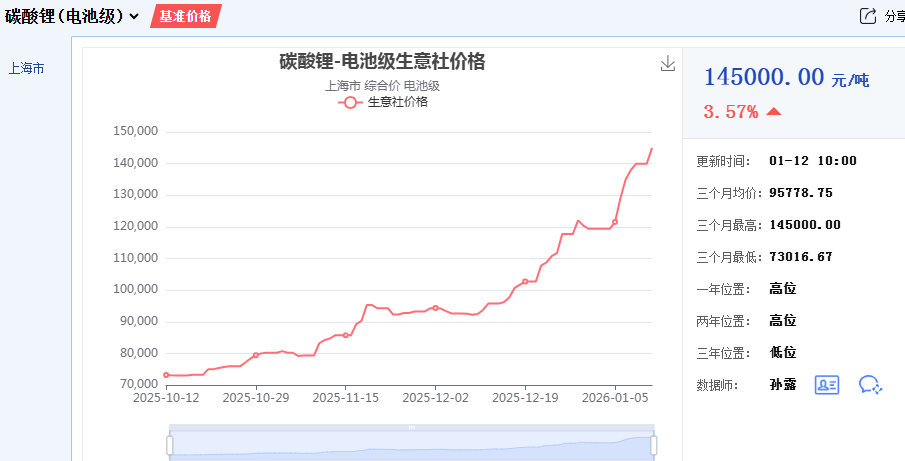
Core Viewpoint - The announcement of a reduction in export tax rebates for battery products has significantly boosted lithium carbonate prices, leading to a surge in futures contracts and a 40% increase in just seven trading days in January 2026, creating a bullish sentiment in the lithium battery sector [1][4]. Supply and Demand Dynamics - The lithium carbonate market is experiencing a supply-demand imbalance, with demand projected to exceed supply by 7,957 tons in December 2025, driven by low inventory levels and a surge in demand from battery manufacturers [1][5]. - The supply side is expected to remain tight due to government policies aimed at controlling new capacity and addressing "involution" in the industry, which may limit future production [5][12]. Price Trends - Lithium carbonate prices have seen a dramatic increase, with spot prices reaching 145,000 yuan per ton as of January 12, 2026, marking a nearly 100% rise from a low of 73,000 yuan per ton in the previous three months [3][11]. - The price recovery is attributed to a combination of supply constraints, policy support, and increased demand from sectors such as AI, data centers, and energy storage [5][10]. Market Sentiment and Investment Opportunities - The lithium battery sector is highly sensitive to fluctuations in lithium carbonate prices, with major companies like Ganfeng Lithium and Tianqi Lithium expected to benefit from the price surge, as they have significant market positions and operational efficiencies [12][13]. - Ganfeng Lithium is expanding its production capabilities and has plans to achieve an annual production capacity of at least 600,000 tons of lithium products by 2030, which positions the company well for future growth [12]. - Tianqi Lithium is also increasing its lithium salt production capacity and has reported a turnaround in profitability, indicating a positive outlook for the company amid rising prices [13]. Future Outlook - The global energy storage market is projected to grow significantly, with expectations of a 71% year-on-year increase in battery shipments in 2025, further supporting demand for lithium carbonate [6][10]. - The anticipated growth in solid-state battery technology and the increasing penetration of electric vehicles in markets outside China present additional opportunities for the lithium sector [10][12].
国内高频指标跟踪(2026年第2期):开年经济温和回暖
Haitong Securities International· 2026-01-13 09:18
Economic Overview - The economy is showing moderate recovery at the beginning of the year, supported by resilient domestic demand and improvements in external demand and production[1] - High-frequency data indicates that automotive consumption is boosted by trade-in subsidies, while service consumption has weakened marginally post-New Year[3] Investment Insights - Special bond issuance has been advanced, potentially stabilizing infrastructure investment in Q1, although the real estate sector remains weak[3] - In the first two weeks of January, special bonds worth CNY 110.2 billion were issued, compared to zero in the same period last year, indicating a shift in issuance pace[7] Trade and Production - External trade conditions are improving, with both export volume and price rising; port operation data shows a year-on-year increase in most metrics[7] - Production is generally recovering, with operating rates in the steel, petrochemical, and chlor-alkali sectors rising[7] Pricing Trends - Consumer prices are weak, with the iCPI index decreasing by 0.53% month-on-month; however, industrial prices are mostly rising, particularly in the non-ferrous metals and lithium carbonate sectors[7] - The price of lithium carbonate has surged by 74.5% year-on-year due to tight supply and demand from emerging industries[10] Liquidity and Interest Rates - Funding rates have slightly increased, with R007 rising by 6.3 basis points and DR007 by 4.4 basis points compared to the previous week[8] - The 10-year government bond yield increased by 3.1 basis points to 1.88%, while the one-year yield decreased by 4.9 basis points to 1.28%[8] Risks - There are uncertainties regarding trade conditions and the potential for domestic demand recovery to fall short of expectations[12]
南方基金:沪指17连阳!两市成交额创新高!
Sou Hu Cai Jing· 2026-01-13 06:06
Group 1: Market Performance - The market experienced a significant rally with all three major indices rising over 1%, with the Shanghai Composite Index up 1.09%, marking a 17-day consecutive increase [1] - The trading volume reached a historical record of 3.6 trillion yuan, surpassing 3 trillion yuan for the second consecutive trading day, and breaking the previous record set on October 8, 2024, by an increase of 478.7 billion yuan [1] Group 2: Domestic Economic Analysis - The domestic economic outlook is stable, with a narrowing decline in food prices and an increase in industrial product prices, indicating improved production post-holiday [3] - The Consumer Price Index (CPI) increased by 0.8% year-on-year, supported by a 1.1% rise in food prices, particularly in vegetables and meat [6] - The Producer Price Index (PPI) decreased by 1.9% year-on-year, but the decline has narrowed by 0.3 percentage points, influenced by anti-involution policies [6] Group 3: International Economic Insights - The U.S. labor market remains stable, with non-farm payroll data meeting expectations, indicating a cautious hiring environment [7] - The ISM manufacturing PMI for December recorded the lowest level for 2025, while the ISM services PMI rose to 54.4, indicating strong expansion in the services sector [9] - Market expectations suggest that the Federal Reserve will maintain the federal funds rate in January, with potential uncertainty surrounding the nomination of a new chair [9] Group 4: Future Market Outlook - The medium-term outlook for gold remains bullish, supported by expectations of U.S. monetary and fiscal easing, with China's gold reserves increasing to 7.415 million ounces [10] - The equity market outlook is positive, with a focus on high-growth sectors such as commercial aerospace, AI, and new energy, while maintaining a balanced investment approach [11]
反内卷持续深化-锂电产品涨价陆续落地
2026-01-13 05:39
Summary of Conference Call Records Industry Overview - The records primarily focus on the lithium battery industry and the new energy vehicle market in China, highlighting trends, policy changes, and market dynamics [1][2][3]. Key Points on Lithium Battery Industry - **Strong Production Data**: Despite the off-season, production data remains robust, indicating strong demand bolstered by export tax rebate policies, particularly benefiting separator and lithium-containing material investments [1][3]. - **Anti-Dumping Meeting Insights**: The recent anti-dumping meeting emphasized capacity, pricing, intellectual property, and quality supervision. It aims to strengthen market price enforcement and cost monitoring, ensuring healthy industry development [4]. - **Export Tax Policy Changes**: Starting April 1, 2026, certain lithium battery materials will see export tax rebates canceled, while lithium batteries will have a one-year buffer period. This policy is expected to enhance the bargaining power and technical strength of Chinese companies [5]. - **Material Price Increases**: Recent price hikes for ternary cathodes, lithium iron phosphate, and electrolytes have been confirmed, with increases of approximately 1,000-2,000 yuan for large customers and even higher for smaller ones, positively impacting industry chain profits [6][12]. - **Positive Outlook for 2026**: The lithium materials sector is expected to perform well, with continuous price increases for separators and a surge in equipment orders from leading companies [7][8]. Solid-State Battery Developments - **Initial Mass Production**: The solid-state battery sector is entering its initial mass production phase in 2026, with several companies beginning vehicle testing and making significant progress in lithium sulfide and auxiliary materials [9]. New Energy Vehicle Market Insights - **2025 Performance**: In 2025, China's new energy vehicle retail sales reached 12.809 million units, a 15% year-on-year increase, while wholesale sales grew over 25% [10]. - **2026 Projections**: The market is expected to maintain strong growth in 2026, driven by policy support, trade-in programs, and increased penetration of commercial vehicles [2][10]. Additional Industry Developments - **Storage Systems Growth**: The domestic storage system bidding volume reached approximately 9.3 GWh in December 2025, reflecting a strong demand and significant year-on-year growth [13][14]. - **Sodium-Ion Battery Advancements**: CATL plans to promote sodium-ion batteries across various applications, with mass production of materials expected this year, alongside improvements in charging and swapping infrastructure [15]. This summary encapsulates the critical insights and developments within the lithium battery and new energy vehicle sectors, highlighting the anticipated growth and ongoing changes in policies and market dynamics.