
库存管理

Search documents
纺织服饰周专题:部分服饰制造商公布11月营收表现
GOLDEN SUN SECURITIES· 2025-12-14 12:34
Investment Rating - The report recommends "Buy" for Shenzhou International and Huali Group, with respective 2026 PE ratios of 12x and 18x [2][30]. Core Views - The textile and apparel industry is experiencing fluctuations in revenue, with notable declines in some manufacturers' performance due to changing international trade environments and tariff policies [1][13]. - The report anticipates a recovery in orders and shipments for apparel manufacturers in 2026, driven by improved demand and healthy inventory levels [23][28]. - Key brands like Nike are expected to show gradual improvement in their operational performance, which may positively impact their suppliers [23][24]. Summary by Sections Recent Revenue Performance - In November 2025, revenue for Feng Tai Enterprises, Ruo Hong, and Yu Yuan Group decreased by 11.8%, increased by 1.5%, and decreased by 2.4% year-on-year, respectively [1][13]. - Cumulatively from January to November 2025, Feng Tai's revenue declined by 4.9%, while Ruo Hong and Yu Yuan reported increases of 3.8% and 0.9% [1][13]. Industry Outlook - The report indicates that the apparel manufacturing sector is expected to see a recovery in orders in 2026, with a focus on companies with integrated and international supply chains [28][29]. - The report highlights that the competitive landscape is improving, with leading manufacturers likely to gain market share [2][27]. Key Investment Opportunities - Recommended stocks include Shenzhou International and Huali Group, with a focus on companies that are expected to benefit from improved customer trends and operational efficiencies [2][28]. - Other companies to watch include Weixing Co., Kairun Co., and Jingyuan International, which are also positioned well for future growth [2][28]. Brand Performance - The report emphasizes the importance of brand performance, particularly for Nike in the Greater China region, which is expected to show a turnaround [28]. - Other recommended brands include Anta Sports and Li Ning, with respective 2026 PE ratios of 14x and 16x [28].




市值一年蒸发250亿美元,lululemon CEO被炒
Sou Hu Cai Jing· 2025-12-13 06:16
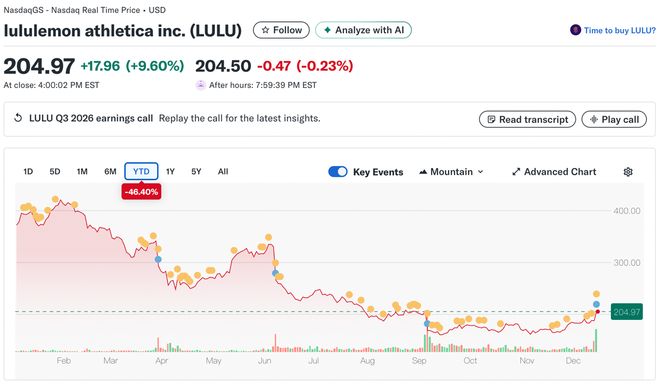
Core Viewpoint - Lululemon's stock has dropped 46.40% this year, resulting in a market value loss of approximately $25 billion, raising concerns among investors about the company's future [2] Leadership Changes - CEO Calvin McDonald will resign effective January 31, 2026, after over seven years in the role, and will serve as a senior advisor until March 31, 2026 [4] - Following the announcement of leadership changes and quarterly performance, Lululemon's stock rose by 10% in after-hours trading [4] Criticism and Response - Founder Chip Wilson criticized the board and McDonald for causing a "loss of cool" for the brand, suggesting a lack of understanding of creative talent and product excellence [6] - McDonald has initiated measures to address sales declines in the U.S. market, including new product launches and shorter production cycles [6] Market Positioning - There is a divergence in target customer focus between Wilson, who aims for products for "super girls" (young, educated professional women), and McDonald, who targets "mindful athletes" [7] - Under McDonald's leadership, Lululemon's annual revenue tripled, with expectations of reaching $11 billion this fiscal year [7] Financial Performance - For Q3 of FY2025, Lululemon reported a 7% year-over-year revenue increase to $2.6 billion, with North American revenue declining by 2% and international revenue growing by 33% [10] - Same-store sales increased by 1% overall, but North America saw a 5% decline while international markets grew by 18% [10] Inventory and Pricing Strategy - The CFO noted that Lululemon has excess seasonal inventory, leading to anticipated price reductions [11] - As of Q3 2025, inventory reached $2 billion, an 11% increase year-over-year, with plans to manage inventory levels more effectively [11] Market Challenges - Lululemon faces intense competition in the activewear market, particularly from emerging brands like Alo Yoga and Vuori, contributing to a decline in market share [9] - The company expects a $210 million reduction in operating income due to increased tariffs and the cancellation of small exemption policies in the U.S. [9] Strategic Focus on China - Lululemon's strategy includes increasing investment in the Chinese market, where Q3 revenue grew by 46% year-over-year, with same-store sales up by 25% [12] - The company plans to open approximately 15 new stores in North America in 2025, with a significant number located in Mexico, and additional stores in China [12]



市值一年蒸发250亿美元CEO被炒,lululemon面临增长分岔口
Xin Lang Cai Jing· 2025-12-13 05:28
Core Viewpoint - Lululemon's stock has dropped 46.40% this year, resulting in a market value loss of approximately $25 billion, raising concerns among investors about the company's future [1] Leadership Changes - Calvin McDonald, the CEO for over seven years, will resign effective January 31, 2026, and will serve as a senior advisor until March 31, 2026 [2] - Following the announcement of leadership changes and quarterly performance, Lululemon's stock rose by 10% in after-hours trading [2] Criticism and Response - Founder Chip Wilson criticized the board and McDonald for causing a "loss of cool" for the brand, suggesting a lack of understanding of creative talent and product excellence [5] - McDonald has initiated measures to address sales declines in the U.S. market, including new product launches and shorter production cycles [5] Market Position and Strategy - There is a divergence in target customer focus between Wilson, who aims for products for "super girls," and McDonald, who targets "mindful athletes" [6] - Under McDonald's leadership, Lululemon's annual revenue tripled, with expectations of reaching $11 billion this fiscal year [6] Financial Performance - For Q3 of FY2025, Lululemon reported a 7% increase in net revenue to $2.6 billion, with North American net revenue declining by 2% and international net revenue increasing by 33% [9] - Same-store sales increased by 1% overall, but North America saw a decline of 5% while international markets grew by 18% [9] Inventory and Pricing Strategy - Lululemon's inventory at the end of Q3 was $2 billion, an 11% increase year-over-year, indicating pressure to manage excess stock [9][10] - The company plans to control inventory units below sales levels to mitigate losses and aims to increase full-price sales penetration [9][10] Market Expansion - Lululemon plans to open approximately 15 new stores in North America in 2025, with a significant focus on the Mexican market, and will also expand in China [11]
《黑色》日报-20251212
Guang Fa Qi Huo· 2025-12-12 03:45
Report 1: Steel Industry 1. Industry Investment Rating No investment rating is provided in the report. 2. Core View The steel market shows a trend of mills reducing production and destocking, with iron - water production decreasing and raw material inventory accumulating, which drags down steel prices. The market's concern about export bottlenecks also affects steel prices. The prices of rebar and hot - rolled coils are expected to move within a range. Consider closing the short position on the hot - rolled coil to rebar spread in the January contract and re - participating in shorting the rebar to iron ore ratio in the January contract [1]. 3. Summary by Directory Steel Prices and Spreads - Rebar and hot - rolled coil prices in different regions and contracts all declined. For example, rebar spot prices in East China, North China, and South China decreased by 10, 20, and 40 yuan/ton respectively. Rebar 05, 10, and 01 contracts dropped by 48, 46, and 30 yuan/ton respectively [1]. - Hot - rolled coil spot prices in East China, North China, and South China decreased by 30, 0, and 40 yuan/ton respectively. Hot - rolled coil 05, 10, and 01 contracts dropped by 44, 44, and 37 yuan/ton respectively [1]. Cost and Profit - Steel billet price decreased by 20 yuan/ton, while slab price remained unchanged. - The cost of Jiangsu electric - arc furnace rebar decreased by 3 yuan/ton, and the cost of Jiangsu converter rebar increased by 9 yuan/ton. - Profits of rebar and hot - rolled coil in different regions showed different changes. For example, East China rebar profit increased by 31 yuan/ton, and North China hot - rolled coil profit increased by 11 yuan/ton [1]. Production - Daily average iron - water production decreased by 30,000 tons to 2.293 million tons, a decline of 1.3%. - The output of five major steel products decreased by 227,000 tons to 8.062 million tons, a decline of 2.7%. - Rebar output decreased by 105,000 tons to 1.788 million tons, a decline of 5.6%. - Hot - rolled coil output decreased by 56,000 tons to 3.087 million tons, a decline of 1.8% [1]. Inventory - The inventory of five major steel products decreased by 335,000 tons to 13.321 million tons, a decline of 2.5%. - Rebar inventory decreased by 243,000 tons to 4.795 million tons, a decline of 4.8%. - Hot - rolled coil inventory decreased by 33,000 tons to 3.971 million tons, a decline of 0.8% [1]. Transaction and Demand - Building materials trading volume decreased by 22,000 tons to 92,000 tons, a decline of 19.3%. - The apparent demand of five major steel products decreased by 245,000 tons to 8.397 million tons, a decline of 2.8%. - The apparent demand of rebar decreased by 139,000 tons to 2.031 million tons, a decline of 6.4%. - The apparent demand of hot - rolled coil decreased by 29,000 tons to 3.12 million tons, a decline of 0.9% [1]. Report 2: Iron Ore Industry 1. Industry Investment Rating No investment rating is provided in the report. 2. Core View The iron ore futures market is expected to be volatile and bearish. With mills continuing to reduce production, iron - water production declining, and the market weakening, the iron ore valuation is likely to decline. It is recommended to short the Iron Ore 2605 contract on rallies, with an operating range of 730 - 780 yuan/ton [3]. 3. Summary by Directory Iron Ore - related Prices and Spreads - The warehouse - receipt costs of various iron ore powders decreased. For example, the warehouse - receipt cost of PB powder decreased by 7.7 yuan/ton, a decline of 0.9%. - The basis of 01 contract for different iron ore powders showed different changes. The 1 - 5 spread increased by 4.5 yuan/ton, a rise of 24.3% [3]. Spot Prices and Price Indexes - Spot prices of iron ore at Rizhao Port decreased. For example, the price of PB powder at Rizhao Port decreased by 7 yuan/ton, a decline of 0.9%. - The Singapore Exchange 62% Fe swap and the Platts 62% Fe index increased slightly [3]. Supply - The 45 - port weekly arrival volume decreased by 2.188 million tons to 24.805 million tons, a decline of 8.1%. - The global weekly shipping volume increased by 454,000 tons to 33.686 million tons, a rise of 1.4%. - The national monthly import volume decreased by 5.006 million tons to 111.309 million tons, a decline of 4.3% [3]. Demand - The daily average iron - water production of 247 mills decreased by 31,000 tons to 2.292 million tons, a decline of 1.3%. - The 45 - port daily average port clearance volume decreased by 85,000 tons to 3.185 million tons, a decline of 2.6%. - The national monthly pig iron output decreased by 49,700 tons to 65.549 million tons, a decline of 0.8%. - The national monthly crude steel output decreased by 1.493 million tons to 71.997 million tons, a decline of 2.0% [3]. Inventory - The 45 - port inventory increased by 482,000 tons to 153.4898 million tons, a rise of 0.3%. - The imported iron ore inventory of 247 mills increased by 42,300 tons to 89.847 million tons, a rise of 0.5%. - The inventory available days of 64 mills increased by 1 day to 20 days, a rise of 5.3% [3]. Report 3: Coke and Coking Coal Industry 1. Industry Investment Rating No investment rating is provided in the report. 2. Core View - Coke: The coke market is weakening, with supply and demand turning unfavorable. The coke futures are expected to be volatile and bearish, with a recommended operating range of 1450 - 1600 yuan/ton. It is recommended to go long on coke and short on coking coal for arbitrage [4]. - Coking Coal: The coking coal market is also facing downward pressure. The coking coal futures are expected to be volatile and bearish, with a recommended operating range of 950 - 1100 yuan/ton. It is also recommended to go long on coke and short on coking coal for arbitrage [4]. 3. Summary by Directory Coke - related Prices and Spreads - Coke prices in different regions and contracts decreased. For example, the 01 contract of coke decreased by 36 yuan/ton, a decline of 2.3%, and the 05 contract decreased by 44 yuan/ton, a decline of 2.6%. - The coking profit calculated by the Steel Union decreased by 11 yuan/ton on a weekly basis [4]. Coking Coal - related Prices and Spreads - Coking coal prices in different regions and contracts decreased. For example, the 01 contract of coking coal decreased by 29 yuan/ton, a decline of 3.0%, and the 05 contract decreased by 35 yuan/ton, a decline of 3.3%. - The profit of sample coal mines decreased by 16 yuan/ton on a weekly basis [4]. Supply - Coke production: The daily average output of all - sample coking plants decreased by 0.6 tons to 64 tons, a decline of 0.9%. The daily average output of 247 mills remained unchanged at 46.6 tons. - Coking coal production: The weekly output of Fenwei sample coal mines decreased. The raw coal output decreased by 2.7 tons to 853.4 tons, a decline of 0.3%, and the clean coal output decreased by 0.6 tons to 438.2 tons, a decline of 0.1% [4]. Demand - Coke demand: The iron - water production of 247 mills decreased by 3.1 tons to 229.2 tons, a decline of 1.3%. - Coking coal demand: The coke production of all - sample coking plants and 247 mills showed a slight decline [4]. Inventory - Coke inventory: The total coke inventory increased by 20.8 tons to 903.8 tons, a rise of 2.4%. The inventories of all - sample coking plants, 247 mills, and ports showed different changes. - Coking coal inventory: The inventories of Fenwei coal mines, all - sample coking plants, and ports increased, while the inventory of 247 mills decreased [4]. Supply - demand Gap - The coke supply - demand gap increased from - 2.5 tons to - 1.9 tons, a change of 31.3% [4].
有色商品日报-20251211
Guang Da Qi Huo· 2025-12-11 05:11
Group 1: Research Views - Overnight copper prices at home and abroad fluctuated weakly. The Fed cut interest rates by 25 basis points and started short - term Treasury bond purchases. The dot - plot shows one expected 25 - basis - point cut next year. China's November CPI rose 0.7% year - on - year, and PPI's year - on - year decline slightly widened. Copper prices are in a pattern of fundamental (inventory) support and short - term macro disturbances, and should be viewed with cautious optimism [1]. - Overnight alumina, aluminum, and aluminum alloy prices fluctuated strongly. Alumina supply remains high, and inventory pressure increases. The aluminum price followed the copper - aluminum ratio repair logic, but the follow - up strength is weakening [1][2]. - Overnight LME nickel and Shanghai nickel prices fell. Nickel prices may still fluctuate in the short term, and attention should be paid to macro and overseas industrial policy changes [3]. Group 2: Daily Data Monitoring - **Copper**: On December 10, 2025, the price of flat - copper decreased by 505 yuan/ton compared to the previous day, and the total inventory (weekly) decreased by 9025 tons [5]. - **Lead**: On December 10, 2025, the average price of 1 lead decreased by 120 yuan/ton compared to the previous day, and the inventory (weekly) decreased by 3064 tons [5]. - **Aluminum**: On December 10, 2025, the Wuxi and Nanhai quotes decreased by 100 yuan/ton compared to the previous day, and the total inventory (weekly) increased by 8353 tons [6]. - **Nickel**: On December 10, 2025, the price of Jinchuan nickel decreased by 1125 yuan/ton compared to the previous day, and the nickel inventory (weekly) increased by 1726 tons [6]. - **Zinc**: On December 10, 2025, the main settlement price decreased by 0.3% compared to the previous day, and the social inventory (weekly) decreased by 0.17 tons [8]. - **Tin**: On December 10, 2025, the main settlement price increased by 0.6% compared to the previous day, and the SHFE inventory (weekly) increased by 506 tons [8]. Group 3: Chart Analysis - **Spot Premium and Discount**: Charts show the spot premium and discount trends of copper, aluminum, nickel, zinc, lead, and tin from 2019 - 2025 [10][12][13]. - **SHFE Near - Far Month Spread**: Charts show the near - far month spread trends of copper, aluminum, nickel, zinc, lead, and tin from 2020 - 2025 [14][17][19]. - **LME Inventory**: Charts show the LME inventory trends of copper, aluminum, nickel, zinc, lead, and tin from 2019 - 2025 [22][24][26]. - **SHFE Inventory**: Charts show the SHFE inventory trends of copper, aluminum, nickel, zinc, lead, and tin from 2019 - 2025 [28][30][32]. - **Social Inventory**: Charts show the social inventory trends of copper, aluminum, nickel, zinc, stainless steel, and 300 - series from 2019 - 2025 [34][36][39]. - **Smelting Profit**: Charts show the smelting profit - related trends of copper, aluminum, nickel, zinc, and stainless steel 304 from 2019 - 2025 [40][42][44]. Group 4: Team Introduction - Zhan Dapeng, a master of science, is the director of non - ferrous research at Everbright Futures Research Institute, with over a decade of commodity research experience [47]. - Wang Heng, a master of finance from the University of Adelaide, Australia, is a non - ferrous researcher at Everbright Futures, mainly researching aluminum and silicon [47]. - Zhu Xi, a master of science from the University of Warwick, UK, is a non - ferrous researcher at Everbright Futures, mainly researching lithium and nickel [48].
Graphic Packaging Holding Company (NYSE:GPK) Receives Updated Rating and Price Target from RBC Capital
Financial Modeling Prep· 2025-12-11 02:06
Core Viewpoint - Graphic Packaging Holding Company (GPK) is undergoing significant restructuring efforts, including cost-cutting initiatives and inventory reduction, while facing a downward revision in its financial outlook for 2025 [2][6]. Financial Outlook - RBC Capital has adjusted its rating for GPK to "Sector Perform" and lowered its price target from $17 to $15, with the current stock price at $14.90 [1][6]. - GPK has revised its 2025 EBITDA and EPS outlook downward but maintains its net sales expectations, indicating confidence in revenue generation [2][6]. Cost-Cutting Initiatives - The company is targeting $60 million in savings by 2026 through staffing and other planned cost reductions, which will incur one-time costs of $20 million for severance [3][6]. - GPK is committed to providing employment placement assistance and support to affected employees, emphasizing responsible restructuring [3]. Market Performance - GPK's stock is currently priced at $14.90, reflecting an increase of approximately 4.67% with a change of $0.67, and has shown significant volatility over the past year [4]. - The stock has fluctuated between a low of $14.02 and a high of $15 today, with a yearly high of $29.90 and a low of $13.93 [4]. - GPK has a market capitalization of approximately $4.40 billion, with a trading volume of 5,976,534 shares on the NYSE, indicating active investor interest [5].


甲醇聚烯烃早报-20251210
Yong An Qi Huo· 2025-12-10 08:51
免责声明: 以上内容所依据的信息均来源于交易所、媒体及资讯公司等发布的公开资料或通过合法授权渠道向发布人取得的资讯,我们力求分析及建议内 容的客观、公正,研究方法专业审慎,分析结论合理,但我司对信息来源的准确性和完整性不作任何保证,也不保证所依据的信息和建议不会 发生任何变化。我们提供的全部分析及建议内容仅供参考,不构成对您的任何投资建议及入市依据,您应当自主做出期货交易决策,独立承担 期货交易后果,凡据此入市者,我司不承担任何责任。我司在为您提供服务时已最大程度避免与您产生利益冲突。未经我司授权,不得随意转 载、复制、传播本网站中所有研究分析报告、行情分析视频等全部或部分材料、内容。对可能因互联网软硬件设备故障或失灵、或因不可抗力 造成的全部或部分信息中断、延迟、遗漏、误导或造成资料传输或储存上的错误、或遭第三人侵入系统篡改或伪造变造资料等,我司均不承担 任何责任。 塑 料 日期 东北亚乙 烯 华北LL 华东LL 华东LD 华东HD LL美金 LL美湾 进口利润 主力期货 基差 两油库存 仓单 2025/12/0 3 740 6750 6965 8725 7030 785 775 172 6808 -60 ...
铜价走高影响下游采购积极性,铜价高位震荡
Hua Tai Qi Huo· 2025-12-09 03:03
1. Report Industry Investment Rating - Not provided in the given content 2. Core Viewpoints of the Report - Currently, the Comex premium persists, and the inventory levels in Shanghai and London remain relatively low. Coupled with the upcoming Fed rate cut, copper prices may continue to fluctuate in a relatively strong pattern. It is recommended to buy on dips for hedging between RMB 91,500/ton and RMB 92,000/ton, while arbitrage is put on hold and short put options are suggested [7]. 3. Summary by Relevant Catalogs Market News and Important Data Futures Quotes - On December 8, 2025, the main contract of Shanghai copper opened at RMB 92,520/ton and closed at RMB 92,970/ton, up 0.20% from the previous trading day's close. In the night session, it opened at RMB 92,820/ton and closed at RMB 92,400/ton, down 0.61% from the afternoon close [1]. Spot Situation - According to SMM, the spot premium of SMM 1 electrolytic copper to the current 2512 contract was between RMB 20/ton - RMB 240/ton, with an average premium of RMB 130/ton, down RMB 40 from the previous trading day. The price of SMM 1 electrolytic copper was between RMB 92,040 - RMB 92,560/ton. The intraday procurement sentiment declined significantly, and the sales sentiment slightly increased, causing the spot premium of Shanghai copper to fall. It is expected that spot transactions will still be at a premium, but as copper prices continue to rise, the number of downstream orders decreases, and the premium is expected to face pressure [2]. Important Information Summary Macro and Geopolitical Aspects - The Fed's December interest rate meeting is approaching. The market generally believes that the Fed is likely to cut interest rates by 25 basis points again. The market will closely watch Powell's press - conference Q&A session and the last "dot - plot" of the year. Regarding the rate - cut amplitude and the number of future rate cuts, Hassett, a potential candidate for the new Fed chairman, believes that data should be closely monitored, and actions should be taken prudently [3]. Economic Data - The US Bureau of Labor Statistics will not release the October Producer Price Index (PPI). Due to the government shutdown, the collection of October data is delayed. According to its website, the Bureau plans to announce the October data together in the November 2025 PPI press release on January 14, 2026 [3]. Mining End - On December 5, Askari Metals announced a successful fundraising of $1.15 million and appointed a new director to accelerate its mineral exploration projects in Ethiopia and Namibia. The funds will be mainly used for the exploration of two core projects: the Nejo copper - gold project in Ethiopia and the Uis lithium - tin - tantalum - rubidium project in Namibia. On December 8, customs data showed that in November 2025, China's imports of copper ore and concentrates were 2.526 million tons, and the cumulative imports from January - November were 27.614 million tons, a year - on - year increase of 8.0% [4]. Smelting and Imports - On December 8, customs data showed that in November 2025, China's imports of unwrought copper and copper products were 427,000 tons, and the cumulative imports from January - November were 4.883 million tons, a year - on - year decrease of 4.7%. LME copper inventory increased last week, reaching a six - month high on December 4 and then slightly declining, with the latest inventory at 162,550 tons. SHFE copper inventory continued to decline last week, falling 9.22% to 88,905 tons, a three - month low. International copper inventory decreased by 573 tons to 11,504 tons. New York copper inventory continued to accumulate, reaching a new high at 436,853 tons [5]. Consumption - In the past week, the State Grid's December tender volume decreased by 20% month - on - month. After copper prices exceeded RMB 91,000/ton, cable enterprises only fulfilled previous long - term orders. The new tender price transmission coefficient was only 0.6, and some enterprises replaced copper cables with aluminum cables, with the estimated substitution ratio rising to 8%. In the home appliance sector, the domestic sales production plan of air conditioners was reduced by 6%, and copper tube procurement was based on "production according to sales". The copper material procurement volume of Midea and Gree in December decreased by 12% month - on - month. The demand for copper strips in refrigerators and microwaves increased slightly due to good export orders. In the automotive sector, the copper consumption of new energy vehicles continued to increase, with a per - vehicle copper consumption of 83 kg and an 11 - month production increase of 35% year - on - year, offsetting the decline of traditional vehicles. However, high - voltage wiring harness enterprises, due to copper accounting for more than 60% of costs, have jointly applied to vehicle manufacturers for a price - linkage mechanism, otherwise they will reduce production to ensure profits. Photovoltaic and data centers have become new highlights. Morgan Stanley predicts that the copper demand of data centers in 2026 will be 475,000 tons, a year - on - year increase of 30%, but high copper prices have forced some projects to postpone tenders, slowing the short - term demand pace [5][6]. Inventory and Warehouse Receipts - LME warehouse receipts decreased by 275 tons to 164,550 tons compared with the previous trading day. SHFE warehouse receipts decreased by 980 tons to 29,956 tons. On December 8, the domestic electrolytic copper spot inventory was 160,300 tons, an increase of 1400 tons compared with the previous week [6].
焦炭首轮提降落地,双焦期价继续探底
Cai Da Qi Huo· 2025-12-08 05:10
财达期货|焦煤焦炭周报 2025-12-08 焦炭首轮提降落地,双焦期价继续探底 【期现行情】 上周焦煤 2605 合约周五收于 1140,周跌幅 1.04%,现货市场主流地区报价偏 弱运行。 研究员 上周焦炭 2601 合约周五收于 1585,周涨幅 0.67%,现货市场主流地区提降 50-55 元/吨落地。 姓名:申伟光 从 业 资 格 号 : 【基本面分析】 F03088716 焦煤: 投 资 咨 询 号 : 供应端:上周全国 523 家炼焦煤矿山核定产能利用率 85.6%,环比下降 0.4%; 精煤日均产量 75.4 万吨,环比减少 1 万吨。全国 314 家独立洗煤厂产能利用率 36.5%,环比上升 0.2%;精煤日均产量 27.1 万吨,环比增加 0.5 万吨。上周,主产 地煤矿复产节奏缓慢,部分地区煤矿因年度生产任务即将完成开始放缓生产节奏进 行控产,炼焦煤矿山核定产能利用率已连续两周下降,短期内炼焦煤原料端供应依 然受限。库存方面,焦煤价格持续偏弱,焦炭提降落地,焦企补库积极性下降,煤 矿出货压力增加,炼焦煤矿山原煤及精煤库存大幅累库,独立洗煤厂精煤库存累库 幅度增加。 需求端:焦炭首轮提降落 ...
供需面改善,铅价反弹修复
Tong Guan Jin Yuan Qi Huo· 2025-12-08 02:16
1. Report Industry Investment Rating No information provided in the content. 2. Core Viewpoints of the Report - Last week, the main contract price of Shanghai lead futures rebounded steadily. The market's dovish bets on the interest - rate cut path increased, the US dollar was weak, and non - ferrous metals such as copper and tin strengthened, driving up the lead price. The supply - demand tension of lead ore is difficult to reverse in the short term, and the cost side supports the lead price. Although the production of some refineries recovered in November, there were more refinery overhauls in December, and the production of primary and recycled lead is expected to decline month - on - month. The terminal consumption is divided, with the consumption of electric bicycle batteries weakening, but the consumption of automobile starting batteries improving, and large - and medium - sized battery enterprises starting year - end stockpiling. Overall, the macro - environment is warm, the fundamentals are marginally improved, and social inventories have dropped to a new low for the year, supporting the lead price. It is expected that the lead price will remain oscillating strongly in the short term, but the rebound space is restricted by the import expectation of lead ingots, and attention should be paid to the resistance around 17,500 yuan/ton [3][6][7]. 3. Summary According to the Directory 3.1 Transaction Data | Contract | 11/28 | 12/5 | Change | Unit | | --- | --- | --- | --- | --- | | SHFE Lead | 17,090 | 17,290 | 200 | yuan/ton | | LME Lead | 1,981 | 2,009 | 28 | US dollars/ton | | Shanghai - London Ratio | 8.63 | 8.61 | - 0.02 | | | SHFE Inventory | 37,799 | 34,735 | - 3,064 | tons | | LME Inventory | 263,175 | 243,550 | - 19,625 | tons | | Social Inventory | 3.07 | 2.36 | - 0.71 | 10,000 tons | | Spot Premium | - 65 | - 65 | 0 | yuan/ton | [4] 3.2 Market Review - Last week, the price of the main Shanghai lead PB2601 contract rebounded steadily, breaking through the moving - average pressure and finally closing at 17,290 yuan/ton, with a weekly increase of 1.17%. The LME lead price also rebounded slightly, closing at 2,009 US dollars/ton, with a weekly increase of 1.41%. In the spot market, the supply of lead in the Jiangsu, Zhejiang, and Shanghai markets was limited, and most of the lead ingots were from refineries. The supply of lead in the East China region was tight, and the mainstream origin quoted a premium of 0 - 50 yuan/ton over the SMM1 lead average price. The recycled lead refineries were more willing to sell, and the downstream enterprises mainly purchased through long - term contracts [5]. - As of December 5, the LME weekly inventory was 243,550 tons, a weekly decrease of 19,625 tons. The SHFE inventory was 34,735 tons, a decrease of 3,064 tons from the previous week. As of December 4, the SMM five - region social inventory was 23,600 tons, a decrease of 7,100 tons from Monday and 11,400 tons from Thursday of the previous week. As the delivery of the current - month contract approaches, some goods holders may transfer their inventory for delivery, and the social inventory is expected to stabilize [6]. 3.3 Industry News - As of the week of December 5, the domestic lead concentrate processing fee was 300 yuan/metal ton, and the imported ore processing fee was - 135 US dollars/dry ton, with the average values remaining flat month - on - month [8]. - In November, the electrolytic lead production was 327,600 tons, a month - on - month increase of 0.5% and a year - on - year decrease of 0.7%. It is expected to slightly decrease to 323,400 tons in December. The recycled refined lead production in November was 296,100 tons, a month - on - month increase of 8.5% and a year - on - year increase of 10.2%. It is expected to slightly decrease to 290,300 tons in December [8]. 3.4 Related Charts The report provides multiple charts, including SHFE and LME lead prices, Shanghai - London ratio, SHFE and LME inventories, 1 lead premium and discount, LME lead premium and discount, the price difference between primary and recycled lead, recycled lead enterprise profits, lead ore processing fees, electrolytic lead and recycled refined lead production, lead ingot social inventory, and refined lead import profit and loss [9][11][13][15].